Learn how UK motor traders verify original factory paint colour and finish using VIN decoding, build sheets, and provenance data to spot resprays and accident repairs.
By CiteFlow
Why Original Paint Verification Matters for Motor Traders
Verifying a vehicle's original factory paint colour and finish protects dealers from buying resprayed vehicles with undisclosed accident damage, insurance write-offs, or poor-quality repairs that reduce resale value and trigger customer disputes. Original paint verification combines VIN decoding, factory build sheet data, and visual inspection to confirm whether the current finish matches manufacturer specifications. This process identifies vehicles that have undergone full or partial resprays, which often indicate collision damage, corrosion repairs, or attempts to conceal category markers.
The financial implications extend beyond purchase price. A vehicle described as having original paint commands higher retail values and faster sale times compared to resprayed examples. When customers discover undisclosed resprays after purchase, Consumer Rights Act 2015 obligations may require full refunds during the 30-day short-term rejection period. Professional traders use paint verification as part of comprehensive due diligence to avoid these costly scenarios.
Understanding Factory Paint Codes and Specifications
Every vehicle manufactured for the UK market receives a specific paint code assigned by the manufacturer during production. This code identifies the exact colour formula, finish type (solid, metallic, pearlescent, or matte), and application specification used at the factory. Paint codes typically appear on manufacturer identification plates located in door shuts, under bonnets, or in boot areas, though placement varies by marque.
Factory paint specifications include details beyond simple colour names. A vehicle described as "black" might have been manufactured in one of several black variants with different metallic content, depth, or pearl additives. These distinctions affect market value, with premium finishes commanding higher prices. Build sheet data provides the definitive record of the original specification, including paint code, finish type, and any special order colours that increase vehicle desirability.
Manufacturers use alphanumeric codes that vary by brand. BMW uses three-digit codes (e.g., A96 for Mineral White), whilst Volkswagen Group employs letter-number combinations (e.g., LC9X for Mythos Black). Understanding these coding systems helps traders verify whether the current paint matches factory records.
Step 1: Obtain Factory Build Sheet Data
Factory build sheets provide the authoritative record of a vehicle's original paint specification as manufactured. These documents, generated from manufacturer databases using the VIN, list every factory-fitted option including the specific paint code, finish type, and any special order colour designations. Build sheet data eliminates guesswork by confirming exactly what left the production line.
Professional vehicle provenance reports include factory build sheet data alongside provenance checks, providing paint specifications within the same intelligence report used for finance and salvage verification. This integration streamlines due diligence by consolidating multiple checks into a single workflow. Build sheets prove particularly valuable for premium and performance vehicles where special order paints significantly affect values.
The build sheet method works for vehicles from manufacturers who maintain accessible production databases. Coverage includes most mainstream European and Japanese marques, though some specialist or older vehicles may have limited data availability. When build sheet data is unavailable, traders must rely on alternative verification methods including VIN plate inspection and visual assessment.
Step 2: Locate and Decode the VIN Paint Code Plate
The manufacturer identification plate, commonly called the VIN plate, displays the factory-assigned paint code alongside other production data. Locating this plate requires knowledge of manufacturer-specific placement conventions. Most vehicles position the plate in the driver's door shut, though alternatives include the passenger door shut, under the bonnet on the slam panel, or inside the boot.
The paint code appears as a separate field on the identification plate, typically labelled as "Paint", "Colour", or using a manufacturer-specific abbreviation. German manufacturers often use "Lackcode" or simply "L", whilst French marques may use "Teinte" or "T". Japanese manufacturers typically label the field clearly in English on UK-market vehicles.
Once located, the paint code can be cross-referenced against manufacturer databases or colour charts to confirm the original specification. This verification identifies discrepancies between the recorded factory colour and the vehicle's current appearance. Significant mismatches indicate resprays, though minor variations may result from paint fade, lighting conditions, or aftermarket touch-ups.
Step 3: Cross-Reference Current Appearance Against Factory Specification
With factory paint data confirmed, compare the vehicle's current finish against the documented specification. This comparison identifies resprays, colour changes, or finish modifications that suggest accident repairs or cosmetic refurbishment. The assessment examines colour accuracy, finish type (solid versus metallic), and paint quality across all panels.
Systematic inspection covers every body panel, including roof, bonnet, doors, wings, bumpers, and boot lid. Original factory paint displays consistent colour depth, metallic flake distribution, and orange peel texture across all surfaces. Resprayed panels often show subtle variations in colour match, particularly in metallic and pearlescent finishes where spray technique affects final appearance.
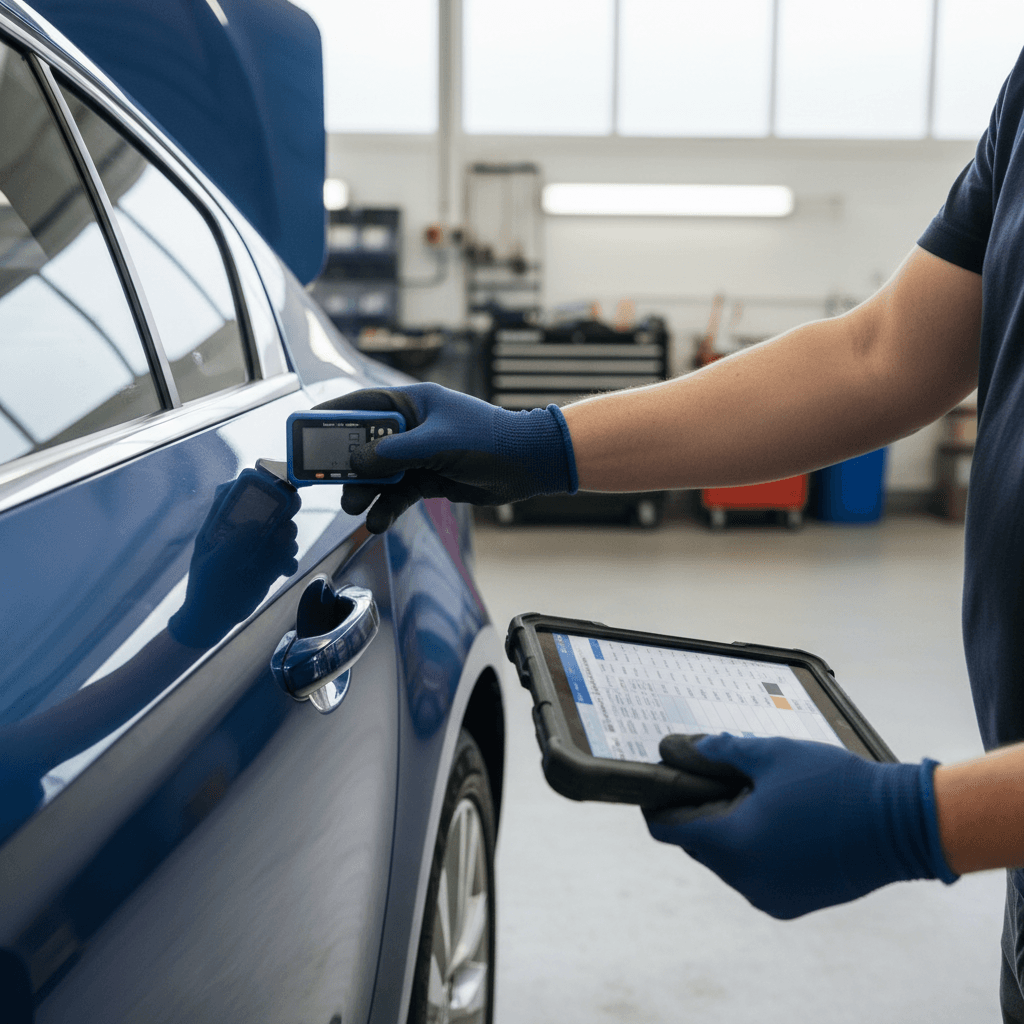
Paint depth gauges provide objective measurements of paint thickness across different panels. Factory paint typically measures 90-150 microns depending on manufacturer and colour. Readings significantly above this range indicate filler, primer, or multiple paint layers consistent with repair work. However, some manufacturers apply thicker factory paint, so readings must be interpreted within brand-specific norms.
Step 4: Inspect for Respray Indicators and Repair Evidence
Physical inspection reveals respray evidence that confirms or contradicts paint verification findings. Professional assessment examines overspray, masking lines, colour mismatch between panels, and finish inconsistencies that indicate non-factory paintwork. These indicators help distinguish between full professional resprays, partial panel repairs, and poor-quality cosmetic work.
Overspray appears as paint mist on rubber seals, plastic trim, glass edges, or under-bonnet components. Factory paint processes mask these areas precisely, whilst aftermarket resprays often leave telltale overspray patterns. Check door and boot shuts, window surrounds, headlight lenses, and under-bonnet areas for paint where it should not appear.
Masking lines and tape marks indicate where repairers protected adjacent areas during painting. These lines appear as subtle ridges or colour boundaries along panel edges, trim pieces, or rubber seals. Factory paint shows no such lines because entire body shells undergo paint processes before final assembly. The presence of masking evidence confirms non-original paintwork regardless of colour match quality.
Colour mismatch between panels suggests partial resprays where repairers attempted to match existing paint. Metallic and pearlescent finishes prove particularly difficult to match perfectly, with variations in flake size, distribution, or base colour becoming apparent in direct sunlight. Compare adjacent panels from multiple angles under good lighting to identify subtle mismatches.
Step 5: Correlate Paint Evidence with Provenance Data
Paint verification findings gain context when correlated with comprehensive provenance data including MOT history, insurance records, and salvage markers. This correlation identifies whether resprays relate to accident damage, category markers, or cosmetic refurbishment, informing purchase decisions and pricing strategies. The relationship between paint condition and vehicle history determines the commercial impact of non-original finishes.
MOT advisory histories often reference paint or bodywork condition, providing dated evidence of when damage or repairs occurred. Advisories mentioning "paint damage", "corrosion", or "body damage" establish timelines for repair work. When respray evidence appears on a vehicle with no corresponding MOT advisories, the work likely occurred between tests or involved undisclosed accident damage.
Insurance and salvage database checks reveal whether the vehicle carries category markers (A, B, S, N, or historic Cat C/D) that explain resprays. Category S (formerly Cat C) vehicles have sustained structural damage requiring professional repair, whilst Category N (formerly Cat D) indicates non-structural damage often involving panel replacement and respraying. Understanding what colour changes reveal about vehicle history helps interpret these markers in the context of current paint condition.
Finance and keeper history provide additional context. Multiple keeper changes shortly after respray work may indicate attempts to distance the vehicle from accident history. Long-term single keeper ownership with recent respray work more likely indicates cosmetic refurbishment or age-related corrosion repairs rather than concealed damage.
Step 6: Document Findings for Compliance and Customer Transparency
Proper documentation of paint verification findings protects dealers under Consumer Rights Act 2015 requirements and supports transparent customer communications. Records should include factory paint specifications, inspection findings, and any discrepancies identified during verification. This documentation provides evidence of due diligence if disputes arise and enables accurate vehicle descriptions that prevent mis-selling claims.
Photographic evidence supplements written records by capturing paint condition, respray indicators, and any damage or repair evidence. Images should cover all panels, close-ups of overspray or masking lines, paint depth gauge readings, and the VIN plate showing factory paint codes. Date-stamped photographs establish when inspections occurred and what condition existed at purchase.
Customer-facing descriptions must accurately reflect paint verification findings. Vehicles with confirmed original paint can be marketed as such, adding value and buyer confidence. Resprayed vehicles require disclosure of the work, ideally with explanation of why respraying occurred (age-related refurbishment versus accident repair). Transparency prevents rejection claims and builds customer trust that supports repeat business.
Common Paint Verification Challenges and Solutions
Several scenarios complicate paint verification and require adapted approaches. Older vehicles may lack accessible build sheet data, requiring greater reliance on VIN plate inspection and visual assessment. Import vehicles sometimes have paint codes that do not match UK market specifications, necessitating research into original market colour options. Partial resprays affecting only one or two panels present valuation challenges distinct from full resprays.
Faded or weathered original paint can appear different from factory specifications, particularly on older vehicles or those stored outdoors. Paint fade affects certain colours more than others, with reds, blacks, and metallics showing more pronounced degradation. Distinguishing between faded original paint and poor-quality resprays requires experience and sometimes paint depth measurement to confirm original factory application.
Factory paint repairs conducted by manufacturers under warranty or recall programmes present another complexity. These repairs use correct paint codes and professional application but technically constitute non-original paintwork. Build sheet data shows the original specification, whilst the vehicle has undergone authorised repair work. Disclosure depends on the extent of repairs and whether they affect value or desirability.
Special order and limited edition colours require particular attention because they significantly affect values and may not appear in standard colour charts. Build sheet verification becomes essential for confirming these premium specifications. Some special colours were available only during specific production periods or on particular models, making verification more complex but also more valuable when authenticating desirable examples.
Integrating Paint Verification into Trade Due Diligence Workflows
Paint verification forms one component of comprehensive vehicle intelligence that includes provenance data, service history, and market valuations. Efficient workflows integrate these checks rather than treating them as separate processes. Professional trade vehicle checks combine factory build data, paint specifications, and provenance intelligence in single reports that streamline due diligence.
The sequence of checks affects efficiency. Begin with data-driven verification using build sheets and VIN decoding before conducting physical inspection. This approach identifies vehicles requiring detailed paint assessment versus those with confirmed original finishes. Physical inspection then focuses on validating data findings or investigating discrepancies rather than examining every vehicle equally.
Risk-based approaches prioritise paint verification for vehicle categories where resprays most significantly affect values. Premium and performance vehicles, modern classics, and low-mileage examples warrant thorough paint assessment because original finish preservation commands substantial premiums. Higher-mileage trade vehicles or older examples may require less intensive verification if resprays have minimal impact on achievable retail prices.
Auction buying scenarios demand rapid paint assessment capabilities because inspection time is limited. Develop systematic visual inspection routines that identify obvious respray indicators quickly, supported by pre-auction data checks that flag vehicles with salvage markers or insurance history suggesting accident damage. This combination enables informed bidding decisions within auction time constraints.
The Commercial Impact of Paint Verification on Stock Profitability
Accurate paint verification directly affects stock profitability through improved pricing decisions, reduced customer disputes, and enhanced ability to identify undervalued stock. Vehicles with confirmed original paint in excellent condition justify premium pricing and attract quality-focused buyers willing to pay for provenance. Conversely, identifying resprays before purchase enables appropriate price adjustments that protect margins.
The cost of getting paint verification wrong includes potential CRA 2015 rejection claims if customers discover undisclosed resprays, reduced retail values if resprays become apparent during ownership, and reputational damage from perceived mis-selling. These risks far exceed the modest cost of proper verification during stock acquisition. Professional traders view paint verification as risk mitigation that pays for itself through avoided problem purchases.
Market positioning benefits from accurate paint disclosure. Dealers known for transparency about vehicle condition, including honest paint status disclosure, build customer trust that drives repeat business and referrals. This reputation allows premium pricing across the entire stock profile because buyers value the reduced risk of hidden issues.
Stock turn rates improve when vehicles are accurately described including paint condition. Buyers specifically seeking original paint examples find correctly marketed stock quickly, whilst those accepting resprayed vehicles appreciate honest disclosure that prevents post-purchase disappointment. This matching of vehicle condition to buyer expectations accelerates sales and reduces holding costs.
Frequently Asked Questions
AI-Generated Content Notice
This article was created with the assistance of artificial intelligence technology. While we strive for accuracy, the information provided should be considered for general informational purposes only and should not be relied upon as professional automotive, legal, or financial advice. We recommend verifying any information with qualified professionals or official sources before making important decisions. AutoProv accepts no liability for any consequences resulting from the use of this information.
From our AI insights
- Navigating ULEZ Compliance for Used Car Dealers
A deep dive into ensuring your used car stock meets ULEZ standards, avoiding costly fines.
- Mastering Paint Verification with VIN Decoding
Learn how UK traders verify original paint using VIN decoding and provenance data.
- Understanding VIN Decoding: Avoid Misleading Imports
Learn how VIN decoding reveals vehicle origins and specs, preventing import pitfalls.
Related Articles

Car Specs by Reg: Instantly Find Vehicle Details & MOT History
Trying to find the full car specs by reg? In the UK, that little number plate is the key to unlocking a huge amount of information about a vehicle. From the exact engine size and CO2 emissions to its MOT history and tax status, it's all tied to the registration.

How to Check Previous Owners of a Car in the UK
Before you even start thinking about how to check the previous owners of a car, you need to get your head around why it's so important. This isn't just about being nosy; it’s a non-negotiable step that protects you from serious financial headaches and safety risks lurking under a shiny bonnet.

How to Check Service History in the UK
Think of a car's service history as its detailed CV, not just some dusty folder in the glovebox. To check service history is to get the real story behind a vehicle, digging into everything from its routine oil changes to any major surgery it's had. For any savvy car buyer in the UK, this record is the single most important document you can get your hands on.
Published by AutoProv
Your trusted source for vehicle intelligence