
When someone says motor trade, they're talking about the massive, sprawling UK industry that revolves around buying, selling, fixing, and financing vehicles. It’s a huge web of businesses, from the gleaming franchised dealerships you see on the A-roads to the small, independent traders tucked away on industrial estates. At its heart, it’s all about moving cars from the factory gates to drivers, and then keeping them moving through the second-hand market.
Understanding The UK Motor Trade Ecosystem

It’s best to think of the UK motor trade less as a simple transaction and more as a living, breathing ecosystem. It's a constant flow of vehicles changing hands, with their value and condition shifting at every step. Every car has a story, and if you want to succeed in this game, you need to learn how to read it.
Success isn’t just about the old mantra of "buy low, sell high." It's about skilfully navigating a complex system where solid information is your most valuable asset. Every single handover—from a leasing company offloading a fleet at auction to an independent dealer picking that same car up—is a chance to make a profit, but it’s also riddled with risk.
The Key Players in the Vehicle Journey
A car’s journey from new to used involves a few key players who keep the wheels of the ecosystem turning. Each has a different role and motive, influencing a car's price, condition, and paper trail along the way.
- Franchised Dealerships: These are your official brand retailers—the Fords, the BMWs, the Vauxhalls. They’re the first stop for brand-new cars and a fantastic source of high-quality used stock that comes in through part-exchanges.
- Independent Traders: These guys are the lifeblood of the used car market. They range from small, one-man-band forecourts to huge car supermarkets. Their entire business model hinges on sourcing the right stock from auctions, trade-ins, and the public, so a good eye for a car is everything.
- Auction Houses: Think of these as the central marketplace, the stock exchange for cars. It’s where a massive volume of vehicles gets traded between professionals. Auctions are a primary hunting ground for dealers and the go-to disposal route for fleet and leasing companies.
- Fleet Operators: This includes rental firms and big companies with fleets of corporate cars. They’re focused on the total cost of ownership and need an efficient way to sell their vehicles once they’ve served their purpose, usually after two or three years.
Navigating the Ecosystem with Vehicle Intelligence
Every time a car changes hands, there’s a risk that vital information gets lost, forgotten, or even deliberately hidden. A car’s history—its MOT record, how many keepers it’s had, whether there’s outstanding finance—has a direct, massive impact on its value and safety. Without a clear view of that history, what looks like a bargain can quickly turn into a financial nightmare.
This is precisely where modern vehicle intelligence becomes non-negotiable. It cuts through the noise and provides the transparency you need to operate effectively, turning a risky guess into a calculated business decision.
Platforms like AutoProv deliver this essential clarity. By pulling together data from dozens of official sources, they give you a single, trustworthy picture of a vehicle's entire life story. This empowers traders to properly assess risk, price their stock with confidence, and ultimately, buy smarter. To get a feel for how data is shaping the industry, it's worth exploring the latest analysis of UK used car market trends and seeing the bigger picture.
The Key Players and What Drives Them

To really get under the bonnet of the motor trade, you need to understand who the main players are and what makes them tick. Everyone has their own angle, their own pressures, and their own definition of success. It’s this mix of motivations that creates the bustling, fast-moving industry we see today.
Take your local independent dealer. Their world revolves around two things: profit margin and how quickly they can shift their stock. They're always on the hunt for cars they can buy low, prep, and sell high—and fast. Every single day a car sits on their forecourt, it’s costing them money. That pressure means they have to make smart decisions in the blink of an eye.
For these dealers, one bad buy can completely wipe out the profit from three or four good sales. Picking up a car with a murky past, like an undisclosed write-off or a dodgy mileage reading, can be a financial disaster. This is why having instant access to reliable vehicle data isn’t a nice-to-have; it's absolutely fundamental to their survival.
The Independent Dealer's Dilemma
An independent trader’s reputation is built on the quality of their stock. They need the full story on a vehicle before they put their hand up at an auction, where the pressure is always on. They’re constantly asking themselves:
- Is this car what the seller says it is? A quick look at the MOT history and the number of previous keepers is their first line of defence.
- Is there any outstanding finance on it? This is a huge red flag. A car with finance attached could be repossessed, leaving both the dealer and the new owner in a terrible position.
- Have I got the price right? Paying over the odds at auction immediately squeezes their already tight margins, making it a struggle to turn a profit.
The Fleet Manager's Perspective
Now, let's switch gears and look at a fleet manager. They aren’t worried about one car; they're managing hundreds, sometimes thousands, for a big company or leasing firm. Their focus isn't on a single sale but on the total cost of ownership (TCO) across the entire fleet. Their performance is judged on efficiency, reliability, and minimising financial losses over the long term.
Depreciation is a fleet manager's biggest headache. They have to accurately predict how much value their vehicles will lose over time to set budgets and plan when to replace them. When it’s time to sell these ex-fleet vehicles—a process called remarketing—they need to get the best possible price to protect the company's investment. Their success hangs on proving the fleet has been well-maintained and has a clean history.
The auction house is the 'stock exchange' of the motor trade. It’s a high-energy, high-volume marketplace where dealers come to buy and fleet managers come to sell. This is the crunch point where transparent, verifiable data makes all the difference.
This is where you see the wider industry trends playing out. The market is changing fast, especially with the shift in what powers our cars. For instance, year-to-date new car sales hit 1,578,172 units by September 2025, up 4.2% on the previous year. That growth was propped up by fleet demand, which made up 60% of all registrations in May.
Dig into the numbers, and you see battery electric vehicles (BEVs) jumped 23.5% in September, while diesel sales fell off a cliff, dropping 28.2%. You can explore more detailed UK vehicle sales statistics to get a feel for these shifts.
For anyone trying to navigate this, solid data is everything. This is where a platform like AutoProv comes in, giving each player the specific intelligence they need. The independent dealer can run an instant DVLA MOT history check to spot a clocked car, while the fleet manager can use an Experian finance check to prove a clean title, squeezing every last pound of value out of their vehicles when they hit the second-hand market.
Staying Compliant in a Regulated Industry
Working in the UK motor trade is about much more than just the nuts and bolts of buying and selling cars. It’s a dance with a complex web of legal and regulatory responsibilities. If you get a step wrong, you’re not just looking at a few unhappy customers; you could be facing hefty financial penalties, legal battles, and a reputation that’s incredibly hard to rebuild. Compliance isn't just red tape—it's the very foundation of a trustworthy, sustainable business.
The real game-changer for consumer protection was the Consumer Rights Act 2015. This legislation single-handedly tore up the old rulebook and put clear, non-negotiable obligations on every trader. It finally put to bed the dangerous old myth of selling a car "as seen."
Under the Act, every car you sell to a consumer must be of satisfactory quality, fit for its purpose, and exactly as described. This isn’t just about making sure the engine starts. It covers everything, from the electric windows that refuse to budge to the air conditioning that only blows hot air. If a fault pops up soon after the sale that was probably there all along, the buck stops with you.
The High Cost of Getting it Wrong
Beyond the mechanical state of the vehicle, the accuracy of your description is everything. Misrepresentation, whether you mean to or not, can land you in some seriously hot water. This applies to every single detail you give a buyer, from the mileage and service history right down to who owned it before.
Picture this: you sell a car advertised with a "full service history," but the new owner quickly finds a massive, undocumented gap. Or you describe it as "one careful lady owner," when in reality, it spent its early life as a high-mileage hire car. These aren't just little slip-ups; they are breaches of consumer law that give a customer the legal right to reject the vehicle and demand their money back.
A vehicle's history isn't just a detail; it's a core part of its description. Failing to mention critical information, like a previous write-off status (e.g., Category S or N), is a huge act of misrepresentation and a major compliance failure.
Your Best Defence Against Legal Headaches
This is where doing your homework—your due diligence—becomes your most powerful shield. Before a car even gets a price tag on your forecourt, you have to verify its entire life story. Just taking the previous owner's word for it or giving it a quick once-over is asking for trouble. You need solid, verifiable data to stand behind your descriptions and protect your business.
This is precisely the job of a comprehensive vehicle provenance check. An AutoProv report is your compliance toolkit, giving you the hard facts you need in seconds.
- Verifying Salvage History: Instantly find out if a car has ever been declared a write-off. This stops you from accidentally selling a car with hidden structural damage.
- Checking Finance Status: An Experian check flags any outstanding finance agreements, making sure you get a clean title and avoiding the nightmare of selling a vehicle that could be repossessed.
- Confirming Vehicle Details: Match the V5C logbook details against official records to spot any red flags that might point to cloning or identity fraud.
Finally, you can't talk about compliance without mentioning motor trade insurance. This isn't your standard business policy. It’s a specialist cover designed for the unique risks of the trade, from protecting your valuable stock to covering customers on test drives. Operating without the right insurance is a gamble no professional should ever take. For a closer look at the rules of the road, you can learn more by understanding UK automotive regulations and how they impact your day-to-day operations.
Managing Risk with Vehicle Provenance Checks
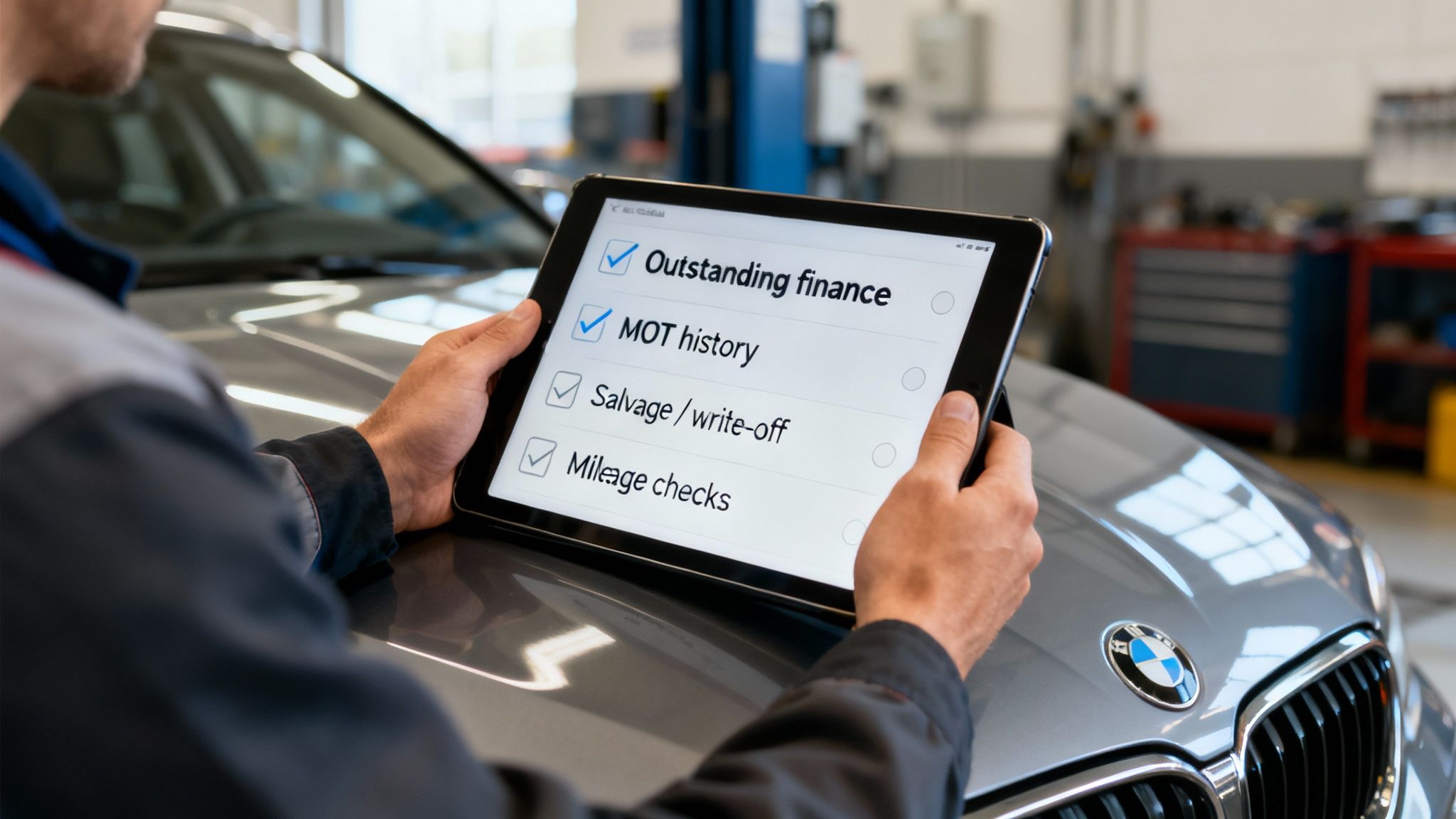
In the motor trade, what you don't know can cripple your business. Beyond just ticking legal boxes, proactive risk management is the real difference between a thriving forecourt and a financial black hole. The single most powerful tool you have for this is a proper vehicle provenance check. It peels back the layers of a car's history to reveal the truths a quick look-over will never find.
Every car that comes your way has a story, and some of those stories are expensive secrets. Without the right data, you’re gambling thousands of pounds on little more than guesswork. A shiny paint job can easily hide a history of undisclosed finance, dodgy mileage, or even a past life as a Category S write-off. These aren't minor hiccups; they are business-breaking risks.
The Dangers Hiding in Plain Sight
Picture this: you buy a nearly new SUV at auction. It looks perfect, the paperwork seems tidy, and you’ve already got a buyer lined up. Weeks later, a letter lands on your desk from a finance company. They’re repossessing the vehicle due to an outstanding loan. Just like that, you’ve lost the car, your investment, and your reputation with a customer.
This nightmare scenario is devastatingly common. Likewise, mileage fraud, or 'clocking', is still a huge problem. A car showing 60,000 miles might have actually done double that, leading to surprise mechanical failures and completely destroying its resale value. Buying an undisclosed write-off is even worse, creating serious safety liabilities and leaving you with unsellable, potentially dangerous stock.
These hidden histories are the biggest threats to your profitability. The UK's used car market is a tough game; total sales have dropped nearly 20% from 2014 levels, despite a few recent bumps. In an arena this competitive, one bad buy can wipe out the profit from several good sales. You can discover more insights about British vehicle market dynamics on focus2move.com to see how these trends are affecting stock acquisition.
Your Shield Against Costly Mistakes
This is where a professional-grade provenance check becomes your shield. It's not about bureaucracy; it's about turning a high-stakes punt into a calculated, data-driven decision. Platforms like AutoProv are built for the motor trade, pulling critical information from multiple official sources to give you a clear, undeniable picture of a vehicle's past.
A comprehensive provenance check does more than just confirm details. It acts as your frontline defence, directly neutralising the most significant financial and legal threats you face every single day.
A detailed report is an instant risk assessment, highlighting the red flags that need your attention. It’s the intelligence you need to bid with confidence at auction, price your stock accurately, and protect your business from the costly fallout of incomplete information. To get a handle on this, it's worth understanding exactly what a provenance check on a used car should include.
How AutoProv Neutralises Key Threats
By pulling together data from trusted sources, an AutoProv report gives you specific, actionable intelligence to shut down the most common risks. Think of it as your own forensic tool for vehicle verification.
- Experian Finance Checks: This is your defence against repossession. The report instantly flags any outstanding finance agreements tied to the vehicle, making sure you secure a clean title before any money changes hands.
- Police National Computer (PNC) Alerts: You get immediate confirmation if a vehicle has been reported stolen. This simple check stops you from accidentally handling stolen goods—a serious criminal offence with severe consequences.
- Mileage Observation Analysis: To fight clocking, the system cross-references mileage readings from MOTs and other historical records. Any gaps or backward steps are flagged, alerting you to potential fraud and stopping you from overpaying for a high-mileage car.
- Salvage and Write-Off History: The check taps into the MIAFTR (Motor Insurance Anti-Fraud and Theft Register), revealing if a car has ever been declared a write-off and its official salvage category. This protects you and your customers from unsafe vehicles.
Ultimately, using this level of vehicle intelligence means you’re no longer operating on faith. You’re operating on facts. This shift from reactive problem-solving to proactive risk management is what allows successful motor trade businesses to thrive, turning uncertainty into opportunity with every car they assess.
Making Smarter Stock and Pricing Decisions
In the motor trade, gut feeling will always have its place. But let's be honest—relying on intuition alone isn't enough to guarantee a profit anymore. The businesses that are really thriving are the ones that have moved beyond guesswork and are using hard data to steer their most important decisions.
It's all about using market insights to price vehicles with surgical accuracy, spotting the most profitable stock before your rivals do, and getting a firm handle on depreciation.
Simply put, data gives you a serious competitive edge. It turns the chaotic, high-pressure buzz of an auction hall into a calculated exercise. Instead of bidding on a hunch and hoping for the best, you can act with confidence. You know exactly what a car is worth in the current market and what your profit margin looks like before you even raise your hand.
This is the key difference between just surviving and genuinely succeeding. It’s about making smarter, data-backed choices at every step, from buying to selling.
Pricing with Pinpoint Accuracy
Pricing a car is a delicate balancing act. Go too high, and it’ll sit on the forecourt collecting dust, costing you money every day. Price it too low, and you're just giving away your hard-earned profit. This is where real-time market valuations become absolutely essential.
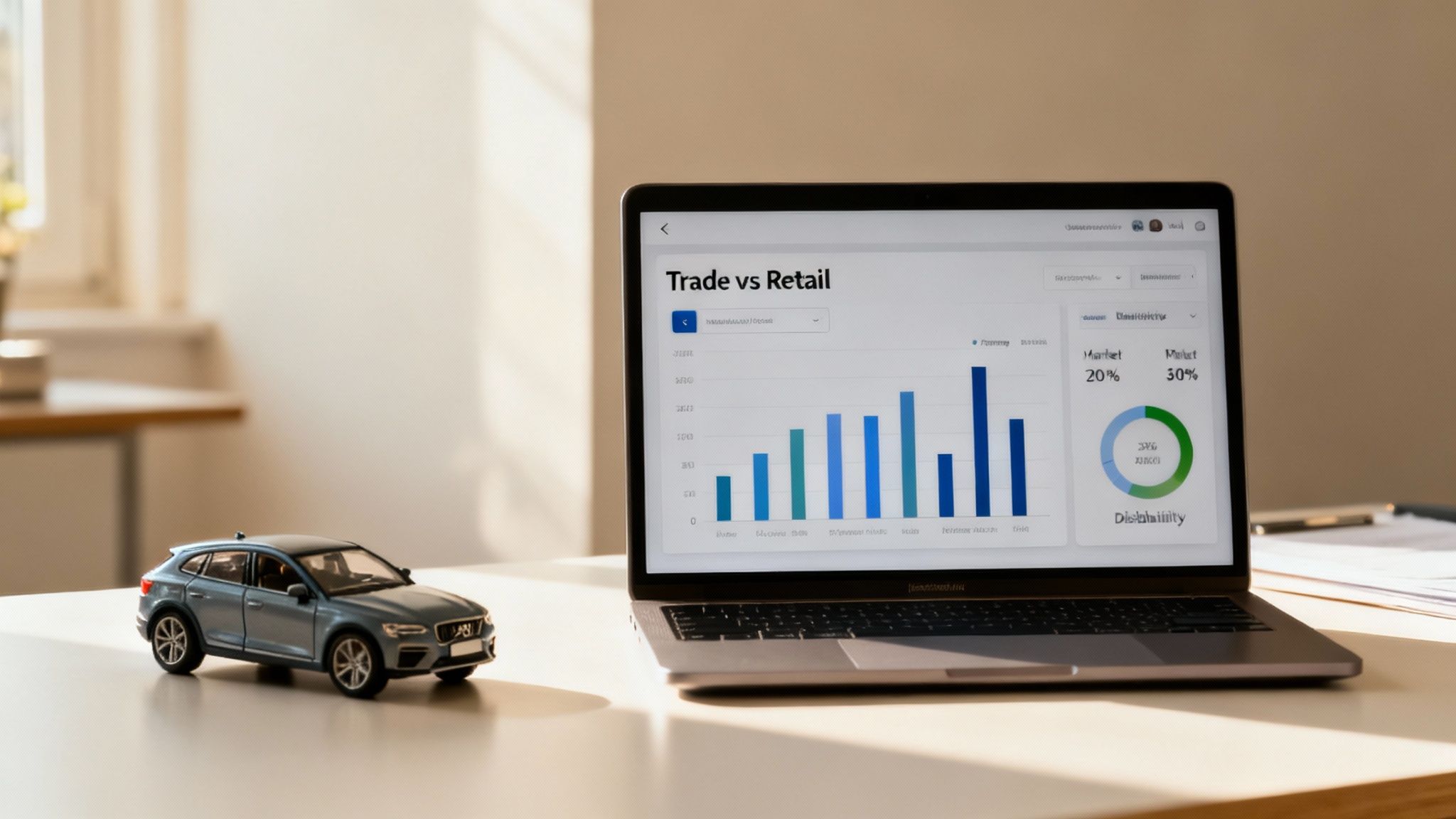
A platform like AutoProv gives you up-to-the-minute data on both trade and retail values, showing you the complete financial picture of any vehicle.
- Trade Valuations: See the current auction and trade-in value, so you never overpay for stock.
- Retail Valuations: Know what similar models are being advertised for on other forecourts, helping you price your own stock competitively.
- Depreciation Forecasts: For fleet managers, this data is pure gold. It helps predict a vehicle's future value, protecting the investment over its entire lifecycle.
By comparing live trade and retail data, you can instantly calculate your potential margin on any vehicle. This clarity empowers you to make confident, profitable decisions in seconds, whether you’re at an auction or negotiating a part-exchange.
Identifying the Most Desirable Stock
Let’s face it, not all stock is created equal. Some models and specs will fly off the forecourt in days, while others can linger for months. Knowing which cars are genuinely in demand is crucial for keeping your stock turning over and your cash flowing.
This is where a desirability score comes in. By analysing market supply and demand, recent sales data, and the average time a car takes to sell, this metric gives you a clear signal of how quickly a vehicle is likely to find a buyer. A high desirability score points to a safe bet—a car you can buy with confidence, knowing it won't tie up your capital for long. That's why it's so important to stay on top of market insights for vehicle pricing and use data to your advantage.
The UK automotive sector's resilience is a testament to the motor trade, which generated £115 billion in total trade value in 2024. But the market is always shifting, with bumps in the road like the 24.5% crash in car exports in September 2025 due to production halts. This kind of volatility makes having accurate, real-time data more important than ever, as detailed in the SMMT Trade Report 2025.
For professionals trying to navigate this landscape, having tools that merge market insights with provenance checks is non-negotiable for buying with confidence. A platform like AutoProv combines desirability scores with vital checks for stolen status, write-off history, and even previous taxi use, giving you a complete picture to make the smartest stock choices. This is the kind of intelligence that protects your business in a complex and ever-changing market.
How AutoProv Gives You a Competitive Edge
Getting ahead in the modern motor trade really boils down to three things: staying compliant, dodging hidden risks, and pricing your stock with total accuracy. Drop the ball on any one of these, and your bottom line will feel it. This is precisely where having a vehicle intelligence partner moves you from simply reacting to problems to making proactive, data-led decisions.
AutoProv was built from the ground up for the UK motor trade. We bring together intelligence from over 10 trusted sources—including the DVLA, the Police National Computer (PNC), and Experian—into one clear, easy-to-read report. This isn't just a data dump; it's a tool designed to protect your investments and drive your profits.
Speed, Certainty, and Confidence
The real edge comes from acting fast without cutting corners. AutoProv is designed around three simple principles that tackle the daily pressures every motor trade professional faces.
- Speed: Pull a complete, detailed vehicle history and valuation report in under 30 seconds. This means you can make instant, informed decisions right there at the auction or during a tricky part-exchange negotiation. You'll never miss out on a great deal again.
- Certainty: Our reports deliver over 40 distinct data points on everything that matters. From outstanding finance and salvage history to mileage discrepancies and whether a car was once a taxi, we cover it all. This depth gives you the certainty to stand behind every vehicle on your forecourt.
- Confidence: By spotting those red flags before you buy, you gain the confidence to sidestep costly mistakes. It turns vehicle acquisition from a high-stakes gamble into a smart, calculated business decision.
Vehicle intelligence isn't an expense; it's a critical investment in your business's security, reputation, and long-term success. It's the foundation that profitable, sustainable motor trade businesses are built on.
Whether you're a smaller trader needing accessible pay-as-you-go reports or a large-scale operation looking for powerful analytics, there’s a solution that fits. By understanding how AutoProv works, you can see just how seamlessly this intelligence slots into your day-to-day workflow.
Ultimately, it gives you the power to buy smarter, price sharper, and sell faster.
Your Questions Answered: Motor Trade FAQs
To wrap things up, let's tackle a few of the questions that come up time and time again from professionals deep in the UK motor trade. Think of this as a quick-fire round to cement the key lessons from this guide and drive home why proper due diligence isn't just a box-ticking exercise—it's the very foundation of a profitable deal.
What is the Most Important Check for a Used Car?
Every bit of information on a vehicle's history adds to the picture, but if you have to prioritise, zero in on outstanding finance and any undisclosed write-off history (Salvage Categories S or N). These two carry the biggest immediate financial risks. A car with finance can be repossessed at a moment's notice, and a hidden write-off means its structural integrity could be shot, making it dangerous and virtually unsellable.
An AutoProv report is built to sniff out these major threats right away. By pulling data directly from Experian and the MIAFTR register, it gives you a clear yes or no on finance and salvage status. It’s a simple check that can stop you from buying a car that ends up costing you thousands.
How Can I Protect My Business from Mileage Fraud?
Mileage fraud, or 'clocking' as it's known in the trade, is one of the oldest tricks in the book—and it still catches people out. The single best way to spot it is to meticulously cross-reference the car's current mileage with its entire recorded history. Look for the tell-tale signs: a sudden, unexplained drop or a suspiciously long period where the mileage barely moved. Those are massive red flags.
This is exactly where historical data proves its worth. The AutoProv platform compiles detailed mileage records from every MOT test and other official sources. Our reports don't just show you the data; they actively flag any strange discrepancies, giving you the solid proof you need to walk away from a deal that looks too good to be true.
In the motor trade, a small investment in a vehicle history check is your best insurance policy against a multi-thousand-pound loss, serious reputational damage, and potential legal action from a disgruntled customer.
Is a Vehicle History Check Really Necessary for Every Car?
Without a doubt, yes. It's a classic mistake to assume a car that looks clean on the surface doesn't need a proper background check. Even a vehicle that appears absolutely pristine can be hiding catastrophic issues like a cloned identity, a stolen marker on the Police National Computer, or a logbook loan that isn't immediately obvious.
Sure, skipping a check might save you a few quid upfront, but the gamble you're taking is enormous. For a professional, every vehicle you buy without a full provenance check is a roll of the dice. A comprehensive report from a provider like AutoProv isn't an expense; it’s the certainty you need to trade profitably and shield your business from the costly gremlins lurking in the second-hand market.
Frequently Asked Questions
AI-Generated Content Notice
This article was created with the assistance of artificial intelligence technology. While we strive for accuracy, the information provided should be considered for general informational purposes only and should not be relied upon as professional automotive, legal, or financial advice. We recommend verifying any information with qualified professionals or official sources before making important decisions. AutoProv accepts no liability for any consequences resulting from the use of this information.
From our AI insights
- Understanding VIN Decoding: Avoid Misleading Imports
Learn how VIN decoding reveals vehicle origins and specs, preventing import pitfalls.
- Spotting Hidden Mods: UK Dealer Insights
Learn how UK traders use build data and MOT checks to identify modifications.
- Unveiling Engine Codes: Avoid Mis-sold Vehicles
Discover how to verify engine codes using factory build sheets and VIN decoding to dodge mis-sold UK vehicles.
Related Articles

Car Specs by Reg: Instantly Find Vehicle Details & MOT History
Trying to find the full car specs by reg? In the UK, that little number plate is the key to unlocking a huge amount of information about a vehicle. From the exact engine size and CO2 emissions to its MOT history and tax status, it's all tied to the registration.

How to Check Previous Owners of a Car in the UK
Before you even start thinking about how to check the previous owners of a car, you need to get your head around why it's so important. This isn't just about being nosy; it’s a non-negotiable step that protects you from serious financial headaches and safety risks lurking under a shiny bonnet.

How to Check Service History in the UK
Think of a car's service history as its detailed CV, not just some dusty folder in the glovebox. To check service history is to get the real story behind a vehicle, digging into everything from its routine oil changes to any major surgery it's had. For any savvy car buyer in the UK, this record is the single most important document you can get your hands on.
Published by AutoProv
Your trusted source for vehicle intelligence