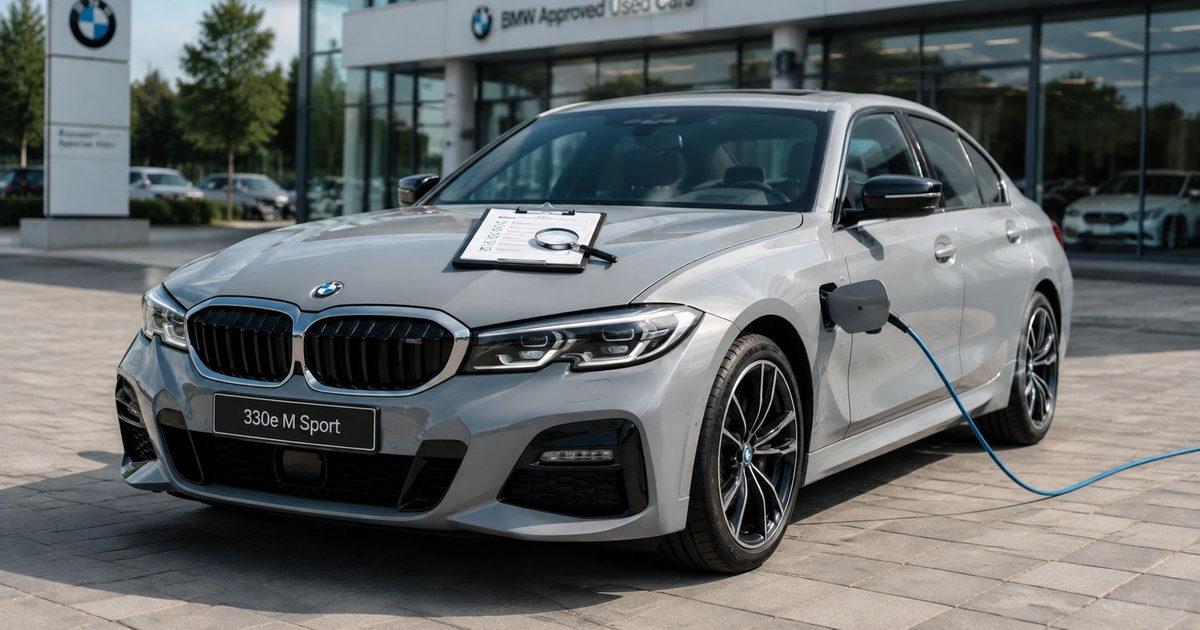
A clean BMW 330e M Sport can look like easy money on the forecourt. Paint is straight, wheels are shiny, the cabin presents well, and the numbers on the screen make it sound like a no-brainer. That's exactly where trade buyers get caught, because a plug-in hybrid isn't just a 3 Series with a battery, it's a vehicle history check UK problem with a powertrain attached, and the wrong assumptions cost you twice, once at purchase and again at retail.
The BMW 330e M Sport sits in a premium part of the used market because it promises executive-car pace, lower official emissions and usable electric running. Independent UK review data for the Touring xDrive M Sport records 156 mpg (WLTP), 41 g/km CO2 and up to 35 miles of electric range, which is exactly the kind of spec that tempts company-car drivers and used buyers alike. But the trade doesn't buy brochure figures, it buys outcomes, and the 330e's outcome depends on charging behaviour, battery condition, trim reality and provenance, not just a clean MOT and a presentable service book.
Table of Contents
- Why the 330e M Sport Deserves a Trade-Side Risk Lens
- Understanding the 330e M Sport Generations and Trim Reality
- What the badge really means on trade stock
- PHEV-Specific Failure Points That Hit Residual Values
- Where the money goes when a 330e goes wrong
- What to watch before you commit
- Forecourt Checks for Battery, Charging and Hybrid Use Patterns
- Start with the obvious signs
- Test the car like a trade buyer, not a passenger
- Reading MOT History, Mileage Patterns and Ownership Signals
- What “normal” looks like on a well-kept 330e
- Use ownership length as a risk signal
- Why a Basic History Check Is Not Enough for a PHEV
- Valuation Impact and Negotiating Strong Prices on the 330e
- Where the price gets squeezed
- Simple trade-side framework
- Pre-Purchase Checklist and Key Questions Before You Bid
- The five questions I'd expect every buyer to answer
Why the 330e M Sport Deserves a Trade-Side Risk Lens
A dealer rolls a white 330e M Sport onto the pitch, the valeter's done a good job, the digital dash looks healthy, and the numbers read well. On paper, it looks like the sort of premium PHEV that should shift quickly. In practice, the first question isn't whether it's tidy, it's whether the last owner used it like a hybrid or treated it like a petrol saloon with a charging flap.
The 330e became popular for a reason. The UK spec combines tax-friendly emissions, a petrol backup and real pace, which explains why it found a home with company-car drivers and premium used-car buyers. Independent UK road test data records 292 bhp, 420 Nm, 0–62 mph in about 5.8 to 5.9 seconds and top speeds around 142 to 143 mph depending on source and trim, so this isn't a soft, underpowered eco-box. It's a brisk executive car that happens to plug in, which is why its buying risk sits between a conventional saloon and a full EV.
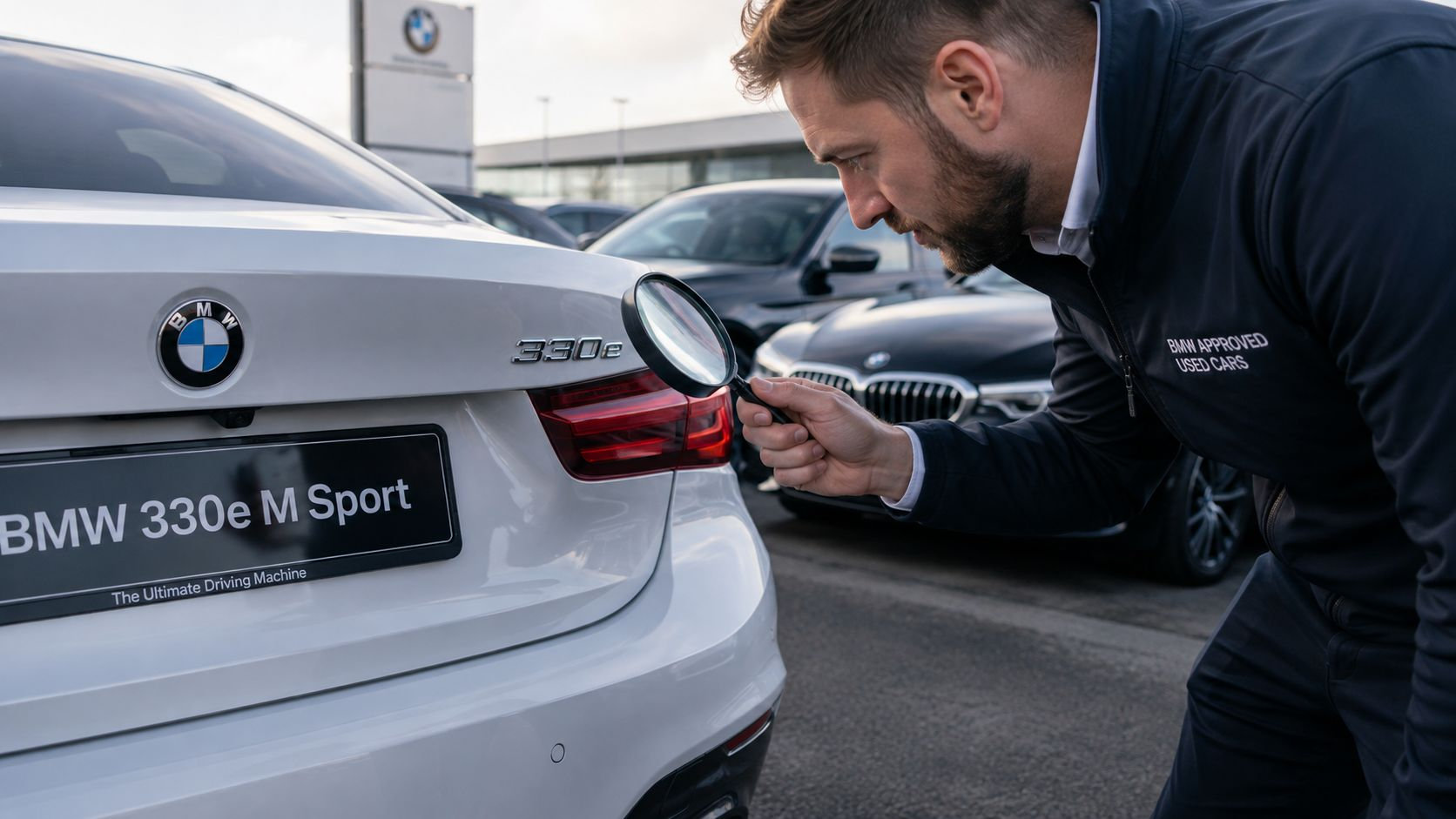
Practical rule: if the car's history doesn't tell you how it was charged, you don't know what you're buying.
The trade-side mistake is treating it like any other 3 Series. You can't price a 330e properly if you only look at body condition, mileage and basic provenance. You need to know whether the electric side has been used enough to support the headline economy and whether the car's previous life created residual value risk you'll inherit at retail.
Independent UK review data for the 330e M Sport records up to 35 miles of all-electric range in the Touring xDrive trim, with combined fuel economy quoted as 156 mpg (WLTP) and 41 g/km CO2. Those figures matter, but only when the car has been charged regularly and driven in the right pattern. If not, you're holding a premium PHEV whose story no longer matches its asking price.
Understanding the 330e M Sport Generations and Trim Reality
The first job on the forecourt is simple, identify exactly which 330e is in front of you. The G20-era saloon arrived first, later cars added the Touring xDrive version, and newer models brought a larger battery and stronger electric running. That changes the ownership story, the range claim, and the way you should pitch the car at retail.
The powertrain itself stays recognisably the same. UK-market technical data shows the 330e uses a 1,998 cc turbocharged four-cylinder petrol engine with an electric motor, giving a total output of 215 kW (292 PS) and 420 Nm, with 0–62 mph in 5.9 seconds and a top speed of 142 mph (AutoProv build spec sheet report). The electric motor is there for more than a clean brochure line, it adds low-down torque and makes the car feel stronger than the petrol engine alone would suggest.
What the badge really means on trade stock
The M Sport badge gets overread all the time. On the 330e, it is mostly a styling and wheel package, not a true chassis overhaul. That matters to trade buyers because bigger wheels and firmer-looking trim can make the car more sensitive to pothole damage and can trim electric efficiency, while not giving the suspension change some retail buyers expect.
Generation Drivetrain EV range (official) Battery Trade note Early G20 saloon Plug-in hybrid, rear-wheel drive 37 miles Smaller earlier pack Check if the car has lived as a petrol-first saloon Later Touring xDrive M Sport Plug-in hybrid, xDrive Touring 35 miles 10.3 kWh in one UK review Stronger family-stock appeal, but range depends on charging discipline Later UK models Plug-in hybrid Up to 62 miles Larger later battery Better electric story, but still only as good as its charging history Treat the badge as a starting point, not a valuation guide. Use the AutoProv vehicle build spec sheet report to confirm the exact factory spec before you commit, because the same name covers different batteries, different body styles, and different retail stories. That is the difference between a tidy stock card and a car that is mispriced from day one.
Independent listings also show 0–62 mph figures ranging from roughly 5.6 to 6.1 seconds, which is enough variation to prove the same model name can cover different spec and valuation profiles (Honest John specifications).
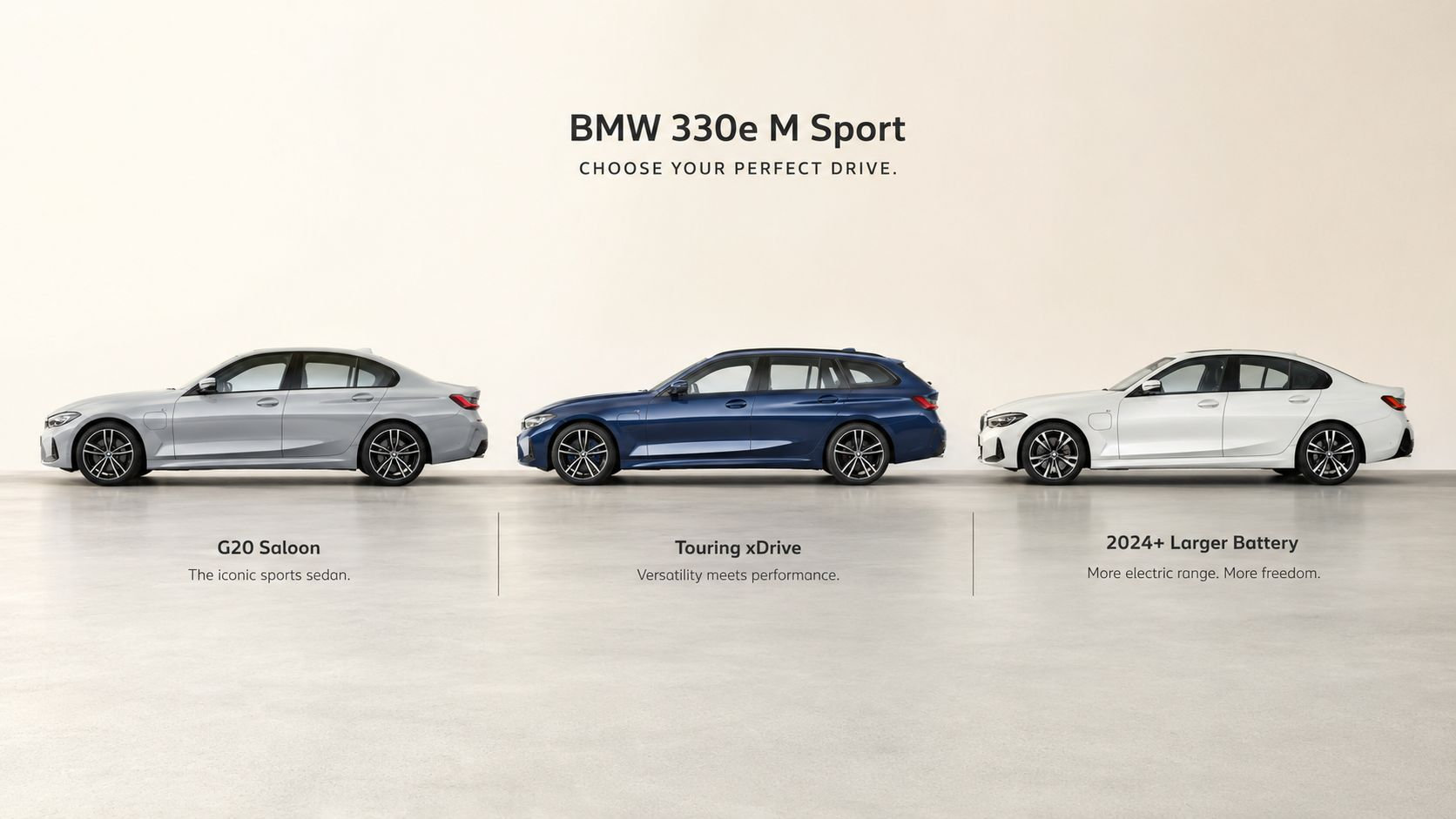
The model mix also makes a proper vehicle provenance check worth doing before you bid. A trade car that has been presented as one variant but turns out to be another can be wrong from the start, and that is before you factor in wheel size, battery age and equipment level. For exact build confirmation, the factory options trail matters as much as the logbook.
Generation Drivetrain EV range (official) Battery Trade note G20 saloon launch spec Plug-in hybrid Earlier quoted range Earlier pack Watch for misdescribed trim and spec drift Touring xDrive M Sport Plug-in hybrid, xDrive Up to 35 miles 10.3 kWh in UK review data Premium family-stock, but only if charging history is credible Later-generation UK model Plug-in hybrid Up to 62 miles Larger battery Better retail narrative, yet still range-sensitive The question is not whether it is a 330e. The question is which 330e it is, and whether the spec matches the stock note, the advert, and the car in front of you.
PHEV-Specific Failure Points That Hit Residual Values
The weak spots on a 330e are not the same as the weak spots on a petrol 3 Series. A basic used car history report might tell you it hasn't been written off or stolen, but it won't tell you whether the hybrid side has been leaned on, neglected or ignored. That's where residual value starts to slip, because buyers pay for confidence as much as they pay for metal.
Where the money goes when a 330e goes wrong
The high-voltage battery is the obvious concern, but it's not the only one. Electric range that falls away from the expected level, repeated hybrid warnings, charging refusal and selector interlocks all create a car that's harder to retail and more awkward to warranty. Once those symptoms appear, you're no longer discussing a normal prep bill, you're discussing a car that needs diagnosis with a specialist mindset.
UK review coverage notes that AC charging from empty to full takes around 2 hours 15 minutes according to manufacturer figures, and later-generation UK models are rated for up to 62 miles of electric range versus 37 miles on the earlier version (RAC review). That spread tells you two things. First, the platform improved over time. Second, charging discipline matters more than most forecourt buyers realise.
If the electric range looks weak and the car hasn't been charged regularly, assume the next owner will notice.
The practical problem for trade buyers is that PHEV faults are often soft at the start. A 330e can still drive, still start, still present cleanly on a test drive and still be a headache later if the battery isn't performing as expected. That's why you need to think in terms of battery condition, charging hardware, software behaviour and 12V health, not just engine and gearbox.
What to watch before you commit
- Charging response: If the flap, cable fit or charge-start process feels clumsy, take it seriously.
- Range behaviour: If the displayed electric range is implausibly low for the car's apparent condition, dig deeper.
- Warning history: Hybrid warnings that disappear after a restart are still warnings.
- Use pattern: A car used rarely on electric power will not tell the same resale story as one that's been charged at home or work.
Use a structured battery-health review alongside your usual inspection flow. A good starting point is AutoProv's EV battery health check guide, because the 330e's risk is as much about interpretation as it is about hardware. You're not just checking whether it starts, you're checking whether the hybrid system has been living the life it was designed for.
Forecourt Checks for Battery, Charging and Hybrid Use Patterns
Run these checks before the car leaves the first row of the forecourt. You do not need an hour, you need discipline. The point is to work out whether the 330e has lived as a proper plug-in hybrid or whether the last keeper used the petrol side and left the rest to drift.
Start with the obvious signs
Look at the charge flap, the cable condition and the consistency of the charging port surround. Dirt, corrosion, damaged covers and cheap repair evidence all tell a story, and not a flattering one. Then switch the ignition on and watch the state-of-charge behaviour rather than just the headline range number.
Use a battery-health check guide such as AutoProv's EV battery health check guide if you need a structured way to assess whether the pack is behaving properly. It fits the 330e well because the issue is not just whether the car moves, it is whether the hybrid system has been living the right life between charges and engine use.
UK review coverage says M Sport trim and larger wheels reduce usable electric range compared with standard variants, while the car still depends on regular charging to deliver the headline fuel economy (Electrifying review). That means a neat-looking M Sport on big wheels can be the least efficient version in practice, which is exactly why a buyer needs to separate image from use case.
Test the car like a trade buyer, not a passenger
Take the car for a short drive and check whether EV-only mode engages cleanly, whether brake feel transitions naturally and whether the drivetrain behaves as a hybrid should under light load. A 330e that has lived mostly on petrol often feels different from one that has been charged and cycled properly. The difference is not dramatic in a showroom video, but it shows up quickly when you know what to listen for.
- Dashboard logic: Does the car report charge, range and mode changes in a believable way?
- Charging evidence: Is there service history or owner paperwork that suggests regular charging?
- Brake feel: Does regen feel consistent, or does the pedal feel odd and underused?
- Infotainment records: Do the menus show recent hybrid-related activity and normal service intervals?
If the car spends its life as a petrol saloon, the resale narrative gets weaker and the future buyer will ask the same questions you should be asking now. That is why a provenance-led workflow matters before you commit to stock.
Reading MOT History, Mileage Patterns and Ownership Signals
MOT history tells you more than pass or fail. On a 330e M Sport, it can show whether the car has been maintained in a way that makes sense for a heavier plug-in hybrid, or whether it's been run cheaply and patched up only when required. A dealer who reads MOT data properly can spot trouble before it becomes an argument after delivery.
What “normal” looks like on a well-kept 330e
The first pass is mileage progression. You want a clean, believable climb over time, not a pattern that jumps around, stalls or looks too neat. The second pass is the advisory cluster. On a heavier PHEV, repeated notes around brakes, tyres, suspension bushes and wheel condition can point to a car that has been worked harder than it should have been or ridden across poor roads without sympathy.
Buying advice for the 330e notes that the M Sport trim does not add a true sport suspension setup, which can mean stiffer ride quality and greater vulnerability to wheel and tyre damage on poor UK road surfaces (Bimmerpost buying advice). That matters because it gives you context for the MOT file. If the car has repeated wheel or tyre advisories, don't dismiss them as one-offs. They may be part of the trim and road-surface equation.
Use ownership length as a risk signal
Short-term ownership doesn't automatically mean trouble, but rapid resale cycles should make you cautious. A trader who keeps a 330e for a short period and moves it on quickly may be exposing an issue the paperwork doesn't show. Combine that with mileage trajectory and MOT timing, and you start to see whether the car has had steady use or stop-start lives.
A mileage check UK process is simple:
- Match mileage across records and look for anything that breaks the pattern.
- Compare ownership spans with service intervals and test dates.
- Read the advisories together instead of one by one.
- Check for movement logic, because a car that has jumped around the country without a sensible reason deserves a closer look.
Use a proper provenance workflow, not just a compliance tick-box. A good reference point is MOT history red flags dealers should watch for, because that's where the value sits for trade buyers. The point isn't to find excuses to walk away from every car, it's to know which ones are boring enough to stock.
Why a Basic History Check Is Not Enough for a PHEV
A basic pass or fail history check will not tell you whether the 330e has been charged properly, whether the battery still behaves as expected, or whether the previous keeper used the car in a way that supports the retail story. That is the problem with reducing a PHEV to finance, theft and write-off screens alone. You get a clearance result, but you do not get a buying decision.
A dealer needs vehicle provenance in the broader sense, not just a certificate. Ownership duration, gap periods, mileage trajectory, service-stamp logic, MOT advisory clustering and pattern changes between keepers all matter because they explain how the car has lived. That context is what turns a used car history report into trade vehicle intelligence.
Trade rule: if the history report only answers “can I sell it”, it has not answered “should I buy it”.
A provenance-led platform earns its place because vehicle data is only a point-in-time snapshot. The useful part is the context around it, not a single binary result. For a 330e, that context matters because the hybrid side can look fine at handover and still create reconditioning or warranty pain later.
Use our EV trade due diligence guide as the next layer after the basic check. It helps you separate a clean-looking file from a car that has the wrong charging pattern, thin ownership evidence or a story that will be hard to defend at retail.
A dealer who buys on context is buying less risk. In a premium PHEV, the stock holds together best when the charging behaviour, ownership story and mileage pattern all line up. If they do not, the price should reflect it immediately, not after the first retail complaint.
Valuation Impact and Negotiating Strong Prices on the 330e
The 330e M Sport brings strong money only when the file reads cleanly. If the battery story is uncertain, or the charging evidence is thin, price it as a softer retail prospect straight away. That does not automatically kill the deal, but it does change how hard you should push on entry cost.
A dealer who buys this car on emotion will pay for it twice, once at purchase and again in reconditioning or comeback risk. On a plug-in hybrid, the hybrid side can look presentable while still leaving you with awkward questions later. Use a hard buying standard from the start.
Where the price gets squeezed
Specification and performance differ by generation and source, and independent listings for the car point to 0–62 mph figures in the low sixes and high fives. That spread matters because the same badge can hide different equipment and different value. If you are pricing without checking the exact car, you are guessing.
The larger hit comes from uncertainty, not a single obvious fault. Weak charging evidence, no believable electric-use pattern, and patchy keeper history all make the car harder to defend to a retail buyer. Once those warning signs stack up, the price needs to move far enough to cover margin and likely reconditioning work.
Simple trade-side framework
- Retail it when the charging story is credible, the MOT pattern is steady and the battery behaviour feels consistent.
- Trade-only it when the car is tidy but the hybrid history is thin and you do not want retail comeback risk.
- Decline it when the electric side is warning-heavy, the charging hardware looks neglected or the provenance is messy enough to cloud the deal.
That framework only works if you apply it before money changes hands. If a specialist inspection is needed, get it done before retail prep starts, not after. A 330e can be a good forecourt car, but only when the buyer is stricter than the average plug-in hybrid advert.
For a valuation method that ties history, mileage and risk context together, AutoProv's market-insights approach is the kind of toolset that suits this stock. You do not need more data for its own sake, you need a stronger price decision.
Pre-Purchase Checklist and Key Questions Before You Bid
A 330e M Sport should be bought with a checklist, not a hunch. If the answers are unclear before you bid, they won't become clearer after the car is on your forecourt. That's especially true with PHEVs, where the difference between a good buy and a problem stock card is often hidden in the usage pattern.
The five questions I'd expect every buyer to answer
- Was it charged regularly? If nobody can show a believable charging routine, treat the electric range story as weak.
- Does the mileage pattern make sense? Look for continuity across MOTs, invoices and seller explanation.
- Do the wheels, tyres and brakes suit the claimed use? M Sport cars on poor roads often tell on themselves.
- Does the battery behave like a healthy hybrid system? Watch the dashboard, the charging response and the drive mode change.
- Does the trim match the advert and the logbook? Variant confusion hurts pricing fast.
You should also ask for the right paperwork. Service history, any charger or cable evidence, ownership records and a clean set of mileage documents all help you build a defensible file. If the car has a gap in its story, make sure the valuation reflects it before the hammer falls.
For a practical buyer-facing checklist that sits well alongside your own process, check a used car before buying is a useful reference point. Keep it beside your own notes, not instead of them.
The best trade process is boring. It catches the oddities early, keeps the money honest and stops the retail team inheriting a car the buyer already had doubts about.
AutoProv helps UK motor traders build a clearer picture of vehicles like the BMW 330e M Sport before money changes hands. If you want trade-focused vehicle provenance, mileage context and risk signals that go beyond a basic check, visit AutoProv and review how it fits your buying process.
Frequently Asked Questions
AI-Generated Content Notice
This article was created with the assistance of artificial intelligence technology. While we strive for accuracy, the information provided should be considered for general informational purposes only and should not be relied upon as professional automotive, legal, or financial advice. We recommend verifying any information with qualified professionals or official sources before making important decisions. AutoProv accepts no liability for any consequences resulting from the use of this information.
From our AI insights
- Auction Pitfalls: Avoiding Costly Mistakes
Navigate UK car auctions with confidence by avoiding finance, write-off, and mileage risks.
- Mastering Paint Code Checks: Detecting Hidden Car Repairs
Discover how to use paint code verification to identify hidden car repairs and ensure a smarter purchase.
- UK Part-Exchange Checks: Protecting Dealer Margins
Explore essential part-exchange checks for UK dealers to safeguard profit margins, including provenance and finance verification.
Related Articles

Your Ultimate Guide to Buying a Used Car in the UK
Navigate the UK used car market with confidence using our comprehensive buying guide. Tips, checks, and AutoProv Provenance insights included.

Difference Between MOT and Service: What You Need to Know
An MOT is a mandatory legal inspection that every car on UK roads needs to pass.Think of it as the government's way of ensuring your vehicle meets the absolute minimum safety and environmental standards to be considered roadworthy. A service, on the other hand, is a completely different beast. It's the proactive maintenance routine recommended by the people who built your car, designed to keep it running smoothly and catch problems before they start. In short, an MOT is a pass-or-fail exam required by law. A service is a comprehensive health plan for your car.

Your Ultimate Used Car Inspection Checklist
A solid used car inspection checklist is the single most powerful tool you have to avoid buying a lemon. It gives you a methodical way to look past the shiny paint and assess a car's real condition, helping you spot hidden problems and get a fair price before you shake hands on the deal.
Published by AutoProv
Your trusted source for vehicle intelligence