
In 2024, 562,185 vehicles were written off in the UK, equivalent to roughly one vehicle every minute, and the total recorded between 2019 and 2024 exceeded three million vehicles.
The reported 2025 data changes the buying question. An insurance write-off check isn't a niche precaution for unusual stock. It's a core control for any dealer committing money to a used vehicle.
A clean-looking car, a current MOT and a tidy DVLA record can still leave important questions unanswered. The professional approach is to establish the vehicle's insurance history, category, ownership pattern, mileage trail, salvage exposure and physical provenance before the purchase becomes difficult to unwind.
Table of Contents
- The Scale of the UK Write-Off Problem
- A market condition, not an edge case
- Understanding ABI Salvage Categories
- Cat A and Cat B
- Cat S and Cat N
- Documents and category evidence
- Running a Proper Insurance Write-Off Check
- Start with DVLA and MOT data
- Query the insurer record
- Use commercial reports as evidence, not a verdict
- Data Gaps Between Insurer and DVLA Records
- What the mismatch means at purchase
- Write-Off Checks Versus Full Salvage History
- Signals outside the core record
- Why absence isn't proof of absence
- Integrating Findings Into Trade Buying Decisions
- Set the decision before the bid
- Decide when the evidence is insufficient
- Use provenance as a negotiation lever
The Scale of the UK Write-Off Problem
A reported 46% increase in annual write-offs between 2017 and 2024 shows how quickly categorised vehicles have moved from unusual purchases into normal trade exposure. Read the underlying UK write-off analysis. Dealers can encounter them through auctions, part-exchanges, private purchases and wholesale channels, often after a repair has made the vehicle look like ordinary stock.
The underlying decision is economic, not technical. Insurers compare the expected repair bill with the vehicle's value and the uncertainty around returning it to service. Modern electronics, sensors, restraint systems and manufacturer repair procedures can push that calculation beyond the vehicle's pre-accident value, even where a skilled repairer could technically restore it.
That distinction matters at purchase. A car may present well on a forecourt while its earlier loss still affects valuation, resale liquidity, underwriting confidence and post-sale dispute risk. Paying an ordinary-stock price leaves no allowance for additional inspection, slower resale or a buyer's concern about the history. A clean DVLA record does not close that gap, because DVLA records and insurer or salvage records serve different purposes.
A market condition, not an edge case
A basic vehicle history check UK search should therefore be treated as an initial filter. A free registration enquiry can confirm administrative details, but it cannot by itself prove that the vehicle has never been written off. A private history check may identify a previous write-off, theft, outstanding finance or mileage discrepancy, yet that still represents one layer of due diligence rather than a complete provenance review. See the government's consumer guide to repaired written-off vehicles.
Year Total write-offs Estimated re-entered market Repair cost inflation 2019-2023 Exceeded 3 million cumulatively across the period Not stated in the verified data Not stated in the verified data 2024 562,185 Not stated in the verified data Not stated in the verified data The verified figures establish the scale of total losses, not the number of repaired vehicles that returned to trade. They also do not provide a defensible repair-cost inflation rate. Those gaps matter because salvage supply, insurer decisions and later retail presentation can separate the vehicle's physical condition from the history visible in a registration enquiry.
Buying rule: Run the insurance write-off check before bidding, transferring funds or accepting a part-exchange. A clear administrative flag is not the same as a clear insurance and salvage history.
Understanding ABI Salvage Categories
The current ABI framework gives trade buyers a decision structure, but it isn't a substitute for inspecting the repair. The ABI's explanation of written-off and total-loss vehicles identifies four salvage groups. Cat A and Cat B cannot return to the road, while Cat S and Cat N may return after proper repair.
Cat A and Cat B
Cat A vehicles are scrap-only. They must be crushed and cannot be reused, including for parts. A dealer must never treat one as road-going stock.
Cat B vehicles may provide salvageable components, but the bodyshell must be destroyed. Parts resale can be relevant to dismantlers, but a Cat B shell cannot lawfully become a repaired retail vehicle. Any seller presenting either category as ordinary used stock should stop the transaction and investigate the identity records immediately.
Cat S and Cat N
Cat S means structural damage. The vehicle can potentially return to the road, but only after suitable repair. The category was introduced as part of the move away from the former Cat C and Cat D framework, so older records and newer category labels need to be read in context. Structural damage can involve chassis elements, crumple zones or load-bearing areas, and a category label alone says nothing about the standard of the repair.
Cat N means non-structural damage, with repair and reuse still possible. It doesn't mean cosmetic, trivial or risk-free damage. Electrical systems, airbags, steering, braking components and advanced driver-assistance systems may all need careful assessment even where the main structure wasn't classified as damaged.
The GOV.UK guidance on insurance write-offs confirms that Cat N vehicles can be repaired and used again if made roadworthy. The marker remains part of the vehicle's history, so a repaired Cat S or Cat N should be valued and described as categorised stock, not folded into an ordinary retail comparison.
Documents and category evidence
Check the registration and VIN first, then compare the report with the V5C, available repair paperwork and physical vehicle identity. A V5C is not proof that the repair was competent, and a clean MOT isn't proof that no insurance loss occurred. For readers dealing with branded-title terminology across jurisdictions, this explanation of how to verify a branded title on Cararam provides useful background, although UK category rules must remain the controlling reference.
For a practical walkthrough of the category process, use AutoProv's guide to checking a car's category. The buying decision should record the category, damage context, evidence supplied and expected resale treatment separately.
Running a Proper Insurance Write-Off Check
A disciplined check has a sequence. Start with identity, move through official records, then validate the result against the vehicle and its paperwork.
Start with DVLA and MOT data
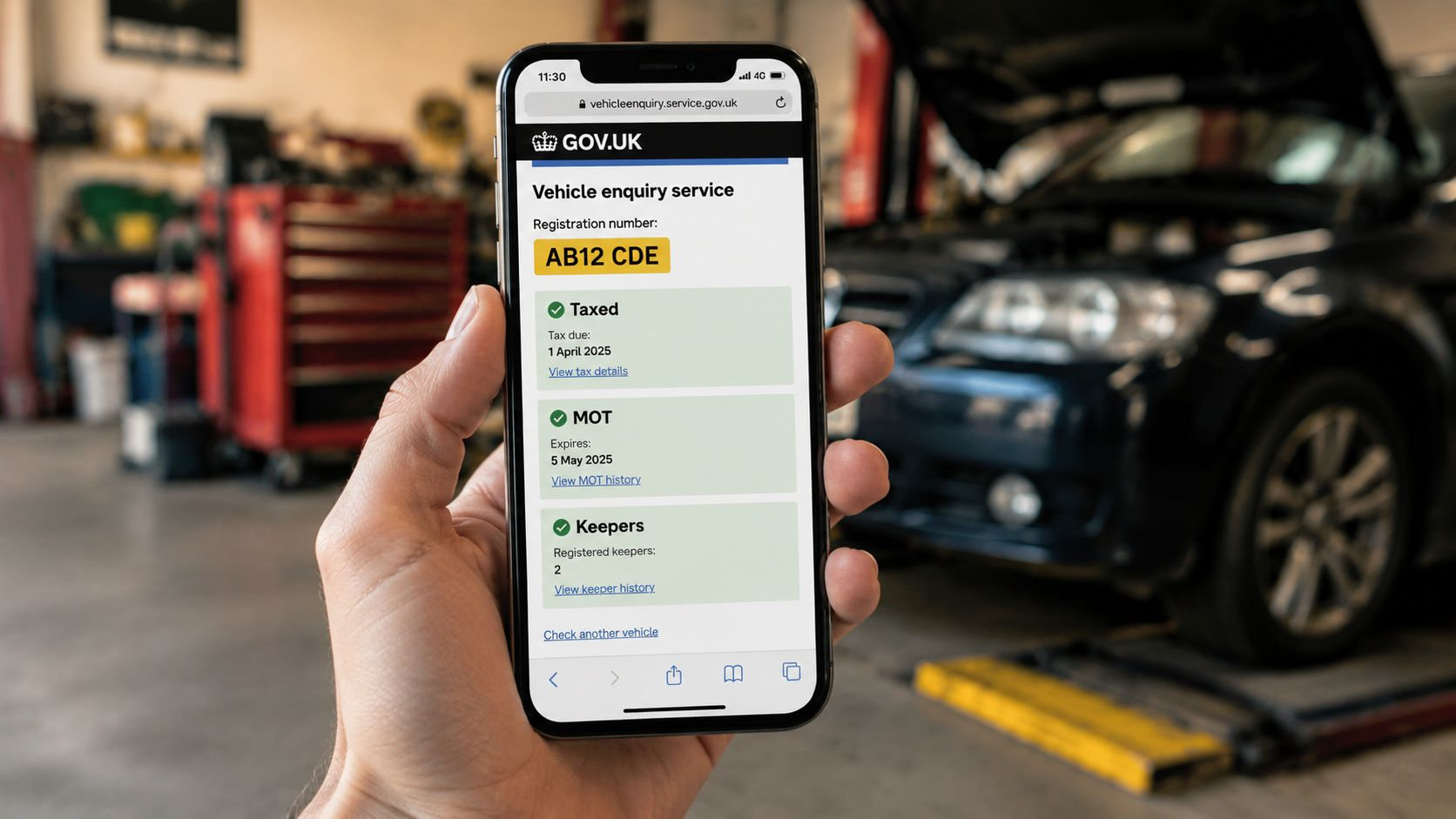
Use the free GOV.UK vehicle enquiry service to confirm the registration, tax status and core vehicle details. The associated MOT record can show test history and recorded mileages, which makes it useful for a mileage check UK workflow. If an MOT mileage entry is wrong, the test centre can correct it, or the error can be reported online through GOV.UK's MOT correction process.
The limitation matters more than the convenience. The free DVLA enquiry doesn't query MIAFTR and doesn't show insurance write-off categories. A current MOT therefore tells you about test records, not whether an insurer previously settled the vehicle as a total loss.
Query the insurer record
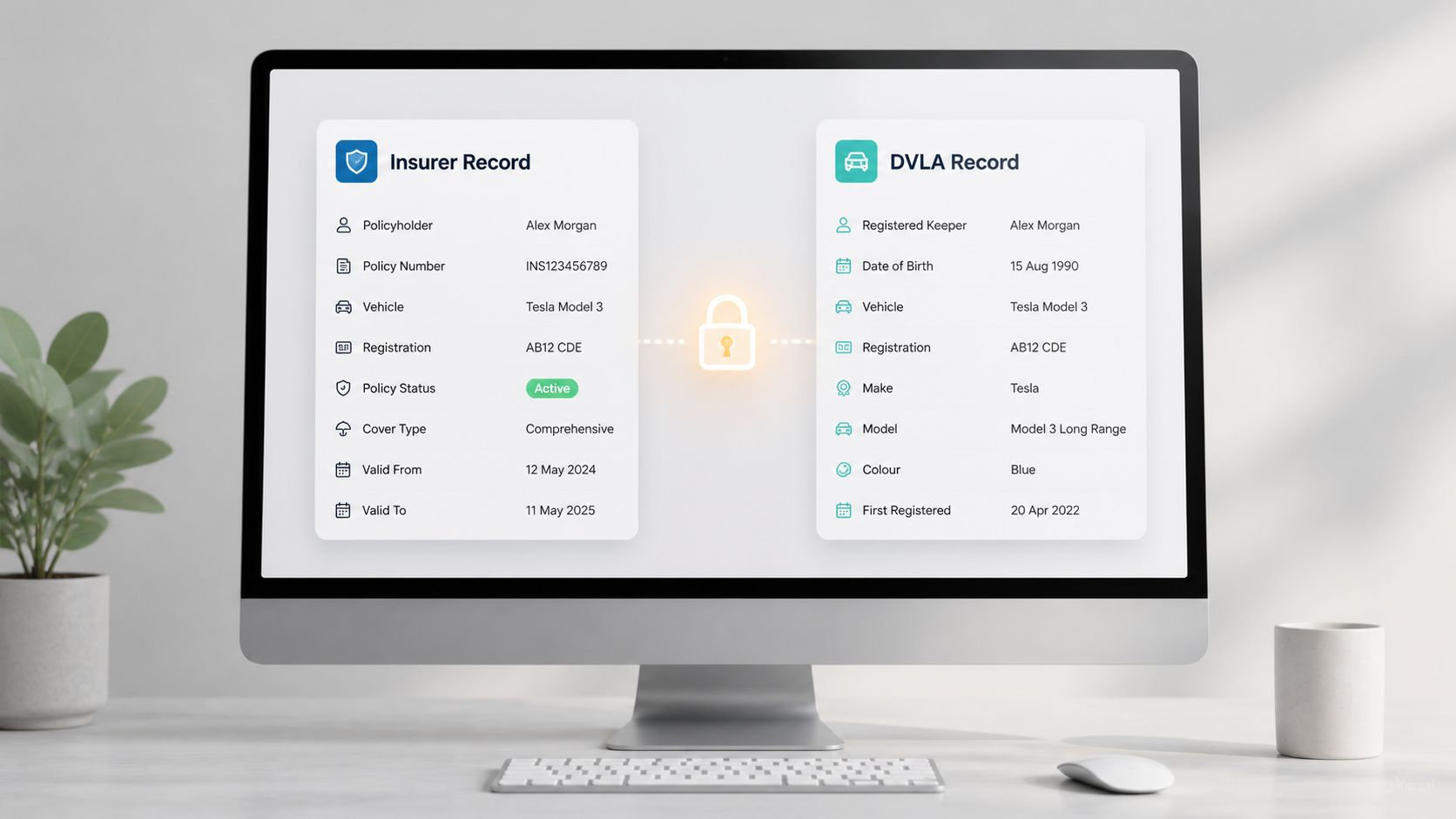
The central insurance write-off check should query the Motor Insurance Anti-Fraud and Theft Register, commonly known as MIAFTR. This is the UK register used to log insurer write-offs. Trade buyers normally access relevant data through an authorised commercial provider.
A positive result means an insurer has recorded a total-loss event. It doesn't automatically prove the current repair is unsafe, but it does establish a permanent commercial fact that must affect valuation, preparation and disclosure. The category should be reconciled with the VIN, registration and supporting records before you proceed.
For more detail on the role of insurer data in a UK check, see this guide to insurance database checks for UK cars.
Use commercial reports as evidence, not a verdict
Providers such as HPI, Experian AutoCheck and the RAC can offer commercial vehicle history reports with different coverage, interfaces and turnaround times. The relevant question isn't which logo appears on the report. It's whether the service gives you enough evidence for the particular purchase, and whether its result agrees with the official and physical record.
Run the report before money changes hands, including at auction where the bidding window is narrow. The recurring workflow failures are straightforward:
- Single-source reliance: A clean result from one platform doesn't prove that every insurer, salvage or ownership record is clean.
- Late checking: Running checks after transport, preparation or payment turns a preventable risk into sunk cost.
- MOT overconfidence: A consistent MOT trail supports mileage analysis, but it doesn't replace an insurance write-off check.
- Identity drift: A registration can look correct while the VIN, V5C or physical stamp needs further reconciliation.
The output should be a recorded buying decision, not merely a green screen. Save the report, note the date, record the category and document any unresolved gap.
Data Gaps Between Insurer and DVLA Records
A clean DVLA-linked result does not establish a clean insurance history. DVLA, MIAFTR and salvage channels serve different purposes, so their records can diverge. An Auto Express analysis of DVLA Freedom of Information data found that repairable write-off totals differed between MIAFTR and the DVLA database in 2016/17 and 2017/18. One comparison recorded 607,548 vehicles versus 702,369, while another recorded 597,278 versus 688,435, a reported gap of about 13% to 15%. Review the Auto Express analysis of the database mismatch.
The figures do not prove that every mismatch involves fraud. They do show why a buyer should not treat one database as complete. Category changes, reporting procedures and the different purposes of each record can alter what appears in a buyer-facing check.
What the mismatch means at purchase
An insurer record indicates whether a total-loss event was logged. DVLA and MOT records provide registration and test information. Salvage operators and auction channels may retain separate listing details, photographs or movement records. A trade buyer must reconcile those strands before committing money.
The gap matters when repairs took place outside the original insurer network, or when only part of the vehicle's history is available. A missing marker deserves further investigation if the car's condition, mileage, ownership timeline or seller's explanation does not fit.
A clean flag is a data result. It is not a declaration that the vehicle has clean provenance.
Use a documented cross-check:
- Confirm the VIN and registration against the car and V5C.
- Query MIAFTR through a suitable provider.
- Review DVLA and MOT information, including mileage progression.
- Request repair invoices, inspection evidence and an ownership explanation.
- Compare the vehicle's physical condition with its stated history.
- Record unresolved inconsistencies before setting a bid or offer.
AutoProv can support this process through trade vehicle intelligence, combining DVLA records, MOT history, mileage patterns, ownership timelines, insurance-related events and risk indicators in a provenance report. It supports the buying decision, but does not replace inspection or resolution of conflicting evidence. Guidance on why single-source vehicle checks create data gaps helps review whether the buying process checks more than one record source.
Write-Off Checks Versus Full Salvage History
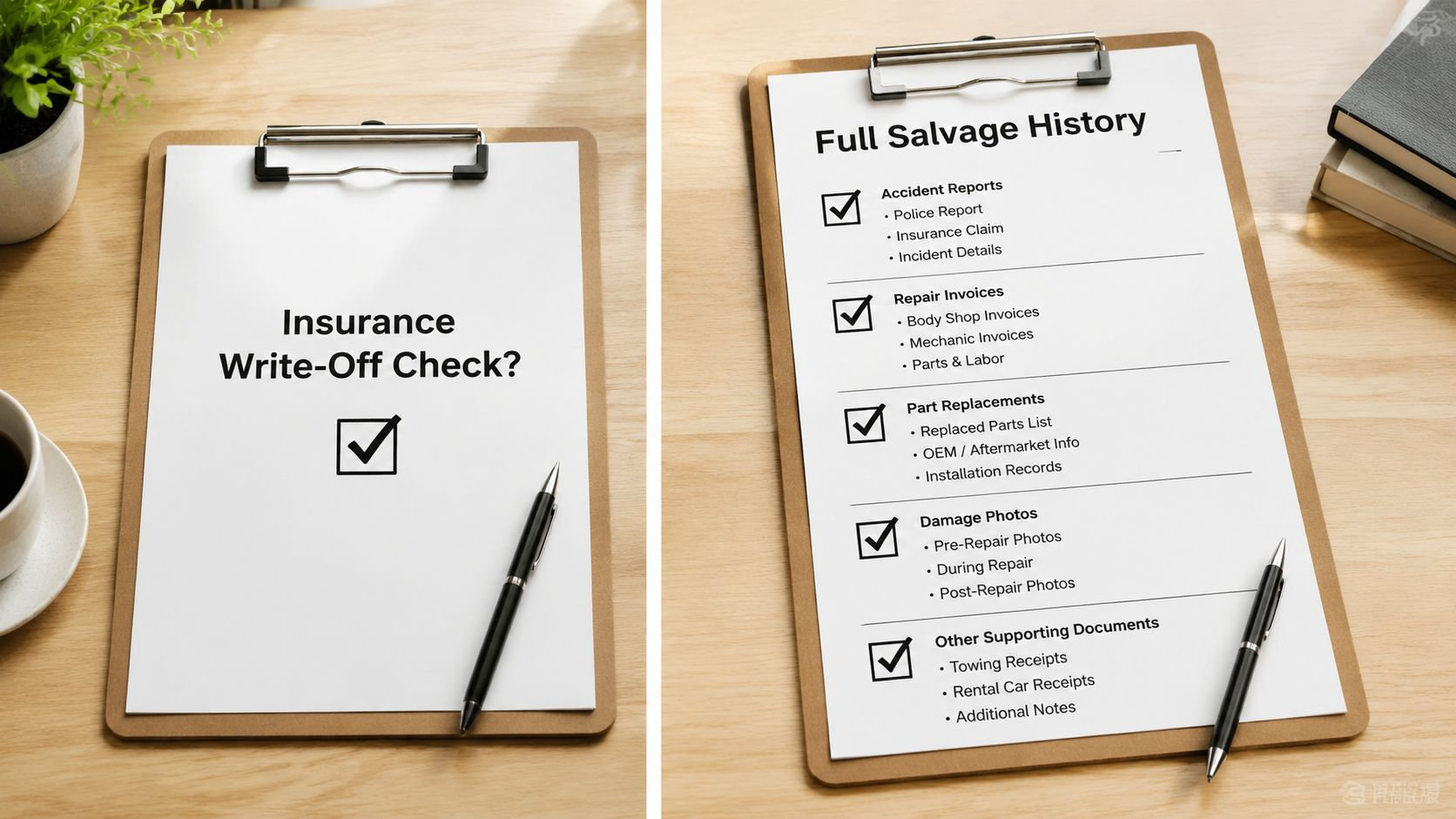
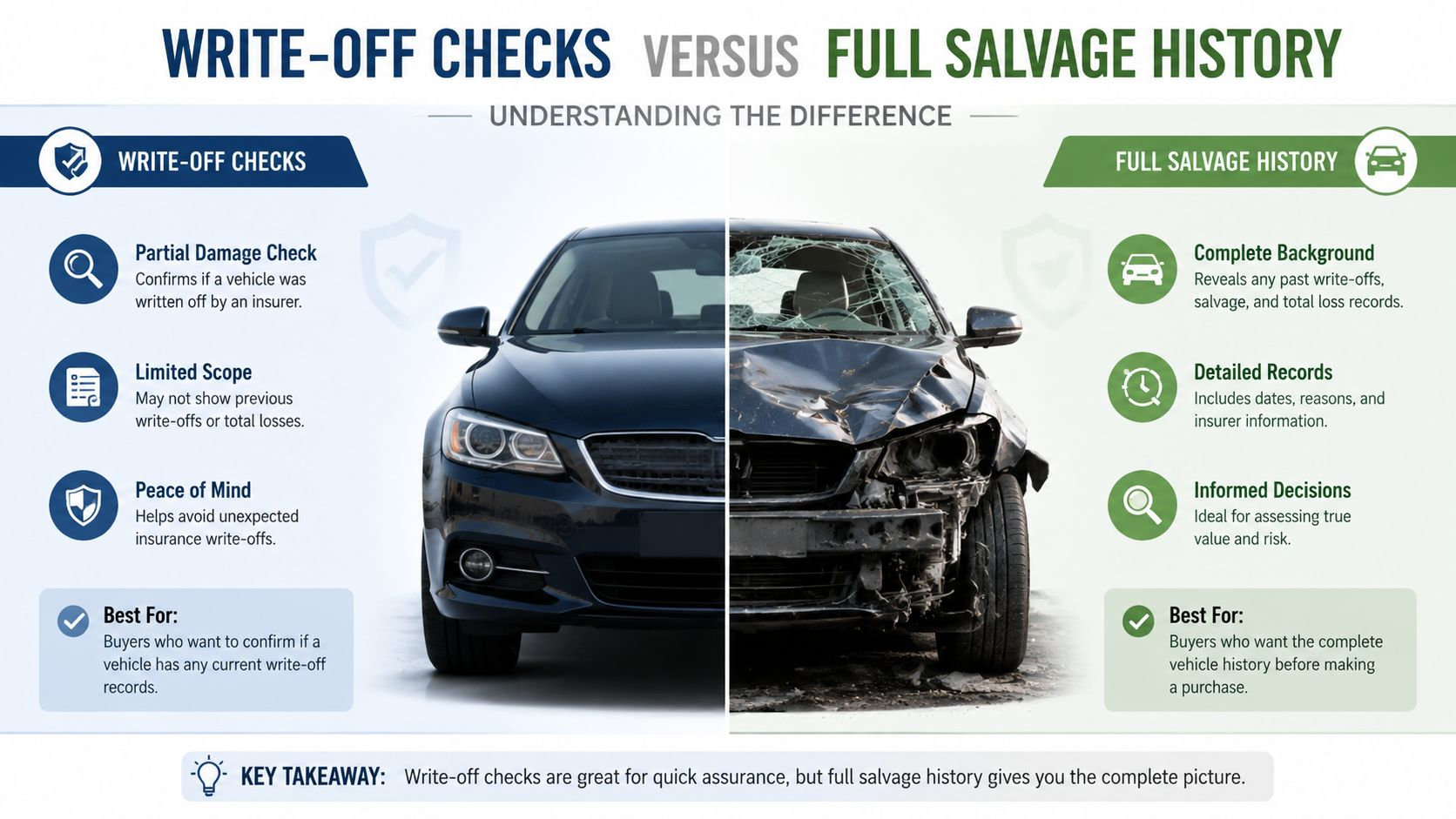
An insurance write-off check answers a narrow question: did an insurer record this vehicle as a total loss, and if so, under which category? A broader salvage check asks what happened before, during and after that event. Those are different products and should produce different buying decisions.
Salvage records may include auction history, VIN or title status, pre-repair photographs and listing descriptions. They may also expose a vehicle that passed through a salvage channel without generating the insurance marker a buyer expected. A clean core write-off result therefore cannot establish that the car has no auction history, no prior serious damage and no non-insurance salvage event.
Signals outside the core record
A flood-damaged vehicle might be sold through a channel without an insurer finalising a UK total-loss classification. A damaged car might be repaired and resold before an insurer's categorisation is visible to the buyer. An exported and re-imported vehicle may also carry a more complicated record than a standard UK registration search reveals.
None of these possibilities proves that a particular vehicle is affected. They show why a used car history report should be read as a collection of evidence rather than a pass-fail certificate.
Look for consistency across:
- Auction provenance: Listing photos, descriptions and condition notes can reveal damage that current panels conceal.
- Repair documentation: Invoices should identify the work performed and support the seller's explanation.
- Identity records: VIN, registration, V5C and imported-vehicle paperwork must describe the same vehicle.
- Physical markers: Overspray, uneven panel gaps, non-matching fasteners, warning lights and inconsistent trim can justify escalation.
- Ownership behaviour: Short-term ownership and rapid resale may not prove a write-off, but they can increase the need for evidence.
Why absence isn't proof of absence
A basic write-off check may be accurate within its defined data scope while still leaving salvage history outside that scope. This is the distinction many buying teams miss. They ask whether the vehicle is written off, receive a negative answer and then stop investigating the provenance.
A more useful process separates the questions:
Question Evidence required Has an insurer recorded a total loss? MIAFTR-based insurance write-off check Does the registration and MOT trail make sense? DVLA and MOT records Has the vehicle appeared in salvage channels? Auction and salvage provenance Was the repair explained and evidenced? Invoices, photographs and inspection Does the current car match the records? VIN, V5C and physical examination For a deeper distinction between a narrow check and wider provenance intelligence, use AutoProv's comparison of a provenance check and a comprehensive provenance report. The commercial principle is simple. Don't pay ordinary-stock money for an unknown history merely because one flag is absent.
Integrating Findings Into Trade Buying Decisions
The category matters only when it changes the decision. A buyer should translate the insurance write-off check into a maximum acquisition price, preparation plan, retail position and exit strategy. Treating every Cat S or Cat N vehicle as identical is as weak as treating every clean result as risk-free.
A Cat S with complete repair evidence, a consistent identity trail and a competent inspection may be commercially workable. A Cat N with unexplained mileage movement, missing invoices and visible electrical faults may be a poor purchase despite its apparently less severe label. Category is a starting point. Provenance quality determines how much uncertainty remains.
Set the decision before the bid
Use a written matrix rather than relying on instinct at the auction screen. The price range below is intentionally qualitative because the category alone can't justify an invented percentage or monetary adjustment.
ABI category Buy or pass decision Price adjustment range Key preparation risks Retail impact Cat A Pass as road-going stock Not applicable Vehicle must be crushed Cannot be retailed as a road vehicle Cat B Pass as road-going stock Not applicable Shell destruction and parts-only handling Cannot be retailed as a repaired road vehicle Cat S Consider only with strong evidence Material adjustment from comparable non-category stock Structural repair quality, alignment, restraint systems and geometry Category disclosure, narrower buyer pool and possible finance or underwriting questions Cat N Consider case by case Adjustment depends on damage, evidence and condition Electronics, airbags, driver-assistance systems and hidden non-structural faults History marker remains relevant to retail pricing and future part exchange For Cat S and Cat N stock, the preparation brief should identify what needs testing, not just what needs cleaning. A repair invoice that lists panels but says nothing about calibration, restraint systems or structural measurement should prompt a technical review.
Decide when the evidence is insufficient
Walk away when the vehicle identity doesn't reconcile, the seller can't explain a material gap, the physical condition conflicts with the report, or the projected margin depends on concealing the history. A tempting purchase price doesn't remove liability, warranty exposure or the cost of resolving a later dispute.
The same discipline applies to mileage. A consistent MOT sequence supports confidence, but a discrepancy requires correction or explanation before valuation. Ownership patterns also deserve context. Rapid resale can have innocent causes, yet combined with incomplete paperwork or inconsistent condition it becomes a risk signal worth pricing or rejecting.
Use provenance as a negotiation lever
A category marker isn't automatically a pass-fail gate. It is evidence that changes the comparable set. The buyer should compare the vehicle with similarly categorised stock, allow for preparation uncertainty and decide whether the retail customer will receive a clear explanation supported by records.
AutoProv's guidance on pricing Cat S vehicles is relevant to that process. AutoProv's vehicle provenance report includes write-off status and categories, alongside ownership timelines, MOT history, mileage patterns and other risk indicators. Used properly, that information helps a dealer distinguish a documented, manageable risk from a vehicle whose unknowns are likely to consume the margin.
The final file should contain the original report, identity checks, category, repair evidence, inspection outcome, offer rationale and planned retail disclosure. That record supports internal consistency and gives the preparation and sales teams the same facts.
AutoProv provides UK-focused vehicle history, provenance and risk intelligence for dealers, wholesalers and professional buyers, including write-off status, category information, MOT and mileage analysis, ownership timelines and anomaly signals. Before committing capital, visit AutoProv to assess how its trade vehicle intelligence can fit into your acquisition and valuation workflow.
Frequently Asked Questions
AI-Generated Content Notice
This article was created with the assistance of artificial intelligence technology. While we strive for accuracy, the information provided should be considered for general informational purposes only and should not be relied upon as professional automotive, legal, or financial advice. We recommend verifying any information with qualified professionals or official sources before making important decisions. AutoProv accepts no liability for any consequences resulting from the use of this information.
From our AI insights
- Spotting Insurance Frauds: Key Indicators UK Dealers Need
Learn to identify insurance frauds with key risk indicators using AutoProv.
- Navigating Insurance Write-Offs in 2024: What UK Traders Need to Know
Explore how UK traders can navigate insurance write-offs using provenance intelligence in 2024.
- Impact of Write-Off Categories on Car Values in 2024
Explore how Cat S, Cat N, Cat A, and Cat B write-offs affect UK vehicle pricing and trader responsibilities.
Related Articles

Understanding UK Car Insurance: Types and Legalities
Explore the UK car insurance sector, types of coverage, and the legal implications of incorrect coverage.
How to Check If a Car Is Insured in the UK | Easy Guide
The quickest and most reliable way to check if a car is insured is by using the Motor Insurance Database (MID) online. All it takes is the vehicle's registration number to see if a valid insurance policy is on record. Remember, driving without at least third-party insurance is a serious offence here in the UK.
Hit by an uninsured driver: UK accident rights & claim guide
Being hit by an uninsured driver is a deeply frustrating experience. The shock of the accident is bad enough, but finding out the other party has no insurance just adds a whole new layer of stress and confusion. Suddenly, the straightforward path to getting your car fixed seems to vanish. This guide is here to cut through that noise and show you that you're not out of options.
Published by AutoProv
Your trusted source for vehicle intelligence