

Getting car valuation right is the engine that drives a profitable motor trade business. It’s so much more than just a number—it’s where market intelligence, vehicle history, and real-world condition all collide. For any trade professional in the UK, mastering this skill is the difference between a great deal and a costly mistake sitting on the forecourt.
Unlocking the True Value of a Used Car
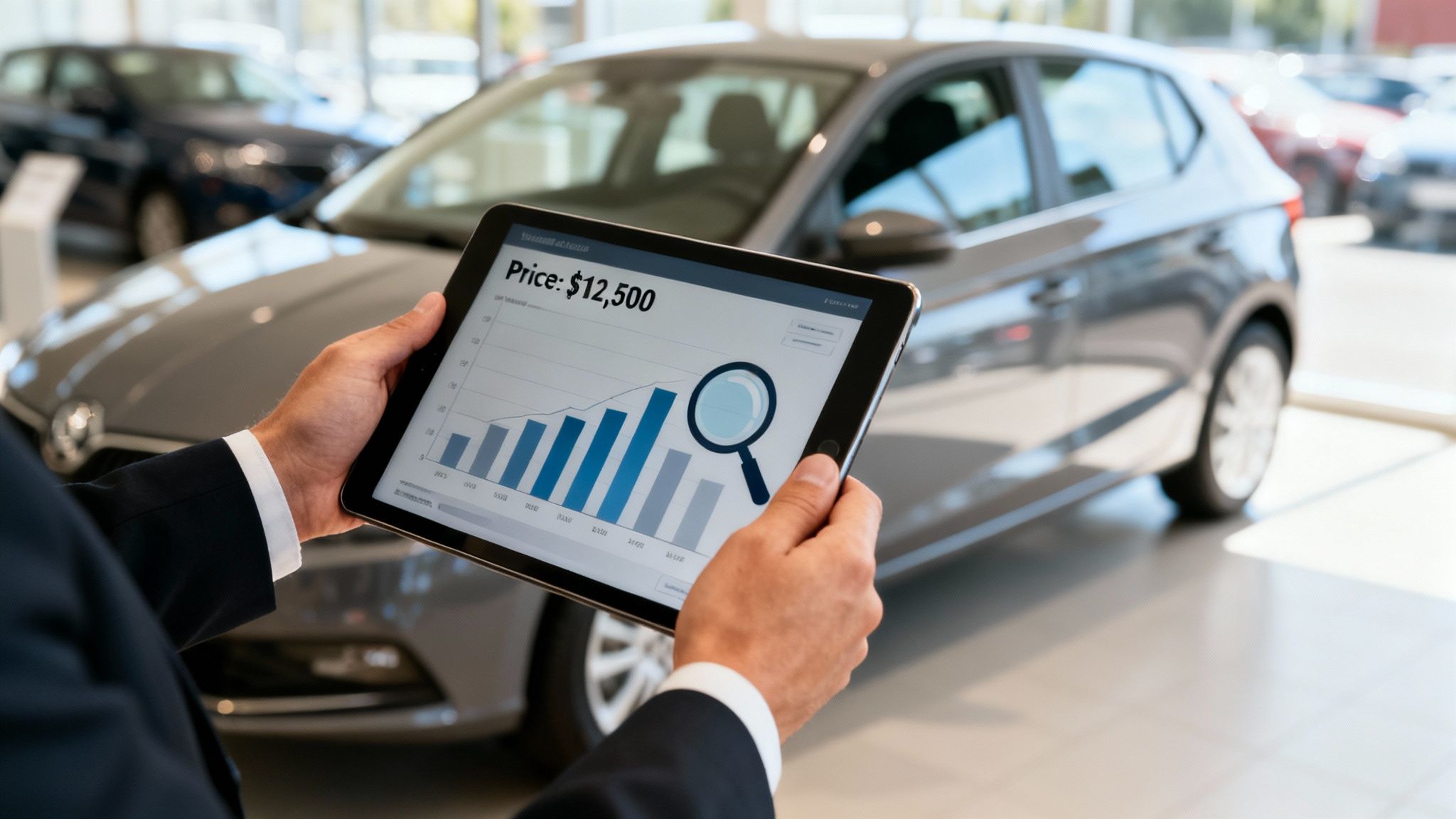
For dealerships and fleet managers, an accurate car valuation is the absolute cornerstone of every single transaction. It’s not about slapping a sticker price on the windscreen; it's a strategic move that dictates your buying price, your profit margin, and how fast that stock turns over. Get it wrong, and you either overpay for a car that won't shift or undervalue a part-exchange and watch a valuable sale walk out the door.
Think of it this way: a basic online price check gives you a rough map, but a professional valuation is your live sat-nav. It doesn’t just show you the destination (the car’s make and model). It accounts for the live traffic (market demand), road closures (hidden history alerts), and calculates the quickest, most profitable route.
Why Professional Insight Matters
In a market that can turn on a sixpence, relying on the same free tools a private seller uses is a massive risk. A professional valuation needs a much deeper level of insight, one that combines automated data with hard, verifiable facts. This is exactly where a platform like AutoProv becomes indispensable, giving you the comprehensive intelligence needed to master the art.
Recent market data really drives this point home. The average retail price of a used car in the UK held steady at £16,786, even with all the economic ups and downs. More telling is that cars sold in just 29 days on average—proof that accurately priced vehicles find buyers quickly.
A truly accurate car valuation isn't a guess; it's a conclusion drawn from verifiable data. It combines live market pricing, desirability scores, and a vehicle's complete provenance into one clear, actionable figure.
Ultimately, a professional car valuation replaces uncertainty with confidence. It gives you the power to:
- Make informed, profitable buying decisions.
- Price your retail stock competitively to sell faster.
- Justify your trade-in offers with transparent, solid data.
- Sidestep vehicles with expensive skeletons in their closets.
By getting to grips with what really influences a vehicle's price, you can navigate the market far more effectively. For a deeper dive, have a look at our guide on market insights and vehicle pricing.
Exploring the Core Methods of Professional Valuation
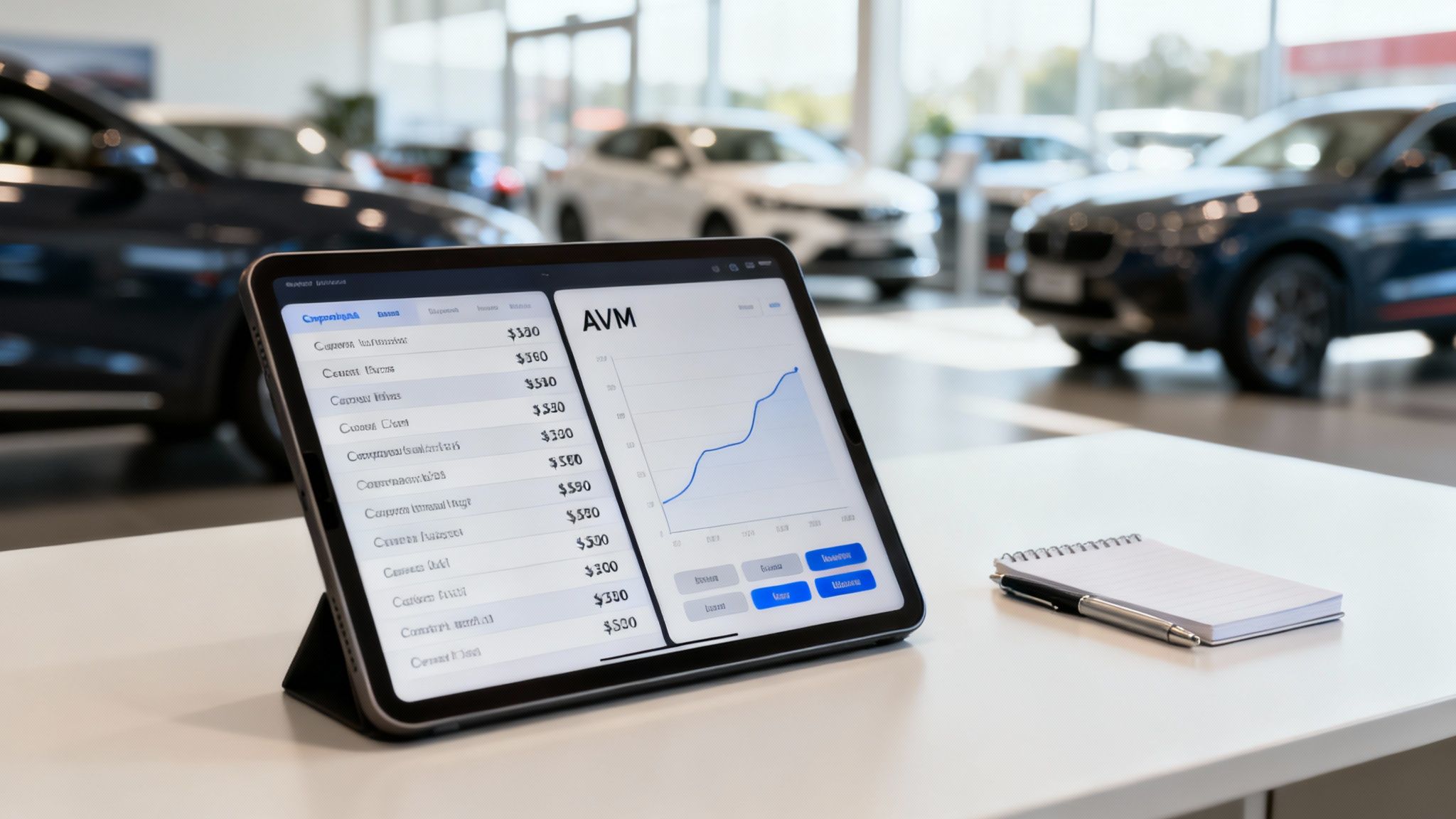
If you want to consistently secure profitable stock, you need to look past the basic online estimators. The real skill is in understanding the core methodologies that drive a genuine car valuation. When you pull back the curtain, you’ll find it’s a smart blend of real-time market analysis and powerful data processing. Nailing these methods is the foundation of every confident acquisition.
The most hands-on approach is what we call market-based analysis, or the 'comparables' method. It's exactly what it sounds like: meticulously researching similar cars—same make, model, age, and comparable mileage—that have recently sold or are currently up for sale. This gives you a live, unfiltered pulse on what the market is actually willing to pay, right now.
This kind of groundwork is fundamental because it reflects true supply and demand in your specific area. A popular SUV might fly off the forecourt and command a premium in one county but sit gathering dust for weeks in another. By analysing comparables, you ground your valuation in today’s reality, not last month's averages.
The Power of Automated Valuation Models
Alongside manual checks, the trade leans heavily on Automated Valuation Models (AVMs). These are the sophisticated data engines that power professional valuation tools like ours at AutoProv. They crunch enormous amounts of information in seconds to give you a solid baseline figure.
Think of an AVM as a sat-nav for pricing. It calculates the most direct route to a valuation by analysing millions of data points, including:
- Historical sales records from auctions and dealerships.
- Current forecourt listings from all over the country.
- Manufacturer specifications and trim levels.
- Standard depreciation curves for that specific model.
But, just as a sat-nav can’t see a temporary road closure, an AVM alone can’t see a vehicle’s unique story. It provides a brilliant, data-driven starting point, but it doesn’t know about the pristine interior, the recent major service, or the subtle signs of a cheap repair. This is precisely why a purely automated valuation is never the full picture.
The professional standard is a hybrid approach. It starts with the robust, data-driven baseline from an AVM and then refines it with an expert on-the-ground appraisal and deep historical checks. This fusion of technology and human expertise produces a valuation you can truly bank on.
Integrating Data for a Holistic View
This is where the real art of a professional car valuation comes into play. The most accurate figures come from weaving all available data streams into one clear picture. While traditional 'book values' still offer a general reference point, today's volatile market demands far more dynamic inputs. An effective valuation brings everything together.
Platforms like AutoProv are built on this very principle of data fusion. By combining live market data with deep provenance checks, we provide a valuation that is both algorithmically powerful and contextually aware. We integrate multiple streams to give you a single, reliable figure. You can explore our extensive range of trusted vehicle data sources to see just how this comprehensive approach delivers real certainty.
Ultimately, a true professional never relies on a single method. They triangulate information from market comparables, AVMs, and the vehicle's verifiable history to build a complete valuation. This multi-faceted approach transforms pricing from a guess into a calculated business decision, protecting your margin and ensuring you only invest in winners.
Adjusting Valuations for Real-World Vehicle Stories
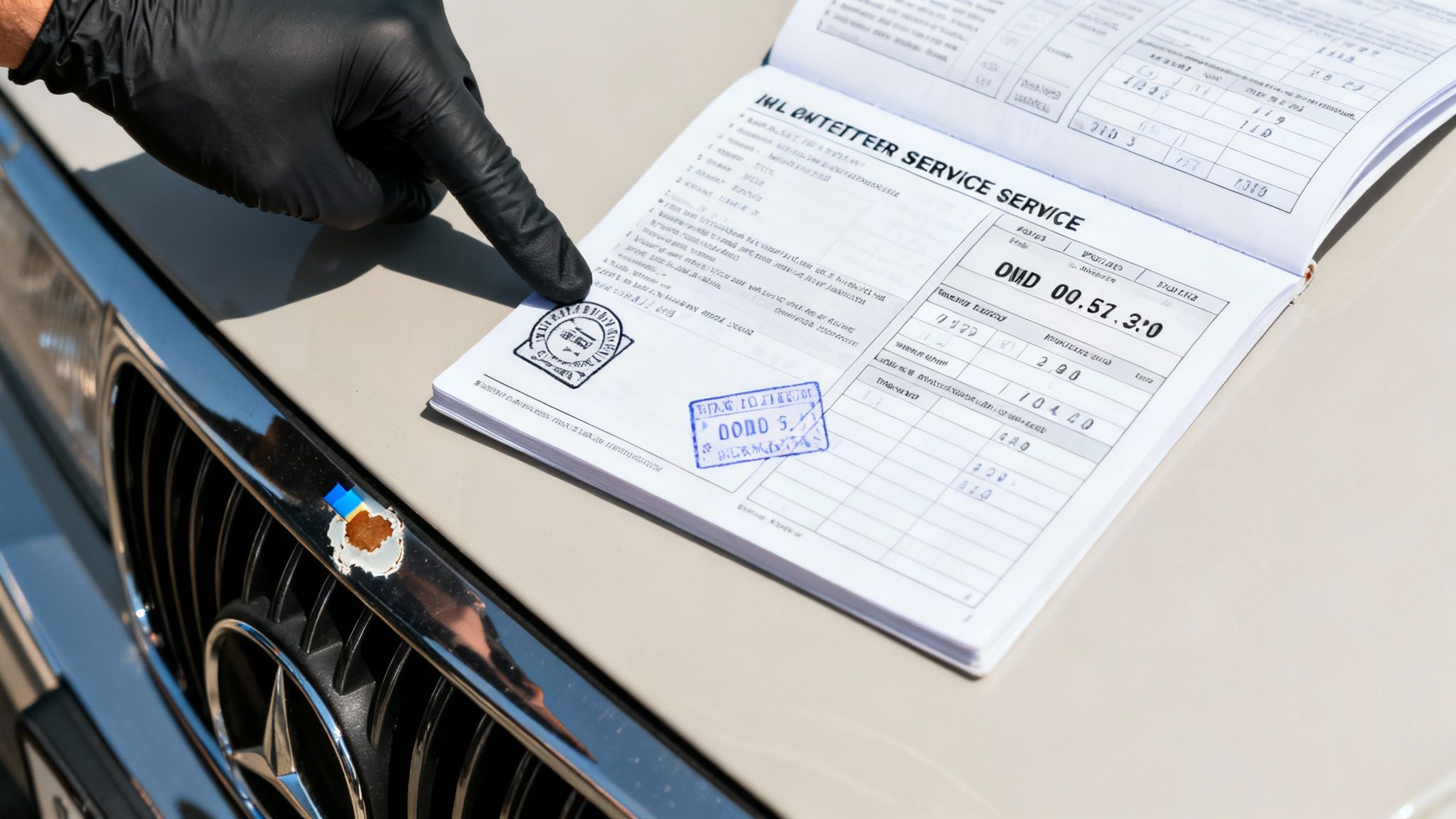
A baseline car valuation is just the beginning of the story, not the final chapter. The real art and science of pricing accurately lies in adjusting that initial figure based on the vehicle's unique history. Every car has a past, and the details of that story can easily add or subtract thousands of pounds from its true market worth.
For anyone in the trade, this adjustment phase is where profit is either protected or lost. It’s about moving beyond the automated model and getting your hands dirty, scrutinising the evidence that tells you what a car is genuinely worth on your forecourt. You have to see the details a simple algorithm can’t.
The Impact of Mileage and Condition
Mileage and physical condition are the two most obvious valuation modifiers. While an Automated Valuation Model (AVM) will make a standard deduction for mileage, it can't tell the difference between 50,000 gentle motorway miles and 50,000 punishing city-centre miles. This is where a proper physical appraisal is non-negotiable.
Likewise, a vehicle's condition goes far beyond a simple 'clean' or 'average' tick box. You need to look for the subtle signs that reveal its true story.
- Pristine Paintwork vs. Hidden Repairs: A flawless factory finish is one thing. But signs of mismatched paint, overspray on the trim, or inconsistent panel gaps can point to previous accident damage that might not be officially recorded.
- Interior Wear and Tear: Heavy wear on the driver's seat bolster, steering wheel, or pedals can suggest a much harder life than the odometer reading lets on.
- Tyre and Brake Condition: Seeing premium brand tyres with plenty of tread and recently replaced brake discs and pads is a huge plus, adding tangible value and demonstrating good upkeep.
A car valuation that ignores the nuanced story told by the vehicle's physical condition and service record is incomplete. The difference between a car with a fully stamped main dealer history and one with patchy records can easily represent a 10-15% swing in its trade value.
Uncovering Financial Significance in Provenance
Beyond the physical, a car's documented history—its provenance—holds immense financial weight. This is where a vehicle's backstory can reveal either hidden value or significant risk. A comprehensive check isn't just a good idea; it's essential to protect your investment and justify your final valuation.
A deep dive into a vehicle's past can uncover critical data points that directly influence its price. Skipping this step is one of the costliest mistakes any buyer can make. For a more detailed look, our complete guide to checking used car history is an essential resource for any trade professional.
The Power of Verifiable Data
This is where relying on guesswork becomes a real liability. To confidently adjust a valuation, you need undeniable evidence. A platform like AutoProv provides this certainty by pulling together over 40 distinct data points into a single, clear report. It’s the difference between suspecting an issue and proving it.
Imagine two seemingly identical vehicles. One report comes back clean, but the other flags up:
- MIAFTR Write-Off Records: Uncovering a hidden Category S or N status instantly slashes a vehicle's value and makes it a much tougher retail proposition.
- Outstanding Finance Alerts: An Experian check can stop you from buying a car that still legally belongs to a finance company.
- DVLA MOT History: This gives you a clear log of mileage readings and advisory notes, making it easy to spot potential clocking or persistent mechanical gremlins.
What's more, desirable factory-fitted extras like a panoramic sunroof, an upgraded sound system, or advanced driver-assistance packages can significantly lift a valuation. AutoProv’s detailed specification data ensures you don't miss these value-adding features, allowing you to price the vehicle accurately for what it is—not just what a basic model would be worth. By using verifiable data, you transform your valuation from a simple estimate into an evidence-based business decision.
Decoding the Difference Between Trade and Retail Prices
For anyone working in the motor trade, the gap between trade and retail prices isn’t just an important detail—it’s the absolute bedrock of your business. These two numbers are the bookends of every single deal. Mastering the margin that sits between them is what separates the thriving dealerships from those just about keeping the lights on.
It sounds simple on the surface. The trade price is what you, the dealer, pay to get a car onto your books. It's the price you'd bid at auction or offer for a part-exchange. The retail price, on the other hand, is the number on the windscreen—what the customer pays to drive it away.
But the real work, the real business, happens in that space between the two. That gap isn't just profit. It's a carefully calculated margin that has to cover every cost involved in turning that trade-in into a forecourt-ready stunner.
Anatomy of the Price Margin
The difference between your buying price and selling price needs to shoulder some serious financial weight. Get this margin wrong, and you can wipe out your profit on a unit before it even sells.
A healthy margin has to cover a few key costs:
- Reconditioning Costs: This is everything from a full valet and polish to sorting out scuffed alloys, touching up paintwork, or even minor mechanical fixes to get the car looking and feeling its best.
- Warranty Provisions: Offering a warranty is standard practice for any reputable dealer. The cost of that peace of mind for the customer (and for you) has to be baked into the retail price.
- Business Overheads: This is the big one. It covers your rent, business rates, staff wages, marketing spend, insurance, and the electric bill. All of it.
- Your Profit: After every other cost is covered, this is what’s left. It's the reason you're in business and the ultimate goal of any sharp valuation.
The margin isn't just about profit; it's the financial engine that fuels the entire retail operation. Price a car too high, and buyers will walk. Price it too low, and you've basically paid for the privilege of selling it.
From Trade-In to Forecourt: A Practical Example
Let’s walk through how this plays out in the real world. A popular three-year-old hatchback comes in as a part-exchange. A quick valuation suggests a baseline trade value of around £9,000. Looking at the market, a similar model in good nick is retailing for about £11,500.
Hold on, though. Before slapping that price tag on it, you need to do your homework. A proper appraisal shows it needs two new tyres, a deep interior clean, and has a few light scuffs on the bumper. You pencil in about £400 for this prep work. You also need to account for a standard six-month warranty, which you cost at £200.
Now for the real maths. Your final retail price of £11,500 minus your £9,000 acquisition cost gives you a gross margin of £2,500. From that, you deduct your known costs: £400 (prep) + £200 (warranty) = £600. This leaves a potential £1,900 to go towards your overheads and, finally, your net profit.
This is exactly where a tool like AutoProv becomes indispensable. It gives you instant, accurate trade and retail valuations side-by-side, so you can see your potential margin in a heartbeat. It takes the guesswork out of pricing, helping you move stock quickly while maximising profitability. This data-first approach turns every valuation into a confident, profitable decision.
How Depreciation and Desirability Drive Future Value
A truly solid valuation isn't just about today's price; it's a forecast of tomorrow's risk. The most switched-on trade professionals look beyond the immediate condition and history. They zero in on two forward-looking factors that protect the bottom line: depreciation and market desirability. Getting these right is the key to making smart, profitable stocking decisions.
Depreciation is more than just a fact of life in the motor trade; it's a dynamic and often unpredictable force. It’s the rate a vehicle loses value, and that rate is never the same across the board. Understanding its quirks can mean the difference between a quick sale and a car that slowly bleeds money on your forecourt.
For example, an electric vehicle's (EV) value might fall off a cliff compared to a traditional petrol hatchback. Things like government incentives, battery tech updates, and public opinion can cause massive shifts in EV depreciation curves. On the other hand, a reliable, frugal supermini might hold its value like a champ.
Understanding the Depreciation Curve
The trick is to spot what slows that curve down. A car with a full main dealer service history, the right optional extras, and a popular colour will always depreciate more slowly than a neglected equivalent in a dodgy spec.
Your goal is to stock vehicles that are on the flattest part of their depreciation curve. AutoProv's depreciation forecasts are built to give you exactly that insight, helping you anticipate future value and steer clear of assets that are about to plummet. For a deeper dive, check out our guide on how to calculate vehicle depreciation in our simple guide.
A smart valuation isn't just about what a car is worth today, but what it will be worth in 30, 60, or 90 days. Predicting this future value is essential for protecting your profit margin and maintaining healthy cash flow.
Gauging Demand with Market Desirability
Running alongside depreciation is market desirability. This is a critical metric that tells you how much buyer demand there is right now for a specific make, model, trim, and even engine. A high desirability score means a vehicle is hot property and will likely fly off the forecourt, minimising the time it sits there tying up your capital.
Think of it as a live popularity contest. A car might look great on paper with a solid valuation, but if its desirability score is in the gutter, it could sit for months, forcing you to slash the price just to shift it. This is a classic trap that eats into profits.
Knowing this score is vital for a few reasons:
- Faster Stock Turn: High-desirability cars sell quicker, boosting your cash flow and freeing up money to buy more stock.
- Pricing Confidence: When you know a car is in high demand, you can price it confidently without expecting to knock thousands off.
- Smarter Acquisitions: It helps you target the models everyone wants at auction or when taking a part-exchange, ensuring you’re buying winners.
The UK's used car market recently saw a healthy 5.5% rise in transactions, hitting over 7.6 million units. A lot of that growth was pushed by price-sensitive but highly desirable cars like superminis, with models like the Audi A1 jumping 3% in value. For independent dealers, these numbers show just how important real-time data is for spotting what buyers are actually looking for.
By building AutoProv’s desirability scores and depreciation forecasts into your valuation process, you stop reacting and start planning. This data-first approach helps dealers and fleet managers sidestep slow-moving stock, fine-tune their inventory, and make buying decisions that are profitable from day one.
Using Professional Intelligence to Avoid Costly Mistakes
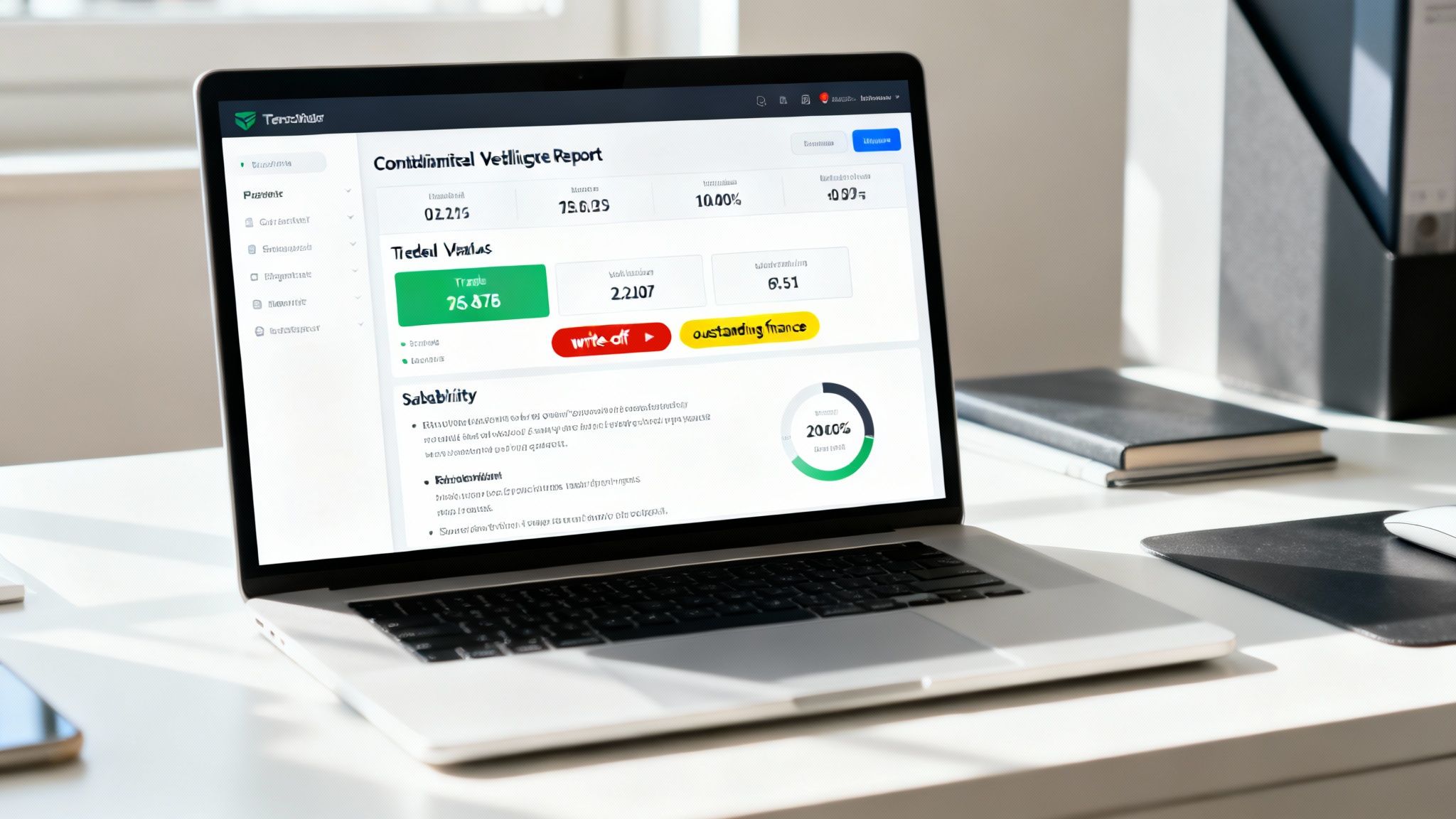
A professional car valuation is your first line of defence against a bad buy. Relying on free, consumer-focused tools is like walking a tightrope without a safety net—you might make it across, but one misstep can be disastrous. Shifting to professional-grade data, however, turns that gamble into a calculated, evidence-based decision.
The difference isn't just about a more accurate price; it's about depth. A basic online calculator gives you a ballpark figure, but it’s completely blind to the hidden problems that can instantly vaporise your profit margin. These issues are far too common in the trade, and each one represents a serious financial threat.
Getting to grips with these risks is the first step. A single oversight can turn a seemingly profitable vehicle into a real liability, tying up your capital and potentially damaging your reputation.
Common Valuation Pitfalls That Erase Profit
So often, the costliest valuation mistakes come from an incomplete vehicle history. Without the full story, you're essentially buying a car on faith, and that’s a risky game to play in the motor trade.
Here are the critical errors a professional intelligence report helps you sidestep:
- Missing a Write-Off History: Picking up a vehicle with an undeclared Category S or N status is a classic blunder. Its true market value is a fraction of what you might pay, and it will be a much tougher sell on the forecourt.
- Overlooking Mileage Discrepancies: A clocked odometer can hide tens of thousands of miles of wear and tear. This doesn’t just inflate the car’s perceived value; it masks potential mechanical nightmares waiting to emerge.
- Buying a Car with Outstanding Finance: Without a proper check, you could end up buying a vehicle that legally still belongs to a finance company. If that happens, the car can be repossessed, leaving you with a total loss.
Each of these pitfalls represents a direct hit to your bottom line. A professional valuation isn't just about finding a price; it's an exercise in risk management, designed to shield your investment from a car's hidden past.
Turning Data into Your Most Valuable Asset
This is exactly where a dedicated vehicle intelligence platform like AutoProv becomes indispensable. Instead of leaving you to stitch together fragments of information from different places, our platform pulls everything into one clear, actionable report. You move from guessing to knowing.
AutoProv delivers the certainty you need to make confident acquisition decisions. It draws data from over 10 trusted sources, including Experian and the DVLA, giving you a single source of truth that cross-references everything to ensure nothing is missed.
For a dealer buying stock, this means you can validate a car’s history in seconds—confirming it’s free of finance, has a clean title, and its mileage is genuine. For an auction buyer making a split-second decision, it’s the instant confidence you need to bid decisively. By using a system that checks every box, you turn comprehensive data into your most powerful and profitable asset.
Common Car Valuation Questions Answered
Getting to grips with car valuation means you're going to have questions. For anyone in the UK motor trade, getting straight, no-nonsense answers is the difference between a good month and a bad one. This section cuts through the noise to give you quick, practical answers to the questions we hear all the time.
Think of it as your go-to guide for those everyday queries that pop up on the forecourt or in the auction hall. Every answer is grounded in the real-world principles of data-led valuation and smart risk management.
How Often Do Car Valuations Change in The UK?
In the UK, car valuations aren't just fluid; they're constantly moving. Values can shift daily, sometimes even hourly. They are a live pulse of the market, reacting in real-time to supply and demand, seasonal buying habits, new model launches, and the wider economic climate.
This is exactly why clinging to an old-school monthly 'book' price is such a dangerous game. A valuation from last month is ancient history. Professional platforms like AutoProv are indispensable because they feed you live market data, making sure your numbers are sharp and competitive, not based on yesterday’s news.
The single biggest mistake you can make in car valuation is failing to see a vehicle's hidden past. Missing a previous write-off status (Category S/N), a major mileage discrepancy, or outstanding finance can turn a tidy profit into a painful loss.
A rock-solid provenance check is your only real defence. By cross-referencing live data from the MIAFTR, Experian, and DVLA databases—as AutoProv does—you get the safety net you need to sidestep those catastrophic errors.
Can I Rely Only on An Automated Valuation Model?
Automated Valuation Models (AVMs) are brilliant for getting you in the ballpark, but relying on them alone is asking for trouble. Think of an AVM as a fantastic starting point, but it’s working blind. It has no eyes, no hands, and no feel for the real world.
An AVM simply can't see the crucial details that make or break a car's true value:
- The vehicle's actual physical condition—from a few stone chips to immaculate paintwork.
- The quality and completeness of its service history.
- The presence of desirable optional extras or modifications.
- The subtle shifts in local market demand that might make a convertible a hot ticket in Brighton but a hard sell in Aberdeen.
A seasoned professional knows the AVM is just the first step. The real art is in taking that initial number and carefully adjusting it based on a thorough physical inspection and the complete story laid bare in a vehicle intelligence report. That’s how you get a car valuation that reflects reality, not just an algorithm.
Frequently Asked Questions
AI-Generated Content Notice
This article was created with the assistance of artificial intelligence technology. While we strive for accuracy, the information provided should be considered for general informational purposes only and should not be relied upon as professional automotive, legal, or financial advice. We recommend verifying any information with qualified professionals or official sources before making important decisions. AutoProv accepts no liability for any consequences resulting from the use of this information.
From our AI insights
- Advanced Mileage Verification for UK Dealers
Explore innovative mileage verification tactics for UK car dealers to mitigate risks and enhance negotiations.
- Harnessing Real-Time Data in UK Motor Trading
Explore how real-time data aids UK traders in identifying vehicle risks swiftly.
- Predictive Insights: Using DVLA Data for Stock Risk Analysis
Explore how DVLA data transforms into predictive insights for UK car dealers managing stock risk.
Related Articles

Navigating the UK Used Car Market
Explore the latest trends in the UK used car market and how AutoProv can reveal true vehicle values.
Understanding Market Insights for Vehicle Pricing
Learn how market insights can guide UK traders in setting the right vehicle prices.

7 Best Second Hand Cars to Buy UK: A 2025 Guide
The search for the best second hand cars to buy in the UK can feel like navigating a maze of private listings, vast online showrooms, and conflicting advice. With prices fluctuating and new models constantly entering the used market, how do you identify a reliable, fairly-priced vehicle that truly suits your needs? This guide is designed to cut through the noise and provide clear, actionable insights for your next purchase.
Published by AutoProv
Your trusted source for vehicle intelligence
