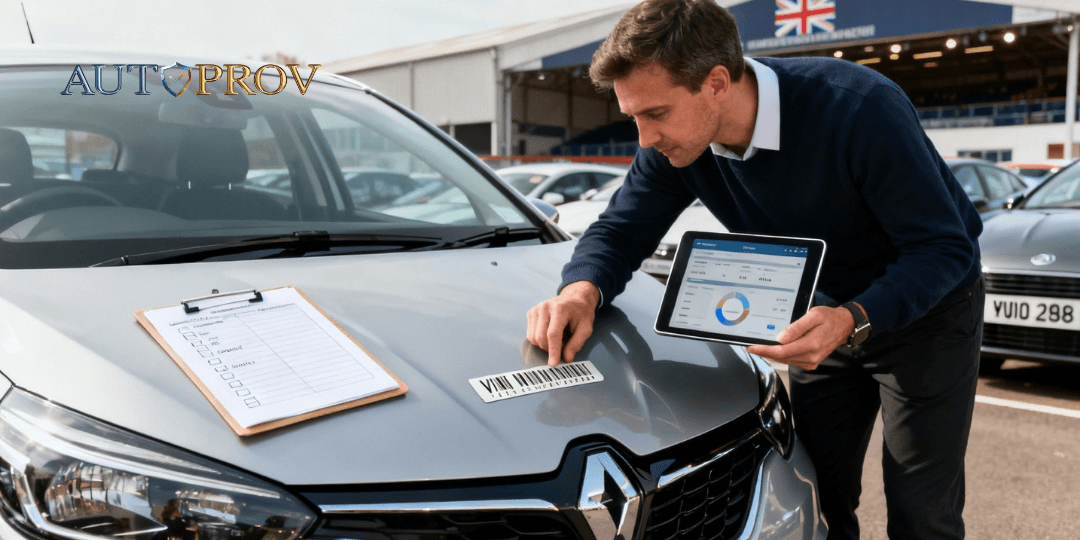
In the motor trade, a thorough pre-purchase car check in the UK isn't just a good idea—it's your first and most important defence against a bad buy. This is the nitty-gritty process of verifying a vehicle's history, its true condition, and legal status before you part with any cash. It's how you ensure the asset you're about to acquire is a genuine profit opportunity, not a hidden liability waiting to bite you.
In the motor trade, a thorough pre-purchase car check in the UK isn't just a good idea—it's your first and most important defence against a bad buy. This is the nitty-gritty process of verifying a vehicle's history, its true condition, and legal status before you part with any cash. It's how you ensure the asset you're about to acquire is a genuine profit opportunity, not a hidden liability waiting to bite you.
Why a Pre-Purchase Check Is Your Best Profit Protection Strategy
We all know the used car game is one of tight margins. Profit isn't just made on the forecourt when you sell; it's protected the moment you buy. For anyone in the motor trade, a comprehensive pre-purchase car check is a core part of the business, not just a box to tick. Get it wrong, and one bad car can wipe out the profit from five good ones.
Think about the pressure cooker of an auction hall or a quick dealer-to-dealer deal. You’ve got minutes, sometimes seconds, to make a call. If you don't have a robust, instant way to verify the car's background, you’re basically gambling. The paint might look pristine, but what if there's outstanding finance, a dodgy mileage record, or it was once an insurance write-off?
These aren't just minor headaches. They're serious financial landmines that can lead to legal battles, a trashed reputation, and thousands down the drain. The days of relying on a quick look-over and a gut feeling are long gone. That's why having a tool like AutoProv.ai is no longer a luxury, but a necessity for making rapid, informed decisions.
The Real Financial Risks of Cutting Corners
Every car has a story, and it's your job to read it before it becomes your problem. Skipping a proper check is a massive risk to your bottom line.
- Outstanding Finance: Buy a car with finance still on it, and you don’t actually own it. The finance house can, and will, come to repossess it, leaving you with nothing but a hole in your accounts.
- Clocked Mileage: A rolled-back odometer doesn't just inflate the car's value; it masks years of potential wear and tear. Selling a clocked car, even if you didn't know, can land you in serious legal trouble and destroy your credibility with customers.
- Hidden Write-Off Status: A vehicle that's been declared a write-off (like a Cat S or N) is worth significantly less. If you don't spot this, you'll overpay at purchase and then have to slash your retail price to shift it.
In this business, knowledge is profit. Simple as that. The more you know about a car before you buy, the better you can judge its true value and negotiate a price that secures your margin. A single check can be the difference between a great bit of stock and a financial disaster.
What Today's Buyer Expects
This isn't just about protecting yourself from duff stock; it's about meeting the expectations of your customers, who are more clued-up than ever. While your checks need to be professional grade, remember that even private buyers are doing their homework now. Recent data shows that buyers who skip history checks are taking huge financial risks, with incidents of outstanding finance and clocked mileage on unchecked cars shooting up. You can read more about these market trends here.
This shift means that when a customer walks onto your forecourt, they assume you’ve already done this work to a high standard.
This is where a professional-grade tool like AutoProv.ai comes in. It turns this vital due diligence from a chore into a real competitive edge. You get the speed and accuracy you need to make smart, profitable decisions on the spot, ensuring every vehicle you bring onto the forecourt is an opportunity, not a liability.
Mastering the Core UK Vehicle Data Checks
A good buy is always built on a solid foundation of data. For anyone in the motor trade, a proper pre-purchase car check in the UK isn’t about getting a simple ‘pass or fail’—it’s about learning to read the car's real story. These core checks are your first, non-negotiable line of defence when vetting potential stock.
Getting these fundamentals right is what separates the seasoned pros from the amateurs. It’s how you build a complete picture of the asset, spotting the profit or flagging a definite lemon before you’ve even thought about making an offer. Let’s break down the essential data points you need to master.
Decoding the V5C and DVLA Data
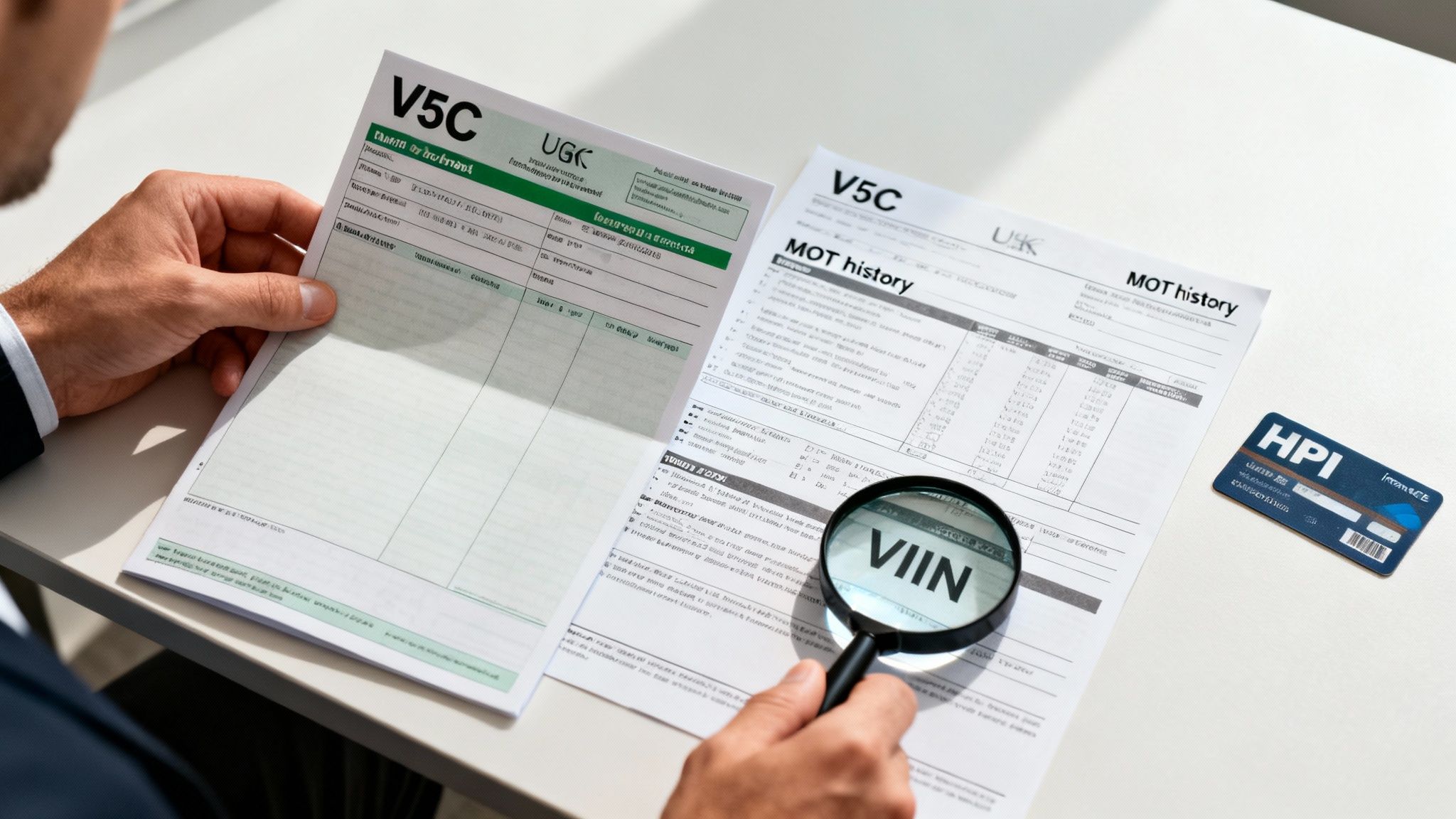
The V5C logbook is much more than a bit of paper; it's the car's legal fingerprint. Your first job is always to make sure the details on the V5C match the car standing in front of you. And I don’t just mean the reg number. You need to physically verify the VIN (Vehicle Identification Number) on the document against the one stamped on the chassis and visible through the windscreen.
Any mismatch here is an immediate, full-stop red flag. It could signal anything from a simple clerical error to something as serious as a stolen, cloned, or 'ringed' vehicle. If they don't match, you walk away.
Beyond the VIN, you need to be eagle-eyed about:
- Previous keepers: A high turnover of owners on a relatively new car is a classic sign of a problem vehicle. It often points to a recurring, unresolved fault that’s frustrated people into selling it on.
- Registration date: Does the car's age actually line up with its condition and the plate it’s wearing?
- Keeper's details: Do they match the person or business selling you the car? If not, you need a watertight reason why.
Reading Between the Lines of an MOT History
An MOT certificate with a recent pass is nice to see, but on its own, it tells you next to nothing. The real gold for a trader is in the full MOT history, which lays out the vehicle's entire maintenance (or lack thereof) narrative. You’re not just scanning for passes; you’re hunting for patterns.
Recurring advisory items are an absolute goldmine. For example, if the same tyre is constantly flagged for being 'close to the legal limit' over several tests, it could point to a tracking or suspension issue that’s causing uneven wear. Likewise, repeated mentions of 'slight corrosion' on brake pipes or subframes can signal a car that’s been neglected or lived a hard life in a salty, coastal area.
Big gaps in the MOT history or sudden, major drops in mileage between tests should set alarm bells ringing. These often mean the car was off the road for major repairs or, more sinisterly, someone's had a go at clocking the mileage. A decent pre-purchase car check UK service will lay this history out clearly, letting you spot these dodgy anomalies in seconds.
A clean MOT pass only proves the car was roadworthy on one particular day. The full history, with all its advisories and fails, tells you how it’s been treated its entire life. That’s the information that dictates your buying price.
Uncovering Critical Finance and Status Markers
This is where the checks become absolutely vital, both legally and financially. Buying a vehicle with a hidden past can have devastating consequences for your business, making these verifications completely non-negotiable.
First up is the outstanding finance check. With some estimates suggesting that up to 30% of used cars on the road have finance attached, this is a massive risk. If you buy a car with an active finance agreement, you don't legally own it. The finance company is still the legal owner and has every right to repossess the vehicle straight from your forecourt, leaving you massively out of pocket.
Next, you have to check for insurance write-off markers. The MIAFTR (Motor Insurance Anti-Fraud and Theft Register) is where insurers record vehicles declared a total loss. They're categorised from Cat N (non-structural damage) right up to Cat S (structural damage). If you fail to spot a car’s category status, you will almost certainly overpay and find it incredibly difficult to retail legally and transparently.
Finally, a check against the Police National Computer (PNC) is essential to confirm the car hasn't been reported stolen. Buying stolen goods, even if you do it unknowingly, is a serious offence that will lead to the car being seized and potential legal action against you.
These high-stakes checks are precisely where a professional tool is worth its weight in gold. Instead of faffing about with multiple separate searches, a platform like AutoProv.ai pulls all these critical DVLA, MOT, finance, MIAFTR, and PNC checks into one comprehensive, easy-to-read report. It gives you the clarity you need to make a smart decision in under 30 seconds, protecting your business from the nastiest hidden risks.
Uncovering Hidden Issues with Advanced Checks
Alright, so the basic DVLA, MOT, and status checks are clear. Now it’s time to get serious. The problems that really eat into your profit aren’t the obvious ones; they’re the issues lurking beneath the surface that a standard report will glide right over.
To properly protect your margin, your pre-purchase car check in the UK has to go deeper. This is where you stop just verifying a car's history and start interrogating it, looking for the tell-tale signs of trouble that less experienced buyers will inevitably miss.
Advanced Mileage Discrepancy Analysis
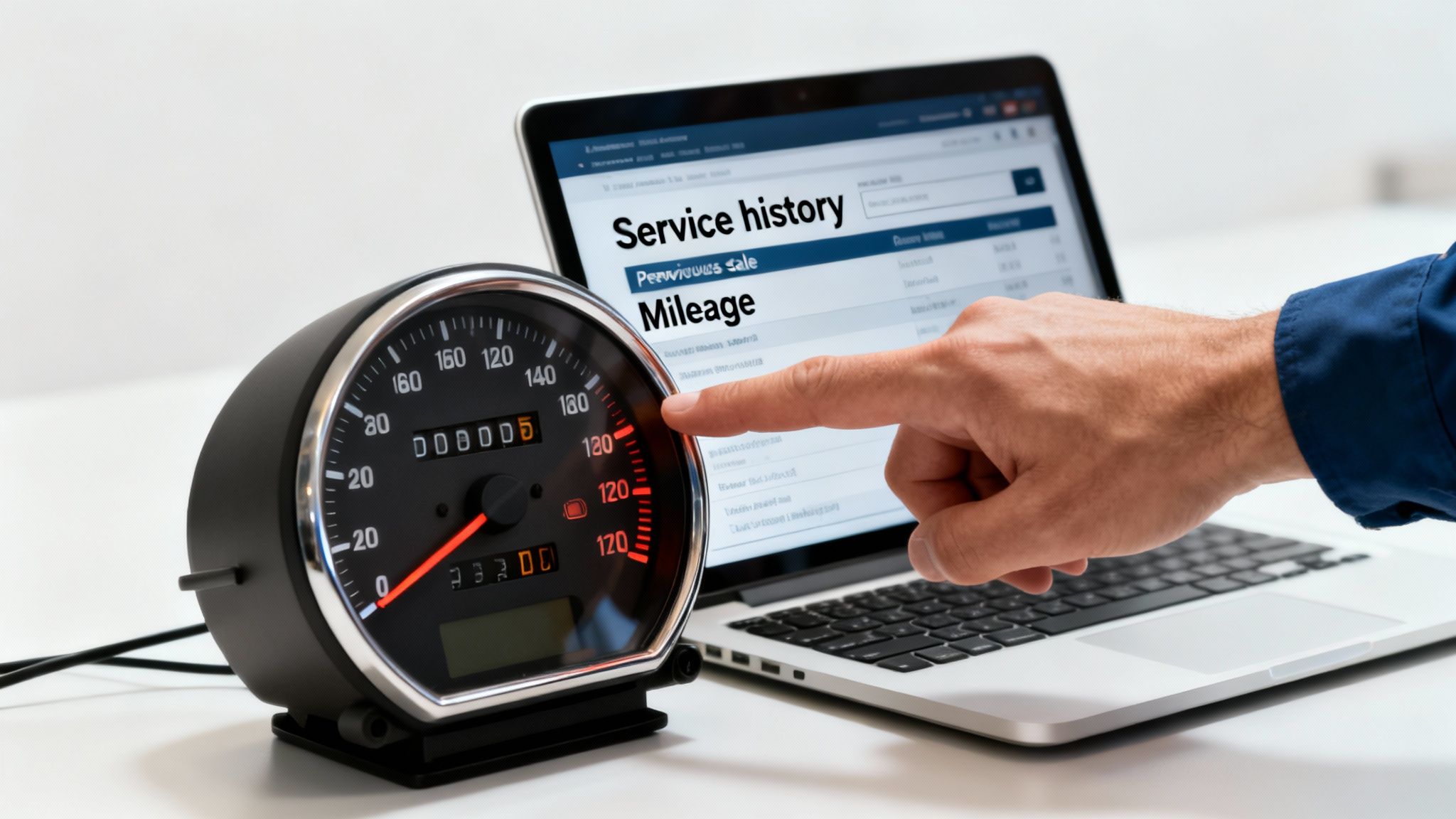
Forget the old days of physically winding back the clock. Mileage ‘correction’ is a digital game now, played with sophisticated software that can easily fool a basic MOT history check. As a professional, you need to be smarter than the fraudsters. That means triangulating data from every possible source to catch them out.
You have to look past the official records and dig into the car’s entire digital footprint. Make sure you’re scrutinising:
- Service Records: Does the mileage logged at each service make sense when you line it up with the MOT history? Any sudden drops or suspiciously long periods with barely any miles added on should set alarm bells ringing.
- Previous Sale Listings: A quick Google of the reg plate can be gold. You might unearth old ads on AutoTrader or eBay. If an advert from two years back shows the car on 80,000 miles and it's now being offered to you with 60,000, you’ve got a clocked car, plain and simple.
- On-board Computers: In most modern cars, the real mileage is squirrelled away in multiple ECUs (Engine Control Units), not just on the dash. Plugging in a diagnostic tool can often reveal a mismatch between what the driver sees and what the car’s brain actually knows.
A proper trade tool brings all this together. It’s about spotting inconsistencies between MOT, service, and other records at a glance, giving you an instant red flag for potential clocking.
The Overlooked Threat of Outstanding Recalls
One of the most common and costly oversights in due diligence is failing to check for outstanding manufacturer safety recalls. These aren’t optional extras; they're official alerts for known safety defects that could be anything from dodgy airbags to serious fire risks.
Selling a car with an unresolved safety recall is a massive own goal. It exposes you to huge legal and financial risk, not to mention the damage to your reputation and the danger to your customer. It’s a non-negotiable part of your professional checks.
For a motor trade professional, an outstanding recall isn't just a mechanical issue; it's a compliance and liability issue. Resolving it before sale is non-negotiable for protecting your business and ensuring the vehicle is legally fit for the road.
This used to mean manually trawling through manufacturer websites, a real time-sink. Now, platforms like AutoProv.ai build recall checks right into their reports, covering dozens of manufacturers. You get an immediate yes/no, so you can factor the cost and time of any rectification work into your bid price straight away.
Connecting Data to Desirability and Profit
The final piece of the puzzle is turning all this data into a cold, hard commercial decision. A car can have a squeaky-clean history but still be a dog to sell if it’s the wrong spec. This is where market intelligence becomes your best friend.
You have to weigh up the things that dictate how quickly a car will shift off your forecourt, and for how much.
- Colour and Trim: Is it a desirable factory colour, or a weird shade that will gather dust for months? Does it have the right trim level that buyers hunt for, like M Sport on a BMW or S-Line on an Audi?
- Engine and Drivetrain: Have you got the engine everyone wants, or the one that’s a nightmare to sell? Think about a manual gearbox in a big luxury saloon – it’s a tough retail proposition.
- Market Data: How many similar cars are for sale in your area right now? How long are they taking to sell? You need to understand the local supply and demand to price your stock right from day one.
The numbers back this up. Market analysis consistently shows that dealers who provide comprehensive, transparent checks sell cars faster and for more money. The top 100 UK dealers, who hold nearly 40% of petrol and diesel stock, sell their cars at an average price of £22,379 in just 46 days. That’s a world away from the market average of 74 days. It’s proof that trust sells. You can dig into the latest numbers on UK used car market dynamics and how documentation affects pricing here.
A proper trade platform gives you this live market intelligence, from valuations to desirability scores. It helps you look beyond the car’s history and focus on what really matters: its profit potential.
How to Spot the Deal-Breaking Red Flags
Right, you’ve got all the data in front of you. This is the moment that separates the pros from the amateurs. All those numbers and reports from your pre-purchase car checks in the UK are just noise until you know how to read them. This is where you turn information into profit.
Every single flag you uncover is going to fall into one of three buckets: a simple negotiation point, a serious issue that needs a closer look, or a flat-out, walk-away-now deal-breaker. Getting a feel for which is which takes time on the forecourt, but you absolutely must set some hard rules for your business from day one.
Minor Flaws vs. Major Faults
Look, not every problem is a reason to drop a car. In fact, small imperfections are your best friend when it comes to negotiating a sharper trade price. The trick is knowing exactly what it's going to cost—in both workshop time and pounds—to put it right.
A classic example is a recurring MOT advisory. Say the history keeps mentioning ‘slight play in nearside front wheel bearing’. That’s not a red card. It's a bread-and-butter repair job. You can get a quick price to fix it, knock that off your offer, and protect your margin. Simple.
On the other hand, a V5C where the VIN doesn't match the one stamped on the chassis? That’s not a negotiation point. That’s a full stop. There’s no good reason for that in the trade; the risk of it being stolen, cloned, or something equally dodgy is just too high to touch.
Getting to Grips with Write-Off Categories
Insurance write-off categories can feel like a bit of a grey area, but they hide both opportunity and massive risk. You need a rock-solid policy on how you handle them. Some traders won't touch them with a barge pole, while others have built a tidy business on correctly repaired and honestly sold categorised cars.
Here’s a common-sense approach to your risk threshold:
- Category N (Non-structural): This is usually the most manageable category. The damage was cosmetic or maybe to some bolt-on parts. A Cat N car can be a cracking buy if the repair work is top-notch and you’ve bought it at the right money to reflect its history.
- Category S (Structural): Now you need to be much more careful. This car has had a knock to its structural frame. It can be repaired, of course, but the quality of that repair is everything. If you can’t see a detailed, verifiable invoice trail for the work, a Cat S vehicle is a huge gamble.
- Categories A and B: For any reputable trader, these are complete non-starters. These cars are meant for the crusher and nothing else (Cat A is the whole vehicle, Cat B allows for salvageable parts). They have no place back on the road. Ever.
The decision to buy a categorised car should never be based on a gut feeling. It has to be a cold, calculated business decision based on the car's specific history, the quality of the repair, and a clear-eyed view of its lower market value.
Setting Your Deal-Breaker Thresholds
Every trading business needs its own set of non-negotiables. These are the red flags that mean you walk away immediately, no matter how sweet the deal looks on the surface. These are the issues that carry way too much financial or legal risk.
Consider making these your hard-and-fast deal-breakers:
- Active Finance Agreement: Don't even think about it. Unless you're a specialist who settles the finance directly with the lender as part of the deal, buying a car with outstanding finance is like volunteering to take on someone else's debt. The finance house can come and lift the car at any moment.
- PNC Stolen Marker: This one is black and white. If a check throws up a stolen marker, the conversation is over. End the viewing politely and, depending on the situation, you might want to give the police a quiet heads-up.
- Major Mileage Discrepancies: If you find solid proof of clocking by comparing the MOT history with service records and old sales listings, walk away. Selling a car with an altered mileage, even if you weren't the one who did it, can land you in serious legal trouble.
In the heat of the moment at an auction or on a seller's driveway, you need speed and clarity. This is precisely why a tool like AutoProv.ai is so effective. Instead of you having to stitch all the different pieces of information together, it flags these critical, deal-breaking alerts right at the top of a summary. It lets you make that crucial 'buy' or 'walk away' decision with confidence in seconds.
Weaving AI Checks into Your Buying Workflow
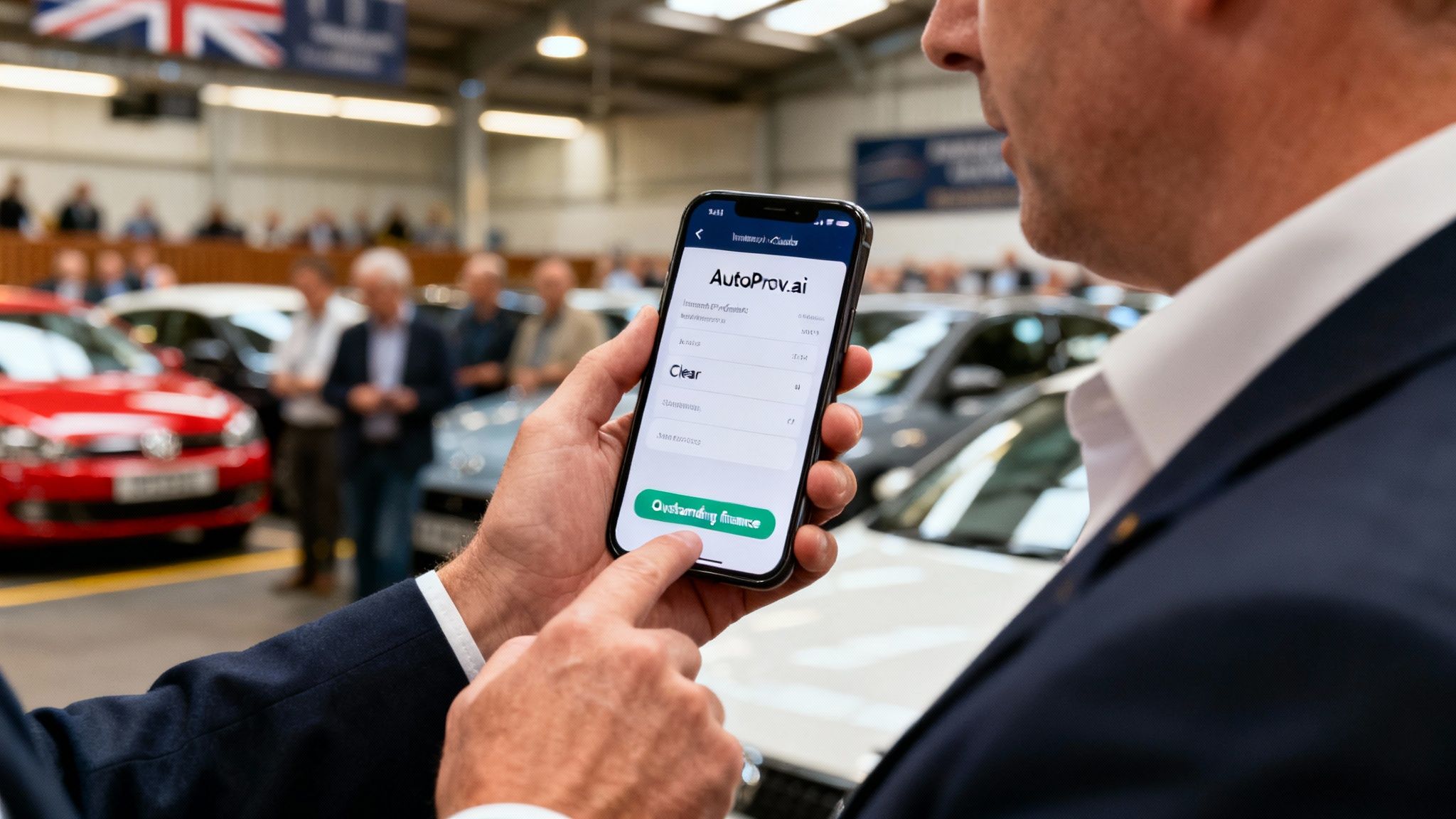
All this data is great, but it’s worthless if you can’t use it in the heat of the moment. Slotting a professional-grade pre-purchase car check UK service into your day-to-day isn’t about adding another step; it’s about sharpening your instincts and making smarter, faster decisions when the pressure is on. It’s about protecting your bottom line.
Let's put this into practice. We’ll walk through two classic scenarios every trader faces and see how instant, AI-driven checks become a genuine tactical advantage, giving you the solid ground you need to act decisively.
Scenario One: At the Auction
The auction hall is a pressure cooker. You’ve got minutes, maybe seconds, to size up a car and decide how deep you’re willing to go. This is where speed and accuracy are everything. Fumbling with slow websites or flimsy consumer checks is a recipe for disaster. You either miss the good stock or, far worse, land yourself with a very expensive problem.
This is where a proper mobile app changes the game.
- Instant Intel: As the car rolls onto the block, you tap the reg plate into your phone. Before the auctioneer has even finished their opening spiel, you've got the full provenance report staring back at you.
- On-the-Spot Red Flags: Is there finance owing? A hidden write-off marker? The summary instantly flags any deal-breakers. You can dismiss a dog of a car in a heartbeat and focus on the next lot without a second thought.
- Bid with Confidence: With a clean report in hand, you know exactly what you’re bidding on. There's no guesswork. You can set your limit with absolute confidence, knowing there are no nasty surprises lurking in the car’s past.
Think about it. Two identical cars go through the sale. One has a hidden Cat S marker and a 20,000-mile clocking discrepancy. Without an instant check, someone’s going to overpay by thousands. With a tool like the AutoProv.ai mobile app, you’d spot those issues in seconds, swerve the bad buy, and keep your cash for genuine, profitable stock.
Scenario Two: Dealer Buys and Part-Exchanges
When you’re buying from another dealer or sizing up a part-ex, the pace might be slower, but the stakes are just as high. Here, your checks aren't just for you; they become a powerful negotiation tool and a critical piece of your due diligence paperwork. A comprehensive report shifts the conversation from opinion to cold, hard fact.
Picture this: a customer brings in a part-exchange, assuring you it’s "never had a knock." Your check reveals it was a Category N write-off two years ago. That’s not just an interesting fact for your records; it’s a concrete, justifiable reason to adjust your valuation.
A professional vehicle check report is your evidence. It lets you have transparent, fact-based negotiations, justifying your offer and showing both customers and other traders that you do your homework.
These reports also form a vital part of the vehicle’s stock file. If any questions about its history pop up after you've sold it, you have a timestamped record proving you carried out your due diligence. For compliance and protecting your reputation, that’s invaluable.
- Valuation Accuracy: Use the detailed report to justify your part-exchange offer, pointing to specific MOT advisories or its write-off history.
- Negotiation Leverage: When buying from another trader, an undiscovered recall or a gap in the service history becomes a fair reason to talk about the price.
- Permanent Record: Every check you run provides a permanent, digital record of the vehicle’s status at the point of purchase, safeguarding your business.
By weaving these instant, detailed checks into your daily buying, you stop gambling and start operating with certainty. It makes your workflow smoother, slashes your risk, and ultimately builds a more secure and profitable business.
Your Questions Answered: Quick-Fire FAQ for Car Traders
Even for those of us who've been in the game for years, the world of vehicle checks can still throw a few curveballs. Getting your pre-purchase checks right is a discipline, not a one-off task. Here are some of the most common questions I hear from fellow traders, with the straight-talking answers you need to stay sharp.
How Quickly Can I Get a Full Vehicle Report?
In this business, speed is everything. Whether you’re trying to get a bid in before the hammer drops at auction or sizing up a part-ex that’s just rolled onto the forecourt, you need answers now. Waiting even a couple of minutes can be the difference between bagging prime stock and making a very expensive paperweight purchase.
The free or consumer-grade checks just don't cut it. They're often slow, clunky, and missing the critical data we need.
That's where professional tools are essential. With a trade-focused platform like AutoProv.ai, you can pull a complete, multi-point vehicle intelligence report in under 30 seconds. Just punch the reg into your phone or web browser, and bang – you’ve got the lot. DVLA history, MOT records, Experian finance flags, MIAFTR write-off markers, and PNC stolen alerts. It's the only way to make a smart call when the pressure is on.
Is an Online Check Enough Without a Physical Inspection?
Look, an online data check and a physical once-over are two halves of the same whole. You can't have one without the other. The data report is your first line of defence; it tells you the car's entire life story on paper – its legal status, any financial skeletons in the closet, and its recorded history.
But it can't tell you what the car is like today. It won't spot the whine from a worn-out clutch, a weeping rocker cover gasket, or a fresh bit of panel damage that hasn’t hit the databases yet.
Think of it this way: the data check tells you if the car is even worth your time. If it comes back clean, then you pop the bonnet and get your hands dirty. Data first, then spanners. Always.
What if a Car Has Outstanding Finance?
Seeing outstanding finance pop up on a report is a massive red flag, but it doesn't have to be an immediate 'no'. You just have to handle it with extreme care. The golden rule is simple: the finance must be settled before you part with a penny for the car itself.
If you’re buying privately, the only safe way is to get a settlement figure directly from the finance company. You then pay them off directly, and the seller gets whatever is left.
When buying from another trader, you need irrefutable proof the finance is cleared. Never, ever take their word for it. An Experian check, like the one inside AutoProv, gives you the definitive answer. Remember, until that debt is cleared, the finance house is the legal owner, and they have every right to come and take their property back – even if it's sitting on your forecourt.
Can I Rely on the V5C Logbook Alone?
Absolutely not. The V5C logbook is a vital piece of paperwork, but treating it as gospel is one of the quickest ways to get burned in this industry. It only shows the registered keeper, not the legal owner. Worse, it can be forged or belong to a cloned vehicle.
Relying solely on the V5C is a huge gamble. It tells you nothing about:
- Outstanding finance agreements.
- A hidden past as an insurance write-off.
- Mileage discrepancies logged elsewhere.
- Whether it's on a police stolen list.
The V5C is just one small piece of a much bigger puzzle. You have to cross-reference the details on that document with a proper, comprehensive data check that pulls from the DVLA, Police National Computer (PNC), and the big finance and insurance databases. That's not just good practice; it's non-negotiable professional due diligence.
Frequently Asked Questions
AI-Generated Content Notice
This article was created with the assistance of artificial intelligence technology. While we strive for accuracy, the information provided should be considered for general informational purposes only and should not be relied upon as professional automotive, legal, or financial advice. We recommend verifying any information with qualified professionals or official sources before making important decisions. AutoProv accepts no liability for any consequences resulting from the use of this information.
From our AI insights
- Auction Pitfalls: Avoiding Costly Mistakes
Navigate UK car auctions with confidence by avoiding finance, write-off, and mileage risks.
- Mastering Paint Code Checks: Detecting Hidden Car Repairs
Discover how to use paint code verification to identify hidden car repairs and ensure a smarter purchase.
- UK Part-Exchange Checks: Protecting Dealer Margins
Explore essential part-exchange checks for UK dealers to safeguard profit margins, including provenance and finance verification.
Related Articles

Your Ultimate Guide to Buying a Used Car in the UK
Navigate the UK used car market with confidence using our comprehensive buying guide. Tips, checks, and AutoProv Provenance insights included.

Difference Between MOT and Service: What You Need to Know
An MOT is a mandatory legal inspection that every car on UK roads needs to pass.Think of it as the government's way of ensuring your vehicle meets the absolute minimum safety and environmental standards to be considered roadworthy. A service, on the other hand, is a completely different beast. It's the proactive maintenance routine recommended by the people who built your car, designed to keep it running smoothly and catch problems before they start. In short, an MOT is a pass-or-fail exam required by law. A service is a comprehensive health plan for your car.
Your Ultimate Used Car Inspection Checklist
A solid used car inspection checklist is the single most powerful tool you have to avoid buying a lemon. It gives you a methodical way to look past the shiny paint and assess a car's real condition, helping you spot hidden problems and get a fair price before you shake hands on the deal.
Published by AutoProv
Your trusted source for vehicle intelligence