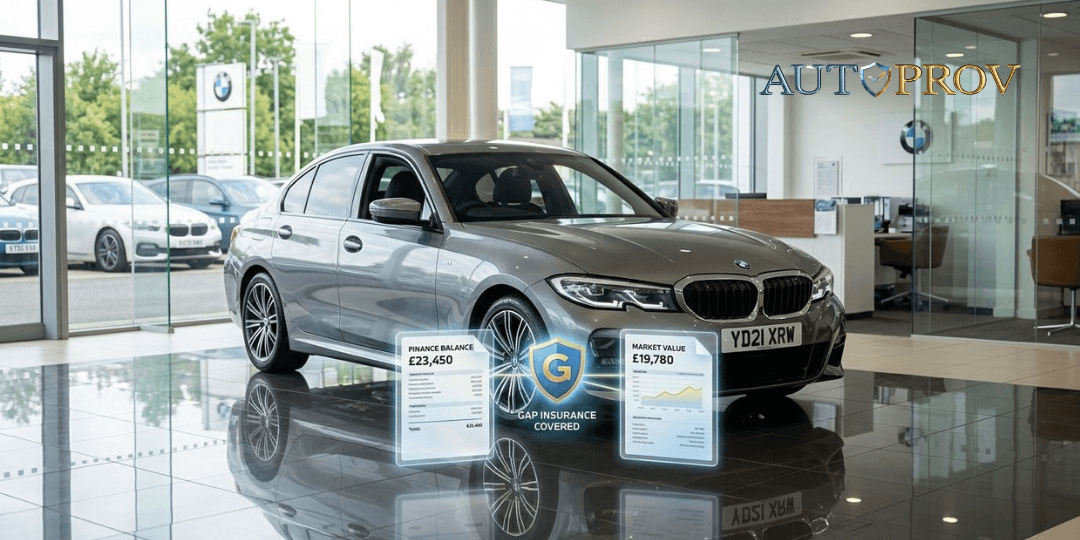
A used car is sold, the finance agreement is live, and everyone moves on to the next deal. Then the customer rings after a theft or write-off. Their motor insurer has paid market value. The finance company still wants the balance cleared. The customer wants to know why there's a shortfall on a car they no longer have.
That's the point where used car GAP insurance stops being a brochure add-on and becomes a dealership risk issue. It can affect complaints, reviews, finance conversations, and how the customer remembers the entire sale. For dealers, it also sits in a difficult space between commercial opportunity and regulated responsibility.
Most commentary on GAP insurance stays too general. In the used market, the question isn't whether GAP exists. It's whether the specific vehicle, sold on that specific deal structure, carries a credible risk of negative equity after a total loss. That requires more than a product script. It requires judgement.
The Financial Shortfall A Hidden Dealership Risk
A customer who bought a used car six months ago isn't usually ringing to discuss policy wording. They're ringing because their car has gone, the insurer has settled at current market value, and the finance balance hasn't disappeared with it.
That's where the dealership often gets pulled back into the transaction. Not always legally, and not always formally, but commercially and reputationally. Sales staff are asked whether GAP was offered, whether it was explained properly, and whether anyone highlighted the possibility of a shortfall.

Why the problem lands back on the dealer
A write-off doesn't just test the customer's insurance. It tests the quality of the original sales process. If the customer financed heavily, added products into the advance, or bought on terms that left the balance reducing slowly, the deal may have carried shortfall risk from day one.
Dealers already understand this logic in stock terms. If the market value of an asset can move faster than the liability attached to it, someone eventually absorbs the mismatch. With GAP, the concern is whether that mismatch becomes the customer's problem after a total loss, and then your complaints problem after that.
A disciplined sales operation should treat this as part of risk management, in the same way it treats pricing, disclosures, and vehicle valuations and market insights.
Practical rule: If a customer would be surprised by a write-off shortfall, the sales conversation probably wasn't clear enough.
The real dealership exposure
The exposure isn't only missed ancillary income. In many cases, the larger risk is softer but more damaging:
- Customer dissatisfaction: A distressed buyer won't separate the finance shortfall from the original vehicle purchase.
- Complaint handling pressure: File notes, needs assessments, and product explanations suddenly matter.
- Brand damage: One poorly handled total-loss case can undermine trust across future referrals and reviews.
- Internal inconsistency: If one salesperson explains GAP properly and another treats it as a routine upsell, your business creates uneven outcomes.
That's why GAP shouldn't sit with generic aftersales patter. It belongs in a controlled, evidence-based process. Dealers who treat it casually tend to create avoidable friction later. Dealers who treat it as part of transaction risk usually manage both customer expectations and compliance more effectively.
Decoding GAP Insurance Products for the Motor Trade
At its core, GAP insurance is a bridge cover for total-loss scenarios. Standard motor insurance settles at the vehicle's market value at the time of loss, so any negative equity created by depreciation, finance add-ons, or a balloon-style structure can remain with the borrower unless GAP is in place. That exposure is most acute in the first 24 to 36 months of ownership, when depreciation is typically steepest, as outlined in Nissan's explanation of GAP insurance.
For the trade, that definition matters because it separates the product's real purpose from the way it is often sold. GAP isn't about making the customer feel protected in a vague sense. It's about identifying what kind of shortfall could arise, and matching cover to that risk.

The main product types dealers need to understand
Return to Invoice GAP usually aims to cover the difference between the motor insurer's settlement and the original invoice price. In a used car setting, this can appeal where the customer wants protection tied to what they paid, rather than only the finance balance.
Finance GAP is narrower and often more practical. Its job is to clear the outstanding finance where that balance sits above the insurer's market-value settlement. For many finance-led used car deals, this is the version most closely aligned to the underlying risk.
Vehicle Replacement GAP is built around the cost of replacing the written-off vehicle with an equivalent replacement, often framed against a newer comparable model. In used stock, this can become harder to explain clearly because replacement cost, invoice value, and finance balance may all point in different directions.
Agreed Value GAP relies on a valuation fixed at the start of the policy. That can sound neat, but the key question is how credible and durable that agreed value is in the context of the vehicle's actual condition and market behaviour.
Where dealers go wrong
The common mistake is treating all GAP products as interchangeable. They aren't. A customer financing a used hatchback with a thin deposit doesn't necessarily need the same form of cover as someone with a large balloon exposure on a higher-value vehicle.
What works is a narrower matching exercise:
- Invoice-driven risk: RTI may be relevant.
- Debt-clearing risk: Finance GAP is often the cleaner fit.
- Replacement-cost anxiety: VRI may be considered, but only if explained carefully.
- Valuation-sensitive stock: Agreed value products need more scrutiny.
The product should follow the deal structure. Not the other way round.
Dealers looking at adjacent underwriting questions in newer segments will recognise similar issues in GAP insurance for electric vehicles in the UK, where asset behaviour and replacement logic can diverge sharply from standard assumptions.
Assessing GAP Suitability for Used Vehicle Sales
Used car GAP insurance makes sense only when the customer is exposed to a genuine shortfall risk. That sounds obvious, but many dealerships still approach it backwards. They start with product availability, then try to justify the sale. The better method is to start with the finance structure and the vehicle's likely value path.
For UK motor-trade decisioning, GAP is most relevant when stock is sold on finance with a low deposit or a long term, because the risk driver is the mismatch between amortisation and depreciation rather than the car's age alone. Once the loan balance drops below the vehicle's market value, the cover stops adding economic value, as noted in Nationwide's outline of GAP cover types.

The deals that usually deserve closer attention
A used vehicle can still carry significant GAP exposure even after its sharpest early depreciation has passed. The trigger isn't just age. It's the financial structure.
Look more closely when the sale includes:
- Minimal customer equity: Small deposits leave less buffer if the vehicle is written off early.
- Long repayment profiles: The balance may remain high while the asset continues to soften.
- Rolled-in costs: Add-ons financed into the agreement can widen the gap between debt and insurer settlement.
- Balloon-style structures: These can preserve a larger liability later into the agreement.
By contrast, a used car bought outright doesn't create a GAP need in the same way. A heavily cash-backed deal may not either. That distinction matters because some sales teams still speak about GAP as if it follows the car rather than the funding.
When GAP starts to look weak
Not every used car buyer needs it. In some cases, offering it may be difficult to justify on value grounds.
Watch for these situations:
Scenario Practical view Large deposit paid The customer may already have enough equity cushion. Short finance term The balance can reduce quickly enough to shrink the risk window. Stable residual position The vehicle may not be especially vulnerable to a large shortfall. Low borrowing relative to value The cover may have little real economic use. A GAP conversation should begin with one question. If this vehicle were written off early in the agreement, would the insurer's market-value settlement leave debt behind?
Why standard vehicle data still matters
Finance structure is the first filter, but it shouldn't be the only one. Dealers should also check whether the asset itself carries value volatility that could make the shortfall less predictable. Even a basic free car data check can help frame whether you're looking at a straightforward used unit or something that needs deeper scrutiny before any protection product is discussed.
That's the point many GAP conversations miss. The product may be sold on debt logic, but the shortfall still depends on what the vehicle would realistically be worth at the point of loss.
Offering GAP A Dealer's Perspective on Pros and Cons
For a dealership, GAP insurance sits in an awkward but useful place. It can support the customer properly when there is a real shortfall risk. It can also become a source of avoidable complaints if it's handled as a routine F&I extra.
The commercial case is easy to understand. The operational burden is where many businesses under-resource the process.
Offering GAP Insurance A Balanced View for Dealers
Pros (Benefits & Opportunities) Cons (Risks & Responsibilities) Relevant customer protection: Where a deal carries negative equity risk, GAP can solve a real financial problem after total loss. Mis-selling exposure: A poor needs assessment can turn the product into a complaint magnet. Additional income stream: Properly governed ancillary products can support per-deal profitability. Training requirement: Sales teams need to understand product fit, exclusions, and suitability. Stronger finance conversation: It can show that the dealership understands the consequences of leveraged borrowing. Documentation burden: File quality matters if the customer later disputes the sale. Post-sale trust: When sold appropriately, it can reduce distress in a claim scenario. Reputational fallout: If customers think they were pushed into low-value cover, the damage spreads beyond one deal. What works in practice
The strongest GAP propositions usually come from dealers who already run disciplined finance processes. Their staff know the deal structure, explain where a shortfall could arise, and avoid presenting the product as automatic.
The weakest approach is the old upsell model. That tends to sound scripted, detached from the facts of the transaction, and too eager to close. Experienced customers pick up on that quickly. So do complaint handlers.
A sensible dealership stance is to view GAP as a risk-control product. Sometimes the right outcome is to recommend it. Sometimes the right outcome is to explain why it probably isn't needed. That kind of judgement tends to improve trust far more than aggressive attachment rates ever will.
Compliance and Sales Best Practices in the UK
The FCA changed the mood around finance-linked add-ons when it introduced a ban on discretionary commission arrangements for motor finance from 28 January 2021, a regulatory shift that increased scrutiny on the value, transparency, and pricing of products such as GAP insurance, as referenced in Nationwide's summary of GAP insurance and related consumer issues.
For dealers, the practical lesson is simple. GAP can't be sold on momentum. It has to be sold, if at all, through a process that is clear, evidenced, and fair.
What a compliant conversation looks like
A compliant sales process usually has a few visible features.
- The risk is explained plainly: The customer understands that motor insurance settles market value, not necessarily the finance balance.
- Suitability is specific: Staff connect the product to the customer's actual borrowing position rather than using a stock script.
- Price and value are transparent: The customer can see what they're paying for and why it may or may not help.
- The decision is unpressured: There's a clear distinction between information, recommendation, and customer choice.
This isn't only about satisfying a regulator. It's about making sure the file reads sensibly months later when memories are poor and the claim has already happened.
Why commission-led habits are dangerous
Some dealerships still carry legacy habits from a looser era of add-on selling. Those habits are risky now. A team that treats GAP as a margin line first will usually become vague on needs, imprecise on product fit, and casual on record keeping.
Compliance-first GAP sales are usually better commercial sales as well. The customer either sees the need, or they don't. Forcing the point weakens the whole transaction.
One useful benchmark is whether your GAP process would stand up alongside your wider obligations on used vehicle quality, fairness, and post-sale handling under the Consumer Rights Act 2015 in used car transactions. Different issue, same discipline. Clear records. Clear representations. No reliance on assumptions.
Best-practice controls dealers should expect
- Structured demands-and-needs capture: Notes should reflect why the product was considered relevant.
- Consistent sales wording: Staff shouldn't improvise key explanations.
- Management oversight: GAP files deserve review, especially where complaints have occurred.
- Team training: Product knowledge and compliance knowledge need to sit together.
A dealer doesn't need to stop offering GAP to stay safe. But they do need to stop treating it as a casual add-on.
How Vehicle Provenance Intelligence Mitigates GAP Risk
Most GAP assessments look only at transaction maths. Purchase price. Finance balance. Settlement risk. That's useful, but incomplete. In the used market, the asset itself can introduce uncertainty that changes the shortfall risk materially.
Many articles explain what GAP insurance is, but miss the more important used-car question. Is this particular vehicle still vulnerable to negative equity at its age and price? That judgement improves when provenance and finance structure are analysed together, as discussed in Progressive's used-car GAP explainer.

Why the asset changes the risk picture
Two used cars can sell at a similar price on similar finance and still carry different GAP risk. The difference often sits in provenance.
A vehicle with unstable history signals may be harder to value consistently after a loss. That can matter because insurer settlement is tied to market value at the point of claim. If that value is more fragile than the headline retail price suggested, the potential shortfall can widen.
Examples of provenance factors that deserve attention include:
- Short-term ownership patterns: These can raise questions about desirability or unresolved issues.
- Mileage anomalies: Any inconsistency can affect confidence in real-world value.
- Insurance-related events or prior damage indicators: These may alter how the market views the unit.
- Thin or inconsistent service history: This can weaken residual confidence, especially on value-sensitive stock.
GAP risk is not just finance risk
Standard product conversations often break down, assuming the car's future value path is broadly normal. Sometimes it isn't.
If a vehicle has a more volatile or uncertain value profile, the dealer should be slower to rely on generic assumptions about whether GAP is worthwhile. The provenance signal may suggest one of two things. Either the customer needs a more careful explanation of the possible shortfall, or the deal itself should be reconsidered because the underlying asset risk is poor.
A finance agreement can create negative equity exposure. A weak vehicle history can make that exposure harder to estimate and harder to defend.
That's why serious vehicle provenance, used car history report, and dealer vehicle checks processes matter beyond buying. They also inform F&I judgement. A deeper vehicle provenance report gives context that a surface-level vehicle history check UK process may miss, especially where mileage check UK, ownership sequencing, and broader trade vehicle intelligence all point to increased motor trade risk.
For dealerships trying to tighten decision quality, that's the useful shift. GAP suitability should be assessed against the deal and the underlying asset, not sold as if every financed used car carries the same exposure.
Practical Takeaways for UK Motor Traders
Used car GAP insurance should sit inside the dealership as a controlled decision, not a default menu item. The product can be useful. It can also be poor value if the customer isn't materially exposed to a finance shortfall.
A workable operating standard is straightforward:
- Start with the deal structure: Low deposit, long term, financed extras, and balloon exposure all deserve closer attention.
- Check whether the risk still exists: If the loan position is already below likely market value, the rationale for GAP weakens.
- Assess the vehicle, not just the finance: Provenance, mileage coherence, ownership pattern, and prior event signals all affect confidence in future value.
- Document suitability carefully: Notes should show why the product was relevant, or why it was not recommended.
- Train sales staff to decline the sale when appropriate: That's often the clearest sign that the process is mature.
The broader lesson is that GAP isn't separate from stock discipline. It sits downstream of it. If a dealership buys better, values more accurately, and understands asset risk in context, its GAP conversations improve automatically.
For experienced operators, that's the primary advantage. Better vehicle intelligence doesn't just support buying and pricing. It sharpens every later decision attached to that unit, including finance presentation, compliance judgement, and exposure to post-sale disputes.
AutoProv helps UK motor traders make those decisions with better evidence. If you need deeper context than a basic vehicle history check UK report can provide, AutoProv brings together vehicle provenance, mileage analysis, ownership patterns, insurance-related signals, and trade-focused risk intelligence to support smarter buying, valuation, and compliance workflows.
Frequently Asked Questions
AI-Generated Content Notice
This article was created with the assistance of artificial intelligence technology. While we strive for accuracy, the information provided should be considered for general informational purposes only and should not be relied upon as professional automotive, legal, or financial advice. We recommend verifying any information with qualified professionals or official sources before making important decisions. AutoProv accepts no liability for any consequences resulting from the use of this information.
From our AI insights
- Spotting Insurance Frauds: Key Indicators UK Dealers Need
Learn to identify insurance frauds with key risk indicators using AutoProv.
- Navigating Insurance Write-Offs in 2024: What UK Traders Need to Know
Explore how UK traders can navigate insurance write-offs using provenance intelligence in 2024.
- Impact of Write-Off Categories on Car Values in 2024
Explore how Cat S, Cat N, Cat A, and Cat B write-offs affect UK vehicle pricing and trader responsibilities.
Related Articles

Understanding UK Car Insurance: Types and Legalities
Explore the UK car insurance sector, types of coverage, and the legal implications of incorrect coverage.

How to Check If a Car Is Insured in the UK | Easy Guide
The quickest and most reliable way to check if a car is insured is by using the Motor Insurance Database (MID) online. All it takes is the vehicle's registration number to see if a valid insurance policy is on record. Remember, driving without at least third-party insurance is a serious offence here in the UK.

Hit by an uninsured driver: UK accident rights & claim guide
Being hit by an uninsured driver is a deeply frustrating experience. The shock of the accident is bad enough, but finding out the other party has no insurance just adds a whole new layer of stress and confusion. Suddenly, the straightforward path to getting your car fixed seems to vanish. This guide is here to cut through that noise and show you that you're not out of options.
Published by AutoProv
Your trusted source for vehicle intelligence