
Ever wondered if your car is really putting out the power it’s supposed to? A car horsepower check isn’t just about chasing numbers for bragging rights; it’s a crucial diagnostic tool that tells you a lot about your vehicle's health and performance.
Ever wondered if your car is really putting out the power it’s supposed to? A car horsepower check isn’t just about chasing numbers for bragging rights; it’s a crucial diagnostic tool that tells you a lot about your vehicle's health and performance.
Whether you're making sure a recent purchase is up to snuff or trying to figure out why your engine feels a bit sluggish, knowing its actual output is key. At AutoProv, we provide the essential data you need to start this journey, giving you the manufacturer's official power figures with a simple registration check.
Why Your Car's Horsepower Matters

Getting a handle on your vehicle's horsepower gives you a clear picture of its mechanical condition. It's one of the most honest indicators of how the engine is holding up.
For anyone who’s just bought a second-hand car, confirming the horsepower is a great way to verify that it’s performing as the seller claimed. It can also be the first clue to an underlying issue you didn't spot on the test drive. If the engine feels a bit lazy or less responsive than you expected, a power check can tell you if age and wear have started to take their toll.
Performance and Diagnostics
A noticeable drop in power is often the first sign that something is amiss. It could point to anything from a faulty sensor to a clogged catalytic converter—issues that can cause much bigger headaches if you ignore them.
This is where a horsepower check really proves its worth. It helps you get to the bottom of things by revealing:
- Engine Health: A healthy, well-maintained engine should produce power pretty close to what the manufacturer stated when it was new.
- Modification Impact: If you've spent money on a new exhaust or air filter, a check shows you the real-world performance gains you've actually achieved.
- Problem Diagnosis: A lower-than-expected figure gives your mechanic a solid lead, pointing them toward specific problems and saving you time and money on diagnostics.
Knowing your vehicle's factory-rated Brake Horsepower (BHP) gives you a critical baseline. It’s the starting point for any performance investigation, telling you exactly what your car was capable of when it rolled off the production line.
Historical Context and Modern Tools
Measuring a car's power has a long history in the UK. Early regulations, like the 1896 Locomotives on Highways Act which famously raised speed limits, pushed engine design forward and created the need for standard performance metrics. Over the decades, this evolved into the precise BHP standard we rely on today.
Thankfully, you no longer have to rely on guesswork. Digital tools like AutoProv can instantly pull up your car’s official factory-specified BHP using just its registration number. Having this baseline is essential before you spend money on further testing. It's a fundamental part of keeping your vehicle in top condition, which you can read more about in our guide to essential car maintenance tips for UK drivers.
The Professional Dyno Test Explained
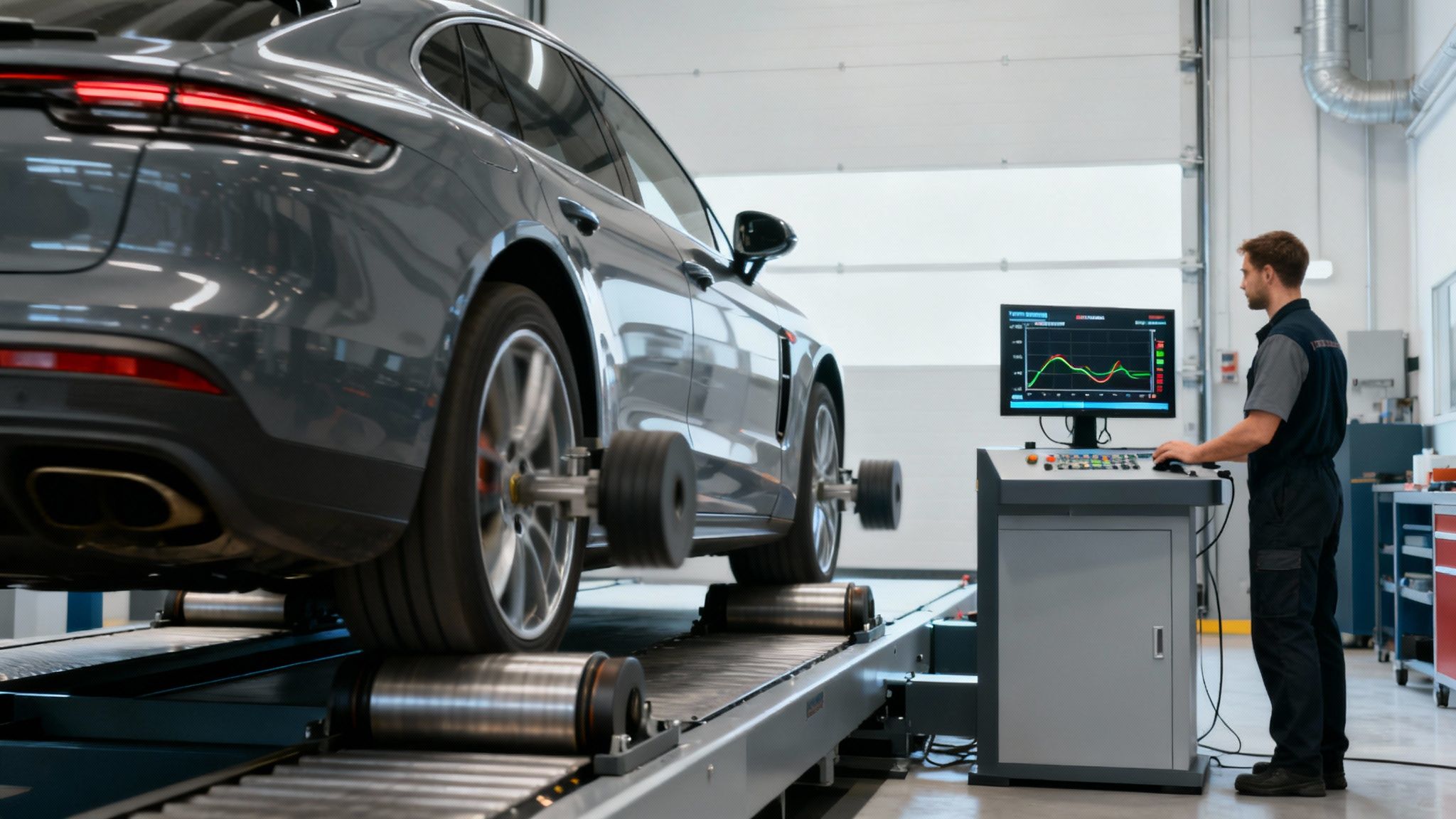
If you're after the most accurate and definitive car horsepower check, nothing beats a dynamometer. Known more commonly in the UK as a 'rolling road', this is the gold standard for measuring a vehicle's true power output—right where it matters, at the wheels.
A dyno test gives you a precise, real-world measurement of your car’s performance. The vehicle is strapped securely onto a set of rollers, allowing a technician to safely run it through its gears at full throttle, all within a controlled environment. Sophisticated sensors measure the force the wheels exert, which is then calculated into an exact figure for wheel horsepower (WHP) and torque.
What to Expect During a Dyno Session
The whole process is pretty straightforward but definitely needs a professional touch. Once your car is safely secured, the operator will perform several 'pulls'. This involves accelerating through a specific gear (usually fourth) all the way to the redline.
This captures the entire power curve across the rev range, spitting out a graph that shows you exactly where your car makes its peak power and torque. It’s invaluable data, especially if you’ve modified your car or you’re a track day regular. It gives you undeniable proof of performance gains and can even help diagnose those frustrating hidden issues that cause power loss.
A professional dyno test can be a crucial part of a pre-purchase check, a topic we cover in more detail in our ultimate used car inspection checklist.
Preparing Your Car for Accurate Results
To get the most reliable reading, a little prep work goes a long way. The first step is just making sure your car is in good mechanical shape.
- Fuel: Top up the tank with the fuel you normally use. If your car is tuned for it, use a high-octane fuel like Shell V-Power or BP Ultimate for the best results.
- Tyres: Make sure your tyre pressures are set to the manufacturer's recommended levels. If they're off, it can mess with the rollers' grip and skew the final numbers.
- Maintenance: A quick check of your oil and coolant levels is essential. The engine is going to be under serious load, and proper fluid levels are vital to protect it.
While a dyno test is the most precise method out there, it's also the most involved when it comes to time and money. For serious enthusiasts or anyone chasing a complex performance issue, however, the investment delivers unparalleled insight into a vehicle's true performance.
Getting a Quick Power Estimate with an OBD-II Reader
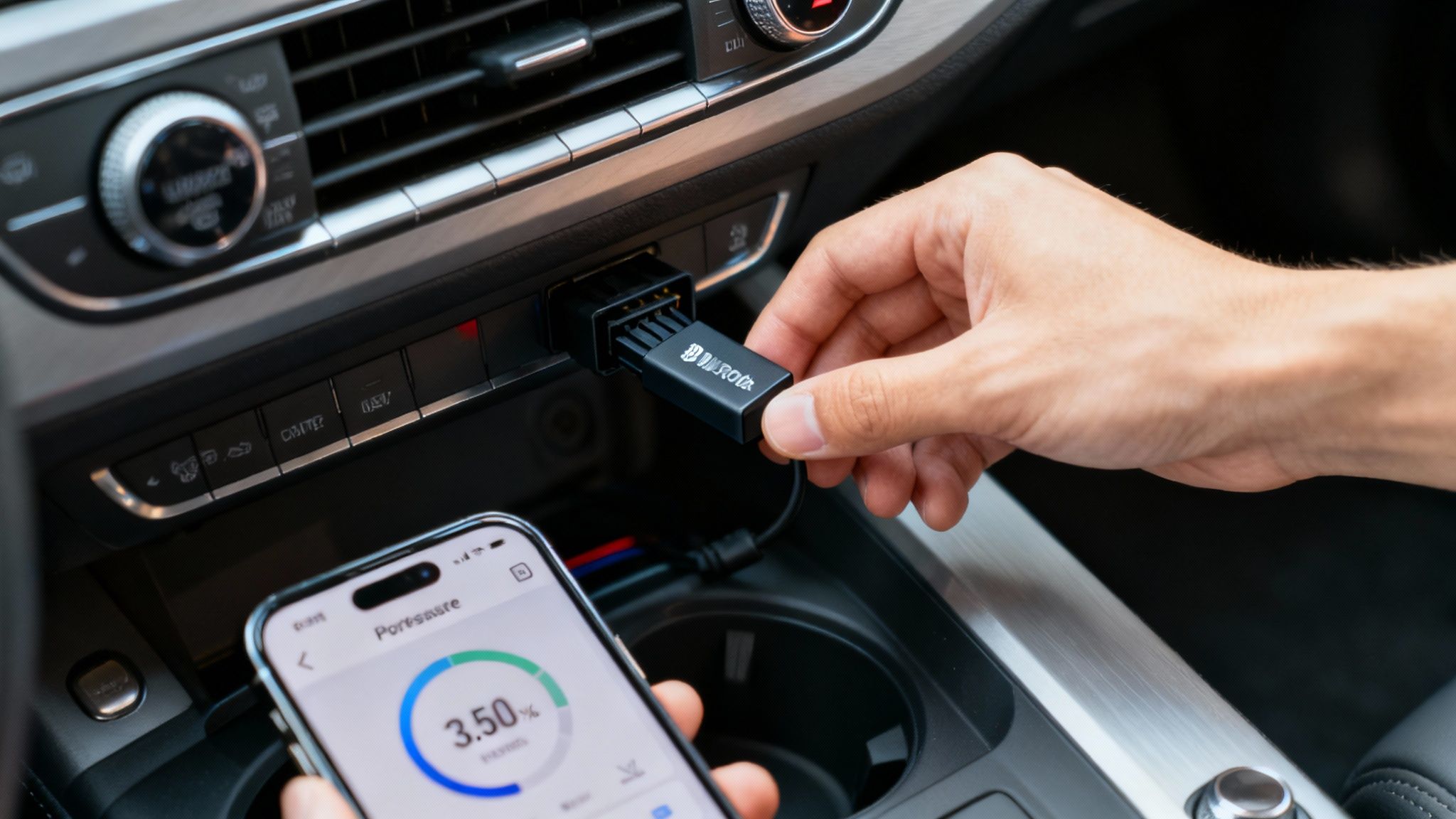
If you're curious about your car’s output but not quite ready to book a full dynamometer session, an On-Board Diagnostics (OBD-II) reader is a fantastic, low-cost alternative. It’s a modern, tech-savvy way to get a quick performance estimate right from your driver’s seat.
Every car built since the late 1990s is fitted with an OBD-II port, which is usually tucked away under the dashboard near the steering column. It's the same port your mechanic plugs into to figure out what that pesky engine warning light means. By popping in a simple Bluetooth or Wi-Fi dongle, you can link your car directly to your smartphone.
How Apps Crunch the Numbers
Once you're connected, specialised apps like Torque Pro or OBD Fusion can perform a virtual car horsepower check. These apps tap into your vehicle’s Engine Control Unit (ECU) and pull a constant stream of real-time data.
They use a few key metrics to make an educated guess at your car's power, including:
- Engine RPM: How quickly the engine is spinning.
- Mass Airflow (MAF): The amount of air being sucked into the engine.
- Vehicle Speed: How quickly the car is accelerating.
By crunching these numbers along with your car's specific weight (which you input yourself), the app’s algorithm produces an estimated horsepower figure. It's a clever bit of engineering that gives you a performance snapshot without ever needing a rolling road.
An OBD-II reading gives you a ballpark figure, not a definitive measurement. It’s perfect for tracking the before-and-after effects of a small modification, like a new air filter, or just for getting a general feel for your car’s health.
Keeping Your Expectations in Check
While these tools are incredibly useful, it’s important to understand their limitations. The accuracy of an OBD-II power estimate hinges on things like entering the correct vehicle weight and the calibration of your car's sensors. It simply won’t have the pinpoint precision of a professional dyno test, which measures power directly at the wheels.
Still, for enthusiasts who want to monitor performance trends, this method is hard to beat for cost and convenience. This approach is one of many recent innovations in automotive tech in the UK that puts more power—and data—directly into the owner's hands.
Find Your Car's Official BHP Instantly

Sometimes, the simplest approach is the best one. The fastest way to find out your car's power is to look up the manufacturer's original, factory-stated figure. This number is what the car was designed to produce straight off the production line.
You could always go rummaging through the glovebox for a dusty owner's manual, but thankfully, modern vehicle intelligence tools have made this job much easier. A professional platform like AutoProv is brilliant for this, turning a tedious search into an instant answer.
Just pop in your vehicle's registration number, and you get immediate access to its official Brake Horsepower (BHP). Our service provides a rock-solid and accurate baseline, showing you exactly what your car was capable of when it left the factory.
Why the Manufacturer's Figure Matters
Think of the official BHP as your launchpad. If you're chasing down a suspected loss of power due to age or trying to measure the gains from your latest modifications, you absolutely need a benchmark to compare against. Without that original number, a dyno printout is just a set of figures without any real context.
This initial data point is everything. Let's say your 2.0-litre diesel saloon was rated at 187 BHP from new. A recent dyno run shows it’s now putting out 165 WHP (Wheel Horsepower). Armed with that original figure, you can start to properly calculate for drivetrain loss and identify any potential engine wear. Knowing how to check car specs by reg gives you this vital starting point in a matter of seconds.
This benchmark is more important than ever, especially when you look at current market trends. Data from the UK's Department for Transport shows a clear shift towards smaller, more efficient engines. New registrations for engines over 3,000cc dropped from 5% to around 3% between 2015 and 2022. This trend makes it even more critical to verify the precise power output for each specific model you're looking at.
Adapting to Electric and Hybrid Power
As the UK's roads fill up with more electric and hybrid vehicles, the way we talk about power is changing, too. The traditional BHP measurement is often joined by—or completely replaced by—kilowatt (kW) ratings for these modern power-trains.
Vehicle intelligence platforms are keeping pace with this shift. An instant reg check can now provide the official kW output for an electric vehicle, making sure you have the correct performance metric, whatever is under the bonnet. This way, you always have the most relevant and accurate baseline to work from.
Making Sense of Your Horsepower Figures
So, you’ve got a horsepower number in front of you. What does it actually mean for the car's real-world performance? Getting to grips with the figures is the only way to truly understand what you're looking at. The first thing you need to know is the crucial difference between Brake Horsepower (BHP) and Wheel Horsepower (WHP).
BHP is the raw power measured right at the engine's crankshaft, before any of it gets lost on the journey to the wheels. This is the official figure you'll see in brochures and the number a service like AutoProv will give you. WHP, on the other hand, is the power that actually makes it to the tarmac, measured at the wheels by a dynamometer. It's always a lower number.
What is Drivetrain Loss?
That drop in power between the engine and the wheels has a name: drivetrain loss. It's the energy that gets used up as power travels through the transmission, the driveshaft, and all the other bits and pieces before it can spin the tyres.
It's a completely normal part of how cars work. For a typical manual car, you can expect to see a 10-15% drop. Automatics tend to lose a little more.
So if your dyno printout shows a figure that looks a bit disappointing compared to the manufacturer's spec, don't panic. That’s drivetrain loss in action, and it's the key bit of context you need. Our ultimate car spec checker guide for trade buyers goes into more detail on why having those original factory specs is so vital for any accurate vehicle appraisal.
Key Takeaway: Having both the official BHP and the measured WHP gives you the full story. It lets you check the health of a car's powertrain by seeing if the power loss sits within the expected range.
Why Horsepower is a Growing Road Safety Topic
Beyond the garage, horsepower figures are becoming a hot topic in UK road safety discussions. There have even been government talks about bringing in a 'superlicence' for cars packing over 400 horsepower, which would mean drivers need extra training.
It just goes to show how seriously the authorities are taking the link between massive power and driver skill. You can read more about what these proposals could mean for UK drivers in this insightful article.
At the end of the day, every method for checking horsepower has its place. Kicking things off with an instant check from AutoProv gives you that all-important factory benchmark, which is the perfect starting point for any deeper dive you plan to take.
Common Questions About Car Horsepower
Even with a good handle on the different methods, a few specific questions always seem to pop up when we talk about checking a car's horsepower. Let's clear up some of the most common queries so you can feel completely confident about understanding your car's performance.
One of the biggest points of confusion is the terminology itself. I often get asked what the real difference is between the figures you see in a shiny brochure and the numbers spat out by a rolling road test.
What Is the Difference Between BHP and WHP?
Brake Horsepower (BHP) is the raw power your engine produces, measured right at the flywheel before any of it gets lost on its journey to the wheels. This is the official figure manufacturers love to advertise.
Wheel Horsepower (WHP), on the other hand, is the power that actually makes it to the tarmac. It’s measured at the wheels on a dynamometer (or 'dyno'). Due to something we call 'drivetrain loss'—the energy soaked up by the gearbox, driveshaft, and differential—WHP is always a lower number than BHP. Think of it as the engine's headline figure versus what you can actually use.
Can I Increase My Car's Horsepower Easily?
You can definitely get some minor gains with simple, bolt-on modifications. Things like a performance air filter or a less restrictive exhaust system can free up a few extra horses.
But if you're chasing significant power increases, you’ll need to call in the professionals for more serious work like an ECU remap or even internal engine upgrades.
A crucial point here: you absolutely must inform your insurance provider about any performance modifications. Failing to declare them can have serious consequences for your policy, potentially invalidating your cover if you need to make a claim.
Why Might My Car's Dyno Result Be Lower Than Claimed?
It's perfectly normal for a car's real-world power to be a bit lower than the manufacturer's original claim, especially on an older vehicle. Don't panic if the numbers aren't what you expected.
There are a few common culprits for this:
- Engine Wear: Over thousands of miles, natural wear and tear on engine components can lead to a gradual drop in power.
- Poor Maintenance: Simple things can make a big difference. Clogged fuel filters, old spark plugs, or a dirty air filter will all stifle performance.
- Fuel Quality: Using a lower-octane fuel than the manufacturer recommends can sometimes cause the engine's management system to pull back the power slightly to protect itself.
A dyno test is a brilliant diagnostic tool. It can confirm if your car is genuinely underperforming and helps point you in the right direction to find the root of the problem.
How Accurate Is an Online Reg Check for Horsepower?
For getting the original manufacturer's data, it's extremely accurate. A professional vehicle intelligence platform like AutoProv uses your registration number to pull the official, factory-rated BHP from verified databases.
This tells you precisely what power your car was designed to produce the day it left the factory, giving you the perfect baseline. Just remember that it won't reflect any changes to the car's power from modifications or age-related wear and tear.
Frequently Asked Questions
AI-Generated Content Notice
This article was created with the assistance of artificial intelligence technology. While we strive for accuracy, the information provided should be considered for general informational purposes only and should not be relied upon as professional automotive, legal, or financial advice. We recommend verifying any information with qualified professionals or official sources before making important decisions. AutoProv accepts no liability for any consequences resulting from the use of this information.
From our AI insights
- Digital Service Records: The Future of Vehicle Maintenance
Discover why UK motor traders trust digital service records for accurate vehicle history verification.
- The Impact of EV Service Records on Resale Value
Discover how electric vehicle service records affect resale value and buyer confidence in the UK market.
- The Importance of Tyre Verification for UK Motor Traders
Discover why verifying tyre specs is crucial for UK traders to ensure safety and compliance.
Related Articles

The Importance of Car Maintenance and Provenance Checks
Discover why regular car maintenance and proper provenance checks are essential for vehicle quality and longevity.
Essential Car Maintenance Tips for UK Drivers
Discover vital car maintenance tips to keep your vehicle roadworthy and compliant in the UK.
How Much Is a Car Service? Complete UK Price Guide
Trying to pin down exactly "how much is a car service?" can feel a bit like asking "how long is a piece of string?". Prices vary quite a bit, but to give you a ballpark figure, an interim service will usually set you back around £100 to get started. A more thorough full service often begins at £180, while a major service for many cars can easily top £300.
Published by AutoProv
Your trusted source for vehicle intelligence