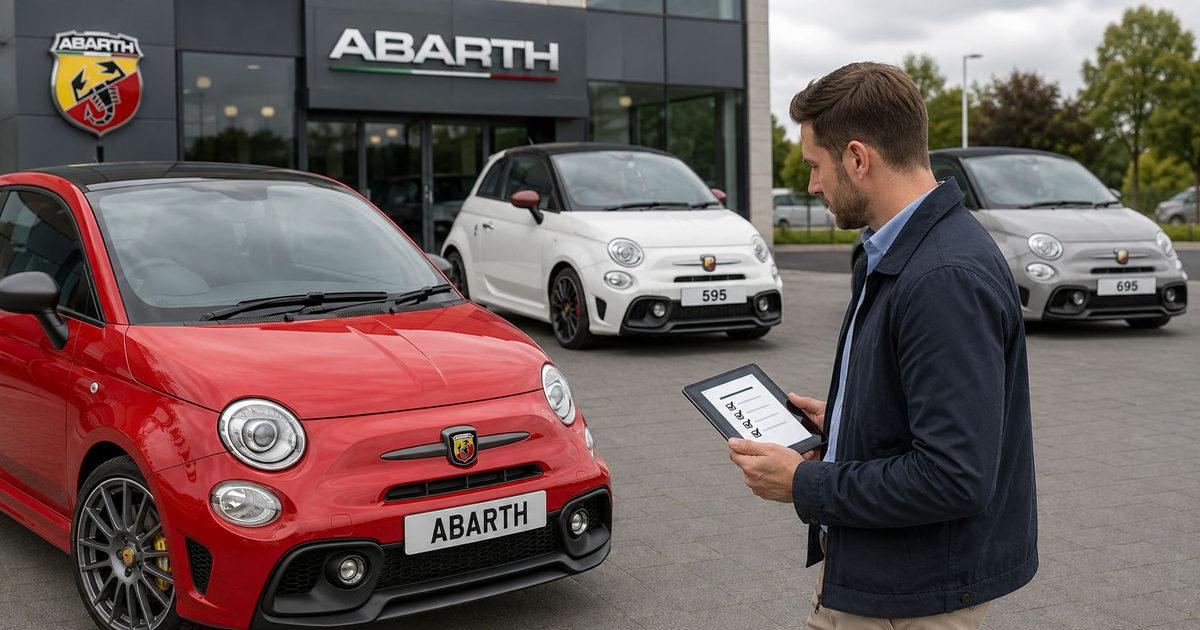
You're on the forecourt with three Abarth for sale leads in front of you. One looks tidy, one looks cheap, and one comes with a finance story that sounds neat enough to retail before lunch. That's exactly where dealers get caught out, because a pretty 595 badge tells you almost nothing about what the car has lived through.
A clean-looking Abarth can still be a poor buy if the ownership pattern is messy, the mileage trail doesn't make sense, or the car's past has been cooked into a glossy listing. The smart trade view starts with vehicle provenance, not trim. If you're buying performance stock with your head, not your heart, you need to read the car like a risk file.
Table of Contents
- Three Abarths, Three Risks
- The UK Abarth Market at a Glance
- What the platform tells you
- Where UK Abarth Pricing Actually Sits
- How to read the spread
- Why a Basic History Check Is Not Enough
- What basic checks miss
- A Trade-Focused Pre-Purchase Checklist
- A workable trade sequence
- Reading a Provenance Report Like a Trader
- How I'd weight the signals
- Using Provenance to Set Price and Negotiate
- Practical pricing logic
Three Abarths, Three Risks
The first listing is the one every dealer likes. A tidy 595, sensible money, decent photos, and no obvious drama in the advert. You can already hear the line you'd use on the pitch, but that's the trap. Clean presentation often just means the seller has bothered to clean it.
The second is the cheap Competizione. It's priced to move, which is usually how trouble introduces itself. Cheap stock can be fine, but on Abarths it often means the seller knows the car is harder to place, or the history is awkward enough to force the price down. The badge doesn't save you from the back story.
The third is the 695 with the tempting finance deal. That one gets attention because it sounds like the best car on paper. In practice, higher-spec Abarths can be the most misunderstood stock, because buyers see the name and assume the car has been cherished, when all they've really seen is a monthly payment. A good dealer knows finance terms don't replace inspection or provenance intelligence.
Practical rule: on an Abarth, price is a clue, not a verdict.
That's why I treat every abarth for sale listing as a source of signals, not an invitation. The right question isn't “which one looks nicest”, it's “which one gives me the cleanest route to margin without storing up a comeback”. On these cars, spec sheets flatter the car, but provenance decides whether it's stock or a headache.
The UK Abarth Market at a Glance
A tidy Abarth advert can fool an inexperienced buyer. The UK parc is small enough to make every decent car matter, yet active enough that trade stock still turns if the provenance is right. Current DVLA-based figures show 31,607 Abarths registered in the UK, with 29,768 licensed and 1,839 declared SORN, which means about 94.2% of the surviving fleet is on the road rather than tucked away (The Classic Valuer DVLA-based Abarth data). For a trader, that is the point. You are not buying into a museum scene, you are buying into a live used-car parc where the right car can move quickly and the wrong one can sit.
The same source shows the total UK fleet has fallen by 1% over the past year. That is a small change on paper, but in a niche parc it tightens supply in the exact trims and colours buyers ask for first. When the market is that thin, weak history, repeated keeper changes, or a suspiciously fast flip hurts harder because there are fewer clean cars to replace them with.
What the platform tells you
The UK 595 and 695 cars sit on the 1.4-litre turbocharged T-Jet petrol engine, and the official UK WLTP combined fuel consumption is quoted at 39.2 to 42.2 mpg, with CO2 emissions of 152 to 163 g/km (Abarth UK price list). The stronger 695 calibration gives the car a sharper edge in the mid-range, but it does not make the ownership story any simpler. If anything, it raises the bar on service history, because buyers still want the noise and pace without inheriting a neglected turbo car.
Mass matters just as much. Published model data puts the 595 at roughly 7.8 seconds for 0 to 100 km/h, with the 695 and Competizione around 6.7 seconds, and kerb weights around 1,065 to 1,120 kg (AutoScout24 Abarth model data). That low weight is why these cars feel lively around town and on B-roads, but it also means the consumables do proper work. Tyres, brakes, dampers, and bushes tell you far more than the badge on the tailgate.
For pricing stock, use AutoProv's market insights alongside the advert. A niche Abarth with clean provenance can sit above the noisy average, while a car with patchy history or repeated keeper churn needs to be treated as a risk case, not a bargain. That is how traders should read this market, through ownership pattern, mileage behaviour, and the story behind the car, not just the trim level.
Where UK Abarth Pricing Actually Sits
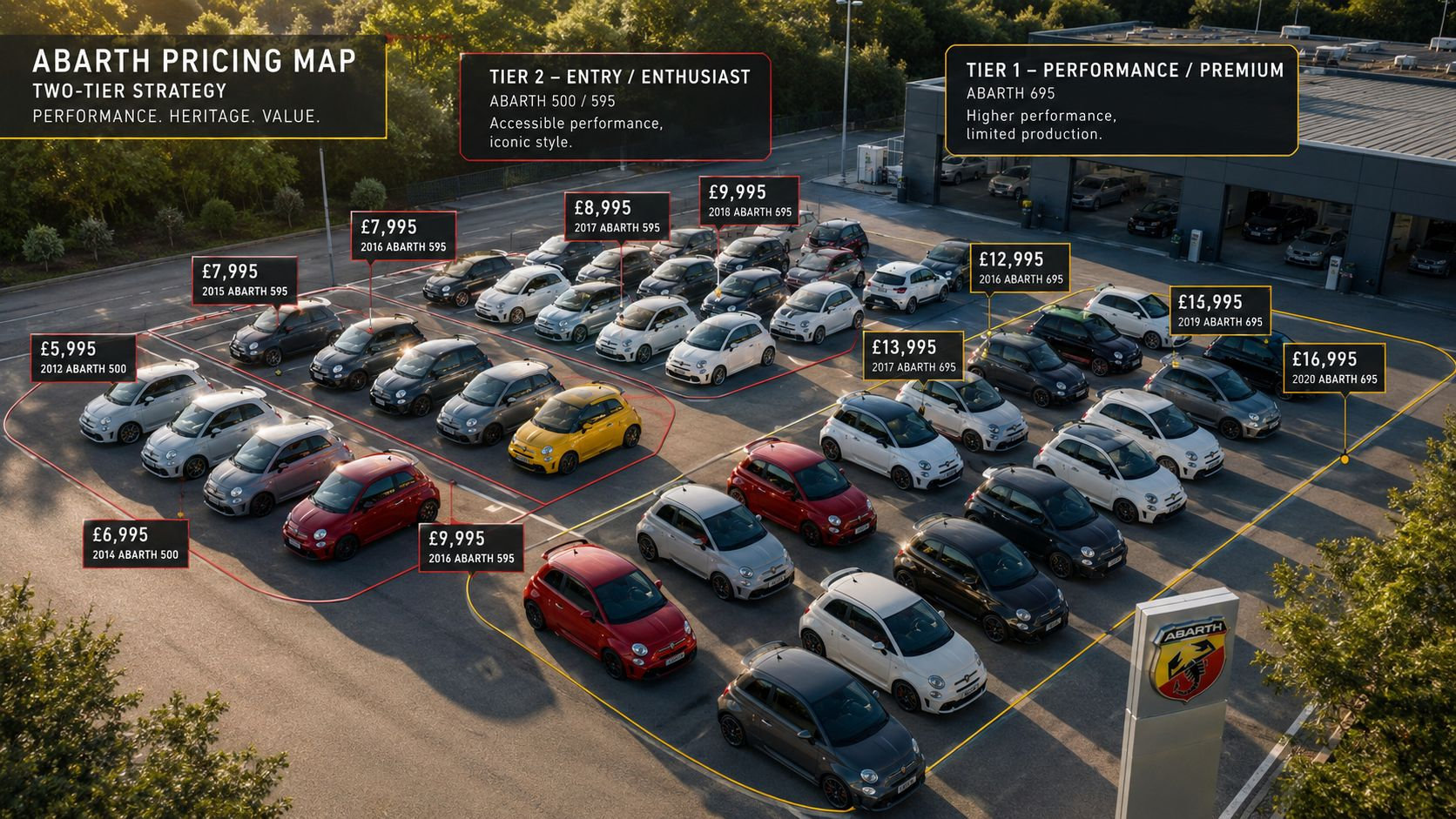
The UK Abarth market has two completely different price realities. At the accessible end, Carwow lists used Abarth cars from £5,995 and new Abarth cars from £26,637 (Carwow Abarth listings). That's the world most dealers will buy and retail in, the one where the 500, 595, and 695 family sits as usable, emotional, everyday stock.
At the other end, the collector side can look absurd if you're only used to retail forecourt logic. The classic-value dataset records 35 sold cars all time, a 73% sell-through rate, £4,848,686 in total sales value, and a median price of £117,500 across recorded auction results (The Classic Valuer Abarth pricing data). That doesn't mean ordinary used Abarths are secretly worth six figures. It means rare, documented examples can sit in a completely different pricing universe.
How to read the spread
A low listing price doesn't automatically mean good buying. It can mean the seller has a common trim, a tired colour combination, or a history file that's awkward enough to suppress demand. A higher price can be justified by rarity, condition, or documentation, but only if the provenance backs it up.
Dealer takeaway: never let the first listing you saw become your anchor price.
That's why regional pricing context matters as well. If you're buying across the UK, the local stock picture and asking-price spread can move faster than the badge suggests, which is exactly why trade buyers should compare cars against the market rather than the advert in front of them. A regional pricing lens from AutoProv's trade buying guidance helps prevent overpaying for a car that only looks rare because it's listed poorly.
Why a Basic History Check Is Not Enough
A basic vehicle history check UK result can confirm the car exists, but it will not tell you whether it belongs on your forecourt. That is the mistake that keeps eating dealer margin. A pass on a checklist is not the same as a sound trade decision, especially on cars that attract owners who buy with emotion and move them on quickly.
The primary problem is context. Short-term ownership, repeated plate changes, and odd mileage progression can all sit outside a simple pass or fail result. You can have a car with no obvious red flag and still be looking at a pattern that points to hurried resale, track-day use, or a seller who is only showing you the tidy parts of the story.
What basic checks miss
A basic check will not always explain why a car changed hands quickly, or whether the mileage trail makes commercial sense. It also will not tell you how a car has been used if the available data is not stitched together properly. That is why a proper used car history report earns its money.
A clean result is a starting point. It is not the end of the decision.
The trade answer is to combine keeper history, MOT patterns, and mileage logic, then read the car as a whole. That matters on Abarths because the enthusiast market can hide heavy use behind aftermarket bits, good detailing, or a seller who knows how to write a tempting advert. If you want a clearer framework for that distinction, the difference between a basic check and a full provenance report makes the split plain.
On an Abarth, a “clean” result that ignores context is usually just an expensive oversimplification. Dealers who rely only on a basic dealer vehicle checks result are buying the paperwork, not the car.
A Trade-Focused Pre-Purchase Checklist
Start with the DVLA record. Confirm the keeper history, VIN match, and registration details before you get distracted by trim level or wheel colour. If the seller can't align the car with its identity cleanly, stop there. On a niche performance hatch, identity problems are never worth rationalising away.
Next, read the MOT history properly. Don't just look for pass or fail. Look for gaps, advisories that repeat, and whether the mileage climbs in a way that fits the car's age and ownership pattern. A smooth upward line is what you want. A jagged one is where your attention should stay.
A workable trade sequence
- Check keeper duration first. Short ownership can be normal, but a chain of brief keepers needs context.
- Match mileage against service and MOT timing. Numbers should make sense together.
- Watch plate changes and repeated adverts. Those are often signs of a car that's been passed around quickly.
- Cross-reference insurance-related indicators where you can. A clean-looking listing can still hide event history that matters commercially.
- Document your inspection properly. If you need a template, customize digital inspections before you send a buyer out with a clipboard.
- Run the car through a provenance workflow that folds the data together. A trade-focused appraisal process like AutoProv's checklist guidance keeps the sequence disciplined.
For a dealer, this shouldn't take all day. The point is to turn a listing into a risk score before you commit cash.
Warning sign: if the paperwork is tidy but the ownership pattern looks rushed, assume the advert is doing more work than the car.
The seller conversation matters too. Ask why the car moved on quickly, whether it's been modified, and whether any repeat advisories have been fixed rather than buried. If the answers are vague, treat that as data. A strong mileage check UK view doesn't live in one document, it lives in the relationship between documents.
Reading a Provenance Report Like a Trader
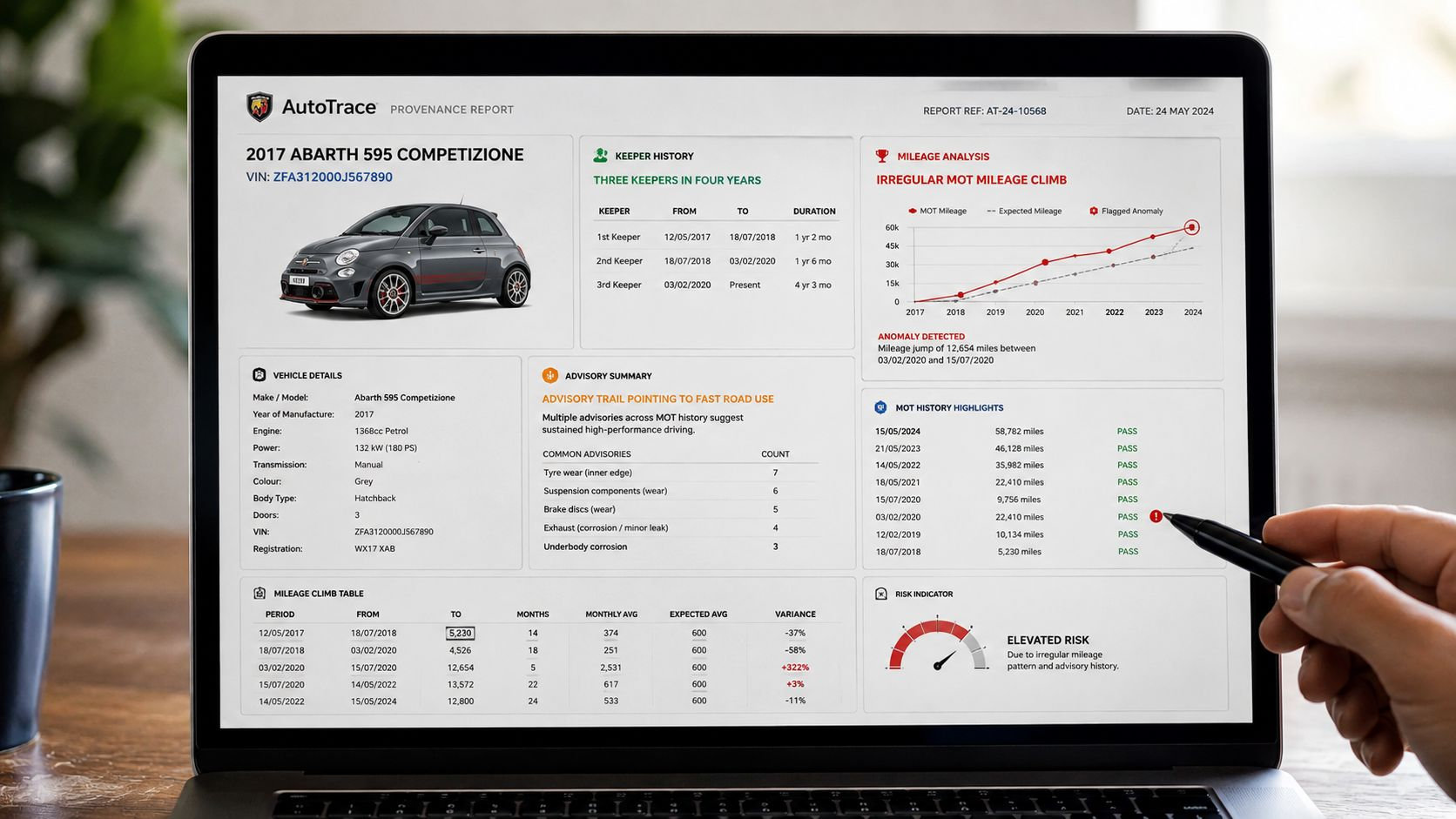
A 2017 Abarth 595 Competizione with three keepers in four years is not automatically a bad car. It is, however, a car that needs reading properly. If the MOT mileage climbs irregularly and the advisory trail hints at harder road use, the story is no longer about colour or spec, it's about how the car has been used and how fast it's been turned.
That's the kind of pattern a proper vehicle provenance report makes easier to see. You're not just looking for a single alarm bell. You're looking at keeper churn, mileage behaviour, and the shape of the advisory trail as a joined-up risk picture. A dealer who reads that pattern well knows when to ask for more detail and when to walk.
How I'd weight the signals
Three keepers in four years doesn't condemn the car on its own, but it does reduce confidence. If the mileage then moves in a way that doesn't feel organic, I start asking whether the car's life has been chopped up by short ownership cycles or enthusiastic use. On a 595 Competizione, that matters because the car's appeal is performance, and performance cars attract harder driving more often than the advert admits.
The right questions are blunt. Who owned it last, how long did they keep it, and what exactly has been done to the suspension, brakes, or tyres? If the seller can't answer those without hand-waving, the report has already done its job.
The value of trade vehicle intelligence is that it changes the conversation before the money leaves your account. It's not there to produce a dramatic story. It's there to stop you retailing a car whose past is more complicated than the photos suggest. That's exactly the point of a report-led buying process, and it's why a tool like AutoProv sits in the workflow rather than at the end of it.
Using Provenance to Set Price and Negotiate
Provenance is a margin tool. If the car is clean, you buy with more confidence and retail with less hesitation. If the history shows short-term ownership, mileage oddities, or usage clues that need explaining, you've got a reason to sharpen your bid or walk away entirely.
That's where negotiation becomes professional instead of emotional. A seller may want to price off badge, colour, and spec, but your offer should reflect the actual risk in the file. A strong provenance report gives you the language to do that without guesswork.
Practical pricing logic
- Clean file, firmer stance. If the report is straightforward, you can be more decisive on asking price and stock turn.
- Mixed file, wider margin. If the car shows ownership churn or mileage anomalies, build in extra margin for uncertainty.
- Unclear answers, no deal. If the seller won't explain the history, the report has already done enough to protect you.
A trade buyer who uses how to negotiate used car prices professionally well doesn't argue from irritation. They argue from evidence. That's the difference between haggling and buying properly.
In a niche parc like Abarth's, the dealers who keep winning aren't the ones who memorise trim names. They're the ones who treat every abarth for sale listing as a provenance case and let the data decide how hard to lean in. If you want that same discipline across your stock, AutoProv gives you the vehicle provenance, history, and risk intelligence layer that helps you buy with more context and less guesswork. Visit AutoProv and make the next Abarth you appraise a data-led decision rather than a hopeful one.
Frequently Asked Questions
AI-Generated Content Notice
This article was created with the assistance of artificial intelligence technology. While we strive for accuracy, the information provided should be considered for general informational purposes only and should not be relied upon as professional automotive, legal, or financial advice. We recommend verifying any information with qualified professionals or official sources before making important decisions. AutoProv accepts no liability for any consequences resulting from the use of this information.
From our AI insights
- Auction Pitfalls: Avoiding Costly Mistakes
Navigate UK car auctions with confidence by avoiding finance, write-off, and mileage risks.
- Mastering Paint Code Checks: Detecting Hidden Car Repairs
Discover how to use paint code verification to identify hidden car repairs and ensure a smarter purchase.
- UK Part-Exchange Checks: Protecting Dealer Margins
Explore essential part-exchange checks for UK dealers to safeguard profit margins, including provenance and finance verification.
Related Articles

Your Ultimate Guide to Buying a Used Car in the UK
Navigate the UK used car market with confidence using our comprehensive buying guide. Tips, checks, and AutoProv Provenance insights included.

Difference Between MOT and Service: What You Need to Know
An MOT is a mandatory legal inspection that every car on UK roads needs to pass.Think of it as the government's way of ensuring your vehicle meets the absolute minimum safety and environmental standards to be considered roadworthy. A service, on the other hand, is a completely different beast. It's the proactive maintenance routine recommended by the people who built your car, designed to keep it running smoothly and catch problems before they start. In short, an MOT is a pass-or-fail exam required by law. A service is a comprehensive health plan for your car.
Your Ultimate Used Car Inspection Checklist
A solid used car inspection checklist is the single most powerful tool you have to avoid buying a lemon. It gives you a methodical way to look past the shiny paint and assess a car's real condition, helping you spot hidden problems and get a fair price before you shake hands on the deal.
Published by AutoProv
Your trusted source for vehicle intelligence