
For any seasoned motor trader, a comprehensive auction car history check isn't just a box to tick—it's the single most powerful tool you have to separate good, clean stock from the kind of car that’ll become a financial nightmare. One click can reveal everything from undisclosed finance and write-off history to mileage discrepancies, all before you even think about raising your hand.
For any seasoned motor trader, a comprehensive auction car history check isn't just a box to tick—it's the single most powerful tool you have to separate good, clean stock from the kind of car that’ll become a financial nightmare. One click can reveal everything from undisclosed finance and write-off history to mileage discrepancies, all before you even think about raising your hand.
Why a History Check Is Your Most Critical Auction Tool
In the high-stakes, fast-moving world of UK car auctions, the biggest risk isn’t getting carried away and overpaying by a couple of hundred quid. The real danger is unknowingly buying a vehicle with a toxic, hidden past that’ll come back to bite you.
This is where a professional-grade auction car history check from a service like AutoProv becomes your most vital asset. It’s not just a ‘nice-to-have’; it’s an absolute essential part of your due diligence. Forget the generic advice aimed at private buyers – this guide is built for traders like you, navigating the daily grind of sourcing stock.
We're going to dive into real-world scenarios and show you how a detailed, instant check is about so much more than just dodging bullets. It's a strategic move that lets you confidently source profitable vehicles, protect your hard-earned reputation, and secure your bottom line in a market where every single detail counts.
The Scale of the Problem
The sheer volume of cars changing hands in the UK used car market puts the risk into sharp perspective. With used car sales hitting a staggering 7,643,180, the auction lanes are busier than ever. This boom is precisely why a meticulous history check is non-negotiable.
Industry reports suggest that around 10-15% of auction vehicles have significant issues flagged against them, from outstanding finance to previous accident damage. Without a proper check, you’re gambling on buying cars with hidden problems like theft markers or, even worse, outstanding finance that could see the vehicle repossessed right off your forecourt. For a deeper dive into these market trends, the SMMT's official report is worth a read.
A vehicle history check isn't just a defensive measure; it's an offensive strategy. It allows you to identify hidden value where others see risk and avoid the money pits that can cripple a small dealership's cash flow.
Beyond the Basics: What a Professional Check Uncovers
A basic check might tell you if a car is nicked, but a proper trade report goes much, much deeper. It unearths the crucial details that make the difference between profit and loss. For instance, a report from AutoProv can immediately flag undisclosed finance, preventing you from buying a car that legally belongs to a finance company. It also details any write-off history, distinguishing between structural (Cat S) and non-structural (Cat N) damage, which is vital for accurate valuation.
Furthermore, a comprehensive check tackles mileage discrepancies by cross-referencing MOT, service, and sales records, exposing "clocked" vehicles. It also helps you spot cloned vehicles by verifying that the VRM on the plate matches the VIN on the chassis—a critical defence against criminals trying to pass off stolen cars with fake identities.
Decoding a Comprehensive Vehicle History Report
A professional-grade history check is far more than a simple pass-or-fail document. It’s an intelligence briefing on a vehicle, packed with data that tells the story of its life so far. For a trader, understanding this story is the difference between buying profitable stock and inheriting someone else’s expensive problem. An effective auction car history check UK traders rely on, such as those from AutoProv, breaks this complex information down into clear, actionable insights.
Forget just looking for a "clean" report. The real skill is in reading between the lines—interpreting the nuances within the data, from a pattern of MOT advisories to a recent change in keepers. Each piece of information is a clue that helps you build a complete picture of the vehicle’s condition, history, and, most importantly, its true value on your forecourt.
Core Data Points and What They Really Mean
When you run a check with a service like AutoProv, you’re pulling together information from multiple official UK databases. Trying to juggle these sources individually in a busy auction hall is a non-starter. A consolidated report puts it all in one place, allowing for quick but thorough analysis. Let's break down the essentials.
The initial DVLA data confirms the vehicle's identity—registration date, colour, and engine size. Crucially, it also shows the number of previous keepers. A high turnover in a short period should set alarm bells ringing, as it often points to a persistent issue that owners keep passing on.
Similarly, a recent issue date for the V5C logbook, especially just before auction, is a major red flag. While it could be a genuine loss, it's also a classic tactic used by criminals to hide a dodgy past or facilitate cloning. Always question why a V5C was reissued so close to the sale date.
Your history report is your first line of defence. It turns raw data from the DVLA, PNC, and MIAFTR into a clear story, letting you assess risk and opportunity in seconds, right from the auction hall.
Uncovering the Mechanical and Financial Story
Beyond the basics, the most critical information is about the car's mechanical health and financial status. These are the two areas where hidden problems can completely obliterate your profit margin.
A detailed MOT history is an absolute goldmine. Don't just glance at the pass/fail results; the real story is in the advisories. For instance, a recurring advisory for a "nearside front tyre worn close to legal limit" over two consecutive MOTs tells you this vehicle has likely been run on a shoestring budget. If they've skimped on tyres, what other, more expensive maintenance has been ignored? Similarly, advisories for corroded brake pipes or suspension components are clear signals of upcoming reconditioning costs you need to build into your bid.
The Critical Financial and Legal Checks
Some of the costliest mistakes come from overlooking the crucial legal and financial markers. For any vehicle you plan to retail, these checks are non-negotiable. An Experian check for outstanding finance is arguably the most important part of any report. A car with an active hire purchase or PCP agreement still legally belongs to the finance company. If you buy it, you’re buying a massive risk—the lender can repossess the vehicle, leaving you with no car and no money.
A check against the Police National Computer (PNC) instantly tells you if the vehicle has been reported as stolen. This is a black-and-white issue; a stolen marker is an immediate "walk away" signal. No exceptions.
Finally, the Motor Insurance Anti-Fraud and Theft Register (MIAFTR) is where insurers log vehicles declared a total loss. Your report will break it down by category: Cat S for structural damage and Cat N for non-structural issues. Knowing the specific category is vital. A Cat N might just need a new bumper and headlight, but a Cat S could have hidden chassis damage that makes it both unsafe and unsellable. The history check provides this crucial context before you commit.
Services like AutoProv are built for the trade, pulling all these vital checks—DVLA, MOT, PNC, MIAFTR, and finance—into a single, easy-to-read summary. Instead of fumbling with multiple websites on your phone as the bidding starts, you get one clear report. This lets you perform a complete auction car history check in the UK in seconds, giving you the confidence to bid smart or the wisdom to walk away.
Building Your Pre-Auction Vetting Process
The real money at auction is made long before the hammer drops. It’s won in the quiet hours before the sale, through a disciplined vetting process that weeds out the duds and pinpoints the genuine gems. This isn't about luck; it's about having a solid, repeatable workflow that gives you a data-backed plan of attack.
This process starts at your desk, not in the auction hall. With online catalogues being the norm, all you need is a reg number to run the same kind of auction car history check UK traders live by. This initial digital legwork is your most powerful tool. It lets you build a tight shortlist, binning the obvious problem cars so you can focus your limited time on real opportunities.
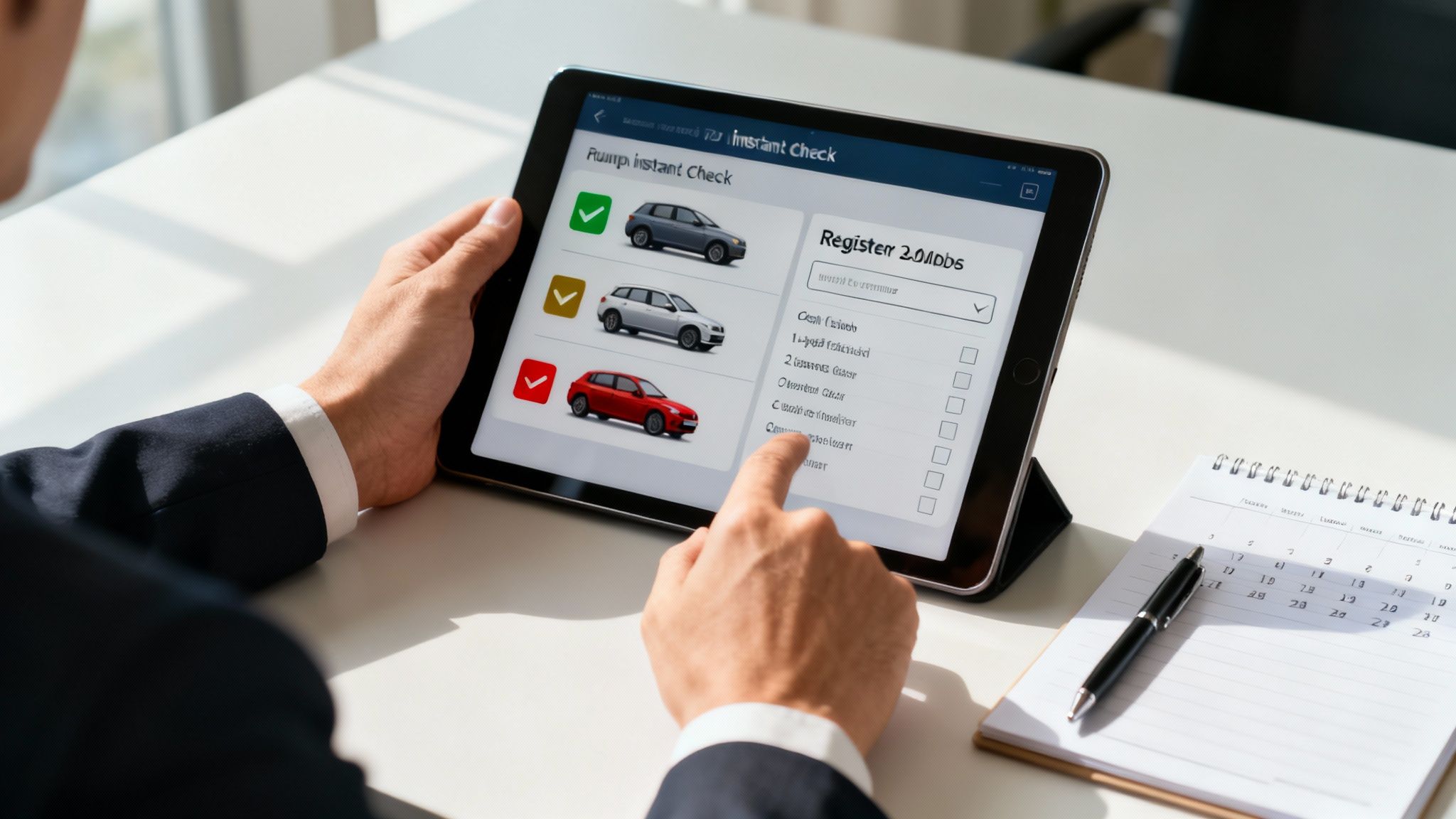
It’s a simple but crucial shift in mindset. You stop reacting to whatever rolls across the block and start curating a list of pre-vetted vehicles you know have profit potential.
Desk-Based Due Diligence
First things first: scan the online auction catalogue. Pick out a handful of vehicles that fit your profile—the right make, model, age, and guide price. Don’t get attached just yet. This is purely about gathering data.
With your list of reg numbers, it's time for the first wave of checks. This is where a trade-focused service like AutoProv is invaluable. It’s built for speed, giving you a full report in seconds so you can make fast, informed calls.
This first screening is all about knocking out cars with deal-breaking red flags. Your first check should be the PNC status for any stolen markers—an instant deal-breaker. Next, identify any vehicles with outstanding finance. Unless the auction house guarantees the title, this is a massive risk. Finally, look for serious write-off history, such as a Category S marker, which requires a much closer on-site inspection. If you're not equipped for that level of scrutiny, it's often smarter to filter these out now. This initial digital sweep can easily slash 50% or more from your list.
The point of pre-auction vetting isn't just finding good cars—it's about efficiently disqualifying the bad ones. Every car you strike off your list before leaving the office is time and money saved on auction day.
Connecting Digital Insights to Physical Reality
Now you’ve got a tight, digitally-cleared shortlist. When you head to the auction viewing, you're not just browsing; you're on a mission. Your job is to physically verify what the report told you and hunt for discrepancies the data can’t show. This is where your experience meets the data.
Use your AutoProv report as a direct checklist for your physical inspection. Your first priority is VIN and V5C verification. Find the VIN on the chassis and ensure it matches the report and the V5C; any mismatch is a huge red flag for a potential clone. If the report flagged a Cat N marker, play detective by looking for poor repairs like inconsistent paint finishes or uneven panel gaps.
Cross-reference the report's mileage history with the car's interior condition. A vehicle showing 30,000 miles shouldn't have a worn-out steering wheel or a collapsed driver's seat. If your check highlighted past MOT advisories for issues like "corrosion on brake pipes," get under the car and have a proper look to factor in real reconditioning costs. This two-stage process—digital screening followed by a targeted physical inspection—takes the guesswork out of buying and ensures every bid is backed by solid data.
Reading the Tea Leaves: How to Interpret Red Flags and Make Smart Bids
Anyone can spot a clean report on a three-year-old, low-mileage motor. That’s the easy part. The real skill in sourcing profitable auction stock, the kind that builds your reputation, lies in navigating the grey areas—the vehicles with a few bumps and bruises in their history. A proper auction car history check isn't just about finding perfect cars; it's about understanding the imperfections.
When you learn to interpret these red flags correctly, you can decide whether to walk away, dig a bit deeper, or—most importantly—adjust your bid to build in a healthy margin. It's all about turning potential problems into calculated opportunities.
Common Red Flags and How to Handle Them
Certain patterns in a car's history should always give you pause. But here’s the thing: not every flag means you should immediately strike the car from your shortlist. You just need to know what you’re looking at.
A car with multiple keepers in a short period, for instance, often points to a persistent, nagging fault. Big gaps in the MOT history could mean the car was SORN, or it could be hiding an unrecorded accident. Similarly, a private plate removed just before sale can sometimes be a tactic to obscure a car's past.
The rise of online auctions has completely changed the game, making these checks more critical than ever. In fact, it’s been noted that around 700,000 used cars were sold with history alerts in just one year, leading to disputes costing an estimated £1 billion. Getting to grips with these histories is the only way to avoid becoming a statistic. You can explore detailed market analysis to see just how much the market has shifted.
Turning Red Flags into Bidding Opportunities
A red flag isn’t always a dead end. Sometimes, it’s leverage. If you can accurately figure out the risk and what it might cost to put right, you can use that information to put in a smarter, lower bid.
Let’s say you’re looking at a desirable German saloon. You run a check with a service like AutoProv and discover it’s a Category N (non-structural) write-off. Straight away, you know that a lot of retail buyers and less experienced traders will run a mile. This is your chance.
You know that Cat N means the damage was cosmetic or electrical, not to the chassis. Your job now is to get your eyes on the car and judge the quality of the repair. If the paint match is spot on, the panel gaps are straight, and there are no warning lights on the dash, you’ve got valuable insight. You can confidently bid £1,000-£1,500 below the guide price for a "clean" one, because you can justify the lower offer with the declared history.
Just like that, the vehicle's past becomes your future profit margin. You’ve used the history check not just to dodge a bullet, but to bag a great car at an even better price.
A history report full of amber warnings doesn't automatically make a car a bad buy. For a savvy trader, it can be a roadmap to a bargain, highlighting issues that scare off the competition and create real bidding leverage.
Making Split-Second Decisions with Confidence
In the thick of an auction, with the noise and the pressure, you don’t have time to wade through pages of data. You need clear, instant signals to guide you as the bidding starts to climb.
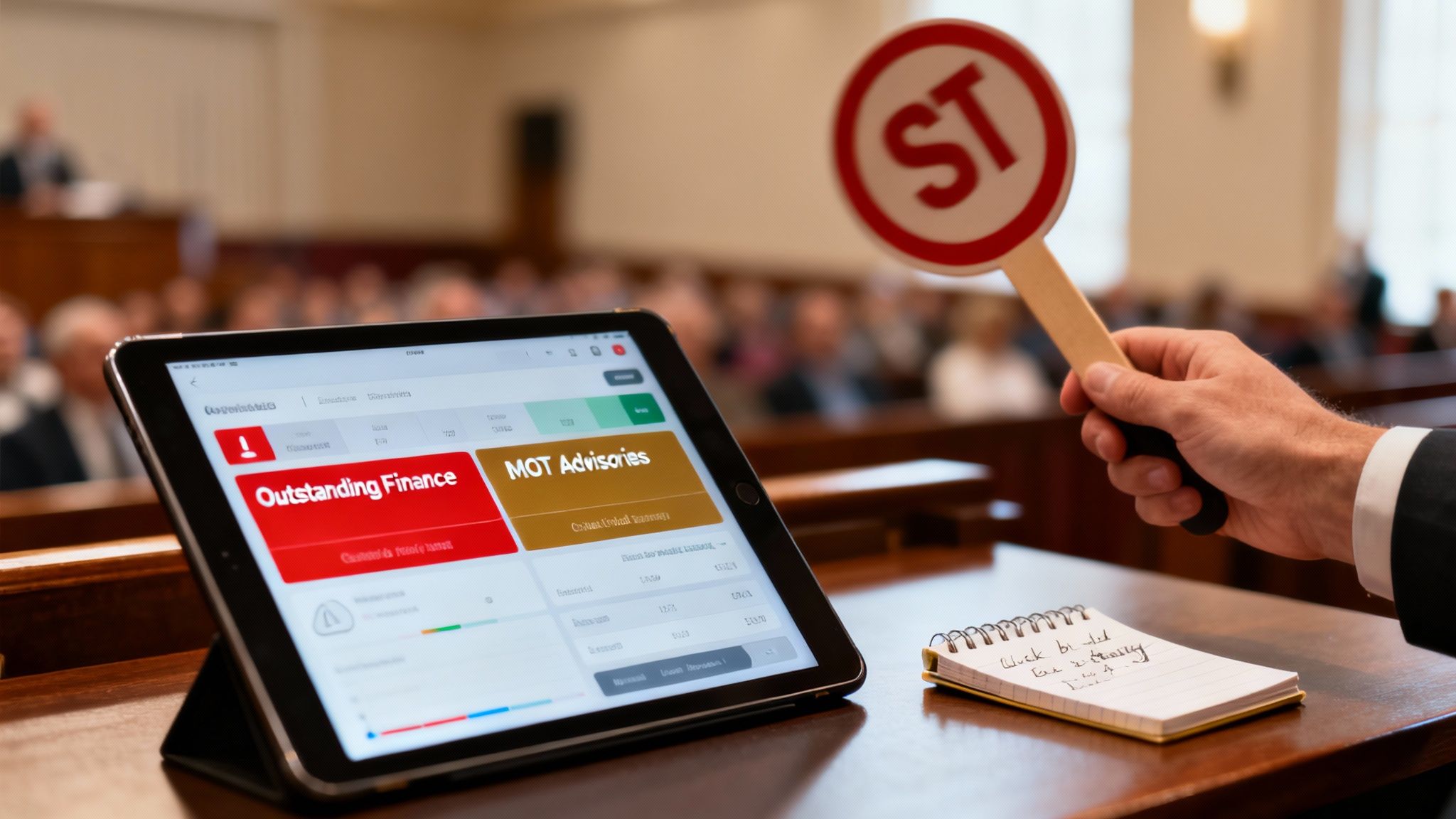
This is where a trade-focused platform like AutoProv really shows its worth. The reports are designed for speed, with simple, colour-coded alerts for major issues like finance, theft, or write-offs.
A green check mark means you can bid with confidence. An amber warning is your cue to check your pre-auction inspection notes. A red flag is an immediate stop. That kind of visual clarity gives you the power to make informed, split-second decisions and ensures you never get caught out in the heat of the moment.
The Real Cost of a Slow Auction Day: Time, Money, and Risk
In the motor trade, we all know that return on investment isn't just about the final sale price. It’s measured in minutes. And on auction day, time is the one thing you simply can't buy more of. Fiddling with multiple websites for DVLA, MOT, and finance data on a single car isn't just a hassle; it’s a direct hit to your bottom line.
The true cost of a manual auction car history check in the UK isn’t what you pay for the reports. It's the deals you miss, the rushed decisions you regret, and the very real risk of a simple mistake costing you thousands under pressure. Every minute you spend piecing together a vehicle's past is a minute you're not inspecting the next car on your list or lining up your next winning bid.
A Disjointed Workflow Will Bleed Your Profits
Let's get real about the old way of doing things. You've got one tab open for a free MOT check, another for a paid finance report, and maybe a third trying to cross-reference DVLA data. For just one car, you can easily sink five, even ten minutes into this – and that's if you've got a decent mobile signal inside a massive, steel-framed auction hall. Good luck with that.
Now, multiply that by the ten or fifteen cars on your initial shortlist. You could easily burn through an hour or more of your prime pre-auction window. This is where the old saying "time is money" stops being a cliché and starts feeling painfully literal.
A proper trade platform like AutoProv is built to kill that friction. By pulling over 40 critical data points into one single report that lands in seconds, it completely changes your approach. Instead of a frantic data-hunt, you get an instant, clear picture. You can vet your entire list in the time it used to take you to manually check maybe two or three cars.
It's never been a question of whether you can afford a professional check. The real question is, can your business afford the time and risk of not using one? Every second wasted fumbling with different websites is potential profit draining straight out of your pocket.
Your Financial Safety Net: The Power of Indemnity
Forget speed for a moment. The single biggest advantage of a professional trade report is the financial shield it gives you. A free check comes with absolutely no guarantees. If that data is wrong—if it misses an outstanding finance agreement or a stolen marker—the financial bomb lands right on your forecourt.
This is where a data guarantee indemnity becomes non-negotiable. It's your financial safety net. When you run a check through AutoProv, you're not just getting data; you're buying peace of mind backed by an Experian indemnity of up to £50,000.
This means if the report says a car is clear, but it later turns out to have an active finance marker you weren't told about, the indemnity covers your loss. The same applies if a stolen marker was missed and the police recover the vehicle from you. This isn’t some abstract perk; it’s a concrete shield that protects your cash flow and the long-term health of your business. It turns a vehicle history check from a simple tick-box exercise into a strategic investment in your own financial security.
A Service That Understands the Trade
At the end of the day, a service like AutoProv is designed for the way we actually work. With trade-grade reports starting from just £3, the cost is a drop in the ocean compared to the potential loss from one bad purchase.
The platform is built around a professional buyer's needs. It gives you instant access not just to the history but to vital market intelligence—current valuations, trade vs. retail pricing, and depreciation forecasts. This is the information that lets you bid smarter, price your stock for maximum profit, and manage your risks with total confidence. It stops being a cost and becomes one of the sharpest tools in your arsenal.
Common Questions from Motor Trade Buyers
If you’re in the trade, you know the auction hall runs on quick decisions and solid information. An auction car history check in the UK is part of the daily grind, but the same questions always seem to come up. Let's get them answered so you can bid with confidence.
Can I Trust the Auction House's Own Checks?
In a word? No. While auction houses provide some basic vehicle details, you can't rely on them to protect your bottom line. Think of their information as a starting point, not the full story.
Their checks often miss the crucial details that can turn a profitable car into a nightmare. We’re talking about hidden finance agreements, a murky MOT advisory history, or specific write-off data from the MIAFTR that drastically alters a vehicle's true market value. To properly cover yourself, you need an independent, indemnified check from a specialist service like AutoProv. It gives you the complete, unbiased picture you need before your hand goes up.
How Quickly Can I Get a Report During an Auction?
Speed is everything when a car is on the block. The last thing you want is to be fumbling with multiple websites on your phone while the auctioneer is rattling through bids. It’s a surefire way to miss out on good stock or, even worse, make a costly mistake under pressure.
This is exactly why professional platforms are built for the job. Services like AutoProv are designed for the fast-paced auction environment, delivering a full, multi-point history check straight to your mobile in seconds. It means you can vet a vehicle in real-time and make that winning bid without a moment's hesitation.
Indemnity is your financial safety net. It protects your business against losses that arise from incorrect or missing information in the vehicle history report. A key feature of professional reports, it turns a check into an insurance policy for your purchase.
What Does Data Guarantee Indemnity Actually Cover?
Think of indemnity as your financial backstop. If a check fails to flag an active finance agreement or a stolen marker and you end up losing money because of it, the indemnity cover (up to a set limit) is there to reimburse you. It’s what separates a basic check from a professional-grade report and it's a core feature of any reputable provider, including AutoProv.
Should I Always Avoid a Category N or S Car?
Not necessarily, but you absolutely have to go in with your eyes wide open. A Category S (structural) vehicle is a different beast entirely from a Category N (non-structural) one, carrying far more risk and demanding a meticulous physical inspection.
A comprehensive history check will confirm the correct write-off category, so you have the facts straight. For a trader with the right skills and contacts, a properly repaired Cat N car bought for the right price can be a great source of profit. The check simply gives you the critical insight you need to properly value the car and decide how high you’re willing to bid.
Frequently Asked Questions
AI-Generated Content Notice
This article was created with the assistance of artificial intelligence technology. While we strive for accuracy, the information provided should be considered for general informational purposes only and should not be relied upon as professional automotive, legal, or financial advice. We recommend verifying any information with qualified professionals or official sources before making important decisions. AutoProv accepts no liability for any consequences resulting from the use of this information.
From our AI insights
- Navigating UK Grey Imports: A Trader's Guide
Understand the complexities and opportunities of UK grey imports for savvy motor traders.
- Uncovering the Real Costs of Vehicle Intelligence Services
Discover hidden fees and data quality issues in vehicle intelligence services.
- Decoding UK Auction Vehicle Histories
Understand how to assess UK auction vehicle histories and uncover hidden risks.
Related Articles

Essential Vehicle Checks Before Buying a Used Car
Learn essential checks to ensure your used car purchase is safe and sound in the UK market.

Why a Provenance Check is Essential for Used Car Buyers
Ensure your used car is a smart investment by understanding the importance of a provenance check and how AutoProv can help.

A Guide to Vehicle Check with VIN Number
A vehicle check with vin number is easily the most important thing you can do before buying a used car. Think of it as your first line of defence—a quick, simple step that pulls back the curtain on a vehicle's past, protecting you from expensive mistakes, legal headaches, and downright dangerous cars.
Published by AutoProv
Your trusted source for vehicle intelligence