
When sourcing an Audi S7 for sale, a motor trade professional is assessing a high-value asset, loaded with both opportunity and significant risk. Healthy margins are achievable, but securing a profitable unit demands a level of due diligence that extends far beyond a standard vehicle inspection. This guide is written specifically for the motor trade. It focuses on the critical vehicle intelligence needed to make informed buying decisions, manage risk, and protect profit.
Understanding the Audi S7 in the UK Trade Market
The Audi S7 occupies a niche that attracts buyers seeking executive comfort combined with high performance. A significant number of these vehicles enter the trade market at the end of a 3-to-4-year lease or PCP agreement, with supply often corresponding to new registration plate changes.
This predictable supply chain presents unique challenges. Many S7s have served as company cars or part of managed fleets. While this may suggest diligent servicing, it can also indicate a history of hard use, a key factor in any risk assessment. Accurately assessing an asset's past is crucial for sound vehicle valuation and market insights.
Key Generational Differences for Trade Valuation
Distinguishing between S7 generations is the first step in any appraisal. The two primary generations in the used market feature entirely different powertrains, which dictates their value, desirability, and potential mechanical liabilities.
- C7 Generation (2012–2018): Equipped with the 4.0-litre TFSI V8 petrol engine, this model is sought after by enthusiasts. However, its engine has well-documented, high-cost vulnerabilities that must be identified during appraisal.
- C8 Generation (2019–Present): The European C8 S7 switched to a 3.0-litre V6 TDI diesel engine with mild-hybrid technology. This model appeals to buyers prioritising torque and fuel economy but introduces a different set of complex diagnostic considerations.
Market Dynamics and Supply Considerations
The powertrain shift from V8 petrol to V6 diesel has bifurcated the S7 market. Early C7 models represent an accessible entry point to the performance segment but often require significant reconditioning expenditure. In contrast, C8s are now entering the market off-lease, featuring modern technology at a higher price point.
A vehicle’s history provides more than a list of events; it reveals its lifecycle. For a performance asset like an S7, interpreting its ownership patterns and maintenance records is what separates a profitable acquisition from a costly error.
Critical Mechanical and Electrical Inspection Points
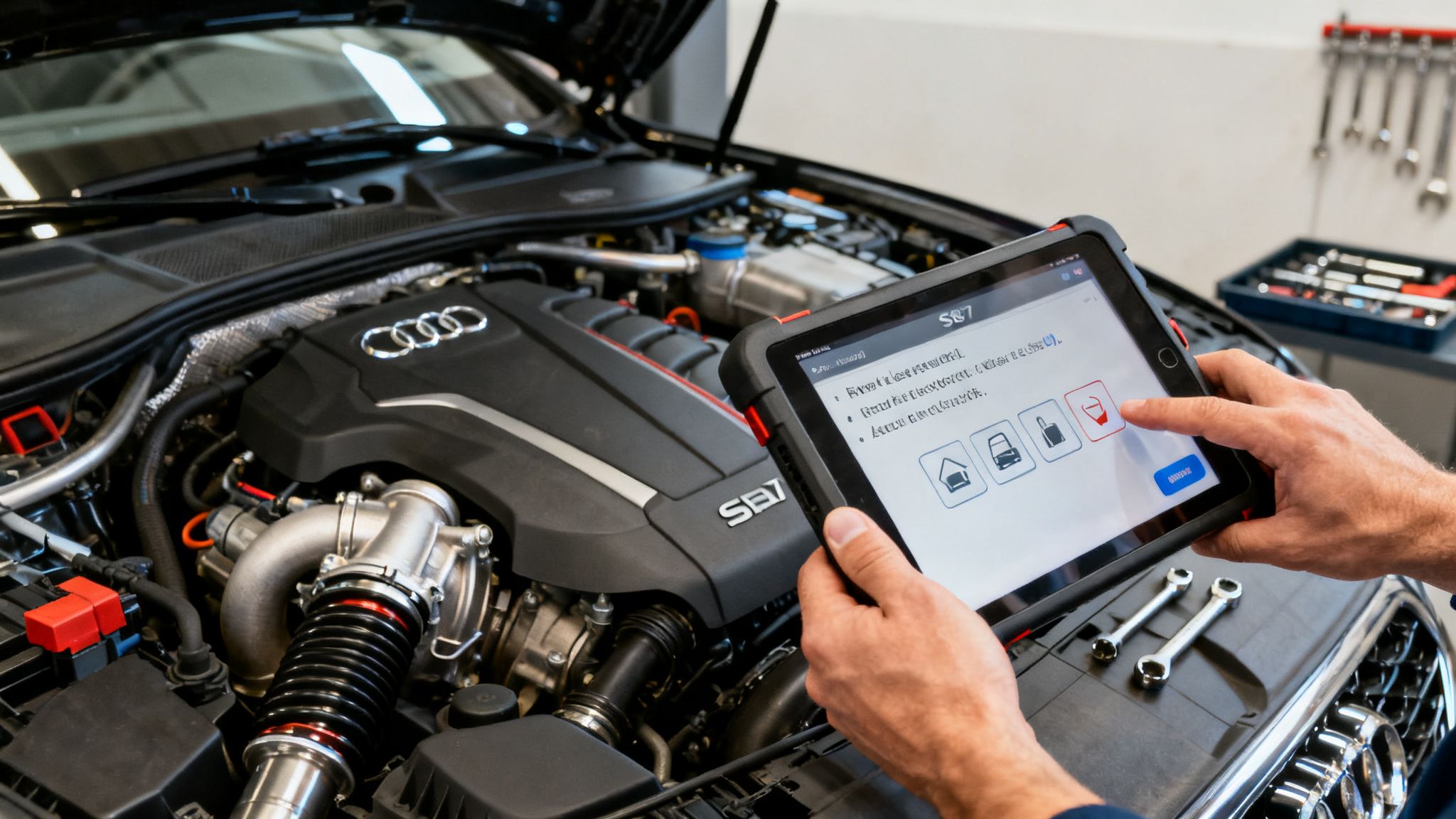
When appraising an Audi S7 for sale, a standard pre-purchase inspection is insufficient. These are complex vehicles with specific, high-cost vulnerabilities that can transform a profitable unit into a workshop liability. A deeper, model-specific assessment is required to accurately factor potential reconditioning costs into any bid.
This level of motor trade risk assessment is non-negotiable for the S7. It begins before the engine is started and targets known failure points to identify expensive issues that less thorough inspections may miss.
The 4.0 TFSI V8 Engine: A Known Risk
The C7’s V8 engine design places the twin turbochargers within the 'V' of the engine block. This configuration creates an intense heat trap, leading to its most notorious and costly fault.
The primary failure point is the turbo oil feed screens. These mesh filters become clogged with carbonised oil, starving the turbochargers of lubrication and leading to catastrophic failure. A full turbocharger replacement can cost £4,000-£6,000 in the trade, a figure that will eliminate any potential margin.
Indicators of V8 Turbocharger Issues:
- Cold Start Rattle: A sharp metallic rattle can indicate a failing turbocharger wastegate actuator.
- Blue Smoke on Acceleration: This is a classic sign of oil burning past worn turbo seals, signalling imminent failure.
- Specific Fault Codes: Underboost codes, such as P0299, are a direct pointer to turbocharger problems. A full diagnostic scan is critical.
Drivetrain and Suspension Weaknesses
The S Tronic dual-clutch transmission is generally robust, but its mechatronic unit is a known weak point. Failure manifests as jerky gear changes, dashboard warnings, or a complete loss of drive. Repair or replacement is a specialist task costing upwards of £2,000. Pay close attention to shift quality during the road test, particularly at low speeds.
The standard-fit air suspension system is another high-cost component. Observe whether the vehicle sits level and listen for a constantly running compressor, which indicates a leak in the system.
An uneven stance or a ‘chassis fault’ warning is an immediate red flag requiring significant further investigation. A single replacement air strut can cost £700-£1,000, and a failed compressor adds another £500 plus labour.
Electrical Systems and ADAS
The S7 is equipped with complex electronic systems that introduce another layer of potential costs. Faults can be intermittent and difficult to diagnose without appropriate equipment. For a more detailed breakdown, refer to our guide on the ultimate used car inspection checklist for UK buyers.
Key electrical systems to verify:
- MMI Infotainment: Confirm the screen deploys correctly and all functions are responsive. A blank or flickering screen often indicates a pending control unit replacement.
- Adaptive Headlights: Test the adaptive lighting system. Faulty level sensors or control modules are common and expensive to rectify.
- Driver-Assistance Systems (ADAS): Verify the operational status of all ADAS features. Check for evidence of windscreen replacement, as incorrect ADAS calibration after windshield replacement can disable critical safety systems.
Audi S7 Common Fault Inspection Checklist
This summary outlines high-risk components, key inspection points, and estimated trade repair costs to inform your appraisal.
Component/System Key Inspection Point / Symptom Estimated Trade Repair Cost 4.0 TFSI Turbochargers Blue smoke on acceleration, underboost fault codes (P0299), cold start rattle. £4,000 - £6,000 S Tronic Mechatronic Unit Jerky/hesitant gear changes, "Gearbox Malfunction" warning light, loss of drive. £2,000+ Air Suspension System Car sitting unevenly, constantly running compressor, "Chassis Fault" warning. £700 - £1,500 (per corner/compressor) MMI Infotainment Screen Screen not deploying, flickering, or completely blank. £500 - £800 PCV Valve / Oil Separator Whistling noise from engine bay, excessive oil consumption. £300 - £500 These figures are estimates for parts and specialist labour and do not account for workshop time or the impact on the vehicle's retail value. Identifying these issues before acquisition is essential to protect your margin.
Analysing Vehicle Provenance and Ownership History
A thorough mechanical inspection is critical, but for a high-performance asset like an Audi S7, the vehicle itself provides only part of the story. Significant risk is often concealed within its provenance. While a standard used car history report offers a snapshot, true trade vehicle intelligence comes from analysing the vehicle's complete ownership journey.
This deep analysis is non-negotiable for the S7, as these vehicles attract risks that basic checks often overlook, such as rapid ownership cycles and repeated movement through the wholesale market. A 'clean' report can mask a problematic history, creating issues for retail or leading to post-sale disputes.
Beyond the Basic Vehicle History Check UK
It is essential to move beyond the pass/fail mentality of a standard history check. Treat the V5C and MOT history as forensic documents. The number of previous keepers is a starting point; the context surrounding those changes provides the real intelligence.
Look for patterns that indicate heightened motor trade risk:
- Rapid Keeper Changes: Multiple owners in a short period (e.g., three keepers in 24 months) is a significant red flag, potentially indicating unresolved faults or use for illicit activities.
- Wholesaler Churn: An S7 passed between several traders in quick succession suggests that other dealers may have inspected the vehicle and identified undesirable issues.
- Suspicious MOT Gaps: Significant gaps between MOT tests, particularly aligned with keeper changes, may mean the vehicle was off the road for major repairs or even exported and re-imported.
This level of scrutiny requires advanced tools. AutoProv's provenance intelligence, for instance, highlights that a significant percentage of performance vehicles exhibit rapid resale patterns, which directly correlates to a higher incidence of underlying issues compared to mainstream models. This is a specific risk that a standard check would likely miss.
Interpreting Ownership Patterns as Risk Signals
Effective vehicle provenance analysis is about connecting disparate data points. A vehicle first registered to a fleet operator and then quickly sold to a private owner in a remote location warrants investigation. This pattern could suggest a hard-driven ex-lease vehicle disposed of at the first sign of trouble.
A vehicle’s history is a narrative. Short chapters and abrupt plot changes are often indicators of underlying problems. The objective is to read between the lines to protect your investment.
A detailed vehicle provenance report provides the necessary context. It cross-references ownership timelines with MOT data, mileage logs, and insurance events to build a comprehensive picture. This is how you identify the anomalies that signal hidden issues—the kind of problems that directly impact valuation and retail confidence.
Ultimately, deconstructing an S7's history is a risk mitigation exercise. By scrutinising every detail of its past, from keeper count to the consistency of its MOT records, you can filter out problematic vehicles before they enter your stock. This forensic approach is fundamental to protecting capital and reputation.
Decoding Mileage and Service History Anomalies
For a performance vehicle like an Audi S7 for sale, the mileage and service history are primary sources of truth regarding its past treatment. A cursory review is insufficient; it is necessary to forensically cross-reference every invoice, MOT certificate, and digital service record to identify inconsistencies that may signal significant issues.
This process is more than a simple mileage check UK. It involves reconciling the service book, physical invoices, and official MOT history. Discrepancies are often the first indicator of a larger problem, such as deferred maintenance or mileage fraud ('clocking').
Spotting Non-Linear Mileage Progression
A common red flag is mileage that does not progress logically. A vehicle's mileage should increase at a reasonably consistent rate. Sudden large jumps or extended periods of stagnation require investigation. For example, a car that averages 12,000 miles annually for three years, then records only 1,000 miles between MOTs, may have been off the road for undisclosed major repairs.
Conversely, a significant, unexplained drop in recorded mileage between tests is a classic sign of clocking. While modern digital odometers are more difficult to alter, mileage fraud remains a persistent threat. Without robust data analysis, it can be very difficult to detect.
The MOT history is a primary tool for constructing a vehicle’s timeline. Any discrepancy, however small, must be investigated. An inconsistent mileage log often points to a more significant, and costly, underlying issue.
Aligning Service Records with Ownership Changes
It is also crucial to align the service history with keeper changes recorded on the V5C. A long-term owner who services the vehicle just before sale is a positive signal. In contrast, a vehicle that has passed through multiple owners in a year with no corresponding service invoices is a major concern.
This is where professional dealer vehicle checks become essential. For example, AutoProv's data indicates a high percentage of used performance Audis have mileage inconsistencies. Deeper analysis of ownership timelines frequently flags these same vehicles for wholesaler churn. As new registrations increase market supply, trade buyers face a rising number of disputes over undisclosed faults. Proper risk intelligence, including analysis of MOT failure rates and insurance history, is needed to protect your margin. For context, you can review trends shaping the Audi market from their official press releases.
A robust vehicle history check UK designed for the trade automates this cross-referencing process. Platforms providing trade vehicle intelligence analyse multiple datasets simultaneously, highlighting patterns that are nearly impossible to detect manually. This turns raw data into actionable intelligence, enabling you to identify high-risk vehicles before acquisition, as detailed in our guide on conducting a DVLA mileage check.
Using Vehicle Intelligence for Smarter Acquisitions
Ultimately, all mechanical, provenance, and mileage checks culminate in a single decision point. Whether at auction or appraising a part-exchange, the skill lies in translating complex data into a clear 'buy' or 'no-buy' judgement. This is where trade vehicle intelligence transitions from a background check to an active, point-of-decision tool.
A modern vehicle provenance report, such as that from AutoProv, is designed for this specific purpose. It does not merely present raw data; it synthesises information from ownership timelines, MOT records, mileage logs, and insurance events into clear, actionable risk signals. The objective is to turn information into a competitive advantage when sourcing a high-value asset like an Audi S7 for sale.
From Data Points to Actionable Insight
The goal is to move beyond a simple "clear" or "not clear" result. True intelligence is found in identifying patterns. A vehicle with a clean provenance check but three keepers in 18 months requires a different valuation approach than a one-owner vehicle with a complete main dealer service history. Recognising this pattern allows you to bid with confidence, having already factored in the potential risk.
This infographic illustrates a decision-making process for assessing an S7's service history—a critical component of its overall provenance.
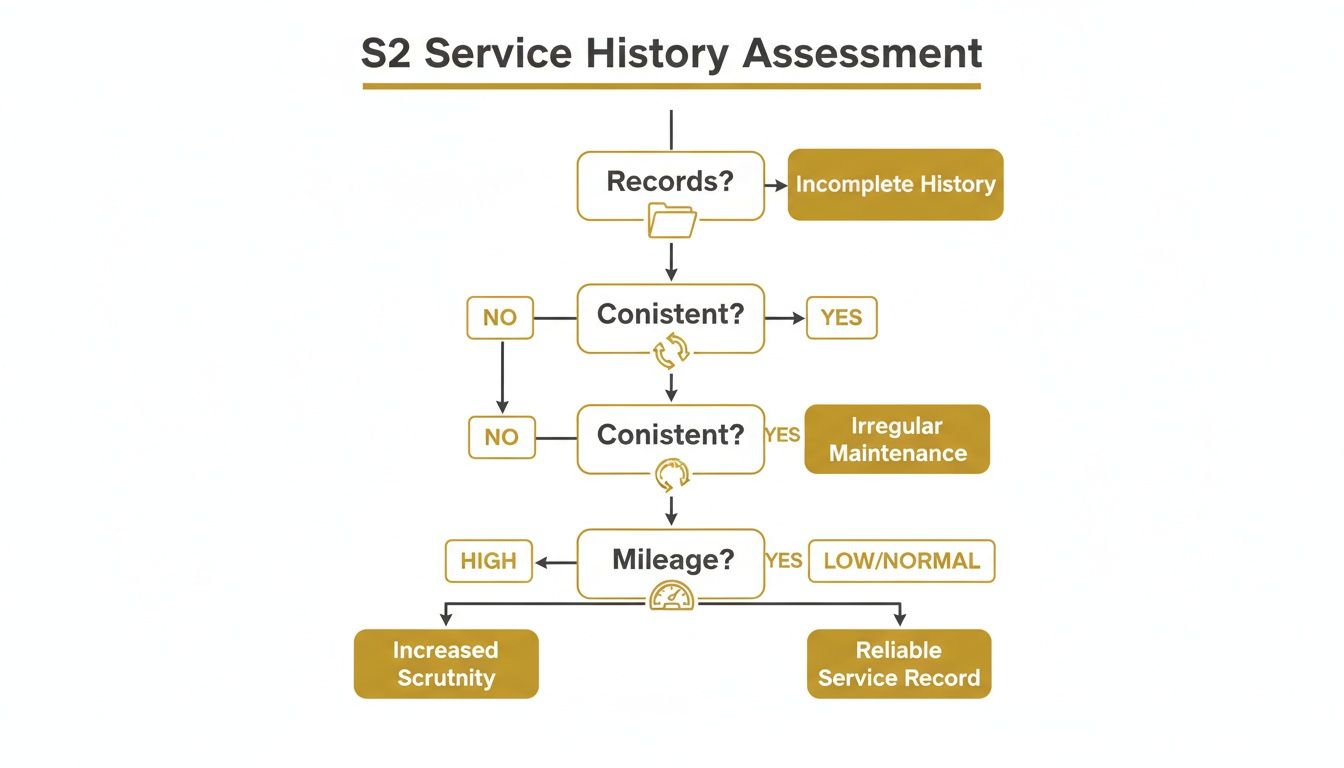
As the flowchart demonstrates, any inconsistencies in service records or mileage logs should immediately prompt a more cautious valuation to reflect the increased risk.
This proactive risk assessment is non-negotiable in the current market. According to SMMT's official used car sales data, the market is active, but this activity conceals hidden risks, particularly in the performance sector. For example, internal analysis shows a significant percentage of high-mileage luxury Audis have ownership anomalies, such as multiple short-term trades indicative of wholesaler flips. By using advanced dealer vehicle checks, traders can identify mileage discrepancies and hidden insurance markers that basic reports miss.
The greatest risk in the motor trade is not the vehicle with obvious faults, but the one with a hidden history. Better intelligence does more than find problems—it prevents them from entering your stock.
Shifting from basic checks to proactive risk assessment is a core strategy for protecting your business. It provides the intelligence to avoid problematic vehicles that consume time and capital while damaging your reputation. By integrating a deep understanding of a vehicle’s past—including its original factory specification, which can be verified with a vehicle build spec sheet report—you can make smarter, more profitable acquisition decisions.
Trader FAQs: Key Considerations When Sourcing an S7
When attempting to source a clean Audi S7 for sale, the relevant questions are about risk, margin, and capital protection. Here are direct answers to common queries from motor trade professionals.
What is the single biggest mechanical risk on a C7 V8 S7?
Without question, it is turbocharger failure. This is a well-documented weakness of the 4.0 TFSI engine, caused by oil starvation due to clogged oil feed screens. Blue smoke on startup or an underboost fault code are final warnings.
Failing to identify this issue can result in a trade repair cost of £4,000 to £6,000, which will likely eliminate the entire profit margin on the vehicle. A specific check for this fault is non-negotiable.
Is the C8 Diesel a lower-risk vehicle to stock?
The C8's V6 TDI powertrain avoids the V8's specific turbocharger issue, but it is not inherently lower risk. It introduces a different set of complex components, including the mild-hybrid system and advanced emissions controls.
A fault in these systems can be equally complex and expensive to rectify. It is not a "safer" vehicle to acquire; it simply requires a different diagnostic focus and risk assessment.
Is a "Clean" provenance check sufficient?
No. A clean provenance check is the minimum baseline. It provides no insight into the vehicle's operational history. It will not flag rapid ownership changes, nor will it identify a vehicle that has been passed repeatedly through the wholesale network.
Crucially, it cannot detect the subtle mileage inconsistencies between service records and MOTs that indicate high risk. A deeper analysis of the car's vehicle provenance is required to see the patterns a basic check will always miss.
A standard history check shows what has been officially recorded. A comprehensive provenance analysis reveals how the vehicle has actually been used, maintained, and traded. For a professional buyer, that is where the true risk—and opportunity—is found.
Can mileage fraud on a modern Audi S7 be detected?
Visually, it is nearly impossible. Modern digital dashboards make detecting a 'clocked' S7 extremely difficult without robust data analysis. The only effective defence is a professional mileage check UK that triangulates all available data points.
This requires cross-referencing MOT history, service records, and ownership timelines to flag any anomalous progression. The subtle discrepancies that a manual check would miss are precisely what a professional-grade vehicle history check UK is designed to identify.
At AutoProv, we deliver the advanced vehicle provenance and risk intelligence the UK motor trade depends on. Move beyond basic checks and protect your bottom line with insights built for professional buyers. See how we do it at https://autoprov.ai.
Frequently Asked Questions
AI-Generated Content Notice
This article was created with the assistance of artificial intelligence technology. While we strive for accuracy, the information provided should be considered for general informational purposes only and should not be relied upon as professional automotive, legal, or financial advice. We recommend verifying any information with qualified professionals or official sources before making important decisions. AutoProv accepts no liability for any consequences resulting from the use of this information.
From our AI insights
- Essential Pre-Purchase Checklist for UK Motor Traders
Ensure a seamless vehicle acquisition with our detailed pre-purchase checklist tailored for UK motor traders.
- Leveraging Auction Data for Strategic Car Purchases
Discover how to use auction data effectively to make profitable car buying decisions.
- Auction Pitfalls: Avoiding Costly Mistakes
Navigate UK car auctions with confidence by avoiding finance, write-off, and mileage risks.
Related Articles

Your Ultimate Guide to Buying a Used Car in the UK
Navigate the UK used car market with confidence using our comprehensive buying guide. Tips, checks, and AutoProv Provenance insights included.

Difference Between MOT and Service: What You Need to Know
An MOT is a mandatory legal inspection that every car on UK roads needs to pass.Think of it as the government's way of ensuring your vehicle meets the absolute minimum safety and environmental standards to be considered roadworthy. A service, on the other hand, is a completely different beast. It's the proactive maintenance routine recommended by the people who built your car, designed to keep it running smoothly and catch problems before they start. In short, an MOT is a pass-or-fail exam required by law. A service is a comprehensive health plan for your car.

Your Ultimate Used Car Inspection Checklist
A solid used car inspection checklist is the single most powerful tool you have to avoid buying a lemon. It gives you a methodical way to look past the shiny paint and assess a car's real condition, helping you spot hidden problems and get a fair price before you shake hands on the deal.
Published by AutoProv
Your trusted source for vehicle intelligence