
For anyone in the motor trade, the title of "best fuel car" isn't about chasing the highest MPG figure. It's a strategic calculation. The real measures of success—the ones that dictate profitability on your forecourt—are market demand, Total Cost of Ownership (TCO), and resale value.
For anyone in the motor trade, the title of "best fuel car" isn't about chasing the highest MPG figure. It's a strategic calculation. The real measures of success—the ones that dictate profitability on your forecourt—are market demand, Total Cost of Ownership (TCO), and resale value.
What a "Best Fuel Car" Really Means for Your Business Today

The conversation has moved far beyond a simple petrol versus diesel debate. For any modern UK dealership or remarketer, the landscape is a complex mix of internal combustion engines (ICE), battery electric vehicles (BEVs), and a whole spectrum of hybrids. This shift demands a much smarter, data-led approach to sourcing and pricing your stock.
It's a fast-moving market. With fluctuating fuel prices, the constant expansion of Clean Air Zones, and rapidly changing buyer attitudes, what sold well last year could easily become a liability gathering dust on the forecourt today. A car that seems economical at the pump can be a nightmare to own due to high road tax, steep insurance premiums, or brutal depreciation. That makes it a tough sell for your customers and a real drain on your margins.
The Shifting Tides of Consumer Demand
The market data tells a clear story. We're seeing a significant drop in demand for traditional petrol and diesel cars, which directly impacts what you should consider a profitable asset for your inventory. You simply can't ignore the historic fall in registrations for these fuel types if you want to stay ahead of the curve.
For instance, recent SMMT data shows petrol registrations fell by 8.5%, pushing market share to just under 45%. Diesel's decline was even more dramatic, dropping 22.9% to a market share below 5%. You can explore more about these market shifts and what they mean for the industry.
These aren't just numbers on a page; they're direct signals from the market telling you where consumer money is (and isn't) going. Ignoring these trends is a surefire way to tie up capital in vehicles that are harder to shift and almost guaranteed to depreciate faster.
Building a Profitable and Future-Proof Inventory
A forward-thinking acquisition strategy now hinges on a much deeper analysis of each vehicle's potential. This means looking well beyond the fuel type and asking the right questions:
- Regional Suitability: Is that diesel saloon still a smart buy for high-mileage commuters in your area? Or has the local charging infrastructure made BEVs a more attractive, and therefore more sellable, option for your typical customer?
- Total Ownership Costs: How do the servicing requirements, VED bands, and insurance groups for a hybrid stack up against its petrol counterpart? These are the real-world costs that heavily influence a buyer's decision.
- Verified History: Does the vehicle have a clean bill of health? A hidden write-off status or clocked mileage can instantly turn a promising vehicle into a significant loss.
This is precisely where a data-first approach becomes absolutely essential. Relying on gut feelings or outdated assumptions just doesn't cut it anymore. To build a profitable inventory, every single buying decision must be backed by solid, verifiable data.
Using a comprehensive vehicle intelligence platform like AutoProv provides the clarity needed to navigate this complex market. It transforms due diligence from a simple background check into a powerful strategic tool, helping you manage risk and ensuring every "best fuel car" you acquire is also the best possible investment for your business.
Calculating the True Total Cost of Ownership

This is where the real money is made or lost. For any professional buyer, looking past the windscreen price isn't just good practice—it's essential. The Total Cost of Ownership (TCO) is the single most important metric you have for sizing up potential stock. It tells the true financial story of a vehicle, moving way beyond the initial outlay to paint the full picture of its long-term profitability.
Relying solely on the purchase price is a rookie mistake, and a costly one at that. A car that looks like a bargain at auction can quickly turn into a financial headache once you factor in all the real-world expenses that pile up while it sits on your forecourt and throughout its life with the next owner. These hidden costs chip away at your bottom line and can make a vehicle much harder to sell.
Beyond the Purchase Price
Figuring out the TCO involves a methodical look at all the associated costs. These are the key variables every dealership and remarketer has to weigh up before signing on the dotted line. Each one plays a part in the vehicle's overall financial performance as an asset on your books.
- Insurance Groups: A car in a high insurance group (think 40-50) will cost a customer a fortune to insure compared to one in a lower group (like 1-10). This has a direct impact on its market appeal and how quickly you'll be able to shift it.
- Vehicle Excise Duty (VED): VED bands, tied to CO2 emissions, can be a deal-maker or a deal-breaker. They range from £0 for many electric vehicles to over £2,000 for the first year on high-emission models. This is a massive selling point—or a major turn-off—for buyers.
- Servicing and Maintenance: The cost and frequency of servicing vary massively between different powertrains. A BEV, with far fewer moving parts, typically has much lower routine maintenance bills than a complex petrol or diesel engine. This difference really influences its long-term value proposition.
- Fuel and Energy Costs: This is the most obvious running cost, but it needs a careful eye. You have to balance the lower cost per mile of electricity against the ever-changing prices of petrol and diesel, all while thinking about the typical mileage of your target customer.
Protecting your profit margin means understanding that a cheaper car isn't always a cheaper asset. The true value is found by forecasting all ownership costs, from VED to servicing, to determine a vehicle's genuine long-term profitability.
The Depreciation Curve
Depreciation is the single biggest cost of ownership and the greatest threat to your profitability. It’s the silent killer of margins. A vehicle that drops in value like a stone can wipe out any potential profit before you've even had a chance to sell it. Understanding how different models and fuel types lose value over time is fundamental to smart stock acquisition.
For instance, certain BEVs and hybrids might have a higher initial price tag but often enjoy a slower depreciation curve thanks to high demand and lower running costs. On the other hand, a big-engine luxury saloon might seem like a steal at auction, but its steep depreciation can make it a very risky investment.
Analysing these trends is vital. With the market valuation data provided by AutoProv, you can forecast a vehicle's future value with confidence, ensuring you price it right from day one and understand its long-term depreciation curve.
A Practical TCO Comparison
Let's walk through a real-world scenario. Imagine you're choosing between three versions of a popular five-door family hatchback, all three years old with similar mileage: a 1.5-litre petrol, a self-charging hybrid, and a fully electric (BEV) model.
The petrol model will almost certainly have the lowest sticker price, making it seem like the obvious choice. But hold on. The hybrid will likely have a lower VED band and much better fuel economy, especially for city driving. The BEV, while being the most expensive to buy, will have zero VED, the lowest 'fuel' costs, and cheaper servicing.
By running the TCO numbers for each over a projected 12-month period, you might discover that the higher-priced hybrid or BEV actually represents a more profitable and desirable asset for your particular market. This data-driven approach, powered by insights from a service like AutoProv, turns a gut feeling into a calculated business strategy. It ensures the best fuel car for your inventory is also the best for your bottom line.
Matching the Right Powertrain to Your Market
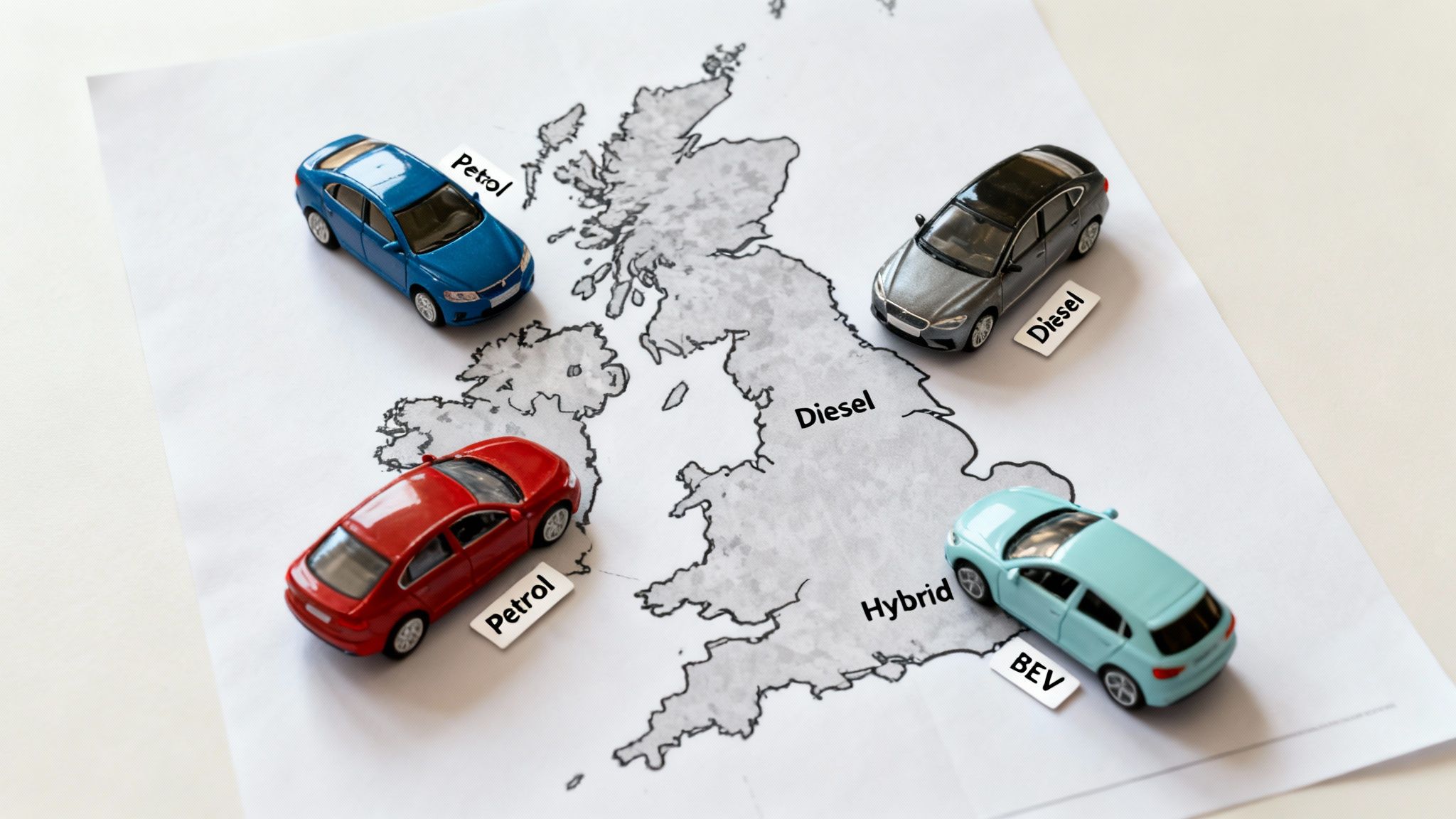
Petrol, diesel, hybrid, or full electric? Picking the right mix for your stock isn’t a one-size-fits-all game anymore. The best answer comes down to your specific customers, your region, and the unique quirks of your local market.
Get this right, and you’ll have a fast-moving, profitable inventory. Get it wrong, and you’re looking at a forecourt full of depreciating assets that just won’t shift.
A generic approach to buying is a recipe for disaster. What sells like hot cakes in central London could be a complete dud at a rural dealership in the Scottish Highlands. Success is all about digging into those local nuances and building a stock profile that your community actually wants.
City Centre vs. Motorway Miles
The most fundamental split in demand boils down to one simple question: where will the car be driven? For any dealership in or around a major city, the maths has changed dramatically over the last few years.
Think about a typical city-based buyer. Their daily drive is probably short, stop-start journeys, the school run, and battling through congested streets. For this customer, the best choice is almost always a hybrid or a full Battery Electric Vehicle (BEV).
- ULEZ and CAZ Compliance: This is the big one. For urban stock, it’s non-negotiable. Any vehicle that falls foul of local Clean Air Zone rules is an instant hard sell, killing its appeal and its resale value.
- Running Costs: Hybrids shine in city traffic where regenerative braking can make a real difference to fuel economy. BEVs, of course, offer the lowest cost-per-mile, a massive selling point for anyone dealing with high city living costs.
- Charging Infrastructure: While still a factor, cities generally have a much higher density of public charging points. This makes BEV ownership a practical reality for far more people, even those without a driveway.
Now, flip the coin. A dealership serving customers who rack up high annual mileages on motorways will see a completely different demand profile. For these long-distance drivers, a modern, Euro 6 compliant diesel can still be an incredibly efficient and sensible choice, often beating hybrids on fuel economy over a long run. But its appeal is narrowing, making it much more of a specialist stock item.
The Electric Revolution Is Here
The shift to electric vehicles is reshaping the UK market at a blistering pace. This isn't some far-off trend; it's happening right now, and the data paints a crystal-clear picture. For a growing number of buyers, BEVs are rapidly becoming the go-to choice.
In fact, recent figures from the Society of Motor Manufacturers and Traders (SMMT) show BEVs grabbed 26% of new car sales in October 2025, a huge 23.6% year-on-year jump. Add in the 27.2% rise in plug-in hybrid sales, and you’ll see that electrified vehicles made up 40% of all new registrations that month. You can discover more insights on these EV market trends and what they mean for the industry.
This data is a clear signal to the motor trade: demand for electric and hybrid powertrains is strong and growing, and it's already influencing second-hand values and what buyers expect to see on your forecourt. To dig deeper, you can explore our full analysis of the future of automotive technology in the UK.
The key takeaway is this: your inventory must reflect local realities. A deep understanding of regional resale values, local charging availability, and your customer's typical driving patterns is crucial for stocking vehicles that meet genuine demand.
Ultimately, curating a profitable inventory requires a forensic understanding of your specific market. It means looking beyond broad national trends and focusing on what drives buying decisions in your postcode. By using detailed vehicle data from a platform like AutoProv, you can analyse specific models and fuel types, ensuring every vehicle you buy is a perfect match for your audience, moves quickly, and maximises your margins.
Uncovering a Vehicle's True History
A car’s past is the best predictor of its future value. That attractive price tag can easily be hiding a history of expensive problems—the kind that don't just eat into your profit margins but can seriously damage your reputation. Proper due diligence isn't just a box-ticking exercise; it's the bedrock of any smart buying strategy.
Skipping this part is like buying a house without getting a survey. Sure, you might get lucky. More likely, you'll uncover costly, hidden issues long after the deal is done. A vehicle's real story is rarely on the windscreen sticker; you have to dig for it in its history.
This is where you learn to separate the genuine bargains from the well-disguised liabilities. It takes a methodical eye, looking right past the shiny paintwork to find the hard evidence that truly determines a vehicle's worth and safety.
Scrutinising the MOT History
The MOT history is always your first port of call. It’s a year-by-year chronicle of a vehicle's health, and it tells you a lot more than just whether it passed or failed. You’re looking for patterns.
A recurring advisory for worn suspension components, for instance, is a clear warning of future repair bills. Consistent mentions of corrosion on brake pipes or sub-frames can signal a car that’s had a rough life, especially if it’s been run in areas where roads are heavily gritted in winter.
But it’s not just about spotting individual faults. It’s about building a picture of how the vehicle has been looked after. A history littered with minor, cheap-to-fix advisories that were never sorted? That screams neglect, and it’s a massive red flag for any buyer.
Finance, Write-Offs, and Clocking
Beyond the MOT, there are three critical checks that can save you from absolute financial disaster. These are the non-negotiables, the deal-breakers that can turn a promising asset into a significant loss in a heartbeat.
- Outstanding Finance: A surprising number of used cars on the market still have finance owed on them. If you buy one, you don't legally own it—the finance company does. It could be repossessed at any moment, leaving you massively out of pocket.
- Salvage and Write-Off History: This is probably the most critical check of all. An undeclared Category S (structural) or Category N (non-structural) write-off completely decimates a car's value and integrity. Selling one on without declaring its past can land you in serious legal trouble.
- Mileage Verification (Clocking): A car’s mileage is a primary driver of its valuation. "Clocking"—the illegal act of winding back the odometer—is still a common type of fraud. It doesn't just artificially inflate the price; it hides excessive wear and tear on the engine, gearbox, and everything else.
A price that looks too good to be true usually is. Whether it's hiding outstanding finance, a write-off status, or a clocked odometer, finding out before you buy is the only way to protect your investment and your reputation.
The Power of a Comprehensive Check
Trying to chase down all this information manually is a slow, painful process, and it’s easy to miss something. This is exactly why a professional vehicle check should be a core, non-negotiable part of your buying workflow. It turns a complex, risky task into a simple, instant verification.
A single, detailed report from a service like AutoProv pulls everything you need into one place, in seconds. It combines data from the DVLA, MOT records, the Police National Computer (PNC) for stolen vehicle status, and the Motor Insurance Anti-Fraud and Theft Register (MIAFTR) for write-off information. You get immediate clarity.
For example, an AutoProv report will cross-reference mileage readings from every available source—MOTs, service records, you name it—to instantly flag discrepancies that point to clocking. It gives you the confidence to walk away from bad investments and the hard data you need to price your stock with pinpoint accuracy. For a more detailed walkthrough, you can check out our guide on how to check a car's history in the UK. This data-first approach ensures that every car you consider has a transparent history you can actually trust.
A Hands-On Vehicle Inspection Checklist
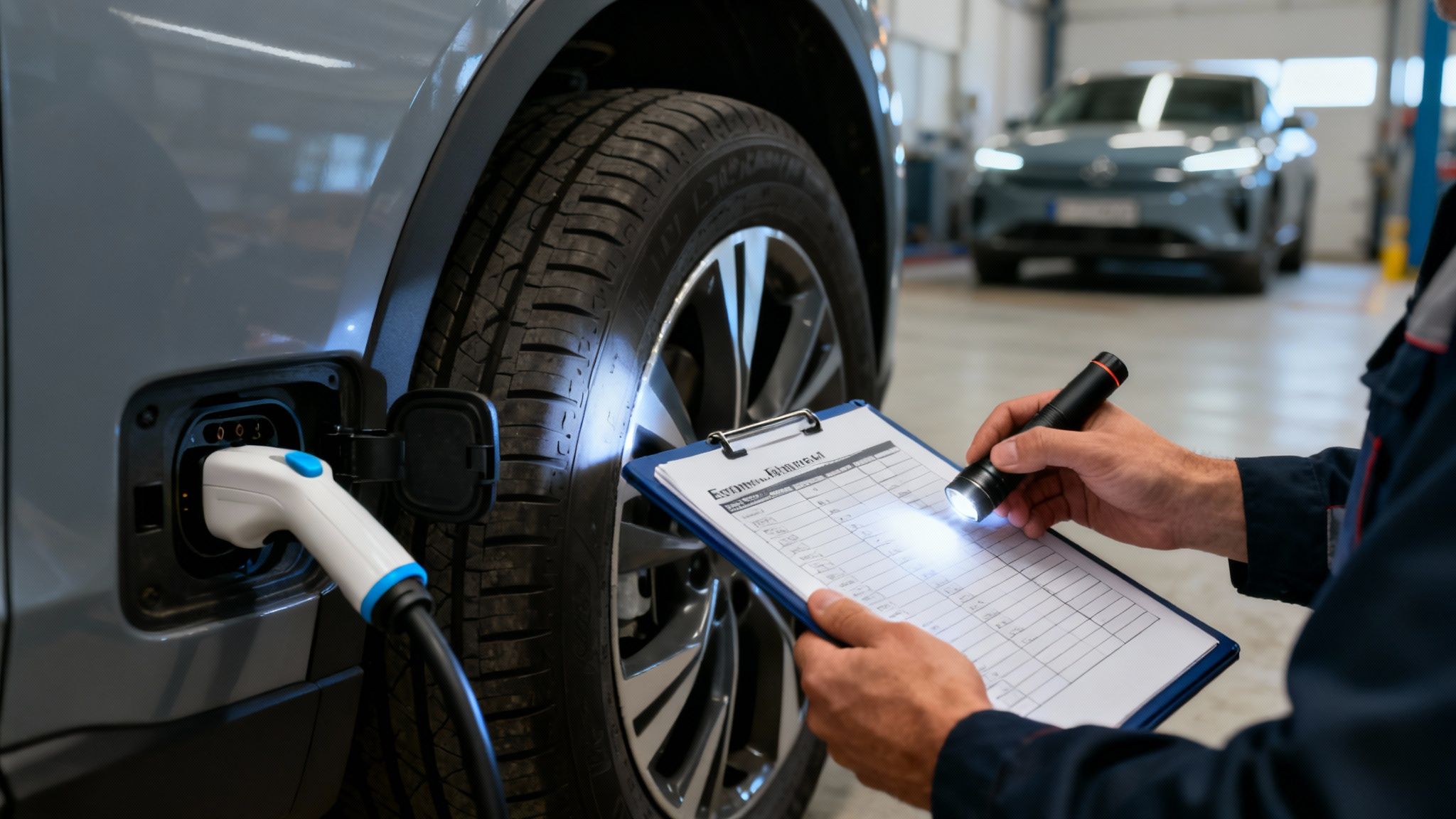
Once an AutoProv report gives you the all-clear on paper, the physical appraisal is your final line of defence. This is where your expertise comes in, confirming the metal matches the data. A sharp, systematic inspection is what separates a profitable unit from a problem car that ties up capital on your forecourt.
A quick walk-around just doesn't cut it. To stay ahead, you need a repeatable process that spots the subtle flaws amateurs miss. This ensures every buyer on your team can perform a consistent, expert-level evaluation, protecting your bottom line with every vehicle you acquire.
Reading the Bodywork and Tyres
A fresh wash and polish can hide a world of hurt, so you need to know exactly what to look for. Start with the panel gaps. Run your hand along the seams between the doors, wings, and bonnet – they should be tight and perfectly uniform.
Any unevenness is a dead giveaway for a past shunt and subpar repair work. Next, get your eyes on the paint. Look for subtle variations in colour or texture between panels by viewing the car from different angles in good light. It’s often the best clue you’ll get about a vehicle’s hidden history.
Now, move on to the tyres. They tell you a surprising amount about the car’s underlying health. Don't just glance at the tread depth; analyse the wear pattern.
- Wear on both outer edges? Usually just under-inflation. An easy fix.
- Wear down the centre? The previous owner likely ran them over-inflated.
- Wear on just one edge (inner or outer)? This is the one to watch. It’s a major red flag for wheel alignment issues, which could be a simple track-rod end or a symptom of deeper suspension damage.
Scalloped or uneven wear across the tread can also point to unbalanced wheels or shot shock absorbers. These details paint a clear picture of how the car’s been treated and what you’ll need to put right before it’s ready for a customer.
Inside the Cabin and Under the Bonnet
Happy with the outside? Time to get in. The cabin’s condition should line up with the odometer reading. A car showing 30,000 miles shouldn’t have a steering wheel polished smooth, a frayed driver’s seat bolster, or a worn-out gear knob. Discrepancies like these should set your alarm bells ringing about potential clocking.
Be methodical. Test every single button, switch, and function. Does the air-con blow ice-cold? Do all the windows glide up and down without hesitation? And critically, do all the dashboard warning lights illuminate on startup and then extinguish as they should? Any light that stays on demands immediate investigation.
Under the bonnet, pull the dipstick and check the caps. The engine oil shouldn’t look like sludge, and the coolant should be a vibrant colour, not a murky, rusty brown. Have a good look around the engine block, hoses, and gaskets for any tell-tale signs of oil or fluid leaks.
When it comes to a hybrid, the crucial test is feeling the transition between electric and petrol power on the road. It should be virtually seamless. Any clunking, hesitation, or noticeable shudder is a clear warning of potential powertrain trouble ahead.
Specific Checks for BEVs
Inspecting a Battery Electric Vehicle (BEV) means shifting your focus from the engine bay to the battery and charging systems. Start at the charging port. Look closely for any physical damage, scorch marks from arcing, or excessive wear on the connection pins.
Next, get into the car’s on-board computer and find the battery’s "State of Health" (SoH), if the vehicle displays it. This percentage gives you a solid estimate of battery degradation. A significant drop from 100% on a low-mileage car is a definite cause for concern and a point for negotiation.
Finally, confirm the vehicle has its correct charging cables and that they actually work. A comprehensive AutoProv report can provide additional vehicle-specific checks to look for, but combining this hands-on approach with the hard data gives you the complete picture you need to buy with total confidence.
Bringing It All Together: Making the Right Call
This is where everything we’ve talked about comes together. Pulling all that data into a single, coherent picture is the final—and most important—step in making a smart buy. A genuinely profitable decision isn't just about a good price or low mileage. It’s about balancing the Total Cost of Ownership (TCO) against the vehicle’s appeal in your local market, all backed up by the hard facts from your due diligence.
We’re moving beyond gut feelings here. The goal is to build a repeatable, data-driven process for every single car you look at. You stop being someone who just buys cars and become someone who strategically acquires assets primed for a quick, profitable turnaround. It’s this systematic approach that slashes risk and builds a more robust, reliable inventory.
Your Repeatable Acquisition Framework
Think of this as your personal checklist, one that balances every factor we've covered. You’re looking for that sweet spot where the TCO numbers line up perfectly with the car’s physical condition and what your customers are actually looking to buy. This ensures every potential purchase is judged by the same high standards.
For instance, you might see a low-mileage hybrid hatchback that looks a bit pricey at first glance. But once you factor in its low VED, its strong appeal to city-based buyers, and a completely clean history report, its profit potential suddenly looks a lot healthier. This kind of disciplined evaluation is what turns raw data into a solid business case.
This is exactly where a service like AutoProv becomes more than just a simple background check. It transforms into an essential tool for managing risk and protecting your profit. It delivers the verified data points—from salvage history to mileage discrepancies—that form the bedrock of your final decision.
Integrating comprehensive vehicle checks into your workflow isn’t an expense. It's a direct investment in protecting your margins, safeguarding your reputation, and ensuring every car on your forecourt is a sound financial asset.
Keeping an Eye on Market Trends
Finally, a truly profitable decision has to be a forward-looking one. The market is changing fast, especially when it comes to what buyers want. We’re seeing a clear shift towards smaller, more efficient vehicles.
In fact, projections for 2025 show a growing UK demand for compact cars that deliver excellent fuel economy, a segment that hybrids and BEVs are starting to dominate. The small car segment is forecast to pull in around US$6 billion in revenue, driven by these priorities. You can discover more insights about the UK small car market on Statista.com to see the data for yourself.
By staying on top of these trends, you can fine-tune your buying strategy. Our guide on market insights and vehicle pricing offers more context here. It helps ensure that the "best fuel car" you source today is exactly what your customers will be queuing up to buy tomorrow.
Your Questions Answered
When you're navigating the fast-moving UK auto market, questions are bound to come up. Here are some quick, straight-to-the-point answers to the queries we hear most often from dealers and fleet managers.
How Does Total Cost of Ownership Differ for EVs vs Petrol Cars?
This is where the real numbers come out to play. The Total Cost of Ownership (TCO) tells the full financial story of a car, well beyond its sticker price. A petrol car might look like the cheaper option on the forecourt, but an EV often pulls ahead with a lower TCO over its lifetime.
Why? It comes down to running costs. EVs benefit from massive savings on "fuel" (electricity is far cheaper per mile than petrol), significantly reduced maintenance thanks to fewer moving parts, and tax perks like lower or zero VED. TCO strips away the showroom price tag to show you the true impact on your bottom line.
What Is the Most Critical Check When Buying Used Stock?
Hands down, the single most important check is for a write-off status. Nothing will torpedo a vehicle's value—and your reputation—faster than an undisclosed Category S (structural) or Category N (non-structural) write-off. It’s not just a financial risk; it’s a potential safety nightmare.
Uncovering this hidden history with a comprehensive AutoProv report isn't just a good idea; it's non-negotiable. It's the most reliable way to sidestep a huge financial loss and protect your dealership's hard-won reputation from the fallout a problem car can cause.
Are Diesels Still a Good Bet for UK Dealership Stock?
This really boils down to knowing your customer. For buyers who rack up serious motorway mileage each year, a modern, Euro 6 compliant diesel can still make a lot of sense from an economic and practical standpoint.
But let's be realistic: their appeal is shrinking fast. With Clean Air Zones (CAZs) and London's ULEZ expanding all the time, they’ve become a tough sell for anyone living or working in urban areas. Stocking diesels is now a specialist game. For broader market appeal, hybrids and BEVs are a much safer bet.
Frequently Asked Questions
AI-Generated Content Notice
This article was created with the assistance of artificial intelligence technology. While we strive for accuracy, the information provided should be considered for general informational purposes only and should not be relied upon as professional automotive, legal, or financial advice. We recommend verifying any information with qualified professionals or official sources before making important decisions. AutoProv accepts no liability for any consequences resulting from the use of this information.
From our AI insights
- The Importance of Tyre Verification for UK Motor Traders
Discover why verifying tyre specs is crucial for UK traders to ensure safety and compliance.
- Decoding CO2 Emissions: A Trader's Guide
Learn how traders can verify CO2 data using factory build sheets to prevent disputes.
- Navigating Recall Compliance for UK Car Traders
Ensure compliance with recall regulations: essential steps for UK car traders.
Related Articles

The Importance of Car Maintenance and Provenance Checks
Discover why regular car maintenance and proper provenance checks are essential for vehicle quality and longevity.

Essential Car Maintenance Tips for UK Drivers
Discover vital car maintenance tips to keep your vehicle roadworthy and compliant in the UK.
How Much Is a Car Service? Complete UK Price Guide
Trying to pin down exactly "how much is a car service?" can feel a bit like asking "how long is a piece of string?". Prices vary quite a bit, but to give you a ballpark figure, an interim service will usually set you back around £100 to get started. A more thorough full service often begins at £180, while a major service for many cars can easily top £300.
Published by AutoProv
Your trusted source for vehicle intelligence