
To properly check a car's history in the UK, you’ll want to start with the free government services for MOT and tax details using the car's registration number. From there, a comprehensive report from a service like AutoProv is essential to uncover hidden details—outstanding finance, write-off status, and mileage discrepancies. This two-step approach gives you the full story on a vehicle's past.
To properly check a car's history in the UK, you’ll want to start with the free government services for MOT and tax details using the car's registration number. From there, a comprehensive report from a service like AutoProv is essential to uncover hidden details—outstanding finance, write-off status, and mileage discrepancies. This two-step approach gives you the full story on a vehicle's past.
The Hidden Risks of Buying a Used Car

Before we jump into the how, it’s crucial to understand why checking a car's history is so important. Let's be honest, buying a used car without doing your homework is a massive gamble. What looks like a fantastic deal on the surface could be hiding a past that will cost you thousands down the line.
Picture this: you've found the perfect car, handed over the cash, and a few weeks later you get a letter saying it has outstanding finance. Suddenly, you discover the finance company is the legal owner, not you. You could be liable for someone else's debt or, even worse, have the car repossessed, leaving you with no car and no money.
Beyond the Obvious Dangers
The risks go much deeper than just financial trouble. A car's hidden history can mask serious safety issues that you'd never spot with a visual inspection alone.
- Insurance Write-Offs: The car you're looking at could have been declared an insurance write-off after a major accident. While some written-off vehicles can be safely put back on the road, many are repaired on the cheap with shoddy workmanship, compromising their structural integrity. We cover this in more detail in our guide to insurance write-offs.
- Clocked Mileage: It’s an old trick, but it still happens. Unscrupulous sellers illegally wind back the milometer to make a car seem less used and more valuable. This completely misrepresents the vehicle's real wear and tear, setting you up for unexpected—and often expensive—mechanical failures.
- Stolen Vehicles: There’s always the grim possibility that the car is stolen. If you buy a stolen car, even without knowing, you will lose both the vehicle and your money when the police eventually recover it.
These aren't just rare horror stories. The reality is that one in three used cars in the UK has a hidden history, from undisclosed accident damage to outstanding finance agreements.
This is exactly why a small investment in a comprehensive check is non-negotiable. Services like AutoProv do the heavy lifting for you, pulling data from the DVLA, police records, finance companies, and more into one easy-to-read report. It's the only way to arm yourself with the facts and turn a risky guess into a confident, informed purchase.
Your First Step: Free Government Checks
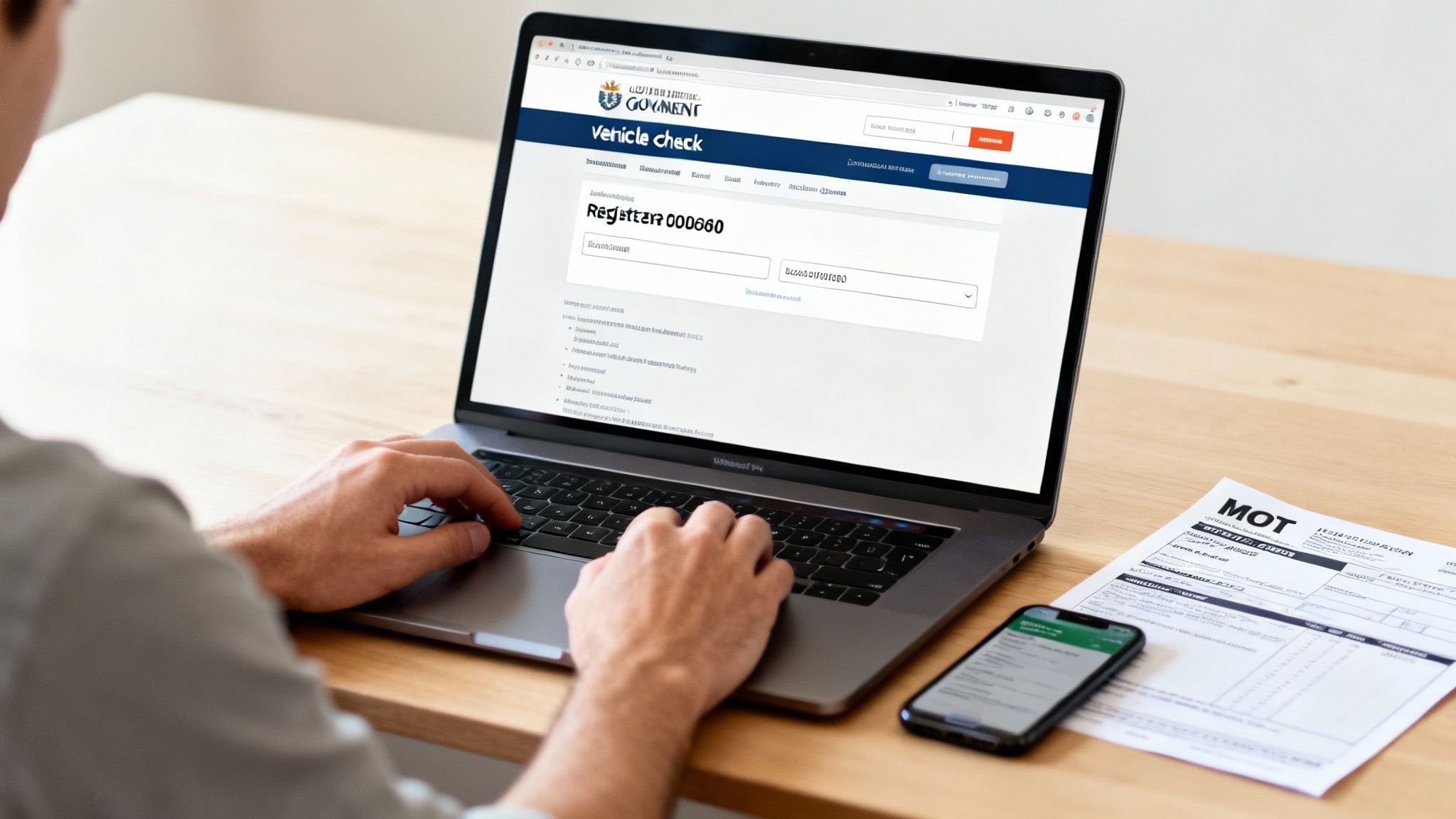
Before you even think about spending money on a full history report, your first move should always be to use the free resources the UK government provides. It’s a brilliant starting point.
With nothing more than the car's registration number, you can get an official snapshot of the vehicle you're looking at. These checks, run by the Driver and Vehicle Licensing Agency (DVLA) and the Driver and Vehicle Standards Agency (DVSA), are your first line of defence, helping you spot early warning signs that something isn’t quite right.
What the Free Checks Reveal
By typing that reg number into the government portals, you can instantly confirm if what the seller is telling you matches the official record. Think of it as your first opportunity to catch any inconsistencies.
- Full MOT History: A complete log of every test the vehicle has taken, showing passes, fails, and—most importantly—any advisories the tester flagged up.
- Vehicle Tax Status: A quick check to see if the car is taxed and when that tax runs out.
- Basic Vehicle Details: This confirms the essentials like the date of first registration, engine size, colour, and its CO2 emissions.
The MOT history is where the real gold is. Don't just glance at the pass or fail status. You need to dig into the advisories. Are you seeing the same issues, like worn tyres or brake pads, popping up year after year? That could be a sign of a car that's only had the bare minimum spent on it.
Big gaps in the MOT history can also be a red flag, often hinting that the car was off the road for a long time—perhaps for major repairs. For a deeper dive, check out our detailed guide on understanding MOT history.
Remember: A clean MOT pass simply means the car met the minimum legal safety and environmental standards on that specific day. It's not a guarantee of the car's overall health.
The Limits of Government Checks
These free checks are fantastic, but you have to know their limits. They build a solid foundation, but they don't tell you the whole story—not by a long shot.
The government services won’t reveal the most serious hidden problems. Critical details like outstanding finance, insurance write-off status, or if the car has been reported stolen are not included in these free checks. As the latest government vehicle statistics confirm, this kind of crucial data is only available from paid providers. You can learn more about this on GOV.UK.
This is exactly why these initial checks are just your first step. They arm you with basic facts but leave dangerous gaps in your knowledge. To get the complete, unvarnished truth, you need a full check from a service like AutoProv to fill in those blanks.
Uncovering the Full Story with a Comprehensive Check
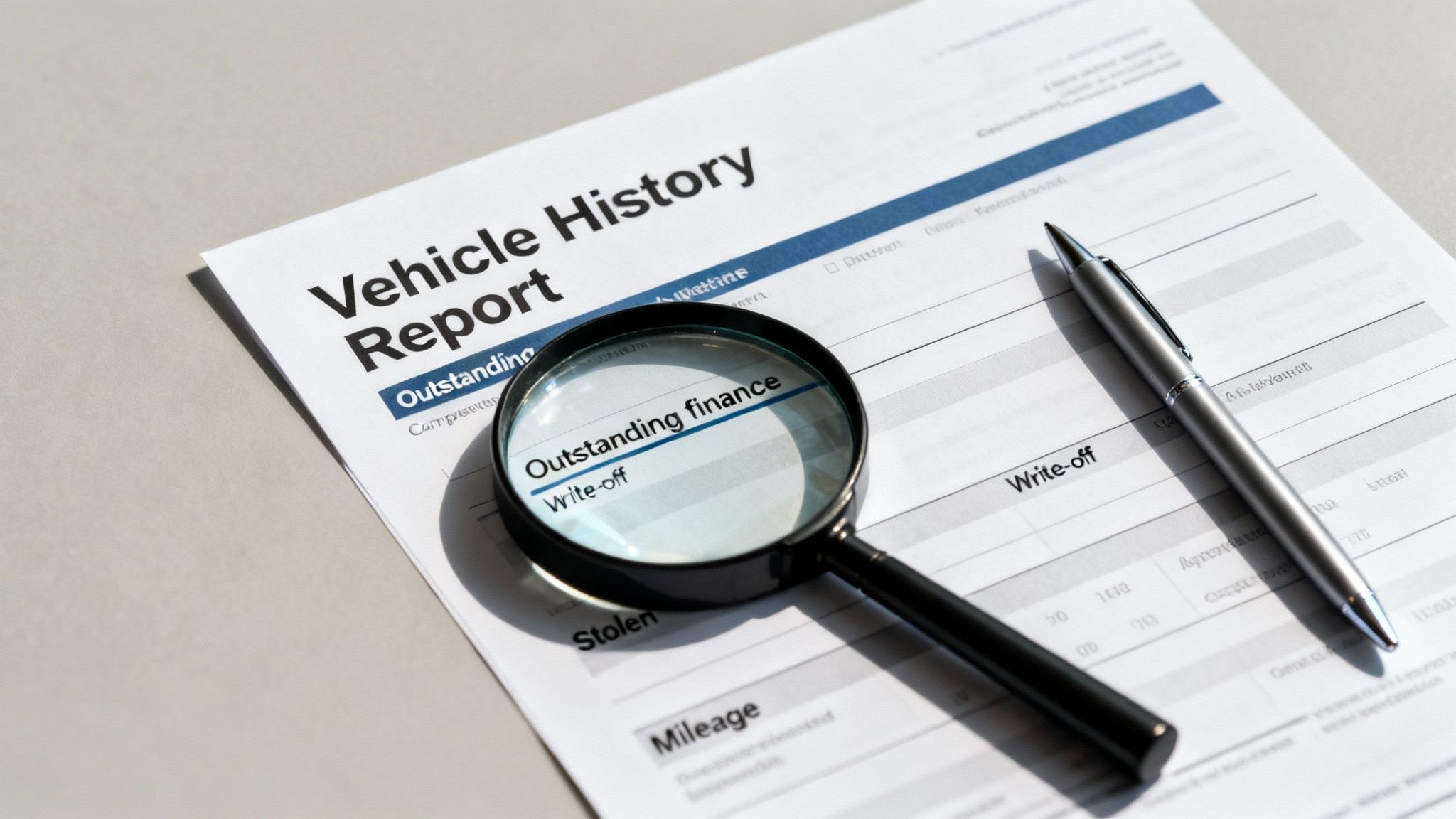
The free checks are great for a first look, but to truly protect yourself, you need to go deeper. A comprehensive history check from a specialist service like AutoProv is the only way to uncover the high-stakes information that government portals simply don't provide.
This is where you find out about the serious issues that could turn your dream car into a financial nightmare.
- Outstanding Finance: Our checks reveal if the vehicle is still legally owned by a finance company. If it is, the seller doesn’t have the right to sell it, and the car could be repossessed from you at any time.
- Stolen Vehicle Check: We cross-reference the car with the Police National Computer to see if the car has been reported stolen. Buying a stolen vehicle, even without knowing, means you'll lose it the moment it’s recovered by the police. No ifs, no buts.
- Insurance Write-Off Status: This reveals if an insurer has ever declared the vehicle a total loss. Our reports specify the damage category, such as Cat S (structurally damaged) or Cat N (non-structurally damaged), which drastically affects the car's value, safety, and insurability.
- Mileage Discrepancies: By checking against the National Mileage Register and other official sources, an AutoProv report can flag potential 'clocking'—where the milometer has been illegally wound back to make the car seem less used than it is.
A car might look perfect on the outside, but a history report is the only way to see what's happened behind the scenes. It's the difference between a smart purchase and a potential financial disaster.
Consolidating Your Knowledge
Imagine trying to gather all this information from separate sources. It would be a frustrating, time-consuming nightmare. This is where modern vehicle check services become indispensable. Platforms like AutoProv, for instance, aggregate data from the DVLA, police records, finance houses, and insurers into a single, easy-to-digest report.
These reports often include other valuable nuggets of information, like previous number plate changes. This could be innocent—someone removing a private plate—or it could be an attempt to hide the car's real history. Understanding all the data, including what’s linked to the car's unique identifier, is key. To get a better handle on this, check out our guide to vehicle checks using a VIN number, which offers more detailed insights.
Ultimately, a complete check gives you the confidence and leverage to make a sound decision. It empowers you to either walk away from a bad deal or negotiate a fairer price based on a complete understanding of the car's true history.
How to Read a Car History Report
Getting your hands on a car history report is one thing, but knowing how to actually read it is a completely different skill. It’s not just about scanning for big, scary warnings. The real story of a car is often hidden in the smaller details, and your job is to piece them together to make a smart decision.
First up, look at the number of previous keepers. If a relatively new car has changed hands multiple times, that can be a symptom of a persistent, niggling problem that previous owners got tired of trying to fix. Pay special attention to how long the current owner has had it. If they're selling after just a few months, you have to ask why. It could be for a perfectly innocent reason, but it might also mean they’ve uncovered an issue and want out.
Spotting Potential Mileage Fraud
Mileage clocking is one of the oldest scams in the book, but a good report gives you everything you need to catch it. Don't just glance at the final mileage figure. The trick is to cross-reference it with the MOT history and look for a logical, steady increase over time.
An MOT history showing 80,000 miles one year and 65,000 miles the next is an undeniable red flag. It’s a classic sign of tampering that you would completely miss without comparing these two data points.
A service like AutoProv makes this dead simple by laying out the MOT and mileage records side-by-side, so you can spot any dodgy patterns in seconds. Any sudden drops or long periods where the mileage barely moves should set alarm bells ringing.
Looking for Less Obvious Clues
Beyond the major checks, it’s the smaller details that help you build a complete picture of the car's life. This is where you go from a good check to a great one.
- Multiple Colour Changes: A car that's been repainted more than once might have lived a hard life as a taxi or commercial vehicle, which usually means higher-than-average wear and tear.
- Location History: Has the car spent most of its life in a coastal town? If so, there's a much higher chance of rust and corrosion underneath – something you'll want to inspect very carefully.
- Plate Changes: People often change plates to add a private one, which is fine. But frequent changes can sometimes be a tactic to muddy the waters and make the car’s history harder to follow.
By connecting the dots between keeper changes, MOT records, and these subtle clues, you start to uncover the story the seller might not be telling you. AutoProv’s clear report format is designed to highlight these connections, ensuring you don’t miss a thing.
Putting It All Together for a Confident Purchase

Let's be honest, bouncing between multiple government websites and trying to make sense of complex reports is a massive headache. It’s easy to get overwhelmed or, worse, miss something critical.
This is exactly where AutoProv steps in. We take all those fragmented pieces of a car's history and weave them into a single, easy-to-understand story.
Instead of you having to manually chase down every lead, our platform does the heavy lifting. We pull together every vital check you need—finance status, stolen vehicle records, write-off history, and crucial MOT and mileage data. The entire process of checking a car's history in the UK is handled in one place, saving you precious time and cutting out the guesswork.
We don’t just dump raw data on you. We provide clear, actionable insights that make the vehicle's history simple to understand. Our goal is to give you the facts you need to make a smart decision, not an emotional one.
From Data to Decision
With a single, seamless AutoProv report, you get the complete picture needed for total peace of mind. We consolidate information from the most trusted sources, including the DVLA, the Police National Computer, and Experian, to deliver a professional-grade overview.
This puts you firmly in the driver's seat. You can move forward with the purchase, use the information to negotiate a better price, or confidently walk away from a car that’s hiding a problematic past.
To see exactly what our reports look like and understand how it works, visit AutoProv.ai.
Got Questions About Car History Checks?
It's only natural to have a few questions when you're digging into a car's past. Here are some straightforward answers to the queries we hear most often from buyers.
How Reliable Are These Checks, Really?
This is a great question. The short answer is: very reliable, provided you use a reputable service. Companies like AutoProv tap directly into official, real-time UK databases. We're talking about information straight from the DVLA, the Police National Computer (PNC), finance houses, and major insurers.
While no system on earth is 100% infallible, a professional check gives you the most accurate and complete picture possible. Think of it as essential homework before you spend your hard-earned money.
Is the Registration Number Enough to Get Started?
For almost all your initial digging, yes – the car's registration number (its number plate) is all you need. It’s the key that unlocks all the MOT and tax data from the government websites.
It's also the only piece of information you need to run a full, professional history check with a service like ours. You'll only need to see the V5C logbook later in the process, once you're with the car, to make sure the seller is the legitimate owner.
What should you do if the check throws up a red flag? If it's something major like a stolen marker, outstanding finance, or a serious Category S write-off, our advice is simple: walk away. For smaller issues, you can use the information as a powerful negotiating tool to get a better price or ask the seller to fix things before you buy.
Always be prepared to proceed with caution if you uncover anything that makes you uncomfortable. If you've got more specific questions, you'll likely find the answers on our comprehensive FAQ page.
Frequently Asked Questions
AI-Generated Content Notice
This article was created with the assistance of artificial intelligence technology. While we strive for accuracy, the information provided should be considered for general informational purposes only and should not be relied upon as professional automotive, legal, or financial advice. We recommend verifying any information with qualified professionals or official sources before making important decisions. AutoProv accepts no liability for any consequences resulting from the use of this information.
From our AI insights
- Navigating UK Grey Imports: A Trader's Guide
Understand the complexities and opportunities of UK grey imports for savvy motor traders.
- Navigating Private Plate Challenges in UK Vehicle Checks
Learn how private plates affect UK vehicle checks and how traders verify provenance and spot cloning risks.
- Navigating VIN Checks Post-Brexit: What UK Traders Need to Know
Discover how Brexit impacts VIN checks for UK traders and the crucial data to review.
Related Articles

Essential Vehicle Checks Before Buying a Used Car
Learn essential checks to ensure your used car purchase is safe and sound in the UK market.

Why a Provenance Check is Essential for Used Car Buyers
Ensure your used car is a smart investment by understanding the importance of a provenance check and how AutoProv can help.

A Guide to Vehicle Check with VIN Number
A vehicle check with vin number is easily the most important thing you can do before buying a used car. Think of it as your first line of defence—a quick, simple step that pulls back the curtain on a vehicle's past, protecting you from expensive mistakes, legal headaches, and downright dangerous cars.
Published by AutoProv
Your trusted source for vehicle intelligence