
You've likely had this happen. A vehicle looks clean enough at first pass, the price is workable, the MOT trail seems usable, and there's no obvious reason to walk away. Then a later check throws up a scrapped marker, or worse, conflicting records that suggest the car has one history on paper and another in actuality.
That's where margin disappears. A DVLA vehicle scrapped record sounds like a simple status, but in trade buying it rarely is. The main problem isn't just whether a car was scrapped. It's whether the official record, the physical vehicle, the ownership paperwork, and the wider provenance all line up at the point you're making a buying decision.
For traders, that gap is where bad stock gets through. It's also where standard checks stop being enough.
Table of Contents
- The Hidden Risk in a Scrapped Vehicle Marker
- The Official Process How a Vehicle is Scrapped
- The legal trigger that matters
- Where traders should pay attention
- The Reality Gap Why DVLA Records Can Mislead
- A live DVLA record can describe a dead vehicle
- Where traders get caught
- What the gap looks like in practice
- A Trade Buyer's Checklist for Verifying Vehicle Status
- What to verify before you commit
- Scrap Risk Verification Checklist
- From Data Points to Decisions The Power of Provenance
- The problem with pass fail thinking
- Why context changes the decision
- Protecting Your Bottom Line from Scrapped Vehicle Risk
The Hidden Risk in a Scrapped Vehicle Marker
A scrapped marker lands differently when you already own the car.
At that point, you're not dealing with theory. You're dealing with tied-up capital, preparation costs, transport, buyer expectations, and the possibility that the vehicle can't be retailed in the way you planned. Some cases are straightforward administrative issues. Some aren't. Some point to a deeper provenance problem that only shows up after the money has gone out.
The trade mistake is treating “scrapped” as a simple yes or no field. In reality, it can indicate a legitimate end-of-life process, a delayed record update, poor notification handling, or an attempted resurrection of a vehicle that should never have returned to market. That's why it sits so close to other risk areas such as identity issues and write-off confusion. The overlap is exactly why traders need to understand the difference between a scrap event and other total-loss histories, including what a write-off really means for a car.
Practical rule: If a scrapped marker appears late in the buying process, stop treating the vehicle as routine stock. It becomes a provenance investigation.
Basic dealer vehicle checks often fall short. A point-in-time result may tell you what a system shows now. It may not tell you when the vehicle was physically dismantled, whether a Certificate of Destruction exists, whether the keeper notification was handled properly, or whether the registration has been reused in a suspicious way.
For a working buyer, that distinction matters. The issue isn't just compliance. It's valuation, disposal options, and whether you can trust the rest of the vehicle's story at all.
The Official Process How a Vehicle is Scrapped
The official route is clear on paper. That clarity matters because you can't spot a broken process unless you know what the correct process looks like first.
The legal trigger that matters
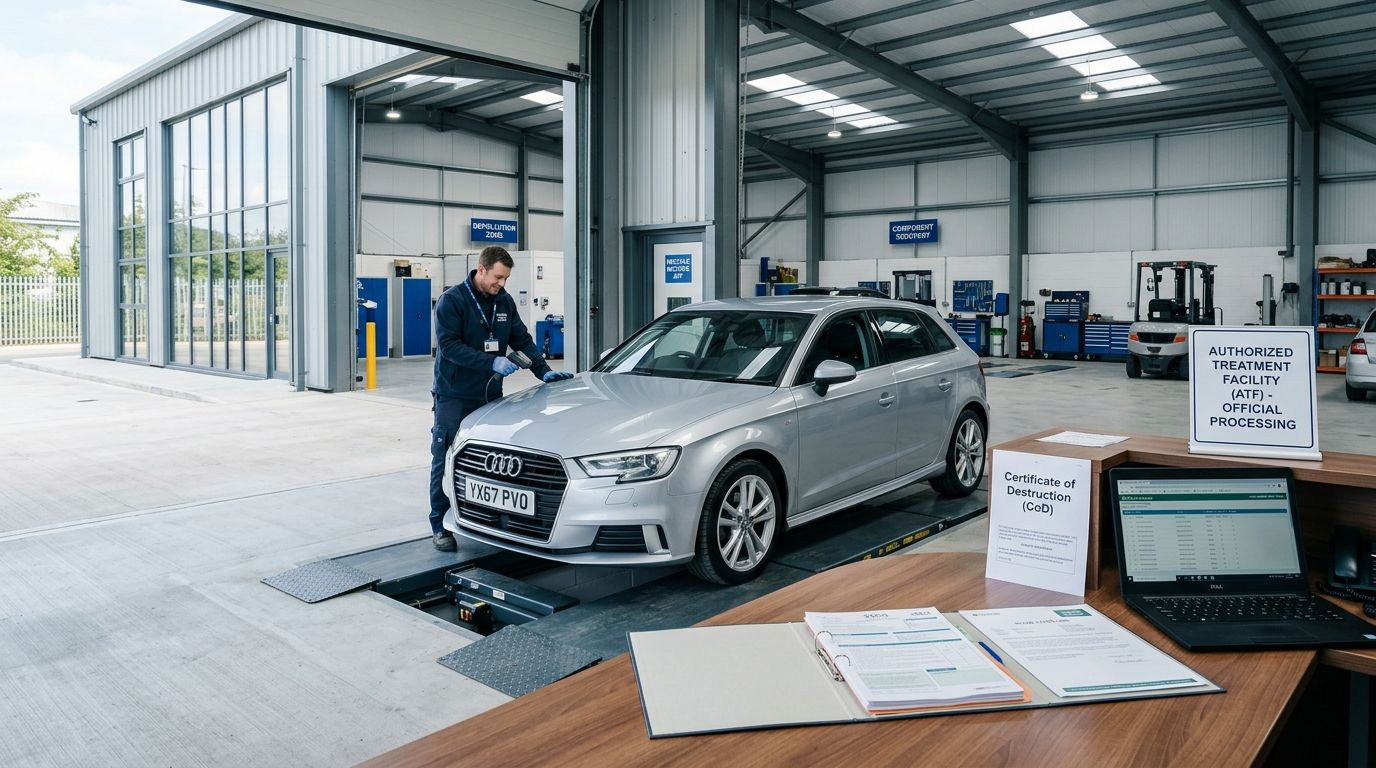
In the UK, the legal mechanism for permanently removing a vehicle from the DVLA register upon scrapping is the issuance of a Certificate of Destruction (CoD) by an Authorised Treatment Facility (ATF), which acts as an electronic notification to the DVLA that the vehicle has been dismantled and is no longer on the register, according to the RAC guide to scrapping a car.
That's the key point. Traders often focus on the visible record change, but the decisive event is the CoD generated through an ATF. Without that, the legal and administrative picture can stay muddy even if the vehicle has physically gone.
The official workflow usually looks like this:
- The keeper disposes of the vehicle through an ATF.
- Using an authorised facility matters because it's the recognised route for lawful dismantling and disposal.
- The ATF processes the vehicle for destruction.
- Once the vehicle reaches the appropriate stage in that process, the CoD can be issued.
- The CoD notifies the DVLA electronically.
- This is the action that supports permanent removal from the register.
- The keeper completes the DVLA notification side correctly.
- If that part isn't handled properly, the record can stay active longer than traders expect.
Where traders should pay attention
For trade buyers, the important lesson isn't how to scrap a car. It's how many opportunities there are for the administrative chain to break.
A lawful scrap event should leave a coherent trail:
- ATF involvement should be evident in the background of the disposal.
- The CoD should exist as the legal proof that the vehicle was permanently removed from use.
- The keeper notification should align with the disposal timeline.
- The DVLA record should eventually reflect that outcome.
If one part is missing, the whole story becomes less reliable.
The keeper side is often underestimated. The DVLA states that a vehicle is officially recorded as scrapped only when the registered keeper notifies them using the relevant V5C section or the online service, entering the V5C reference and scrapyard details, as set out in the government guidance on written-off and scrapped vehicles. That means a physically destroyed vehicle and a correctly updated DVLA record are related, but they are not the same thing.
A trader who only checks the end result can miss the fact that the process behind it never completed cleanly.
That's why paperwork still matters in an age of digital data. If the V5C history, disposal route, and registration status don't sit comfortably together, you've got a vehicle provenance question, not just an admin query. The registration certificate itself often becomes part of the risk analysis, especially when dates, keeper changes, or document handling don't match what the vehicle is supposed to be. That's why experienced buyers still understand the vehicle registration certificate and what it really tells you.
What works in practice is simple. Treat the official process as your baseline, not your reassurance. If the vehicle's story departs from that baseline at any point, push harder before you buy.
The Reality Gap Why DVLA Records Can Mislead
A trader appraises a van on Monday. The DVLA record looks live. MOT history is present. Tax status does not raise an immediate red flag. By Friday, the deal starts to smell wrong because the vehicle was physically broken for parts weeks earlier and the registration identity kept circulating after the metal should have dropped out of the market.
That gap is where losses happen.
A live DVLA record can describe a dead vehicle
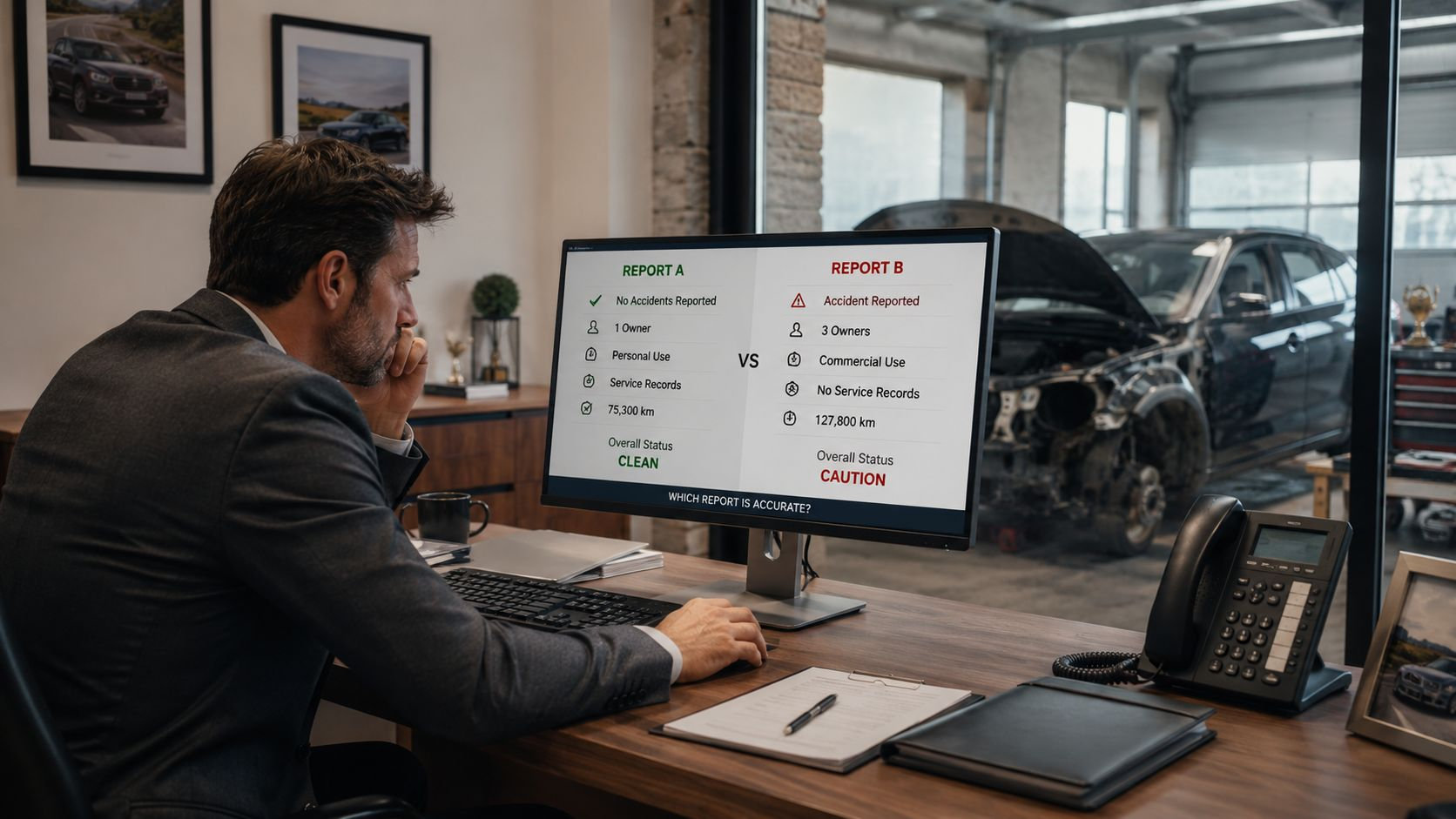
The trade often treats a current DVLA record, live tax position, or recent MOT entry as proof that the vehicle still exists in a normal, tradable form. That assumption is unsafe.
A Guardian report from August 2025 described a van that passed an MOT even though the DVLA said it had already been scrapped, according to The Guardian's investigation into a van marked scrapped by the DVLA. The point is not that DVLA data has no value. The point is that timing, reporting, and system alignment can break down badly enough to leave traders relying on a record that no longer matches physical reality.
That is the ghost vehicle risk. The shell may be gone, dismantled, exported in parts, or otherwise out of legitimate circulation, while the registration trail still looks active enough to support enquiry, pricing, finance discussion, or a fraudulent resale attempt.
Clean surface data does not repair a broken provenance chain.
Where traders get caught
The weak point is usually timing. Physical disposal happens in one place. Notification happens somewhere else. Record updates land later, or not cleanly at all.
On the ground, vehicles do not always exit the market through a neat sequence. A damaged car can be stripped before paperwork is complete. A keeper can delay notification. An intermediary can handle disposal badly. An identity can stay usable long enough for someone else to attach it to another vehicle, or to market a car that should never have reached stock.
That creates a practical mismatch between what the yard knows and what the record shows.
For a buyer, the risk is not limited to buying a car that was once marked scrapped. The larger risk is buying during the period when the physical vehicle and the official status are out of step. That is when false reassurance is strongest and fraud controls are weakest.
What the gap looks like in practice
Common warning signs include:
- an apparently active registration with a disposal story that sounds rushed or incomplete
- MOT continuity that looks normal, even though the seller cannot explain where the vehicle has been
- gaps in keeper paperwork or V5C timing that do not fit the claimed history
- salvage, dismantling, or parts-sale indicators with no clear administrative closure
- a vehicle identity that remains usable after the original asset should have left circulation
Single-source checking misses this more often than traders like to admit. One database can still look tidy while another part of the history is already pointing in the wrong direction. That is why it helps to understand the data gaps created by single-source vehicle checks.
The DVLA record is still useful. It just needs to be treated as one piece of evidence, not the last word.
A Trade Buyer's Checklist for Verifying Vehicle Status
When a vehicle raises any scrap concern, the right response isn't panic. It's process.
You need a repeatable way to verify status before the car moves further through appraisal, preparation, or disposal planning. The strongest buyers don't ask one question. They ask several questions that test whether the documents, timings, usage history, and seller narrative all support the same conclusion.
What to verify before you commit
Start with the legal and administrative sequence. The DVLA's road tax refund process for scrapped vehicles triggers an immediate cancellation and a 6-week automatic refund calculation based on unused full months of tax, provided the CoD has been registered and the keeper has completed the correct V5C notification, according to Webuyanycar's guide to DVLA scrap car notification. The same guidance notes that failure to complete the correct V5C section before the CoD is issued can leave the vehicle legally active and the refund rejected.
For traders, that's not just owner admin. It's a diagnostic clue. A vehicle with signs of disposal but an apparently active administrative trail deserves closer attention.
Use a layered check:
- Check the V5C timeline first.
- Look for keeper transitions that don't make sense, delays in document issue dates, or a disposal story that doesn't fit the registration trail.
- Review the MOT history as a sequence, not a list.
- A valid MOT doesn't settle a scrap concern. What matters is whether the testing pattern aligns with the ownership and usage story.
- Interrogate tax and disposal logic.
- If the seller's account suggests scrapping, off-road status, or interrupted use, the tax history should broadly make sense against that narrative.
- Ask direct questions about the disposal route.
- If an ATF was involved, who handled it, when did it happen, and what proof exists? Evasive answers are information.
- Treat rapid resale with caution.
- A vehicle that changes hands quickly after an unexplained status issue often carries unresolved risk somewhere in the chain.
Buyer discipline: Don't try to explain away inconsistencies because the stock fits your price point. The cheaper problem car usually becomes the expensive one.
Scrap Risk Verification Checklist
Verification Point What to Check Red Flag Registration paperwork V5C issue timing, keeper continuity, correct scrap-related notification history Dates or ownership changes that don't fit the seller's explanation Disposal evidence Whether there is a credible route through an ATF and any proof of destruction No clear disposal path, vague statements, or missing proof MOT pattern Test dates, advisories, and continuity around the disputed period MOT activity that clashes with a claimed scrap event or long inactivity Tax status logic Whether tax history aligns with off-road, disposal, or resumed use claims Administrative activity that makes the scrap narrative look incomplete Seller narrative Consistency in how the vehicle was acquired, stored, and prepared for sale Story changes when challenged on dates or previous status Ownership behaviour Short-term keeperships or immediate resale after status confusion Fast churn that suggests risk is being pushed down the line A good used car history report helps, but trade vehicle intelligence becomes more useful than a simple pass or fail screen. You're not just looking for one adverse marker. You're trying to determine whether the vehicle has a coherent life story.
For many buyers, the easiest improvement is to formalise this into appraisal workflow. A standardised process reduces the chance that a busy buyer waves through a car on instinct alone. If your team wants a stronger structure for this stage, a trade-focused complete vehicle appraisal checklist for trade buyers is the kind of operational document worth building into every purchase decision.
What doesn't work is isolated checking. Looking at one data point in one portal and treating it as conclusive is how ghost vehicles slip through.
From Data Points to Decisions The Power of Provenance
A scrapped marker tells you something happened. It doesn't tell you enough about what happened, when it happened, or whether the current vehicle identity should be trusted.
That's the difference between a simple dealer check and proper vehicle provenance work.

The problem with pass fail thinking
Most used car workflows still lean too heavily on binary outcomes. Clear or not clear. Recorded or not recorded. Scrapped or not scrapped.
That model breaks down when the underlying risk is contextual. A vehicle might have no obvious current scrapped marker and still present concerns through its ownership behaviour, timing anomalies, mileage pattern, documentation sequence, or unexplained market path. Equally, a vehicle may raise a concern that turns out to be explainable once the full chain is visible.
At this stage, motor trade risk assessment becomes more mature. Instead of asking only whether one field has passed, the better question is whether the vehicle's story is internally consistent across multiple records.
Why context changes the decision
Not every scrap-related risk comes from collision damage or physical failure. Data from the Scrap Car Network indicates that emission regulations are increasingly forcing “perfectly functional older vehicles” towards scrapping earlier than mechanical condition alone would dictate, and that scrapping is becoming a financial decision for owners rather than a mechanical one, as noted in the Scrap Car Network analysis of common cars sent to scrap.
That matters for valuation and stock strategy. A mechanically decent vehicle can still carry future trade risk if its operating economics, compliance profile, and likely buyer demand are moving the wrong way. In those cases, the question isn't merely whether the car was officially scrapped. It's whether the vehicle sits in a pattern that points towards shrinking desirability, shorter keeper cycles, or disposal pressure.
A stronger approach brings together:
- Ownership timelines to spot short-term keepership and rapid resale risk
- Mileage check UK analysis to test whether usage is plausible over time
- Insurance and event signals that may add context to disposal concerns
- Vehicle provenance patterns that show whether the identity has remained stable
- Trade vehicle intelligence that helps a buyer decide, not just observe
The useful report isn't the one that gives you more raw data. It's the one that helps you decide whether the story makes sense.
This is why more trade buyers now look beyond a standard vehicle history check UK and use a broader vehicle provenance report when the stock carries any ambiguity. The gain isn't certainty. It's better judgement at the point money changes hands.
Protecting Your Bottom Line from Scrapped Vehicle Risk
A trader agrees a deal on a clean-looking reg, checks the DVLA record, and sees nothing that kills the car. A week later, a conflicting disposal trail surfaces and the vehicle starts to look like a ghost. Physically scrapped, officially lagging, still capable of catching out a buyer who treated one record as final.
That is the loss point.
The practical lesson is simple. A DVLA marker helps, but it does not close the file. There is often a gap between what has physically happened to the vehicle and what appears on the official record. In that gap, fraud has room to work. So do bad assumptions, weak appraisals, and expensive buying mistakes.
I treat scrapped vehicle risk as a timing problem as much as a status problem. If the disposal story, keeper history, MOT activity, tax position, identity documents, and seller account do not line up in a believable order, the issue is not clerical. It is commercial. You are being asked to price an asset before its history is stable enough to trust.
A buying process that protects margin usually comes down to three habits:
- Check chronology, not just the latest marker.
- A single status flag can look harmless in isolation. The sequence is what exposes trouble.
- Pause early when the story drifts.
- If the seller explanation needs too much interpretation, step back from the deal or cut the bid to reflect the uncertainty.
- Use a repeatable due diligence process.
- Good buyers do not leave this to memory, confidence, or whoever happens to be on the desk that day. They use a system that can be applied the same way across stock sources. If you are reviewing that process more broadly, it is useful to see how other risk-led teams find the right due diligence system.
The upside is straightforward. Better checks help you avoid dead money, defend your valuation, and challenge a seller before the problem becomes yours. They also protect reputation. If a customer, finance house, or auditor questions the car later, you need more than a basic record. You need a file that shows why the decision made sense at the time.
The trade does not lose money because data is unavailable. It loses money because official data can arrive after the actual event, and buyers act before the picture is settled.
AutoProv helps UK motor traders make that judgement with deeper vehicle history, provenance, and risk intelligence. If you need a clearer view of ownership patterns, mileage anomalies, rapid resale behaviour, and hidden signals that basic checks can miss, AutoProv gives you a trade-focused way to assess risk before you commit capital.
Frequently Asked Questions
AI-Generated Content Notice
This article was created with the assistance of artificial intelligence technology. While we strive for accuracy, the information provided should be considered for general informational purposes only and should not be relied upon as professional automotive, legal, or financial advice. We recommend verifying any information with qualified professionals or official sources before making important decisions. AutoProv accepts no liability for any consequences resulting from the use of this information.
From our AI insights
- Navigating UK Grey Imports: A Trader's Guide
Understand the complexities and opportunities of UK grey imports for savvy motor traders.
- Navigating Private Plate Challenges in UK Vehicle Checks
Learn how private plates affect UK vehicle checks and how traders verify provenance and spot cloning risks.
- Navigating VIN Checks Post-Brexit: What UK Traders Need to Know
Discover how Brexit impacts VIN checks for UK traders and the crucial data to review.
Related Articles

Essential Vehicle Checks Before Buying a Used Car
Learn essential checks to ensure your used car purchase is safe and sound in the UK market.

Why a Provenance Check is Essential for Used Car Buyers
Ensure your used car is a smart investment by understanding the importance of a provenance check and how AutoProv can help.
A Guide to Vehicle Check with VIN Number
A vehicle check with vin number is easily the most important thing you can do before buying a used car. Think of it as your first line of defence—a quick, simple step that pulls back the curtain on a vehicle's past, protecting you from expensive mistakes, legal headaches, and downright dangerous cars.
Published by AutoProv
Your trusted source for vehicle intelligence