To get a vehicle's specifications, you can start with its registration number (VRM) for the basics or use its Vehicle Identification Number (VIN) to pull the complete factory build sheet. In the UK motor trade, however, relying on anything less than precise, professional-grade data from a service like AutoProv is a massive gamble. A single error isn’t a small hiccup; it can cost you thousands.
Why Accurate Vehicle Specs Are Mission-Critical
In the fast-paced world of the UK motor trade, getting a detail wrong isn't just a minor mistake—it's a direct hit to your bottom line. The process to find a vehicle's specifications is much more than just admin; it’s a core business function that props up your profitability and manages your risk. Every decision, from what you pay for a car to its forecourt price, hinges on having completely accurate data.
Imagine this scenario: you buy a car advertised as a top-of-the-range "Titanium X" trim, only to find out later it's actually a lower-spec "Zetec" with some aftermarket bits bolted on. The difference in value could easily be thousands of pounds. That's an instant loss your dealership has to swallow, and it's a shockingly common and expensive mistake that basic checks often miss.
The Real-World Cost of Inaccuracy
Dodgy vehicle data creates very real problems that damage your finances and your reputation. A misidentified engine code, for example, can lead to ordering the wrong parts, causing workshop delays and leaving you with an unhappy customer. Likewise, not spotting non-standard wheel fitments can create safety issues and add unexpected costs to your prep work.
These situations reveal a fundamental truth for anyone serious about making money in this industry:
- Valuation Errors: The wrong trim or engine data means you’re almost certainly overpaying for stock.
- Lost Deals: Finding discrepancies late in the game destroys a buyer's trust and kills the sale.
- Operational Inefficiency: You end up wasting time and money fixing mistakes that were easily avoidable from the start.
- Reputational Damage: Consistently getting vehicle details wrong makes you look amateurish and untrustworthy.
In this business, certainty is your most valuable asset. Guesswork based on a quick look or incomplete public records is a guaranteed recipe for financial loss. The aim is to move beyond the basics and achieve trade-grade certainty.
The Professional's Advantage
This is exactly why professional tools are no longer a 'nice-to-have'—they're an essential part of a modern dealership's arsenal. Platforms like AutoProv are built specifically to wipe out these risks by delivering verified, in-depth specifications straight from manufacturer and industry databases.
By building this level of detail into your workflow, you turn the hunt for vehicle specs from a potential liability into a genuine strategic advantage. It ensures every car you buy, value, or sell is based on solid facts, not risky assumptions.
Starting Your Search with the Registration Mark
For anyone in the UK motor trade, the first port of call for vehicle specs is almost always the registration mark, or VRM. It’s fast, simple, and gives you a baseline of information to start with. Think of it as the first step in any valuation or verification workflow.
You can get a surprising amount of info from publicly available resources, with the DVLA's vehicle information checker being the most obvious one. Popping a reg number in there is a non-negotiable first check to confirm a vehicle’s identity against its V5C logbook or what a seller is telling you.
It's a straightforward process. You just need the reg number to get started on the official government service.
The data that comes back gives you that high-level overview, letting you confirm the basics at a glance before you sink any more time or money into the vehicle.
What a Free VRM Check Actually Tells You
Using the DVLA service or other free online tools will give you a consistent, top-level set of details. This information is pulled straight from the national vehicle record, so while it's reliable, it's also pretty limited.
You’ll almost always get confirmation of the:
- Make and Model: For instance, ‘Ford Focus’ or ‘Vauxhall Corsa’.
- Colour: The officially recorded vehicle colour.
- Engine Size: Displayed in cubic centimetres (cc), like ‘1598cc’.
- Fuel Type: Petrol, Diesel, Electric, etc.
- Date of First Registration: Absolutely crucial for pinning down the vehicle's age.
But this is exactly where the usefulness of a free check stops—and where the serious financial risks begin for a motor trade professional. You can dive deeper into the data you can get for a car's specs using just its registration number in our detailed guide on the topic.
The Critical Gaps That Cost You Money
The real problem isn’t what a free check tells you; it’s what it doesn't. The difference between a basic ‘Ford Focus’ and a ‘Ford Focus ST-Line X with the optional Driver Assistance Pack’ can be thousands of pounds in value. A free VRM lookup just isn't going to give you that level of granularity.
Relying solely on public VRM data is like valuing a house based only on its postcode. You know the general area, but you have no idea if it’s a run-down flat or a luxury penthouse.
This is where the limitations become a massive business liability. The critical data points you need for accurate valuation and risk assessment are completely missing. We're talking about details like:
- Precise Trim Level: Is it an SE, a Sport, or a Titanium model?
- Factory-Fitted Options: Things like panoramic roofs, upgraded sound systems, or advanced safety features that dramatically affect value.
- OE Fitment Data: Crucial details for the workshop, like original wheel and tyre sizes.
These missing pieces are precisely why professional platforms like AutoProv exist. We bridge that huge information gap, pulling in detailed manufacturer and industry data to give you the complete picture. Without it, every purchase is a gamble.
Unlocking Deeper Insights with the VIN
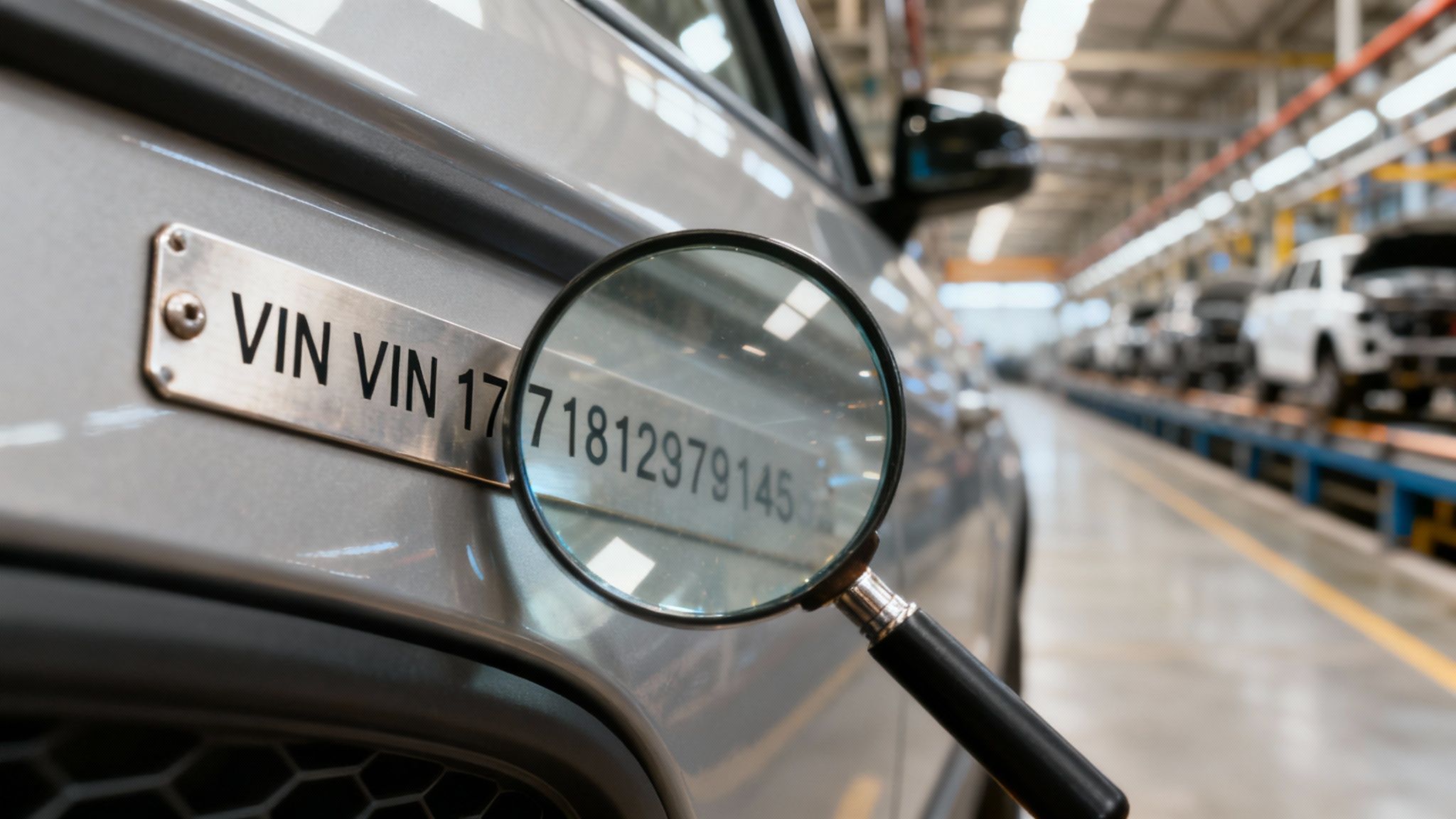
While a vehicle's registration can change over its lifetime, its Vehicle Identification Number (VIN) is for life. This 17-character code is the car’s unique fingerprint, stamped onto the chassis at the factory and never altered.
It’s an immutable record of the vehicle's identity as it was originally built, making it the ultimate source of truth when you need to find vehicle specifications with absolute certainty.
Think of the VIN as the vehicle’s DNA. While the reg plate tells you its current identity in the UK system, the VIN tells you its entire life story, right from the assembly line. For professionals in the motor trade, moving beyond the registration mark and interrogating the VIN isn't just good practice—it's essential for avoiding costly mistakes.
Decoding the 17-Character Fingerprint
Each section of the VIN holds specific information, but trying to decode it manually is a complex and often fruitless task. The real power comes from using professional-grade VIN decoders that can instantly translate this code into a detailed specification sheet. This is a massive leap beyond what basic online tools can offer.
A professional lookup doesn’t just confirm the make and model; it drills down into the precise details that determine a vehicle's true market value. This is where the granular data lives, and getting access to it is key to accurate valuations.
These decoders reveal mission-critical data points, including:
- The specific manufacturing plant where the vehicle was assembled.
- Exact engine and transmission codes, crucial for ordering parts and planning maintenance.
- Precise trim level identifiers, distinguishing a high-spec model from a base version.
- Original factory-fitted options and equipment packages.
This is exactly the level of detail platforms like AutoProv are designed to provide. By integrating advanced VIN decoding, we transform that 17-character string into an actionable report that verifies a vehicle's true identity against its factory records. For a complete overview of this process, our guide to performing a vehicle check with a VIN number offers more detailed insights.
Why the VIN is Non-Negotiable
Relying solely on a vehicle's appearance or even its V5C document can be seriously misleading. Badges get swapped, and aftermarket modifications can make a car appear to be a higher specification than it truly is. The VIN cuts straight through all of this noise.
A car might have an 'M Sport' badge on the boot, but the VIN will tell you if it left the factory as a standard SE model. This is the kind of detail that can save you thousands on a single purchase.
The VIN provides an unchangeable baseline of truth. It confirms the vehicle's original colour, engine, transmission, and every factory option. In a market where accuracy is everything, using the VIN to find vehicle specifications isn’t just an option; it's the only way to operate with complete confidence and protect your bottom line. It’s the definitive step in moving from a basic check to a professional verification.
Focusing on the Specs That Drive Vehicle Value
When you're trying to pin down vehicle specs for professional use, you quickly realise that not all data is created equal. A retail buyer might get excited about the size of the infotainment screen or the colour of the ambient lighting. But in the trade, our focus is laser-sharp on the details that actually dictate a vehicle's value, risk, and profitability.
Getting this right means going way beyond the basics you get from a simple reg check. It demands a proper dive into the granular data that separates a great buy from a costly mistake. This is the stuff that defines a vehicle's true market standing and has a direct impact on your bottom line.
Why OE Fitments Are Non-Negotiable
One of the most critical—and often overlooked—data points is the Original Equipment (OE) wheel and tyre fitment. This isn't just about looks; it's fundamental to the car's safety, handling, and ultimately, its value. A car on the wrong set of wheels can suffer from dodgy performance and might even be an MOT fail waiting to happen.
For any dealership, spotting these discrepancies early is absolutely vital. Finding out a car needs a new set of OE-compliant wheels and tyres during workshop prep can add hundreds, if not thousands, of pounds in unexpected costs. Your profit margin on that unit? Gone.
Knowing the correct OE fitment from the get-go allows you to:
- Accurately price up reconditioning costs before you even make an offer.
- Ensure the vehicle is safe and ready for the forecourt without nasty surprises.
- Spot undeclared modifications that could mess with its history and value.
This level of detail is a standard feature in professional-grade reports, like those from AutoProv, precisely because everyone in the trade understands the financial implications.
The Financial Impact of Trim Levels and Engine Codes
The difference between trim levels can be subtle to the naked eye but can represent a huge gap in value. An 'S Line' Audi A3, for instance, will hold its value far better than a standard 'Technik' model. Relying on the badges on the boot lid is a classic rookie error—they’re cheap to buy and easy to stick on. The only way to be 100% certain is to check the factory build sheet against the VIN.
It’s the same story with engine codes. Take two diesel hatchbacks that look identical. One might have a bulletproof engine, while the other is notorious for expensive timing chain or injector problems. This knowledge, which is tied to the specific engine code, completely changes the vehicle's desirability and your potential liability down the line.
A vehicle's value isn't just in its make and model. It's in the precise combination of its factory-fitted trim, engine, and optional extras. Getting this combination wrong is one of the fastest ways to lose money on a deal.
This is where having access to detailed specification data really proves its worth. By confirming the exact trim and engine code, you can price the vehicle with total confidence. For a more detailed look at how these factors play into the numbers, check out our complete guide on using a professional car valuation tool in the UK.
Platforms like AutoProv deliver this essential, granular detail in an instant. It lets you move past the guesswork and make buying decisions based on the hard facts that genuinely drive a car's value, helping you sidestep the expensive mistakes that less detailed checks will always miss.
The Professional Workflow for Total Certainty

Anyone who's been in the motor trade for a while knows a crucial truth: you can't rely on a single source of data. Ever. Sticking to just a DVLA check or a free VIN decoder is a rookie mistake that leaves you wide open to expensive surprises down the line. For absolute certainty, you have to think bigger.
The professional method isn't just a simple spec check; it's a full-blown provenance investigation. It's about building a complete, verified picture of a vehicle so the data you see is data you can bet your money on. This is where a proper, integrated platform like AutoProv really earns its keep.
Consolidating Data for a Complete Picture
An effective workflow means pulling information from every corner of the industry and laying it side-by-side to see what lines up and, more importantly, what doesn't. Platforms like AutoProv are built to do this heavy lifting for you in seconds, merging all the critical intel into one single, actionable report.
A robust check will query and combine data from several key places at once:
- DVLA Records: The basics are covered here—registration, tax, and MOT status.
- Manufacturer Databases: This gives you access to the original factory build sheet, straight from the source and tied to the VIN.
- Insurance Records (MIAFTR): Essential for uncovering a hidden past as a write-off.
- Finance Houses: Quickly tells you if there’s outstanding finance that could jeopardise legal ownership.
When you bring all these sources together, you create a powerful system of checks and balances. The reg details from the DVLA must match the manufacturing data from the VIN. Any difference, no matter how small, is an immediate red flag. You can get a better feel for this by reading about the essential used car history report for dealers.
Spotting the Discrepancies That Matter
This multi-source approach is your best defence against the hidden nightmares that can turn a profitable car into a financial disaster. It's when you cross-reference the data that the real problems jump out at you.
A professional verification isn't just about what the data tells you; it's about what the conflicts between different data sources reveal. This is where you uncover the real risks.
Think about it. The VIN might say a car left the factory as a blue, 1.6-litre diesel, but the DVLA record shows it as a black, 2.0-litre model. That’s not a simple admin error; that’s a massive problem. This kind of mismatch could point to anything from vehicle cloning and VIN swapping to major, undeclared modifications that kill its insurance cover and compromise its safety.
Understanding the market context is vital, too. The UK new car market saw registrations climb by 3.5% to 2,020,520 cars in a recent full year—the first time it’s broken the two million mark since 2019. For dealers, that influx of vehicles into the used market makes solid data tools more critical than ever for managing stock and pricing things right.
Ultimately, this integrated workflow is how you protect your investment and your reputation. It’s the definitive way to find vehicle specifications and be sure that every single detail is verified, accurate, and ready for your forecourt.
Common Pitfalls in Vehicle Specification Checks
Even the most seasoned hands in the motor trade get caught out on vehicle specs from time to time. We’ve all been there. A simple oversight can quickly sour a profitable deal, turning a clean unit into a costly headache. Knowing the common traps is the first step to protecting your investment and your reputation.
One of the oldest mistakes in the book is putting too much faith in the V5C logbook. Of course, it’s essential for confirming ownership and the basics, but it only tells part of the story. The V5C will give you the make, model, and engine size, but it says nothing about the specific trim level or, crucially, those high-value factory-fitted options that can swing a car's value by thousands.
Undeclared Mods and Model Year Mix-Ups
Another classic blunder is failing to spot undeclared aftermarket modifications. That car might roll in with bigger alloys or a fancy infotainment screen, but are they genuine OE parts or cheap replicas? Non-standard parts don’t just hit a vehicle's value; they can affect its safety and even make it harder to insure. Without checking against the original factory build sheet, you’re flying blind.
Something more subtle, but just as dangerous, is confusing a car’s registration date with its model year. It happens all the time. A car with a March 2021 plate could easily be a 2020 model year vehicle, meaning it might lack key updates or features a buyer expects. It's an easy mistake to make if you’re just glancing at the number plate, but it's an error that directly impacts market value.
The most costly assumption you can make in this business is that what you see is what you get. From a misleading badge on the boot to outdated registration data, the visual evidence is often the least reliable. Verification against a trusted, comprehensive data source is the only way to be sure.
The Problem with Market and Data Blind Spots
The UK vehicle market itself adds another layer of complexity. We see huge seasonal swings in demand, with registrations fluctuating anywhere from 145,000 to over 312,000 units in a given month. For example, a strong September surge of 13.7% to 312,891 units might be followed by a December slump to just 146,249 units. You can see these UK vehicle registration trends for yourself to get a feel for the patterns that directly impact stock acquisition and pricing.
These pitfalls aren't just minor inconveniences; they’re gaping holes in your due diligence. Relying on isolated data points is a recipe for disaster. This is where a system like AutoProv becomes absolutely vital. By cross-referencing DVLA data with original manufacturer build sheets and insurance records, it instantly flags the discrepancies that point to bigger problems, like cloning or a hidden past. To get ahead of these risks, check out our guide on how UK dealerships can prevent car cloning fraud. Ultimately, using an integrated tool is the only definitive way to sidestep these common but costly mistakes.
Answering Your Key Questions
Can I Find All Vehicle Specifications From The V5C Logbook Alone?
Honestly? No. It's a common trap many people fall into. The V5C logbook gives you the basics – make, model, VIN, engine size – but that's where it stops. It tells you almost nothing about the specific trim level, desirable factory-fitted options, or crucial technical data like the Original Equipment (OE) wheel and tyre fitments.
For anyone in the motor trade, relying only on the V5C is asking for trouble. It's a direct route to mis-valuing a vehicle. To get the full, accurate picture, you need a professional service like AutoProv that pulls the complete factory build sheet. That's the only way to know you're pricing the car correctly.
How Accurate Are Free Online VIN Decoders?
They can be okay for a quick, top-level check, but you get what you pay for. Free online VIN decoders often pull from generic, sometimes outdated, databases. A big problem is their frequent lack of UK-specific model data or the very latest manufacturer updates, which is exactly the detail you need for a precise valuation.
When there's money on the line, you can't afford to guess. A professional-grade data provider is non-negotiable for any serious business decision.
What Is The Biggest Mistake When Checking Vehicle Specs?
The single biggest mistake is simply taking a vehicle at face value. A car might have the 'M Sport' badge or the right alloy wheels for a top-tier model, but that means very little on its own. It's surprisingly easy and common for owners to add badges or aftermarket parts to mimic a higher-spec model.
The only way to be certain of what you're buying is to verify the spec against the VIN using a trusted data source. This confirms the car’s original factory build, stopping you from overpaying for a base model with a few cosmetic tweaks.
This isn't just about being cautious; it's fundamental due diligence.
Why Does AutoProv Provide OE Fitment Data?
Knowing the Original Equipment (OE) fitment for things like wheels and tyres is far more important than most people realise. It’s not just about looks; it directly impacts a vehicle's valuation, safety, and handling performance as the manufacturer intended it.
For a dealership, having the correct OE fitment information is essential. It ensures the cars on your forecourt are retail-ready, compliant with regulations, and, most importantly, safe for your customers. It’s also a brilliant way to spot undeclared modifications that could cause headaches with insurance or provenance down the line, protecting your investment and your reputation.
Frequently Asked Questions
AI-Generated Content Notice
This article was created with the assistance of artificial intelligence technology. While we strive for accuracy, the information provided should be considered for general informational purposes only and should not be relied upon as professional automotive, legal, or financial advice. We recommend verifying any information with qualified professionals or official sources before making important decisions. AutoProv accepts no liability for any consequences resulting from the use of this information.
From our AI insights
- Navigating ULEZ Compliance for Used Car Dealers
A deep dive into ensuring your used car stock meets ULEZ standards, avoiding costly fines.
- Mastering Paint Verification with VIN Decoding
Learn how UK traders verify original paint using VIN decoding and provenance data.
- Understanding VIN Decoding: Avoid Misleading Imports
Learn how VIN decoding reveals vehicle origins and specs, preventing import pitfalls.
Related Articles

Car Specs by Reg: Instantly Find Vehicle Details & MOT History
Trying to find the full car specs by reg? In the UK, that little number plate is the key to unlocking a huge amount of information about a vehicle. From the exact engine size and CO2 emissions to its MOT history and tax status, it's all tied to the registration.

How to Check Previous Owners of a Car in the UK
Before you even start thinking about how to check the previous owners of a car, you need to get your head around why it's so important. This isn't just about being nosy; it’s a non-negotiable step that protects you from serious financial headaches and safety risks lurking under a shiny bonnet.

How to Check Service History in the UK
Think of a car's service history as its detailed CV, not just some dusty folder in the glovebox. To check service history is to get the real story behind a vehicle, digging into everything from its routine oil changes to any major surgery it's had. For any savvy car buyer in the UK, this record is the single most important document you can get your hands on.
Published by AutoProv
Your trusted source for vehicle intelligence