
For anyone in the UK motor trade, a vehicle's Ministry of Transport (MOT) history is much more than a simple pass or fail certificate. It's the car's diary, a detailed logbook of its life on the road. Glancing only at the latest MOT is a rookie mistake, and a costly one at that. To really get under the bonnet of a vehicle's past, you need to view MOT history in its entirety—it’s the only way to see the true timeline of maintenance versus neglect.
Why MOT History Is a Non-Negotiable Trade Insight
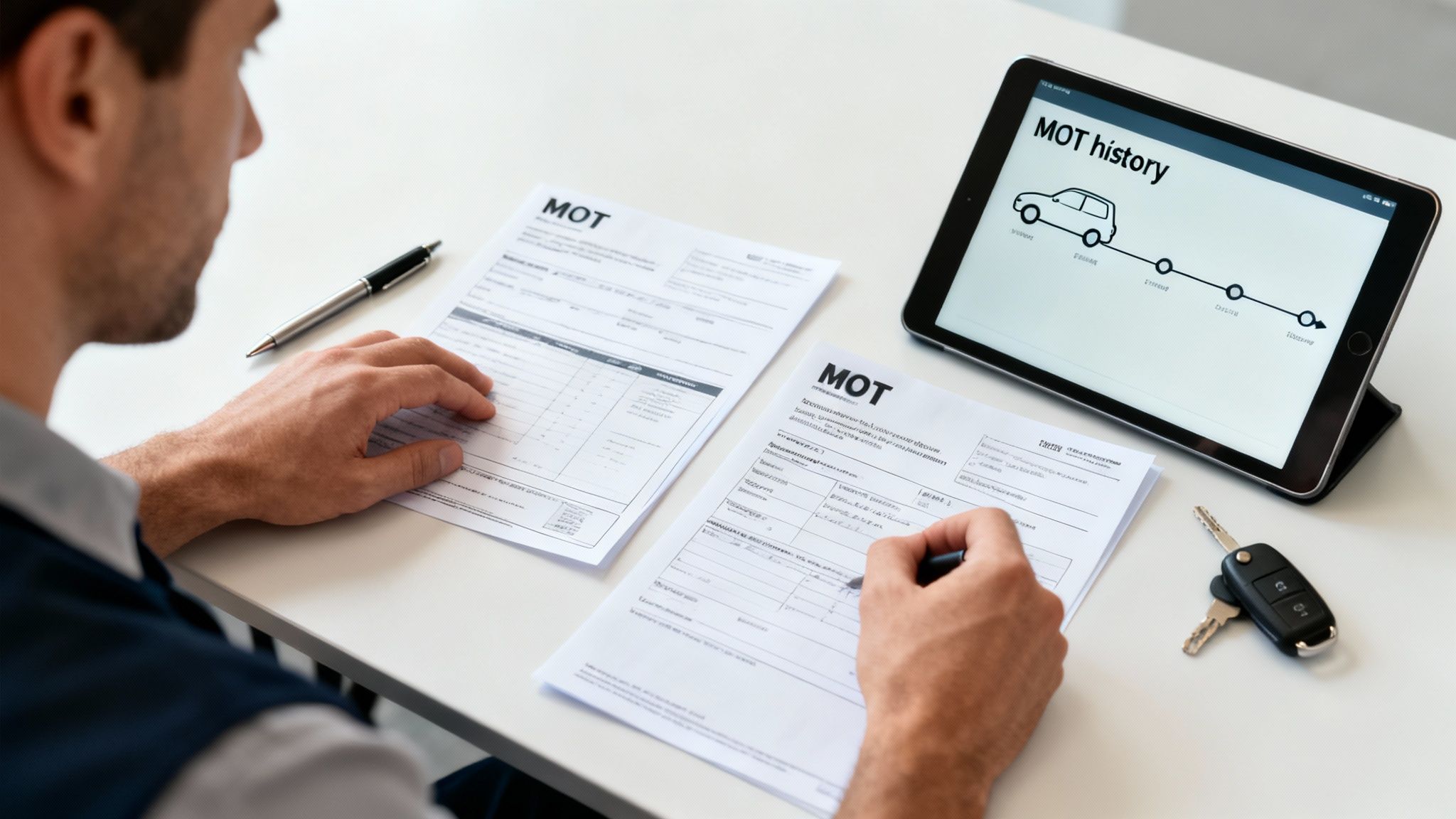
Relying on a current MOT certificate is like reading the last page of a book and thinking you know the whole story. It tells you where the vehicle is now, but it completely misses how it got there. For a dealership, this blind spot can hit you right in the wallet, leading to everything from surprise reconditioning costs to a massively devalued retail price. This isn't just about compliance; it's about protecting your profit margin.
Revealing the True Narrative
An MOT history check gives you the chronological story of a vehicle's health. It’s where you’ll spot those recurring issues that a single pass certificate conveniently hides. Think about it: a car could have scraped through its last test, but a quick look back might show consistent advisories for corroded brake pipes or worn suspension components. Those aren't one-offs; they're patterns. They point to underlying problems and a history of doing the bare minimum, flagging the car as a potential money pit.
The Financial Impact of Neglect
Ignoring this data is just asking for trouble. Imagine buying a vehicle with a clean MOT, only to find a history of emissions failures that suggest a DPF or engine issue is just around the corner. Those are the kinds of hidden costs that completely wipe out your margin. A proper dive into the MOT history empowers you to:
- Identify recurring faults that signal expensive future repairs.
- Spot potential mileage discrepancies or "clocking" by tracking the mileage recorded at each test.
- Gauge the previous owner's attitude towards proper maintenance and care.
A vehicle's MOT record is the most honest account of its past you'll ever get. It exposes patterns of neglect that a visual inspection can easily miss, directly impacting its value and your bottom line.
This historical data is a powerful tool for negotiation and accurate pricing. It gives you the hard evidence to make savvy buying decisions, helping you separate the genuinely well-kept stock from the cars with a troubled past. For those new to buying used cars, our comprehensive used car buying guide for the UK offers even more insight into these essential checks.
AutoProv was built to turn this raw MOT data into actionable intelligence. Our platform seamlessly integrates a vehicle's full MOT history with other critical checks, giving your dealership the complete picture you need to sidestep expensive mistakes and price every vehicle with total confidence.
Accessing MOT Records Using the Official GOV.UK Service

Your first port of call for any MOT history check should always be the official government portal. Run by the Driver and Vehicle Licensing Agency (DVLA), this free service on the GOV.UK website is the definitive source for a vehicle's test history and an absolutely essential first step.
Getting to it is simple. Just search for "check MOT history" online, and you'll find the government page. All you need is the car's registration number (VRM). Pop that in, and the system pulls up all the publicly available MOT records in seconds.
What the GOV.UK Report Provides
The government service lays out a chronological history of every MOT test the vehicle has had since records were digitised back in 2005. For each test, you get a snapshot of key details that start to paint a picture of the car's life.
- Test Date and Outcome: You’ll see the exact date of every test and whether it passed or failed.
- Mileage at Test: This is a goldmine for spotting potential clocking. You can easily track the mileage progression from one year to the next.
- Failure Reasons: For any failed test, the report itemises the specific "dangerous" or "major" defects that caused the MOT to be refused.
- Advisory Notices: This is where the tester notes things that weren't bad enough to fail the car but will need attention soon. Think worn tyres or slight corrosion.
This basic rundown is great for spotting obvious red flags, like a car that keeps failing on the same suspension component or has a sudden, inexplicable drop in mileage.
The Limitations for Trade Professionals
While the GOV.UK portal is an indispensable starting point, for anyone in the motor trade, it only tells part of the story. The data is raw, presented without any commercial context, leaving you to connect all the dots yourself.
The official MOT history check is a solid foundation, but it lacks the commercial intelligence needed for fast, profitable decision-making. It won't tell you if the vehicle is a former write-off, has outstanding finance, or what its current market value is.
This is where you hit the wall with the free service. It just can't answer the critical questions a dealer needs to ask. For instance, is that two-year gap in the MOT history because the owner was working abroad, or was the car stolen or written off? The government check won't give you that context. You can learn more about verifying a vehicle's background in our guide to performing a free DVLA vehicle owner check.
This is precisely the gap AutoProv is designed to fill. We pull in this essential GOV.UK MOT data and integrate it into a single, comprehensive report. By layering it with provenance checks, salvage records, and real-time valuation data, we transform a simple history log into a powerful tool that saves you time and protects your bottom line.
How to Interpret MOT Records Like a Seasoned Professional
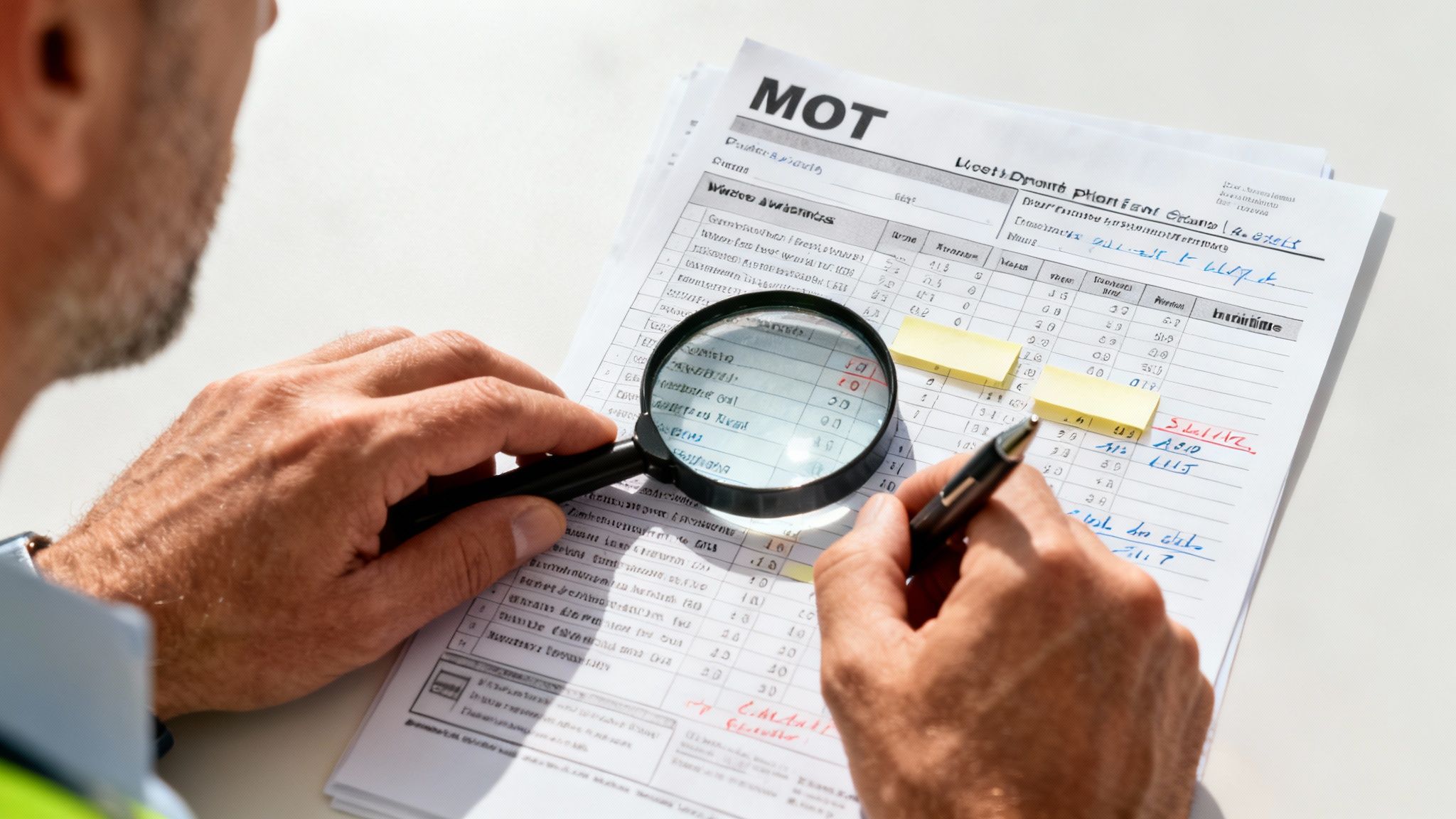
Getting your hands on the raw MOT data is the easy part. The real commercial advantage comes from knowing how to read between the lines. A professional analysis goes way beyond a simple pass or fail; it's about uncovering the subtle narrative of a vehicle’s life and spotting the small clues that point to bigger, more expensive problems down the road.
This is where you shift from just collecting data to applying genuine tradecraft. An experienced eye can pick up on patterns that a quick glance would miss, turning a standard MOT record into a powerful tool for valuation and risk assessment.
Decoding Advisory Notices
Advisory notices are, without a doubt, the most valuable part of any MOT history. They are the tester's way of saying, "This isn't a failure now, but it's on its way." Ignoring them is a costly mistake.
Think of them as early warnings. A one-off advisory for a "tyre worn close to legal limit" isn't a massive drama. But what if you see the same advisory pop up year after year, maybe alongside notes on suspension components? That tells a very different story.
- Recurring Wear: Consistent advisories for tyres, brakes, or suspension bushes, especially on one side of the car, can signal underlying alignment issues or even chassis damage.
- Corrosion Mentions: Pay close attention to notes like "brake pipes corroded" or "slight corrosion on subframe." These are huge red flags. This kind of decay doesn't get better on its own and often points to a vehicle that's been used in harsh conditions or simply neglected.
- Minor to Major: An advisory one year can easily become a major failure the next. Tracking these progressions helps you accurately predict future reconditioning costs before you even see the car.
A pattern of unaddressed advisories is a dead giveaway of a neglectful owner. It suggests a history of doing the bare minimum—just enough to scrape through the test—rather than proper, preventative maintenance.
The Problem with Gaps and Mileage
Significant gaps in a vehicle's MOT timeline need a closer look. Sure, it could be an innocent period where the vehicle was declared SORN, but it could also be hiding something far more sinister. A year-long gap might conceal major accident repairs or even a period where the vehicle was stolen and recovered.
Mileage is another crucial checkpoint. The progression should be logical and consistent year on year. Any sudden, unexplained drop is a massive warning sign for "clocking" or odometer tampering. A low-mileage executive car showing advisories for heavily corroded brake pipes just doesn't add up—it strongly suggests the mileage isn't a true reflection of its use.
Cross-Referencing Data for a Complete Picture
This is where a tool like AutoProv becomes indispensable. Our intelligent reporting automatically flags mileage discrepancies and cross-references MOT data with other critical checks. We can instantly tell you if that gap in the MOT history coincides with the vehicle being recorded as a Category S insurance write-off, turning your suspicion into solid, actionable intelligence. Our service gives you the full picture, ensuring you never make a purchase based on incomplete information.
Critical MOT Red Flags That Signal a Bad Investment
When you’re looking at an MOT history, you’re not just checking for a pass certificate. You're a detective, hunting for clues that reveal a vehicle’s real story. For anyone in the motor trade, spotting these red flags is what separates a profitable sale from a problem car that bleeds you dry on the forecourt. Some issues aren't just minor faults—they're giant, flashing warning signs screaming "bad investment."
It’s all about understanding the subtext. A car that repeatedly fails on the same items or just scrapes through with a laundry list of advisories is telling you a tale of neglect. It screams that the previous owner did the bare minimum to get a pass, leaving deeper issues to fester and grow. This is the kind of car that almost guarantees you’ll be footing some hefty reconditioning bills.
Decoding Emissions and Corrosion Warnings
Frequent emissions failures, especially on modern diesels, should set alarm bells ringing. These aren't simple fixes. They often point to serious, expensive problems with the engine management system, exhaust gas recirculation (EGR) valve, or the diesel particulate filter (DPF). A DPF replacement alone can easily run into four figures, wiping out your entire profit margin in one go.
Likewise, you need to take any mention of corrosion on an advisory notice very seriously. "Surface rust on components" might sound harmless, but the devil is in the detail—specifically, where it is. Corrosion on brake pipes, fuel lines, or, most critically, the vehicle’s subframe or structural sills, is a massive red flag. It tells you the car has lived a tough life, likely in a coastal area or on heavily gritted winter roads. This kind of decay compromises the car’s structural integrity and can be an absolute deal-breaker.
A history of emissions failures or structural corrosion advisories is a clear sign that a vehicle's running costs are about to escalate. These aren't just wear-and-tear items; they are indicators of significant, underlying health problems.
Mileage Discrepancies and Advisory Patterns
One of the most vital checks is tracking the mileage progression between each MOT test. Any illogical jumps or—even worse—a sudden drop, is a huge warning for odometer tampering, or "clocking." A car that shows 80,000 miles one year and 60,000 the next is a car you should walk away from, fast. An inconsistent mileage history often hides more than just a clocked odometer; it could be masking a past life as a write-off.
Checking a vehicle's MOT history through a platform like AutoProv gives you the full picture of its maintenance and roadworthiness. We pull the GOV.UK data together with over 10 other sources, highlighting mileage observations to help you avoid paying over the odds for cars with hidden problems. Our consolidated reports are designed to automatically flag these critical red flags. By cross-referencing MOT data with mileage records and other provenance checks, AutoProv instantly spots inconsistencies. We turn raw, overwhelming data into a clear risk assessment, protecting your business from bad investments.
Gaining the Full Picture with AutoProv
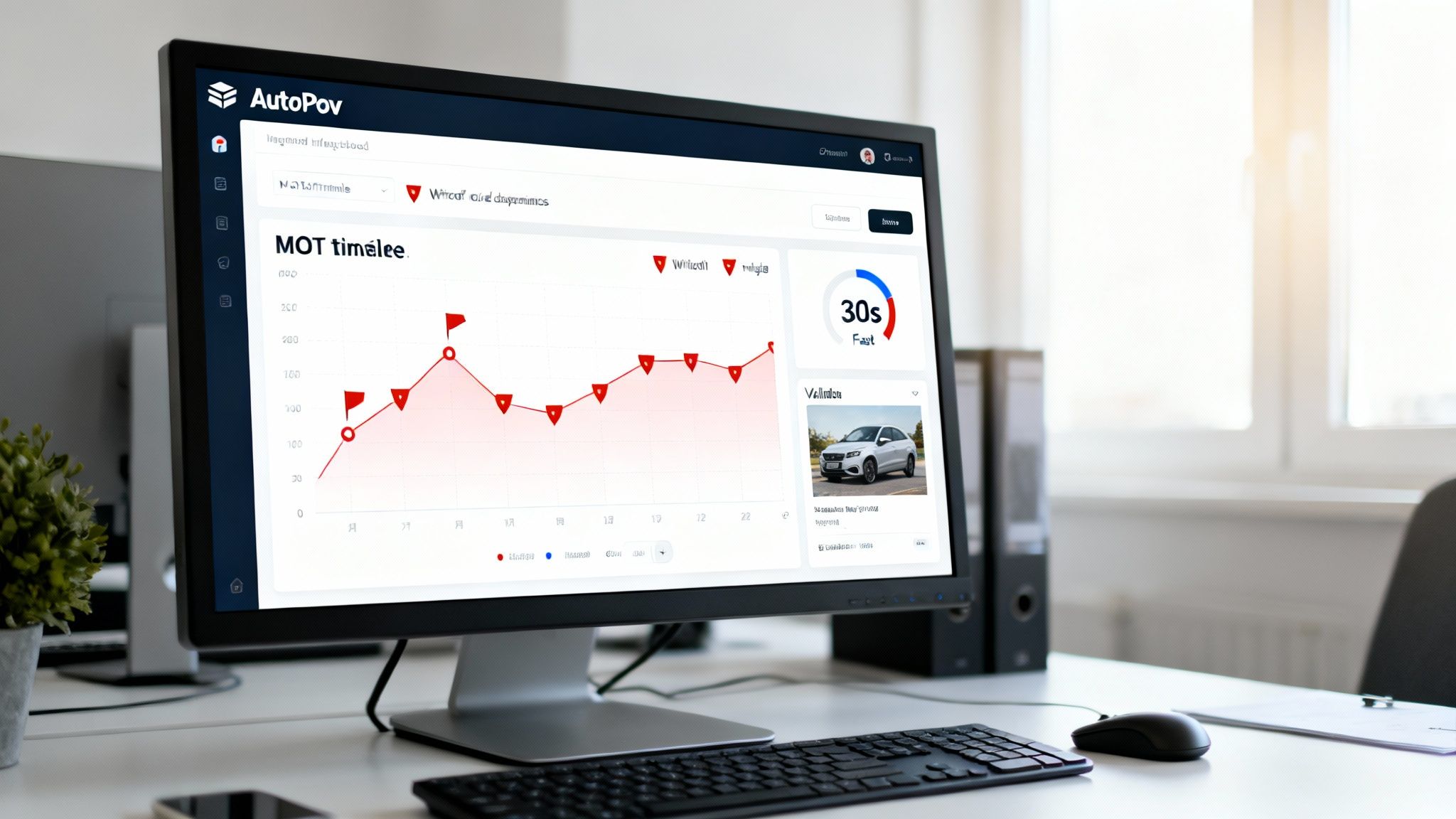
While the official government portal is an essential first stop, relying on it alone leaves dangerous gaps in your due diligence. For any professional in the motor trade, a standalone MOT history is just one chapter of a much larger story.
This is where AutoProv comes in. We move beyond the free check to deliver the complete, commercially-focused intelligence your business needs to operate safely and profitably.
Our platform is built from the ground up for the trade, because we know that speed, accuracy, and depth are what make the difference between a good buy and a bad one. We don't just show you the MOT data; we integrate it. AutoProv pulls a vehicle's entire MOT history and layers it with over 10 other critical data sources into a single, easy-to-digest report.
Beyond the Basic Check
Picture this scenario. You're looking at a three-year-old motor with a perfect MOT history. It’s just passed its first test with flying colours – no advisories, and the mileage looks spot on. On the surface, it seems like a straightforward, profitable addition to your stock.
But an AutoProv report, generated in under 30 seconds, tells a very different story. While the MOT is clean, our system cross-references the vehicle's details against other key databases. It turns out the car was recorded as a Category S (structural damage) write-off just six months ago. The repair was clearly done well enough to pass an MOT, but the vehicle's history—and its true value—are permanently scarred.
This is exactly the kind of critical context a simple MOT check will always miss. Our reports automatically include:
- Experian Finance Checks to see if there are any outstanding credit agreements.
- PNC Stolen Vehicle Status for immediate peace of mind.
- MIAFTR Insurance Write-Off Records to uncover hidden, and often costly, damage.
- Crucial Market Valuations so you know precisely what the vehicle is worth today, not what the seller hopes it's worth.
A clean MOT certificate does not equal a clean history. Without combining it with salvage, finance, and theft data, you are essentially appraising a vehicle with one eye closed, exposing your business to significant financial risk.
Data-Driven Decisions in Seconds
By consolidating all these checks into one place, AutoProv completely changes how you view MOT history. It's no longer just a pass/fail certificate; it becomes part of a complete provenance profile. Our service fuses GOV.UK MOT data with salvage categories, finance checks, and more, instantly flagging inconsistencies that a basic check would never catch. This allows you to make faster, more confident, and ultimately more profitable decisions for your business.
You can explore a full breakdown of how AutoProv's intelligent reporting works to see the full scope of our checks.
Common Questions About MOT History Checks
Even the most experienced dealers have questions when digging into a vehicle's MOT data. Getting the right answers is crucial for protecting your bottom line. Let's tackle some of the most common queries we hear from the trade about how to properly view MOT history.
Can a Vehicle's MOT History Be Faked or Altered?
This is a big concern, but the short answer is no. The official MOT history on the GOV.UK database is a secure government record. A seller can't just log in and change it.
The real danger isn't outright fakery—it's what the MOT doesn't tell you. A car can have a fresh MOT pass certificate that conveniently papers over a long history of recurring, serious faults. Or worse, it could be hiding a past life as a major insurance write-off. That’s exactly why a full check from AutoProv is so important. We go beyond the MOT, cross-referencing the timeline with salvage, finance, and theft records to give you the complete picture.
What Should I Do If There Is a Big Gap in the MOT History?
A significant gap in a car's MOT history is a massive red flag and needs looking into immediately. Sure, there could be an innocent reason, like the vehicle being declared SORN (Statutory Off Road Notification) and stored in a garage. But it could also be hiding something much more costly.
An unexplained gap in MOT records is a blind spot you can't afford to have. It could mean anything from being tucked away in storage to undergoing extensive, unrecorded repairs after a major smash.
An AutoProv report fills in these blanks. By running the VRM against the Motor Insurance Anti-Fraud and Theft Register (MIAFTR) and the Police National Computer (PNC), we can quickly see if that gap lines up with a theft or a major insurance claim. This turns a risky unknown into a clear, data-backed fact, letting you either proceed with confidence or walk away from a bad deal.
How Far Back Does the Online MOT History Go?
The digital MOT records you can pull up on the GOV.UK portal generally go back to 2005. That was when MOT stations started computerising the whole process. For most cars you’ll be looking at, this gives you a pretty complete timeline of their test history.
As a trade professional, the most telling information is usually found in the last five to seven years. This window gives you the clearest picture of recent maintenance, highlights any nasty patterns of wear, and helps you accurately forecast what work might be needed soon. AutoProv lays this crucial data out in a clean, easy-to-scan format. Our reports pinpoint mileage progression and patterns in failures or advisories, making it quick and simple to size up a vehicle's recent health and make a confident call on its value.
Frequently Asked Questions
AI-Generated Content Notice
This article was created with the assistance of artificial intelligence technology. While we strive for accuracy, the information provided should be considered for general informational purposes only and should not be relied upon as professional automotive, legal, or financial advice. We recommend verifying any information with qualified professionals or official sources before making important decisions. AutoProv accepts no liability for any consequences resulting from the use of this information.
From our AI insights
- MOT History: Understanding Seasonal Trends
Explore how seasonal trends impact MOT history and what it means for vehicle checks in 2026.
- Predicting Mechanical Issues with MOT Patterns
Learn how to analyse MOT patterns to foresee potential mechanical issues and make informed buying decisions.
- Mastering MOT Data for Smart Stock Acquisitions
Unlock the potential of MOT data to make smarter stock decisions and reduce risks.
Related Articles

Understanding the MOT History: A Comprehensive Guide
Explore everything you need to know about MOT history, including its significance, how to check it, and what to look out for.
Understanding MOT History: A Key to Smart Used Car Purchases
Discover how MOT history can guide your used car buying decisions and ensure you make an informed choice.

How to Check if a Car Has MOT: A UK Trade Guide
You’re usually not checking if a car has MOT out of curiosity. You’re checking because you’re about to bid, appraise, part-ex, or commit cash, and you need to know whether the vehicle is straightforward stock or the start of an avoidable problem.
Published by AutoProv
Your trusted source for vehicle intelligence