
You've got a forecourt to keep moving, an auction list to clear, and another buyer asking whether that car is clean enough to bid on before the lane closes. In that moment, the pressure isn't just speed. It's whether the check you've just done will hold up when the car lands in prep, in retail, and eventually in front of a customer who spots something you missed.
That's where process automation benefits matter in the trade. The gain isn't a flashy software layer or a vague promise of “efficiency”. It's a tighter, more repeatable way of making stock decisions so the same vehicle gets judged the same way, whether it's a Monday morning desk review or a Friday afternoon auction call.
Table of Contents
- The Real Cost of Manual Vehicle Checks in the Trade
- Where manual checking breaks down
- What Process Automation Means for a Dealer
- The trade version of automation
- Five Core Benefits That Change a Dealer's Day
- The five that matter on the desk
- Motor Trade Workflows That Automation Transforms
- Provenance checks without the tab chaos
- Risky stock triage that stays consistent
- Mileage anomaly review that doesn't depend on luck
- Measuring ROI and the KPIs That Matter
- The numbers worth tracking
- Implementing Automation Without Disrupting the Trade Floor
- Start with data sources, then the rules
- Roll out with controlled ownership
- Common Pitfalls That Undermine Automation Projects
- The failure modes to watch
- Next Steps for Dealers Ready to Move
The Real Cost of Manual Vehicle Checks in the Trade
A buyer is standing in front of a clean-looking car at auction, the sheet looks fine, the asking money feels right, and the clock's already ticking. They've opened the DVLA vehicle enquiry service, skimmed the MOT history, eyeballed the mileage, and phoned the supplier for a quick reassurance. Nothing obvious has popped, so the bid goes in.
That's how risky stock slips through. Not because anyone was careless, but because manual checks reward speed and memory, then punish inconsistency later when the same information is spread across tabs, calls and half-finished notes.
Where manual checking breaks down
The issue isn't the existence of the checks, it's the variation in how they're done. One buyer spots a short ownership pattern and digs deeper, another is focused on bodywork and misses it, and a third is tired by the time the lane gets busy. The process changes with the person, the time of day and the pressure on the desk.
That's costly in a trade business because the loss often shows up after the vehicle is bought. A missed mileage anomaly becomes a negotiation problem. A weak provenance view becomes a dispute. A rushed decision becomes stock that should never have been booked in.
Practical rule: if a check relies on someone remembering to compare three data points across three places, it isn't controlled enough for busy acquisition work.
UK policy has already moved towards this mindset in public services. The government's digital strategy frames automation as part of replacing manual, paper-heavy workflows with more efficient digital services, and the Department for Science, Innovation and Technology set a target to transform 50 of the 75 highest-volume government services by 2025 (UK business process automation statistics). That's not a motor-trade number, but the logic is the same. Standardised workflows reduce friction, and friction is where avoidable buying errors tend to hide.
What Process Automation Means for a Dealer
A buyer who has done this work for years will recognise the difference quickly. Manual checking asks one experienced person to carry the whole judgement load. Process automation sets out a repeatable checklist that applies the same rules every time, even when the desk is busy and the lane is moving fast.
It does not replace the buyer's judgement. It supports it by handling the repeated steps, capturing the data, applying the rules, routing exceptions and keeping the evidence trail in one place. Microsoft's automation guidance links this kind of setup to faster workflows, fewer mistakes, built-in analytics and audit trails, which is why it fits a compliance-heavy buying environment (Microsoft Power Automate business process automation benefits).

The trade version of automation
In a dealership, automation starts when a vehicle enters the workflow, not when someone remembers to check it. Data is pulled in, matched against the right records, and passed through a set of rules that say what is acceptable, what needs a second look, and what should be rejected outright. The buyer is not chasing information, they are reviewing a structured output.
That matters because the weak point in many acquisition processes is not effort, it is inconsistency. One buyer may spot a mileage anomaly straight away, another may focus on bodywork and miss it, and a third may be working under pressure when the lane is busy. Process automation makes the checks consistent, so provenance triage, mileage anomaly review and risky-stock flagging happen in the same order every time.
Workflow automation sits inside a larger process automation setup. A workflow is the sequence, a process is the business outcome. For a dealer, that outcome is safer stock decisions, less rework and a cleaner audit trail.
The best automation in the motor trade feels boring. It removes decisions that should never have been subjective in the first place.
The practical value shows up in the evidence trail. When a unit is questioned later, the team can see what was checked, what was flagged and why the decision went the way it did. That is where decision integrity starts to improve, because the process is visible rather than buried in someone's memory or a stack of notes.
If you want to see how that looks in practice, AutoProv's explanation of the workflow is a useful reference point, especially where provenance checks need to run in a consistent order, not as a one-off manual search: how AutoProv works. It also fits alongside wider reading on automation benefits for B2B SaaS, even though the trade use case is different.
Five Core Benefits That Change a Dealer's Day
A dealer feels the benefit first in the handover of risk, not in the spreadsheet. If the checks are inconsistent, the team can move quickly and still make a bad call. Process automation changes that by making the review path repeatable, so provenance triage, mileage anomaly review and risky-stock flagging happen in the same order every time.
The point is not to strip judgement out of the process. It is to make sure judgement sits on top of the same evidence each time, whether the buyer is on the desk, in the lane or clearing a purchase before auction time.
The five that matter on the desk
1. Efficiency.
Manual lookups, rekeying and cross-checking fall away from the front end of the workflow. That gives buyers more time for appraisal, negotiation and proper exception review instead of repetitive admin. It also reduces the stop-start feel that comes from hunting for the next piece of evidence.
2. Risk reduction.
A fixed rule set makes weak stock easier to spot before money changes hands. That matters in a market where the National Fraud Intelligence Bureau reported 89,347 fraud reports in the year to March 2024 and UK Finance estimated authorised fraud losses at £460.5 million in 2023 (Kissflow business process automation benefits). Those figures cover the wider economy, but they show why provenance intelligence deserves more than a quick pass or fail. Dealers need checks that hold up when the unit is challenged later.
3. Consistency.
A junior buyer and a senior buyer should not reach different answers on the same mileage trail because one had more time than the other. Consistency protects margin across the buying team, and it keeps the risk threshold steady when volume rises or the day gets busy.
4. Cost control.
Kissflow's industry summary says automation can cut costs by 20 to 40% (Kissflow business process automation benefits). In dealer terms, the primary value is usually lower rework, fewer returns to suppliers and less time spent on vehicles that should have been rejected earlier. It also cuts the hidden cost of senior staff being pulled into avoidable manual checks.
5. Faster decision-making.
Automation shortens the gap between data capture and action. A buyer can decide whether to bid, walk away or escalate for review while the car is still in play, rather than after the moment has passed. That matters because a slow answer is often the same as no answer.
For a broader view of how repeatable workflows change operating discipline, the breakdown in automation benefits for B2B SaaS is useful. The sector is different, but the pattern is familiar. Consistent inputs produce more reliable decisions under pressure.
If you want to connect that to evidence handling, the discussion of automotive data analytics shows the same principle in a trade setting. Better data handling turns a vague gut feel into a stock decision that can be defended later.
Motor Trade Workflows That Automation Transforms
The cleanest way to understand value is to look at the work that happens every week. In a dealer environment, automation isn't abstract. It changes how a vehicle is cleared, flagged or rejected before it ever reaches the forecourt.
Provenance checks without the tab chaos
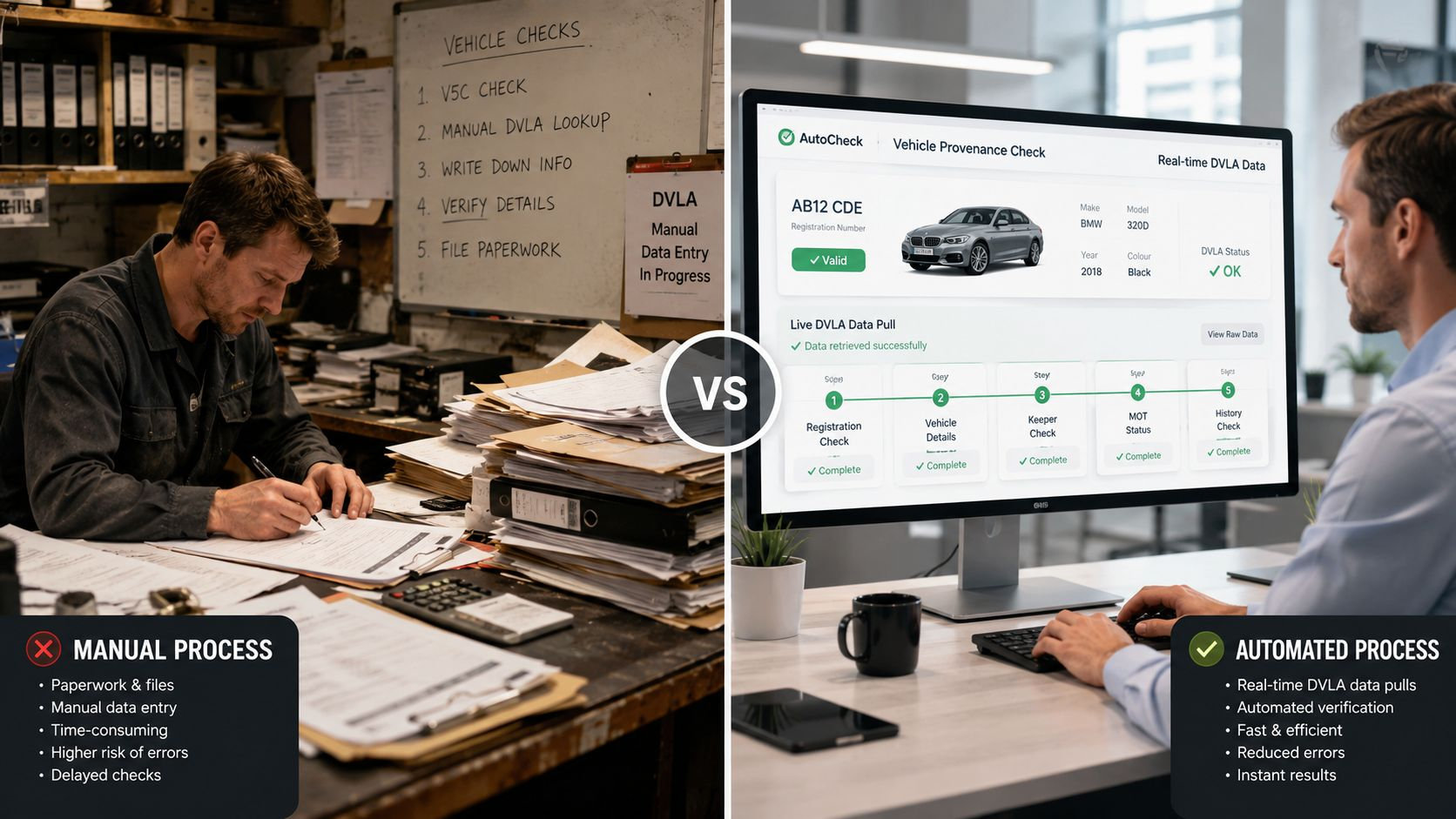
A manual provenance check often means opening DVLA, MOT and other records separately, then trying to reconcile them from memory. That works when the volume is low. It starts to fray when several cars need looking at before the auction clock runs out.
With automation, those records are pulled into one structured view, and the buyer sees the risk picture instead of the raw fragments. That doesn't eliminate judgement. It removes the time spent stitching together evidence that should have been assembled for them.
Risky stock triage that stays consistent
The second workflow is triage. A borderline vehicle should be treated the same way whether the buyer is confident, rushed or sceptical. Automation lets the business define the rule, then apply it every time, so the car is either cleared, flagged or rejected on the same basis.
That matters because dealers often lose discipline at the edges. A vehicle looks good, the stock is thin, or the price feels attractive. A rules-based workflow makes those exceptions visible before emotion gets involved.
Mileage anomaly review that doesn't depend on luck
Mileage discrepancies are one of the clearest examples of why automation helps. The DVLA MOT history and the Department for Transport's MOT dataset create a longitudinal trail of odometer readings, and once a vehicle is three years old in Great Britain, those readings recur annually (MOT workflow automation statistics). That gives the trade a real evidence chain, not just a snapshot.
A manual review may catch a jump, a plateau or a reversal if someone happens to notice it. An automated review should surface the pattern every time. That's the difference between spotting a bad story by chance and making sure it's flagged by default.
For dealers looking at implementation patterns, the digitised workflow implementation guide is a sensible reference because it reflects the core issue: workflows need structure before they need more tools. The same principle applies when automation sits alongside a dealer management system rather than replacing it.
If you're integrating this kind of workflow into existing operations, AutoProv's discussion of dealer management system integration is relevant because most trade teams don't want another silo. They want the risk view where the buying decision already happens.
Measuring ROI and the KPIs That Matter
A business case for automation gets weak fast if it only talks about headcount. In the trade, the better question is whether the workflow produces fewer bad decisions, fewer corrections and less money tied up in avoidable problems.
The numbers worth tracking
KPI Manual Baseline (Typical) Direction After Automation Cycle time per vehicle check Variable, depends on buyer and volume Down Exception rate Inconsistent, often handled ad hoc More visible, then down Rework cost Hidden in admin and follow-up calls Down Dispute rate after sale Hard to trace back to source checks Down Stock rejected pre-purchase Often undercounted Up, then stabilises on better stock Those figures are deliberately directional rather than numeric, because the baseline has to come from your own operation. Start by timing the current manual path, counting how often a check needs a second review and recording how many post-sale issues can be traced back to missed provenance signals.
A buyer can feel efficient and still be expensive. If a flawed provenance review lets a weak car onto the forecourt, or a mileage anomaly is missed until after retail prep, the cost shows up later as write-downs, awkward conversations and time spent fixing something that should have been caught earlier.
Useful rule: if the dashboard only measures saved minutes, it is missing the actual commercial value.
A practical ROI discussion should also look at what gets avoided. Use estimate savings from automation as a starting point for the cost logic, then adapt the thinking to acquisition risk rather than just labour. The point is to estimate the cost of a bad stock decision, the time spent cleaning it up and the margin pressure that follows.
For the finance conversation, a cost benefit analysis keeps the focus on rework, exception handling and risk exposure. That is the sort of accounting dealers need when automation is being judged on decision quality, not just admin time.
Implementing Automation Without Disrupting the Trade Floor
The cleanest rollout starts with the messiest part of the process. Map the current buying and intake flow first, then find the steps where people spend time chasing data, repeating checks or reconciling different views of the same vehicle.
Start with data sources, then the rules
For most UK dealers, the obvious starting data is DVLA, MOT history, ownership timeline signals and mileage data. Those sources are enough to build an initial risk view without trying to automate everything at once.
The next decision is where the automation sits. It should live alongside the tools the business already uses, not outside them. That means fitting into the existing DMS, auction workflows and stock feeds so the buyer sees the output in the normal buying process, not in a separate system that nobody opens twice.
Roll out with controlled ownership
The rule set needs an owner. Someone has to decide what triggers a flag, when an exception should escalate and when a buyer can override the output with a note. Without that governance, the workflow will drift.
Buyers also need training on what the flag means and what it doesn't mean. Automation should support judgement, not replace it. The best teams use it to reduce noise so their human reviews go where they matter most.
If you're looking at platform choices, the right lens is practical rather than flashy. A trade-focused layer such as AutoProv can sit in that decision path as vehicle intelligence, while the broader workflow lives in the DMS and stock process. For anyone planning implementation, the pricing page is the place to sanity-check fit against the intended rollout model, not to chase features for their own sake.

Common Pitfalls That Undermine Automation Projects
A lot of automation projects fail for ordinary reasons. The team buys a tool, then tries to automate a process that was never properly defined. That usually creates faster bad decisions, which isn't progress.
The failure modes to watch
Broken workflow, automated faster.
If the current buying process has loose criteria, automation will just lock in the same inconsistency. Fix the rule first, then automate it.
Incomplete data, confident output.
Automation is only as good as the inputs. If the mileage trail or ownership data is weak, the system should flag uncertainty rather than pretend certainty.
Too much judgement removed.
Some calls still need a buyer. A rule-based workflow should surface the cases that need human review, not pretend every stock decision can be reduced to a binary output.
Rule drift.
The market changes, suppliers change and risk patterns change. If the rule set isn't reviewed, yesterday's safe filter becomes today's blind spot.
Senior resistance to standardisation.
Experienced buyers sometimes equate flexibility with good judgement and standard outputs with bureaucracy. The fix is not argument, it's showing that the workflow frees them from repetitive checks so they can focus on the edge cases that need their eye.
The simplest test is whether the business can explain why a vehicle was flagged, cleared or rejected six weeks later. If the answer is buried in someone's head, the automation hasn't solved the control problem yet.
Next Steps for Dealers Ready to Move
A dealer that wants better control should start with the checks that carry the clearest risk. Provenance and mileage workflows are usually the right place, because the data points are familiar, the failure modes are easy to spot and the buying team can see the effect on real stock decisions. Once those controls are working properly, the same approach can extend into wider stock triage and exception handling.
A practical first pass is simple. Map the current vehicle history check UK process, define the rules for mileage anomaly review, decide who owns exceptions and pilot the workflow on a small slice of stock. That gives you a usable vehicle provenance baseline before you widen the scope, and it helps the team see where judgement still needs to stay with the buyer.
The point is consistency. A good setup should flag the same sort of risky stock in the same way every time, so the team is not relying on memory, habit or whoever happened to review the file last. In a trade environment, that matters as much as speed.
If you are comparing options, AutoProv pricing is the place to check how the platform is structured for dealer vehicle checks before the next purchase decision lands on your desk.
Frequently Asked Questions
AI-Generated Content Notice
This article was created with the assistance of artificial intelligence technology. While we strive for accuracy, the information provided should be considered for general informational purposes only and should not be relied upon as professional automotive, legal, or financial advice. We recommend verifying any information with qualified professionals or official sources before making important decisions. AutoProv accepts no liability for any consequences resulting from the use of this information.
From our AI insights
- Navigating UK Dealer Software Regs: A 2024 Deep Dive
Explore 2024 UK dealer software regulations, focusing on compliance, features and strategic choices.
- Decoding Vehicle Build Sheets: A Trader's Guide
Master the art of decoding factory build sheets for precise vehicle insights.
- Integrating Vehicle Data: Mitigating Risks for UK Dealers
Explore how data integration platforms help UK dealers manage risk using DVLA, MOT, and provenance data.
Related Articles

Latest Innovations in UK Automotive Technology
Explore cutting-edge technology advancements in the UK car market and future trends.

Innovations in Automotive Tech: Benefits for UK Drivers
Explore the latest automotive technologies and their benefits for UK drivers, from EV advancements to smart safety features.

The Future of Automotive Technology in the UK
Explore how emerging automotive technologies are shaping the UK market, from electric vehicles to autonomous driving.
Published by AutoProv
Your trusted source for vehicle intelligence