For anyone in the UK motor trade, a professional reg plates check is the single most important bit of due diligence you'll ever do. Think of it as your first line of defence. It’s the tool that instantly exposes a vehicle's hidden story, protecting you from buying a world of trouble before it ever hits your forecourt. At AutoProv, we provide the comprehensive data you need to secure every transaction.
Why a Reg Plates Check Is a Non-Negotiable Tool
We’ve all seen it. A nearly new, high-spec SUV rolls in as a potential part-exchange. It looks immaculate, the mileage seems spot on, and the V5C logbook is present and correct. On the surface, it’s a straightforward, profitable addition to your stock.
But a quick check with a service like AutoProv reveals a devastating red flag: the vehicle has outstanding finance.
Without that crucial insight, you could have bought the car, only for the finance company—the legal owner—to rock up and repossess it weeks later. That’s a total loss of your investment and a serious knock to your reputation. This isn't some scare story; it's a daily risk in this business that our checks are designed to prevent.
The Difference Between Trade and Consumer Checks
It's vital to understand the chasm between a basic consumer search and a professional-grade reg plates check. A consumer check might pull up MOT history or tax status, but frankly, it barely scratches the surface. A professional tool is built for commercial risk management, focusing on the data points that carry serious financial and legal weight.
These trade-grade checks, like those offered by AutoProv, are built on four essential pillars of data:
- Provenance: Verifying the vehicle's real identity, keeper history, and any plate changes to guard against cloning and fraud.
- Finance: Confirming there are no active finance agreements tied to the car. This is the big one, ensuring you can acquire a clear title and avoid catastrophic financial loss.
- Condition: Uncovering past insurance write-offs (like Cat S/N) or reported accidents that hammer a car's structural integrity and value.
- Valuation: Tapping into live market data, including trade and retail pricing, so you can make informed, profitable buying decisions every single time.
Your First Line of Defence
Think of a comprehensive check as the foundation of every confident vehicle acquisition. It moves you from guesswork to data-driven certainty. Platforms like AutoProv are designed specifically for this, pulling all these different data sources into a single, instant report. Instead of wasting time manually digging through multiple government and private databases, you get one clear, actionable overview.
This consolidated approach doesn't just save time; it transforms your due diligence process. It ensures every vehicle is vetted against the most critical risk factors, allowing you to price accurately, negotiate effectively, and maintain a trustworthy, profitable inventory. As we cover in our guide on the essential used car history report for dealers, a robust check is fundamental to modern dealership operations.
Decoding a Vehicle's Official History
Beyond what you can see on the surface, a vehicle's official history is where the real story lives. A professional reg plates check isn't just about matching a number to a car; it's about digging into the data held by official bodies like the DVLA and the police. This is where you find the small clues that point to massive problems.
The whole system of vehicle registration is the backbone of what we do. It started way back with the Motor Car Act of 1903, mainly so the police could catch speeding motorists. That means for over 120 years, registration data has been the cornerstone of a car's identity. This long history is what allows platforms like AutoProv to pull accurate, reliable data in seconds. You can learn more about how these historic vehicle records have evolved over time.
Reading Between the Lines of DVLA Data
The V5C logbook is your starting point, but the data behind it tells you so much more. For example, a very recent V5C issue date might be innocent—perhaps the last owner lost it. Or, it could be a classic red flag for a stolen vehicle getting a dodgy new identity.
You need to keep a sharp eye on these specific DVLA data points:
- V5C Issue Date: A brand-new V5C on an older car needs a closer look. Always ask the seller about it and see if their story matches the rest of the data.
- Keeper History: A high number of keepers in a short space of time often screams "problem car." It suggests a persistent fault that's being passed from one unlucky owner to the next.
- Colour Changes: A professional respray isn't a problem, but a recent, undocumented colour change? That's a textbook move for disguising a stolen car.
AutoProv pulls this information straight from the DVLA, laying it out clearly so you can spot these patterns without shuffling through paperwork. It lets you focus on making a decision, not gathering the data.
This decision tree shows how a simple reg plate input branches out, leading to either a quick initial screening or a full-blown professional check for proper due diligence.
The key takeaway here is simple: a professional-grade check acts as a shield, protecting your business from the kind of risks that basic checks completely miss.
Uncovering the Story in the MOT History
Having a valid MOT certificate is the bare minimum. The real value is in the vehicle’s entire testing history, which gives you a timeline of its health and how it's been looked after. Don't just look for a pass; look for the patterns.
For instance, if you see the same advisory for "slight play in front nearside wheel bearing" pop up on three consecutive MOTs, you know it's an issue that's been ignored. It might just need a simple repair, or it could be a symptom of a much bigger problem the owner's been avoiding. Gaps in the MOT history are another huge red flag, often meaning the car was off the road for major repairs—or worse, driven illegally.
An AutoProv check puts the entire MOT history, including every advisory and failure, into a simple chronological list. This makes spotting those recurring faults and unexplained gaps dead easy, giving you powerful leverage to negotiate the price or a clear reason to just walk away.
The Critical Police National Computer (PNC) Check
This one is the big one. Finding a stolen vehicle marker on the Police National Computer (PNC) is the most definitive red flag you can get. It's an immediate, no-questions-asked deal-breaker. If a vehicle is flagged as stolen on the PNC, it means there's an active police interest in it.
Trying to buy or sell a car with a PNC marker can land you in serious legal hot water, implicating your business in handling stolen goods. There is absolutely no grey area here.
If a reg plates check flags a PNC stolen marker, you should stop the transaction immediately, end your conversation with the seller calmly and professionally, and contact the police straight away to report that you've found a vehicle with a stolen marker.
Using a service like AutoProv, which runs a direct PNC check, is the only way to be certain. It gives you instant confirmation, ensuring you never accidentally buy a stolen vehicle and protecting your dealership from catastrophic legal and financial fallout. When you combine this check with a deeper look into how to find car specs by reg, you get a complete picture of both its history and its identity.
Uncovering Hidden Financial and Accident Records
Once you've confirmed a vehicle’s official identity, it’s time to dig deeper. The next stage of any professional reg plates check is all about hunting for the two biggest hidden liabilities: outstanding finance and undisclosed accident damage.
These are the kinds of problems you’ll never spot with a visual inspection or a basic DVLA search, yet they carry the most serious financial risk for your business. A car can look absolutely pristine on the surface while hiding a past that completely craters its value and legality.
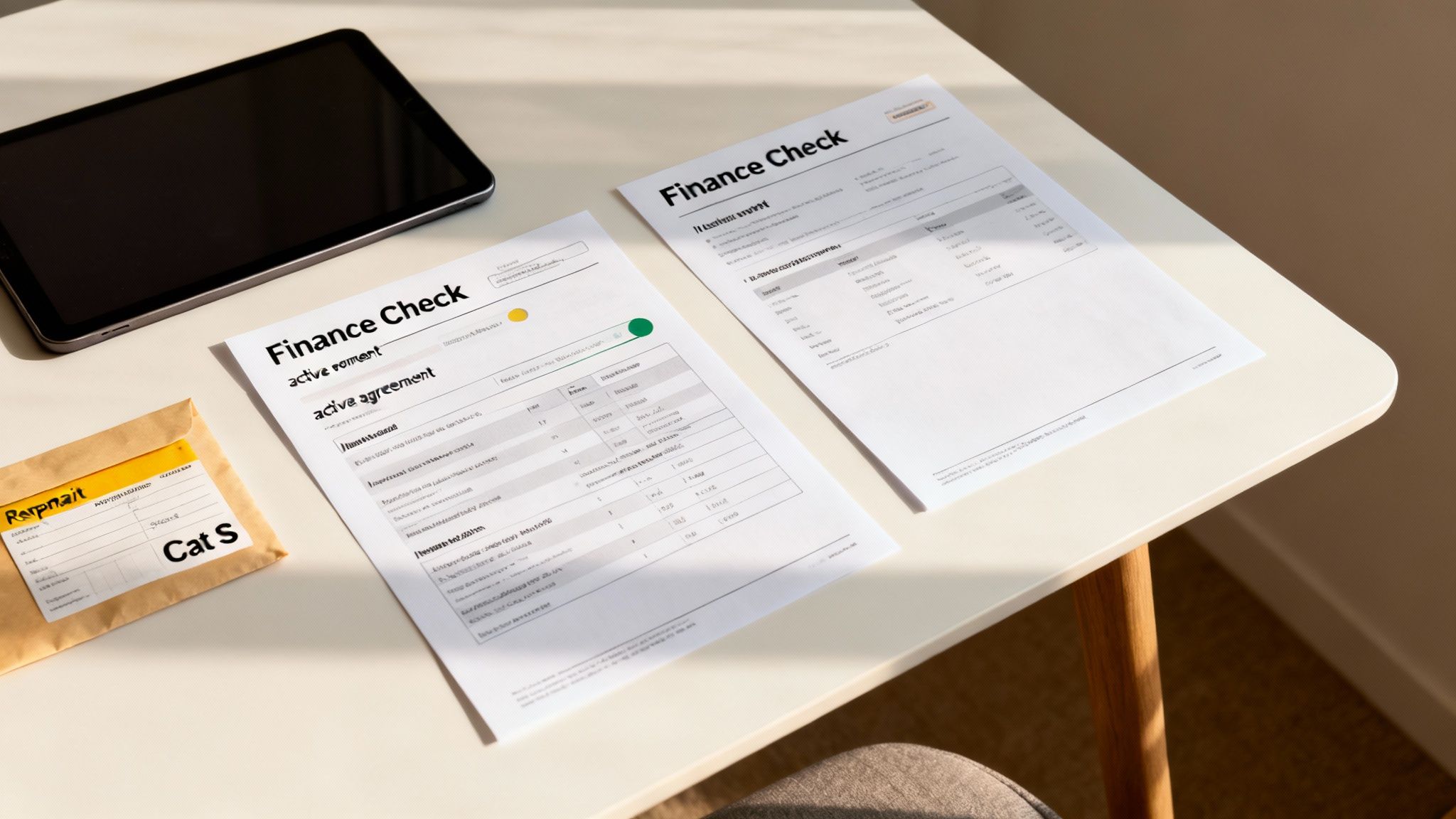
This is where you move beyond simple provenance and get into serious commercial due diligence. Failing to uncover these records isn't just a mistake; it can lead to the total financial loss of a unit and do real damage to your dealership's reputation.
The Critical Experian Finance Check
Of all the checks you can run, the finance check is arguably the most important. It's a staggering thought, but some estimates suggest as many as one in three used cars on UK roads have some form of active finance agreement against them. If you take one of these vehicles into stock without getting clearance, you do not gain legal title. Simple as that.
The finance company remains the legal owner, and they have every right to repossess the vehicle from your forecourt—or even worse, from your customer.
An active agreement on an Experian check means the vehicle is still legally owned by a lender. This is usually a Hire Purchase (HP) or Personal Contract Purchase (PCP) agreement that the seller hasn't settled. For a deeper dive into the specifics, you can review our complete guide on how to check for outstanding car finance in the UK.
Never, ever take a seller's word that the finance is "about to be cleared." Until your check shows the agreement is settled and the vehicle is clear of all financial interest, it represents a direct and unacceptable risk to your business.
Using a tool like AutoProv, which integrates a guaranteed Experian check, gives you instant confirmation. You get a clear "finance clear" or "finance outstanding" result in seconds, removing all the guesswork and protecting your capital.
Demystifying Insurance Write-Off Categories
Just as dangerous as hidden finance is a hidden accident history. A vehicle that has been declared an insurance write-off (or total loss) has its value and safety profile permanently changed. Understanding the official categories is absolutely vital for accurate pricing and risk assessment.
The Association of British Insurers (ABI) sets the salvage code of practice, which categorises vehicle write-offs. The two you'll bump into most often are Category S (Structural), which means the vehicle has sustained damage to its structural frame or chassis, and Category N (Non-Structural), which is for vehicles that haven't suffered structural damage but were deemed uneconomical to repair by the insurer. While a Cat S vehicle can be professionally repaired, its structural integrity has been compromised and repaired. A Cat N vehicle's issues could be cosmetic, electrical, or related to safety parts like steering or brakes.
A car recorded as Cat S or Cat N will always be worth significantly less than an equivalent vehicle with a clean history. Many buyers are wary of them, and failing to declare this status at the point of sale can land you in serious legal trouble.
Uncovering History with the MIAFTR
So, how do you find this information? The definitive source is the Motor Insurance Anti-Fraud and Theft Register (MIAFTR). This is a comprehensive database shared by UK insurers that records every vehicle subject to a total loss claim.
When a professional reg plates check queries the MIAFTR, it's looking for that official record of the vehicle being written off. This is a non-negotiable part of your due diligence. A car might have been expertly repaired and look perfect, but a MIAFTR entry is a permanent part of its history.
Consider this scenario: you're offered a three-year-old executive saloon at a very attractive price. It looks clean, drives well, and has a full service history. However, a quick check through AutoProv reveals a Cat S marker logged on the MIAFTR nine months ago.
Without this check, you might have priced it as a standard vehicle. With it, you now know its history involves significant structural repair. This insight empowers you to either reject the car outright or negotiate a price that accurately reflects its diminished value and history, protecting both your profit margin and your integrity as a dealer. AutoProv’s direct integration with these essential databases ensures you get this vital information instantly, providing the guaranteed clearance you need to operate with confidence.
Digging Deeper: Mileage, Recalls, and Commercial Use
Once you’ve cleared a vehicle on finance and accident history, the real detective work begins. A professional reg plates check has to go deeper, uncovering the subtle details that reveal how a car has actually lived its life. This is where you find the deal-breakers hiding in plain sight.
We’re talking about mileage authenticity, outstanding safety recalls, and any history of commercial use. These are the things that don't just affect a car's value; they impact its reliability, its safety, and ultimately, your reputation. Getting this wrong can completely torpedo your profit margin on a vehicle.
Cross-Referencing Mileage to Catch Clocking
Vehicle "clocking"—illegally winding back the odometer—is an age-old scam that's still alive and well. A car showing 50,000 miles when it’s actually done 120,000 isn't just a bad deal; it’s a mechanical time bomb.
A quick glance at the dashboard is useless. The only way to spot a dodgy reading is to dig into the historical records and look for the story the numbers tell.
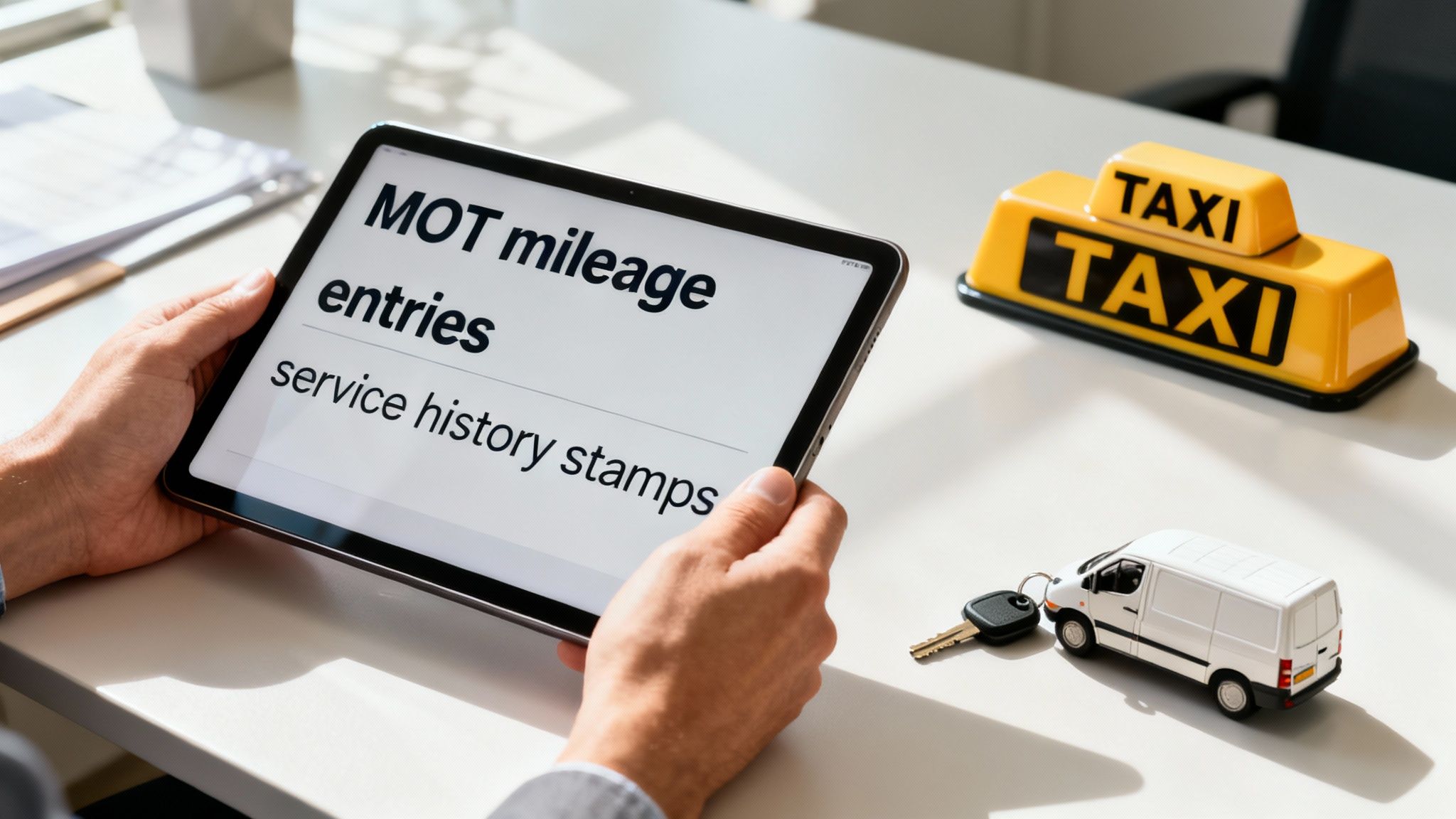
- MOT History: This is your best friend. Every MOT test logs the mileage, creating a timeline you can trust. Any sudden drops or ridiculously small increases between tests should set alarm bells ringing.
- Service Records: While not as official, service invoices from main dealers or reputable garages are another valuable source. If the service book says one thing and the MOT history says another, you need to start asking some serious questions.
An inconsistency isn't always outright fraud, but it always demands a solid explanation. For a proper deep dive into this, check out our guide on how to handle a car mileage discrepancy for UK motor traders.
Uncovering Outstanding Safety Recalls
An unresolved manufacturer safety recall is a massive red flag for both your due diligence and your duty of care. When a manufacturer or the DVSA finds a serious safety defect, they issue a recall for anything from faulty airbags to dodgy brakes.
Selling a car with an outstanding recall is a huge liability. It puts your customer in danger and can do serious damage to your dealership's reputation if something goes wrong.
An AutoProv reg plates check will query OEM recall databases directly. It needs to tell you not just if a recall was issued, but crucially, whether the fix has been completed by an authorised dealer.
This isn't just about ticking a box. It’s about ensuring you aren't passing on a dangerous vehicle and giving you the chance to get it rectified before it ever hits your forecourt.
Spotting a Hidden Commercial Past
A car that’s spent its life as a taxi, private hire vehicle, or driving school runabout has been worked hard. Really hard. Think punishingly high mileage, constant stop-start city driving, and interiors that have seen better days. This kind of life takes a heavy toll on the engine, gearbox, suspension—everything.
The trouble is, these cars are often tidied up and put back into the private market looking deceptively clean. The evidence of their commercial life is buried in local authority licensing records, far from a standard check.
A proper reg plates check can unearth this hidden past. AutoProv, for instance, cross-references against taxi and private hire licensing databases, flagging any vehicle that’s ever been used for hire. This one piece of information can be the difference between buying a solid, reliable motor and inheriting a worn-out workhorse on its last legs.
Given the UK vehicle market saw a massive 29.4% registration drop during the 2020 lockdown, followed by a frantic recovery, stock dynamics have been all over the place. That kind of volatility makes having precise data more critical than ever.
By pulling mileage records, recall data, and commercial use flags into one clear, instant report, a tool like AutoProv gives you the certainty you need to make smart, safe, and profitable buying decisions every single time.
Turning Data Into Profitable Business Decisions
Spotting red flags during a reg plates check is only half the job. The real skill, the thing that separates the pros from the amateurs, is turning all that raw data—from keeper history to market trends—into a single, profitable business decision.
It’s about moving beyond just dodging the lemons. This is where you learn to price every single vehicle with surgical precision to protect and maximise your margin on every deal. This final step is what connects your due diligence directly to your bottom line, helping you build a smarter, more profitable inventory from the ground up.
From Data Points to True Market Value
A vehicle's real worth is a lot more complex than just its age and mileage. It's a calculation that has to factor in its specific technical makeup, how desirable it is in the current market, and wider industry trends. A professional check gives you the tools to see this complete picture.
This means digging deeper than the basics and using data like detailed technical specifications, market desirability scores, and depreciation trends. Knowing the exact trim level and optional extras helps you price a car based on what it actually is. A desirability score, included in an AutoProv report, tells you how hot a vehicle is likely to be, letting you fine-tune your pricing strategy. Finally, understanding a model's typical depreciation curve is critical for stock management, helping you forecast its future value.
This level of detail moves your valuation from a rough guess to a data-driven science.
Informing Your Buying and Selling Strategy
When you have a crystal-clear understanding of a vehicle's true market value, you walk into every negotiation with a massive advantage. This is where you can really make trade vs. retail pricing guides work for you. The data helps you set a firm, evidence-backed maximum offer when you're buying, stopping you from ever overpaying.
At the same time, it lets you set a retail price that’s both competitive and profitable. You can justify your pricing to customers with confidence, backed by a comprehensive report that proves the vehicle's clean history and value. That kind of transparency doesn't just help close the deal; it builds the trust that creates repeat business.
For anyone in the motor trade, market dynamics are everything. Knowing which manufacturers and models are flying high is essential for smart stock acquisition. Recent figures show Volkswagen leading the charge in new registrations, with models like the Ford Puma and Kia Sportage not far behind. This kind of insight, which you can dig into with the latest SMMT registration data, helps you pinpoint vehicles with stronger residual values and higher demand—making them much safer bets for your business.
A Simple Workflow for Commercial Success
You don't need to overcomplicate things. Integrating a professional reg plates check into your daily operations should make your process faster, more consistent, and more profitable. Using a consolidated platform like AutoProv streamlines the entire workflow, from first look to final sale.
The process is simple: run an instant check before you even see the car. In under 30 seconds, you have the full story. Scan the consolidated report for high-priority alerts like finance markers or a stolen flag. Armed with trade pricing and a full provenance report, you can make a sharp, confident offer. Once in stock, use the clean report as a sales tool to build trust with customers and justify your asking price.
This simple process transforms the check from a defensive safety net into a proactive tool for commercial success. It ensures every car you buy is a sound investment and every vehicle you sell is backed by undeniable proof of its quality.
Common Questions About Professional Reg Plates Checks
Even if you’ve been in the motor trade for years, the world of vehicle data can still throw a few curveballs. Getting straight answers to tricky questions is key to making fast, confident decisions on the forecourt. Here are a few of the most common queries we hear from professionals about running a proper reg plates check.
How Is a Professional Trade Check Different from a Cheap Consumer Check?
Honestly, the difference is night and day. It all comes down to the data sources and the level of risk they’re designed to manage.
A professional trade check, like the ones we provide at AutoProv, is built from the ground up for commercial risk management. A cheap consumer check might show you the MOT history, but a trade-grade report plugs you directly into exclusive data feeds that are non-negotiable for business. These include Experian for outstanding finance, the Police National Computer (PNC) to check for a stolen status, and the MIAFTR database for official insurance write-off history.
Crucially, an AutoProv trade report also gives you vital market intelligence, like up-to-date trade and retail valuations. This turns a simple background check into a powerful risk management and valuation tool—something a basic consumer check just can't do.
What Is the Single Biggest Risk I Can Avoid with a Proper Check?
While clocked mileage and stolen vehicles are serious issues, the single biggest financial trap you can sidestep is buying a car with outstanding finance. It’s a devastatingly simple mistake to make.
If a finance agreement is still live, the finance company remains the legal owner of that vehicle. They have every right to repossess it at any time—whether it's on your forecourt or has already been sold to a customer. When that happens, you’re left with a total financial loss. The only way to properly shield your business is with a comprehensive check that includes a guaranteed search with Experian, ensuring you get a clean title every single time.
Is a Physical Inspection Still Necessary with a Full Check?
Absolutely. You should always think of the digital check and the physical inspection as two essential halves of the same process. A comprehensive reg plates check is your first line of defence, but it has to be followed up with a thorough, hands-on look at the vehicle itself.
A digital check uncovers a vehicle's recorded past—its ownership, financial status, and any hidden damage that’s on the record. The physical inspection, on the other hand, tells you about its present condition, from engine health and tyre wear to the state of the interior.
The data tells you if a car is worth your time; the inspection confirms its physical condition matches its documented history. For a closer look at other common questions, you can find more answers in our AutoProv FAQ section.
Ready to eliminate the guesswork and protect your business with every acquisition? AutoProv delivers instant, trade-grade vehicle intelligence, giving you the complete picture in under 30 seconds. https://autoprov.ai
Frequently Asked Questions
AI-Generated Content Notice
This article was created with the assistance of artificial intelligence technology. While we strive for accuracy, the information provided should be considered for general informational purposes only and should not be relied upon as professional automotive, legal, or financial advice. We recommend verifying any information with qualified professionals or official sources before making important decisions. AutoProv accepts no liability for any consequences resulting from the use of this information.
From our AI insights
- Navigating ULEZ Compliance for Used Car Dealers
A deep dive into ensuring your used car stock meets ULEZ standards, avoiding costly fines.
- Mastering Paint Verification with VIN Decoding
Learn how UK traders verify original paint using VIN decoding and provenance data.
- Understanding VIN Decoding: Avoid Misleading Imports
Learn how VIN decoding reveals vehicle origins and specs, preventing import pitfalls.
Related Articles

Car Specs by Reg: Instantly Find Vehicle Details & MOT History
Trying to find the full car specs by reg? In the UK, that little number plate is the key to unlocking a huge amount of information about a vehicle. From the exact engine size and CO2 emissions to its MOT history and tax status, it's all tied to the registration.

How to Check Previous Owners of a Car in the UK
Before you even start thinking about how to check the previous owners of a car, you need to get your head around why it's so important. This isn't just about being nosy; it’s a non-negotiable step that protects you from serious financial headaches and safety risks lurking under a shiny bonnet.

How to Check Service History in the UK
Think of a car's service history as its detailed CV, not just some dusty folder in the glovebox. To check service history is to get the real story behind a vehicle, digging into everything from its routine oil changes to any major surgery it's had. For any savvy car buyer in the UK, this record is the single most important document you can get your hands on.
Published by AutoProv
Your trusted source for vehicle intelligence