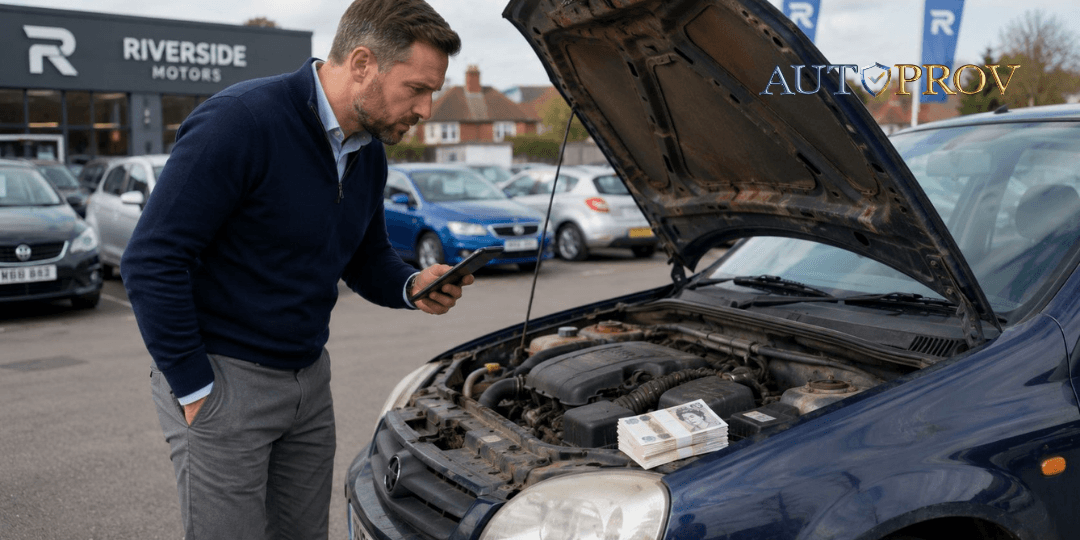
A trader spots the advert, sees the headline price, and starts doing mental arithmetic before the kettle has boiled. Buy at the right number, spend a bit in prep, move it quickly, and there's margin in it.
That's how the sub-£2k end of the market pulls people in. It also punishes lazy buying faster than almost any other stock band.
A used car under 2000 isn't just a cheap retail opportunity. In trade terms, it's a compressed risk decision where provenance, MOT pattern, admin quality, and likely rectification all matter more than badge appeal. If you treat it like a bargain hunt, you'll end up owning someone else's deferred maintenance.
The Sub-£2k Market High Risk or High Reward?
The attraction is obvious. Entry money is lower, disposal can be quick, and there's always demand for basic transport at the bottom of the market. But this bracket only works when the buyer stays disciplined.
The wider context matters. The UK vehicle parc is older than it used to be. The average age of a car on UK roads reached 9.4 years in 2023, up from 8.4 years in 2019, and that increase is roughly 12% over four years, according to SMMT data cited in these used-car market figures. That ageing profile helps explain why very cheap stock still exists in volume, but it also explains why these cars are rarely straightforward.
Most sub-£2,000 units sit at the edge of mainstream retail life. They've often had longer ownership cycles, more repair-led decisions, and a history shaped less by normal depreciation and more by whether the last owner could justify the next bill.
For traders, that changes the buying question.
Cheap stock isn't automatically cheap risk
The wrong way to buy this segment is to ask, “Can I retail this at a higher number?” The right question is, “What is this car likely to cost me before it becomes saleable, compliant, and defensible?”
Three realities usually define this end of the trade:
- Age drives uncertainty: Older vehicles carry more unknowns even when they present well.
- History matters more than cosmetics: Fresh valeting can hide neglect. MOT patterns usually can't.
- Margin is fragile: One missed fault, one paperwork issue, or one provenance red flag can wipe out the deal.
Practical rule: In this bracket, profit comes from what you avoid buying, not only what you buy well.
A lot of dealers already feel this in day-to-day sourcing. The stock that looks easiest on first inspection is often the one that's been dressed for disposal. The one with honest age, complete paperwork, and a readable maintenance story is usually the safer bet.
That's also why broad market reading helps before you even start appraising individual units. A trader who understands UK used car market trends will usually price risk more accurately than one who only reacts to the advert in front of them.
Where reward still exists
There is still money in this segment. Not because the cars are naturally desirable, but because many buyers in this market need function first. If you source carefully, prep realistically, and avoid hidden liability, older low-ticket cars can still turn cleanly.
The mistake is assuming all cheap stock is equal. It isn't. Two cars at the same asking price can sit on completely different risk profiles. One needs routine prep. The other needs a suspension bill, tyres, admin chasing, and an argument with a customer in three weeks' time.
Sourcing Profitable Stock and Managing Expectations
Stock under £2,000 usually comes from places where the previous owner or seller has already decided the vehicle isn't worth further investment. That's why the buying method matters as much as the vehicle itself.

The sourcing channels that actually matter
Trade-ins can still be useful because you often know the customer, can inspect the car in context, and may get a clearer story about recent use. The downside is emotional valuation. Sellers often price the memory of the car, not its current trade reality.
Auctions can produce opportunities, especially where the room has overreacted to age or cosmetic roughness. They can also trap buyers who mistake low hammer prices for safe margin.
Private acquisitions sit somewhere in the middle. You may find honest stock from owners who want rid, but you also take on more narrative risk. If the story doesn't stack up, walk away.
A practical shortlist looks like this:
- Part exchanges: Better when the ownership story is clear and the handover is local.
- Budget auction lanes: Useful for experienced buyers who can price reconditioning on sight.
- Direct private buying: Viable only when paperwork, identity, and vehicle history line up cleanly.
If your sourcing mix is too reliant on hopeful private ads, your problem won't be finding stock. It'll be buying avoidable grief. Dealers looking to widen acquisition routes without defaulting to random classifieds often benefit from a more structured sourcing approach such as these platforms used to find trade stock.
Price is only one part of the stock budget
This bracket should be treated as a high-risk repair threshold. The MOT database shows that older vehicles in this segment are disproportionately exposed to repeat failures on safety-critical items such as suspension, brakes, tyres and lighting, and hidden mechanical wear becomes more significant than cosmetic condition, as reflected in this market overview of ultra-low-priced used cars.
That has a direct trade implication. A purchase that looks cheap on paper can become expensive the moment prep starts.
What realistic expectations look like
In this band, assume age, mileage, and prior maintenance quality will matter far more than model desirability. You're rarely buying a clean, modern used car at a bargain. You're usually buying an older vehicle that has survived long enough to reach a very sensitive value point.
Use a basic triage before you commit:
Buying question Why it matters Is the car structurally honest? Corrosion and poor repairs can kill the deal before prep begins. Are faults age-related or neglect-related? Age can be manageable. Neglect often isn't. Does the seller's story match the documents? Mismatches usually get worse, not better. Can it be retailed without heroic spending? If prep feels open-ended, the margin probably is too. The best cheap stock usually doesn't look exciting. It looks consistent.
That's the mindset shift. You're not buying a headline price. You're buying a total cost position. If the likely reconditioning load is too high relative to the gross stock budget, the right move is to leave it for someone else.
Beyond Basic Checks Mastering Vehicle Provenance
Basic checks tell you whether a car throws up obvious issues. In the sub-£2k market, that isn't enough, making vehicle provenance more important than the headline listing.

A cheap car can be more of a legal and administrative liability than a transport solution. UK-style registration and MOT records can expose rapid keeper changes, mileage discontinuities, and other patterns that materially change the economics of a sub-£2,000 purchase, as noted in this discussion of low-cost used-car risk signals.
That point gets missed constantly. Traders still spend too much time asking whether a Fiesta, Corsa, or Yaris will sell, and not enough time asking whether this specific example has a believable life story.
Why standard reports fall short
A generic used car history report can still be useful. It may surface finance, theft markers, write-off data, and registration details. But at this price point, many of the problems sit in the gaps between those headline markers.
The risk often comes from pattern, not a single flag.
A standard vehicle history check UK process may not tell you enough about:
- Short-term ownership churn: Cars that move too quickly can signal unresolved faults or disposal behaviour.
- Mileage rhythm: Not just the latest reading, but whether the timeline makes sense year to year.
- Administrative inconsistency: Seller name, address, V5C details, and the handover context all need to align.
- Use pattern: Long dormant periods can matter just as much as high use.
What proper provenance work looks like
A trader buying a used car under 2000 should build a narrative from the records before inspecting the metal. If the story looks unstable on paper, don't assume the car will somehow become safer in person.
The strongest process usually includes:
- Keeper pattern review
- Frequent changes aren't automatically a deal-breaker, but they do raise questions. Why did no one keep it? Was it repeatedly moved after faults emerged?
- Mileage sequence analysis
- A proper mileage check UK approach isn't only about spotting obvious rollbacks. Flat periods, erratic jumps, and unexplained gaps can all point to issues in use, storage, or disclosure.
- Administrative context
- Check whether the seller appears connected to the vehicle in a straightforward way. If the handover feels like a favour for “a mate” or “a relative”, slow the deal down.
- Cross-reading with MOT remarks
- Provenance and condition are linked. A car with repeated advisories and unstable ownership is a different proposition from one with a settled history and gradual age-related wear.
If the paperwork story feels awkward before you've bought the car, it won't get easier after you've paid for it.
Trade vehicle intelligence matters more than raw data dumps. Dealers need context at the point of decision. That's the practical gap between a commodity check and a real dealer vehicle checks workflow.
One option in that workflow is AutoProv's vehicle provenance report, which is built around ownership timelines, mileage patterns, and broader risk indicators rather than a simple pass or fail output. For this market, that sort of context is often what keeps a cheap acquisition from becoming expensive stock.
The key test
Ask one question before you buy. Does this vehicle present as a tired but explainable car, or as a car that keeps changing hands because no one wants to own the next problem?
That distinction is where most losses in this bracket begin.
Evaluating the Car MOT History and Physical Inspection
When the provenance story is acceptable, the next job is to decide whether the vehicle is likely to survive retail prep without swallowing the margin. That starts with MOT analysis, then moves to a disciplined physical inspection.

Reading MOT history for survival probability
The most defensible way to buy a car under £2,000 is to screen for survival probability. Reviewing the last 3–5 MOTs for repeated corrosion, braking, or suspension advisories, and comparing annual mileage progression, helps identify high-risk stock before purchase, as described in this guidance on evaluating ageing vehicles and depreciation risk.
The DVSA MOT system is valuable because it gives you a mileage-stamped sequence rather than a one-off snapshot. The latest annual reporting reflects roughly 36 million tests per year, with the wider dataset comprising hundreds of millions of records, which is why MOT history is such a useful evidence base when judging low-value stock, according to this summary referencing DVSA MOT reporting.
That doesn't mean every fail is fatal. It means repeated patterns matter more than isolated events.
What to look for in the digital record
Read the MOT history like a trend line, not a checklist. One old advisory for a consumable isn't the same as the same system appearing year after year.
Watch for:
- Corrosion recurrence: Especially when the wording evolves from advisory to fail.
- Brake patterns: Repeated mentions of pipes, discs, imbalance, or efficiency concerns.
- Suspension wear: Ongoing deterioration can turn a “cheap buy” into a workshop queue.
- Mileage irregularity: Annual progression should make practical sense.
- Advisory density: A long list of age-related comments can tell you the car is being nursed through tests rather than maintained properly.
A useful working habit is to review MOT history before seeing the vehicle, then inspect with those notes in hand. For dealers who want a cleaner workflow, this guide on how to check MOT and mileage together is a practical reference point.
Buy the pattern, not the latest pass.
The physical inspection that follows the data
Once the digital record has highlighted likely weak points, inspect the car with intent. Don't wander around it and hope faults reveal themselves. Go looking for the evidence the records hinted at.
A trade-focused inspection should cover the following areas.
Exterior and structure
- Panel alignment: Uneven gaps, overspray, and inconsistent finishes can suggest previous repairs.
- Rust points: Check arches, sills, subframes, brake lines, spring seats, and known weak spots.
- Tyres: Uneven wear can point to suspension or alignment problems rather than simple neglect.
Interior and controls
The cabin can confirm or challenge the mileage story. Heavy seat wear, polished controls, and damaged trim on a supposedly modest-use car deserve scrutiny.
Check warning lights properly. A dashboard that behaves oddly on ignition often tells you more than the seller does.
Under bonnet and underneath
Fluid leaks, contaminated coolant, rough idle, smoke, poor battery condition, and tired hoses all matter in this bracket because there isn't much room for “small jobs” to stay small.
If the MOT history shows repeated braking or corrosion concerns, get underneath and verify what's there now. Has it been repaired properly, patched for sale, or completely ignored?
Brief road test priorities
Keep it simple but focused:
Road test area What you're trying to confirm Braking Straight stop, no major vibration, no obvious imbalance Steering No excessive play, knock, wandering, or heaviness Gear selection No crunching, baulking, or obvious clutch distress Temperature behaviour Normal warm-up and stable running Noise Listen for wheel bearings, suspension knocks, exhaust leaks A used car under 2000 doesn't need to be perfect. It does need to be understandable. If you can't reconcile the MOT record, the physical condition, and the seller's story into one coherent picture, the stock is too risky at the wrong end of the market.
Securing the Deal Paperwork Legal Checks and Negotiation
A surprising number of bad budget-car deals happen after the inspection, not before it. The buyer gets comfortable with the vehicle, then rushes the paperwork because the price feels low enough to justify speed.
That's backwards. The cheaper the stock, the more carefully the admin needs checking.
The documents that need to line up
Start with the V5C. The registration, VIN, keeper details, and vehicle itself must all match. If there's friction around that, stop and resolve it before talking price.
Then review the rest of the handover pack:
- Service paperwork: Look for continuity, not just a bundle of random invoices.
- Keys: Missing keys affect retailability and cost.
- Seller identity: The person taking payment should have a credible connection to the vehicle.
- VIN consistency: Check the visible VIN points against the paperwork and the car.
For a clean process around ownership evidence, dealers often use a checklist similar to this guide on proof of ownership of a car.
Use risk findings to negotiate properly
Negotiation in this market works best when it's calm and evidenced. Don't argue in generalities. Price the issues you've found and explain their impact on your position.
Examples of valid negotiation advantages include:
- Unstable provenance: Rapid keeper changes or a muddled seller story reduce confidence.
- MOT pattern concerns: Repeated advisories create probable prep cost.
- Document weakness: Missing records, absent keys, or unclear keeper authority all affect risk.
- Condition mismatch: If the vehicle presents worse than the advert implied, price that gap.
This approach does two things. It protects margin, and it tests the seller's honesty. Straight sellers usually respond to evidence. Awkward sellers often become defensive as soon as the conversation moves from headline price to substantiated risk.
A negotiation is strongest when every discount request ties back to a document, a record, or a visible defect.
Don't be casual about the agreement
Even in low-ticket buying, the transaction still needs to be clear. The parties, vehicle details, price, and agreed terms should be recorded properly. That matters for dispute prevention and for internal stock control later.
If a junior buyer in your business needs a refresher on what makes a deal document stand up, this breakdown of how to ensure a binding business agreement is a useful practical reference.
The final discipline is simple. If the car is borderline and the paperwork is also messy, the answer is usually no. A mechanically average car with clean admin is often safer stock than a slightly better-driving car with questionable documents.
Buying Smarter in the Budget Used Car Market
The sub-£2k market still offers opportunity, but it doesn't forgive loose process. A used car under 2000 becomes profitable when the buyer treats it as a risk exercise first and a retail proposition second.
That means setting expectations early. Don't buy on model reputation alone. Don't assume a current MOT equals safe stock. Don't let a tidy advert replace proper motor trade risk assessment.
The buyers who do well here usually follow the same habits:
- They source selectively: They don't chase every cheap advert.
- They read history in sequence: MOT and mileage patterns get reviewed before emotion enters the deal.
- They inspect with purpose: The physical check follows the data, not the other way round.
- They verify the admin: Registration, VIN, seller identity, and paperwork all need to stack up.
- They negotiate from evidence: Margin is protected before purchase, not hoped for after prep.
That's the true dividing line in this segment. One trader sees cheap stock. Another sees a set of signals, liabilities, and likely outcomes. The second trader usually buys fewer cars and loses less money.
For dealers, that's where a stronger vehicle history check UK workflow matters. Not because any report can eliminate risk, but because better context improves decisions at the exact moment capital is committed. In this bracket, better intelligence isn't an optional extra. It's part of the buying discipline.
For dealers and wholesalers working the lower end of the market, AutoProv supports point-of-decision buying with UK-focused vehicle history, provenance, mileage, and risk intelligence designed for trade use. If you're assessing stock where one missed detail can wipe out the margin, that extra context helps you reject the wrong cars earlier and buy the right ones with clearer justification.
Frequently Asked Questions
AI-Generated Content Notice
This article was created with the assistance of artificial intelligence technology. While we strive for accuracy, the information provided should be considered for general informational purposes only and should not be relied upon as professional automotive, legal, or financial advice. We recommend verifying any information with qualified professionals or official sources before making important decisions. AutoProv accepts no liability for any consequences resulting from the use of this information.
From our AI insights
- Leveraging Auction Data for Strategic Car Purchases
Discover how to use auction data effectively to make profitable car buying decisions.
- Auction Pitfalls: Avoiding Costly Mistakes
Navigate UK car auctions with confidence by avoiding finance, write-off, and mileage risks.
- Mastering Paint Code Checks: Detecting Hidden Car Repairs
Discover how to use paint code verification to identify hidden car repairs and ensure a smarter purchase.
Related Articles

Your Ultimate Guide to Buying a Used Car in the UK
Navigate the UK used car market with confidence using our comprehensive buying guide. Tips, checks, and AutoProv Provenance insights included.

Difference Between MOT and Service: What You Need to Know
An MOT is a mandatory legal inspection that every car on UK roads needs to pass.Think of it as the government's way of ensuring your vehicle meets the absolute minimum safety and environmental standards to be considered roadworthy. A service, on the other hand, is a completely different beast. It's the proactive maintenance routine recommended by the people who built your car, designed to keep it running smoothly and catch problems before they start. In short, an MOT is a pass-or-fail exam required by law. A service is a comprehensive health plan for your car.
Your Ultimate Used Car Inspection Checklist
A solid used car inspection checklist is the single most powerful tool you have to avoid buying a lemon. It gives you a methodical way to look past the shiny paint and assess a car's real condition, helping you spot hidden problems and get a fair price before you shake hands on the deal.
Published by AutoProv
Your trusted source for vehicle intelligence