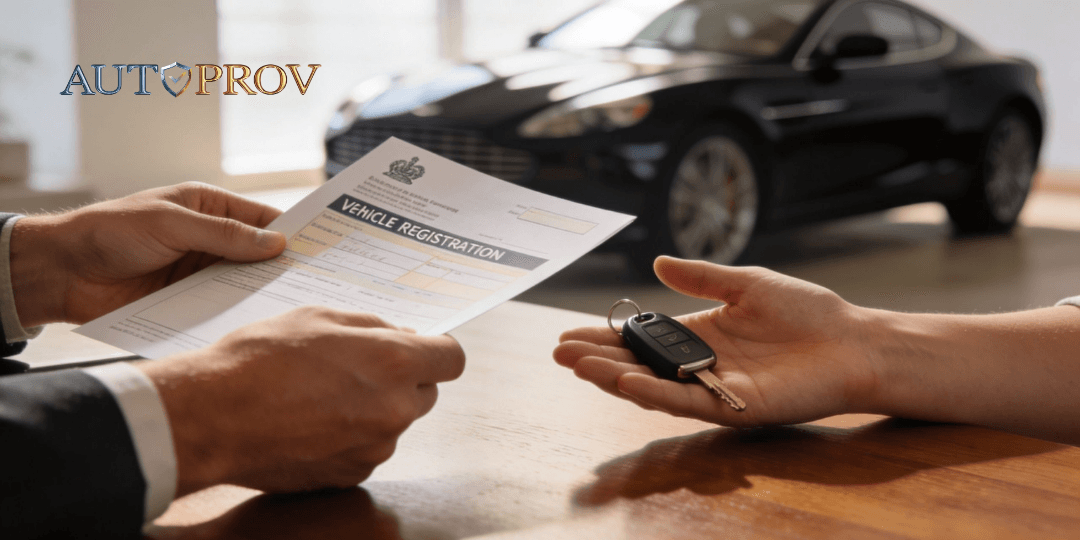
A car turns up at appraisal. The seller has the keys, the V5C looks clean, the registration matches the plates, and the story sounds plausible. Then one detail jars. The named keeper on the log book doesn’t line up neatly with the person in front of you, or the handover chain feels rushed, or the supporting paperwork is thin.
That’s the moment where margin can disappear.
For a UK motor trader, what is proof of ownership of a car isn’t an academic question. It sits right in the middle of stock acquisition, complaint handling, finance exposure, and reputation. If you buy from someone who doesn’t have the legal right to sell, a tidy-looking vehicle can become an expensive argument.
The Hidden Risk in Every Handover
Most ownership problems don’t start with obvious fraud. They start with paperwork that looks almost complete.

A seller arrives with a log book, a driving licence, and a reason for the sale. On the surface, that’s routine. In practice, the risk sits in what the paperwork proves, and what it doesn’t.
A V5C is essential. It helps you identify the vehicle, inspect keeper details, and compare the document against the car in front of you. But if you treat it as complete proof of ownership, you leave a gap in your buying process. That gap is where disputed sales, cloned documents, and post-purchase challenges tend to appear.
Where dealers get caught
The trap is usually operational, not theoretical. Busy buyers move quickly. A stock controller wants a fast answer. The car fits profile, price, and pitch. The documents appear “good enough”, so the handover goes ahead before anyone has tested whether the seller has title to transfer.
That’s why issues around a missing or replacement log book deserve extra caution. If you’re dealing with incomplete registration paperwork, lost log book guidance for trade buyers is worth folding into your process before you commit.
Practical rule: If the seller’s right to sell isn’t clear from the full paper trail, the vehicle isn’t ready to buy.
Why this matters to profit
Ownership disputes don’t stay in the file. They turn into delayed retailing, rejected part-exchanges, customer complaints, and time spent proving decisions after the event. Even where a dispute is eventually resolved, the cost sits in friction, not just the headline loss.
A disciplined buyer asks one question before talking about price. Can this seller prove legal authority to sell this vehicle, not just physical possession of it?
Registered Keeper vs Legal Owner The Critical Distinction
The biggest misunderstanding in UK vehicle paperwork is simple. The registered keeper is not automatically the legal owner.

The V5C records the registered keeper. That’s the person recorded by DVLA in connection with the vehicle’s use and administration. They’re the one associated with notices, tax, and day-to-day responsibility.
The legal owner is the person or business with the right to dispose of the asset. That right usually sits in the transaction record, not in the registration record.
A simple way to think about it
Use a property analogy. The registered keeper is closer to the occupier. The legal owner is the party with title.
That distinction matters because a trader doesn’t just need to know who used the car. A trader needs to know who can legally sell it. If those two things are treated as the same, due diligence becomes superficial.
What the V5C does and does not do
The V5C is still a key document. It gives you:
- Vehicle identity details such as make, model, colour, and VIN
- Keeper record context that helps build an ownership timeline
- Administrative consistency checks between the paper document and the car presented
What it doesn’t do is settle title by itself.
For trade buyers, that’s the central point. The log book supports the provenance picture. It does not replace the need for transactional proof.
A useful technical refresher sits in AutoProv’s guide to the vehicle registration certificate, especially if you’re standardising document review across multiple buyers.
The financial impact of getting this wrong
This distinction isn’t niche. It creates real loss. 2023 provenance data shows 18,000 vehicles with title discrepancies are sold annually, leading to £250 million in dealer losses from ownership disputes according to CarVertical’s explanation of proof of ownership in the UK.
If a seller only proves they are the keeper, you still haven’t established that they have the right to sell.
That’s why experienced buyers separate two checks at appraisal. First, is this the correct vehicle? Second, does this seller have legal authority to transfer it?
The Paper Trail Building a Complete Ownership Picture
Proof of ownership works best as a chain, not a single document. When one piece is weak, the rest of the file has to carry more weight. When several pieces line up cleanly, risk falls sharply.
The V5C sits in that chain, but it isn’t the whole chain. The stronger approach is to assemble a vehicle provenance file that shows identity, transaction history, and continuity.
Core documents that establish the transaction
Start with the paperwork that records a sale.
A proper bill of sale or purchase invoice should identify the vehicle clearly and tie it to named parties. At a minimum, it should show the registration, make and model, the agreed price, the buyer and seller names, and their addresses. In trade terms, this is the document that answers the most important question. Who transferred the vehicle to whom, and on what basis?
If finance has been involved, you also need evidence that title isn’t still clouded by outstanding interest. A settlement letter or equivalent finance clearance document helps show that the seller is passing a vehicle free from unresolved claims.
Supporting documents that test the story
Supporting documents don’t usually prove title on their own, but they do test whether the ownership story makes sense.
Consider these as corroboration points:
- Insurance records can help support who had an insurable interest in the vehicle during a period of use.
- MOT history helps you test mileage and timing against the claimed ownership timeline.
- Service invoices often show dates, mileages, locations, and customer names that either support the narrative or unsettle it.
- Bank payment evidence can help confirm that a genuine transaction took place between identifiable parties.
- Photo ID and address matching reduce the chance that you’re dealing with someone using borrowed or partial identity.
What a complete file looks like
A clean file usually reads consistently from top to bottom. The seller’s ID aligns with the seller on the invoice. The vehicle on the invoice aligns with the V5C and the physical VIN. The MOT timeline fits the stated period of use. Service records don’t suggest a different keeper story.
That’s the practical standard.
A useful background reference for the paperwork side of the DVLA record is AutoProv’s guide to the car logbook in the UK. It’s a good reminder that the registration document has to be read in context, not in isolation.
Working rule: Don’t ask whether one document looks fine. Ask whether all documents tell the same story.
A quick hierarchy for trade decisions
Document What it helps prove Trade value V5C Registered keeper record and vehicle identity Important, but not title on its own Bill of sale or purchase invoice Transaction and transfer between parties Core proof Finance settlement evidence Clearance of third-party interest Critical where relevant MOT and service history Timeline consistency and supporting provenance Strong corroboration Seller ID and payment trail Identity and legitimacy of the transaction Operationally important When a file lacks the transactional layer, you don’t have strong proof of ownership. You have partial context.
Practical Verification for Motor Trade Buyers
A good buying process doesn’t rely on instinct. It relies on repeatable checks that every buyer can perform under time pressure.
The practical test is simple. Can your team verify ownership while standing in the lane, on the forecourt, or at the seller’s premises, without having to “fill in the gaps later”? If the answer is no, the process needs tightening.
A field checklist that works
Use a document cross-check before discussing final money:
- Match the vehicle first
- Compare VIN, registration, make, model, and colour across the car, the V5C, and the sale paperwork. If one field is off, stop and resolve it before moving on.
- Identify the seller properly
- Check that the person selling matches the name and address on the supporting documents, or that they can explain and evidence why they are acting for the named party.
- Read the dates, not just the headings
- Ownership problems often sit in timing. A freshly issued V5C, a recent keeper change, or a purchase invoice that doesn’t fit the stated story all need explanation.
- Ask direct questions
- How long have you had it? Who bought it? Is there any finance history? Why is the sale happening now? Genuine sellers usually answer cleanly and consistently. Weak chains tend to unravel when the details are repeated.
Fraud checks that shouldn’t be skipped
Document fraud remains a real issue. The DVLA reports that identity and ownership document fraud, including V5C cloning, accounted for 12% of all vehicle-related crimes in 2022, leading to losses exceeding £50 million for the motor trade, as cited in this reference on UK car ownership records.
That matters because cloned or manipulated paperwork often looks convincing enough for a rushed buyer.
Focus on mismatch rather than appearance alone:
- Names that shift slightly across ID, invoice, and V5C
- Addresses that don’t reconcile
- A seller who can produce the car and keys but not the transaction trail
- A story built around urgency, especially where documents are incomplete
- MOT or service timing that doesn’t support the stated ownership period
For buyers who deal with more complex transactions, the discipline overlaps with wider corporate review. The mindset behind M&A and investment due diligence is useful here. You’re not taking documents at face value. You’re testing whether the rights being transferred are real, clear, and evidenced.
Build it into workflow
The process needs to be operational, not personal. Use the same ownership verification standard for trade-ins, private purchases, auction follow-up, and off-site sourcing.
A structured trade provenance check process is part of that, but it shouldn’t be mistaken for full ownership verification. A basic vehicle history check UK process tells you something important. It does not tell you everything you need to know about title and seller authority.
Good buyers don’t chase paperwork after the funds move. They settle the ownership question before acquisition.
Spotting Red Flags with Provenance Intelligence
Some ownership risk doesn’t sit in the documents. It sits in the pattern behind them.

A file can look presentable and still be wrong. That’s where trade vehicle intelligence becomes useful. Instead of asking whether the current papers exist, you ask whether the whole timeline behaves like a legitimate vehicle history.
Patterns that deserve attention
Short-term ownership, repeated handovers, and mileage movement that doesn’t fit the keeper timeline are all signals worth examining. None of them proves fraud on its own. Together, they can tell you the story needs more work before you buy.
This matters in the trade because disputed ownership often surfaces after the vehicle has already moved through stock. Auto Trader data from 2025 reveals 28% of used car disputes among UK dealers stem from disputed ownership chains, often due to short-term ownership patterns indicating potential fraud or undisclosed issues, cited in the earlier CarVertical source used above.
What basic checks often miss
A standard used car history report may confirm whether there are obvious markers to note, but it won’t always highlight the context around timing, pattern, and sequence.
Three examples come up regularly in dealer vehicle checks:
- Rapid keeper turnover that looks administrative on paper but unusual in context
- Mileage progression that appears technically possible, yet doesn’t sit naturally with service and MOT events
- A seller narrative that fits one document, but not the full chronology
That’s why a proper mileage check UK process should be read alongside ownership analysis, not separately. Provenance is cumulative. One clean datapoint doesn’t cancel out a weak chain.
Where deeper analysis helps
A more advanced review looks across multiple records to identify anomalies in ownership sequence, mileage development, and event timing. That’s the practical value of provenance intelligence.
AutoProv is one example of a trade-focused system that analyses DVLA records, MOT history, mileage patterns, ownership timelines, and related risk indicators to flag vehicles that need closer scrutiny. In operational terms, it helps buyers move beyond pass or fail thinking and into structured risk assessment.
If a vehicle also raises concerns around theft exposure, a separate stolen vehicle review should sit alongside ownership work. AutoProv’s guide on how to check a stolen vehicle fits that part of the workflow.
A vehicle can pass a basic check and still fail a professional buying standard once the timeline is analysed properly.
Conclusion Building a Resilient Buying Strategy
For the UK motor trade, the answer to what is proof of ownership of a car is broader than the log book. The V5C matters, but it records the registered keeper, not definitive title on its own.
A resilient buying strategy uses layers. You verify the vehicle itself. You verify the seller’s identity. You verify the transaction documents. Then you test the ownership story against the wider provenance record. That combination is what protects stock funding, retail confidence, and internal compliance.
This isn’t administrative overkill. It’s part of trading professionally.
The dealers who avoid avoidable ownership disputes usually do one thing well. They don’t let a presentable document stand in for a proven chain. A clear sale agreement, strong supporting paperwork, and consistent vehicle history intelligence should all sit in the file before the deal is treated as safe.
If you need to tighten the final handover stage, a documented contract for vehicle sale helps reinforce that discipline and gives your team a clearer acquisition standard.
AutoProv helps UK dealers and motor traders assess vehicle provenance, ownership timelines, mileage patterns, and document-related risk before capital is committed. If your current process stops at a basic history check, AutoProv provides a deeper view of the signals that can affect buying decisions, disputes, and downstream profitability.
Frequently Asked Questions
AI-Generated Content Notice
This article was created with the assistance of artificial intelligence technology. While we strive for accuracy, the information provided should be considered for general informational purposes only and should not be relied upon as professional automotive, legal, or financial advice. We recommend verifying any information with qualified professionals or official sources before making important decisions. AutoProv accepts no liability for any consequences resulting from the use of this information.
From our AI insights
- V5C Logbook: Untold Legal Limitations & Verification Needs
Explore the V5C logbook's legal boundaries and why traders need extra checks.
- Managing CRA 2015 Rejections: Evidence Essentials for Dealers
Learn how UK motor traders can effectively handle CRA 2015 rejection claims with proper evidence management.
- Ensuring Vehicle Safety: CRA 2015 Durability Standards
Explore how CRA 2015 durability standards impact vehicle safety, focusing on dealer responsibilities.
Related Articles

Understanding the Consumer Rights Act 2015 in the UK Motor Trade
Explore the Consumer Rights Act 2015 and its impact on UK car buyers and sellers, offering essential protections and insights.

Understanding UK Automotive Regulations
Explore the complexities of automotive regulations in the UK, covering DVLA, FCA, MOT, and more.
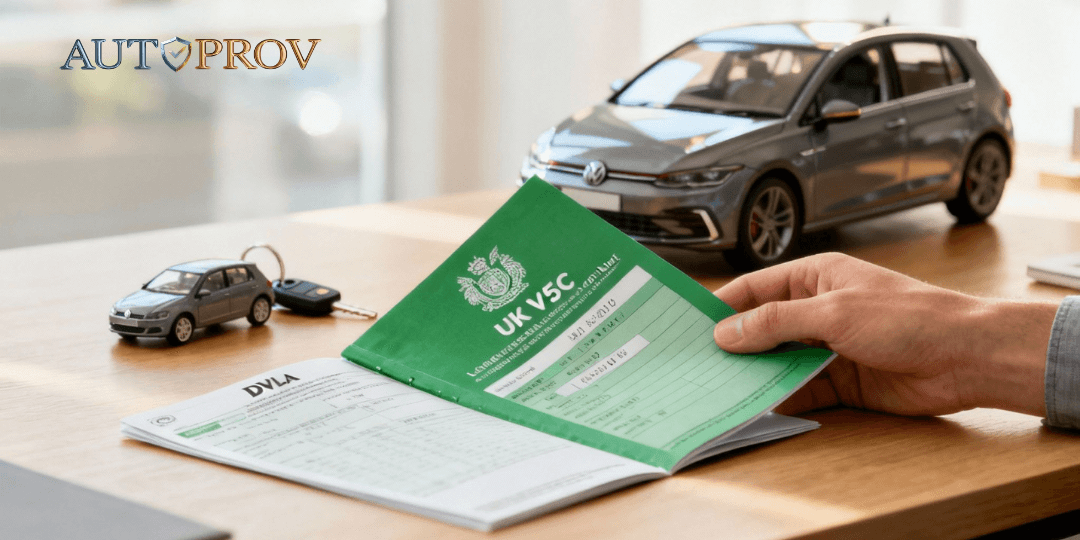
What is a V5C Document: A Quick UK Log Book Guide
If you've ever bought or sold a car in the UK, you've definitely come across the V5C. It's often just called the 'log book', and it’s the official Vehicle Registration Certificate issued by the DVLA.
Published by AutoProv
Your trusted source for vehicle intelligence