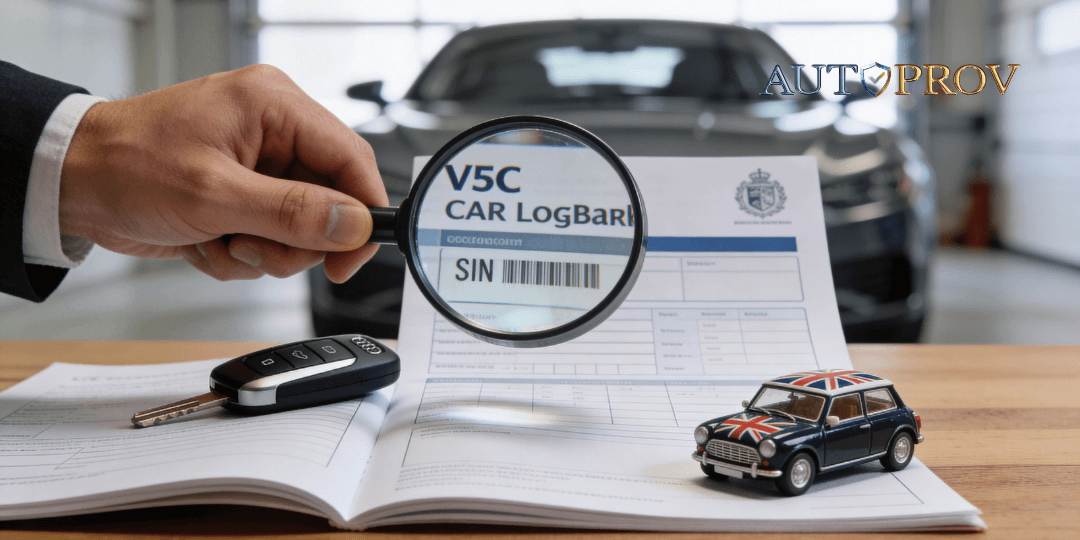
A car arrives looking straightforward. Clean presentation, sensible margin, paperwork present, no immediate reason to walk away. Then the detail that matters appears. The V5C is technically there, but the timeline feels wrong, the specification on paper does not quite sit with the vehicle in front of you, or the seller is leaning on speed instead of clarity. In the trade, that is the moment where profit turns into exposure. A car logbook uk check is not an admin task. It is an early risk decision. Most dealers already know how to read a logbook at face value. The stronger operators treat it differently. They use it as a prompt to verify identity, test consistency, and challenge the story around the car before money moves. That discipline protects margin, avoids a
Why the Car Logbook Is More Than Just Paperwork
A V5C can make a car look orderly when the deal is anything but. I have seen stock presented with a current logbook, matching registration, and a seller who sounds credible, yet the ownership pattern, timing, or vehicle details do not stand up once you start checking properly.
That is why the V5C registration certificate matters in the trade. It links the vehicle to the DVLA record and supports tax, transfer, and registration processes, but its real value is evidential. It gives you a starting point for verification. It does not give you comfort on title, condition, provenance, or seller honesty.
If you need the basic document background, this quick UK V5C document guide covers the form itself. The trade issue starts after that. The gap is not understanding what a V5C is. The gap is understanding what it does not prove.
Trade use of a V5C
A buying desk should treat the V5C as baseline evidence to test, not paperwork to file. It helps establish three things:
- Vehicle identity: Registration mark, VIN, make, model, fuel type, body type, colour, and other core descriptors.
- Keeper record: Who the DVLA shows as the registered keeper.
- Administrative usability: Whether the document supports routine transfer and compliance tasks.
Those points matter, but they do not close risk.
Experienced buyers read the V5C the way a credit team reads an application. The document is relevant. It is never the whole case. A clean logbook can still sit behind a car with an implausible keeper sequence, undeclared specification changes, plate transfer history that needs context, or a seller story that only works if nobody asks a second question.
That is where margin disappears. Not on the obvious stolen-recovered headline car, but on the apparently normal unit that turns awkward after prep, after finance review, or worse, after retail handover.
Practical takeaway: In a car logbook uk review, the key question is whether the V5C survives comparison against the vehicle, the seller, and the wider provenance record.
What the V5C does not tell you
The V5C does not confirm legal ownership. It does not confirm the car is free of finance. It does not explain why the keeper pattern changed. It does not tell you whether the vehicle spent time off road for a legitimate reason or because it was sitting in dispute, repair, or storage.
It also does not tell you whether the car in front of you still matches the identity built up through its earlier life. That matters with modified vehicles, rebuilt theft recoveries, cherished transfer cases, and stock that has moved quickly through private hands before arriving in the trade.
This is the difference between consumer advice and trade buying discipline. A private buyer may stop at “V5C present.” A professional buyer needs to ask whether the timeline is logical, whether the specification has drifted, and whether the paperwork creates confidence or reduces suspicion for long enough to get the deal done.
Where traders get caught
Many dealers do not lose money because they cannot read the form. They lose money because they stop at the form.
The recurring assumptions are familiar:
- The presence of a V5C means the car is low risk.
- The registered keeper must be the person entitled to sell.
- A basic match on registration, colour, and make is enough to proceed.
- A strange date pattern can be sorted out after purchase.
- If the story sounds plausible, the gaps are probably harmless.
Those assumptions create both financial and reputational exposure. The cost shows up in delayed retailing, aborted finance proposals, disputes over misdescription, wasted workshop time, and customer complaints that could have been prevented at appraisal.
The V5C earns its place in the file because it gives you something to challenge. In the trade, that is its real function.
Reading and Understanding the V5C Logbook Section by Section
A current red V5C should be read as a series of verification points, not a single pass or fail document. Every key field has a practical implication for valuation, compliance, or fraud risk.
Dealers who handle the car logbook uk properly do not just “check the details”. They match each section to an action.
Start with identity fields
The first priority is confirming that the document belongs to the vehicle in front of you.
Look closely at the registration mark, make, model, body type, colour, fuel type and VIN. The V5C records core vehicle details such as registration number, make, model, body type, colour, engine size, fuel type and VIN through the DVLA registration system (GOV.UK vehicle statistics).
That means little unless you physically verify them.
What to check on the vehicle itself
- VIN match: Compare section E against the physical chassis stamping and any visible manufacturer plates.
- Specification coherence: Check that body style, fuel type and model description fit the actual car, not just the advert or seller explanation.
- Visible alterations: If the vehicle presents like it has had major modification work, the paper should usually give you a reason to understand why.
A mismatch here is not an admin error until proven otherwise.
Keeper details need interpretation
Keeper information is useful, but it is often misunderstood. The V5C records the registered keeper, not proof of legal ownership. In the trade, that distinction matters because a tidy keeper story can still sit alongside a poor buying proposition.
Use keeper information to test whether the seller narrative makes sense. If a vehicle has moved quickly between hands, or if the person presenting it has a vague relationship to the keeper on the document, slow the deal down.
Questions worth asking include:
- How did the seller acquire the car?
- Why is the seller not the keeper named on the document?
- Does the explanation line up with the rest of the paperwork?
- Is there anything in the vehicle presentation that suggests a fast turn rather than normal use?
Technical sections affect tax and compliance
The technical sections are where experienced buyers often gain an edge, because these fields influence downstream cost and saleability.
The V5C’s structured sections directly influence taxation and compliance. Section V.7 records CO2 emissions, which determine the VED band. Vehicles exceeding 255 g/km CO2 face the highest first-year rate of £2,745 under 2024 rates. Section P.1 shows cylinder capacity and P.2 shows maximum net power, both of which can indicate an engine swap if they do not align with the vehicle. These discrepancies can lead to post-sale disputes and financial loss (CarVeto DVLA logbook guide).
That is why a trade buyer should read these sections commercially, not just mechanically.
V5C Key Section Verification for Motor Traders
V5C Section Information Trade Verification Action Section E VIN Match against physical chassis stamp and manufacturer identifiers Section D Make, model, body type, colour Confirm against the actual vehicle and stock appraisal notes Section P.1 and P.2 Cylinder capacity and max net power Test for engine swap risk or specification inconsistency Section V.1 to V.7 Emissions and CO2 data Check tax implications and any compliance sensitivity Keeper details Registered keeper identity Compare with seller explanation and transaction circumstances Taxation class Vehicle class information Ensure the classification makes sense for the vehicle presented Read for contradiction, not completion
Many buyers are too focused on whether every box is filled. The better question is whether the sections support one another.
A few examples:
- A high-spec presentation with technical fields that look out of line.
- A seller describing the car as standard when the document and vehicle suggest meaningful modification.
- An apparently simple part-exchange with a keeper position that creates avoidable uncertainty.
Trade tip: If a V5C detail creates a question you cannot answer before purchase, you do not have a paperwork issue. You have a stock risk issue.
Evaluating Service History and Maintenance Logbooks
The V5C tells you how the vehicle is registered. It does not tell you how the vehicle has been cared for.
That distinction gets blurred in fast-moving deals. A trader hears “full history” and sees a presentable folder, then starts treating maintenance records as if they carry the same authority as the DVLA document. They do not. They serve a different purpose.

The V5C and service history are not interchangeable
The V5C is an official registration certificate. A service book, invoice file, or digital service record is evidence of maintenance activity.
Those records influence buyer confidence, prep planning, and valuation. They can also mislead if the file looks thorough but does not stand up to inspection.
A proper review should ask:
- Is the service history internally consistent?
- Does the mileage progression look sensible across entries?
- Do dates, servicing intervals, and workshop names fit the vehicle’s use pattern?
- Are there long gaps that need explaining?
- Does the condition of the vehicle support the maintenance story?
What a credible service history looks like
A credible history usually feels ordinary. That is a good sign.
It tends to include a mix of invoices, workshop references, itemised work, and dates that make sense. Main dealer history can help, especially on younger stock, but independent specialist records can be just as persuasive if they are detailed and coherent.
What tends to weaken confidence is the opposite:
- Over-neat paperwork: Every stamp looks identical, all entries use the same handwriting, or the file has no supporting invoices.
- Mileage jumps without context: The service cadence does not match the vehicle’s apparent use.
- Recent reconstruction: A seller presents a polished service file assembled just before disposal.
Digital records need the same discipline
Digital Service Records have changed the review process, but not the underlying principle. A screen print or portal screenshot is still only useful if it can be validated.
That means checking whether the dates, mileage entries, and workshop details line up with the rest of the vehicle file. If you rely on digital records, your team needs a consistent process for storing and reviewing them. A useful reference on this area is AutoProv’s guide to a car service history check.
Practical point: A service history should improve confidence because it is believable, not because it is bulky.
How service history affects stock decisions
In buying meetings, service history should change the conversation in three ways.
First, it influences preparation forecasting. If the file suggests neglected routine maintenance, your workshop risk rises.
Second, it affects retailability. Some stock categories tolerate patchy history better than others. Premium or enthusiast stock usually does not.
Third, it shapes dispute risk. A vehicle sold with an overstated maintenance story is far more likely to create friction after delivery.
I would rather buy a car with an incomplete but honest service file than one with a perfect-looking book that raises quiet doubts. The former can often be priced correctly. The latter can waste time all the way through stocking, prep, sale, and complaint handling.
Spotting V5C Fraud and Critical Red Flags
Fraudulent cars rarely arrive labelled as fraudulent. They arrive as “cheap for a reason”, “my brother’s handling the sale”, or “all the paperwork is there somewhere”.
That is why V5C fraud is dangerous in the trade. It often looks almost normal until you start pulling on small inconsistencies. The car logbook uk check only becomes useful when your team is trained to challenge the story around the document, not just the document itself.

The keeper problem most traders already know, but still underestimate
The V5C shows the registered keeper, not legal ownership. That gap is not theoretical. It is one of the easiest ways for bad actors to present a vehicle with enough apparent legitimacy to keep a rushed buyer moving.
The broader fraud environment makes this worse. UK used car fraud reporting for 2025 indicates a rise in clocking cases, affecting many vehicles annually, and advanced provenance intelligence that cross-references V5C data with MOT and insurance event timelines can identify short-term ownership patterns and other anomalies, uncovering additional risks per vehicle than a logbook check alone (GOV.UK vehicle log book guidance).
That matters because a forged or misused V5C is often only one part of the setup. The primary issue is the wider pattern around the car.
Red flags worth treating seriously
Some warning signs are obvious. Others are easy to excuse when stock is scarce.
Watch for these:
- Specification mismatch: The make, model, fuel type, or VIN does not align cleanly with the vehicle.
- Poor document quality: Print quality feels off, text appears unusual, or the document condition does not fit the rest of the file.
- Seller detachment: The person selling has an unclear relationship to the keeper on the V5C.
- Rushed disposal: The seller pushes urgency, immediate payment, or limited inspection time.
- Narrative drift: Small facts change during the conversation, especially around acquisition, use, or reason for sale.
A single red flag does not always mean fraud. Multiple small inconsistencies often mean you have not yet found the problem.
Fraud often sits in the timeline
One of the most useful habits in stock buying is learning to distrust “clean” paperwork when the ownership story feels compressed.
Rapid resale patterns, unexplained movement between sellers, and mileage context that feels too neat are all signs that basic dealer vehicle checks may not be enough. Teams benefit from a documented review process in these situations, rather than individual instinct alone. For operators handling scanned paperwork, document hygiene also matters. If your teams circulate copies internally or externally, knowing how to remove metadata from PDF files can help reduce unnecessary information leakage in document workflows.
Build a desk-level fraud routine
A good anti-fraud process does not need to be dramatic. It needs to be consistent.
Use a routine like this:
- Verify the document against the vehicle before discussing price in depth.
- Challenge the seller relationship to the vehicle and the keeper record.
- Test the timeline for ownership, use, servicing, and disposal.
- Escalate anomalies instead of letting sales pressure settle them informally.
- Record the concern so repeated seller patterns are visible across the group.
For a broader operational checklist, this guide to car fraud prevention tips for UK professionals is a useful companion process.
Key point: Fraud prevention in the used car market is less about one dramatic clue and more about refusing to normalise a cluster of small inconsistencies.
Managing DVLA Logbook Processes for the Trade
A buyer agrees a part-exchange at 4:45pm on a Saturday. The car is clean, the margin works, and everyone moves on to the next deal. On Monday, the V5C is still in a sales drawer, the admin team has partial details, and the vehicle is already in prep. That is how avoidable logbook problems start.
In trade terms, the V5C process is a control point. If that control point is weak, you create exposure after the commercial decision has already been made. The cost is rarely dramatic at first. It shows up as stock delayed for retail, disputes over keeper notifications, avoidable customer complaints, and audit gaps that are hard to defend later.

Why process discipline matters
A V5C is not proof of title, but it still sits at the centre of how a dealership records receipt, movement, and disposal. Get the handling wrong and you invite confusion about who was responsible for the vehicle at a given point, whether the right DVLA update was submitted, and whether an exception was noticed early enough to contain the risk.
There is also a basic compliance point. Errors in DVLA handling can lead to penalties, but the bigger trade issue is operational credibility. If a group cannot show a clean chain from acquisition to retail sale or disposal, small paperwork failures become larger questions about process control.
That matters in groups with multiple sites. A missing or delayed V5C update is rarely just one missing form. It often exposes weak handover between buying, branch admin, central compliance, and remarketing.
Core trade processes to control tightly
The strongest dealer operations assign ownership at each stage and treat exceptions as reportable events, not informal fixes.
Transfer notifications to motor traders Notify DVLA promptly when stock comes into trade. A vehicle leaving the forecourt without the paperwork being logged properly can leave your records out of step with the transaction file.
Part-exchanges without a V5C A missing logbook is manageable if the reason stands up and the file shows what was checked, who approved the exception, and what action followed. Without that record, the same missing document can look acceptable in one branch and suspicious in another.
Changes to vehicle details Registration record updates need to be aligned with the vehicle you intend to retail. If the car has been modified or corrected details are pending, the stock file should show the status clearly before listing.
Scrap or export cases These cases often receive less attention because they are outside the normal retail path. They still need clear ownership, submission records, and final sign-off. Loose treatment here creates avoidable queries months later.
What works in practice
The fix is procedural. The V5C should never travel through the business without a named owner and a timestamped action.
In well-run stores, the buying team records receipt, admin verifies the document against the vehicle and deal file, and prep or sales cannot progress the unit to retail-ready status until any DVLA action or exception is logged. That can feel slower at the front end. It is cheaper than trying to reconstruct the file after a complaint, a cancellation, or an internal audit.
A workable control sheet usually includes:
- Date received: when the V5C or replacement evidence entered your control
- Vehicle match check: confirmation that registration, VIN, and keeper-related details were reviewed against the vehicle and acquisition file
- DVLA action taken: transfer, update, replacement request, or exception hold
- Exception owner: named person responsible for resolving missing, damaged, or inconsistent paperwork
- Release authority: confirmation that the vehicle can move to retail, wholesale, scrap, or export
For teams standardising these handovers across sites, this guide on UK V5C changes in trade sales is a useful operational reference.
Operational tip: V5C admin failures usually come from unclear ownership, not difficult paperwork. Assign responsibility, log each action, and make exceptions visible early.
How Logbooks Fit into a Complete Provenance Check
A V5C gives you a valid starting point. It does not give you a complete risk picture.
That distinction is where many standard buying processes still fall short. A dealer runs a routine vehicle history check UK workflow, sees no obvious issue in the logbook layer, and assumes the remaining risk is normal market noise. In reality, the most expensive problems often sit outside the V5C itself.

What the logbook does not tell you
DVLA logbook data is the backbone of UK vehicle records, but it does not cover critical history such as finance or write-offs, issues affecting a significant number of used cars. The V5C records keeper changes for many vehicles annually, yet a standard vehicle history check UK is still largely reliant on DVLA data, which is not enough for thorough motor trade risk assessment (SMMT vehicle data and car registrations).
That single limitation changes how the document should be used.
The V5C can support a decision. It cannot safely make the decision on its own.
Provenance is about context, not just data points
A proper used car history report should answer questions the logbook cannot answer by itself:
- Has the vehicle’s identity remained consistent across different records?
- Does the mileage story feel natural across time?
- Are there signs of rapid resale or short-term keeper patterns?
- Is there evidence that changes in the vehicle’s life were recorded consistently?
- Do MOT and event timelines support the seller’s account?
It is in this context that vehicle provenance becomes commercially useful. The point is not to accumulate more paperwork. The point is to understand whether the story behind the vehicle is coherent enough to justify committing capital.
What stronger dealer vehicle checks look like
A stronger buying workflow combines the V5C with contextual intelligence from other records and timelines. That turns a basic document check into trade vehicle intelligence.
For example, a dealer may see a present V5C and acceptable condition, but still pause if the broader record suggests compressed keeper movement, suspicious mileage context, or inconsistent event timing. Those are not always hard fails. They are pricing, disposal, and reputational signals.
One option used in the trade is AutoProv, which analyses DVLA records, MOT history, mileage patterns, ownership timelines, insurance-related events, and anomaly indicators to support point-of-decision risk assessment. That type of process is useful when a basic logbook review looks clean but the buyer still needs more context before funding stock.
A useful companion read on this topic is this guide to a car provenance report in the UK.
Bottom line: The V5C tells you who the DVLA records. Provenance work tells you whether the whole vehicle story deserves your confidence.
The trade-off buyers need to accept
There is always a balance between speed and certainty. Buying teams cannot investigate every ordinary hatchback as if it were a forensic exercise.
But the answer is not to trust the logbook too much. The answer is to decide where a deeper check is justified. High-value stock, unusual ownership patterns, specification inconsistencies, weak service support, and seller ambiguity are all situations where deeper provenance review earns its keep.
That is how good buyers protect margin without paralysing the buying desk.
From Document Verification to Strategic Risk Assessment
The old model was simple. Check the V5C, inspect the car, make a judgement, move on.
That model still handles a lot of routine stock. It just does not handle modern risk particularly well. Fraud patterns are more adaptive, paperwork can be superficially convincing, and dealer exposure now extends well beyond the moment of purchase into prep cost, finance suitability, complaint management, and online reputation.
Professional buying now needs a wider lens
A strong car logbook uk process remains a core trade skill. If your team cannot read the V5C properly, everything that follows is weaker.
But strong buying teams now do something more valuable. They integrate document verification into a broader risk framework:
- Identity verification at the vehicle and document level
- Timeline analysis across keepers, mileage, and events
- Commercial judgement on whether the risk fits the stock profile
- Operational control so exceptions are documented, escalated, and learned from
That is a strategic change, not a clerical one.
Better process beats more confidence
In group operations, the primary challenge is consistency. One experienced buyer may spot a weak V5C narrative instantly. Another may wave it through because the car looks right and the margin appears acceptable.
That inconsistency is expensive. Structured review, documented escalation rules, and better document handling standards reduce the dependence on individual instinct. Teams exploring automation in this area may find it useful to understand how Intelligent Document Processing fits into document-heavy workflows, especially where paperwork needs to be reviewed consistently across multiple sites.
What protects margin
In practical terms, dealers protect margin when they:
- Refuse to treat the V5C as proof of ownership.
- Verify technical and identity details against the vehicle, not just the file.
- Distinguish between tidy paperwork and trustworthy provenance.
- Escalate compressed ownership patterns and timeline anomalies.
- Build buying and admin processes that do not rely on memory.
That is the shift from document handling to risk assessment. It is also the fundamental difference between buying stock and underwriting it properly.
If your team wants a more consistent way to assess vehicle provenance, mileage context, ownership timelines, and hidden risk before committing stock, AutoProv provides trade-focused vehicle intelligence designed for UK dealers, wholesalers, and buying teams.
Frequently Asked Questions
AI-Generated Content Notice
This article was created with the assistance of artificial intelligence technology. While we strive for accuracy, the information provided should be considered for general informational purposes only and should not be relied upon as professional automotive, legal, or financial advice. We recommend verifying any information with qualified professionals or official sources before making important decisions. AutoProv accepts no liability for any consequences resulting from the use of this information.
From our AI insights
- Navigating CCR 2013: Niche Insights for UK Motor Traders
Explore niche insights on CCR 2013 for UK motor traders, focusing on compliance and cancellation rights.
- Decoding CRA 2015: Dealer's Guide to 30-Day Rejections
Explore CRA 2015's 30-day rejection rights from a dealer's perspective, highlighting key compliance strategies.
- Navigating DVLA Conviction Checks: Dealer Compliance
Understand DVLA conviction checks and lawful access for UK dealers.
Related Articles

Understanding the Consumer Rights Act 2015 in the UK Motor Trade
Explore the Consumer Rights Act 2015 and its impact on UK car buyers and sellers, offering essential protections and insights.

Understanding UK Automotive Regulations
Explore the complexities of automotive regulations in the UK, covering DVLA, FCA, MOT, and more.
What is a V5C Document: A Quick UK Log Book Guide
If you've ever bought or sold a car in the UK, you've definitely come across the V5C. It's often just called the 'log book', and it’s the official Vehicle Registration Certificate issued by the DVLA.
Published by AutoProv
Your trusted source for vehicle intelligence