Think of a car provenance report in the UK as a vehicle's professional biography. It digs much deeper than a basic history check, revealing the car's complete, unfiltered story from day one. For anyone in the motor trade, it’s your first line of defence against the kind of hidden problems that can flip a profitable deal into a serious liability. We’re talking about things like outstanding finance, undisclosed insurance write-offs, or dodgy mileage. At AutoProv, we provide the trade-grade intelligence you need to make every purchase a secure one.
Think of a car provenance report in the UK as a vehicle's professional biography. It digs much deeper than a basic history check, revealing the car's complete, unfiltered story from day one. For anyone in the motor trade, it’s your first line of defence against the kind of hidden problems that can flip a profitable deal into a serious liability. We’re talking about things like outstanding finance, undisclosed insurance write-offs, or dodgy mileage. At AutoProv, we provide the trade-grade intelligence you need to make every purchase a secure one.
What Is a Car Provenance Report and Why Does It Matter?

A car provenance report is your essential due diligence tool for any vehicle you're thinking of adding to your stock. It's an investigative deep dive, pulling together data from a whole host of official sources to paint an absolutely clear picture of a car's past. This isn't just about dodging a lemon; it’s about protecting your reputation and your bottom line.
A professional-grade report answers the critical questions that a quick visual inspection or a spin around the block simply can't. Without it, you’re basically buying blind, leaving your business wide open to some hefty financial and legal risks.
The Growing Need for Vehicle Verification
The sheer volume of cars on UK roads makes these comprehensive checks more crucial than ever. The latest stats from the Department for Transport show there are over 33.9 million cars licensed in the United Kingdom. In such a crowded market, the chances of coming across a vehicle with a chequered history are naturally much higher.
With millions of cars changing hands every single year, a solid car provenance report becomes indispensable. It’s what helps you cut through the noise and spot quality stock with real confidence.
Beyond a Basic Check
A proper provenance report isn't just a list of dates and facts. It’s a consolidated dossier that gives you actionable intelligence, empowering you to make secure investments. The core components you need to see include:
- Financial Status: This is non-negotiable. Checking for outstanding finance agreements is vital to ensure you get a clean title.
- Write-Off History: Uncovering whether a vehicle has ever been declared a total loss by an insurer (like a Category S or N).
- Mileage Verification: Cross-referencing records from MOTs and services to spot any signs of tampering or "clocking."
- Theft Status: A simple but critical check to confirm the vehicle hasn’t been reported stolen on the Police National Computer (PNC).
A detailed provenance check is the absolute foundation of smart vehicle acquisition. It turns uncertainty into certainty, helps you price vehicles accurately, and builds the kind of trust that keeps customers coming back.
Ultimately, these reports are all about managing risk. By using a platform like AutoProv, motor trade professionals get this vital intelligence instantly. This means you can assess a vehicle’s risk on the spot, whether you’re at an auction or working out a part-exchange valuation. For a closer look, have a read of our guide on the essentials of checking used car history. This proactive approach ensures every single vehicle on your forecourt is a secure, profitable asset.
Decoding the Data in a Professional Report
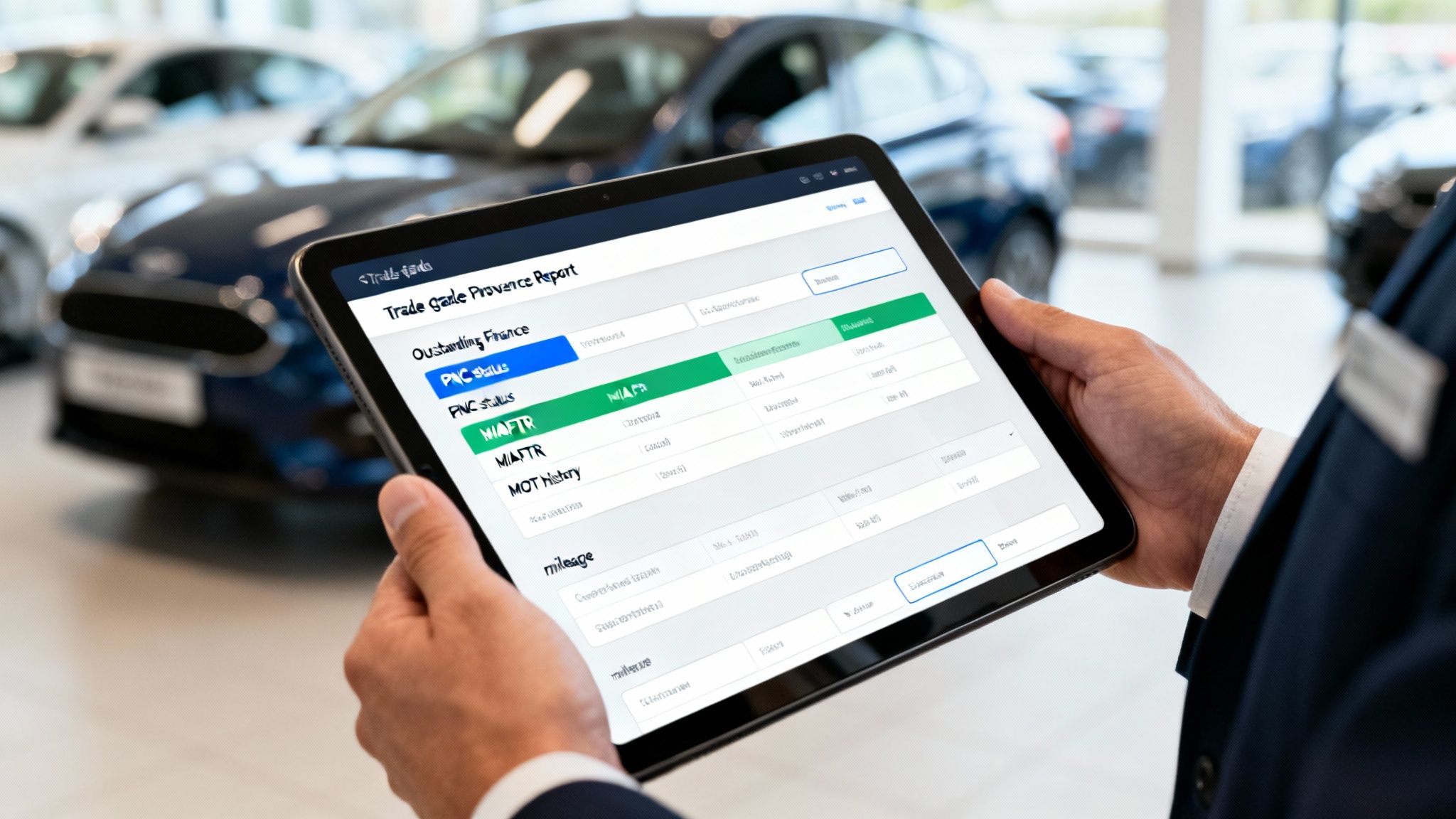
A professional-grade car provenance report UK traders rely on is far more than a simple history check; it's a detailed intelligence document. Understanding the data inside is what transforms it from a simple printout into a powerful tool that protects your investments and your hard-earned reputation. Every data point tells a piece of the car’s story, and knowing how to read them is absolutely essential.
At its core, the report runs several non-negotiable checks that hit the highest-risk areas of buying stock. These are the red flags you simply cannot afford to miss. Glancing over them can lead to serious financial loss, legal headaches, and damage to your dealership's credibility.
The Critical Financial and Legal Checks
Before you even think about a car's condition, you must confirm its legal status. A professional report puts these checks front and centre, giving you an immediate go/no-go signal. The two most crucial elements? Outstanding finance and theft status, as both can make a vehicle completely unsaleable.
The outstanding finance check is arguably the single most important part of any report. If you buy a vehicle with an active finance agreement attached, the finance company legally remains the owner. That means they have every right to repossess the car at any time, leaving you out of pocket with an empty bay on the forecourt and no comeback. A staggering one in four cars checked by some services has outstanding finance, making this an incredibly common pitfall.
Equally critical is the Police National Computer (PNC) status check. This instantly tells you if a vehicle has been reported as stolen. Acquiring stolen goods, even if you do it unknowingly, is a serious offence that can lead to the vehicle being seized and you being tangled up in legal trouble.
Think of these initial checks as the gatekeepers for your business. They stop high-risk vehicles at the door, ensuring you only spend time and money on stock that has a clean, legitimate title you can confidently pass on to a customer.
Uncovering the Vehicle’s Physical History
Once you’ve cleared the big legal hurdles, the next job is to dig into the car's physical past. This is where you uncover its life on the road, including any major accidents or usage patterns that could hammer its value and reliability. These data points give you the context needed to make a smart buying decision.
The Motor Insurance Anti-Fraud and Theft Register (MIAFTR) is a key resource here. It records vehicles that have been subject to an insurance claim and declared a write-off. This data reveals if a car has been categorised as A, B, S, or N, flagging everything from irreparable structural damage to purely cosmetic issues. Without this check, you could easily buy a vehicle with a hidden history of severe damage.
Another vital element is the complete MOT history. A close look at this data shows you more than just passes and fails. You can spot recurring advisory notes that point to persistent mechanical problems, identify signs of neglect, and cross-reference mileage readings at each test. This brings us neatly to mileage verification.
Dodgy mileage readings are a massive red flag for "clocking." A professional report checks the car's recorded mileage against the National Mileage Register, which holds millions of records from previous reports, MOTs, and service histories. Any inconsistencies are flagged up, protecting you from overpaying for a car with artificially lowered mileage.
Building a Complete Picture of Provenance
A truly professional report goes even further to build a complete profile of the vehicle’s life. Understanding how a car has been used is just as important as knowing its accident history.
- Taxi and Private Hire History: Cars used for commercial purposes endure far more wear and tear than privately owned ones. A check against licensing databases reveals if a car has a past life as a taxi, which drastically affects its condition and market value.
- Original Equipment Manufacturer (OEM) Specs: Checking the car’s original factory specifications helps you spot any non-standard modifications. This is crucial for an accurate valuation and for making sure the vehicle is exactly what your customer expects.
AutoProv expertly pulls information from all these different places, presenting it in a single, easy-to-digest format. By exploring the full range of our trusted vehicle data sources, you can see how we turn millions of raw data points into clear, actionable insights for your dealership. This consolidation is what allows you to make fast, confident decisions based on a complete understanding of a vehicle's true story.
Understanding Insurance Write-Off Categories

Insurance write-off categories are one of the biggest red flags you'll find in a vehicle's history, but it's a mistake to think they're all the same. For anyone in the motor trade, knowing the subtle but critical differences between these classifications is fundamental to making smart buying decisions. A car might look pristine on the forecourt, but its past could be hiding costly secrets that only a professional car provenance report in the UK can uncover.
When an insurer decides a vehicle is uneconomical to repair, it's declared a "total loss" and given a specific category. The system, which was updated back in 2017, gives a clear picture of the type and severity of the damage. Get this wrong, and you could end up overpaying for stock, facing nightmare repair bills, or worse, damaging your reputation by selling a car with a hidden past.
With vehicle crime on the rise and repairs becoming ever more complex, checking for a write-off history is no longer optional—it’s an essential part of your due diligence. As of 2024, the total number of vehicles on UK roads hit a record 41.9 million, which means the pool of potential problem cars is bigger than ever. A proper provenance report will tell you instantly if a vehicle is a Category A, B, S, or N, signalling everything from "crush immediately" to "professionally rebuilt."
The Categories That Are Absolute No-Goes
Let's start with the easy ones. The first two categories are straightforward and should be considered absolute deal-breakers. If a vehicle has one of these classifications, it has no business being on the road, and buying one is a serious risk.
- Category A (Scrap): This is the end of the line. It’s for vehicles so badly damaged they must be crushed entirely. Not a single part—not even a nut or bolt—can be legally salvaged. These cars should never, ever re-enter the market.
- Category B (Break): A Category B vehicle has also suffered severe damage, and its bodyshell must be destroyed. The key difference is that some non-structural parts can be safely removed and used on other cars. The vehicle itself can never be legally repaired and returned to the road.
An AutoProv report flags these categories immediately with an unmissable warning. It’s a clear signal to walk away, protecting your business from massive legal and safety headaches.
A vehicle’s write-off category is a permanent mark on its record. It dictates its safety, its legality, and its future value. Ignoring this is a gamble no professional can afford to take.
Navigating Repairable Write-Offs
The classifications you'll come across far more often are Category S and Category N. While these cars can be legally repaired and put back on the road, they demand a sharp eye, careful inspection, and transparent pricing.
Category S (Structurally Damaged but Repairable) This one means the vehicle has sustained damage to its core structural frame or chassis. Think of a bent or twisted chassis or a collapsed crumple zone. The car is deemed repairable, but it must be fixed to professional standards to be safe and roadworthy. A Cat S marker will always hit a vehicle's value hard, and any potential buyer will expect a significant discount to reflect that history.
Category N (Non-Structurally Damaged) A Category N classification tells you the vehicle’s structural frame is intact. The damage was non-structural, which could mean anything from cosmetic issues with body panels to problems with the electrics or other components. While less severe than Cat S, the crucial point is that the cost of repair still exceeded the vehicle's value at the time. For a deeper look into what this means for you, you can learn more in our complete guide to Cat N write-offs.
AutoProv’s reports highlight these critical classifications clearly and simply. This gives you the immediate insight you need to either sidestep a bad investment or price a repaired vehicle with complete confidence and transparency.
How to Turn Report Data Into Smart Decisions
Getting your hands on a professional car provenance report for a UK vehicle is only half the battle. The real skill is knowing exactly how to use what's inside. For any motor trader, this intelligence is the fine line between a savvy investment and a nightmare on your forecourt. It’s all about turning raw data into a clear-cut plan of action, whether you're bidding at auction or pricing a part-exchange.
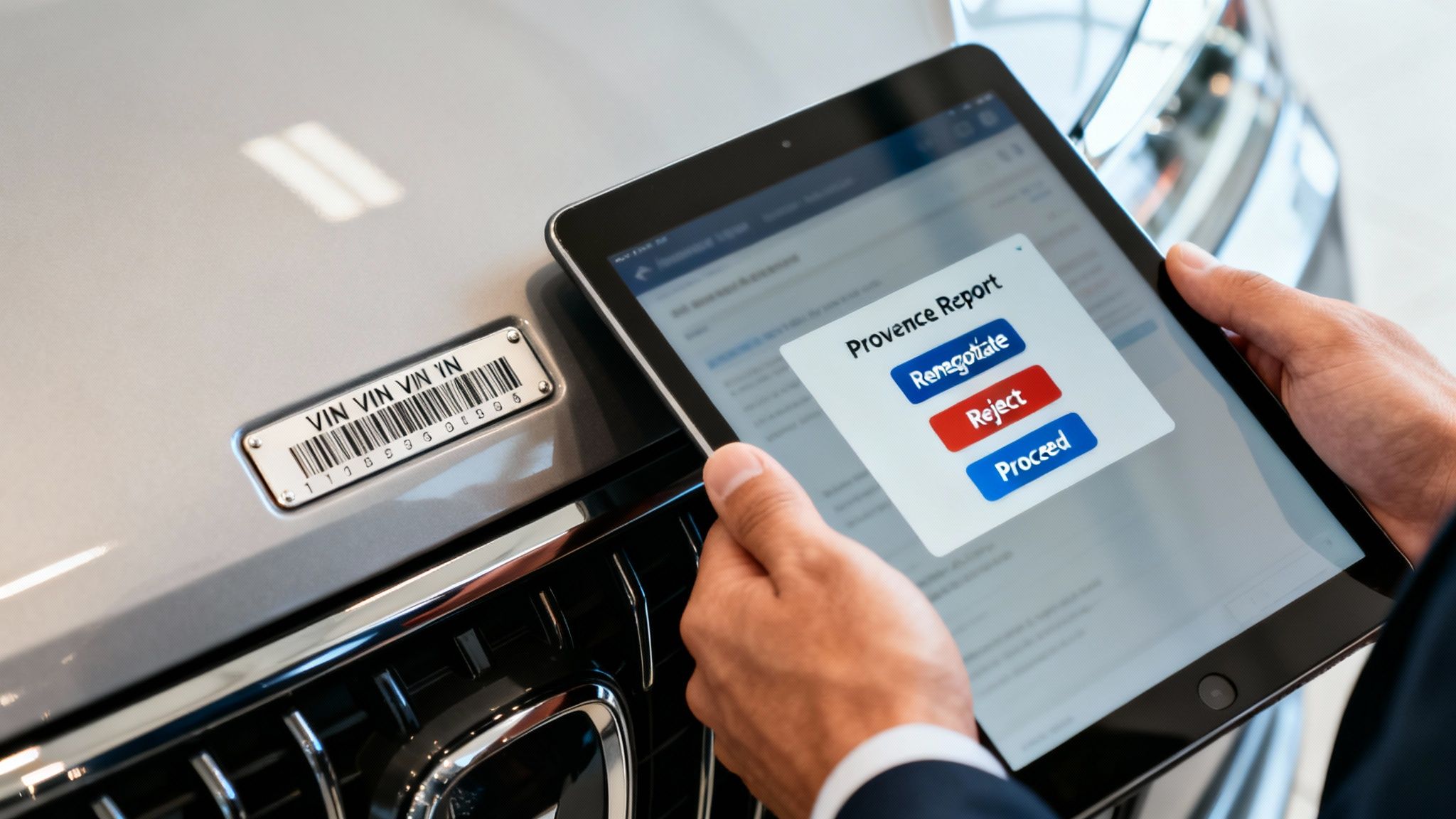
The very first move is always the same, and it’s not on the screen. It’s physical. Before you even think about the data, you need to confirm the car in front of you is the one on the report. Match the Vehicle Registration Mark (VRM) and the Vehicle Identification Number (VIN) on the report with what’s on the car’s plates, the V5C logbook, and the chassis stamp. Any discrepancy is an immediate, full-stop red flag.
Interpreting and Acting on Key Alerts
With the physical checks done, it’s time to decode the digital findings. A good trade report, like one from AutoProv, is designed for speed. It uses clear visual flags and simple summaries to pull your eye straight to the problems. This means you can go from spotting an issue to making a decision in moments. Your mindset should be a simple 'if this, then that'.
For instance, what if a mileage discrepancy pops up? Your first action is to dive into the MOT and service records. Is it a small typo from a garage, or is there a massive, unexplained drop in the numbers? That 'then' step could be grilling the seller for more paperwork or deciding the risk of clocking is just too great and walking away.
A provenance report isn't a simple pass/fail certificate. Think of it as a live decision-making tool. It gives you the ammunition to negotiate, reject, or buy with confidence, all backed by solid facts.
Navigating Finance and Write-Off Markers
Outstanding finance and insurance write-offs are two of the biggest deal-breakers you’ll encounter. Each one requires a careful, specific response to protect your business.
- Handling Outstanding Finance: If a vehicle has a finance marker, it’s not the seller’s car to sell – it legally belongs to the finance company. Your 'then' action here is non-negotiable: you must see that finance settled before any money is exchanged. Often, this means you’ll pay the finance house directly to get a clearance letter, ensuring you get a clean title.
- Assessing a Write-Off Category: A Category S or N marker is your cue for a much closer physical inspection. A Cat N might be perfectly fine if the damage was only cosmetic and the repair work is top-notch. A Cat S, however, points to structural damage and demands an expert eye to judge the quality of the repair. This discovery should directly slash your valuation and arm you to either renegotiate hard or reject the car if the work looks dodgy.
From Data Points to Deal-Making
Every single line item on that report is a chance to make a smarter move. An unusually high number of previous keepers for a car's age might make you scrutinise its MOT history for recurring faults. A past life as a private hire vehicle immediately tells you to adjust your valuation down to account for the heavy wear and tear.
The clean, intuitive layout of an AutoProv report is built for exactly this workflow. By flagging these critical data points with bold, clear alerts, it cuts through the noise and lets you focus on what really matters. This is how you instantly find the leverage to knock the price down, spot the deal-breakers that tell you to walk away, and recognise the clean cars you can snap up with complete peace of mind.
Why Trade-Grade Reports Outperform Consumer Checks
Not all vehicle checks are created equal. Out in the wild world of vehicle data, there's a huge gap between a basic consumer check and a professional-grade car provenance report in the UK built for the motor trade. For a private buyer, a cheap online check might feel like a box ticked. But for a business, relying on one is like trying to navigate a minefield with a tourist map—it shows you the main roads but misses all the hidden dangers.
The real difference boils down to three things: depth, accuracy, and the financial protection you get. Consumer-level services often just scratch the surface, pulling from a limited pool of public data. This can leave dangerous blind spots in a vehicle’s history, creating massive risks for your dealership.
The Critical Data Gap
The biggest weakness of cheaper services is that they simply don't have access to exclusive, trade-only datasets. These are the sources that flag up the most costly and damaging problems. Without them, you’re essentially trying to complete a puzzle with half the pieces missing.
A perfect example is real-time finance data. A basic check might show an old finance agreement, but trade-grade services like AutoProv plug directly into live, up-to-the-minute information from Experian. This is a crucial distinction. It's what stops you from buying a car that could be repossessed moments after you’ve paid for it.
For a motor trade professional, "good enough" data is never good enough. The small saving on a consumer check is insignificant compared to the potential loss from a single missed issue like outstanding finance or a hidden write-off history.
On top of that, many consumer checks miss vital information that directly hits a vehicle's value and your reputation. This can include:
- Salvage Auction History: Getting access to records from salvage auctions can uncover damage that never resulted in an official insurance write-off.
- Detailed Mileage Discrepancies: Professional reports cross-reference a much wider range of sources. This builds a more solid mileage history, making it far easier to spot clocking.
- Robust Data Guarantees: The indemnity that comes with a trade report is designed for business-level risk, often covering losses up to £50,000. Consumer checks typically offer minimal guarantees that are completely inadequate for a commercial transaction.
Built for Business Speed and Certainty
Beyond the data itself, the very structure of a professional report is different. It’s built for efficiency. When you’re at a busy auction or sizing up a part-exchange on the forecourt, you need answers in seconds, not minutes. Consumer tools just aren't designed for that kind of pace.
AutoProv delivers a complete report in under 30 seconds, flagging up critical alerts in a clear, at-a-glance format. This speed gives you a serious competitive advantage, letting you make faster, more confident decisions than your rivals. The entire workflow is designed to support the rapid pace of the motor trade, ensuring your due diligence doesn't become a bottleneck.
Ultimately, investing in a professional tool is about protecting your reputation, minimising your financial exposure, and securing your bottom line. While a basic check might be better than nothing, it simply can’t provide the certainty and security a business needs to thrive. For a direct comparison of features and protections, you can explore our breakdown of AutoProv versus other market providers. It clearly shows why a trade-grade car provenance report in the UK is an essential investment, not an expense.
Making Provenance Checks Part of Your Daily Rhythm
The best dealers treat risk management as a proactive sport, not a reactive chore. They don't see a car provenance report in the UK as just another box to tick before a sale. Instead, it’s a fundamental part of how they do business, day in and day out. Weaving these checks seamlessly into your operations is what separates the good from the great – it turns a simple report into a tool that sharpens efficiency, builds rock-solid trust, and protects your margin.
The real trick is a simple shift in mindset: the check becomes a pre-purchase necessity, not just a pre-sale requirement. This needs to be a hard-and-fast rule for every single car you're thinking of adding to your stock, whether it's from an auction, a part-exchange, or a private seller. Running that report before a single penny leaves your account is the only way to avoid buying someone else’s headache. It's a simple change, but it's the one that stops problem cars from ever hitting your forecourt.
Weaving Provenance into Your Core Process
Bringing these checks into your daily flow isn't about adding another task to your already busy day; it’s about working smarter. Professional-grade services like AutoProv are built for speed and efficiency, designed to slot right into how you already work. Getting a report instantly means you can make a call on a car right there on the spot, giving you a massive advantage when the market is moving quickly.
Just think about how much car ownership has changed in the UK. By the early 2020s, around 77% of UK households had at least one car, and the number of families with two or more cars shot up to nearly 34%. What does that mean for you? More cars with more owners, more complex histories, and more potential pitfalls. A modern provenance report cuts through all that noise, laying out the number of keepers, the full MOT history, and any past life as a taxi or hire car. It's the only way to know the true story of a vehicle before you commit. You can dive deeper into the data on UK vehicle ownership trends to see just how crucial this has become.
More Than Just Due Diligence—It’s a Sales Tool
A clean report isn't just a green light for your buying team; it's a golden ticket for your sales staff. Today's buyers are savvy. They’ve done their research, and they’re cautious. In this environment, total transparency is your most powerful sales pitch. Handing a customer a complete, clean report from a trusted name like AutoProv instantly builds credibility.
When you show a customer a clean provenance report, you're not just showing them data. You're showing them you're confident in your stock and you respect them enough to be transparent. It’s tangible proof that says, "We've done our homework so you don't have to."
This one simple act can dramatically shorten the sales cycle. It answers questions before they’re even asked, knocks down barriers to a sale, and gives your customers the final bit of reassurance they need to say "yes". It’s a proactive move that cements your reputation as a dealership people can trust.
A Straight Line to Better Profitability
At the end of the day, a consistent checking strategy isn't an extra cost or a chore. It's a streamlined process that supports every part of your business, from buying to selling. It filters out the lemons at the source, gives you the facts you need to negotiate better prices, and builds the kind of customer confidence that leads to faster sales and repeat business.
- At Acquisition: Instantly spot deal-breakers like outstanding finance or a write-off marker, saving you from costly blunders.
- During Valuation: Use the car's real history to price it right, ensuring you never overpay for a vehicle with a chequered past.
- On the Forecourt: Use a clean AutoProv report as a stamp of quality that makes your cars stand out from the competition.
By embedding these checks into your daily rhythm, you turn simple due diligence into a genuine competitive edge that drives efficiency, slashes risk, and builds a more profitable dealership.
Frequently Asked Questions
Getting into the nitty-gritty of vehicle data can bring up a few questions. We get it. Here are some of the most common things UK motor trade professionals ask us about our car provenance report UK service, with straight-talking answers to help you get the most out of every check.
How Quickly Can I Get a Report from AutoProv?
Instantly. Or as close to it as makes no difference.
The moment you punch in a vehicle registration mark (VRM), our platform is already talking to the DVLA, Police National Computer, and finance houses in real-time. The full report flashes up on your screen within seconds. This means you can make a confident, data-backed decision right there and then—whether you're stood in a draughty auction hall or sizing up a part-exchange on your own forecourt.
What Does the Data Guarantee Actually Cover?
Think of our data guarantee as your financial safety net. It’s designed to protect your business from the costly fallout of specific, inaccurate data.
For instance, if our report gives a car the all-clear on finance but it turns out there’s a logbook loan on it and the vehicle gets repossessed, our guarantee steps in. It’s there to cover your financial loss up to a significant, specified limit. This is a world away from the token guarantees you might see on consumer checks, because we understand the high-stakes reality of the motor trade.
A professional guarantee isn’t just a nice-to-have; it's a core part of the service. It provides genuine financial recourse against data errors that could otherwise wipe out your profit on a high-value vehicle.
Will a Provenance Report Show Minor Accidents?
No, and it's important to know the distinction. A provenance report will only flag accidents that led to an official insurance write-off—think Categories A, B, S, or N.
If a car has had a minor bump and the owner paid a local bodyshop to sort it out without involving their insurer, there’s simply no official record for us to find. This is exactly why a provenance report is one half of the due diligence puzzle. It must always be paired with a thorough physical inspection to spot the tell-tale signs of cosmetic repairs or mechanical work.
For a deeper dive into our service and the data we provide, feel free to explore our comprehensive AutoProv FAQ page.
Frequently Asked Questions
AI-Generated Content Notice
This article was created with the assistance of artificial intelligence technology. While we strive for accuracy, the information provided should be considered for general informational purposes only and should not be relied upon as professional automotive, legal, or financial advice. We recommend verifying any information with qualified professionals or official sources before making important decisions. AutoProv accepts no liability for any consequences resulting from the use of this information.
From our AI insights
- Navigating UK Grey Imports: A Trader's Guide
Understand the complexities and opportunities of UK grey imports for savvy motor traders.
- Uncovering the Real Costs of Vehicle Intelligence Services
Discover hidden fees and data quality issues in vehicle intelligence services.
- Decoding UK Auction Vehicle Histories
Understand how to assess UK auction vehicle histories and uncover hidden risks.
Related Articles

Essential Vehicle Checks Before Buying a Used Car
Learn essential checks to ensure your used car purchase is safe and sound in the UK market.

Why a Provenance Check is Essential for Used Car Buyers
Ensure your used car is a smart investment by understanding the importance of a provenance check and how AutoProv can help.
A Guide to Vehicle Check with VIN Number
A vehicle check with vin number is easily the most important thing you can do before buying a used car. Think of it as your first line of defence—a quick, simple step that pulls back the curtain on a vehicle's past, protecting you from expensive mistakes, legal headaches, and downright dangerous cars.
Published by AutoProv
Your trusted source for vehicle intelligence