A solid contract for vehicle sale is so much more than just admin paperwork. Think of it as the foundational legal shield for your motor trade business. This document sets clear, legally-binding expectations between you and the buyer, dramatically cutting down the risk of disputes before any money or keys change hands.
Why Your Vehicle Sale Contract Is Your Best Defence
For any professional in the motor trade, every single transaction carries a bit of risk. Simple misunderstandings over a car's condition, its history, or the terms of the sale can quickly spiral into costly legal battles, a string of negative reviews, and serious damage to your hard-earned reputation. A meticulously drafted vehicle sale contract is your first and best line of defence, providing a clear, indisputable record of the agreement.
This isn't just about jotting down the price and the reg number. A professional contract does several crucial jobs:
- Sets Clear Expectations: It spells out the rights and responsibilities of both you and the buyer, leaving zero room for doubt about what's included in the sale.
- Provides Legal Protection: It creates a legally binding agreement that will stand up if a dispute ever arises, protecting your business from baseless claims.
- Builds Customer Trust: A transparent and thorough contract is a mark of professionalism. It gives the buyer confidence in the deal and reinforces your credibility.
The Link Between Provenance and Protection
Here's the thing: the strength of any contract for vehicle sale is directly tied to the accuracy of the information inside it. You can't draft a watertight agreement based on guesswork or incomplete data. This is where your pre-contract due diligence becomes absolutely non-negotiable. Before you write a single clause, verifying the vehicle’s complete history is a must-do step.
A contract built on verified data is a fortress. One built on guesswork is a house of cards. Ensuring every detail is confirmed beforehand isn't just best practice—it's essential risk management for the modern dealer.
This process involves more than just a quick glance at the V5C. Proper diligence means confirming every critical data point that could affect the sale and your legal standing down the line. For example, declaring a vehicle is free from outstanding finance without a definitive check is a massive gamble. Misrepresenting a car's history, even by accident, can lead to serious trouble under consumer law. You can learn more about how the Consumer Rights Act 2015 impacts the UK motor trade in our detailed guide.
By using a professional vehicle intelligence service like AutoProv, you turn this critical step from a liability into a strength. An AutoProv report gives you instant confirmation on everything from outstanding finance and write-off history to mileage discrepancies and MOT records. Integrating this verified data directly into your contract shifts the entire transaction from a position of uncertainty to one of absolute confidence, protecting your business and ensuring every sale is built on a foundation of truth.
Core Components Every UK Vehicle Sale Contract Must Have
Before any keys are handed over or money changes hands, the foundation of a solid deal is laid out in black and white. A properly drafted contract for vehicle sale isn't just red tape; it's your single most important tool for clarity and legal protection. Think of it as the framework that holds the entire transaction together, shutting the door on costly misunderstandings down the line.
To be legally sound in the UK, every sales agreement needs several non-negotiable elements. These aren't just suggestions—they're the absolute essentials that define the who, what, and how of the entire deal.
Identifying the Parties Involved
First things first, the contract must be crystal clear about who is buying and who is selling. It sounds painfully obvious, but any ambiguity here can render the whole document useless. You have to be precise.
Make sure your contract includes:
- The Seller’s Full Legal Name and Address: This should be your registered business name and official trading address.
- The Buyer’s Full Legal Name and Current Address: Always, always verify this against a driving licence or other official ID. Don't just take their word for it.
This simple step establishes the legal entities bound by the agreement, leaving no doubt about who is responsible for what.
Defining the Vehicle with Precision
Next up: the car itself. The contract has to describe the asset being sold with absolute certainty. A vague description like "the blue Ford" is just asking for trouble. Your goal is to identify the vehicle so specifically that it can't be confused with any other car on the planet.
Nail down these critical identifiers:
- Vehicle Registration Mark (VRM): The number plate is the most obvious starting point.
- Vehicle Identification Number (VIN): This is the car's unique 17-digit fingerprint. It's non-negotiable.
- Make and Model: For instance, ‘Vauxhall Corsa SRi’.
- Exact Mileage: Record the odometer reading at the point of sale and state it clearly.
This level of detail is your shield. The VIN, for example, is directly linked to the car’s entire history and is a key data point on the V5C log book. For a refresher on this vital document, check out our quick UK log book guide. Getting these details right from the start is what stops future claims of misrepresentation dead in their tracks.
A contract's strength is in its specifics. A single ambiguous detail, like a slightly off mileage figure or a mistyped VIN, can become the weak point a disgruntled customer or their solicitor will zero in on. Double-checking every digit isn't paranoia; it's professional diligence.
Outlining the Financial Terms
Nothing causes disputes faster than fuzzy maths. Every single figure involved in the deal must be explicitly stated to prevent any arguments over payment later. Never leave financial details open to interpretation.
Your financial clause must clearly document:
- The Total Sale Price: The full, agreed-upon price for the vehicle, making sure to state if it's inclusive of VAT.
- Deposit Amount Paid: The exact figure the buyer has already paid to secure the car.
- Outstanding Balance: The remaining amount due on collection or delivery.
- Method of Payment: Specify exactly how the final balance will be paid (e.g., bank transfer, debit card).
With the UK's used vehicle market seeing its strongest activity since 2019, stock is turning over faster than ever. This high volume makes it even more critical to have ironclad financial terms in every single contract to head off administrative errors and protect your cash flow.
Stating Key Legal Declarations
Finally, your contract needs a section for legal statements and declarations. This is where you formally confirm your legal position and the status of the vehicle, adding a vital layer of protection for your dealership.
A crucial declaration is confirming you have the legal right to sell the vehicle. This clause asserts that you are the lawful owner or have the owner's authority to transfer the title. It’s fundamental.
Just as important is a declaration that the vehicle is free from any outstanding finance agreements. This is a powerful statement, but one you should never, ever make without being 100% certain. Guessing here is a massive risk. This is precisely why running an AutoProv report beforehand is non-negotiable; it provides the documented proof you need to back up this contractual claim, ensuring you don't end up on the hook for someone else's debt.
Using Provenance Data to Minimise Contractual Risk
A well-written contract for a vehicle sale is your first line of defence, but its real strength comes from the verified facts packed inside. Drafting clauses based on guesswork is a high-stakes gamble for any motor trade professional. The moment you state a vehicle has no outstanding finance or warrant its mileage without concrete proof, you’re opening your business up to serious financial and legal blowback. This is where provenance data stops being just a pre-purchase check and becomes a vital contract-fortifying tool.
By building a comprehensive vehicle intelligence report directly into your drafting process, you replace dangerous assumptions with solid certainty. Every key data point becomes a building block for a stronger, more defensible agreement. This isn't just about ticking compliance boxes; it's about building a robust legal shield around every single transaction.
This concept map breaks down the three core pillars of a vehicle sale, all of which are held together by a well-informed contract.
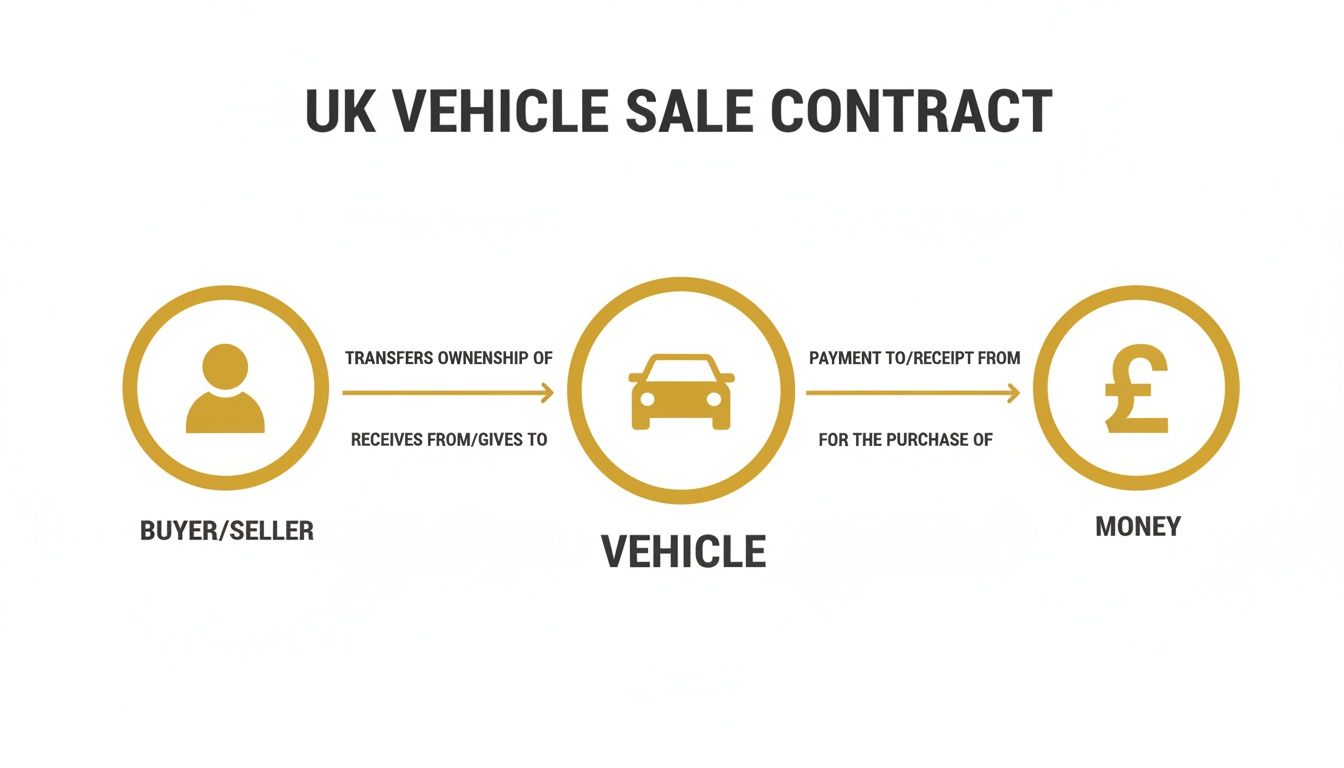
As you can see, the contract is the foundation linking the buyer and seller, the vehicle itself, and the financial side of the deal. Get the facts wrong in that contract, and the whole thing can come tumbling down.
Translating Provenance Checks into Protective Clauses
Think of a provenance report from a service like AutoProv as the hard evidence you need to back up your contractual claims. It lets you confidently translate raw data into specific, protective clauses that leave zero room for argument. This process slams the door on legal loopholes and shows you've done your professional homework.
Here’s how you can turn key data points from an AutoProv report into bulletproof clauses:
- Experian Finance Check: This one is a non-negotiable. A clear report means you can confidently write a clause like: "The Seller warrants that the vehicle is free from all liens, charges, and hire purchase agreements as of the date of sale."
- Mileage Verification: AutoProv cross-references DVLA, MOT, and other records to catch discrepancies. This data gives you the backbone for a solid ‘Mileage Declaration’ clause, such as: "The Seller declares that the odometer reading of [insert mileage] is correct to the best of their knowledge and belief, as supported by available records."
- Write-Off History (MIAFTR): Transparency is everything here. If a car has a salvage history (e.g., Category S or N), the report provides the exact details for a full disclosure clause. This protects you from future claims of misrepresentation down the line.
By grounding your contract in verified facts from a provenance report, you shift the conversation from "I think" to "I can confirm." That small change is the difference between a potential dispute and a secure, transparent sale.
From V5C Data to Contractual Certainty
The V5C logbook gives you the basics, but a professional report verifies those details and adds crucial context. For instance, the number of previous keepers listed on the V5GVC can be confirmed and included right there in your contract, giving the buyer the complete picture. This level of detail builds trust and adds another layer of accuracy to your agreement.
Understanding the full scope of what a vehicle history check gives you is critical. You can explore the ultimate guide to a car provenance report in the UK to see how every single data point can be used to strengthen your business operations and legal documents.
The AutoProv Advantage in Contract Drafting
Using a trade-grade platform like AutoProv gives you more than just data—it gives you confidence. When you know a vehicle's full history, from its taxi licensing records right through to potential recall notices, you can draft a contract that accurately reflects its status and value. This diligence protects your margin and, just as importantly, your reputation.
Imagine a scenario where a vehicle has a mileage discrepancy flagged deep in its MOT history. Without this insight, you might innocently warrant the incorrect mileage. With an AutoProv report in hand, you can tackle this head-on in the contract, perhaps by stating the known history and selling the vehicle with the mileage declared as unverified. This kind of transparency protects you completely.
Ultimately, every clause in your contract should be a statement of fact. A professional provenance report is your source for those facts, making it an indispensable tool not just for buying stock, but for securing every single sale you make.
Advanced Clauses for Enhanced Business Protection
Once you've got the essentials nailed down, it's time to add the clauses that turn a standard sales agreement into a serious piece of business protection. Think of these as the professional-grade clauses that anticipate and shut down the most common headaches in the motor trade *before* they happen.
This isn't about burying your customer in legal jargon. It's about clarity and managing expectations from the get-go. A buyer who understands exactly what's covered in a warranty is far less likely to cause a fuss later. Likewise, clear post-sale responsibilities prevent you from getting dragged into issues that aren't your problem.
Defining Trade Sale Terms
One of the most critical distinctions you can make in your paperwork is the difference between a retail sale and a trade sale. Get this wrong, and you could find yourself bound by consumer rights law in a business-to-business (B2B) deal where it simply doesn't apply. This is where a rock-solid 'Trade Sale' clause is worth its weight in gold.
This clause needs to state, in no uncertain terms, that the vehicle is being sold on a trade basis to another professional in the motor trade. The language makes it clear the buyer is knowledgeable, isn't buying for personal use, and understands the transaction falls outside consumer protection laws.
Here’s an example of how you could word it:
- "This vehicle is sold on a 'Trade Sale' basis to a bona fide member of the motor trade. The buyer confirms they are purchasing this vehicle for business purposes (such as resale) and not as a consumer. As such, the statutory rights granted to consumers under the Consumer Rights Act 2015 do not apply to this transaction."
This is more important than ever. The UK market is buzzing with B2B activity. Recent figures show new car registrations have climbed past two million for the first time since the pandemic, with fleet and business buyers making up nearly 60% of that total. That’s a huge volume of professional deals where a specific trade sale clause is an absolute must.
Structuring Warranty and Part-Exchange Clauses
Warranties are a minefield for disputes. A vague or poorly defined warranty clause is an open invitation for arguments down the line. Your contract has to spell out the exact scope, duration, and limits of any warranty you offer, whether it's your own or a third-party plan.
Your warranty clause should detail:
- What is covered: List the specific parts, like the engine and gearbox.
- What is excluded: Be blunt about what's not covered, such as wear-and-tear items like tyres, brakes, and clutches.
- Claim Procedure: Lay out the precise steps the buyer must follow to make a claim.
Part-exchange deals bring another car—and a whole new set of risks—into the picture. Your contract has to make the main sale conditional on the part-exchange vehicle being exactly what the customer claims it is.
A part-exchange clause is your safety net. It must give you the explicit right to renegotiate or even walk away from the deal if the trade-in vehicle isn't up to scratch on final inspection, especially if it has hidden faults or outstanding finance.
A strong part-exchange clause makes the deal contingent on a final inspection and confirmation that the vehicle is provenance-clear. This is where you absolutely must run a check; our guide on the importance of finance checks when purchasing a vehicle dives deeper into this. An AutoProv report gives you the concrete proof you need to ensure the vehicle you’re taking in has a clean title.
Clarifying Post-Sale Responsibilities
The second those keys are handed over, all responsibility for the vehicle needs to transfer cleanly to the new owner. Your contract should have a clause that spells this out, leaving zero ambiguity.
This clause confirms that from the moment of collection, the buyer is legally responsible for everything to do with the car. It’s a simple but powerful bit of text that shields you from fines or legal headaches caused by the new owner dropping the ball.
Make sure your contract states the buyer is now responsible for:
- Taxing the vehicle: Remind them that road tax is no longer transferable.
- Insuring the vehicle: They must have their own policy in place before driving off your forecourt.
- Notifying the DVLA: Emphasise their duty to complete their section of the V5C.
By adding these advanced, real-world clauses, your vehicle sale contract becomes much more than a receipt. It’s a smart, dynamic tool that protects your business from all angles. It shows you're a professional who has seen it all before and has a process to handle it.
Finalising the Sale Contract Execution and Record Keeping

The last few moments of a deal—the handshake, the key handover, the signature on the dotted line—are where all your hard work pays off. A perfectly drafted contract for vehicle sale is only as good as its execution. This final stage is just as critical as writing the clauses themselves; it's about sealing the deal in a way that’s legally sound, transparent, and professional.
Getting this bit right is what turns a piece of paper into a binding agreement. It’s the official point where terms are accepted and responsibilities are transferred. Dropping the ball here can undermine the most watertight contract, leaving you exposed despite all your careful preparation.
The Signing Process: Best Practices
Before any ink hits the paper, the golden rule is to make sure everyone is on the same page. Never, ever rush a customer through the signing process. Encourage them to read every clause and ask questions. This isn't just good service; it's a vital risk management step.
A buyer who feels pressured or confused is far more likely to raise a dispute down the line. Taking a few extra minutes to walk them through the key terms—warranties, part-exchange conditions, post-sale responsibilities—builds trust and confirms their informed consent.
The moment of signing is the final checkpoint for clarity. A signature should represent full agreement, not rushed compliance. Ensuring the buyer genuinely understands what they are signing is your best defence against future claims of misunderstanding or misrepresentation.
Once both parties are ready, the signing itself makes everything official. Here’s a practical checklist to run through during the final handover:
- Final Walk-Through: Briefly go over the main points one last time. Verbally confirm the vehicle's details, the final price, and any specific conditions you've discussed.
- Clear Signatures: Make sure both the seller (representing your business) and the buyer sign and date the document in the right places. Legible signatures matter.
- Witness If Necessary: While not always legally required for a simple car sale, having a witness can add an extra layer of validation. It’s worth considering for particularly high-value transactions.
- Provide a Full Copy: The buyer must leave with a complete, signed copy of the contract. This is non-negotiable. It’s their official record of the agreement.
Wet Signatures vs Digital Signatures
In the UK, the law has kept up with modern business. Both traditional 'wet' ink signatures and electronic signatures are legally recognised. An electronic signature can be as simple as a typed name on an email or a more secure, encrypted signature via a digital platform. For a contract for vehicle sale, both are valid, as long as it's clear the person intended to be bound by the terms.
Many dealerships now use digital contract solutions for their efficiency and secure audit trails. These systems often log the time, date, and even the IP address linked to the signature, providing robust evidence of the agreement. Whichever method you stick with, consistency and clarity are what count.
Secure and Compliant Record Keeping
Once the deal is done and the customer drives off, your duty to the contract isn't over. Proper storage of sales documents is crucial for both legal protection and financial compliance. Losing a sales contract could leave you defenceless if a dispute pops up months or even years later.
For your own business records, you have to keep copies of all sales contracts. But for how long? HMRC requires businesses to keep records for at least six years after the end of the last company financial year they relate to. Think of this as the absolute minimum.
Your storage system needs to be secure and organised. A few practical tips:
- Digital Archiving: Scan any physical copies and store them in a secure, cloud-based folder. Use a logical naming convention like VRM_BuyerSurname_Date so you can find things easily. Crucially, make sure it’s all backed up.
- Physical Storage: If you still use paper, a locked, fireproof filing cabinet is the way to go. Organise them logically, either by date or alphabetically, so you’re not scrambling if you need to find one.
By locking down a solid process for signing and archiving, you ensure every contract you write delivers the long-term security your business needs to operate with confidence. This final step secures the protection you’ve so carefully built.
Common Questions About Vehicle Sale Contracts
Even for seasoned pros in the motor trade, the fine print of a vehicle sale contract can throw up a few questions. Getting the details right isn't just about compliance; it's about managing risk and building the kind of customer trust that keeps people coming back. Here are the straight answers to some of the most common queries we hear from dealers across the UK.
Trade Sale vs Retail Sale: What Is the Difference?
This is probably one of the most critical distinctions in the trade, and getting it wrong can be costly. A retail sale is your standard business-to-consumer (B2C) deal. The key thing to remember here is that the buyer is fully protected by the Consumer Rights Act 2015, which gives them powerful statutory rights on the car's quality and fitness for purpose.
A trade sale, however, is a business-to-business (B2B) transaction. You're selling to another motor trade professional who is buying the vehicle for their business, usually for resale. The Consumer Rights Act doesn't apply here, and the old principle of caveat emptor (let the buyer beware) carries a lot more weight. Your contract must explicitly state "Trade Sale" to make this distinction legally watertight.
Can I Use a Digital Signature on My Contracts?
Absolutely, and you should be. Electronic signatures are fully recognised in the UK and have been for years. Under the Electronic Communications Act 2000, a digital signature carries the same legal weight as a traditional "wet ink" one, as long as it's clear the person signing intended to be bound by the terms.
Using digital signatures is a no-brainer. It speeds up the whole sales process, gives the customer a much slicker experience, and creates a secure, searchable audit trail for your records. Most modern dealership management systems have this functionality baked right in.
What Happens If a Buyer Finds a Fault After Signing?
This all comes down to the type of sale and what you've put in the contract. For a retail sale, the Consumer Rights Act gives the buyer a short-term right to reject the car if there's a significant fault that was present when they bought it.
If a fault pops up later, that’s where your warranty terms kick in. A well-worded warranty clause will lay out exactly what's covered, for how long, and the precise process for making a claim. On the other hand, if it was a "trade sale" with no warranty offered, your liability is massively reduced—though being transparent about known faults is always the best policy.
The moments after a sale are when a meticulously detailed contract proves its worth. Ambiguity regarding post-sale faults is a direct path to a dispute. Your contract should be a clear roadmap, leaving no doubt about your obligations and the buyer's responsibilities.
How Long Must I Keep Sale Records for HMRC?
Good record-keeping isn't just good business sense; it's a legal requirement. HM Revenue & Customs (HMRC) requires you to keep all business records, which includes sales invoices and contracts, for at least six years from the end of the last company financial year they relate to.
Dropping the ball on this can lead to penalties, so having a solid digital or physical filing system is essential. It means you can lay your hands on any document you need, whether for an audit or to deal with a legal query that crops up years down the line. For more answers to common queries, you can explore the AutoProv FAQ page, which covers a wide range of topics relevant to the UK motor trade.
A robust contract is your shield, but it must be built on a foundation of verified data. With AutoProv, you gain instant access to over 40 critical data points, from Experian finance checks to DVLA history, allowing you to draft every contract with complete confidence. Protect your business and build trust with every sale. Discover the AutoProv advantage at https://autoprov.ai.
Frequently Asked Questions
AI-Generated Content Notice
This article was created with the assistance of artificial intelligence technology. While we strive for accuracy, the information provided should be considered for general informational purposes only and should not be relied upon as professional automotive, legal, or financial advice. We recommend verifying any information with qualified professionals or official sources before making important decisions. AutoProv accepts no liability for any consequences resulting from the use of this information.
From our AI insights
- Avoiding Towing Missteps: Legal Checks for Dealers
Protect your dealership by ensuring vehicle weight and towing capacity compliance before listing stock.
- V5C Logbook: Untold Legal Limitations & Verification Needs
Explore the V5C logbook's legal boundaries and why traders need extra checks.
- Managing CRA 2015 Rejections: Evidence Essentials for Dealers
Learn how UK motor traders can effectively handle CRA 2015 rejection claims with proper evidence management.
Related Articles

Understanding the Consumer Rights Act 2015 in the UK Motor Trade
Explore the Consumer Rights Act 2015 and its impact on UK car buyers and sellers, offering essential protections and insights.

Understanding UK Automotive Regulations
Explore the complexities of automotive regulations in the UK, covering DVLA, FCA, MOT, and more.
What is a V5C Document: A Quick UK Log Book Guide
If you've ever bought or sold a car in the UK, you've definitely come across the V5C. It's often just called the 'log book', and it’s the official Vehicle Registration Certificate issued by the DVLA.
Published by AutoProv
Your trusted source for vehicle intelligence