

If you buy a car with Northern Ireland history and run a standard UK check, do you know what you're buying? In many cases, you don't. That's the mistake behind a lot of avoidable trade losses. Dealers assume a vehicle history check UK workflow covers the whole market evenly, but Northern Ireland sits in a different operational reality. The issue isn't just paperwork. It's visibility. A car can look clean on a routine report while key provenance details still sit outside the usual lookup path.
That matters at the point of purchase. If you can't see MOT context, mileage confirmation, ownership anomalies, or cross-border risk signals clearly enough, you're pricing stock on incomplete intelligence. That affects margin, appraisal confidence, and the chance of a post-sale argument you could have prevented.
Northern Ireland vehicles need a different level of scrutiny because the data infrastructure is different. A used car history report that works well for a Great Britain registered vehicle may leave gaps for an NI registration, especially where private plates, Irish history, or manual DVA confirmation are involved. For experienced buyers, that isn't a technical footnote. It's a buying risk.
The practical answer is not panic and it's not overcomplication. It's a tighter process. Good dealer vehicle checks for NI-sourced stock rely on knowing where the gaps are, what a standard check won't show, and when you need to push beyond automated results into proper provenance work.
Table of Contents
- Introduction Why a Standard UK Check Fails in NI
- The NI Data Gap DVA vs DVLA Explained
- Why Northern Ireland behaves differently
- What a trader can actually do
- High-Risk Signals for NI-Sourced Vehicles
- Cross-border risks that basic reports miss
- Trading signals worth slowing down for
- A Provenance Workflow for Buying NI Trade Stock
- Build the check before you view the car
- Questions and documents that change the decision
- How Advanced Intelligence Bridges the NI Data Gap
- Why fragmented data needs interpretation
- What better trade vehicle intelligence looks like
- Conclusion Protecting Your Margin and Reputation
Introduction Why a Standard UK Check Fails in NI
The phrase vehicle history check Northern Ireland sounds straightforward. In practice, it isn't. A buyer can run a familiar report, see no immediate warning, and still miss part of the vehicle's real background because the Northern Ireland workflow doesn't mirror Great Britain.
That's where experienced traders get caught. The problem usually isn't that anyone skipped a check. It's that the wrong type of check was treated as sufficient. Standard reports are useful, but they're often built around data structures and assumptions that fit mainland UK buying patterns better than NI stock with mixed registration history, private plates, or cross-border movement.
A proper vehicle provenance review for NI cars needs more than a pass or fail mindset. It needs context. You want to know whether the history shown is complete enough to support a buying decision, whether the mileage trail is consistent, whether the ownership path makes sense, and whether there are signs the car has spent time in more than one system.
Basic checks answer whether something obvious is recorded. Good trade process answers whether anything important is still missing.
For motor trade risk, the weak point is usually not one dramatic red flag. It's a chain of smaller omissions. An incomplete mileage trail. A seller who can't explain where the car was maintained. A Northern Ireland registration that looks ordinary until you realise the standard lookup isn't giving you the same depth you'd expect on a comparable GB vehicle.
That's why NI sourcing needs its own discipline. If you buy from auction, trade disposal, wholesaler channels, or direct stock opportunities, you need a process that treats Northern Ireland as a separate provenance environment. Not because every NI car is risky. Because the route to confidence is different.
The NI Data Gap DVA vs DVLA Explained
Why Northern Ireland behaves differently
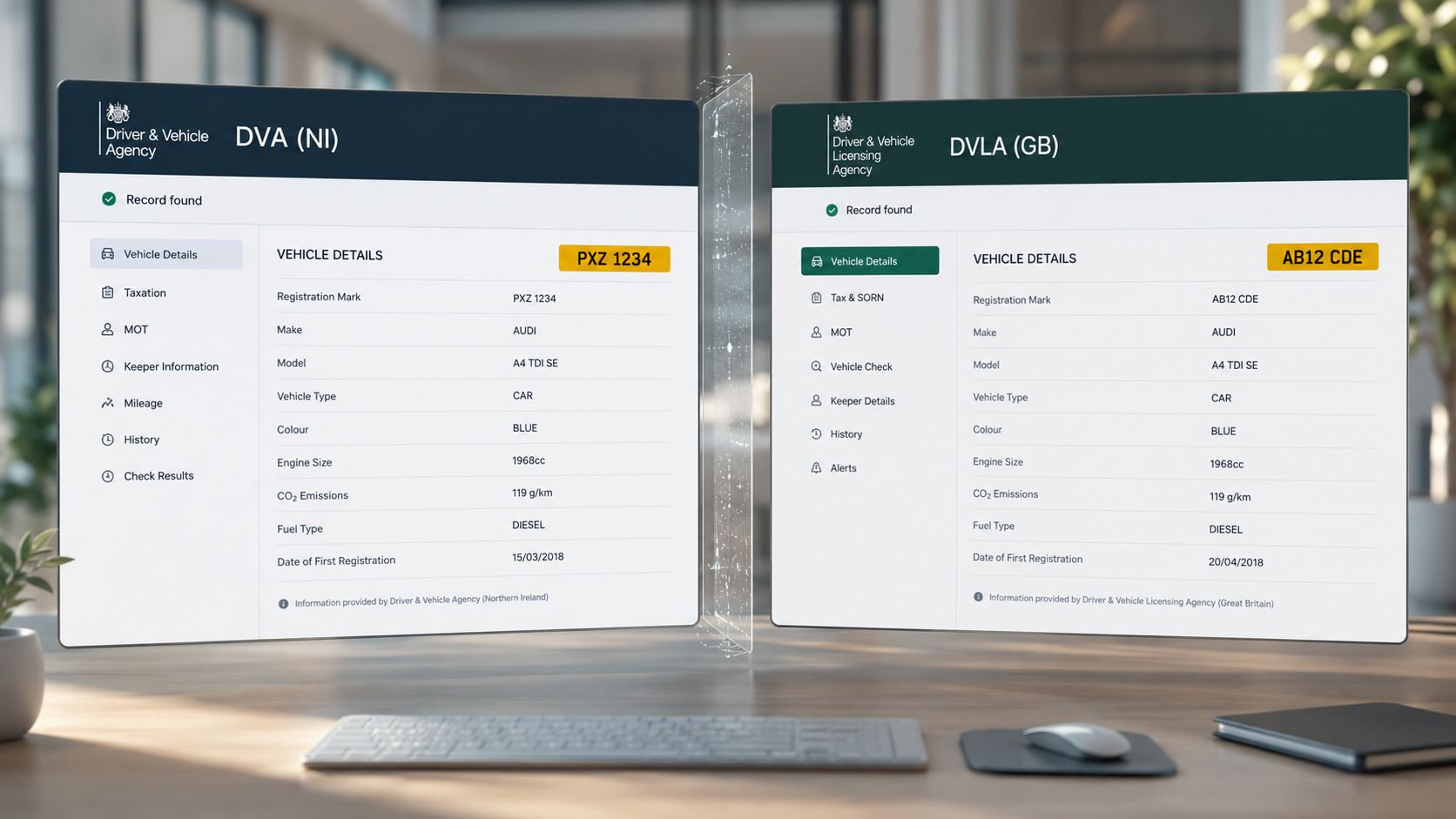
The core issue is structural. In Northern Ireland, vehicle testing statistics come from records maintained by exactly 15 official vehicle test centres, which form the backbone of DVA operations, and the MOT database isn't publicly linked for online mileage and defect lookups in the way traders expect from Great Britain systems, according to the Office for Statistics Regulation case example on Northern Ireland driver and vehicle statistics.
That single difference changes how a buyer should think. In Great Britain, traders are used to quick online MOT visibility. In NI, that instant self-serve path isn't the same. If you want confirmation of specific details, the route is manual contact with the DVA. That slows down appraisal and creates a real quality-control problem when you're trying to buy decisively.
Data people in other sectors would recognise this immediately as a reliability issue, not just a convenience issue. If you work with fragmented records, inconsistent retrieval, and manual intervention, the buying decision becomes only as strong as the process around the data. The wider principles in this guide to data quality for commerce teams apply neatly here. Incomplete access creates false confidence if the user mistakes “not shown” for “not present”.
What a trader can actually do
For a dealer, the practical implications are simple.
Area Great Britain expectation Northern Ireland reality MOT visibility Often treated as quick and accessible online Not publicly linked in the same way Mileage context Easier to align with visible MOT trail May require manual confirmation Defect detail review More straightforward through standard patterns More limited through NI access routes Appraisal speed Fast desk-based screening Slower, more dependent on follow-up The first rule is to stop treating NI like a normal extension of a mainland workflow. It isn't. If the registration, plate history, seller narrative, or service paperwork suggests Northern Ireland involvement, the check process needs to branch.
Use a layered approach:
- Start with the obvious data: Run your usual used car history report and review what is present, not what you assume should be present.
- Check whether the timeline feels complete: If there's a gap in recorded activity, treat that as a question, not a blank.
- Escalate mileage review: If you need a stronger audit trail, use a more specific DVLA mileage check guide as part of your process, while recognising that NI cases may still require manual confirmation outside the normal online route.
- Prepare for manual work: In NI-linked cases, traders may need to contact DVA directly in Coleraine by phone or email to confirm mileage dates and test outcomes.
Practical rule: If the vehicle's margin only works when you assume the visible history is complete, you haven't appraised it conservatively enough.
That's the trade-off. NI stock can be attractive, but it often demands more effort per buying decision. The buyers who handle it well don't rely on one report. They build confidence from several signals, then decide whether the unresolved gaps are acceptable for the age, value, and disposal profile of the car.
High-Risk Signals for NI-Sourced Vehicles
Cross-border risks that basic reports miss
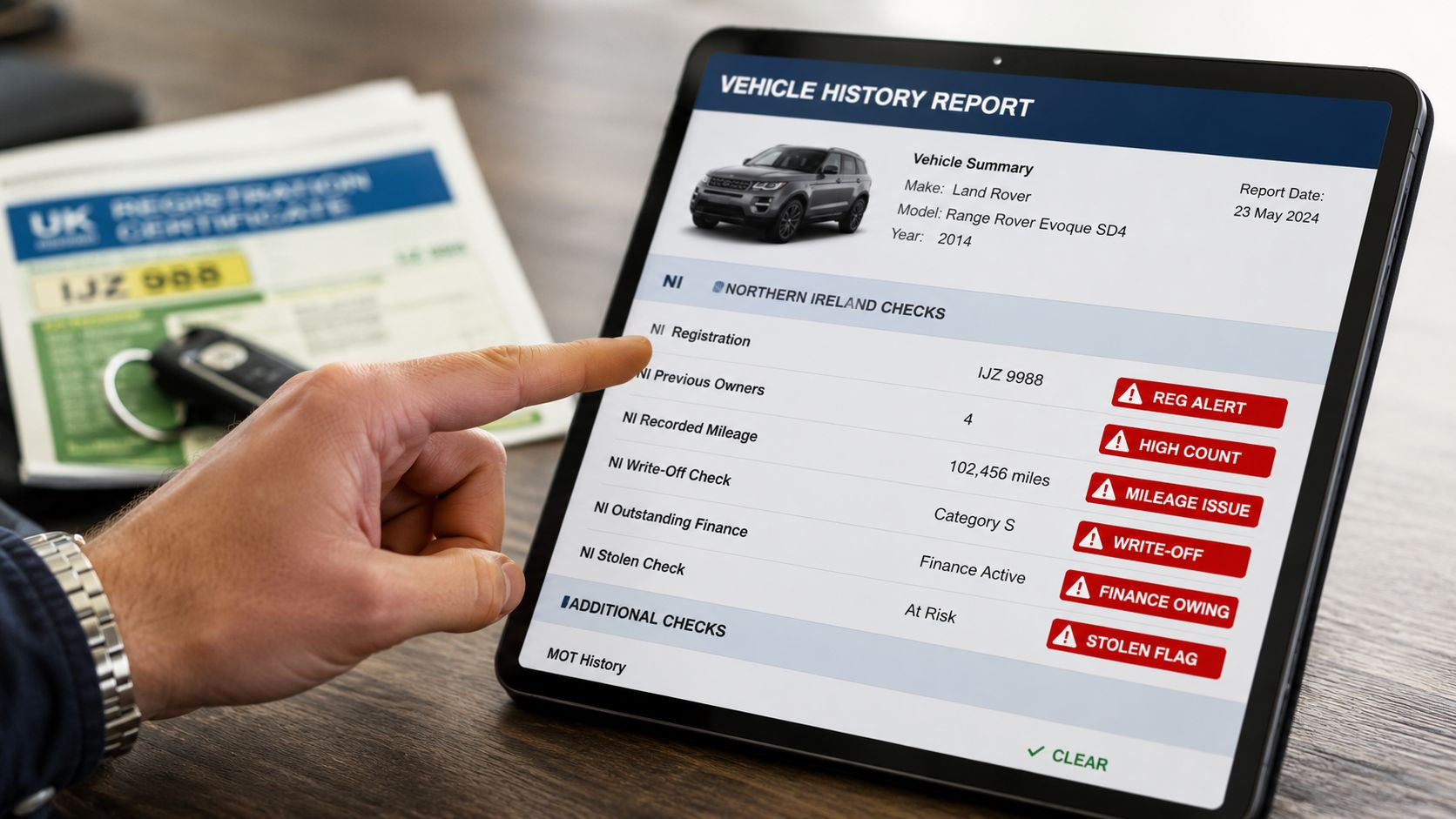
The sharpest blind spot is cross-border write-off laundering. That's the situation where a vehicle written off in one jurisdiction moves across the Northern Ireland and Ireland boundary in a way that reduces the chance of that event appearing clearly in a standard DVLA-based check. The risk is real because Gerry Caffrey Motors notes that over 50,000 vehicles are written off annually across both jurisdictions, creating a meaningful pool of stock where undisclosed structural history can slip through routine screening.
This isn't a niche issue for specialist buyers only. It affects ordinary retail stock. A car can present well, drive well, and still carry a history that changes valuation and retail appetite the moment it surfaces later. If your dealer vehicle checks don't account for Irish insurance loss records and cross-border movement, you can end up owning somebody else's hidden problem.
Another problem sits in mixed-history maintenance trails. NI-registered vehicles may have prior servicing in Ireland, but standard UK checks often won't give that context clearly. If the paperwork suggests the car has lived on both sides of the border, a clean-looking UK screen isn't enough.
Trading signals worth slowing down for
Some warning signs don't prove a vehicle is wrong. They do tell you to stop buying on instinct.
- Private plate complexity: Northern Ireland vehicles may have been on private NI plates before sale. Verified background material notes that up to 30% of Northern Ireland registered vehicles may previously have been on private NI plates, with early records only retrievable through manual DVA Coleraine contact via direct phone or email, as discussed in the Northern Ireland MOT history discussion on CarTalkUK. A shallow registration search can miss that earlier trail.
- Mileage that looks tidy but thin: Mileage fraud remains a known UK risk. A basic mileage check UK review may show no obvious contradiction because the data trail is incomplete. That's why a visible MOT pattern should be treated as evidence, not proof in itself.
- Fast keeper churn: Short-term ownership and rapid resale activity are established risk indicators in trade buying. If a vehicle appears to have unusually brief ownership spans, especially where the story behind those changes is vague, the car needs deeper review, not quicker bidding.
- Irish links with no corresponding paperwork: Service stamps, dealer branding, or seller explanations that point to Irish use should line up with documents. If they don't, the burden of proof shifts back to the vendor.
A practical route for these cases is to widen the history work, especially where NI servicing and registration patterns are involved. A focused review of Northern Ireland service and maintenance history helps frame what should exist and what may still need manual confirmation.
A vehicle doesn't become low risk because the first report looks clean. It becomes lower risk when the visible history, seller story, paperwork, and registration behaviour all agree.
The most expensive NI mistakes usually happen when one plausible explanation is accepted without checking whether the rest of the record supports it.
A Provenance Workflow for Buying NI Trade Stock
A disciplined buying workflow matters more in Northern Ireland because unresolved gaps are common enough to distort decision-making. You're not just checking whether the car has a recorded problem. You're checking whether the provenance is strong enough to price the car correctly.
That's particularly relevant when supply pressure encourages quick buys. NISRA reported that 14,928 vehicles failed to attend a booked vehicle test in a single quarter, a 27.0% increase year-on-year. For traders, that matters because some vehicles entering the market may have been sitting outside normal testing patterns for reasons that aren't immediately obvious from a standard report.
Build the check before you view the car
The strongest NI workflow starts before inspection.
- Screen the registration history first. Don't just ask whether the car is currently on an NI plate. Ask whether Northern Ireland appears anywhere in the registration path, plate history, service paperwork, or seller narrative.
- Decide what would make the car unbuyable. On some stock, an unresolved mileage question is enough to walk away. On others, the issue is prior structural damage risk or unclear ownership sequencing. Set the rule before you get attached to the metal.
- Review the visible data for missing context. A thin timeline should trigger follow-up. It shouldn't be treated as neutral.
Buying discipline: If there's a provenance gap you wouldn't want to explain to a retail customer, don't explain it away to yourself at trade-buying stage.
Questions and documents that change the decision
Once the car is live in your appraisal process, the seller's answers matter.
Ask for:
- Service paperwork with locations: Dealer and workshop names can reveal whether the car was maintained in NI, in Ireland, or across both.
- A clear ownership story: The explanation should fit the paper trail. If it changes during the conversation, treat that as a signal.
- Evidence for off-road periods: Where there are apparent gaps, ask why the vehicle wasn't tested, used, or retailed.
- Any supporting MOT or mileage confirmation available: If the case needs it, pursue manual DVA confirmation rather than relying on assumptions.
A simple decision table helps:
Finding What it means in trade terms Typical action Full, coherent paper trail Easier valuation and cleaner retail story Proceed if other checks align Mixed NI and Ireland footprint Higher provenance workload Escalate checks before committing Gaps with weak seller explanation Elevated motor trade risk Reprice hard or walk away Missing context on mileage or damage history Uncertain retail exposure Don't buy on optimism For teams that want a repeatable structure, a dedicated Northern Ireland vehicle provenance report workflow is useful as an internal benchmark. Not because every car needs the same depth, but because your buyers need a consistent threshold for what “enough evidence” looks like.
The aim isn't to eliminate all uncertainty. It's to stop paying clean money for unclear stock.
How Advanced Intelligence Bridges the NI Data Gap
Why fragmented data needs interpretation
The problem with NI-linked stock isn't only access. It's interpretation. Traders don't need more disconnected data points. They need a decision-ready view of what those points mean together.
That's where advanced trade vehicle intelligence becomes different from a basic used car history report. Instead of reading one source at a time, the process has to cross-reference registration patterns, ownership sequencing, mileage behaviour, insurance-related events, and jurisdiction clues. The point is not to replace judgement. It's to give judgement a stronger evidence base.
The gap is measurable. Benchmark Automotive states that 78% of Irish history reports include hidden UK history, but only 42% capture Northern Ireland ownership timelines accurately without manual DVA verification. For a buyer, that means ordinary automation can still leave NI-specific blind spots even when a report appears complete.
What better trade vehicle intelligence looks like
A stronger system does three things well.
First, it surfaces anomalies instead of just listing records. A trader should be able to see when the ownership pattern looks unstable, when mileage progression lacks confidence, or when cross-border movement creates unanswered questions.
Second, it connects datasets that are usually reviewed in isolation. That's one reason data engineering matters in provenance work. Teams building this kind of capability often rely on infrastructure approaches similar to a modern web scraping api, not because scraping replaces official records, but because fragmented online data environments need structured collection and normalisation before analysts can compare signals properly.
Third, it supports point-of-decision use. Buyers at auction, on a part-exchange desk, or in wholesale negotiations don't have time for academic analysis. They need practical outputs. Is the timeline coherent? Are there ownership gaps? Does the valuation need risk-adjusting? Is the stock profile suitable for your forecourt?
The best vehicle provenance systems don't tell traders what to buy. They show where confidence is justified and where caution should change the number.
More advanced platforms help bridge the NI gap. They don't remove the need for manual checks in every case, and they don't magically create records that don't exist. What they can do is make fragmented information more usable by organising it around risk signals that matter commercially. For teams comparing options in this area, it's worth reviewing the breadth of vehicle history data sources used in trade intelligence rather than focusing only on whether a report returns a headline result.
That's the practical standard. Better intelligence doesn't mean more noise. It means fewer bad assumptions.
Conclusion Protecting Your Margin and Reputation
Northern Ireland isn't just another region inside a standard buying workflow. It's a separate provenance challenge. The data path is different, the verification process can be manual, and the trade risks become sharper when a buyer assumes a routine UK check gives full coverage.
For dealers, that changes the meaning of due diligence. A vehicle history check Northern Ireland process has to go beyond basic lookup habits. It needs stronger scrutiny around mileage continuity, ownership logic, private plate history, cross-border movement, and whether the paper trail is complete enough to support your retail position later.
That isn't admin for its own sake. It's margin protection. If you overpay for stock with hidden history, the loss shows up in reconditioning decisions, disposal route changes, reduced buyer confidence, and time spent dealing with disputes that damage repeat business. Reputation takes the hit alongside gross profit.
Good operators handle this by building structure into the buy. They use a repeatable provenance workflow, know when to escalate to manual verification, and treat uncertainty as a pricing issue instead of an inconvenience. The wider discipline behind that approach aligns with practical risk mitigation strategies for vehicle sourcing, especially where incomplete data can distort appraisal confidence.
Northern Ireland can produce strong stock opportunities. But only if the intelligence behind the purchase matches the complexity of the market.
AutoProv helps UK dealers, traders, and wholesalers make better buying decisions with advanced vehicle history, provenance, and risk intelligence built for the motor trade. If you need deeper context on NI-linked stock, cross-border history, mileage anomalies, and ownership risk signals that standard checks can miss, explore AutoProv.
Frequently Asked Questions
AI-Generated Content Notice
This article was created with the assistance of artificial intelligence technology. While we strive for accuracy, the information provided should be considered for general informational purposes only and should not be relied upon as professional automotive, legal, or financial advice. We recommend verifying any information with qualified professionals or official sources before making important decisions. AutoProv accepts no liability for any consequences resulting from the use of this information.
From our AI insights
- Navigating UK Grey Imports: A Trader's Guide
Understand the complexities and opportunities of UK grey imports for savvy motor traders.
- Navigating Private Plate Challenges in UK Vehicle Checks
Learn how private plates affect UK vehicle checks and how traders verify provenance and spot cloning risks.
- Navigating VIN Checks Post-Brexit: What UK Traders Need to Know
Discover how Brexit impacts VIN checks for UK traders and the crucial data to review.
Related Articles

Essential Vehicle Checks Before Buying a Used Car
Learn essential checks to ensure your used car purchase is safe and sound in the UK market.

Why a Provenance Check is Essential for Used Car Buyers
Ensure your used car is a smart investment by understanding the importance of a provenance check and how AutoProv can help.

A Guide to Vehicle Check with VIN Number
A vehicle check with vin number is easily the most important thing you can do before buying a used car. Think of it as your first line of defence—a quick, simple step that pulls back the curtain on a vehicle's past, protecting you from expensive mistakes, legal headaches, and downright dangerous cars.
Published by AutoProv
Your trusted source for vehicle intelligence
