Right now, the average annual mileage for a car in the UK hovers around 7,000 miles. For anyone in the motor trade, that number is more than just a statistic; it’s a vital benchmark that helps buyers, sellers, and insurers get a quick read on a car's usage and potential wear and tear.
Right now, the average annual mileage for a car in the UK hovers around 7,000 miles. For anyone in the motor trade, that number is more than just a statistic; it’s a vital benchmark that helps buyers, sellers, and insurers get a quick read on a car's usage and potential wear and tear.
Unpacking Average Annual Mileage
It’s best to think of average annual mileage less as a rigid rule and more as a yardstick. It’s the go-to figure that dealers, insurers, and everyday buyers use to quickly size up a vehicle's life on the road and predict what its future might look like.
This single number is one of the most powerful clues to a car’s overall health and, ultimately, its value. A car with mileage well above the average might suggest a life spent cruising on motorways—journeys that can actually be less stressful on an engine than city driving.
On the flip side, a vehicle with unusually low mileage could be a sign of a life spent on short, stop-start trips. These kinds of journeys can put a lot more strain on the engine, brakes, and other key components over time.
Why Context Is Crucial
Knowing the benchmark is a great starting point, but the number on the odometer only ever tells part of the story. The kind of miles driven is just as telling as the quantity. In fact, recent data shows a major shift in driving habits right across the UK.
Over the past couple of decades, the average annual mileage for cars in England has dropped quite a bit. Back in 2002, the typical car clocked up about 9,200 miles a year. By 2023, that number had fallen to roughly 7,000 miles. This drop of nearly 24% is a direct reflection of big changes in our society, like the rise of remote working and different patterns in business and personal travel.
A vehicle’s mileage is its biography written in miles. While the total number gives you the summary, the details hidden in its history reveal the true story of its condition and reliability.
Verifying the Mileage Story
This is exactly why just knowing the average isn’t enough. You have to be sure the number you’re looking at is accurate. A proper provenance check is what gives you the full, trustworthy picture of a vehicle's past, making sure the recorded mileage actually lines up with its documented history. You can learn more about why this matters in our detailed guide on the importance of vehicle mileage.
Getting this data verified is critical. With an AutoProv check, you can be confident that the mileage reading is accurate and consistent with the car’s entire history. Our service is designed to protect you from potential fraud and provide a true, honest assessment of a vehicle’s value and condition.
Why Mileage Is a Key Part of Your Car's Story

A car's mileage is much more than a number on the clock. It's the most direct measure of its journey so far and a strong hint at its future reliability. Think of every mile as a small chapter in the vehicle's life story, each one contributing to the natural wear and tear on its most vital parts.
Every single turn of the wheel adds a tiny bit of stress to the engine, the gearbox, the brakes, and the suspension. Over thousands of miles, this all adds up, translating directly into future maintenance needs and potential repair bills. It’s simple, really: a car with higher-than-average mileage for its age will likely need more attention sooner. That's a fundamental fact every savvy buyer or dealer has to weigh up.
Mileage as a Predictor of Risk and Value
This undeniable link between mileage and wear is exactly why the odometer reading holds so much sway in the motor trade. Insurers, for instance, lean on it heavily to calculate their premiums. Fewer miles often suggest a lower chance of being involved in an incident, which means less risk for them to underwrite.
For those of us buying and selling, the mileage is a cornerstone of a vehicle's market value. A low average annual mileage is one of the fastest ways to justify a higher asking price, as it implies less mechanical fatigue and a longer life ahead. On the flip side, a high reading can seriously dent its appeal and knock down the price. To see how this works in the real world, check out our detailed post on what is a good mileage for used cars.
Mileage tells a story of use, but provenance tells the story of care. A high-mileage vehicle with a perfect service history can often be a better asset than a low-mileage one with a questionable past.
But here’s the crucial part: mileage on its own can be misleading. That number is only as trustworthy as the history behind it. A car might show low miles, but that could be masking a history of clocking or long periods of inactivity followed by heavy use. The real value is found when you place that number in a verified context.
Verifying the Narrative
This is where a proper provenance check becomes non-negotiable. An AutoProv report doesn't just glance at the odometer reading. Our platform digs deeper, cross-referencing that figure against a massive pool of historical data, including MOT records and service histories.
By doing this, we confirm that the mileage progression makes sense and is consistent over time. This process ensures the story the car is telling is the true one, free from tampering or suspicious gaps. It provides the solid proof you need to make confident buying decisions, price your stock accurately, and protect your business from costly mistakes.
UK Average Annual Mileage Benchmarks Explained
When you're trying to figure out if a car's mileage is high, low, or just right, you need a decent yardstick. While there’s no single ‘normal’ number that fits every car, UK industry benchmarks give you an essential starting point for any vehicle assessment. The national average is the headline figure, but the real story is often in the details.
This benchmark isn’t set in stone; it’s constantly shifting based on things like the car's fuel type and its age. For example, diesel cars have historically covered more ground each year, often serving as the workhorses for long-distance motorway commutes. In contrast, electric vehicle (EV) usage is still carving out its own patterns, typically involving shorter, more local journeys. Getting your head around these nuances is key to accurately judging a car's life on the road.
The Evolving UK Driving Landscape
Recent data has uncovered a fascinating trend in British driving habits. Surprisingly, the average annual mileage for cars in the UK is now at levels we haven't seen since the national lockdowns of 2020.
Right now, the average stands at approximately 6,551 miles per year. That’s only a whisker up from the lockdown period and marks a significant 12% drop over the last decade. It strongly suggests that the shift towards remote working and changing commute patterns has had a lasting impact.
This new reality makes it even more important to put a vehicle's mileage into context. A three-year-old car with 30,000 miles on the clock might have seemed perfectly average a few years back, but today, that could be considered well above the norm. And, of course, this directly impacts the car's value and how quickly it depreciates.
From Benchmark to Verification
Knowing the right benchmark for a car's age and type gives you a powerful tool for valuation. It helps you decide if the mileage is a great selling point or a potential red flag. For a deeper dive into how these figures influence a car's worth over time, check out our guide on how to calculate vehicle depreciation made simple.
A benchmark tells you what to expect, but verification tells you what is real. The most accurate assessment combines industry averages with a proven, data-backed vehicle history.
However, having a benchmark is only half the battle. The next step is the most critical one: verification. Is that odometer reading genuine? Does it actually line up with the car’s documented past? This is where a simple average just isn't enough.
An AutoProv report cross-references the displayed mileage against historical records, confirming its consistency and protecting you from the costly risk of mileage fraud. It turns a simple benchmark into a verified fact, giving you the confidence to buy and sell smartly.
How to Calculate a Vehicle's Annual Mileage
Working out a car's average annual mileage sounds easy, right? You just divide the total miles on the clock by its age. But getting a figure you can actually trust is a bit more involved than simple maths.
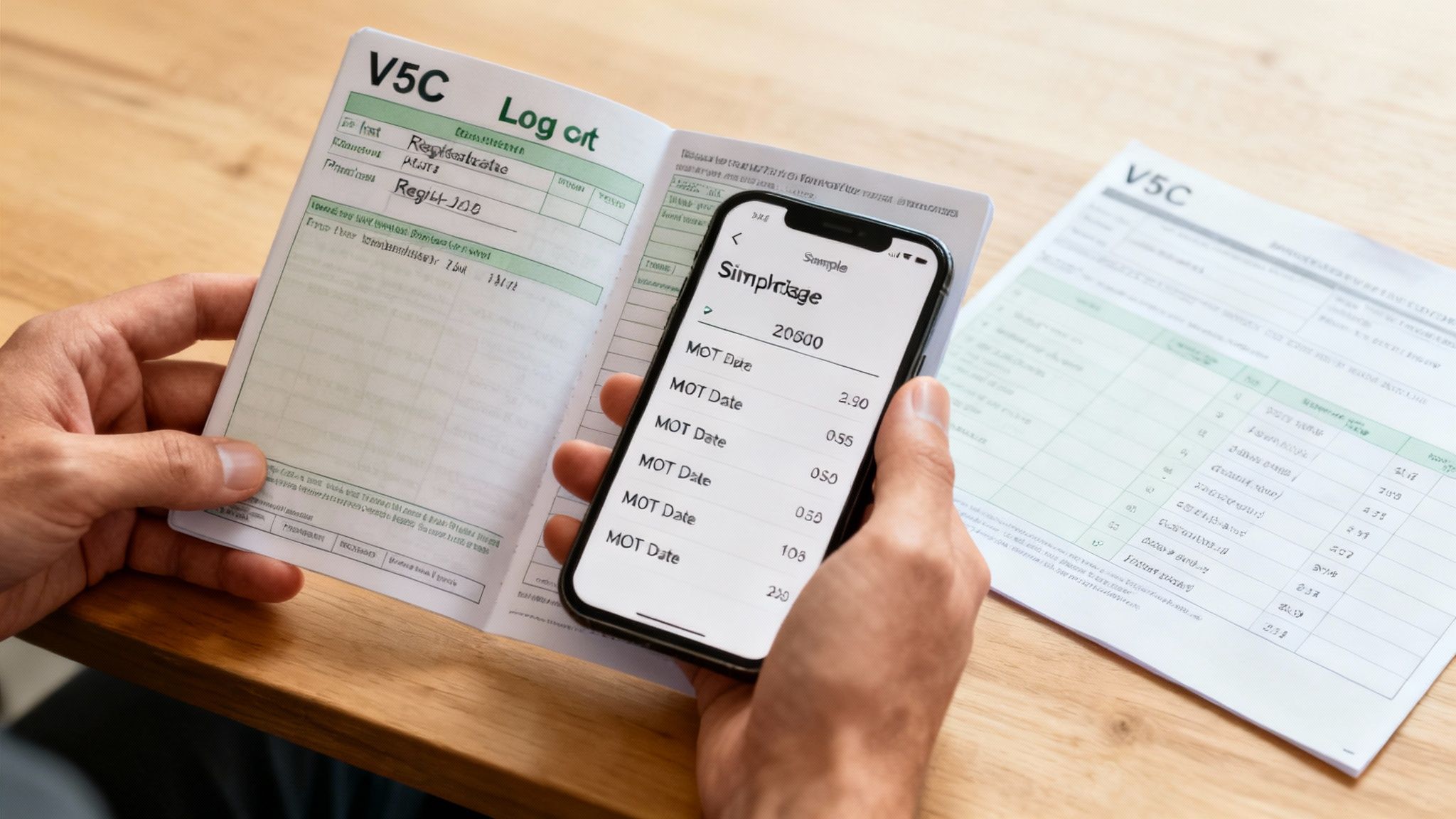
To get it right, you need to be precise from the get-go. A rough guess at the car’s age won’t cut it. You need the exact date of first registration, which you’ll find on the V5C logbook. This little detail lets you calculate the vehicle's true age down to the day, making sure your starting point is as solid as possible.
The Manual Calculation Process
Running the numbers yourself is a great first step when you're sizing up a car. It gives you a baseline figure to work with and helps you spot anything that seems immediately off.
First, find the total mileage straight from the vehicle's odometer. Next, determine the exact age by looking up the date of first registration on the V5C. Calculate the car’s age in years, using decimals for parts of a year (so a five-and-a-half-year-old car is 5.5). Finally, do the sum: Total Mileage ÷ Exact Age = Average Annual Mileage.
This calculation gives you a number, but it's a number without a story. It doesn’t tell you how or when those miles were added, and that’s where the real detective work begins.
Why Context Is Everything
A simple average on its own can be misleading. The crucial next step is to pull up the car’s official MOT history and compare it to the figure you just calculated. You're looking for a consistent, believable pattern.
Any sudden drops in mileage, long periods where the odometer barely moved, or huge jumps between tests are massive red flags. These discrepancies could point to anything from odometer tampering – known as ‘clocking’ – to the car being off the road for an extended time, which brings its own set of potential maintenance problems. Digging into the MOT and service records is non-negotiable. For a deeper dive, our guide on how to check service history in the UK has some great tips.
A manual calculation gives you a number. A verified history gives you the truth. Without cross-referencing against trusted data, the average annual mileage is just an assumption.
While this manual process is a useful skill, it's also time-consuming and leaves room for error. This is exactly where the AutoProv platform comes in. Our service automates the entire verification, instantly cross-referencing thousands of data points to flag discrepancies a manual check could easily miss. It ensures the mileage figure you’re relying on isn’t just a calculation, but a verified fact.
The Truth About High vs Low Mileage Cars

It’s a classic belief in the motor trade: lower mileage always equals a better car. But in reality, things are far more nuanced than that. The number on the odometer is just that—a number. The real story, the one that truly determines a vehicle’s health and value, is how those miles were clocked up.
Think about it. A high-mileage car that’s spent its life cruising on motorways has had a relatively easy time. Compare that to a low-mileage car that’s only ever done the school run in stop-start city traffic. That daily grind puts immense strain on the engine, gearbox, and brakes, causing wear and tear the odometer simply can’t show you.
The truth isn't in the mileage figure itself, but in the combination of mileage, maintenance, and the type of driving it has done. A car showing 100,000 miles with a perfect, fully documented service history is often a much smarter buy than one with just 30,000 miles and a patchy, questionable past.
Looking Beyond the Odometer
Getting your head around this distinction is absolutely vital for making smart buying decisions. It’s all about shifting your focus from a single number to the complete picture of the vehicle's life. This is precisely why a comprehensive provenance report is no longer a 'nice-to-have'—it's an essential part of your due diligence.
A thorough report peels back the layers, revealing the entire story. Key things to look for include service records confirming regular maintenance, the MOT history to track its condition and mileage build-up over time, and the ownership trail for clues as to how the vehicle was likely used.
A low odometer reading can create a false sense of security. True confidence comes from verified data that confirms the mileage is not only low but also backed by a history of consistent care and legitimate use.
The Power of a Complete Provenance Check
This is where a service like AutoProv becomes indispensable. We don’t just check the average annual mileage. Our platform is built to dig deep into a vehicle's history, uncovering the full story that the dashboard can't tell you. By pulling together service records, MOT history, and the complete ownership trail, we provide the context you need to make an informed judgement.
This level of detail allows you to accurately size up the true condition of any vehicle, no matter what the odometer says. It helps you spot that well-maintained, high-mileage workhorse that represents fantastic value, and just as importantly, avoid the low-mileage lemon with a hidden history of neglect.
Of course, before finalising any purchase, you need to get hands-on. Our guide on creating your ultimate used car inspection checklist can help you cover all the physical bases.
Ultimately, AutoProv empowers you to understand a vehicle's true condition, not just its mileage, ensuring every car you consider is judged on verified facts, not assumptions.
Your Top Average Mileage Questions Answered
When you're digging into a car's history, the mileage often throws up more questions than answers. Let's tackle some of the most common ones that crop up, so you can get a clearer picture of what those numbers on the dashboard really mean.
Does The UK Average Annual Mileage Apply To Electric Cars?
This is a great question, and the honest answer is: not quite, but it’s getting there. The core idea is the same – mileage equals wear – but electric vehicles (EVs) have danced to their own tune for a while.
Early data showed many EVs were used as second cars for shorter, local trips and daily commutes. This often resulted in a lower average annual mileage than, say, a diesel saloon munching up motorway miles.
But things are changing fast. As the UK’s charging network gets better and bigger, and those initial worries about running out of juice fade away, we're seeing EV usage patterns start to look a lot more like their petrol and diesel counterparts.
When looking at an EV, you have to think beyond just the odometer. Things like battery health and charging history are just as important. A service like AutoProv can give you the full story, looking at the whole picture of an EV’s life, not just the miles it's covered.
How Can I Tell If A Car's Mileage Has Been Tampered With?
Spotting a 'clocked' car just by looking at it is nearly impossible these days. The old-school mechanical odometers that could be physically wound back are long gone. Modern digital dashboards don't leave any tell-tale signs, which makes diving into the car's data history your best weapon.
The most effective starting point is to scrutinise the car's records for anything that doesn't add up.
A crucial first step is to check the car's MOT history online – it's public information. You're looking for illogical jumps or drops. Did the mileage suddenly go down between tests? Did it barely move for two years and then shoot up? These are huge red flags. Cross-reference this with the service records, which should also have mileage logged at each visit.
Any major disagreement between the MOT history and the service book is a serious cause for concern. For genuine peace of mind, a professional provenance check is your strongest line of defence.
This is exactly what AutoProv was built to do. Our platform automatically cross-references data from multiple trusted sources, instantly flagging anomalies that suggest mileage fraud. It offers a level of security that you simply can't achieve by manually sifting through paperwork.
Is A Car With Very Low Mileage Always A Good Buy?
Not necessarily. It's easy to see a low number and think "less wear, great deal!", but a car that’s spent most of its life sitting still can be hiding a different set of problems.
Think of it like an athlete who suddenly stops training. Things start to seize up. For a car, this can mean degraded rubber seals and hoses, tyres with flat spots, a failing battery, and degraded fluids like oil and brake fluid. On top of all that, an unusually low odometer reading can sometimes be a sign that the car has been clocked.
The real trick is to understand the story behind the number. A detailed vehicle history check, like the one from AutoProv, doesn't just show you a number; it verifies how that mileage has built up over the car's lifetime. It gives you access to service records, helping you figure out if the low mileage is genuine and, more importantly, if the car has been looked after properly despite its lack of use.
This is how you make sure you’re buying a genuinely well-preserved vehicle, not just one with a pretty number on the dash.
Frequently Asked Questions
AI-Generated Content Notice
This article was created with the assistance of artificial intelligence technology. While we strive for accuracy, the information provided should be considered for general informational purposes only and should not be relied upon as professional automotive, legal, or financial advice. We recommend verifying any information with qualified professionals or official sources before making important decisions. AutoProv accepts no liability for any consequences resulting from the use of this information.
From our AI insights
- Decoding Mileage: Impact of Seasonal Driving Patterns
Explore how seasonal driving impacts your car's mileage verification.
- Tackling Mileage Fraud in Electric Vehicles
Explore how motor traders can prevent mileage fraud in electric vehicles using advanced techniques.
- Mileage Verification for Hybrid Cars: A 2024 Update
Explore the nuances of mileage verification for hybrid vehicles in 2024 with our expert guide.
Related Articles

Understanding Vehicle Mileage Importance
Discover the critical role of accurate mileage in vehicle provenance and how AutoProv can safeguard your purchase.
Car Mileage Discrepancy Explained: A Guide for UK Motor Traders
When it comes to a car’s history, its mileage record should tell a simple, straightforward story: the number always goes up. A mileage discrepancy is what happens when that story suddenly does not make sense.

A UK Trader's Guide to the DVLA Mileage Check
For anyone in the UK motor trade, running a DVLA mileage check is an absolute must-do before buying any vehicle. It’s your official window into a car’s mileage history, pulled directly from its annual MOT tests. Think of it as your first line of defence against mileage fraud—a stubborn problem that plagues thousands of cars on the used market. This simple check gives you a crucial baseline for a vehicle's authenticity and, ultimately, its value.
Published by AutoProv
Your trusted source for vehicle intelligence