
For UK motor traders, the 6 seater car market is a distinct opportunity, drawing in clients from growing families to private hire firms. These vehicles are specialised assets, and buying them for stock demands a forensic look into their history to protect margins and reputation. A superficial vehicle check is insufficient for assessing the true condition and risk profile of these assets.
The Trader's Opportunity in 6 Seater Cars
The market for 6 seaters offers consistent, purpose-driven demand. Unlike standard family cars, these vehicles are acquired for specific functions, which often leads to unique wear patterns and, crucially, hidden histories that can expose an unwary dealer to significant risk. Success in this segment is not about volume; it's about acquiring the right stock with a clean, verifiable past.
The key appeal for any motor trade professional is sourcing a vehicle that commands strong retail interest, provided its condition and history are sound. However, the risks are equally high. A 6 seater presented as a low-mileage family car could have a history as a hard-working private hire vehicle—a fact a basic check might completely miss. This undisclosed history invalidates its valuation and erodes profit margins.
Key Considerations Before Acquisition
When evaluating a 6 seater for stock, the assessment must go beyond a standard walkaround. The vehicle's real story is in its vehicle provenance—the narrative told by its ownership history. A few key areas demand closer scrutiny:
- Buyer Profiles: Understand the typical end-user. Are they large families or airport transfer operators? This knowledge helps anticipate likely wear and tear and identify potential mechanical stress points before they become liabilities.
- Unique Wear Patterns: Six-seat layouts, such as the Honda FR-V's 3+3 configuration, wear differently. Inspect every seat, folding mechanism, and rear cabin trim for evidence of heavy or commercial use.
- Provenance Risks: These vehicles are prime candidates for an undisclosed commercial past. A robust vehicle history check UK traders can rely on must analyse ownership cycles and usage patterns, not just officially recorded data points.
To focus your assessment, the following table breaks down the critical areas to evaluate when considering these vehicles for inventory.
Key Stocking Considerations for 6 Seater Vehicles
Consideration Area Key Focus for Dealers Potential Risk Factor Usage History Has it been used for private hire, taxi, or fleet purposes? Undisclosed commercial use leads to accelerated wear and tear. Interior Condition Check all six seats, seatbelts, and folding mechanisms. Damage to rear seats and trim indicates heavy family or commercial use. Mechanical Health Pay close attention to clutch, gearbox, suspension, and brakes. High mileage from taxi work can lead to imminent costly repairs. MOT History Scrutinise advisories for recurring issues. Persistent advisories can signal neglect or an underlying fault. Valuation Impact How does its specific history affect its true market value? A hidden past as a taxi can slash resale value significantly. Each of these points represents a potential pitfall that can turn a profitable acquisition into a liability. A detailed, trade-focused report is the first line of defence against such risks.
When pricing a 6 seater, it is imperative to weigh every factor shaping its real-world worth. This includes its history and the impact of any previous damage, making it vital to be familiar with concepts like understanding after-accident car value. This forensic approach is non-negotiable. An AutoProv report, for instance, delivers the deep trade vehicle intelligence needed to identify these risks early. Further guidance on finding quality stock is available in our guide on sourcing hubs for cars good on fuel. This article provides a framework to assess 6 seater cars as valuable but potentially high-risk assets.
Decoding the 6 Seater Market Segments

To profit from the 6 seater cars UK market, a trader must understand the distinct segments these vehicles occupy. Each category attracts a different buyer profile, depreciates at a unique rate, and carries a different set of risks. A one-size-fits-all appraisal methodology is a strategy for a bad buy.
Success in this sector requires a granular understanding of the available stock, from quirky MPVs and high-end SUVs to commercial-derived carriers.
The Niche MPV Segment
This segment includes unconventional designs like the Fiat Multipla or Honda FR-V. While often overlooked, these cars have a dedicated following among buyers who prioritise practicality over aesthetics. For a trader, they represent an interesting but volatile opportunity.
Their appeal lies in clever interior packaging, but their depreciation curves can be steep. A crucial part of any appraisal is a thorough mileage check UK traders can trust, as these cars are often used as family workhorses for school runs and long trips.
- Typical Ownership: Families often hold onto them for extended periods, so a short ownership cycle could be a red flag for underlying mechanical issues.
- Common Issues: Be vigilant for excessive wear on interior plastics and trim, particularly complex folding seat mechanisms. Electrical faults are also common on older, high-mileage examples.
- Trade Insight: Condition is paramount. A low-mileage, well-maintained example can command a premium from the right buyer, but a tired one is difficult to retail at any price.
The Premium SUV Segment
At the opposite end of the market are premium SUVs with six-seat layouts, such as certain specifications of the Volvo XC90 or Tesla Model X. These vehicles command higher prices and attract more affluent buyers, but the financial exposure for the dealer is proportionally greater.
The vehicle provenance of these SUVs is critical. A flawless history is non-negotiable for achieving a strong retail margin. Buyers in this segment expect perfection, and any suggestion of a troubled past—from undisclosed repairs to data discrepancies—can terminate a sale instantly.
A premium SUV's value is intrinsically linked to its history and condition. Any discrepancy found during a dealer vehicle check can create significant financial exposure, making a deep-dive analysis essential before committing capital.
Appraising these vehicles requires a keen eye for signs of hard family use disguised by valeting. Check for wear on expensive leather upholstery, damage to alloy wheels, and ensure all high-specification electronic features are fully functional. The cost of rectifying faults on these models can eliminate the entire profit margin.
The Commercial-Derived Carrier
This segment, populated by vehicles like the Ford Tourneo Custom or Vauxhall Vivaro Life, is a mainstay of the private hire and taxi industry. Their durability and space make them ideal for commercial work, which is precisely why they represent a major area of motor trade risk.
Many of these vehicles enter the used market with their commercial history obscured, presented as one-owner family transport. A basic check may not flag this, but the mechanical reality will be one of exceptionally high wear on the engine, gearbox, and suspension.
- Key Red Flags: Look for evidence of removed taxi equipment (holes in the dashboard), excessive wear on the driver's seat and in the rear cabin, and unusually high mileage for the vehicle's age.
- Ownership Patterns: A history showing a leasing company or business name, followed by a very short period of private ownership, is a classic indicator that a de-fleeted commercial vehicle is being moved into the retail market.
Navigating this segment requires more than a simple data check; it demands genuine trade vehicle intelligence. Knowing these nuances is vital. This is why it is crucial for traders to rely on expert analysis and deep provenance checks to make informed buying decisions. For more sourcing strategies, consult our guide on the best platforms to find used cars in 2025.
Assessing Running Costs and Resale Margins
The acquisition price is only the starting point. For any motor trade professional, a vehicle's true profitability is determined over its entire lifecycle in stock. When sourcing 6 seater cars UK, a firm grasp of running costs and likely resale margins is fundamental to protecting the bottom line.
These figures directly influence a car's desirability on the forecourt and, critically, its sales velocity. A correct analysis enables accurate pricing, confident negotiation, and the ability to provide retail customers with advice that builds trust. It is the difference between a fast, profitable sale and a unit that ties up capital for months.
Breaking Down the Key Running Costs
Beyond fuel consumption, several key expenses determine the true cost of owning a 6 seater. These are precisely the calculations a savvy retail buyer will perform, and a dealer's ability to address them is a powerful sales tool.
Three primary factors come into play:
- Vehicle Excise Duty (VED) Bands: Larger 6 seaters, particularly older diesel SUVs, often fall into higher VED bands. This significant annual cost can deter budget-conscious families.
- Insurance Group Ratings: Their size, passenger capacity, and potentially higher repair costs mean these vehicles frequently occupy higher insurance groups. For some demographics, the insurance premium alone can be a deal-breaker.
- Real-World Fuel Economy: Published MPG figures rarely reflect the reality of a fully laden vehicle. While diesel models were historically favoured, the expansion of ULEZ zones and the rise of efficient hybrids are rapidly shifting buyer priorities.
When calculating a vehicle's potential margin, all reconditioning costs must be factored in, including often-overlooked expenses like the cost of duplicating a car key if one is missing.
Depreciation and Resale Value Insights
Depreciation is the single largest cost of ownership for a retail buyer and the greatest threat to a dealer's margin. In the niche market of 6 seater cars, values can be volatile, influenced heavily by the vehicle's segment and its reputation for reliability.
A strong used car history report is the foundation of a strong resale value. For 6 seaters, where the risk of a hidden commercial past is high, demonstrating clean vehicle provenance is not a luxury—it’s essential for achieving the best possible forecourt price.
Workhorse MPVs tend to depreciate sharply from new but can reach a value floor where they become practical, affordable options for large families. At that point, their value is almost entirely dependent on condition and a verifiable service history.
Conversely, premium SUVs with six seats often retain their value better initially, supported by brand prestige and high specifications. However, they are far more sensitive to market fluctuations and any hint of a questionable past. A single red flag on a dealer vehicle check can cause their value to plummet, exposing the business to a significant loss. Pricing these correctly demands a deep dive into their background, a topic we cover in our guide to mastering accurate vehicle pricing.
Pinpointing specific trends in this segment is challenging, as broad market data often lacks the required granularity. This is where specialised trade vehicle intelligence becomes crucial for navigating niche markets. An AutoProv report provides deeper context, identifying ownership patterns and risk signals that are vital for forecasting a vehicle’s true residual value.
Uncovering the Hidden Risks in a Vehicle's Past
The versatility of a 6 seater car often means it has lived a harder life than a typical family vehicle. This creates a minefield of hidden issues that a standard provenance-style check can easily miss, leaving a business exposed to financial loss and reputational damage.
For the motor trade, risk management is not just about identifying a write-off; it is about interpreting the subtle narrative within a car's history. The real intelligence lies in the patterns—ownership cycles, mileage anomalies, and usage indicators—that reveal a vehicle's true past, not just its recorded one. An 'all clear' report can often conceal the most expensive problems.
The Undisclosed Commercial History
One of the most common and costly risks with 6-seaters is an undisclosed history as a taxi or private hire vehicle. These cars accumulate extreme mechanical wear at an accelerated rate yet are often presented to the trade as low-use family transport.
This hidden commercial life introduces a predictable set of problems:
- Extreme Mechanical Wear: Constant stop-start driving, high mileage, and heavy passenger loads place immense stress on the engine, gearbox, suspension, and brakes. A vehicle that appears solid could be weeks away from a catastrophic and costly failure.
- Significant Mileage Discrepancies: It is common for these vehicles to have their mileage altered before sale. A reliable mileage check UK traders can use must be more than a single number; it needs to cross-reference MOT and service records to flag inconsistencies.
- Interior and Cosmetic Concealment: Professional valeting can hide many cosmetic issues, but it cannot erase all evidence. Look for giveaways such as screw holes in the dashboard from removed equipment, excessive wear on the driver’s seat bolster, and damage to plastics in rear passenger areas.
Such a history completely alters a car's valuation. Retailing a former taxi without disclosure is a direct route to customer complaints and regulatory scrutiny. This is why a deep vehicle history check UK traders use is non-negotiable.
Decoding Short-Term Ownership Cycles
Beyond a commercial past, the ownership pattern itself is a major red flag. A vehicle that has changed hands multiple times in a short period should trigger immediate caution. A standard check may list previous keepers, but proper trade vehicle intelligence investigates the context.
A rapid succession of owners often signals a persistent, hard-to-diagnose fault that previous keepers have failed to fix. This is a classic case of a problem car being passed from one unsuspecting owner to the next, and it could be heading for your forecourt.
This pattern is a critical piece of the vehicle provenance puzzle. It suggests each owner encountered a problem, found it too expensive or complex to resolve, and chose to dispose of the vehicle quickly. Without identifying this pattern, a dealer risks acquiring a car with a recurring electrical issue, an intermittent engine fault, or a DPF problem that is about to become their liability.
A checklist of common risk indicators is an invaluable tool. Before committing, review these potential signals to ensure no crucial information has been missed.
Common Risk Indicators for 6 Seater Vehicles
Risk Signal What to Investigate Why It Matters for Resale Multiple Keepers in < 2 Years Dive into MOT advisories for recurring issues. Ask the seller direct questions about why they're selling so soon. A classic sign of a "problem car" being passed around. It spooks retail buyers and makes the vehicle hard to shift. Gaps in Service History Scrutinise the service book. Are there long periods with no stamps? Cross-reference mileage with MOTs to see how far it travelled between services. Indicates potential neglect and missed essential maintenance, leading to premature wear and a lower valuation. Inconsistent Mileage Readings Compare every available record: MOT history, service invoices, and previous sales listings. Look for sudden drops or stagnant mileage. This is a huge red flag for clocking. A clocked car is worth significantly less and is a legal minefield to retail. Previous Taxi/PHV Licence Check for specific licensing markers on the V5C and run a specialised check. Look for physical signs like filled dashboard holes. These vehicles have endured exceptionally hard lives. Their real mechanical condition is often far worse than their appearance suggests. Ultimately, interpreting these patterns provides far more valuable insight than a basic data report. An advanced used car history report from a provider like AutoProv is designed to highlight these anomalies. By analysing the duration between keeper changes, our platform helps identify vehicles that are being flipped rapidly—a key signal of underlying motor trade risk.
Spotting these patterns is crucial. For instance, when sourcing stock, a detailed check of a vehicle's background can prevent costly mistakes. Learn more about how to do this by using our guide on conducting a free UK VIN number check to gather initial information. It helps you sidestep the problem stock and protect your margins.
Why Advanced Provenance Checks Are Non-Negotiable
When stocking a niche segment like 6 seater cars UK, relying on the same basic checks as the general public is a flawed strategy. A standard data report can confirm details like finance status but often misses the critical context—the narrative between the data points. It is this hidden narrative that can impact the bottom line.
A smarter, more sophisticated approach to vehicle intelligence is therefore essential. A simple 'all clear' can mask a history of punishing commercial use, a rapid succession of owners frustrated by a recurring fault, or developing mechanical issues. These critical information gaps must be filled before acquisition.
Moving Beyond Standard Data Points
A basic check reports what has been officially recorded. An advanced vehicle provenance analysis, in contrast, interprets patterns within that data to reveal what may have been deliberately obscured. It connects data points that most checks do not correlate.
This deeper level of analysis is focused on flagging the inconsistencies that signal serious motor trade risk. It is the difference between seeing a list of previous keepers and understanding that a vehicle changing hands three times in 18 months is a significant red flag for underlying problems.
For a motor trader, the most expensive mistake is often not what's on the report, but what's missing from it. Advanced checks are built to highlight these omissions and contextual gaps, turning raw data into actionable decision support.
Armed with this level of insight, a dealer can ask more targeted and informed questions during a vehicle viewing. It provides the evidence needed to justify a lower offer or, more importantly, to walk away from a vehicle that could damage profitability and reputation.
Identifying Critical Risk Signals
A trade-grade analysis excels at spotting patterns that basic checks are not designed to identify. By cross-referencing multiple, often exclusive, data sources, it builds a much clearer picture of a vehicle's true history.
Key areas where this provides an advantage include:
- Rapid Resale Patterns: The system can flag short-term ownership cycles that are a classic indicator of a persistent fault being passed from one owner to the next. This is a hallmark of a problem vehicle to be avoided.
- Mileage Anomaly Detection: By comparing MOT records, service history, and previous sales listings, the type of mileage check UK traders require can spot discrepancies pointing to potential clocking far more effectively than a simple timeline.
- Undisclosed Commercial Use: Analysing ownership timelines alongside MOT data—such as frequent advisories for tyres and brakes—can quickly highlight a usage pattern more consistent with a private hire vehicle than a low-mileage family car.
This forensic approach is vital for any vehicle but is especially crucial for versatile 6 seaters that are prime candidates for a hard working life.
Ultimately, this level of intelligence is a crucial decision-support tool. An AutoProv used car history report is specifically designed to deliver this deeper context. You can learn more about what our trade-focused vehicle provenance report includes and how it helps dealers buy with more confidence, sidestep problematic stock, and price vehicles based on their true, verified history.
A Framework for Smarter Buying Decisions
Achieving consistent profit on 6 seater cars in the UK is not a matter of luck. It is the result of a disciplined, intelligence-led approach to sourcing and appraisal. A solid framework that combines physical inspection with deep data analysis is essential for identifying genuine value and avoiding the hidden risks these vehicles often conceal.
The process begins with a physical check but must go much deeper than a brief walkaround. The physical inspection serves to verify the narrative presented by the vehicle's documentation and history report.
The Conclusive Assessment Checklist
Before committing capital, every vehicle requires a multi-layered assessment. This process is about building a complete, accurate picture of the vehicle’s true condition and history to enable confident valuation.
- Physical Inspection Focus: Forensically inspect the third-row seat mechanisms, which are complex and prone to wear. Check for smooth operation, secure latching, and signs of excessive use. Scrutinise interior trim, especially around rear doors and the boot, for damage indicative of heavy family or commercial use.
- Document Verification: Cross-reference the V5C against the service history and every MOT certificate. Ensure all details align perfectly. Any discrepancy, no matter how small, is a red flag that requires a full explanation.
- Advanced Provenance Report: This is the non-negotiable final step. A professional used car history report from a provider like AutoProv uncovers patterns that basic checks miss. It analyses ownership cycles, flags mileage anomalies, and identifies tell-tale signs of undisclosed use—providing the critical trade vehicle intelligence needed to buy safely.
This decision tree illustrates the difference between a cursory glance and a professional assessment.
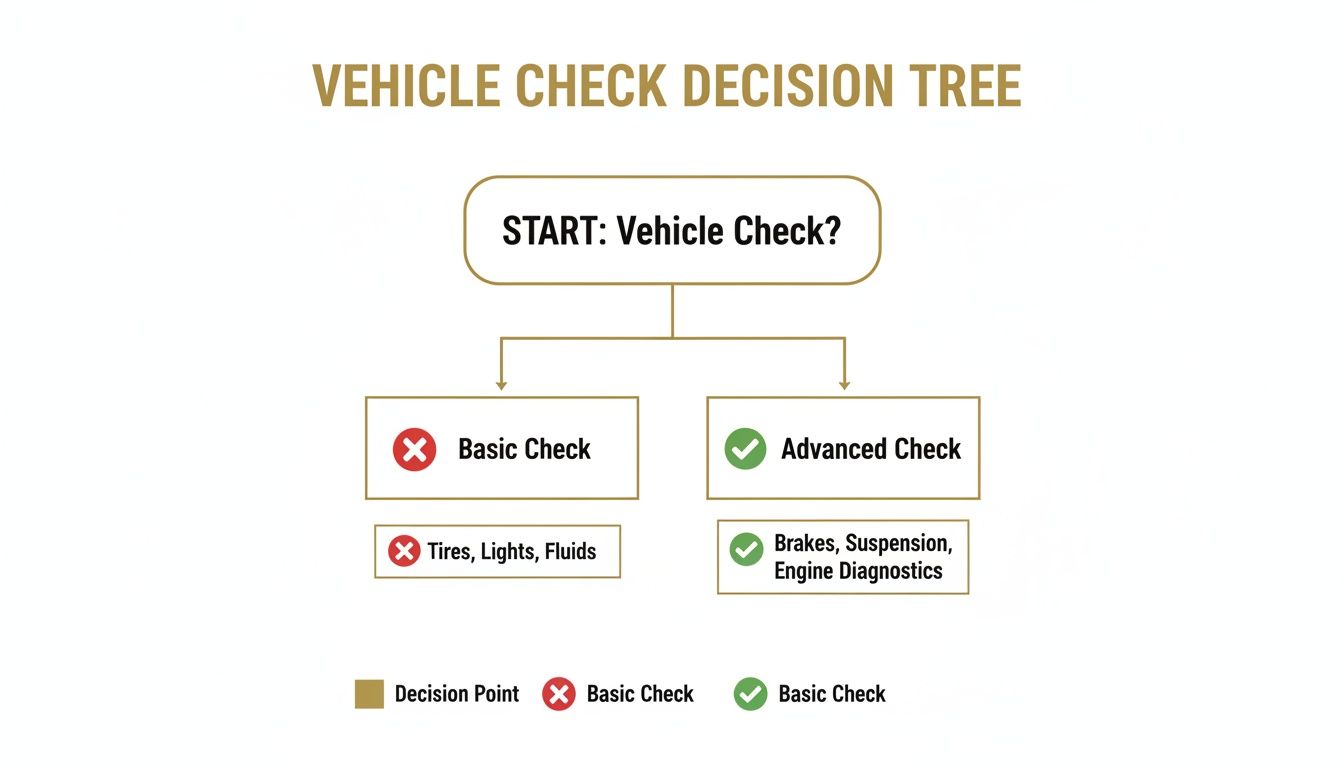
As the flowchart shows, a basic check provides a starting point, but an advanced provenance analysis is what uncovers the deeper risks that impact a vehicle’s value and safety.
The core principle is simple: lasting success in this niche is built on using superior intelligence to mitigate motor trade risk. It is about transitioning from speculative acquisitions to data-driven, confident investments.
By integrating this disciplined framework into the buying process, a dealer changes their operational model. They are no longer just buying a car; they are acquiring an asset with a verified history and a predictable, profitable future. This methodology enables the acquisition of reliable stock, strengthens market position, and protects the bottom line.
Frequently Asked Questions for Motor Traders
Sourcing and valuing 6 seater cars in the UK presents a unique set of challenges that extend beyond a standard appraisal. Navigating this specialist market requires answers to specific, trade-focused questions.
What Is the Biggest Hidden Risk with 6 Seaters?
The single greatest risk is an undisclosed commercial past. A significant number of 6-seaters, particularly van-derived models, have been used as taxis, private hire vehicles, or airport shuttles. While valeting can hide cosmetic wear, the extreme mechanical stress is permanent.
A standard check may not identify this history, but the engine, gearbox, and suspension will be in a far worse state than a privately owned equivalent. A comprehensive vehicle provenance check is the only effective defence. It is essential for uncovering commercial history, which fundamentally alters the vehicle’s true market value and acquisition price.
Are Premium 6 Seater SUVs a Safer Bet?
Not necessarily. While high-end models like a Volvo XC90 often come with a more complete service history, they present their own set of risks. The primary danger is significant financial exposure due to the high cost of repairs for their complex electronics, air suspension systems, and interior components.
Any gap in the used car history report or evidence of substandard repair work can make them difficult to retail profitably. A buyer in this segment expects perfection, and even a minor historical issue can terminate a deal. This makes a thorough dealer vehicle check absolutely essential.
How Can I Spot a Potential Mileage Discrepancy?
A reliable mileage check UK traders can use involves more than glancing at the last MOT. It requires a forensic cross-referencing of the entire MOT history, the service book, and any available online sales listings to identify inconsistencies.
A classic red flag is a long period of stagnant mileage between MOTs, followed by a sudden, sharp increase. This often points to a vehicle being run hard for commercial work (with in-house servicing) before being prepared for retail sale with an adjusted mileage reading.
Why Do Ownership Patterns Matter So Much?
The pattern of ownership can be more revealing than the number of keepers. Rapid resale—where a vehicle changes hands multiple times in a short period, such as three owners in 18 months—is a primary indicator of motor trade risk.
This churn frequently points to a persistent, hard-to-diagnose fault that previous owners have been unable or unwilling to fix. By analysing the duration and sequence of ownership, a dealer can identify these ‘problem’ vehicles before they become a liability on the forecourt.
At AutoProv, we provide the advanced trade vehicle intelligence you need to answer these questions with total confidence. Our reports are built specifically for the UK motor trade, focusing on uncovering the ownership patterns, mileage anomalies, and hidden histories that standard checks just don't see. Secure your stock and protect your margins by making smarter, data-driven buying decisions. Find out more at https://autoprov.ai.
Frequently Asked Questions
AI-Generated Content Notice
This article was created with the assistance of artificial intelligence technology. While we strive for accuracy, the information provided should be considered for general informational purposes only and should not be relied upon as professional automotive, legal, or financial advice. We recommend verifying any information with qualified professionals or official sources before making important decisions. AutoProv accepts no liability for any consequences resulting from the use of this information.
From our AI insights
- Auction Pitfalls: Avoiding Costly Mistakes
Navigate UK car auctions with confidence by avoiding finance, write-off, and mileage risks.
- Mastering Paint Code Checks: Detecting Hidden Car Repairs
Discover how to use paint code verification to identify hidden car repairs and ensure a smarter purchase.
- UK Part-Exchange Checks: Protecting Dealer Margins
Explore essential part-exchange checks for UK dealers to safeguard profit margins, including provenance and finance verification.
Related Articles

Your Ultimate Guide to Buying a Used Car in the UK
Navigate the UK used car market with confidence using our comprehensive buying guide. Tips, checks, and AutoProv Provenance insights included.

Difference Between MOT and Service: What You Need to Know
An MOT is a mandatory legal inspection that every car on UK roads needs to pass.Think of it as the government's way of ensuring your vehicle meets the absolute minimum safety and environmental standards to be considered roadworthy. A service, on the other hand, is a completely different beast. It's the proactive maintenance routine recommended by the people who built your car, designed to keep it running smoothly and catch problems before they start. In short, an MOT is a pass-or-fail exam required by law. A service is a comprehensive health plan for your car.

Your Ultimate Used Car Inspection Checklist
A solid used car inspection checklist is the single most powerful tool you have to avoid buying a lemon. It gives you a methodical way to look past the shiny paint and assess a car's real condition, helping you spot hidden problems and get a fair price before you shake hands on the deal.
Published by AutoProv
Your trusted source for vehicle intelligence