For any seasoned pro in the motor trade, a free UK VIN number check is the go-to first step. It's the quick, initial glance you need to confirm a vehicle's basic identity – think make, model, colour, and MOT status – pulled straight from DVLA records. It's an absolutely essential, no-cost tool for vetting cars on the fly, and AutoProv provides this basic check instantly.
The True Value of a Free UK VIN Number Check
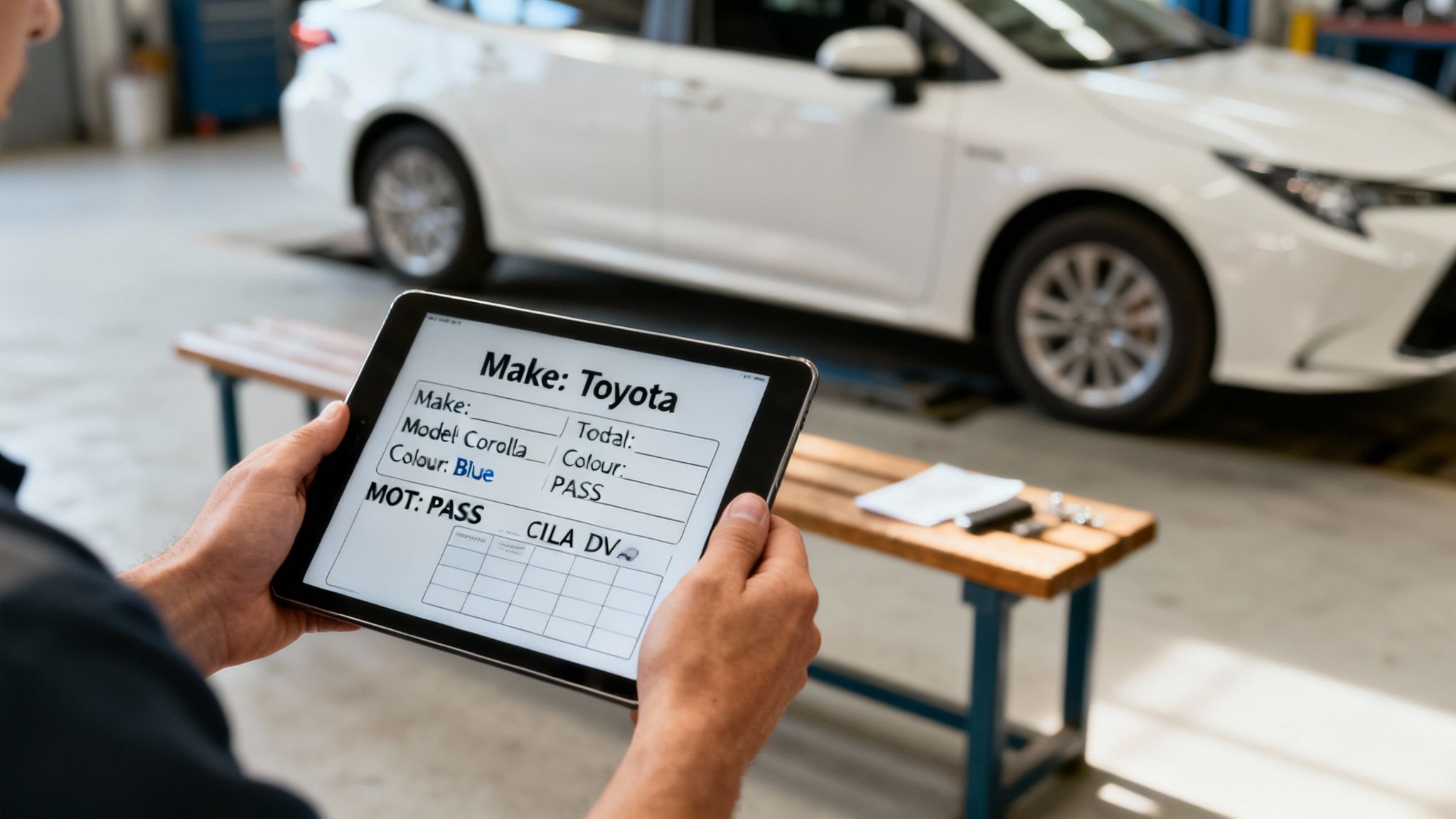
In the fast-moving world of buying cars, you need to be quick and accurate. Whether you're standing in a noisy auction hall or sizing up a part-exchange on your own forecourt, you need the basic facts, and you need them now. This is precisely where a free check from a provider like AutoProv shines.
Think of it as the vehicle's business card. It gives you the official, top-line information you need to make that first call. You can instantly confirm that the car you're looking at is the car the DVLA thinks it is, which is the absolute bedrock of any proper vehicle check.
What You Can Achieve with a Free Check
A free VIN check is the perfect filter for your potential stock. It lets you instantly weed out cars with glaring problems, like a dodgy MOT history or obvious data mismatches, without spending a single penny. It’s all about efficiency.
With a quick search, you can see:
- Basic Vehicle Identity: The correct make, model, colour, and engine size.
- Key Dates: Its date of first registration and year of manufacture.
- MOT and Tax Status: Up-to-date MOT status, expiry date, and current tax details.
- Environmental Data: CO2 emissions figures, crucial for understanding running costs and ULEZ compliance.
This data gives you a snapshot, a solid starting point for your appraisal. But this is exactly where the usefulness of a free check ends and the real risk to your dealership begins. If you want a deeper dive into what a VIN is and how it works, have a look at our comprehensive guide to vehicle checks with a VIN number.
The Hidden Dangers Behind the Basics
While that business card tells you the car's name, it says nothing about its past troubles or hidden liabilities. A free check is fundamentally limited because it only shows publicly available data. It can't warn you about the biggest financial and legal threats hiding under the surface.
A free check confirms what a car is, but a professional report reveals what a car has been through. This distinction is the difference between a smart purchase and a costly mistake.
Crucially, a free check will never flag outstanding finance, a history as an insurance write-off, or if the vehicle is currently listed as stolen on the Police National Computer (PNC). Relying only on the basics is like buying a house after just glancing at the front door; the real value and the serious problems are always inside.
This is where you need to move beyond the surface-level view to protect your investment, your reputation, and your bottom line with the professional-grade intelligence you get from an AutoProv.ai report.
What Free Vehicle Checks Reveal—and What They Conceal
So, let's get down to brass tacks. What exactly does a free UK VIN number check tell you? Think of it as peeling back the very first layer of a car's story. It’s a good start, for sure, but knowing its limits is absolutely critical if you want to avoid some very expensive mistakes.
A free check simply pulls in the data that’s already publicly available, mostly from government sources like the DVLA and DVSA. This gives you a quick, official snapshot of the vehicle.
The Surface-Level Data You Can See
When you run a free vehicle check, you get the top-line stats. This is your first line of defence, perfect for a quick verification to see if the car in front of you actually matches its paperwork.
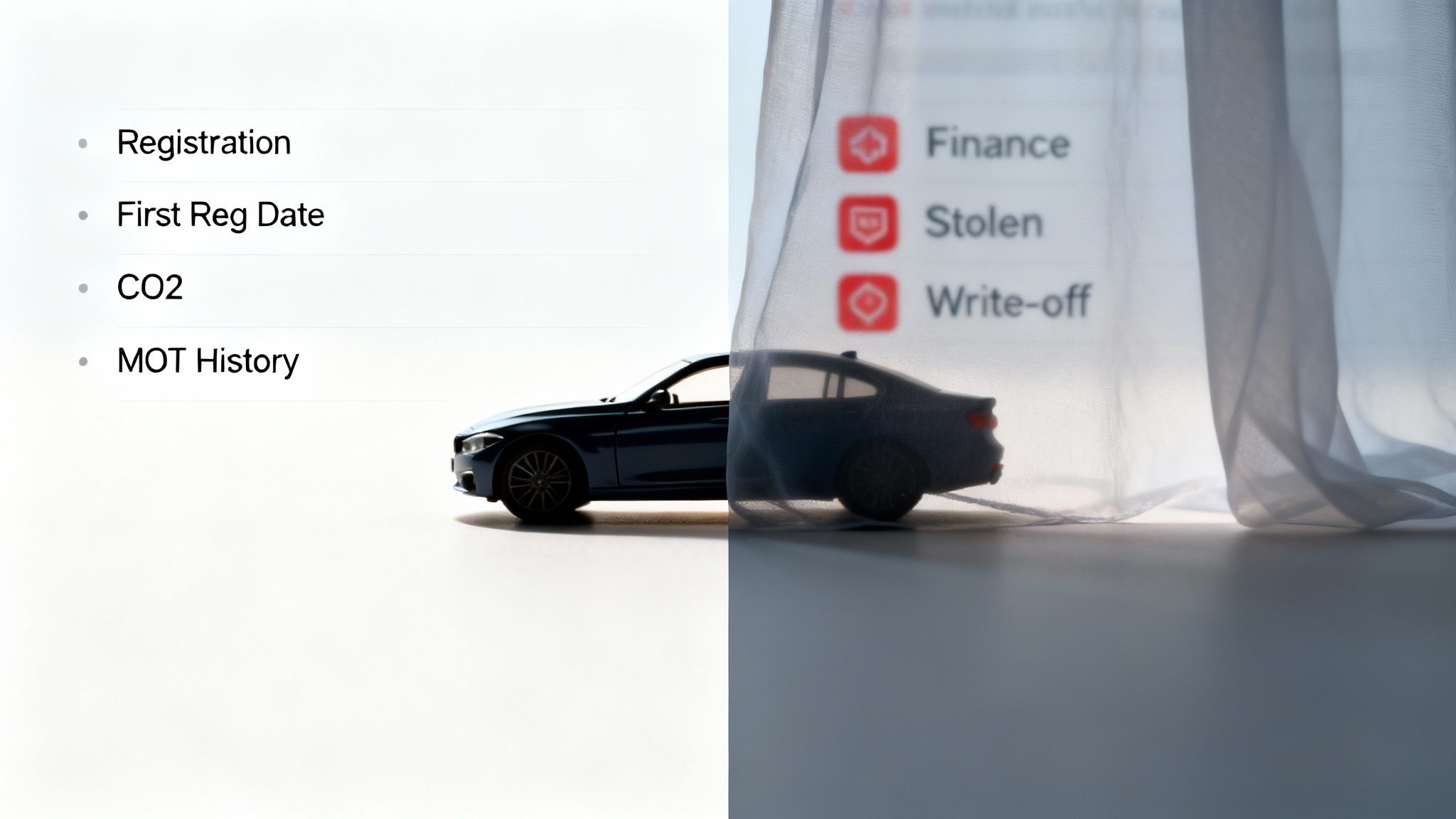
Here’s what a typical free report will lay out for you:
- Vehicle Specifications: The basics – make, model, colour, engine size, and fuel type.
- Registration Details: The date of first registration, so you can confirm its true age.
- MOT History: A full rundown of past MOT tests, including every pass, fail, and any advisories the tester noted down.
- Tax Status: A simple confirmation of whether the vehicle is taxed and when it expires.
- Environmental Information: Key figures like CO2 emissions, essential for figuring out ULEZ charges and general running costs.
This is all handy stuff. It lets you spot immediate red flags, like a dodgy MOT history with the same problems cropping up year after year, or a car being advertised with the wrong engine. It's a brilliant, no-cost way to weed out the obvious lemons before you sink any real time or money into them.
What the Free Check Deliberately Conceals
While that information is useful, it’s what a free check doesn't show you that poses the real threat to your business. All the critical, high-risk data—the stuff that determines a vehicle's true history and legal status—is locked away behind paywalls. It simply isn't available in any free report.
Relying only on these checks is a bit like letting a stranger into your home after they’ve only shown you their passport. You know their name and age, but you have no idea about their real background. The most dangerous information remains completely hidden.
The real story of a vehicle isn't in its MOT advisories; it's in the data points that free checks are designed to hide. This hidden history is where your profit and reputation are most at risk.
This is where things can go badly wrong for a motor trader. A free report won't breathe a word about outstanding finance, which could lead to the vehicle being repossessed straight off your forecourt. That’s a total loss. To really get to grips with this threat, have a read of our guide on how to check for outstanding car finance in the UK.
On top of that, a free check won't flag if the car is logged as stolen on the Police National Computer (PNC) or if it's been declared an insurance write-off (Category S or N) on the MIAFTR database. This is a massive blind spot. Industry data shows that a staggering 1 in 3 cars on the market has a hidden issue like outstanding finance. Even more worrying, checks uncover over 74 stolen vehicles every single day. That's a risk you just can't afford to take.
Ultimately, this hidden data is what truly defines a vehicle's value, safety, and legality. An AutoProv report is built to fill these critical gaps, blending the free data with trade-grade intelligence from over 10 sources to give you the complete picture you need to trade with absolute confidence.
Moving From a Basic Check to Business Intelligence
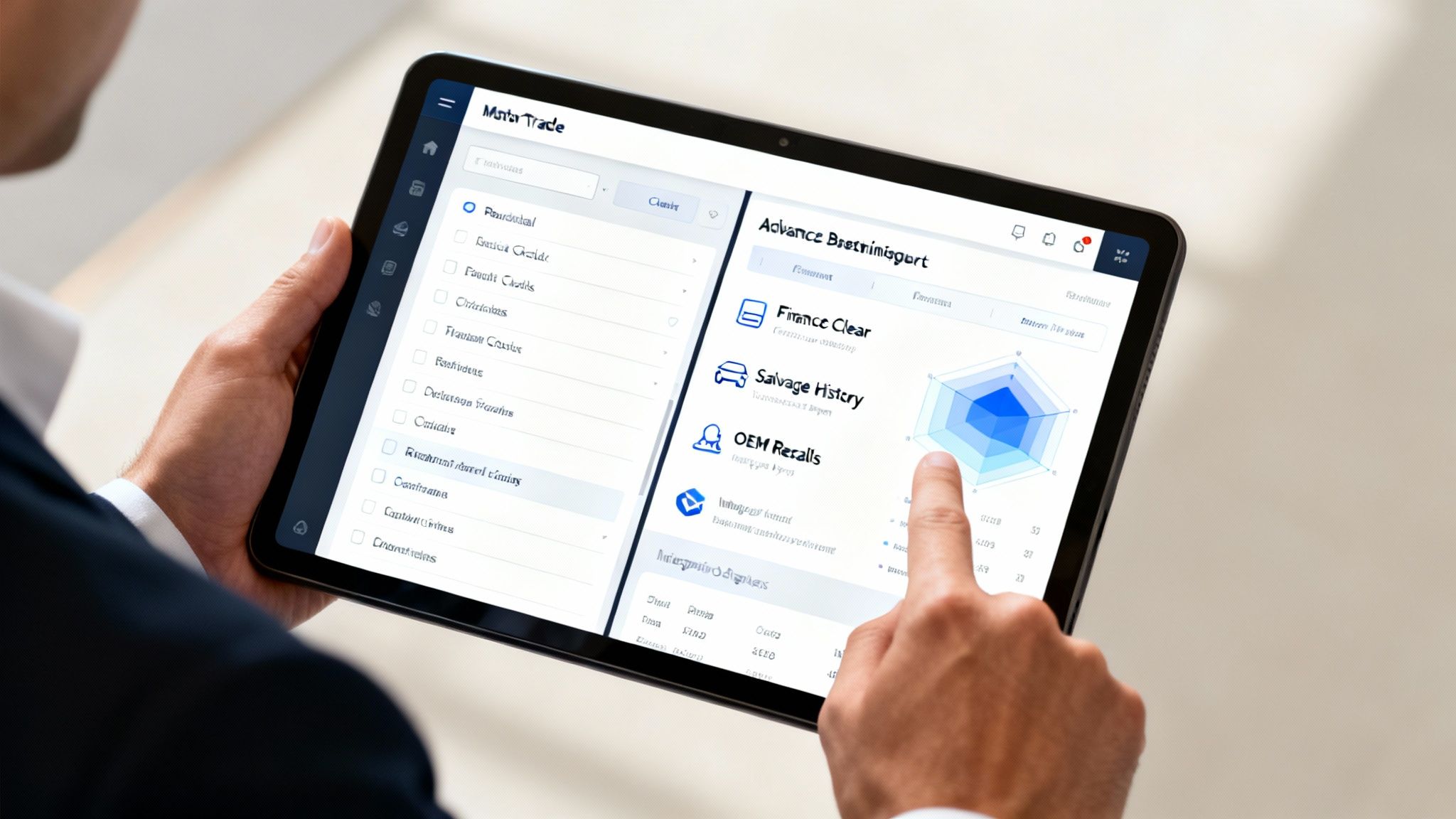
Upgrading from a free UK VIN number check to a professional report is a bit like swapping a first-aid kit for a fully staffed A&E department. The first-aid kit is fine for surface-level scrapes, but you need the A&E team to spot the critical, underlying conditions that could cause real trouble down the line.
A free check confirms the basics and stops right there. For any motor trade professional, that’s a risky place to be, because unseen issues always translate into financial loss and a dent in your reputation. An AutoProv report is your diagnostic tool, designed to turn simple vehicle data into sharp, actionable business intelligence.
This shift in mindset is what separates successful dealers from those constantly putting out fires. It’s about getting ahead of the risk, not just reacting when disaster strikes.
Safeguarding Against Financial Catastrophe
One of the biggest gambles in the motor trade is outstanding finance. A free check tells you absolutely nothing about a vehicle's financial history, leaving a gaping hole in your due diligence.
An AutoProv report, on the other hand, digs much deeper. We run a full Experian check that gives you a definitive answer on the vehicle's finance status. This isn’t a simple guess; it’s an authoritative confirmation of whether the car is clear of any hire purchase or loan agreements.
Why does this matter so much? If you buy a vehicle with outstanding finance without realising it, the finance company still owns it. They can—and will—reclaim their asset, even if it's sitting on your forecourt. The result is a catastrophic and total loss for your business.
Uncovering a Vehicle's True History
The MOT history from a free check is useful, but it barely scratches the surface of a vehicle's past life. Advisory notes might hint at problems, but they won't tell you about the most serious events a car might have been through.
This is where a trade-grade report gives you a completely different level of insight. AutoProv checks the Motor Insurance Anti-Fraud and Theft Register (MIAFTR) to tell you if a vehicle has ever been declared an insurance write-off.
A clean MOT history can easily hide the fact a car is a Category S (structural) or Category N (non-structural) write-off. An AutoProv check is the only sure-fire way to uncover this history and stop you from buying a dangerously repaired vehicle.
Knowing a vehicle's write-off history is non-negotiable. Selling one without disclosure can land you in legal hot water, while unknowingly buying one puts your customers' safety and your dealership's reputation squarely on the line.
Transforming Data into Profitability
A truly professional vehicle check doesn't just list facts; it connects them to your bottom line. It delivers the intelligence you need to make smarter, more profitable decisions every time you buy or sell.
An AutoProv report pulls in multiple critical data points that a free check will never show you:
- Salvage and Auction History: See if a vehicle has been through the salvage auctions, which hammers its value and integrity.
- Previous Taxi Use: Find out if a car has endured the high mileage and punishing wear and tear of life as a private hire vehicle.
- Crucial OEM Recall Notices: Get data from 42 manufacturers to see if a vehicle has outstanding safety recalls that must be fixed before you can sell it.
Every single one of these data points gives you the power to price your stock with precision. Knowing about a hidden write-off or previous taxi use gives you the leverage to negotiate a much better purchase price. On the flip side, a report confirming a vehicle's clean bill of health lets you justify a higher retail price with total confidence. You can learn more about this in our detailed article on how to use market insights for vehicle pricing.
That's the fundamental difference. A free check gives you data. AutoProv gives you the intelligence to cut risk, protect your capital, and maximise your profit margins on every single vehicle.
A Practical Due Diligence Checklist for Motor Traders
Making proper vehicle checks part of your daily workflow is the single best way to protect your business from costly mistakes. For any motor trader, a systematic due diligence process isn't just a "nice-to-have"—it's a core part of managing risk. A clear, repeatable checklist means nothing gets missed, from the first glance at an auction to the final handshake on a deal.
It all starts with efficiency. When you're standing in an auction hall or sizing up a part-exchange on the forecourt, you need answers fast. You need a quick-fire way to filter out the obvious non-starters without spending a penny.
But the moment a car goes from a "maybe" to a serious contender, your process has to step up a gear. A basic check just won't cut it anymore. This is where a professional-grade report becomes your shield, protecting you from the hidden problems that can completely destroy your profit margin.
Step 1: Initial Screening With a Free Check
The first line of defence in your due diligence should always be a free UK VIN number check. Think of it as your rapid-assessment tool, built for the fast-paced world of auctions and quick customer appraisals.
Use a free check from AutoProv to:
- Verify Basic Identity: Instantly confirm the make, model, colour, and engine size against the DVLA database. Does it match what you’re looking at?
- Screen MOT History: Get a quick overview of its past. Are there recurring advisory notes or big failure points that hint at deeper mechanical troubles?
- Confirm Key Dates: Check the date of first registration. Is the car's age exactly as advertised?
This initial step costs you nothing but a few seconds, but it’s invaluable for weeding out cars with glaring issues. It’s the smart way to build a shortlist of potential stock before you commit any real time or money.
Step 2: Upgrading to a Full AutoProv Report
Once a vehicle has passed that first sniff test, it’s time for the real investigation. The second you seriously consider placing a bid, making a payment, or listing a car for sale, you must run a full report. Trying to get by with just a free check at this stage is a huge, unnecessary gamble.
An AutoProv report isn’t just another vehicle check; it's your documented proof of due diligence. It acts as a shield, protecting your business from the financial and legal fallout of buying a car with a hidden past.
This is a non-negotiable step in your buying process. The deep data inside a professional report gives you the intelligence you need to make a confident, profitable decision.
Step 3: Analysing the Report for Red Flags
A full report is packed with information, but the real skill is knowing what to look for. When you open your AutoProv report, your focus should be on the major red flags—the ones that pose the biggest threat to your dealership. For a deeper dive into what to look for, check out our motor trader's guide to the professional car report.
Here’s your checklist for cutting through the noise:
- Check for Outstanding Finance: Find the Experian finance marker. You need to see an "all clear" here. An active finance agreement means the lender owns the car, and it could be repossessed right off your forecourt, leaving you with a total loss.
- Verify Stolen Vehicle Status: Scan for any alerts from the Police National Computer (PNC). Buying a stolen vehicle, even by accident, comes with serious legal and financial headaches you just don’t need.
- Identify Insurance Write-Offs: Look for any Category S (structural) or Category N (non-structural) markers from the MIAFTR database. Knowing a car’s write-off history is critical for valuing it correctly and being transparent with your future customers.
Getting to grips with these critical markers is essential. The AutoProv platform is designed to fit right into your workflow, making this deep-dive check a simple, repeatable part of your process. This methodical approach turns data into a powerful tool for preventing expensive mistakes, ensuring every car you sell has been properly vetted to protect both your investment and your reputation.
Real-World Scenarios Where a Free Check Fails
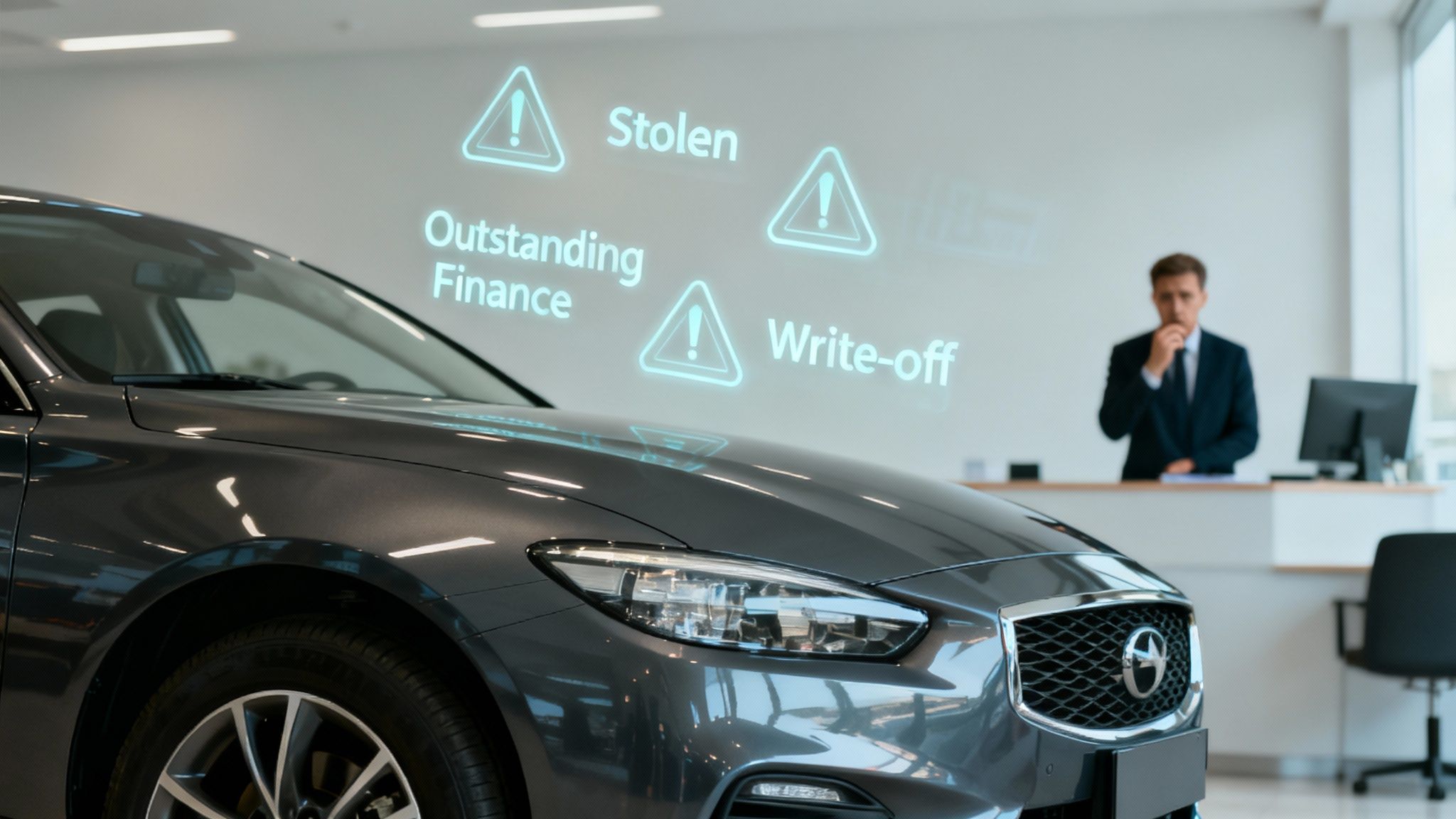
To really get to grips with the high stakes involved, we need to move beyond theory. Let's look at the real-world situations where a free UK VIN number check is dangerously inadequate. These aren't far-fetched hypotheticals; they're the daily risks that motor trade professionals face.
A free check can give you a false sense of security, leaving your business wide open to costly and reputation-shattering problems. The gap between what a free check tells you and what a professional report reveals is precisely where the disasters happen. Relying on basic MOT and tax data alone is like trying to navigate a minefield with a blindfold on.
Let's break down the three most common traps where a free check fails, spectacularly.
The Cloned Vehicle Trap
Vehicle cloning is one of the most devious scams in the motor trade. Criminals steal the identity of a legitimate, roadworthy car—its registration number and VIN—and slap it onto a stolen vehicle of the same make and model. When you run a free check on the cloned registration, everything looks perfectly fine.
The check will pull up the genuine car's clean MOT history and confirm it's taxed. To the untrained eye, or with only basic data to hand, the vehicle looks like a solid, safe purchase.
In reality, you're about to buy a stolen car that the police will seize the moment its true identity comes to light. An AutoProv report is built to shut this trap down. It cross-references multiple data points that go way beyond the basics, flagging discrepancies between the VIN on the car and the one recorded in other official databases. It's the kind of critical red flag a free check would never, ever see.
The Hidden Finance Disaster
This is probably the most financially crippling scenario of all: buying a car that still has an outstanding finance agreement. A dealer buys a vehicle, believing it's free and clear. Months later, a finance company calls. The previous owner stopped making their payments, and now the lender is legally entitled to repossess their asset—the car sitting on your forecourt.
A free check gives you zero visibility into a vehicle's financial history. It can’t tell you if there’s a hire purchase, PCP, or personal loan secured against it.
This isn't just a financial loss; it's a total write-off of your investment. The finance company takes the car, and you're left with nothing but a hole in your accounts and the massive headache of trying to get your money back.
An AutoProv report includes a full Experian finance check, giving you a definitive "all clear" or a warning of an active agreement. This one check can save you from a five-figure loss, making it an absolutely essential part of any professional buying process.
The Undisclosed Write-Off Nightmare
Picture this: you buy a vehicle that looks pristine. The paintwork is immaculate, the interior is spotless, and a free check shows a perfect MOT pass. Weeks later, you discover it was involved in a major accident and declared a Category S (structural damage) insurance write-off.
Cosmetic repairs can easily hide severe, underlying structural damage that makes a vehicle unsafe to drive. A free check has no access to the MIAFTR (Motor Insurance Anti-Fraud and Theft Register), so it will never tell you about a car's write-off history. You're flying completely blind to its past trauma.
This puts your business in an incredibly vulnerable position. Selling a vehicle without disclosing its write-off history is a legal minefield and a direct threat to your reputation. If you want to dive deeper into this, our guide on how to avoid buying a scrapped car in the UK offers some crucial advice.
An AutoProv report reveals this critical history instantly, allowing you to:
- Avoid Dangerous Stock: Steer clear of vehicles with compromised structural integrity.
- Negotiate Smarter: Use the write-off category to negotiate a much better purchase price.
- Ensure Transparency: Accurately describe the vehicle to retail customers, upholding your legal duties and protecting your good name.
These three scenarios highlight the fundamental weakness of relying on a free check. It only skims the surface details while leaving you completely exposed to the biggest financial, legal, and safety risks in the motor trade. A professional report is your only reliable defence.
Your Questions Answered on UK Vehicle Checks
When you're in the thick of the motor trade, you've got questions, and you need answers that are quick, clear, and practical. Anything less just slows you down. Let's cut through the noise and tackle some of the most common queries we hear from dealers.
We’re going to get straight to the point on the issues that hit your bottom line and legal standing—what you need to know to buy right, protect your business, and stay compliant.
Is a Free VIN Check Good Enough for Me to Legally Sell a Car?
In a word, no. A free UK VIN number check doesn't come close to meeting the due diligence you're legally obliged to perform as a dealer. While no law points to a specific brand of check you must use, the Consumer Rights Act is crystal clear: you have to ensure the cars you sell are accurately described and of satisfactory quality.
Think of a free check as just scratching the surface. It pulls basic DVLA data but leaves you completely blind to the big-ticket risks: outstanding finance, insurance write-offs, or if the car is on a police stolen register.
Selling a car with a murky past—whether it's an undeclared write-off or has finance owing—can land you in serious legal and financial hot water. Relying on a free check just isn't professional due diligence and won't stand up if a customer makes a claim.
To properly shield your dealership, you need a comprehensive, trade-grade report from a service like AutoProv. It’s your documented proof that you’ve done your homework, protecting you from future comeback.
How Fast Can I Get a Full Trade Vehicle History Check?
In this business, time is money. Whether you’re trying to get the jump on a car at auction or sizing up a part-exchange on the forecourt, you can't be left waiting for a vehicle check to load. It has to be instant.
That’s exactly why professional platforms are built for speed. Here at AutoProv, our system is designed for the fast pace of the trade. You can pull a complete, multi-point vehicle history report straight to your phone or tablet in under 30 seconds. This kind of speed means proper due diligence becomes part of your natural workflow, not a roadblock.
What's the Difference Between a VIN and a Registration Check?
Honestly, for the purpose of getting a vehicle history report, there’s practically no difference at all. Both the VIN (Vehicle Identification Number) and the VRM (Vehicle Registration Mark, or number plate) are unique codes that point to the exact same vehicle.
- VIN: This is the 17-character code stamped on the car's chassis, a global identifier.
- VRM (Reg Plate): This is the unique identifier the DVLA assigns for UK road use.
Both numbers connect to the same central records. When you use the AutoProv platform, it doesn't matter which one you type in. The system uses whatever you provide to pull the vehicle’s complete, single history file.
Can I Check a Car's History if I Don't Have the V5C Logbook?
Yes, absolutely. You don't need the V5C logbook in your hand to run a complete, in-depth history check. While the V5C is the official registration document, all the crucial historical data is tied to the car itself, not a piece of paper.
All you need is the car's registration number (VRM) or its VIN. With just one of those, you can run a full AutoProv report and uncover everything you need to know. You'll see any red flags around finance, theft, write-offs, mileage discrepancies, and much more, giving you the power to make a smart decision long before you see any paperwork.
Frequently Asked Questions
AI-Generated Content Notice
This article was created with the assistance of artificial intelligence technology. While we strive for accuracy, the information provided should be considered for general informational purposes only and should not be relied upon as professional automotive, legal, or financial advice. We recommend verifying any information with qualified professionals or official sources before making important decisions. AutoProv accepts no liability for any consequences resulting from the use of this information.
From our AI insights
- Navigating ULEZ Compliance for Used Car Dealers
A deep dive into ensuring your used car stock meets ULEZ standards, avoiding costly fines.
- Mastering Paint Verification with VIN Decoding
Learn how UK traders verify original paint using VIN decoding and provenance data.
- Understanding VIN Decoding: Avoid Misleading Imports
Learn how VIN decoding reveals vehicle origins and specs, preventing import pitfalls.
Related Articles

Car Specs by Reg: Instantly Find Vehicle Details & MOT History
Trying to find the full car specs by reg? In the UK, that little number plate is the key to unlocking a huge amount of information about a vehicle. From the exact engine size and CO2 emissions to its MOT history and tax status, it's all tied to the registration.

How to Check Previous Owners of a Car in the UK
Before you even start thinking about how to check the previous owners of a car, you need to get your head around why it's so important. This isn't just about being nosy; it’s a non-negotiable step that protects you from serious financial headaches and safety risks lurking under a shiny bonnet.

How to Check Service History in the UK
Think of a car's service history as its detailed CV, not just some dusty folder in the glovebox. To check service history is to get the real story behind a vehicle, digging into everything from its routine oil changes to any major surgery it's had. For any savvy car buyer in the UK, this record is the single most important document you can get your hands on.
Published by AutoProv
Your trusted source for vehicle intelligence