
For any professional motor trader in the UK, the Audi A3 isn't just another premium hatchback. It is a high-turnover, high-volume asset class. This guide provides the trade-specific intelligence required to source, appraise, and retail this model profitably, moving beyond consumer-focused reviews.
The Audi A3 as a High-Volume Asset
The Audi A3 occupies a uniquely profitable position in the used car market. It combines the premium brand appeal that drives retail demand with the sales volume of a mainstream model, making it a reliable staple for independent dealers. This strong brand equity supports residual values and helps maintain margins, while its widespread popularity ensures a rapid stock turn.
For the informed trader, the A3 is a dependable commodity. However, high volume introduces significant risk. The quality of available stock varies enormously, from cherished, low-mileage examples to neglected vehicles with undisclosed issues. Distinguishing between them requires more than a standard appraisal.
Beyond the Surface-Level Check
To consistently profit from the audi a3 used market, it is essential to look past the superficial condition and analyse the vehicle's complete history. A basic vehicle check provides the fundamentals, but profitable trading in premium stock demands deeper analysis. This is where provenance intelligence becomes an indispensable tool. It involves interpreting a vehicle's entire operational history through its data, identifying patterns and risk signals that are often missed.
Provenance intelligence is not just a history check. It is the analysis of ownership timelines, MOT histories, and mileage data to construct a comprehensive picture of a vehicle's life. This process helps traders avoid the hidden liabilities that can erode margins and damage professional reputation.
This guide offers an inside track on the A3 market, breaking down how to identify profitable specifications, spot common faults, and understand valuation trends. While mechanical knowledge is vital, the ability to interpret a vehicle's complete history is what separates the most successful traders. For a wider view on how models like the A3 are performing, see our analysis of UK used car market trends in our related article. By combining solid mechanical appraisal with data-driven insights, you can consistently source prime A3 stock and make smarter, more confident buying decisions.
Identifying Profitable Audi A3 Generations and Trims
Not every used Audi A3 represents a sound investment. In a saturated market, profitability comes from knowing precisely which combinations of generation, engine, and trim level will generate immediate retail interest. Correctly identifying these vehicles leads to rapid stock turn and healthy margins; a misjudgement results in static stock that ties up capital.
For a switched-on trader today, the primary focus is on two key generations: the third-generation 8V (2012-2020) and the current fourth-generation 8Y (2020-present). The 8V represents the core of the current used market, offering a premium ownership experience at a price point accessible to a broad segment of buyers. The 8Y is the newer model, commanding a higher price but attracting customers seeking the latest technology and design.
The A3 presents a dual opportunity for a trader. It has the premium badge appeal that customers desire, yet it sells with the speed and volume of a mainstream hatchback. This combination can be highly profitable for those who select the right stock.
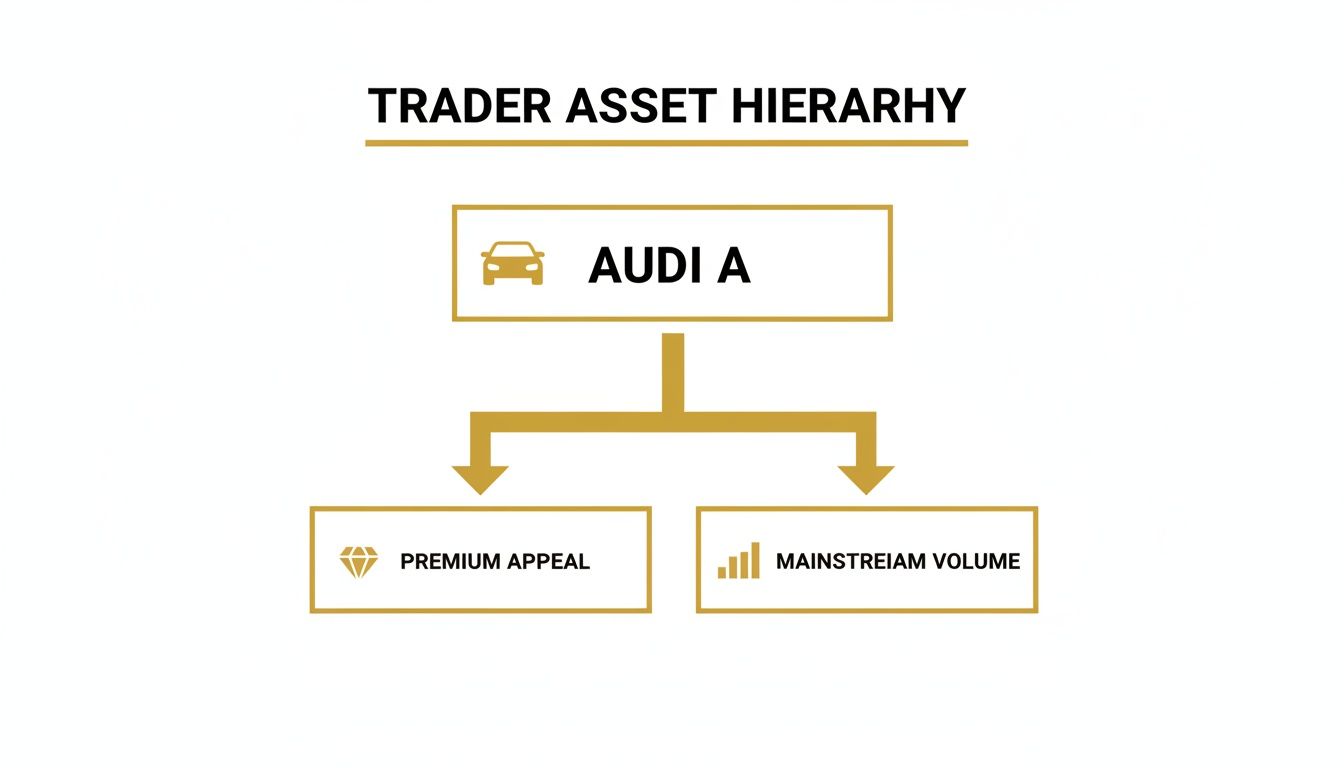
This dual identity is key. To trade the A3 successfully, its aspirational brand image must be balanced with its function as a fast-moving, high-volume product.
Decoding Engine and Trim Hierarchies
The engine and trim level are the two most significant factors influencing an A3's desirability and, therefore, its market value. Mastering this aspect is fundamental to a profitable acquisition.
Trader's Quick Guide to Audi A3 (8V & 8Y) Engine and Trim Specs
This reference table breaks down the key specifications for the 8V and 8Y generations, providing an at-a-glance guide to identifying the most desirable configurations.
Generation/Model Engine Type (Petrol/Diesel/Hybrid) Key Trim Levels Primary Market Appeal 8V (2012-2020) Petrol (TFSI): 1.4, 1.5
Diesel (TDI): 2.0 Sport, S line, Black Edition Broad appeal; premium feel for the money. The 1.5 TFSI S line is the definitive all-rounder. 8Y (2020-Present) Petrol (TFSI): 1.5
Hybrid (TFSI e): 1.4 Sport, S line, Edition 1 Tech-focused buyers; latest design. Hybrids appeal to urban, low-emission drivers. This table highlights the core models that should be on your radar. The 8V S line and Black Edition are volume sellers, while the 8Y appeals to a customer willing to pay a premium for the latest model.
Engine Options and Market Demand:
- TFSI (Petrol): These are the most sought-after engines. The turbocharged petrol units, particularly the 1.4 and 1.5 TFSI with Cylinder on Demand (CoD) technology, offer an optimal balance of performance and running costs. They are a sound choice for almost any customer profile.
- TDI (Diesel): While market demand for diesel has softened, the 2.0 TDI remains a robust and efficient engine, making it a solid option for high-mileage drivers. It has a strong reputation for reliability and economy. ULEZ compliance is a key consideration when retailing these vehicles in urban areas.
- e-tron (PHEV): Plug-in Hybrids are gaining significant market traction. They command a premium but appeal to a growing segment of buyers focused on running costs and emissions. Their complexity makes a comprehensive provenance check essential.
Trim Levels That Drive Value:
The trim level is a key factor in a vehicle's retail appeal and visual impact.
A higher trim level, such as S line or Black Edition, can add £1,500 to £2,500 to the retail price over a standard Sport model. This specification uplift is a primary source of additional margin.
- Sport: A solid, well-equipped mid-range option that will always find a buyer. A safe stock choice.
- S line: The most desirable trim for the majority of buyers. The enhanced bumpers, larger alloy wheels, and upgraded interior details provide significant forecourt appeal.
- Black Edition: The range-topping trim. It builds on the S line specification with de-chromed, black styling elements that are currently in high demand. These models command the highest retail prices and tend to sell quickly.
Body Style and Stocking Strategy
The A3’s versatility is a key strength, but a focused stocking strategy is more effective than attempting to cover all variants.
The five-door Sportback is the dominant model. Its combination of aesthetics and practicality makes it the preferred choice for the vast majority of buyers and should form the core of any A3 inventory. The Saloon offers a more executive feel, appealing to a different customer demographic. These models demonstrate strong value retention, partly due to their relative scarcity.
The three-door hatchback and the Cabriolet are more niche propositions. A clean Cabriolet can be a profitable vehicle, but its appeal is highly seasonal. They sell well in spring and summer but can tie up capital during colder months. Stocking these is a matter of timing.
To ensure accurate appraisal, it is vital to have the exact factory specifications. You can learn how to get my car specs for any UK vehicle in our detailed guide.
In summary, a successful strategy for a used Audi A3 involves focusing on high-specification Sportback and Saloon models, preferably with a desirable TFSI petrol engine.
Inspecting for Common and Costly Audi A3 Faults
A thorough appraisal is the first line of defence against unexpected reconditioning costs that can eliminate profit margins. Any experienced trader can identify worn tyres or poor paintwork, but profiting from a used Audi A3 requires knowledge of its specific vulnerabilities. This is not a generic inspection; it is a targeted assessment for common and costly issues that can turn prime stock into a workshop liability.
Moving beyond standard checks is where you uncover the mechanical and electrical weaknesses unique to the A3. Identifying these risk signals before acquisition allows for an accurate calculation of the true cost-to-retail and helps sidestep vehicles with significant hidden problems. For a robust framework, learn more about building your ultimate used car inspection checklist in our dedicated guide.

Drivetrain and Engine Bay Checks
The powertrain can be the source of some of the most significant A3 repair costs. A meticulous road test and engine bay inspection are non-negotiable.
S tronic (DSG) Gearbox Issues The dual-clutch S tronic gearbox is a major selling point but can be a source of considerable expense if not correctly maintained. During the test drive, pay close attention to its operation.
- Listen for whining or clunking sounds, particularly during low-speed manoeuvres and gear changes.
- Feel for hesitation or jerky shifts, especially when pulling away or shifting between first and second gear.
- Scrutinise the service history for evidence of regular oil and filter changes, typically required every 40,000 miles. A missing gearbox service is a significant red flag.
TFSI Water Pump & Thermostat Housing A known weakness on the 1.4 and 1.5 TFSI engines is the plastic water pump and thermostat housing assembly, which is prone to cracking and leaking over time.
A failed water pump is more than just a leak; it presents a risk of severe engine damage. Overheating from coolant loss can lead to head gasket failure, a repair that will negate any potential profit in the vehicle.
Visually inspect the area around the housing for signs of pink or white crystalline residue, a clear indicator of a coolant leak. Monitor the temperature gauge during the road test to ensure it remains stable.
TDI Dual-Mass Flywheel (DMF) On manual TDI models, the dual-mass flywheel is a common and expensive wear item. A failing DMF presents clear symptoms. Listen for a rattling or chattering noise at idle that disappears when the clutch pedal is depressed. You may also feel excessive vibration through the clutch pedal and floorpan.
Electrical and Interior Systems
Modern premium vehicles like the A3 contain complex electronics, which introduces more potential points of failure.
MMI Infotainment System Audi's MMI system is generally reliable, but faults can occur. Test every function thoroughly.
- Check for a screen that fails to rise from the dashboard or flickers.
- Ensure all buttons and the central control wheel operate correctly without sticking.
- Connect a phone via Bluetooth and test both media streaming and call functions.
Locks, Keys and Ignition Systems When appraising a used Audi A3, it is crucial to check all related systems, including any potential issues with keys, locks, or the ignition. Confirm both key fobs function correctly and test every door and boot locking mechanism. Intermittent faults may require specialist automotive locksmith services to diagnose and repair, adding a further potential cost.
Chassis and Suspension Inspection
The A3's ride quality is central to its premium appeal, but suspension components are subject to significant wear on UK roads. Listen for knocking or clonking sounds over uneven surfaces, which often indicates worn anti-roll bar drop links or control arm bushes. A visual inspection of the shock absorbers for any signs of fluid leaks is also essential. These components are frequently overlooked but can be costly to rectify, directly impacting your bottom line.
Understanding Audi A3 Valuations and Depreciation
Accurate valuation of a used Audi A3 is fundamental to protecting margins. This requires more than a glance at a guide price; it demands a deep understanding of the market forces that shape its value. An A3's depreciation curve is complex, influenced by specification, mileage, age, and even seasonality. Mastering this allows you to buy and price with confidence.
Specification is arguably the single most important factor. A low-mileage S line Sportback with the correct petrol engine will always command a premium and retain its value far better than a base-specification diesel. Desirable options such as the Technology Pack or a panoramic sunroof can add hundreds, or even thousands, to the residual value, making them key features to identify in top-tier stock.
Ultimately, value is dictated by market demand. Identifying the ideal age and mileage bracket for an A3—the point where the initial sharp depreciation has levelled off, but the vehicle is still modern enough to have strong retail appeal—is where the greatest profit potential lies.
Key Drivers of a Used A3's Value
Understanding the A3's market performance means looking beyond a single average price and analysing the nuances between different versions. While the used A3 market as a whole may show volatility, specific models behave differently. The average used A3 is currently priced around £16,073, but this figure masks significant variations. For a closer look at the data, you can explore A3 price trends at CarGurus.
For instance, the Audi A3 Cabriolet was one of the UK’s strongest performing used cars in early 2024, with average asking prices increasing by 19.9% year-on-year. Simultaneously, some newer Sportback models experienced a value decrease, demonstrating how segmented the market is by body type and specification.
This data underscores a critical point for traders: you are never just buying "an Audi A3." You are acquiring a specific configuration with its own unique demand and depreciation curve. Several core factors dictate this value:
- Age and Generation: The steepest depreciation occurs in the first three years. Vehicles between three and five years old often represent the optimal balance of modern features and stabilised value.
- Mileage: Sub-50,000 mile examples carry a strong premium. Once a vehicle exceeds 80,000 miles, its value can decline more sharply as it appeals to a different buyer segment.
- Engine and Drivetrain: Petrol TFSI models are in high demand, particularly the 1.5-litre unit. An S tronic automatic gearbox typically adds more to the retail price than a manual.
- Trim and Specification: As noted, S line and Black Edition trims are the most desirable. The price difference between a basic SE and a high-spec version can easily amount to thousands of pounds.
Capitalising on Market and Seasonal Trends
Wider market forces also create acquisition opportunities. Seasonality, for example, has a predictable effect on certain A3 models.
Demand for the Audi A3 Cabriolet surges in spring and early summer. Traders who source this stock during the winter months can achieve significantly higher margins. This is a classic example of buying out of season to maximise profit.
Similarly, a large influx of three-year-old ex-lease or fleet vehicles entering the market can temporarily soften prices, creating a buying window for informed traders. Staying aware of these market shifts allows for a proactive, rather than reactive, buying strategy. A solid grasp of these financial dynamics is crucial; you can learn more in our guide on how to calculate vehicle depreciation simply.
Ultimately, profiting from used Audi A3s requires a data-led approach to valuation. By analysing these trends, you can move beyond generic guide prices and develop an accurate assessment of a vehicle's true market worth. This enables smarter buying, confident pricing, and protected margins.
Uncovering Hidden Risks with Provenance Intelligence
A standard vehicle history check is a necessary first step, but for a premium asset like a used Audi A3, it is insufficient. Relying on it alone provides an incomplete picture. Effective motor trade risk management means digging deeper, using advanced provenance intelligence to uncover the subtle but significant risks that basic reports invariably miss.
For a high-volume model like the audi a3 used, these hidden risks are where profit is made or lost. A "clean" provenance check does not explain why a vehicle has had three keepers in 18 months, nor does it flag a pattern of MOT advisories that suggests a persistent underlying fault. This is the context that separates a sound vehicle from a liability. It is where professional-grade dealer vehicle checks become non-negotiable.

Beyond Pass/Fail Indicators
The true value in a used car history report is not just in the headline data—outstanding finance, stolen markers, or insurance write-offs. Actionable intelligence lies in the patterns and anomalies within the ownership timeline and MOT history. This is the core of vehicle provenance analysis.
A vehicle's history is more than a list of events. A rapid succession of owners, for example, is a classic red flag. It often indicates an intermittent fault that previous keepers have been unable to rectify, choosing instead to dispose of the vehicle.
This pattern of short-term ownership is a major warning sign, especially with a complex vehicle like the A3. A basic check may show no adverse markers, but the ownership timeline tells a story of potential frustration—one that could conclude with you bearing the cost of diagnostics and repair. A professional vehicle history check UK traders can rely on must interpret these patterns.
Interpreting MOT History and Mileage Data
The MOT history is a rich source of information, yet many traders only focus on failure items. The real intelligence is often found in the advisories, particularly when tracked over several years.
- Recurring Advisories: An advisory for "slight play in offside front wheel bearing" one year, followed by the same note the next, indicates a developing problem that has been ignored. It represents a predictable future cost that must be factored into your valuation.
- Corrosion Patterns: Advisories mentioning corrosion on brake pipes or suspension components on a relatively young A3 can suggest the vehicle has operated in a harsh environment, such as a coastal area or a region with heavy winter road salting.
- Tyre Wear Clues: Consistently uneven tyre wear flagged on multiple MOTs can be a symptom of underlying suspension or alignment issues that may be more complex than a simple tracking adjustment.
Mileage data is another area where discrepancies can hide. A thorough mileage check UK platform should do more than just flag obvious clocking. It must cross-reference data from MOTs, service records, and other sources to identify inconsistencies. An unexplained drop in annual mileage could indicate the vehicle was off the road for an extended period, possibly for an undocumented major repair.
The AutoProv Advantage in Risk Assessment
This is precisely where AutoProv's approach to trade vehicle intelligence provides a critical advantage. Our system is designed to analyse and contextualise these data points, transforming raw information into actionable insights at the point of decision. We do not just present data; we highlight the suspicious ownership patterns and data anomalies that signal a high-risk vehicle.
By focusing on the complete story of the vehicle, AutoProv provides the crucial context needed to distinguish a well-maintained Audi A3 from one with a problematic past. This deeper level of analysis protects your investment, your margin, and your reputation. To see how this works in practice, review the insights provided in a full vehicle provenance report.
Actionable Sourcing and Stocking Strategies
Successfully trading the audi a3 used market depends on a disciplined strategy that combines expert physical appraisal with deep provenance intelligence. Profitable stock can be found through various channels, but the rigorous checks outlined must be applied to every potential acquisition, whether from a trade auction or as a part-exchange. The goal is to build a balanced A3 inventory that meets the needs of a diverse retail customer base.
Profitability is not determined at the point of sale; it is secured at the point of acquisition. The ability to accurately assess an A3's true history and condition is what separates a good piece of stock from a future problem. This requires moving beyond basic checks and leveraging professional trade vehicle intelligence to gain a competitive advantage.
Curating a Balanced A3 Inventory
A one-size-fits-all approach to stocking the A3 is inefficient and will slow sales. A carefully curated mix that addresses different segments of the used car market is required.
- Volume Movers: These are the core of your inventory. Focus on high-demand specifications that sell quickly. This includes three-to-five-year-old Sportback models in S line or Black Edition trim, ideally with the 1.5 TFSI engine and an S tronic gearbox. These vehicles generate the most online interest and achieve the fastest stock turn.
- Value Propositions: Do not overlook well-maintained, lower-specification Sport or SE models. These provide an entry point to the Audi brand for budget-conscious buyers and attract a different customer segment to your forecourt.
- Niche Opportunities: Remain alert for clean, low-mileage Saloon and Cabriolet models. While the market is smaller, the right example can command a strong premium and attract a specific, motivated buyer, particularly when timed with seasonal demand.
Leveraging Data for a Competitive Edge
The A3's enduring popularity ensures a reliable stream of customer demand. Official data confirms this, with the A3 consistently ranking among the UK's most popular used cars. In 2023 alone, 125,752 units were sold in the secondary market, making it the sixth best-selling used model. This volume confirms its status as an essential model for any dealer aiming to appeal to a broad market. You can explore these figures further at the Society of Motor Manufacturers and Traders (SMMT).
At its core, a successful A3 stocking strategy is a risk management exercise. Every sourcing decision must be supported by a vehicle history check UK traders can trust—one that analyses ownership patterns and data anomalies, not just headline flags.
This is where AutoProv provides support. By delivering deep vehicle provenance insights, our platform allows you to validate a vehicle's history with confidence, ensuring you only stock units with a clean and verifiable past. Of course, acquiring the right stock is only part of the process. To maximise returns, traders must also understand essential marketing strategies for small businesses to attract both sellers and buyers.
Ultimately, a disciplined, data-led approach to sourcing and stocking is what transforms the popular Audi A3 into a consistently profitable asset for your business.
A Few Pointers from the Trade
Common questions arise when stocking the Audi A3. Here are direct answers to queries we frequently hear from dealers.
What is the ideal specification for a used Audi A3?
For rapid retail and strong value retention, focus on the third-generation (8V) S line or Black Edition Sportback. The most desirable configuration is the 1.5 TFSI petrol engine paired with the S tronic automatic gearbox.
This specification meets all the key requirements of the modern premium used car buyer: desirable aesthetics, modern technology, and an optimal balance of performance and running costs. These are the models that consistently achieve the strongest residual values.
Are high-mileage diesel A3s still a viable purchase?
They can be, but they must be bought selectively. A high-mileage 2.0 TDI with a comprehensive service history can be an excellent vehicle for a long-distance commuter, and a market for these cars still exists.
However, its value is now contingent on two primary factors: ULEZ compliance and its mechanical condition. Pay close attention to the dual-mass flywheel on manual vehicles for any audible rattles. A professional mileage check UK traders can rely on is non-negotiable to verify its history.
What is the biggest red flag on a vehicle history check?
Beyond obvious adverse markers like write-offs or outstanding finance, the most significant warning sign is a pattern of short-term ownership.
An A3 that has had three registered keepers in two years is a classic indicator of a persistent, underlying fault that previous owners have passed on rather than rectify. This represents a significant motor trade risk. A basic used car history report may not highlight this pattern, but it is often a clear signal of future problems.
A clean provenance check is not the complete story. The ownership timeline must be scrutinised as a core component of analysing a vehicle's vehicle provenance. Rapid owner turnover is often a more significant warning sign than a single MOT failure.
This type of history points to underlying issues that could result in substantial repair costs and reputational damage.
Building a profitable inventory of audi a3 used stock is about more than a physical inspection. It requires understanding a vehicle's true history. AutoProv delivers advanced trade vehicle intelligence, analysing ownership patterns and identifying hidden risks. Get the complete picture on every vehicle you appraise at https://autoprov.ai.
Frequently Asked Questions
AI-Generated Content Notice
This article was created with the assistance of artificial intelligence technology. While we strive for accuracy, the information provided should be considered for general informational purposes only and should not be relied upon as professional automotive, legal, or financial advice. We recommend verifying any information with qualified professionals or official sources before making important decisions. AutoProv accepts no liability for any consequences resulting from the use of this information.
From our AI insights
- Auction Pitfalls: Avoiding Costly Mistakes
Navigate UK car auctions with confidence by avoiding finance, write-off, and mileage risks.
- Mastering Paint Code Checks: Detecting Hidden Car Repairs
Discover how to use paint code verification to identify hidden car repairs and ensure a smarter purchase.
- UK Part-Exchange Checks: Protecting Dealer Margins
Explore essential part-exchange checks for UK dealers to safeguard profit margins, including provenance and finance verification.
Related Articles

Your Ultimate Guide to Buying a Used Car in the UK
Navigate the UK used car market with confidence using our comprehensive buying guide. Tips, checks, and AutoProv Provenance insights included.

Difference Between MOT and Service: What You Need to Know
An MOT is a mandatory legal inspection that every car on UK roads needs to pass.Think of it as the government's way of ensuring your vehicle meets the absolute minimum safety and environmental standards to be considered roadworthy. A service, on the other hand, is a completely different beast. It's the proactive maintenance routine recommended by the people who built your car, designed to keep it running smoothly and catch problems before they start. In short, an MOT is a pass-or-fail exam required by law. A service is a comprehensive health plan for your car.

Your Ultimate Used Car Inspection Checklist
A solid used car inspection checklist is the single most powerful tool you have to avoid buying a lemon. It gives you a methodical way to look past the shiny paint and assess a car's real condition, helping you spot hidden problems and get a fair price before you shake hands on the deal.
Published by AutoProv
Your trusted source for vehicle intelligence