
That little red battery warning light pinging on a car's dashboard? For anyone in the motor trade, that’s not just an amber gambler—it’s a full-on red light demanding an immediate, sharp diagnosis. Too many people think it just means a flat battery. In our world, we know better. That light is signaling a deeper, more urgent fault somewhere in the vehicle's charging system.
Decoding The Illuminated Battery Warning Light

When that light flicks on, it's the car telling you its electrical system voltage has dropped below a healthy level. Plain and simple, the alternator—the bit responsible for charging the battery and powering everything electrical while the engine's running—isn't pulling its weight anymore.
This is a direct alert. It means the car is now running entirely on the battery's stored power. That's a finite resource, and you know as well as I do that it won't last long.
More Than Just A Battery Problem
So, what's really going on under the bonnet? The root cause can come from a few key places, and knowing the usual suspects is half the battle in getting a quick and accurate diagnosis.
Nine times out of ten, the fault will trace back to one of these:
- A failing alternator: This is the most common culprit. Its internal gubbins, like the voltage regulator or diode rectifier, have simply given up the ghost.
- A snapped or slipping serpentine belt: If the belt that spins the alternator pulley is damaged, loose, or gone completely, then the alternator can't do its job.
- Corroded or loose connections: You’d be surprised how often it's just a bad contact. Grime and corrosion on battery terminals, the alternator connections, or the main earth points can stop the charge from getting through.
- A wiring fault: A bit more of a headache to find, but frayed or broken wires in the charging circuit will create resistance or an open circuit.
Ignoring this light is never an option in our trade. You’re risking a non-starter, potential damage to sensitive ECUs, and a guaranteed hit on the vehicle's value. When you're appraising a car for stock, that light is a massive red flag that demands proper investigation. You might find our guide on how long a car battery should last a useful resource for some extra background.
For a used car professional, a battery warning light isn't just a maintenance issue; it's a direct threat to a vehicle's provenance and profitability. A swift, data-backed assessment from a service like AutoProv is essential to protect the asset's value and the dealership's reputation.
This is where a professional vehicle intelligence platform like AutoProv proves its worth. By pulling a vehicle’s detailed history, you can spot patterns—like previous MOT advisories on battery security or wiring—that might point to an underlying electrical weakness. It allows you to get ahead of these costly problems before they start eating into your margin.
Initial Visual Checks And Symptom Triage

Before you even think about reaching for a multimeter, a good, old-fashioned look under the bonnet can often nail the culprit behind a battery warning light in minutes. This isn't about skipping steps; it’s about working smart, not hard. A quick visual triage can save you a serious amount of diagnostic time, especially when you’re trying to get through multiple appraisals in a day.
Your first port of call should always be the most common mechanical failure point: the serpentine belt.
This single belt is responsible for driving the alternator, along with a host of other components. Check its condition and tension straight away. You’re looking for the obvious signs of wear—cracking, fraying along the edges, or that glazed, shiny look that screams it’s been slipping. A snapped belt is an open-and-shut case, but a loose one can be just as problematic, causing all sorts of intermittent charging faults.
Inspecting Connections And Components
Once you’ve cleared the belt, move your focus to the battery itself. The terminals are a classic source of trouble. Any build-up of that white or greenish chalky corrosion creates resistance and chokes the flow of electricity. It’s a simple fix but one that can easily mimic a complete charging system failure. While you're there, give the terminal clamps a good wiggle—a loose connection is another textbook cause for that light to pop on.
From the battery, trace the main wiring loom from the alternator. Scan for any visible signs of damage, like chafing where it's rubbed against something, burns from getting too close to hot engine parts, or brittle, cracked insulation. Even a quick glance at the alternator body can give you clues. Is it caked in dirt or oil? That sort of contamination can lead to overheating and kill it prematurely.
These initial visual checks are a non-negotiable part of any professional appraisal, a principle we cover in depth in our guide to creating the ultimate used car inspection checklist.
Correlating Visuals With Symptoms
Now, it's time to connect what you're seeing with what the car is actually doing. Different symptoms often point to very specific faults, letting you build a strong case for a suspect before you've even run a single test.
Consider these common scenarios you've likely seen a dozen times:
- Dimming Lights & Slow Wipers: If the headlights dip at idle but brighten up as soon as you rev the engine, that's a tell-tale sign of a weak alternator that just can't keep up with the electrical demand.
- Whining or Grinding Noises: A high-pitched whine that changes in pitch with the engine RPM almost always points to failing alternator bearings. A grinding or squealing noise? That's more likely a worn-out belt or a dodgy tensioner pulley.
- Slow Engine Crank: This is a dead giveaway that the battery isn’t getting the charge it needs. Your investigation should immediately pivot towards the alternator's output or a nasty parasitic drain.
By linking what you can see and hear with your visual inspection, you build a powerful diagnostic hypothesis right from the start. A slow crank combined with a loose, glazed serpentine belt makes the belt your prime suspect long before any diagnostic tool comes out of the box. This approach streamlines your workflow, turning a vague warning light into a specific, actionable problem to solve.
Essential On-Car Diagnostic Tests For Accurate Fault Finding
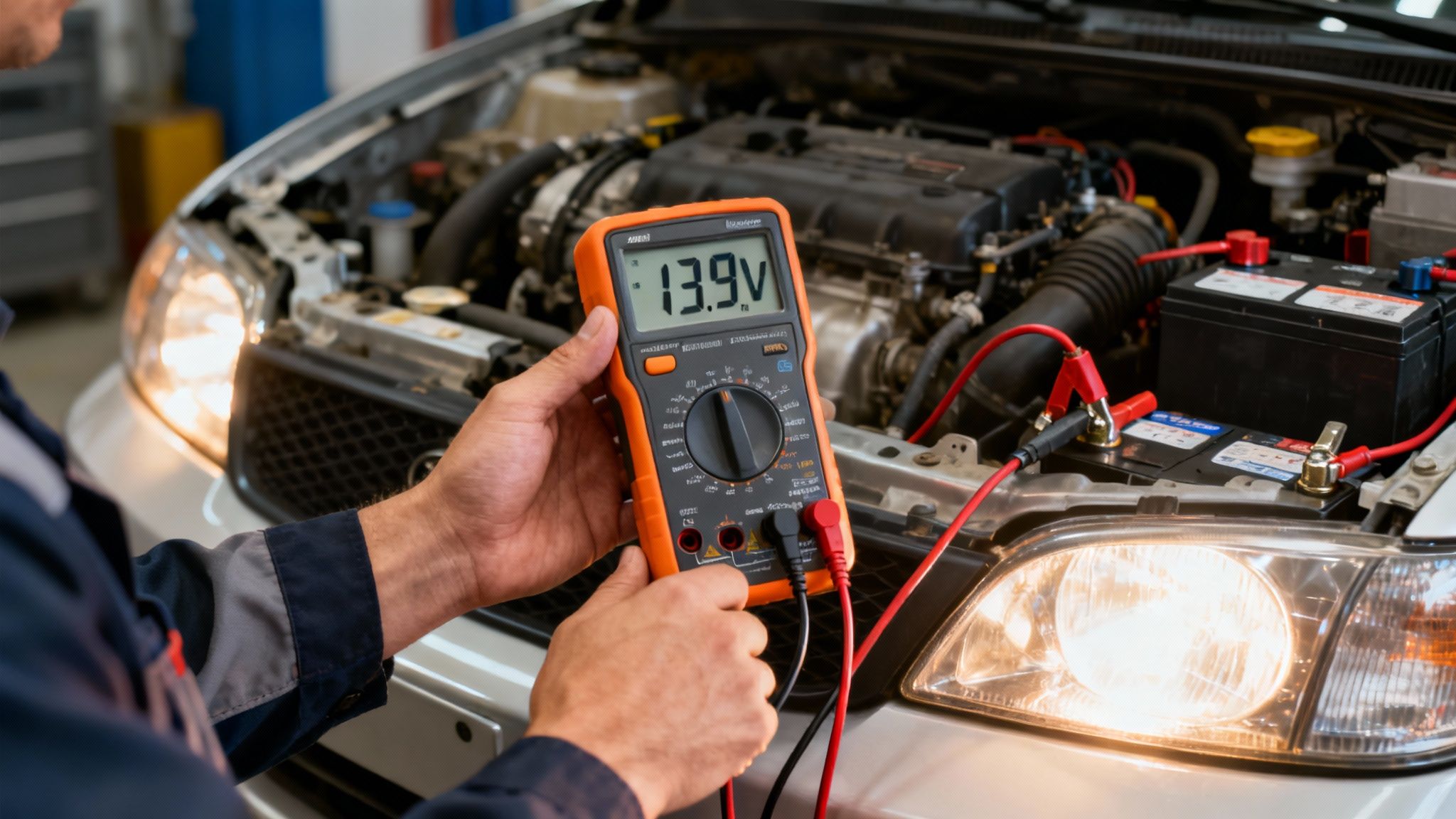
A visual check gets you into the right ballpark, but to nail down the cause of a battery warning light, you need hard data. This is where your trusty multimeter becomes the most important tool in the box, shifting you from an educated guess to absolute certainty. These simple, on-car tests are the bedrock of any professional electrical system appraisal.
First things first, you need a baseline. Let’s see what the battery's static voltage is. With the ignition off and everything switched off, get your multimeter across the battery terminals. A healthy, fully charged battery should give you a reading of around 12.6 volts.
Anything below 12.4 volts points to a battery that’s seriously discharged, likely because of the very charging fault you’re hunting down. This initial reading tells you the battery's state of health before it’s asked to do any work—a critical first step in the diagnostic chain. A low static voltage could mean the battery itself is on its last legs, or it's simply been drained by a failing alternator.
Analysing Voltage Under Load
The next test reveals how the battery holds up under real strain. With the multimeter still connected, have someone crank the engine. The voltage will naturally take a dive as the starter motor draws a massive amount of current, but the key is how much it drops.
You should never see the voltage dip below 10 volts. If it does, the battery is almost certainly toast and doesn't have the internal grunt to handle the load. A battery that passes this test, holding steady above 10V, proves it has enough life in it to start the car. This moves your focus squarely onto the charging system.
Now for the most important test of all: checking the charging voltage. Start the engine and let it settle to a normal idle. The multimeter reading should jump up significantly. What you’re looking for is a healthy charging voltage between 13.8V and 14.4V.
If the voltage stays put at the static level (around 12.6V) or only creeps up a little, you've just confirmed the alternator isn't charging the battery. This is the definitive evidence you need to condemn the alternator or diagnose a fault in its control circuit.
This is a critical data point to log. When you’re using a platform like AutoProv to build a vehicle’s provenance report, noting a failed charging test provides concrete evidence to justify repair costs or adjust a vehicle’s valuation. It’s the difference between saying "there's an issue" and stating "charging system output is 12.5V, indicating alternator failure".
The Alternator Stress Test
A charging system might seem fine at idle but can easily fall over when put under real-world pressure. That's why a full load test is non-negotiable. With the engine still running, turn on every major electrical consumer you can find: main beam headlights, the heater blower on full, heated front and rear screens, and the radio.
Keep a close eye on the multimeter. The voltage will dip, but a healthy alternator should be able to compensate and maintain a voltage above 13.5V. If the voltage plummets back towards the battery's static level, the alternator just can't handle the demand, pointing to worn-out internals or a failing voltage regulator.
This test is particularly crucial for vehicles flagged in an AutoProv report with high mileage and a patchy MOT history, where premature alternator failure is a significant risk. For more general advice, you can find our other essential car maintenance tips for UK drivers helpful.
It’s no surprise that flat battery warning lights are a common sight, especially in winter. They trigger over 440,000 breakdowns between November and January in the UK, accounting for 35% of all call-outs. That's more than nine breakdowns every single minute, with flat batteries surging by 60% in colder months.
Finally, a quick check for a failed diode can save you from a misdiagnosis. Switch your multimeter to the AC voltage setting. With the engine running, a good alternator should produce very little AC voltage—typically less than 0.5V AC. A reading higher than this indicates a faulty diode in the alternator's rectifier pack is allowing AC current to "leak" into the DC system, disrupting electronics and stopping it from charging properly.
Interpreting The Data To Make Repair Or Replace Decisions
With multimeter readings in hand, you've moved past the guesswork. Now comes the critical bit: turning that raw data into a smart, profitable decision. This is where your diagnostic experience really pays off, separating a good repair from one that bleeds your margins dry.
A low but stable charging voltage, for instance, doesn't automatically condemn the whole alternator. On many models, a reading hovering just under the ideal 13.8V might just be a tired but replaceable voltage regulator. That’s a far cheaper fix, in both parts and labour, than swapping out the entire unit.
Pinpointing The Point Of Failure
On the other hand, if your AC ripple test came back high, the decision is pretty much made for you. That’s a classic sign of a failed diode in the alternator's rectifier pack. It’s rarely economical or practical to replace that component on its own, making a full alternator replacement the only sensible way forward.
Here are some common scenarios you’ll see day-to-day:
- Low Voltage Under Load Only: The alternator holds a healthy voltage at idle but tanks during the stress test. This points to a weak unit struggling with internal wear. A full replacement is almost always the most durable solution here.
- No Charging Voltage At All: If your meter is stuck at the battery's static voltage (around 12.6V), the alternator is dead to the world. But before you get a new one ordered, always do a quick continuity check on the main power and control wires. A snapped wire can look exactly like a dead alternator.
- Intermittent Charging Fault: These are the real head-scratchers. The voltage is fine one minute, gone the next. This often points to worn alternator brushes or a failing regulator, which can sometimes make a component repair a viable, cost-effective option if the parts are available.
Balancing Cost Against Vehicle Value
Of course, the repair-or-replace decision is also a commercial one. Should you spring for a genuine OEM part, a reliable aftermarket alternative, or a reconditioned unit? The answer nearly always depends on the vehicle's profile.
For a high-value, low-mileage car, fitting an OEM alternator is the right call. It protects its provenance and resale value. You can find more details on how a vehicle's history impacts its worth in our guide to understanding service and maintenance records.
But for older, higher-mileage stock, a quality aftermarket or reconditioned part often hits that sweet spot between reliability and cost. This is where an AutoProv report becomes invaluable. By checking the vehicle's market value and desirability score, you can make sure your repair budget is in line with the potential profit.
It's a sobering thought, but a huge number of drivers are completely clueless about what that battery light means. A recent survey found a staggering 46% of UK drivers can't identify even half of their dashboard warning lights, and 3% recognise none at all. For those of us dealing with part-exchanges, this means cars often land on our doorstep with developing faults that have been ignored for weeks. Learn more about these findings on driver awareness from Warrantywise. It really underlines the importance of your expert diagnosis—you’re catching the problems the previous owner almost certainly missed.
Documenting Faults And Protecting Vehicle Provenance
For any professional in the motor trade, good paperwork isn’t just about being organised—it’s about protecting an asset’s value. When that battery warning light pings on, the way you document the fault and the repair that follows has a direct impact on the vehicle's provenance and, ultimately, your bottom line.
Vague notes like "fixed battery light" are useless down the line. Consistent, clear, and professional language is what creates a transparent and trustworthy service history. This isn't just good practice; it's what separates the pros from the amateurs when it comes to sale disclosures or future diagnostics.
Standardising Your Repair Logs
When you’re logging a charging system fault, the goal is clarity and detail. Anyone picking up that service book, whether it's another mechanic or a potential buyer, should understand exactly what went wrong and how you fixed it.
- Log the Diagnosis, Not the Symptom: Instead of "Customer reported battery light," write what you actually found. For example, "Confirmed charging voltage at 12.4V under load, indicating alternator failure."
- Detail the Action Taken: Be specific about the fix. "Replaced alternator with new OEM unit and fitted new serpentine belt. Post-repair charging voltage confirmed at 14.2V under full load."
- Specify the Parts: Was it an OEM part, aftermarket, or reconditioned? This detail is absolutely crucial for vehicle valuation and tells a story about the quality of the repair.
A history peppered with recurring battery light issues is a massive red flag for any savvy buyer. Even with a record of repairs, it screams of a persistent, underlying electrical gremlin that can seriously devalue the vehicle. This is exactly where comprehensive vehicle intelligence becomes your best friend.
The decision tree below maps out a typical diagnostic path once a charging fault is suspected. It’s a great visual guide for choosing between a component repair and a full replacement.
The key takeaway here is simple: solid data from your multimeter tests should always drive the most cost-effective and reliable repair strategy.
The Role Of AutoProv In Vetting Stock
An AutoProv report lets you spot these troublesome patterns before a vehicle ever makes it into your stock. By pulling together data from over 10 different sources, including MOT history and MIAFTR condition records, our reports can highlight a history of electrical advisories or repeat issues that point to a chronic problem. Our detailed vehicle provenance reports give you the power to sidestep vehicles with baked-in faults and build trust with your customers through a transparent, data-backed history.
This level of diligence is even more critical when you're dealing with EVs. In an electric vehicle, a battery warning light can signal far more complex and dangerous problems, like the early signs of lithium-ion cell failure—a known and serious fire risk. The London Fire Brigade tackled 179 e-bike and scooter blazes in 2023 alone, part of a worrying trend across the country. With AutoProv’s access to recall notices across 42 OEMs, you can flag these potential battery vulnerabilities before you commit to a purchase.
Common Questions About The Battery Warning Light
Even for the most experienced hands in the trade, that little red battery light can still spark a few questions, especially when you're talking a customer through a diagnosis or sizing up an unfamiliar car. Having solid, straight-talking answers ready to go doesn't just speed things up; it builds instant trust.
We’ve pulled together some of the most common queries that crop up on the workshop floor and the sales forecourt, giving you the no-nonsense answers you need.
Can A New Battery Fix The Light?
This is a classic misconception, and the answer is almost always a hard no. That light is there to tell you there's a problem with the charging system, not the battery itself.
Sticking a brand-new battery into a car with a knackered alternator is like putting a fresh bucket under a leaky roof. Sure, it helps for a minute, but you haven't fixed the real problem. The new battery won't get any charge, it'll drain flat in no time, and you'll be right back to square one with a non-starter and that warning light still glowing. Always, always run a full charging system diagnostic before you even think about swapping the battery.
Is It Safe To Drive With The Light On?
Absolutely not. Driving with the battery light on means the car is running entirely on borrowed time—the battery's stored power. Once that's gone, the engine will cut out.
This can happen without any warning at all, often leading to a sudden loss of power steering and brake servo assistance. Losing control like that on the road is a massive safety risk. The only correct move is to find a safe place to pull over immediately and get the vehicle recovered for a proper diagnosis.
How Does MOT History Predict Charging Issues?
A vehicle's MOT history is a goldmine of clues, especially when you can see the whole picture on a platform built for the trade. An AutoProv report, for instance, pulls all the DVLA MOT data together, letting you spot patterns that scream "future charging system trouble."
Keep an eye out for repeat advisories like these:
- "Undertray fitted obscuring engine components" – a classic way to hide a deteriorating alternator or a frayed serpentine belt.
- Repeated notes on battery security – this often hints at previous electrical bodges or ongoing issues.
- A history of seemingly random electrical faults – when you see them all together, they can point to a deeper weakness in the charging system.
This kind of data lets you build a proper risk profile for a vehicle before it even lands on your forecourt, telling you to give the electrical system an extra-thorough check during appraisal. As electric vehicles become more common, this deep dive is even more critical; for example, understanding the context of electric car fire statistics helps build a fuller picture of battery health and safety concerns across the board.
This proactive, data-first approach is exactly how you protect your margins.
Getting the diagnosis right on a battery warning light protects the car's value and your reputation. With AutoProv, you get the critical data you need to properly assess a vehicle's electrical health and its entire history, making sure every car you buy or sell is a confident, profitable decision. See the full picture at https://autoprov.ai.
Frequently Asked Questions
AI-Generated Content Notice
This article was created with the assistance of artificial intelligence technology. While we strive for accuracy, the information provided should be considered for general informational purposes only and should not be relied upon as professional automotive, legal, or financial advice. We recommend verifying any information with qualified professionals or official sources before making important decisions. AutoProv accepts no liability for any consequences resulting from the use of this information.
From our AI insights
- The Impact of EV Service Records on Resale Value
Discover how electric vehicle service records affect resale value and buyer confidence in the UK market.
- The Importance of Tyre Verification for UK Motor Traders
Discover why verifying tyre specs is crucial for UK traders to ensure safety and compliance.
- Decoding CO2 Emissions: A Trader's Guide
Learn how traders can verify CO2 data using factory build sheets to prevent disputes.
Related Articles

The Importance of Car Maintenance and Provenance Checks
Discover why regular car maintenance and proper provenance checks are essential for vehicle quality and longevity.

Essential Car Maintenance Tips for UK Drivers
Discover vital car maintenance tips to keep your vehicle roadworthy and compliant in the UK.

How Much Is a Car Service? Complete UK Price Guide
Trying to pin down exactly "how much is a car service?" can feel a bit like asking "how long is a piece of string?". Prices vary quite a bit, but to give you a ballpark figure, an interim service will usually set you back around £100 to get started. A more thorough full service often begins at £180, while a major service for many cars can easily top £300.
Published by AutoProv
Your trusted source for vehicle intelligence