
For any professional in the UK motor trade, the best way to buy a used car has little in common with how a retail customer shops. It is not about finding the cheapest private deal. Instead, it’s a disciplined process of acquiring the most profitable, lowest-risk asset for your business. This requires a fundamental shift in mindset. You need to move beyond basic checks and adopt a comprehensive risk assessment workflow. Your profit is made—or lost—at the point of acquisition.
The Professional Approach to Used Vehicle Acquisition
The difference between profitable stock and a problem vehicle often comes down to the quality of your pre-purchase intelligence. A standard vehicle history check is a necessary first step, but it barely scratches the surface. For a professional buyer, proper due diligence means digging deeper to understand a vehicle's entire life story—its provenance.
This is where your margin is truly protected. Adopting a professional method means you are not just looking for a "clear" report; you are analysing the subtle but critical data points that expose hidden risks. These are the details a retail buyer would almost certainly miss:
- Ownership Patterns: How many keepers, and for how long? A string of short-term owners is a classic red flag that often points to a persistent, underlying fault the previous keepers could not resolve.
- Mileage Consistency: This is about more than the final number. Scrutinise the mileage graph across every MOT and service record. Any unexplained jumps or flat spots can be a clear indicator of clocking—a significant risk to your valuation and reputation.
- Market Context: Where has the vehicle been registered, and what was its likely use? A vehicle from a high-risk area or one with a history as a hire car carries a completely different risk profile from a low-mileage, one-owner car.
The core principle is simple: every piece of information about a vehicle's past directly influences its future value and your potential profit. Relying only on a basic 'pass/fail' report is no longer sufficient for making sound buying decisions in today's market.
This process is about mastering the key strategic areas of vehicle acquisition. It is a journey from the simple checks everyone performs to the advanced intelligence that sets professionals apart.
Core Pillars of Professional Used Car Buying
Pillar Traditional Focus (Basic Check) Professional Focus (Provenance Intelligence) Data Depth Surface-level pass/fail alerts (finance, stolen). Full vehicle life story, including keeper changes, MOT advisories, and usage patterns. Risk Assessment Identifies obvious "deal-breaker" risks. Uncovers subtle red flags and hidden liabilities that impact future value and reliability. Valuation Based on current market guides and visible condition. Informed by the vehicle's complete history, allowing for precise, risk-adjusted pricing. Outcome Avoids major legal issues. Secures profitable assets, protects margins, and builds forecourt and brand reputation. Mastering these pillars is what allows you to move with confidence, knowing you are buying assets, not liabilities.
This flowchart shows how that professional journey works in practice, layering deep provenance intelligence on top of basic checks to build a complete picture.

It highlights how this layered approach gives you a far more complete risk assessment, which naturally leads to smarter, more profitable acquisitions. Platforms built for the trade, like AutoProv, are designed specifically to deliver this deeper context, turning raw data into actionable insights right when you need them.
This blueprint is your foundation for creating a buying process that is repeatable, profitable, and secure.
Mastering Sourcing and Digital Vetting

Effective sourcing is the engine room of a profitable used car business. Finding the right stock is the first, and arguably most important, step in protecting your margin. The best way to buy a used car in the trade is not about chasing the absolute lowest price; it is about spotting vehicles with the lowest risk and highest retail potential from the outset.
This all starts with a disciplined approach to digital vetting. Before wasting fuel on a viewing or a day at an auction, a sharp and thorough online assessment can filter out more than 80% of unsuitable vehicles. This preliminary work saves a significant amount of time and money, focusing your efforts where they will yield a return.
Key Sourcing Channels in the UK Trade
The UK motor trade offers several main channels for sourcing used stock, each with its own risk-reward profile. Success comes from knowing the characteristics of each platform and adjusting your vetting process accordingly.
- Trade Auctions (Physical and Online): These offer high volume but can be a minefield. Decisions must be made quickly, often with little more than a basic condition report. This is where the ability to vet a vehicle digitally in minutes becomes a significant advantage.
- Remarketing Platforms: These are typically where leasing companies and large fleets dispose of their vehicles. You can find well-maintained, one-owner vehicles here, but be prepared for high mileage and the wear and tear associated with company car life.
- Direct Part-Exchanges: Sourcing directly from the public can offer the best margins, but it also demands the most robust vetting. When you are dealing with a private seller, you are the only line of defence against undisclosed histories and conveniently forgotten problems.
Understanding where a vehicle is coming from is the first piece of the puzzle. A vehicle from a trade auction requires a different level of scrutiny than a part-exchange from a local customer you know.
The Initial Digital Vetting Checklist
The purpose of this first digital pass is to build a high-quality shortlist of vehicles that are worth investigating further. This should take minutes, not hours, and focuses on data you can obtain for free or very quickly.
Start with the basics from the DVLA's public MOT history checker. This free tool is your first port of call. Pay close attention to the mileage graph and any advisory notes.
A vehicle with a perfectly straight-line mileage progression and only minor, consistent advisories is a promising start. Conversely, a history showing erratic mileage jumps, long gaps off the road (SORN), or the same unresolved issue recurring should raise concerns.
From there, your initial check should always include:
- Keeper Change Dates: Find the date the last V5C was issued. A very recent change—within the last 3-6 months—is a significant red flag for motor trade risk. It often indicates the vehicle has been quickly resold to hide a significant fault.
- Advertised Description Analysis: Learn to read between the lines. Vague phrases like "needs some TLC" or a complete lack of any mention of service history are often deliberate omissions. The seller knows the vehicle’s weak points; your job is to spot them in what they do not say.
- MOT Advisory Patterns: Do not just look at the fails. A pattern of advisories for issues like corrosion, oil leaks, or suspension components on a relatively young vehicle points to neglect or a hard life.
This first sweep is about pattern recognition. A single red flag might be explainable, but a combination—such as a recent keeper change, a gap in the MOT history, and a vague advert—is a clear signal to walk away. This triage process ensures you do not waste time on vehicles that are problematic from the outset. For a detailed breakdown of different sourcing options, you can explore our guide on the top platforms to find the best used car to buy.
Ultimately, this digital vetting phase sets you up for a much deeper dive. By eliminating the obvious liabilities first, you can focus your resources on properly analysing the vehicle provenance of the remaining, more promising vehicles. This is where advanced trade vehicle intelligence, such as that provided by AutoProv, becomes invaluable, allowing you to connect the dots and uncover the risks a basic check will always miss.
Digging Deeper: Provenance, Risk, and the Real Story of a Vehicle
You have a shortlist of promising vehicles. Now the real work begins. This is where a professional buyer earns their margin, moving beyond a basic history check to uncover a vehicle’s true story – its provenance. Getting this right is fundamental to buying well in the trade. It is where you find the hidden risks that destroy profit and unearth the real value.
A basic check tells you if a vehicle is recorded as stolen or has outstanding finance. That is essential, but it is the bare minimum. It is the starting line, not the finish. The real motor trade risk is not in the obvious alerts; it is buried in the patterns and anomalies that standard reports are not designed to find. A "clear" report can provide a false sense of security, hiding issues that impact a vehicle's safety, reliability, and your margin.
Beyond Basic Checks: The Importance of the Ownership Timeline
One of the most revealing parts of a vehicle's history, and one that is often glossed over, is its ownership timeline. The number of keepers is just a number. The real intelligence is in how long each person kept the vehicle.
Short-term ownership—or 'rapid resale'—is a significant red flag. If a vehicle has changed hands two or three times in less than 24 months, you need to be extremely cautious. This pattern is a classic sign of trouble:
- Hidden Faults: The last keeper likely discovered an expensive, recurring issue and decided to pass the problem on instead of rectifying it.
- Poor Accident Repairs: The vehicle might have been in an accident, repaired cosmetically on the cheap, and sold on before the filler starts to crack.
- A Known 'Problem Vehicle': You could be looking at a vehicle being passed around the trade, with each dealer trying to offload it.
Professional buyers do not just count the keepers; they analyse the dates. A vehicle with three owners in ten years is a completely different proposition to one with three owners in two years. The second one indicates instability and trouble, demanding much closer inspection.
Trade intelligence platforms like AutoProv are built to flag these rapid resale patterns automatically. This means you can spot a high-risk vehicle instantly without manually piecing together dates from a V5C, saving critical time when sourcing or appraising.
Advanced Mileage Check UK Techniques
Mileage is a cornerstone of any valuation, but taking the number on the dashboard at face value is a fundamental error. A professional mileage check UK is more like a forensic investigation, using every data point available to spot discrepancies that indicate potential "clocking."
Your most effective tool here is the MOT history, which can be checked online for free. The goal is simple: plot the mileage readings over time and look for anything that does not add up.
Here is an example of what you are looking at on the GOV.UK website for a vehicle’s MOT history.
This public record provides a timeline of mileage at every test, and it is invaluable for spotting illogical patterns that signal a major problem.
Keep a sharp eye out for these anomalies:
- Sudden Drops: If the mileage goes down between tests, that is an immediate, significant red flag for clocking.
- Flat-Lining: Long periods where the mileage barely moves might mean the vehicle was off the road (SORN), which needs explaining.
- Anomalous Increments: A vehicle that has been doing a steady 12,000 miles a year suddenly does only 1,000 before being put up for sale. You need to find out why. Was it laid up, or is something else at play?
A proper used car history report will cross-reference MOT data with service records and other sources to build a much fuller picture. Any gaps between the service book stamps and the official MOT record are another powerful sign that something is not right. You can see the level of detail available in an advanced vehicle provenance report to understand how these dots are connected for you.
Contextual Red Flags That Basic Reports Miss
The UK used car market is substantial. To remain competitive, independent traders must leverage specialist risk platforms. These platforms excel at spotting the patterns in ownership and mileage that, according to trade insights from sources like Cox Automotive, are missed by 70% of standard reports.
This is all about contextual risk signals—the red flags that only become apparent when you look at all the data together. A single anomaly might be explainable, but a cluster of them paints a picture of a vehicle you should avoid.
Consider these two scenarios:
- Scenario A: A 4-year-old vehicle, one previous owner, full main dealer history, and consistent mileage gains on every MOT. The risk here is minimal.
- Scenario B: A 4-year-old vehicle with three keepers, the last two of whom owned it for less than eight months each. It has a gap in its service history and a recent MOT advisory for an "under-tray fitted obscuring some components."
A basic history check might show both vehicles as 'clear'. But proper dealer vehicle checks that deliver real provenance intelligence would immediately flag Scenario B as high-risk. The rapid owner changes combined with an MOT note that could be hiding oil leaks or even structural issues is a recipe for problems. This kind of contextual analysis is what professional due diligence is all about, and it is fundamental to buying smarter.
The Definitive Physical Inspection and Appraisal
 You have completed the digital due diligence. The history report appears clean. Now it is time for the physical inspection. This is where the vehicle's paper story meets reality, and for any trade professional, it is a non-negotiable part of the process. You are not just looking for minor cosmetic blemishes; you are connecting the dots between the vehicle provenance report and the metal in front of you.
Your appraisal starts before you get close. Stand back. Look at the vehicle in good, natural light. How does it sit? Is it level, or is one side sagging? A quick glance underneath for any obvious fluid puddles can tell you a lot. This first impression sets the tone for the entire inspection.
Reading the Bodywork
A vehicle's paint and panels tell its life story. You just need to know how to read the language. Your job is to train your eye to spot the subtle clues of past repairs that an amateur buyer would overlook.
Start with the panel gaps. On a factory-finished vehicle, the gaps between panels are tight and perfectly even. If you see wide, uneven gaps between a wing and the bonnet, or a door that does not sit quite flush, that is a classic sign a panel has been removed. It points to previous accident damage and a subpar repair.
Next, get your eyes on the paint. Look down the length of the vehicle from a sharp angle. This will reveal any ripples or dull patches in the finish—a sure sign of body filler underneath. Always check for overspray on the rubber seals, window trim, and inside the door shuts. It is the calling card of a cheap respray. While some cosmetic work is expected, knowing what is involved in rectifying issues, like learning how to remove scratches from a black car, helps you build a realistic prep budget.
The goal here is simple: find evidence that contradicts the history report. A 'clean' report on a vehicle with mismatched paint and poor panel gaps is a significant red flag. This disconnect is where a huge amount of motor trade risk resides.
Mechanical and Structural Inspection Points
Once you are satisfied with the bodywork, it is time to get under the bonnet and look for expensive problems. This is where you will find the hidden issues that affect a vehicle's safety, reliability, and ultimately, your profit margin.
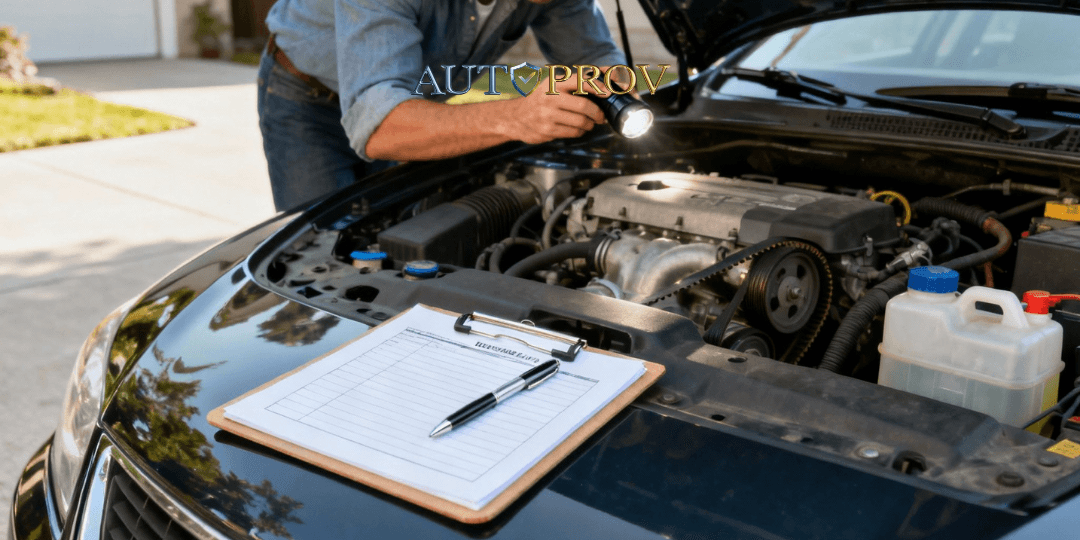
Open the bonnet and have a good look around the engine bay. You are looking for a few key things:
- Cleanliness: An engine bay that has been aggressively steam-cleaned can be a deliberate attempt to hide oil and fluid leaks. Conversely, an engine caked in fresh oil is an obvious sign of a problem.
- Chassis Legs and Strut Tops: Inspect the main chassis legs for any signs of creasing, poor welding, or fresh paint. These are critical structural parts. If they have been repaired, walk away.
- Fluid Levels and Condition: Check the dipstick and the coolant. Is the oil black and sludgy? Is there a creamy, mayonnaise-like film on the oil cap or a greasy sheen in the coolant? Both are tell-tale signs of head gasket failure, a repair bill you do not want.
Do not forget to check the tyres. Uneven wear—where just the inner or outer edges are worn—is a direct pointer to alignment problems. That could be caused by worn-out suspension components or, more worryingly, hidden damage from a pothole or kerb impact.
Correlating Interior Wear with Mileage
Finally, get inside. The interior is your last chance to verify the mileage. The condition of the cabin has to be consistent with the number on the odometer and the mileage check UK records you have already pulled.
Pay close attention to high-contact points. A vehicle with a claimed 40,000 miles should not have a steering wheel that is worn shiny and smooth, a collapsed driver's seat bolster, or pedal rubbers worn down to the metal. These are classic giveaways of a "clocked" vehicle. If the interior looks like it has done 100,000 miles but the dashboard says 40,000, trust your instincts. Something is wrong.
For a more granular breakdown of what to look for, make sure you check out our guide on building your ultimate used car inspection checklist.
Strategic Valuation and Negotiation
 Once you have done your digital vetting and given the vehicle a proper physical inspection, you are into the final stage: the valuation. Securing your profit is not about taking a number from a pricing guide; it is about methodically adjusting that baseline figure with all the intelligence you have gathered.
Think of the book price from a guide as your starting point. It is a generic value for a perfectly average vehicle. Your job, as a professional, is to determine exactly where this specific vehicle sits in relation to that average. The only way to buy a used car profitably is to price it against its true risk profile, not just its make and model.
Adjusting Value Based on Provenance Intelligence
The art of valuation is in putting a pound value against the vehicle's history. A detailed vehicle provenance report gives you the evidence to make those adjustments confidently. It turns what could be a subjective guess into a data-driven business decision.
Every piece of information you have uncovered translates directly into your buying price. For example:
- A vehicle with a single, long-term owner and a flawless, main-dealer service history can easily command a premium over the guide price. It is a low-risk, desirable piece of stock.
- Conversely, a vehicle with flagged mileage discrepancies or a history of being passed around carries significant motor trade risk. It demands a substantial reduction from the guide price.
This is where advanced trade vehicle intelligence becomes essential. Using a platform like AutoProv to highlight patterns—like short-term ownership or large gaps in the MOT history—gives you a documented case for your valuation. This is not just about paying less; it is about paying the correct price to account for future holding costs, potential reconditioning bills, and the simple fact that a higher-risk vehicle is harder to retail.
The core principle is this: your buying price must reflect the vehicle's true story. A 'clear' vehicle on paper that has been sold three times in 18 months is not a clean vehicle in reality, and its price must reflect that instability to protect your margin.
Leveraging Evidence in Trade Negotiations
Negotiating in the motor trade is a different game from a retail sale. It is less about charm and more about a factual exchange based on solid evidence. Whether you are at an auction, on another dealer's forecourt, or dealing with a private seller, your power comes directly from the quality of your research.
Armed with a comprehensive used car history report, you can steer the conversation away from opinion and towards the facts. Instead of saying, "I think it's worth less," you can state with confidence, "The guide price is £X, but given the two keeper changes in the last 12 months and the 8-month gap in its MOT history, my price is £Y to mitigate that risk."
This approach is effective in different sourcing situations:
- With Private Sellers: They are often completely unaware of the risk signals their vehicle's history is sending to a trade buyer. Presenting a provenance report that shows inconsistent mileage is a powerful, non-confrontational way to justify a lower offer.
- At Auction: You have minutes, sometimes seconds, to make a decision. Having a report that flags a critical risk like a mileage anomaly lets you confidently set a hard bidding limit or walk away entirely.
- Dealer-to-Dealer: When you are trading with other professionals, documented evidence is the expected standard. A report showing a clear, positive history can help you secure a vehicle, while one flagging issues gives you a solid footing for negotiation.
In the UK used car market, focusing on vehicles aged 3-5 years is often one of the smartest buying strategies, as this is where values tend to stabilise while retail demand is at its peak. Recent market analysis shows vehicles in this age bracket made up a significant portion of the UK's used car market. For traders, this highlights the immense value of using advanced history checks to verify stock from this prime age bracket, which can help boost margins by up to 15-20% on verified low-risk vehicles. You can find a deeper analysis of the UK used car market and its dynamics here.
Ultimately, your valuation and negotiation strategy should be a direct output of your research. For a more detailed look into this crucial step, you can review our dedicated article on mastering car valuation and accurate vehicle pricing. This methodical, evidence-based approach is what separates speculative buying from professional, profitable acquisition.
Finalising the Purchase and Post-Acquisition Workflow
You have done the checks, inspected the vehicle, and agreed on a price. Now comes the part that truly protects your business. A successful deal is not sealed with a handshake; it is locked down with meticulous paperwork that creates a watertight audit trail.
This final stage is where the risk officially transfers from the seller to you. It is your last chance to ensure everything you have learned about the vehicle lines up perfectly with its legal reality.
Essential Documentation and Verification
Before any money changes hands, it is time to be forensic with the paperwork. Every document is a piece of the puzzle, and your job is to ensure none are missing or forged.
Your must-have checklist should include:
- V5C Logbook Verification: This is non-negotiable. Is the seller's name and address on the V5C the same as the identification they are showing you? Check the serial number and watermark on the V5C itself – fakes are more common than you might think.
- Service History and Receipts: Do not just glance at the stamps in the service book. Cross-reference them with the actual receipts. Do the dates and mileages align with the MOT history and the vehicle provenance report you have already run? Any gaps require a solid explanation or a reduction in price.
- Spare Keys and Manuals: Having a full set of keys, the original book pack, and the locking wheel nut key is not just a bonus for retail. It is a good sign of a careful owner. If keys are missing, that cost must be factored into your buying price.
A classic red flag for motor trade risk is a seller who is not the registered keeper on the V5C. Be very wary of the "I'm selling it for a mate" line. It can be a tactic to sell a vehicle with hidden problems or, in the worst cases, a sign of fraud.
To make the transaction secure, a clear and comprehensive sale agreement is vital. You can learn about the key elements to include in our guide to creating a contract for vehicle sale that protects your dealership.
Post-Acquisition Workflow on the Forecourt
The moment a new vehicle lands on your premises, your internal process should begin. A slick workflow ensures every piece of stock is handled efficiently, consistently, and is primed for retail from day one.
The first step is booking it into your stock management system. This is where all the intelligence you gathered during your due diligence becomes a powerful sales asset, not just a buying tool.
Your post-acquisition process should be simple and repeatable:
- Log and Store Intelligence: Attach the used car history report to the vehicle's digital file. Ensure the advanced trade vehicle intelligence from a platform like AutoProv is saved permanently. This creates a fully auditable record of the vehicle’s history and the checks you have carried out.
- Schedule Prep Work: Based on your physical inspection, get the vehicle booked straight into your workshop or with trusted partners for any reconditioning, servicing, or smart repairs.
- Inform the Sales Team: Arm your sales staff with a summary of the vehicle’s strong points. A one-owner vehicle with a flawless history can be marketed with confidence and command a premium price. Equally, knowing about past advisories allows them to handle customer questions with transparency and professionalism.
This structured approach transforms a newly acquired vehicle into a retail-ready asset with a clear, demonstrable history that builds trust with its next owner.
Frequently Asked Questions for Motor Traders
Even experienced traders have questions when it comes to fine-tuning their buying process. Here are some direct answers to common queries we hear from professionals about sourcing stock and managing risk.
What Is the Single Biggest Mistake Traders Make When Buying Used Stock?
The most common and costly mistake is relying solely on a basic history check and assuming a "clear" report means you are safe. It does not. Those standard checks often miss the biggest financial threats.
These are the issues that truly impact a vehicle's value and your ability to sell it—such as rapid ownership changes or anomalous mileage patterns between MOTs. Overlooking this leaves you exposed to buying vehicles with recurring faults or a history of being passed around the trade.
How Can I Quickly Vet a Car at Auction?
At an auction, there is no time for a lengthy inspection. Speed is crucial. Before you consider bidding, you must run a quick but deep analysis using a dedicated trade vehicle intelligence tool on your mobile device.
Focus on two key areas:
- Ownership Timeline: Is there a history of short ownership stints? Anyone selling a vehicle in under 6-12 months is a significant red flag. It is a classic sign of a "problem vehicle" that someone is keen to offload.
- MOT Mileage Graph: Scrutinise the graph. Are there strange drops, long flat periods, or sudden jumps? These are fast, visual clues that indicate potential clocking or extended time off the road.
These two checks are your most effective filters for weeding out unsuitable stock in seconds, long before the hammer falls. A quick mileage check UK can save you thousands.
The ability to instantly pull up and understand a vehicle’s complete provenance on your mobile is no longer a luxury—it’s an essential tool for protecting your capital in a fast-moving auction environment.
Is It Worth Paying More for a Vehicle with Full Service History?
Absolutely, but with one crucial condition: you must verify it. A complete, stamped-up service book from reputable garages makes a vehicle far easier to sell and can add a healthy amount to its retail value, reducing your motor trade risk.
However, never take it at face value. The verification step is where you protect your investment. Always cross-reference the service dates and recorded mileages with the official MOT history and the ownership timeline from your used car history report. When all that data aligns, a full history becomes a significant profit driver.
To navigate the complexities of vehicle acquisition and protect your margins, you need intelligence that goes beyond basic checks. AutoProv delivers advanced vehicle provenance and risk insights, built specifically for the UK motor trade.
Discover how AutoProv can strengthen your buying decisions today.
Frequently Asked Questions
AI-Generated Content Notice
This article was created with the assistance of artificial intelligence technology. While we strive for accuracy, the information provided should be considered for general informational purposes only and should not be relied upon as professional automotive, legal, or financial advice. We recommend verifying any information with qualified professionals or official sources before making important decisions. AutoProv accepts no liability for any consequences resulting from the use of this information.
From our AI insights
- Auction Pitfalls: Avoiding Costly Mistakes
Navigate UK car auctions with confidence by avoiding finance, write-off, and mileage risks.
- Mastering Paint Code Checks: Detecting Hidden Car Repairs
Discover how to use paint code verification to identify hidden car repairs and ensure a smarter purchase.
- UK Part-Exchange Checks: Protecting Dealer Margins
Explore essential part-exchange checks for UK dealers to safeguard profit margins, including provenance and finance verification.
Related Articles

Your Ultimate Guide to Buying a Used Car in the UK
Navigate the UK used car market with confidence using our comprehensive buying guide. Tips, checks, and AutoProv Provenance insights included.

Difference Between MOT and Service: What You Need to Know
An MOT is a mandatory legal inspection that every car on UK roads needs to pass.Think of it as the government's way of ensuring your vehicle meets the absolute minimum safety and environmental standards to be considered roadworthy. A service, on the other hand, is a completely different beast. It's the proactive maintenance routine recommended by the people who built your car, designed to keep it running smoothly and catch problems before they start. In short, an MOT is a pass-or-fail exam required by law. A service is a comprehensive health plan for your car.
Your Ultimate Used Car Inspection Checklist
A solid used car inspection checklist is the single most powerful tool you have to avoid buying a lemon. It gives you a methodical way to look past the shiny paint and assess a car's real condition, helping you spot hidden problems and get a fair price before you shake hands on the deal.
Published by AutoProv
Your trusted source for vehicle intelligence