For any professional in the motor trade, a bike history check is not just another step in the process—it is your first and most important line of defence against a bad investment. It is the tool that instantly pulls back the curtain on a motorcycle's past, flagging up everything from outstanding finance and write-off status to theft markers. Skipping it is a gamble you just cannot afford to take.
Why a Professional Bike History Check Is Essential
In the fast-moving world of buying and selling bikes, every decision hits your bottom line. Overlooking a proper history check is not just a minor slip-up; it is a massive business risk. A quick walk-around and a test ride will never uncover the hidden liabilities tied to a bike that looks perfect on the surface.
Imagine this scenario: you bring in a bike that still has an outstanding Hire Purchase (HP) agreement on it. Without you knowing, the finance company is still the legal owner until that debt is cleared. They have every right to show up and repossess it straight from your forecourt, leaving you with a total loss and a serious dent in your professional reputation.
The True Cost of Incomplete Data
Basic checks just do not cut it. They might pull up the MOT history, but they will completely miss the deal-breaking red flags that can cripple your business. This is where a professional-grade service from a provider like AutoProv becomes absolutely essential.
A proper report from AutoProv pulls together crucial data from multiple high-stakes sources, giving you the full picture. This includes checking for outstanding finance by directly referencing Experian records to uncover any live finance agreements. It flags if the bike has ever been declared a write-off, such as a Cat S or Cat N. It also cross-references the bike against the Police National Computer (PNC) to ensure it is not stolen property.
A thorough bike history check elevates due diligence from a simple box-ticking exercise into a powerful risk management strategy. It’s about protecting your capital, safeguarding your name, and making sure every bike you stock is a solid asset.
Turning Due Diligence into an Advantage
By building a professional history check into your buying process, you shift from being reactive to proactive. When you have complete and accurate information at your fingertips, you can make confident buying decisions in seconds. To get a real sense of the detail involved, it is worth taking a moment to explore the comprehensive features of professional history checks available on dedicated platforms like AutoProv.
Ultimately, this is not just about dodging bad stock. It is about building a business on a foundation of certainty and trust. You can learn more about the critical importance of checking for outstanding finance in our detailed guide on the subject.
Decoding the Data in Your Bike History Check
A proper bike history check is so much more than a quick look at the MOT and tax status. It is about piecing together the bike’s entire story from multiple, often hidden, data sources. Getting this right is the difference between an accurate valuation and a catastrophic financial hit—not to mention protecting your dealership’s hard-earned reputation.
Unpacking this data correctly is what separates a sharp buy from a disaster waiting to happen. A trade-grade service like AutoProv is designed to pull all these disparate datasets together, presenting them in a single, clear report so you can make fast, evidence-based decisions on the spot.
Scrutinising Outstanding Finance Agreements
One of the single biggest risks when taking on new stock is undisclosed finance. A bike might look like a clean asset, but if there's an outstanding Hire Purchase (HP) or Personal Contract Purchase (PCP) agreement tied to it, the finance company is still the legal owner.
An AutoProv report pulls data directly from Experian, giving you an immediate red or green light. But understanding the nuances is what really matters. For instance, with a Hire Purchase agreement, the lender owns the bike until the final payment. If you buy a bike with live HP finance, it can be repossessed from you or your customer without compensation. With a Personal Contract Purchase, while the lender still has a financial interest, there's a final "balloon" payment. Uncovering an active PCP plan is a critical negotiation point, as the seller has absolutely no right to sell until that finance is settled.
Skipping this check is a high-stakes gamble. You stand to lose the entire value of the bike and the money you paid for it.
Interpreting Write-Off Categories
The next crucial layer of data you need to dissect comes from the Motor Insurance Anti-Fraud and Theft Register (MIAFTR). This is the database that records any vehicle an insurer has declared a total loss, or "write-off."
A write-off marker doesn't automatically mean you should walk away, but it dramatically impacts the bike's value and your ability to sell it. Understanding the specific category is essential for accurate pricing and transparency with future customers.
The modern categories you will come across are Category S (Structural), where the bike has sustained damage to its core structural frame or chassis, and Category N (Non-Structural), which points to cosmetic, electrical, or other damage that does not affect the frame. A bike with a Category S marker can be professionally repaired, but its resale value will be significantly lower. Category N bikes are often seen as less of a risk, but you still have to account for the repaired damage when pricing it.
A clean report from AutoProv with no write-off history gives you the confidence you need to move forward. You can find out more about the different types of information available in our guide to understanding a motorcycle's service and maintenance history.
Cross-Referencing Police and DVLA Records
Finally, a complete bike history check from AutoProv pulls together vital information from the Police National Computer (PNC) and the DVLA to nail down two other critical points: theft and mileage integrity. A check against the PNC will instantly flag if a bike has been reported stolen, stopping you from illegally purchasing stolen goods.
At the same time, DVLA data provides the full MOT history, which lets you spot mileage discrepancies or strange gaps between tests. This is your best defence against clocked bikes and helps build a far more accurate picture of how the vehicle has been used and cared for. To really master using this data strategically, understanding the principles of competitive intelligence gathering can be a massive advantage.
By combining all these checks, you get a full, 360-degree view of any motorcycle’s past, turning uncertainty into a solid, profitable decision.
How to Spot Red Flags and Interpret the Results
Getting a data report is just the starting line. Knowing how to read between the lines is what separates a profitable buy from a costly headache. A comprehensive bike history check from AutoProv lays out all the raw data; your expertise is what connects the dots and flags the subtle warning signs.
This is where the real work begins. You need to develop a gut feeling for what looks right and what sets off alarm bells, turning a page of data into actionable intelligence for your business.
Analysing Mileage and MOT Patterns
One of the most common red flags you will find is a dodgy mileage record. It is rarely as simple as a blatant rollback; the clues are usually buried in the patterns of MOT tests and service logs.
For example, you might see a bike that clocked up 15,000 miles in its first couple of years, but then only 500 miles over the next three. Now, this could be innocent—maybe the owner was ill or working abroad—but it absolutely demands a closer look. An unusually long gap between MOTs is another tell-tale sign that the bike could have been off the road, possibly due to major damage that was never reported to an insurer.
This is exactly why a detailed report from AutoProv is so vital. If you spot a weird pattern, your next move is to ask the seller for the story. If they cannot give you a believable explanation or show you the service history to back it up, you need to tread very, very carefully. You can get more specific advice in our guide on how to perform a DVLA mileage check.
A single piece of data rarely tells the whole story. The real skill lies in seeing how different data points—mileage, finance history, and MOT advisories—interact to paint a complete picture of the motorcycle's life.
Uncovering Suspicious Finance and Ownership Cycles
Another critical area to dig into is the finance and ownership history, especially on pricier models. A single, straightforward finance agreement that has been fully settled is perfectly normal. However, certain patterns should make you stop and think.
Imagine a premium sports bike that has changed hands three times and had two separate finance agreements settled within just 18 months. That kind of rapid turnover is a massive red flag. It could easily point to a persistent, niggling mechanical issue that is being passed from one frustrated owner to the next.
This is where an AutoProv report gives you a real edge. By flagging these historical finance markers, it arms you with the right questions to ask, such as why the bike was sold so quickly after the last finance was settled, or if there are any recurring issues noted in its service history. If the answers feel vague or do not add up, it is a clear sign to renegotiate the price to cover the potential risk. In some cases, it is a signal to walk away altogether. Your goal is not just to buy stock; it is to buy good stock. Interpreting these subtle warnings is the key to making sure every bike on your forecourt is a solid, profitable asset, not a hidden liability waiting to bite you.
Integrating Bike Checks into Your Buying Workflow
In the motor trade, speed and accuracy are everything. Profitability hinges on making smart decisions quickly, especially when you are at an auction or sizing up a potential part-exchange. Making a professional bike history check a seamless part of your daily operations is not just good practice—it is a decisive competitive advantage.
The goal is to move from manual, fragmented checks to a fluid, integrated process. A modern workflow means you can be stood next to a motorcycle, enter its reg into a tool like AutoProv on your phone, and have the full story in seconds. This speed transforms your buying strategy.
From Initial Appraisal to Final Handshake
Imagine you are at a busy auction. A dozen other traders are eyeing up the same high-value sports bike. While they are still making educated guesses, you have already run a comprehensive check with AutoProv. In under 30 seconds, you know its finance status, write-off history, and mileage integrity.
This is not about rushing; it is about being informed faster than anyone else. By pulling data from over 10 sources—including Experian, the DVLA, and the Police National Computer—into a single report, you gain immediate certainty. This lets you bid with absolute confidence, securing the best stock before your competitors have even finished their initial walk-around. This workflow should be as standard as the steps in this professional guide for checking a used car.
The process flow below shows just how quickly you can spot the key indicators—from mileage gaps to finance issues—and decide whether it is a good deal.
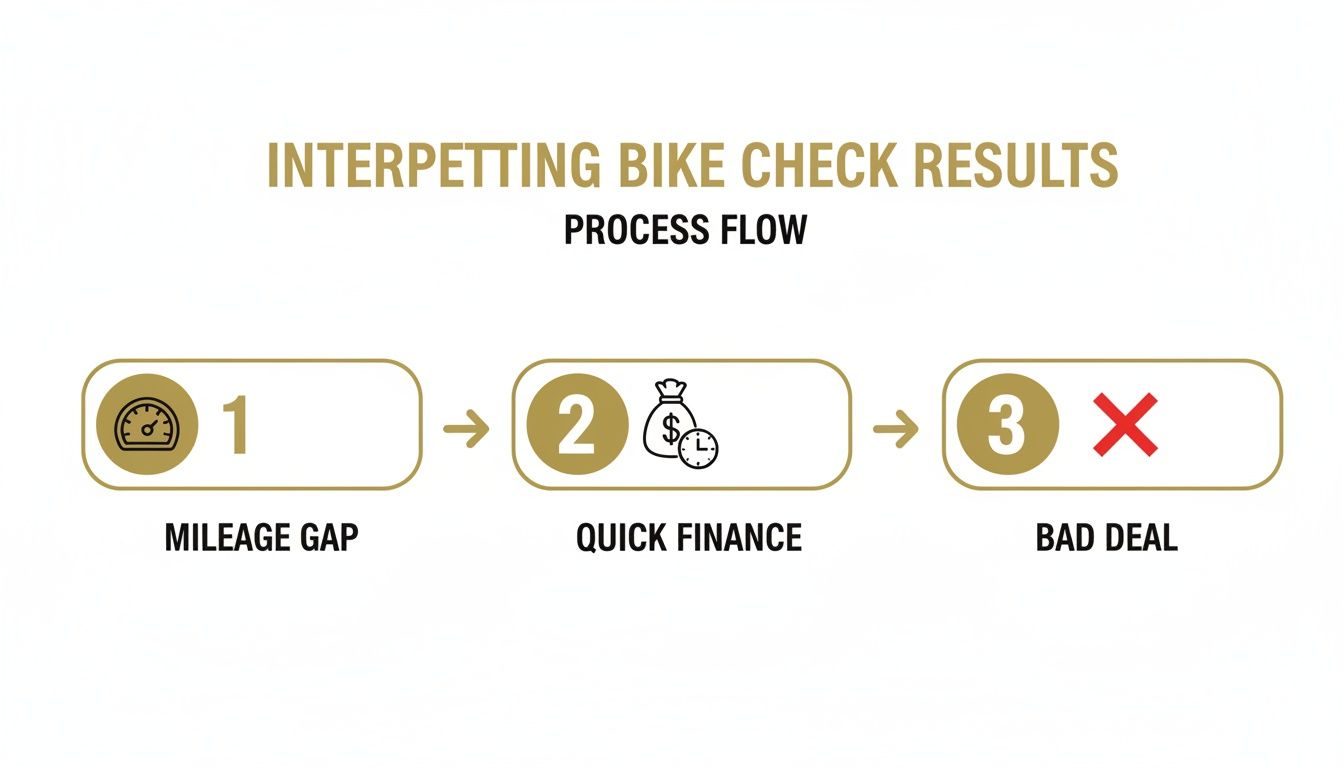
This visual breaks it down: a streamlined check immediately flags the red flags, letting you make a swift, confident call to proceed or walk away.
Adding a Financial Safety Net
For particularly high-value acquisitions, your due diligence needs an extra layer of protection. This is where an indemnity guarantee becomes a non-negotiable part of your workflow. Even with the best data, the unexpected can happen.
Integrating an instant check is no longer just about avoiding bad bikes. It's about building a repeatable, efficient process that consistently secures the most profitable stock for your dealership.
Services like AutoProv offer an optional Experian indemnity of up to £50,000. This is not just a feature; it is a financial backstop. If a check provides incorrect information regarding finance or other specified data points that results in a loss, this indemnity covers your investment.
Think of it as professional insurance for your professional judgement. By making this optional cover a standard part of your process for any bike over a certain value, you effectively eliminate the financial risk associated with a hidden history. This final step completes the workflow, giving you not just data-driven confidence but also a robust financial guarantee that protects your bottom line.
Using Data for Smarter Pricing and Stock Management
A professional bike history check does a lot more than just give you a thumbs-up or thumbs-down on a potential purchase. Think of it as a deep well of business intelligence that you can use to really sharpen your competitive edge. When you stop seeing it as just a way to dodge a lemon, the rich data inside an AutoProv report becomes a tool for making smarter, more profitable decisions across the board.
It is about shifting from a defensive mindset to a proactive strategy. The check becomes your tool for optimising how you manage your entire stock, letting you price bikes for maximum margin and ensuring your forecourt is filled with metal that actually moves.
Fine-Tuning Your Pricing Strategy
Accurate pricing is the absolute bedrock of a profitable dealership, but nailing it without real-time market data is a mug's game. An AutoProv report cuts through the noise, giving you clear, current trade versus retail valuations. This gives you a solid, fact-based baseline for every single negotiation.
With this data, you can finally move beyond guesswork and confidently set prices that reflect a bike's true market value, taking its entire story into account. A bike with a flawless record and only one or two owners can rightly command a premium. On the flip side, one with a repaired Category N write-off needs to be priced aggressively to find the right buyer. Our guide to vehicle valuations and market insights shows you exactly how this works in the real world.
Think of the history check as your pricing playbook. Every data point—from the number of previous owners to MOT advisories—is a piece of information that helps you define the bike’s exact value in the current market.
This level of detail is absolutely critical in today's choppy market. We have all seen the sharp downturn after the post-pandemic boom, with mechanical bike sales hitting a two-decade low in the UK. Industry revenue has taken a hit, with total mechanical bike volumes falling 22% in 2022 alone. In this climate, precise, data-driven pricing is not just a nice-to-have; it is essential for survival.
Informing Your Purchasing and Stocking Decisions
The intelligence from a bike history check should also be your guide for what you choose to buy in the first place. AutoProv reports do not just tell you a bike's past; they give you a glimpse into its future with key metrics like desirability scores and depreciation trends. This is what helps you spot the models that are in hot demand versus the ones that are likely to gather dust on your forecourt.
Imagine you are looking at two similar bikes. The AutoProv report might show that one has a much stronger desirability score and a slower, flatter depreciation curve. This insight is gold. It allows you to prioritise high-demand models that will sell fast, avoid overpaying for bikes that are about to drop in value, and identify undervalued gems that other dealers might overlook.
By weaving this information into your buying strategy, you can build a more profitable inventory from the ground up. You will stop tying up capital in slow-moving stock and can focus your resources on the bikes that actually deliver the best possible return on your investment.
Got Questions About Motorcycle History Checks?
When you are looking to integrate a new tool into your buying process, a few questions always crop up. Speed, accuracy, what is really included – these are the things that matter on the ground. Let's tackle some of the most common queries we hear from motor trade pros.
Getting the right information quickly is often the difference between bagging the best stock and watching it drive away on your competitor's transporter. You need answers you can trust, delivered in seconds, not minutes.
How Quickly Can I Actually Get a Report?
In the fast-and-furious environment of an auction hall or a seller's driveway, every second is precious. With a professional platform like AutoProv, you are looking at a full, comprehensive bike history report in under 30 seconds.
This is not a stripped-back summary; it is the full works. That kind of speed means you can do your due diligence right there on the spot, making an informed call on a bike before anyone else has even loaded a webpage.
What’s the Real Difference Between a Free Check and a Professional One?
This is a big one, and the distinction is critical. A free check will only ever give you the basic, publicly available DVLA data – think MOT history and tax status. It completely misses the high-risk, high-stakes information that can turn a profitable bike into a financial nightmare.
A professional, trade-grade report from AutoProv is a different beast entirely. It includes the crucial data you simply cannot get for free, such as outstanding finance information pulled directly from Experian, stolen vehicle status checked against the Police National Computer, and write-off history sourced from the Motor Insurance Anti-Fraud and Theft Register. These are the checks that protect your investment, your dealership, and your reputation.
The real value of a professional check is in the data you can't get for free. It’s the finance, theft, and write-off history that reveals a bike’s true story and stops you from making a catastrophic buying mistake.
Can I Check a Bike Without the V5C Logbook?
Yes, absolutely. To run a complete, detailed history check with AutoProv, all you need is the bike's registration mark (VRM) – its number plate.
Of course, you will still need to see the V5C to verify the seller's details and finalise the purchase later. But for that initial, on-the-spot appraisal of a potential piece of stock, the VRM is all it takes to get the instant intelligence you need.
At AutoProv, we deliver the instant, trade-grade data you need to buy bikes with absolute confidence. Our reports consolidate over 10 trusted data sources into a single, easy-to-read format, delivered in seconds. Protect your business and make smarter buying decisions today by visiting https://autoprov.ai.
Frequently Asked Questions
AI-Generated Content Notice
This article was created with the assistance of artificial intelligence technology. While we strive for accuracy, the information provided should be considered for general informational purposes only and should not be relied upon as professional automotive, legal, or financial advice. We recommend verifying any information with qualified professionals or official sources before making important decisions. AutoProv accepts no liability for any consequences resulting from the use of this information.
From our AI insights
- Navigating UK Grey Imports: A Trader's Guide
Understand the complexities and opportunities of UK grey imports for savvy motor traders.
- Navigating Private Plate Challenges in UK Vehicle Checks
Learn how private plates affect UK vehicle checks and how traders verify provenance and spot cloning risks.
- Navigating VIN Checks Post-Brexit: What UK Traders Need to Know
Discover how Brexit impacts VIN checks for UK traders and the crucial data to review.
Related Articles

Essential Vehicle Checks Before Buying a Used Car
Learn essential checks to ensure your used car purchase is safe and sound in the UK market.

Why a Provenance Check is Essential for Used Car Buyers
Ensure your used car is a smart investment by understanding the importance of a provenance check and how AutoProv can help.

A Guide to Vehicle Check with VIN Number
A vehicle check with vin number is easily the most important thing you can do before buying a used car. Think of it as your first line of defence—a quick, simple step that pulls back the curtain on a vehicle's past, protecting you from expensive mistakes, legal headaches, and downright dangerous cars.
Published by AutoProv
Your trusted source for vehicle intelligence