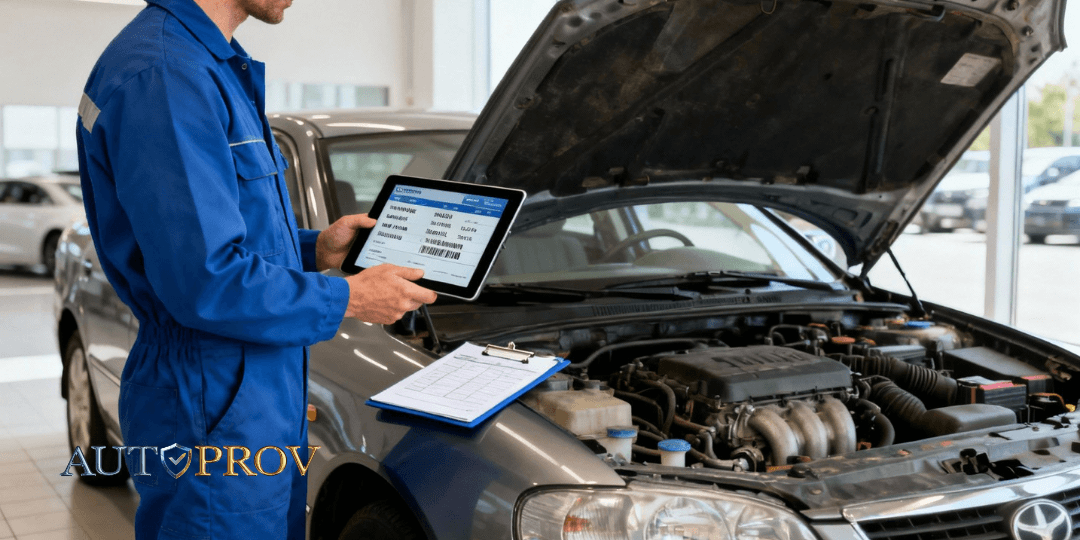
Knowing how to properly check a used car comes down to three things: digging into its digital history, getting hands-on to confirm its mechanical condition, and nailing its true market value. For anyone in the motor trade, this isn't just about avoiding duds; it's about building a solid, data-backed process to secure profitable stock and protect your bottom line.
Moving Beyond the Tyre Kick: A Modern Approach to Vehicle Appraisal

In today's fast-moving used car market, old habits like giving the tyres a kick just don't cut it anymore. It’s a shortcut to losing money. A shiny bonnet can easily hide a nightmare of outstanding finance, an undeclared accident, or years of missed services. For professionals, the game has changed completely. Whether you're at the auction, appraising a part-exchange, or buying privately, your decisions have to be backed by a systematic, data-first approach.
This guide is about moving past the superficial visual checks and adopting a workflow that the pros use. A proper modern appraisal is built on a foundation of hard data, ensuring every car you buy is a calculated investment, not a gamble.
The Three Pillars of Modern Vehicle Appraisal
A profitable purchase is built on three critical pillars. Get one wrong, and that potential forecourt star can quickly become a costly liability.
First, you must verify its digital provenance. This is your first line of defence, and it happens before you even see the metal. You need to confirm the car’s identity, its legal status, and its entire recorded history. That means checking for outstanding finance, stolen markers, and any write-off history. No exceptions.
Second, you have to confirm its mechanical integrity. Once the digital footprint checks out, it's time for a thorough physical inspection. This is where you verify if the car’s real-world condition matches what the reports say and uncover any hidden issues that could eat into your margin.
Third, and finally, you need to accurately assess its market value. This is the final piece of the puzzle, knowing exactly what the vehicle is worth today. This isn't about gut feelings; it's about using real-time market data to pinpoint its trade and retail value, so you know your potential profit before you make an offer. For this, a solid car valuation tool for the UK is non-negotiable.
The real challenge for dealers today isn't just finding stock; it's finding the right stock. A data-driven approach removes the guesswork, allowing you to identify vehicles with a clean history and strong profit potential in seconds.
This is where a professional tool like AutoProv becomes essential. By pulling everything together into instant reports covering over 40 business-critical data points, it turns a fragmented and time-consuming job into a single, streamlined process. It lets you see a car’s complete history and its market position before you commit a penny, protecting both your capital and your reputation.
Starting with the Paper Trail: Document and Identity Verification

Before you even think about touching the car, the real work begins with the paperwork. This is where you uncover the vehicle's true story, and getting it wrong can be catastrophic. We're talking about everything from unwittingly buying a stolen or cloned car to discovering it's still legally tied to someone else.
The very first thing you need to get your hands on is the V5C logbook. Don't just give it a quick glance; treat it like a forensic document. Does the seller's name and address on their driving licence match what's printed on the V5C? Even a small discrepancy is a massive red flag that you need to dig into, no excuses.
Cross-Referencing the VIN: The Non-Negotiable Check
Think of the Vehicle Identification Number (VIN) as the car's unique fingerprint. This 17-digit code is your golden ticket to confirming a car is what it claims to be. It absolutely must match in three places: on the V5C, on the car itself, and on your vehicle history report. Any mismatch is a classic sign of a cloned car, where a thief has slapped the identity of a legitimate vehicle onto a stolen one.
You'll need to physically find the VIN on the car. Get your hands dirty and look in the usual spots: at the bottom of the windscreen, usually on the passenger's side; on a sticker inside the driver's side door jamb; or stamped directly onto the chassis, often under the bonnet or in the boot.
Scrutinise the VIN plate or sticker. Has it been tampered with? Look for scratches, weird-looking rivets, or any sign it's been peeled off and stuck back on. The stamping should be clean, clear, and uniform.
A recently issued V5C can sometimes be a warning sign. While there are legitimate reasons for a replacement, criminals often apply for a new logbook to try and erase a vehicle's shady past or to assist in a cloning scam. Always question why a new one was needed.
This hands-on, physical check is vital, but it's only one piece of the puzzle. You still need to confirm that what you're seeing matches the official records held by the DVLA.
Using Technology as Your First Line of Defence
This is exactly where a professional tool like AutoProv comes in. Before you waste time arranging a viewing, you can run the registration number and get an instant, definitive check against official DVLA data. An AutoProv report immediately confirms the correct VIN, engine number, and vehicle colour, and it verifies when the current keeper acquired the vehicle. This one quick check can expose a scam in seconds, saving you from a wasted trip or, far worse, a disastrous purchase. It pits the seller's story against cold, hard data—a cornerstone of any professional how to check a used car process.
If the details in your AutoProv report don't line up perfectly with the V5C and the VIN on the car, just walk away. There's simply no good reason for these fundamentals to be out of sync. For a closer look at this critical document, our quick guide on what a V5C document is is well worth a read. Learning to spot the subtle signs of forgery on a logbook, like poor print quality or missing watermarks, is a skill that truly separates the pros from the amateurs.
Uncovering a Vehicle's Hidden Financial and Legal History
Once you've confirmed a vehicle's identity, the real detective work begins. You need to dig into its financial and legal background. A car with a clean MOT and shiny paintwork can easily hide a toxic past, one that could vaporise your profit margin or, worse, land your business in serious trouble.
This is where you separate the genuinely good stock from the liabilities dressed up with a fresh valet. The three biggest landmines you're looking for are outstanding finance, stolen markers, and an undisclosed write-off history. Each one is a deal-breaker. Buying a car with finance still attached means the finance company legally owns it, not the seller. If they stop paying, that car is getting repossessed from your forecourt, leaving you with a total loss.
Navigating Outstanding Finance
One of the most common—and costly—mistakes in the motor trade is skipping a finance check. It's surprisingly frequent. A huge number of vehicles on the market still have an active finance agreement tied to them. Sometimes the seller isn't even trying to pull a fast one; they might genuinely not realise they can't legally sell the car until the loan is completely paid off.
Without a proper check, you could pay good money for a car you'll never legally own. When the finance company tracks it down, you'll have no choice but to hand it over. Your investment? Gone. For a deep dive into the risks, it's worth understanding exactly how to check for outstanding car finance in the UK.
The rule is simple: never, ever take the seller's word for it. Always run a finance check. A vehicle with outstanding finance is a ticking time bomb that can detonate your capital and your reputation.
This is why an instant check is non-negotiable. AutoProv pulls data directly from Experian, one of the UK's top credit reference agencies, to give you a definitive answer on the spot. In less than 30 seconds, you’ll know if the vehicle is clear or if there’s a financial interest registered against it, protecting your business from what could be a devastating mistake.
Stolen and Written-Off Vehicle Checks
Just as damaging is the risk of buying a stolen car or an undisclosed write-off. Accidentally buying a stolen vehicle is a legal nightmare. The police will seize it and return it to its rightful owner or insurer, leaving you with another complete financial loss. Checking against the Police National Computer (PNC) is the only way to be sure of a vehicle's status. This isn't a check you can afford to skip or put off.
Then there’s the write-off history, which massively impacts a car's value and safety. Insurers classify damaged vehicles into categories, with Category S (structural damage) and Category N (non-structural damage) being repairable. While these cars can legally be put back on the road, that history must be declared. Miss a previous write-off and you can kiss your margin goodbye. The market value for a Cat S or N vehicle is significantly lower than for a car with a clean record. If you pay full whack only to discover its past later, your profit is already gone.
This happens more than you’d think. UK data reveals that 1 in 50 used cars (2%) has an undisclosed write-off history, which can slash its value by 60-80%. With millions of used transactions happening, the market is complex. As Cox Automotive notes, residual values are under pressure, making every check more important than ever.
AutoProv cuts through these risks by rolling all three critical checks into one clear report. We run every registration against Experian for outstanding finance, the Police National Computer (PNC) for stolen vehicle markers, and the Motor Insurance Anti-Fraud and Theft Register (MIAFTR) for write-off and salvage records. This unified check removes any guesswork. Instead of juggling multiple reports, you get a single, easy-to-read result that flags any financial or legal skeletons in the car’s closet. It’s the definitive way to know if the vehicle you’re looking at is a safe, profitable investment.
Verifying the Car's Story with MOT and Service Records
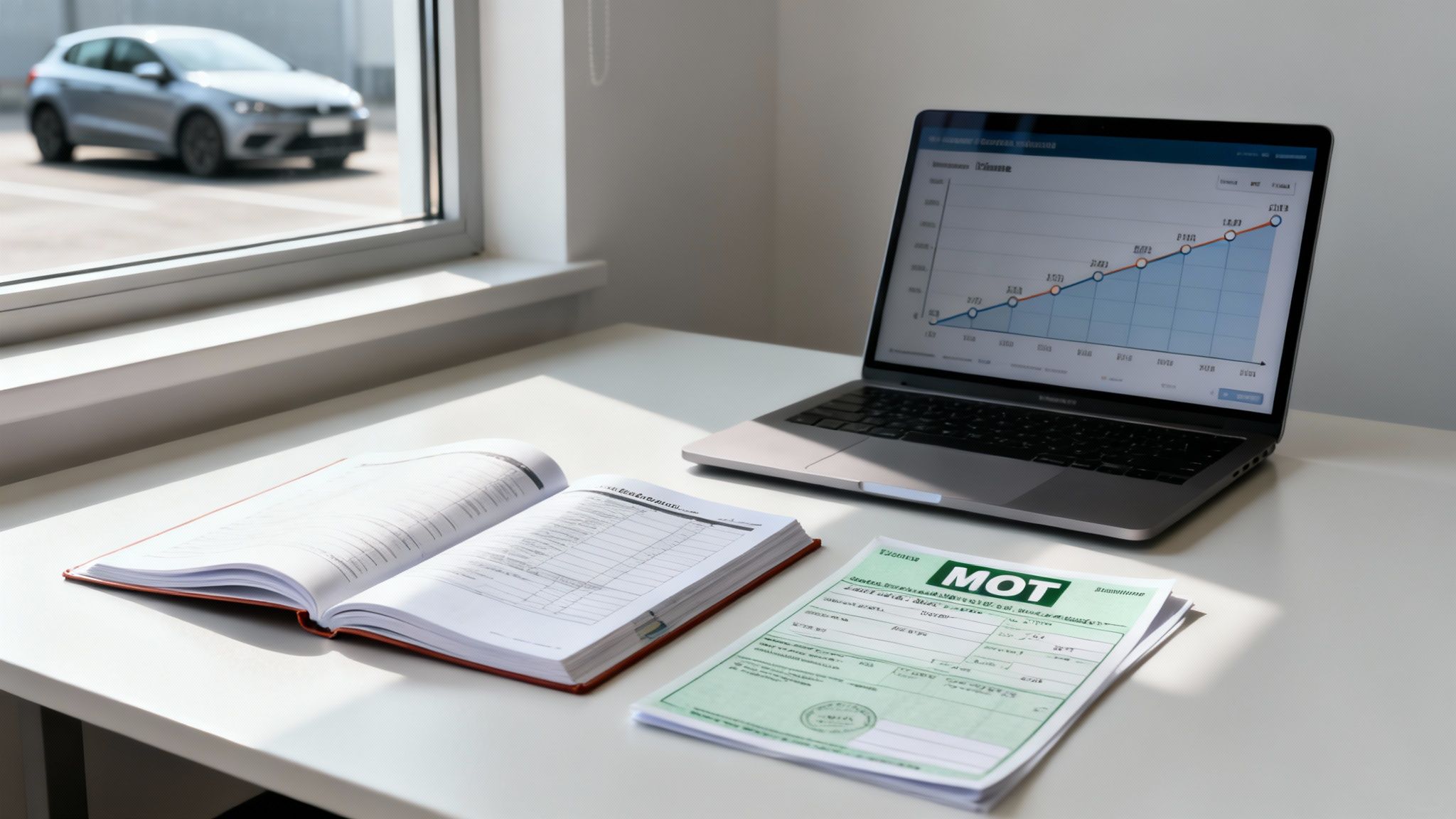
Right, you’ve confirmed the car is who it says it is and doesn't have any nasty legal or financial skeletons in the closet. Now for the interesting part: digging into its personal history. Think of the service book and MOT records as the car's CV. They tell you exactly how it’s been treated throughout its life. A well-cared-for car with a solid, documented past is always a safer bet than one with a story full of holes.
This stage of the check is less about spotting outright fraud and more about getting a real feel for future reliability and running costs. A car's maintenance history is one of the single best predictors of its future performance, making this a non-negotiable step for any serious buyer.
Reading Between the Lines of the Service History
The service book is where you start. But don't just give it a quick flick-through to see a few stamps. You need to interrogate it. A pristine, fully-stamped main dealer book is the gold standard, of course, but you've got to look closer. Are the stamps from a genuine garage? A quick Google search of the garage name will tell you if they actually exist.
Next, check the dates and mileage between each service. Consistent, timely servicing that follows the manufacturer’s schedule is a massive green flag. On the other hand, big gaps are a major cause for concern. A car that has missed services by thousands of miles—or even years—has likely been neglected. That neglect could spell serious trouble for big-ticket components like the engine and gearbox down the line. An AutoProv check helps verify this by comparing service records against other data points, giving you a fuller picture of the vehicle’s life.
Unpacking the MOT History
The MOT history is an absolute goldmine of information, and it's all publicly available. It gives you a year-by-year snapshot of the vehicle's condition and, just as importantly, its mileage. Pay very close attention to the advisory notes on past MOT certificates. These are often the ghosts of MOTs future—problems that weren't quite bad enough to fail the test then but are almost certainly going to need attention soon.
Look for patterns in the advisories. For instance, if you see recurring notes about tyre wear on one side, that could point to a deeper suspension or alignment problem. Consistent mentions of slight corrosion underneath are a clear heads-up that you'll need to factor in rust-proofing or even future welding costs.
MOT advisories are your early warning system. They highlight the small issues that the previous owner chose not to fix. For a professional buyer, they represent potential reconditioning costs that must be factored into your purchase price.
An AutoProv report conveniently pulls the entire DVLA MOT history into one clean, easy-to-read timeline. This includes every pass, fail, and advisory note ever recorded, giving you a crystal-clear picture of the car’s health over the years without having to manually trawl through government websites.
The Critical Mileage Verification Check
Mileage fraud, or "clocking," is one of the oldest tricks in the book, and it's still a huge problem. It’s a simple way to artificially inflate a car's value while hiding the true extent of its wear and tear. This is where a data-led approach is absolutely essential. Your number one tool here is comparing the mileage progression across every single MOT record.
In the UK market, scrutinising the MOT history is one of the most vital steps you can take; any oddities can point to serious issues like clocking. Industry analysis suggests that roughly 1 in 10 used cars has a suspicious mileage reading. Some estimates even suggest over 100,000 vehicles are clocked in the UK each year, costing buyers and the industry millions.
Your AutoProv report makes spotting this kind of fraud straightforward. It consolidates the DVLA MOT history and cross-references it with mileage data from over 10 other trusted sources. The system then automatically flags any glaring inconsistencies, such as mileage drops, long plateaus where the car seems to have covered suspiciously few miles, or unusual patterns that don't add up. This forensic, data-first approach ensures the story you're being told by the seller actually matches the official record. It protects you from paying over the odds for a car that's lived a much harder life than it appears.
Getting Hands-On: The Professional Inspection and Test Drive

Alright, the digital detective work is done. Now for the real acid test: getting your hands on the metal. This is where the story told by the paperwork meets reality. A quick walk-around and a spin around the block simply won't do. You need a systematic, repeatable process to spot the kind of issues that can turn a profitable car into a money pit.
Forget just kicking the tyres. Think of this as a forensic examination. You're hunting for clues of hidden repairs, signs of neglect, and the whispers of impending mechanical failure that even the most thorough valet can't erase. This is where a trained eye and a methodical approach really make the difference.
The Systematic Exterior Walk-Around
Your inspection starts before a single door is opened. Always view the car in good daylight and begin with a slow walk-around, looking at it from various distances and angles. This is the best way to catch inconsistencies in paint shade and bodywork that you might miss up close.
Get down low and pay serious attention to the panel gaps—the seams between the doors, bonnet, boot, and wings. Are they tight, straight, and consistent all the way around? If you see wide or uneven gaps, that’s a massive red flag for previous accident damage and a subpar repair job. Next, crouch down to eye-level with the side panels and look along the length of the car. This angle is your best friend for spotting the tell-tale ripples and waves that scream "body filler." While you're at it, check the paint's texture. Any "orange peel" finish or signs of overspray on rubber seals and plastic trim points directly to a cheap respray.
Finally, give the tyres a proper once-over. Are they a matching set from a decent brand? More importantly, is the wear pattern even across the tread? Uneven wear is a classic symptom of alignment problems or, worse, underlying suspension issues.
Your AutoProv report is a vital tool here. It provides the original equipment (OE) specifications for wheels and tyres. If the car is sitting on non-standard, oversized alloys, it's a red flag that could affect the vehicle's handling, safety, and insurance.
Interior and Electrics Check
Step inside. That first impression often tells you everything you need to know about how the car has been treated. Does the wear on the driver's seat bolster, steering wheel, and gear knob match the mileage on the clock? A low-mileage car with a heavily worn interior should set your alarm bells ringing.
Now, get methodical. Don't be shy about testing every single button, switch, and gizmo. A proper professional appraisal means verifying all the electrics, because chasing down electrical gremlins can become a costly nightmare. You must check all electric windows and mirrors, the air conditioning, the infotainment system, and the dashboard warning lights. This is critical. Check that they all light up when you turn the ignition on and, crucially, that they all go out once the engine is running. Any lingering light means trouble.
The Professional Test Drive Protocol
The test drive is your opportunity to really listen to what the car is telling you. This is all about the feel of the engine, gearbox, suspension, and brakes. Always aim for a route with a mix of driving conditions—some slow town traffic, a faster A-road, and a few roundabouts to load up the suspension.
First things first: turn the radio off. Listen. From a cold start, are there any unusual rattles or knocks from the engine bay? As you pull away, feel the clutch. The biting point should be smooth and progressive. If it’s right at the top of the pedal's travel, a replacement is likely on the horizon. On the move, pay close attention to the handling. Does the steering pull to one side? Do you hear any clunks or bangs from the suspension over bumps or potholes? These are dead giveaways for worn components. In a safe spot, perform a firm, controlled stop to check the brakes for any pulling or juddering.
To finish, find a quiet car park for a few low-speed manoeuvres. Wind the steering from full lock to full lock. Any groaning from the power steering pump or clicking from the driveshafts are classic signs of wear that you need to factor into your offer.
Turning Your Checks into a Profitable Purchase Decision
You've done the hard yards. The paperwork is solid, the history checks out, and the car looks good in the metal. Now for the moment of truth: turning all that due diligence into a smart, profitable deal. This is where you switch hats from inspector to investor, and where having the right market data isn't just a nice-to-have—it's everything.
At the end of the day, a good buy comes down to one thing: getting it at the right price. But "right" in the motor trade is a world away from a private sale. You have to operate with a crystal-clear understanding of both trade and retail values. Get this right, and you bake a healthy margin into every car you stock. Get it wrong, and even the cleanest, lowest-mileage motor can become a financial deadweight on your forecourt.
Understanding Trade vs Retail Values
Knowing the gap between what a car is worth to the trade and what a retail customer will pay for it is the absolute foundation of this business. The trade value is your buying-in price, heavily influenced by live auction results and part-exchange values. The retail value is your forecourt sticker price, reflecting what a customer will pay for a fully prepped, warrantied, and professionally presented vehicle from a trusted dealership. The space between these two numbers is your gross profit, and your entire job as a buyer is to protect that margin by buying intelligently. That means you need data that’s live, accurate, and specific to the exact car you're looking at.
Removing the Guesswork with Live Market Data
Guesswork has no place in a professional buying decision. Relying on gut feelings or, even worse, outdated price guides is a surefire way to either overpay for undesirable stock or miss out on a cracking deal. This is precisely where the live market insights inside an AutoProv report become your most powerful tool.
An AutoProv report doesn't just spit out a static number from last month's book. It gives you a dynamic, real-time picture of that car's true position in the market right now. You can see accurate trade and retail prices, get a feel for how fast a specific model is selling with a model desirability score, and even look into the future with depreciation forecasts. This is key for managing risk and avoiding models that are about to take a nosedive. Understanding these trends is crucial, and you can learn more about how to calculate vehicle depreciation simply to protect your investments.
A car isn't just a car; it's a moving asset with a fluctuating value. AutoProv's live data gives you the financial clarity to treat it as such, ensuring you buy not just a vehicle, but a predictable return on investment.
Using this data turns your buying decision from a bit of a gamble into a calculated business move. You can see your potential margin with razor-sharp precision before you even shake hands on a deal. When an AutoProv report gives you the green light on a vehicle's history and its market value, you can buy with total confidence. You know you’re securing a profitable asset for your business, not just taking on somebody else’s problem.
Frequently Asked Questions
AI-Generated Content Notice
This article was created with the assistance of artificial intelligence technology. While we strive for accuracy, the information provided should be considered for general informational purposes only and should not be relied upon as professional automotive, legal, or financial advice. We recommend verifying any information with qualified professionals or official sources before making important decisions. AutoProv accepts no liability for any consequences resulting from the use of this information.
From our AI insights
- Navigating UK Grey Imports: A Trader's Guide
Understand the complexities and opportunities of UK grey imports for savvy motor traders.
- Navigating Private Plate Challenges in UK Vehicle Checks
Learn how private plates affect UK vehicle checks and how traders verify provenance and spot cloning risks.
- Navigating VIN Checks Post-Brexit: What UK Traders Need to Know
Discover how Brexit impacts VIN checks for UK traders and the crucial data to review.
Related Articles

Essential Vehicle Checks Before Buying a Used Car
Learn essential checks to ensure your used car purchase is safe and sound in the UK market.

Why a Provenance Check is Essential for Used Car Buyers
Ensure your used car is a smart investment by understanding the importance of a provenance check and how AutoProv can help.
A Guide to Vehicle Check with VIN Number
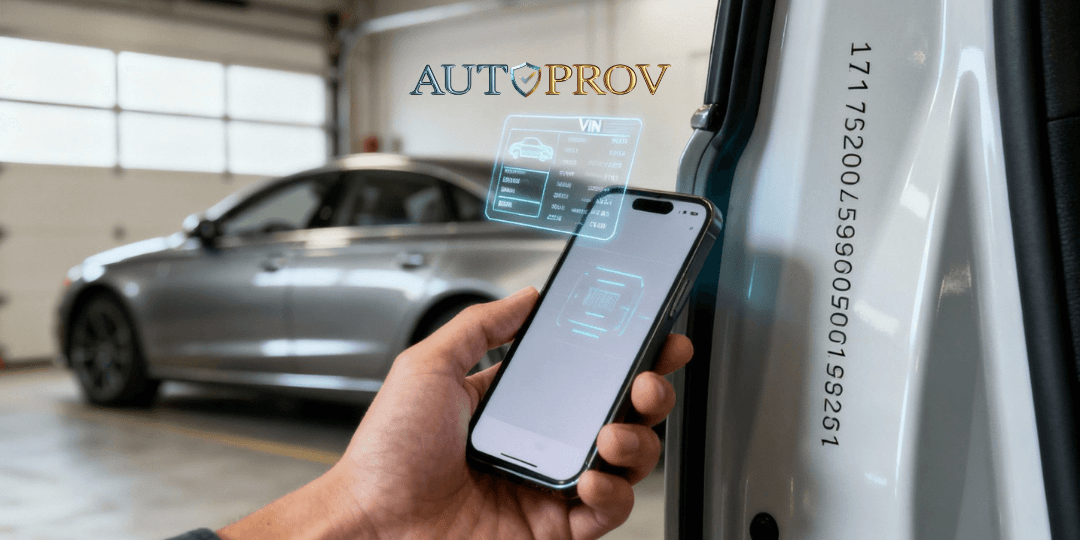
A vehicle check with vin number is easily the most important thing you can do before buying a used car. Think of it as your first line of defence—a quick, simple step that pulls back the curtain on a vehicle's past, protecting you from expensive mistakes, legal headaches, and downright dangerous cars.
Published by AutoProv
Your trusted source for vehicle intelligence