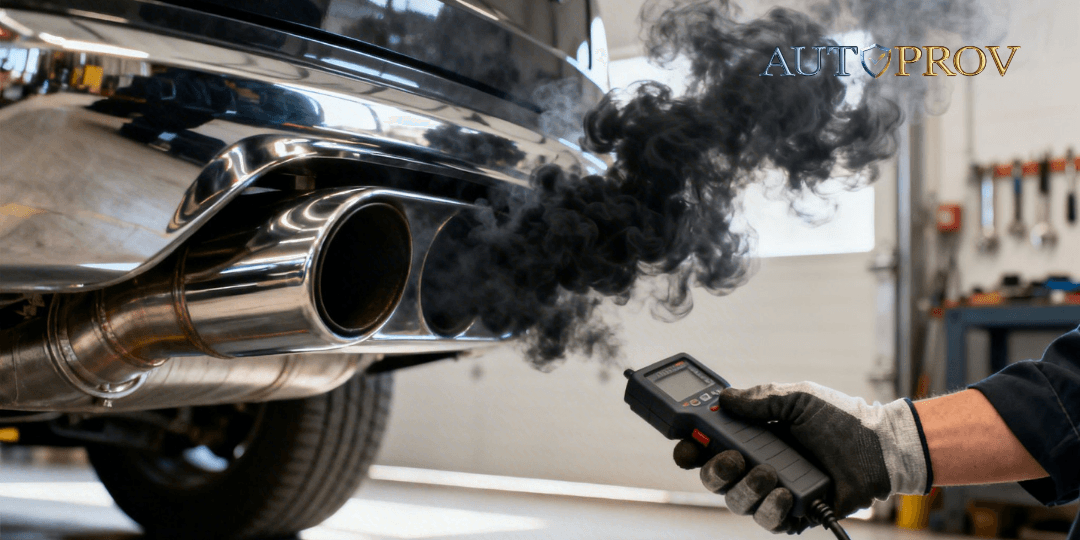
Black smoke from an exhaust is one of the most visible red flags in the motor trade. At its core, it signifies the engine is burning too much fuel for the amount of air available. The engine is "running rich," and this unburnt fuel exits the exhaust as a cloud of black, sooty particles.
What Black Smoke From An Exhaust Really Means For Your Stock
For any motor trade professional assessing a potential purchase, a plume of black smoke is a direct threat to the profit margin. It is a clear warning sign for a range of underlying faults that can diminish a vehicle's value, guarantee an MOT failure, and tie up capital in unexpected repairs. A thorough diagnosis is essential for making a sound buying decision.

The cause often depends on the engine type. In a diesel, the likely culprits are faulty injectors, a failing turbocharger, or issues with the DPF and EGR systems. With a petrol engine, the focus shifts to sensor malfunctions—such as the Mass Airflow (MAF) sensor—a faulty fuel pressure regulator, or leaking injectors.
To assist with a rapid initial assessment, the following table outlines the most common causes for both engine types.
Black Smoke Causes: Petrol vs Diesel Comparison
Symptom Common Causes in Diesel Engines Common Causes in Petrol Engines Black Smoke on Acceleration Faulty or leaking injectors, failing turbocharger, clogged DPF/EGR valve. Faulty Mass Airflow (MAF) sensor, incorrect fuel pressure, leaking injectors. Poor Fuel Economy Worn injectors delivering excess fuel, blocked air filter restricting airflow. Faulty O2 sensor, defective fuel pressure regulator, clogged air filter. Loss of Power Clogged Diesel Particulate Filter (DPF), faulty EGR valve, turbocharger issues. Clogged catalytic converter, problems with fuel injectors or fuel pump. Engine Warning Light On Sensor failures related to the emissions system (DPF, EGR). Faulty MAF, O2, or coolant temperature sensors. While this table serves as a useful starting point, these are merely the most frequent offenders. An accurate diagnosis always requires a more detailed investigation to pinpoint the exact fault and avoid speculative repairs.
Beyond The Smoke: A Business Risk Perspective
This single visual cue necessitates a deeper investigation into the vehicle's history. Black smoke is not just a mechanical symptom; it often indicates wider issues with significant financial implications. It can be an indicator of:
- Poor Maintenance History: It suggests previous owners may have neglected routine servicing. A simple air filter change might have been overlooked, potentially leading to more complex and expensive problems.
- Significant Upcoming Repair Costs: The smoke could be the first sign of a failing turbocharger or injector system, with repair costs that can easily run into thousands of pounds.
- Undisclosed Faults: A seller may be attempting to dispose of a vehicle with known emissions faults before incurring the cost of repair.
These potential issues directly impact profitability. A vehicle emitting black smoke is a liability on the forecourt; it signals a problem to potential buyers and is a guaranteed MOT failure. For any trader, such problem vehicles disrupt cash flow and challenge effective stock management.
This is precisely where a comprehensive analysis of the vehicle’s provenance becomes essential, turning a simple visual flaw into the actionable trade intelligence needed to mitigate business risk.
How Past Emissions Policies Create Modern MOT Risks
For professionals in the UK motor trade, a vehicle emitting black smoke is an immediate MOT failure. To fully understand the commercial implications, it is useful to consider the historical context. The origins of today's stringent emissions tests are rooted in Britain's industrial past, and this history directly influences the financial risks present in your stock.
Understanding this background is a critical component of motor trade risk intelligence. The narrative begins with the Great Smog of 1952. For five days, London was enveloped in a fatal combination of fog and pollution, primarily caused by black, sooty particulate matter from coal fires, industry, and vehicles. This event resulted in at least 4,000 fatalities, compelling the government to enact the Clean Air Act of 1956. This was the UK’s first significant legislation to control air pollution, and you can explore detailed government reports that document how this set the precedent for future regulations.
From Smog to MOT Smoke Tests: The Regulatory Evolution
The initial crackdown on visible smoke is the direct ancestor of the modern MOT test. The focus began with industrial and domestic sources but, as vehicle ownership increased, naturally shifted to vehicle exhausts. What started as a basic visual check for "excessive smoke" has evolved into the precise, meter-based testing required today.
For a diesel vehicle, the MOT test includes a smoke opacity test where a meter measures the density of the emitted smoke. Any visible black smoke during this test is an almost certain failure, as the meter will detect particulate levels far exceeding the legal limit.
This means a vehicle with black smoke from exhaust is not just a cosmetic issue; it is a compliance problem that renders it unsaleable.
Financial Implications For Your Stock
This direct line from historical policy to the modern workshop has clear financial consequences. A vehicle that fails its MOT on emissions cannot be retailed, halting its journey from stock to sale. This leaves you with two primary options:
- Invest in Costly Repairs: Diagnosing and rectifying the root cause—be it injectors, a DPF, a turbocharger, or EGR faults—can easily cost thousands, eroding any potential profit margin.
- Sell into the Trade at a Loss: The alternative is to move the vehicle on via trade auction, accepting a significant financial loss as the problem becomes another trader's liability.
Viewing a vehicle with black smoke through this lens makes the risk apparent. It represents not just an engine fault but a direct challenge to the vehicle's roadworthiness, with its origins in decades of environmental policy. This is why a thorough vehicle history check UK is so important. It helps reveal patterns of emissions advisories or failures, providing the trade vehicle intelligence needed to avoid acquiring a costly historical liability.
A Trade Checklist For Diagnosing Black Smoke In Diesel Engines
When a diesel vehicle presents with black smoke, a methodical diagnostic process is required to determine whether the issue is a minor fix or a major financial outlay. For any trader appraising stock, this process separates a profitable acquisition from a significant loss.
This checklist is structured to mirror a professional approach, starting with the most common and least expensive potential causes before proceeding to major component failures.
Begin with the fundamentals. A contaminated and clogged air filter is a primary cause of an engine running rich, as it starves the engine of the air required for clean combustion. Reviewing guidance on how often to change air filter is a good starting point, as this is the most frequent—and cheapest—potential fix.
If the air filter is serviceable, the next area to investigate is the fuel system. Defective or leaking injectors are a classic cause of black smoke from exhaust in diesel engines. If an injector remains open, it injects excess fuel into the cylinder, which cannot combust completely and is expelled as thick, black soot.
Inspecting Emissions Control Systems
On modern diesel vehicles, the emissions control systems are a common source of faults. The Exhaust Gas Recirculation (EGR) valve and the Diesel Particulate Filter (DPF) are two of the most frequent culprits.
- EGR Valve Issues: A stuck or failing EGR valve disrupts the air-to-fuel ratio. If it is jammed open, it recirculates excessive exhaust gas, leading to rough running, poor performance, and smoke.
- DPF Problems: It is a common misconception that a DPF causes black smoke. It does not. The presence of black smoke indicates a serious upstream problem that is overwhelming the DPF. By the time smoke is visible, the filter is almost certainly blocked or has failed due to an excessive soot load from another fault.
This flowchart illustrates the most immediate risk black smoke presents: an instant, non-negotiable MOT failure.

The key takeaway for any trader is that black smoke is not just a sign of an engine fault; it is a compliance red flag that makes a vehicle unsaleable until significant investment is made in repairs.
Assessing Major Component Failure
If basic checks do not reveal the cause, attention must turn to more serious mechanical failures. A failing turbocharger is a major concern. Worn seals or damaged bearings can disrupt boost pressure, restricting the air supply and causing a rich, smoky combustion. A high-pitched whistle or whine during operation is a classic indicator of a failing turbo.
A critical part of any dealer vehicle checks is to listen to the engine under load. A healthy diesel should pull strongly and cleanly. Hesitation, coupled with smoke, points towards a significant issue with fuel delivery or forced induction.
Ultimately, these diagnostic steps are vital for managing motor trade risk. Understanding the likely causes allows for a rapid estimation of repair costs, which should be factored into the vehicle's valuation. For a more in-depth analysis of how maintenance patterns affect these components, you can explore the diesel maintenance insights in our detailed guide. This is the type of trade intelligence that helps turn a potential loss into a profitable transaction.
Uncovering The Causes Of Black Smoke In Petrol Engines
While less common than in diesels, black smoke from a petrol engine's exhaust is a significant red flag. For a motor trade professional, it is an immediate signal of a rich fuel condition—the engine is receiving far more fuel than the available air can combust. A rapid diagnosis is essential to avoid acquiring a vehicle with costly hidden issues.
In a petrol engine, black smoke often points towards the complex network of sensors that manage the air-fuel mixture. The Engine Control Unit (ECU) constantly adjusts to achieve the optimal 14.7:1 air-to-fuel ratio for clean combustion. When a sensor provides incorrect data, this balance is disrupted, resulting in the tell-tale sooty smoke.
Petrol Diagnostic Checklist For The Trade
When a petrol vehicle exhibits black smoke, a methodical approach should focus on the components that measure air and deliver fuel.
- Leaking Fuel Injectors: This is a primary cause. An injector can become stuck open or its seal may fail, allowing a continuous flow of petrol into the combustion chamber. This excess fuel cannot be burned and is expelled as black smoke.
- Faulty Fuel Pressure Regulator: This component maintains stable fuel pressure. If it fails and allows pressure to rise excessively, the injectors will deliver too much fuel with each cycle. The system becomes overwhelmed, runs rich, and produces black smoke.
From a trade perspective, a rich-running petrol engine is not only a guaranteed MOT failure but also a sign of poor fuel economy and potential damage to the catalytic converter. A customer will quickly notice the excessive fuel consumption, making it a post-sale headache waiting to happen.
Sensor Failures And ECU Data
If mechanical fuel components are ruled out, sensor failures are the next logical area of investigation.
A defective Mass Airflow (MAF) sensor is a prime example. If it under-reports the volume of air entering the engine, the ECU will compensate by injecting more fuel, leading directly to black smoke. Similarly, a faulty coolant temperature sensor stuck on a "cold" reading can trick the ECU into maintaining a rich "choke" mixture long after the engine has reached operating temperature.
Knowledge of these petrol-specific faults is crucial for any trader. It enables an accurate estimation of potential repair costs, which should directly influence the vehicle's valuation. Changes in fuel composition can also affect engine performance, a topic covered in our guide on how E10 fuel can impact car maintenance.
Putting a Price on the Problem: Protecting Your Profit Margin
Once the cause of black smoke has been diagnosed, the focus shifts to the commercial implications. For a trader, every mechanical fault is a financial calculation. That puff of smoke can conceal a repair bill ranging from a few hundred pounds to several thousand, severely impacting the potential profit margin.
Accurately estimating these potential repair costs at the point of acquisition is a critical skill. It dictates whether to adjust a bid to cover the cost or to walk away from a vehicle that cannot be retailed profitably. This is where diagnosis transitions from mechanics to risk management.
Estimated Repair Costs For Common Faults
Repair costs in the UK vary based on vehicle make, model, and parts sourcing. However, having a general understanding of the costs associated with common black smoke culprits allows for a more informed on-the-spot valuation.
- Diesel Injector Replacement: For a set of four, costs can range from £800 - £1,800+, depending on the use of new or reconditioned parts.
- Turbocharger Repair or Replacement: A rebuild may cost between £400 - £800. A new unit, however, can easily exceed £1,200 - £2,500, plus labour.
- DPF Cleaning or Replacement: Professional off-car cleaning is a more economical option, typically costing £250 - £500. A full DPF replacement is a major expense, often between £1,000 and £3,000.
- EGR Valve Replacement: This repair generally falls between £200 and £600, although more complex electronic valves can be more expensive.
- Sensor Replacements (MAF/O2): These are typically less costly repairs, usually in the £150 - £400 range, including diagnostics and fitting.
The crucial takeaway here is the massive financial gulf between a simple sensor fix and a full turbo replacement. Without proper pre-acquisition checks, you're essentially gambling with a potential £2,000+ liability on what might look like a minor issue. For a deeper dive into another high-cost repair, check out our guide on what a head gasket repair costs in the UK.
Using Vehicle Intelligence To Mitigate Risk
The presence of black smoke from a modern vehicle is a far more significant red flag than it once was. While emissions regulations have greatly improved air quality—a study showed black smoke concentrations at UK monitoring sites fell by over 50% between 1990 and 2002—a vehicle still producing it today points to serious, and often expensive, underlying problems. You can learn more about these historical emission trends and their impact.
For AutoProv users, this symptom directly correlates with the type of anomalies our platform is designed to identify. Our trade vehicle intelligence often highlights related issues, such as mileage discrepancies or suspicious gaps in service history, by cross-referencing MOT, ownership, and insurance data to provide a complete picture before you commit to a purchase.
Using Vehicle Provenance To Reveal Hidden Emissions Risks
Observing black smoke from exhaust during a physical appraisal is an obvious warning, but it only reflects the vehicle's current state. The real challenge for a motor trade professional is not just spotting the smoke but understanding its implications for the vehicle's history and its future viability as stock.
This requires moving beyond a simple visual check to a deep analysis of the vehicle's vehicle provenance. The smoke is a symptom; the vehicle's history often reveals the underlying condition. A pattern of recurring MOT advisories for emissions, a sequence of short-term owners, or anomalies in the mileage record are all digital markers of a chronic, costly issue that a seller may be hoping to pass on.

A comprehensive vehicle history check UK is the most effective tool for uncovering this narrative. By synthesising data from the DVLA, MOT records, and ownership logs, you can identify suspicious patterns that a basic check will invariably miss.
Connecting Data To Forecourt Decisions
Consider a practical scenario: a diesel vehicle presents with a history of repeatedly failing its MOT on smoke opacity. Then, just before being offered for sale, it achieves a clean pass with no evidence of major repair work. This is not a coincidence; it is a significant red flag. It may indicate a temporary, low-cost "fix" designed solely to pass the test or, more alarmingly, evidence of emissions system tampering.
Vehicle exhausts have been a major factor in UK air quality for decades. While government data shows PM10 emissions from road transport were part of a 42% national decline between 1990 and 2001, for today's trader, any visible smoke is a serious liability. It indicates incomplete combustion from faulty injectors, a failing turbo, or a blocked EGR valve—all common issues on higher-mileage trade-ins. You can review the government's own data on historical UK air quality trends.pdf) for more context.
This is exactly where genuine trade vehicle intelligence proves its worth. It goes beyond just listing dates and faults. It highlights the patterns and anomalies that point directly to hidden risks—risks that will hammer your valuation and destroy your profit margin.
This demonstrates the value of a detailed vehicle provenance report. By analysing UK-specific DVLA records, MOT failures, and rapid ownership changes, a platform like AutoProv provides the context needed to interpret physical observations. This deeper intelligence supports smarter buying decisions, protecting your capital and professional reputation from vehicles with a hidden, expensive history.
FAQs Straight From The Trade
These are common questions we receive from traders. Here are direct, factual answers to the most frequent queries about exhaust smoke and related issues.
Can a DPF regeneration fix black smoke?
No. A DPF regeneration does not address the root cause of black smoke. Black smoke is a symptom of a problem occurring before the exhaust gas reaches the DPF, typically a rich fuel mixture caused by a faulty injector, sensor, or other component.
A forced regeneration merely cleans the existing soot from the filter; it does not rectify the underlying fault. The black smoke will return, and the DPF will quickly become blocked again. It is a temporary measure, not a permanent solution.
Is white or blue smoke as serious?
Yes. Different smoke colours indicate different, but equally serious, internal engine problems requiring immediate investigation.
- Blue Smoke: This is the classic sign of the engine burning oil. The cause is typically internal wear, such as worn piston rings, failing valve stem seals, or faulty turbocharger seals.
- White Smoke: Persistent, thick, sweet-smelling white smoke is a major red flag for coolant entering the combustion chamber. In most cases, this indicates head gasket failure.
All three smoke colours are indicators of significant mechanical failure. If observed, further investigation is essential, as covered in our guide on what to do when the engine management light comes on.
How can I spot a tampered emissions system?
This requires both physical inspection and data analysis. During a walk-around, look for obvious signs: a suspiciously empty DPF canister, fresh weld marks on the exhaust where a component has been removed, or blanking plates where an EGR valve should be.
Digitally, a comprehensive vehicle history check UK is the most powerful tool. Provenance data can reveal suspicious patterns that a physical inspection cannot. A classic example is a vehicle with a history of emissions-related MOT failures that suddenly obtains a clean pass with no corresponding record of repair work. This is a strong indicator of a temporary "MOT fix" or outright tampering.
To confidently assess these risks and move beyond surface-level checks, you need deeper trade vehicle intelligence. AutoProv delivers advanced UK vehicle provenance reports that uncover hidden patterns and anomalies, helping you make safer, more profitable buying decisions. Explore how AutoProv works today.
Frequently Asked Questions
AI-Generated Content Notice
This article was created with the assistance of artificial intelligence technology. While we strive for accuracy, the information provided should be considered for general informational purposes only and should not be relied upon as professional automotive, legal, or financial advice. We recommend verifying any information with qualified professionals or official sources before making important decisions. AutoProv accepts no liability for any consequences resulting from the use of this information.
From our AI insights
- The Importance of Tyre Verification for UK Motor Traders
Discover why verifying tyre specs is crucial for UK traders to ensure safety and compliance.
- Decoding CO2 Emissions: A Trader's Guide
Learn how traders can verify CO2 data using factory build sheets to prevent disputes.
- Navigating Recall Compliance for UK Car Traders
Ensure compliance with recall regulations: essential steps for UK car traders.
Related Articles
The Importance of Car Maintenance and Provenance Checks
Discover why regular car maintenance and proper provenance checks are essential for vehicle quality and longevity.
Essential Car Maintenance Tips for UK Drivers
Discover vital car maintenance tips to keep your vehicle roadworthy and compliant in the UK.
How Much Is a Car Service? Complete UK Price Guide
Trying to pin down exactly "how much is a car service?" can feel a bit like asking "how long is a piece of string?". Prices vary quite a bit, but to give you a ballpark figure, an interim service will usually set you back around £100 to get started. A more thorough full service often begins at £180, while a major service for many cars can easily top £300.
Published by AutoProv
Your trusted source for vehicle intelligence