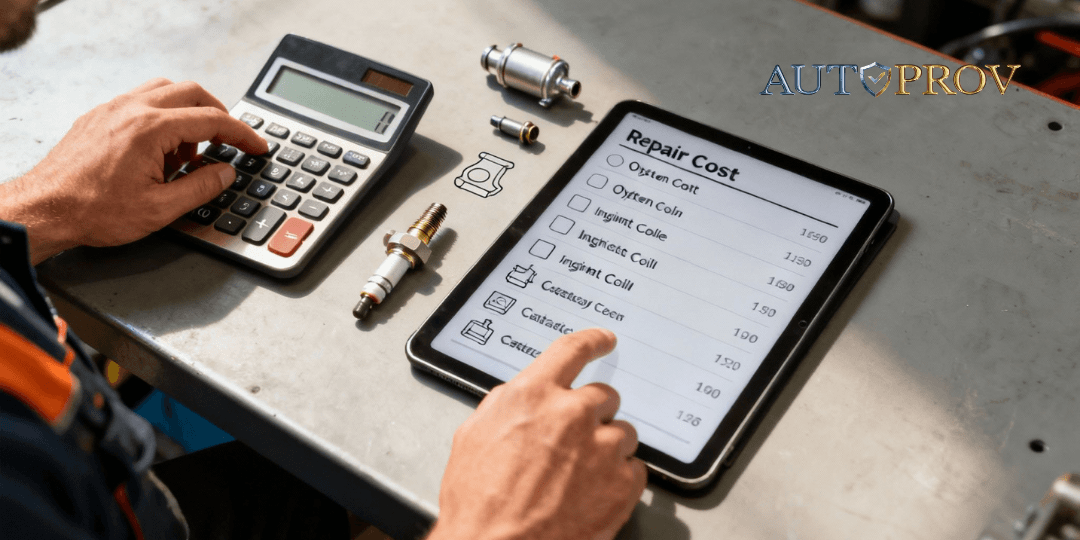
That amber light on the dashboard? It’s not just a warning; it’s a critical decision point for any motor trade professional. When the engine management light is on, you know the vehicle’s brain has flagged a fault. This instantly hits its value and chips away at your potential profit. Understanding exactly what you're looking at is your first line of defence against buying a dud.
Decoding The Engine Management Light: A Trader's Perspective
For a retail customer, that glowing amber light is an unwelcome surprise that means a trip to the garage. For a trader, it's a financial calculation that has to be made in seconds. It represents an unknown cost, a powerful negotiation point, and a direct threat to your margin. Ignoring it isn't an option; interpreting it correctly is a fundamental skill.
This light is the visible tip of the iceberg for the Engine Management System (EMS), a complex web of sensors controlling everything from fuel injection and ignition timing to emissions. When any of these parts send back a reading that's out of whack, the system logs a fault and flicks the light on. The cause could be anything from a loose fuel cap to a failing catalytic converter.
Increasing Complexity and Greater Risk
The real challenge for traders is that these systems get more intricate with every new model year. In the UK, the engine management light comes on when the onboard diagnostics (OBD) system spots a fault, and on modern metal, the list of potential triggers is massive. Pushed by tough regulations like the Euro 7 standards, which demand real-time emissions monitoring, the technology is only getting more complex. This means EML triggers are becoming far more common in the used vehicles you’re appraising every single day.
This constant evolution means that what was a simple fix on a five-year-old car might be a far more involved and costly repair on a newer one. Relying on gut feeling and experience alone just doesn't cut it anymore. You need hard data—from both the car itself and its documented history—to make a profitable call.
From Warning Light to Actionable Intelligence
Treating the EML as a single problem is a rookie mistake. It’s a data point that demands a structured diagnostic approach. Your initial on-the-spot checks are vital, of course, but they only tell you part of the story. The real power comes from combining your physical inspection with a deep dive into the vehicle's provenance.
For a professional in the motor trade, an illuminated EML shouldn't cause panic—it should trigger a process. It’s an immediate signal to stop, diagnose, and assess the financial risk before committing to a purchase or part-exchange.
This is where a tool built specifically for the trade becomes essential. A diagnostic scanner tells you what the car thinks is wrong right now, but an AutoProv report gives you the crucial context it can't.
This dashboard is designed for speed and clarity, getting you to a vehicle's complete history in moments. By cross-referencing MOT advisories, service records, and other historical data, you can quickly figure out if the EML fault is a new issue or a recurring gremlin that a previous owner has failed to sort. This level of insight transforms a simple warning light from a potential liability into a quantifiable business risk.
To get the full picture, pair this data-driven approach with a solid hands-on assessment. For more on that, take a look at our comprehensive guide on the ultimate used car inspection checklist. It’s this combined approach that gives you the best defence in today's market.
Rapid Assessment at the Curbside or Auction
Time is money. That’s never truer than when you’re standing by a car at the curbside or in a noisy, fast-paced auction hall. When that engine management light is on, you don’t have the luxury of a full workshop diagnosis. What you need is a rapid, trade-focused workflow to make a quick, smart call on whether to bid, buy, or walk away.
This isn’t about textbook advice; it's about making a swift financial calculation under pressure.
The very first thing to clock is the light's behaviour. This simple observation tells you a hell of a lot about the severity of the problem before you even pop the bonnet.
- A solid amber light means a fault has been detected and logged by the ECU. It’s not a five-alarm fire, but it needs investigating sharpish. It could be anything from a dodgy sensor to an emissions issue, but you can usually drive the car for a short diagnostic run.
- A flashing amber light is a different beast entirely. Treat this as a red alert. It’s screaming that there's a serious, active fault—almost always a severe engine misfire. Keep that engine running, and you’re just pumping unburnt fuel into the exhaust, which will kill the catalytic converter in minutes. That turns a potentially cheap fix into a very expensive one. If you see a flashing EML, the only move is to shut the engine down immediately.
Your Initial Sensory Checks
Before you even think about plugging in an OBD-II scanner, your own senses are your most valuable diagnostic tools. A few quick checks can help you build a mental picture of the potential issue and, crucially, the likely cost. You're trying to gauge whether you're looking at a minor glitch or a major mechanical headache.
Start the engine (but only if the light is solid) and just listen. Anything sound off? A rhythmic ticking could point to a valvetrain problem, while a lumpy, uneven idle often signals a misfire. A loud hissing might suggest a vacuum leak—a common and often cheap fix.
Next, feel how the car drives, even if you’re only moving it a few feet. Is there a noticeable lack of power or hesitation when you touch the throttle? Does the car judder or vibrate more than it should? These are classic symptoms of misfires, fuel delivery problems, or restricted airflow.
Finally, have a quick glance at the exhaust. Any smoke? Blue smoke means it’s burning oil, black smoke suggests it’s running rich (too much fuel), and thick white smoke could be a coolant leak—potentially a head gasket job. Each of those signs comes with a hefty price tag.
This decision tree shows the ideal diagnostic flow, from spotting the light to using provenance data to make the final call.
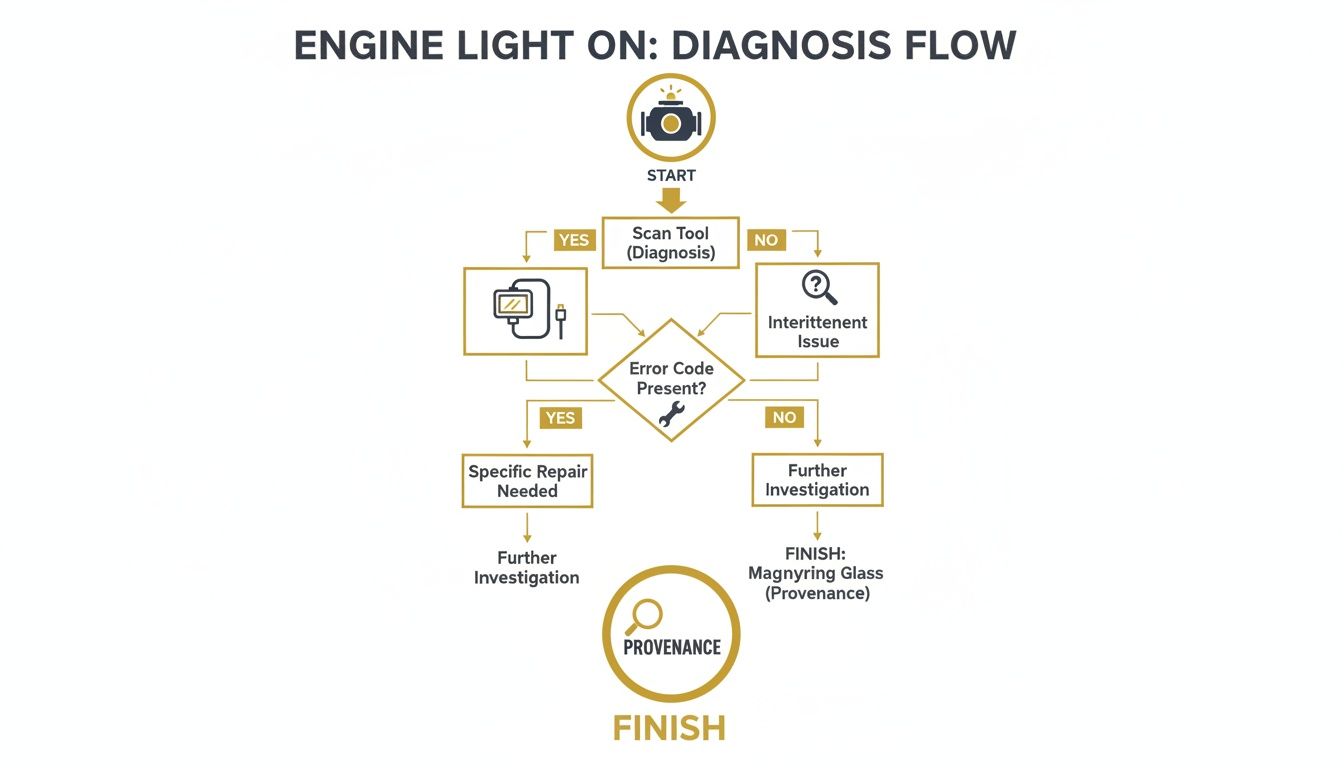
The key takeaway here is that a fault code from a scanner is only one piece of the puzzle. Proper due diligence combines your initial physical assessment with a deep dive into the vehicle's history.
A quick curbside assessment isn’t about making a definitive diagnosis. It's about rapidly qualifying the risk. You’re trying to figure out if the potential profit margin is big enough to swallow the worst-case-scenario repair cost.
This initial triage is absolutely critical, especially in a high-pressure auction environment. For more strategies on making smart buys, check out our essential tips for UK car auctions. Combining these on-the-spot checks with a solid history report from AutoProv gives you the data you need to turn an unknown EML risk into a calculated business decision.
Going Beyond The Code With OBD-II Diagnostics
An On-Board Diagnostics (OBD-II) scanner is a must-have bit of kit for anyone in the motor trade. We all know that. But simply pulling a Diagnostic Trouble Code (DTC) is only the first step. The real skill—the bit that protects your bottom line—is knowing how to interpret that code when the engine management light is on.
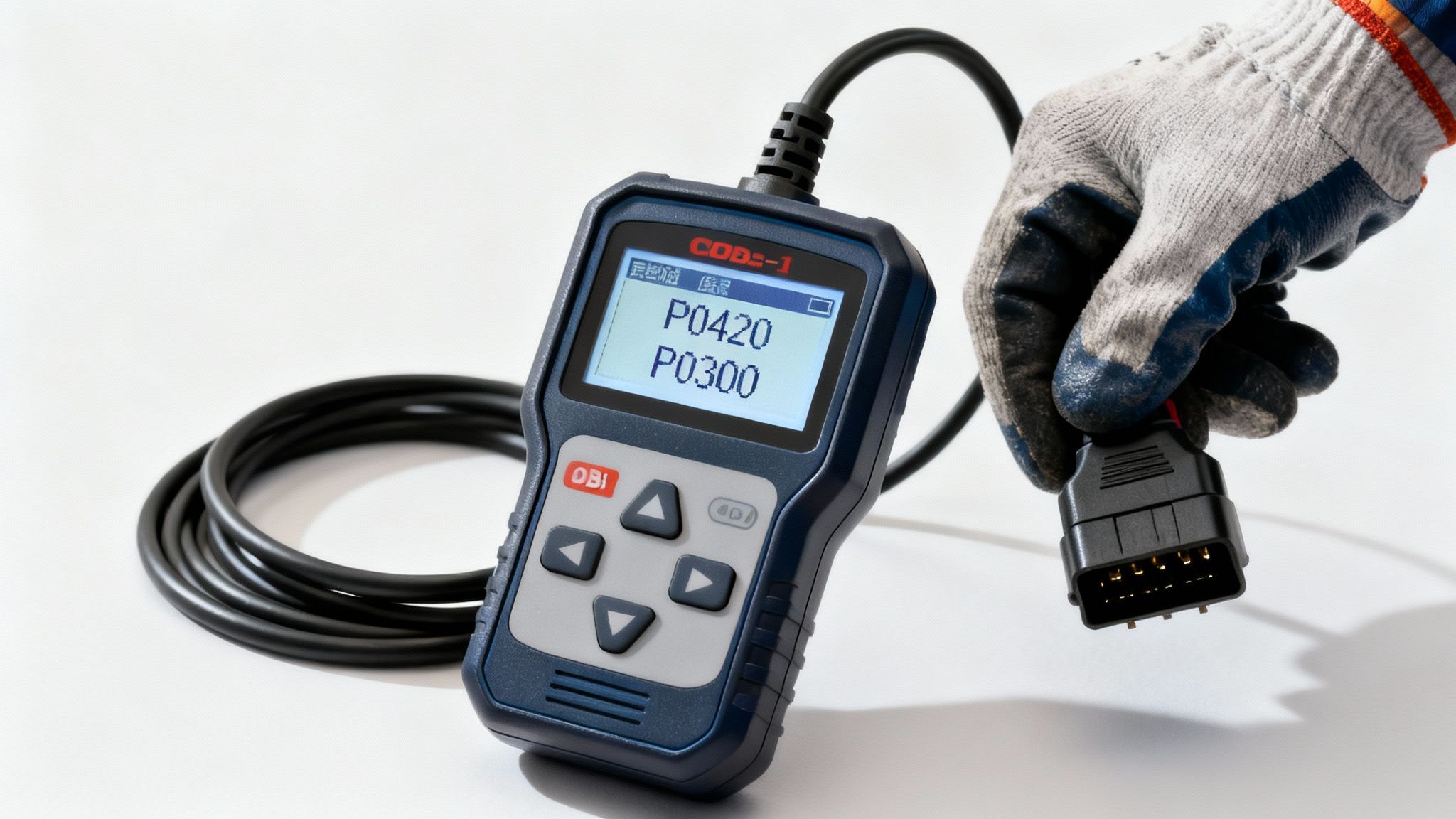
Getting a code is the easy part. You find the OBD-II port—usually tucked under the driver's side of the dash—plug in your scanner, and follow the prompts. Within seconds, a string of letters and numbers points you towards the fault. But that code isn't the final diagnosis. It's just the first clue in your investigation.
Think of this initial data point as your gateway to understanding the car's true health and, more importantly, its potential reconditioning costs.
Translating Codes into Costs
A fault code tells you which system or sensor has thrown a wobbly, but it doesn't tell you why. A seasoned trader knows how to look past the code itself and start thinking about the most likely causes and, crucially, the repair bills that come with them. This is where you graduate from being a code-reader to a proper diagnostician.
Let's break down a couple of common codes you’ll see time and time again in the UK used car market.
- P0420 – Catalyst System Efficiency Below Threshold: This is one of the codes that makes your heart sink a little. While it points straight at the catalytic converter, the 'cat' itself might not be the real culprit. It could be failing because of a completely different issue, like an engine misfire chucking unburnt fuel down the exhaust.
- P0300 – Random/Multiple Cylinder Misfire Detected: This one is frustratingly vague. It tells you the engine isn't running right, but the cause could be anything from something cheap and simple (worn spark plugs) to something much more involved and expensive (dodgy ignition coils, blocked fuel injectors, or even low engine compression).
The financial gulf between those potential fixes is massive. A fresh set of spark plugs might set you back less than £100 fitted. A new catalytic converter, on the other hand, can easily run into four figures.
The Diagnostic Trail Unpacked
Let's run through a real-world scenario. You're appraising a 2014 Ford Focus as a part-exchange, you plug in the scanner, and up pops P0300. The engine's idling a bit lumpy, which backs up your suspicion. What's your next move?
Your diagnostic trail should look something like this:
- Check the basics first. When were the spark plugs and ignition coils last changed? A quick flick through the service history, if there is one, can be a goldmine. If they're well overdue, that's your most likely—and cheapest—place to start.
- Look for related codes. Is P0300 sitting there on its own? Sometimes other codes crop up alongside it, pointing to a specific cylinder (like P0301 for cylinder 1) or another sensor (like the mass airflow sensor), helping you narrow the search.
- Consider the fuel system. A misfire can also be a fuel delivery problem. Think blocked injectors or a failing fuel pump. They're less common than ignition faults, but still very much on the table.
This methodical approach stops you from jumping to the most expensive conclusion. It’s all about systematically ruling out the cheap stuff before you condemn a big-ticket component. For traders dealing with that dreaded amber light, effective diagnosis requires a solid understanding and implementing diagnostic technology in auto repair shops.
A fault code is a symptom, not the disease. Your job is to trace that symptom back to its source to accurately calculate your risk and potential profit.
This is exactly why just clearing the code and hoping for the best is a fool's game. The underlying fault is still there, the light will inevitably come back on, and the problem will soon become your customer's—and ultimately, your liability. Getting to grips with common failure points for certain makes and models is just part of the job, something we touch on in our guide covering essential car maintenance tips for UK drivers.
Ultimately, a confident diagnosis is power. It gives you the hard evidence you need to negotiate a price reduction on a part-ex or to set a firm bidding limit at auction, ensuring those potential repair costs are already baked into your margin.
Calculating The Real Cost Of An EML Fault
Once your OBD-II scanner spits out a fault code, the game immediately switches from diagnosis to finance. For any motor trader, the critical question is always the same: "How much is this going to cost me?". When that engine management light is on, every second you spend appraising the vehicle is about calculating risk and protecting your margin.

Knowing the financial hit of common EML faults isn't just useful; it's non-negotiable. This is the knowledge that lets you confidently value a part-exchange, set your ceiling at auction, and accurately factor reconditioning costs into your pricing from the get-go. Get it wrong, and a promising car can fast become a financial black hole that swallows your profit whole.
The Low-Cost Culprits
Thankfully, not every glowing EML spells disaster for your wallet. A good chunk of faults can be traced back to relatively cheap components. These are the fixes you hope for—quick, straightforward jobs that get the car retail-ready without a huge bill.
Here are some of the most common low-cost repairs you’ll bump into:
- Faulty Oxygen (O₂) or Lambda Sensor: This one’s a frequent offender. An O₂ sensor measures unburnt oxygen in the exhaust, helping the ECU keep the air-fuel mix right. When it fails, you'll often see poor fuel economy. A replacement sensor usually costs between £150 and £250, including fitting.
- Mass Air Flow (MAF) Sensor: This little sensor tells the ECU how much air is coming into the engine. If it gets dirty or fails, it can cause rough idling, hesitation, and poor performance. Sometimes a good clean sorts it, but a replacement is often needed, typically setting you back around £150 to £300.
These relatively minor issues are manageable, but even small costs stack up. Knowing these figures helps you adjust your offer on the spot. For a deeper look into vehicle running costs, you might find our complete UK guide on car service prices useful.
Mid-Range Repair Costs
Climbing the cost ladder, you'll find faults that need a bigger investment in both parts and labour. They aren't necessarily deal-breakers, but they will take a much bigger bite out of your potential profit if you haven't factored them in.
A couple of prime examples include:
- Ignition Coils and Spark Plugs: Responsible for igniting the fuel in the cylinders, a failure here causes misfires (think P0300 codes). While spark plugs are cheap, ignition coils can be pricier, especially on cars with individual coil-on-plug units. You should budget for £200 to £500 for a full set of plugs and one or two coils.
- Exhaust Gas Recirculation (EGR) Valve: Particularly common on diesels, the EGR valve gets clogged with carbon, leading to performance issues and MOT emission failures. A replacement can run anywhere from £250 to £600, depending on the car and how awkward it is to get to.
The key to managing these mid-range costs is accurate diagnosis. Throwing a new ignition coil at a problem when the real issue is a spark plug is just money down the drain. An accurate initial assessment saves you from chasing faults and overspending.
The Budget-Killers To Watch For
And then we have the big ones—the problems that can instantly turn a profitable car into a loss-making parts donor. These are the red flags that should make you think very, very carefully before you even consider making an offer.
The most notorious budget-killers you’ll see with an EML are:
- Catalytic Converter Failure (P0420): This is a biggie. A new 'cat' is expensive because of the precious metals inside. The cost can range from £500 to well over £1,500 for genuine parts and labour. Always find out what killed the old one; a persistent misfire can destroy a brand new cat in no time.
- Diesel Particulate Filter (DPF) Issues: For any diesel, a blocked DPF is a common and expensive headache. A forced regeneration might clear it, but often, replacement is the only way forward. This is a serious expense, typically falling between £800 and £2,000+.
The reality is, engine management light problems can spike unexpectedly, especially in UK summers. Projections show thousands of potential breakdowns from heat-stressed engines, where the ECU is the first to spot problems like oil shortages or sensor glitches. A single overlooked EML can easily lead to repairs topping £1,000, but this is where a data-led approach using AutoProv changes the game. By having these cost ranges in your head, you can turn a dashboard warning from a gamble into a calculated business decision.
Using Provenance Data To Mitigate EML Risks
The Complete Guide to Vehicle History Reports: https://youtu.be/ig0QxjLx_QU
An OBD-II scanner is a fantastic tool. It tells you what the car’s ECU thinks is wrong, right now. What it can’t tell you is the story behind the fault.
Is this a brand-new issue on an otherwise perfect car? Or is it a recurring nightmare that a previous owner has thrown cheap parts at for years? This is where provenance data becomes your most powerful diagnostic tool.
When that amber light is glowing on the dash, a proper vehicle history check is your first line of defence against a bad buy. It provides the crucial context a fault code can never give you, turning an unknown liability into a calculated business decision. A trade-grade tool like AutoProv connects the dots between the present fault and the vehicle's past.
This historical data helps you spot the red flags and recurring patterns you’d never see at the curbside. It’s the insight you need to adjust your offer, budget for the repair properly, or simply walk away from a car that’s destined to become a problem.
Scrutinising The MOT History For Clues
The DVLA MOT history inside an AutoProv report is an absolute goldmine. It’s often the first place you’ll find documented proof of long-running engine or emissions problems. You’re not just looking for failures; the real story is often buried in the advisories.
Keep an eye out for recurring patterns over several years. For example:
- Repeated emissions advisories: Seeing notes like "Exhaust emissions Lambda reading after 2nd fast idle outside specified limits" year after year is a massive red flag. It points to a persistent issue that has never been properly fixed.
- Engine oil leak advisories: A minor oil leak one year might be nothing to worry about. But if it keeps showing up on multiple tests, it could point to failing gaskets or seals that might be the root cause of other sensor-related faults.
- "Undertray fitted": While this is a common note, it can sometimes be used to hide leaks. If you see this alongside emissions advisories, it’s a clear signal to get the car on a ramp for a much closer look.
This kind of historical context helps you figure out if the current EML fault is an isolated incident or just the latest symptom of a chronic illness.
Cross-Referencing Mileage And Component Lifespans
Another vital check is to line up the vehicle's current mileage with the expected lifespan of major, expensive-to-replace components. When the EML is on, this simple cross-reference can help you anticipate big-ticket repairs before you even plug in the scanner.
A classic example is the Diesel Particulate Filter (DPF). Most DPFs have a typical lifespan of around 80,000 to 120,000 miles. If you're looking at a diesel with 95,000 miles on the clock and the EML is on, a DPF-related fault suddenly becomes a much stronger—and more expensive—possibility.
A vehicle's history isn't just a record of the past; it's a predictor of future costs. An AutoProv report gives you the data to make that prediction with far greater accuracy.
The same logic applies to timing belts, dual-mass flywheels, and certain automatic gearboxes. Using the mileage data from AutoProv allows you to build a risk profile for the vehicle, factoring in not just the immediate EML fault but also any major service items looming on the horizon.
Uncovering Hidden Damage With Write-Off Records
Sometimes, the root cause of a persistent electronic gremlin isn't wear and tear—it's historic accident damage. A frontal impact, even one that was "professionally" repaired, can leave lasting damage to wiring looms, sensors, and control modules. These are the kinds of faults that are notoriously difficult and time-consuming to diagnose.
This is why checking the MIAFTR (Motor Insurance Anti-Fraud and Theft Register) and salvage auction records in an AutoProv report is non-negotiable. If a car has a history as a Category S (structural) or Category N (non-structural) write-off, you need to proceed with extreme caution.
A poorly repaired car can be an electrical nightmare. Water ingress from a damaged seal can corrode connectors, and stretched wiring looms can cause intermittent faults that are almost impossible to trace. When you see an EML on a car with a salvage history, the potential for complex, hidden problems increases tenfold.
This information is vital for making an informed decision and avoiding a car that will spend more time in your workshop than on your forecourt. For a deeper dive, learn more about how a provenance check for a used car protects your business.
Your Questions Answered
Even for seasoned pros, that glowing engine management light can throw up a few nagging questions. Getting the answers right isn't just about fixing the car; it's about protecting your business, your reputation, and your bottom line. Let’s cut through the noise and get straight to the trade-focused answers you need.
Can I Sell a Car With The Engine Management Light On?
You technically can, but honestly, it’s commercial suicide for any reputable dealer in the UK. The Consumer Rights Act 2015 is painfully clear on this: a vehicle has to be of 'satisfactory quality'. An active engine management light is on, which is a direct signal of a known fault, makes arguing that point almost impossible.
Selling a car in this state is basically inviting a customer rejection and a demand for a full refund. The only professional way forward is to diagnose and properly sort the fault before that car even sniffs the forecourt. It’s the only way to protect your business from costly comebacks and keep your hard-earned reputation intact.
Does a Fresh MOT Mean The Engine Is Fine?
Absolutely not. This is one of the most common and dangerous assumptions in the book. An MOT is just a snapshot in time—a certificate that says the car met the minimum safety and emissions standards on one particular day.
A fault big enough to trigger the EML could easily pop up the second it rolls out of the testing bay. Plus, many issues that bring the light on, like a dodgy sensor that’s only slightly messing with the fuel trim, might not be severe enough to fail the emissions test at that exact moment.
Think of a fresh MOT as just one piece of the puzzle, not a clean bill of health. Your own diagnostic work, paired with a comprehensive provenance report from a provider like AutoProv, will always give you a much more reliable picture of the vehicle's real condition.
Will Clearing The Code Fix The Problem?
That’s a hard no. Plugging in a scanner and clearing a Diagnostic Trouble Code (DTC) does nothing more than wipe the error from the car's memory. It makes the light go off for a bit, but it doesn’t touch the underlying mechanical or electrical problem that caused it.
As soon as the car’s onboard diagnostics run another cycle, it’ll spot the fault again, and that light will be back on. For any motor trade professional, this is a deceptive practice that only ever leads to angry customers, warranty claims, and serious damage to your name. The only real solution is to find the root cause and fix it properly.
At AutoProv, we provide the in-depth vehicle history and provenance data you need to make properly informed decisions when you’re faced with an engine management light. Mitigate your risk and protect your profits by getting the full story behind every vehicle. Get your trade-grade report at https://autoprov.ai.
Frequently Asked Questions
AI-Generated Content Notice
This article was created with the assistance of artificial intelligence technology. While we strive for accuracy, the information provided should be considered for general informational purposes only and should not be relied upon as professional automotive, legal, or financial advice. We recommend verifying any information with qualified professionals or official sources before making important decisions. AutoProv accepts no liability for any consequences resulting from the use of this information.
From our AI insights
- Navigating ULEZ Compliance for Used Car Dealers
A deep dive into ensuring your used car stock meets ULEZ standards, avoiding costly fines.
- Understanding Days-to-Sell: Improve Dealer Stock Turn
Learn how to calculate and optimise days-to-sell for better dealership profitability.
- Leveraging VIN Data for Vehicle Option Verification
Discover how UK motor traders use VIN data to authenticate vehicle options and avoid mis-described purchases.
Related Articles

Car Specs by Reg: Instantly Find Vehicle Details & MOT History
Trying to find the full car specs by reg? In the UK, that little number plate is the key to unlocking a huge amount of information about a vehicle. From the exact engine size and CO2 emissions to its MOT history and tax status, it's all tied to the registration.

How to Check Previous Owners of a Car in the UK
Before you even start thinking about how to check the previous owners of a car, you need to get your head around why it's so important. This isn't just about being nosy; it’s a non-negotiable step that protects you from serious financial headaches and safety risks lurking under a shiny bonnet.

How to Check Service History in the UK
Think of a car's service history as its detailed CV, not just some dusty folder in the glovebox. To check service history is to get the real story behind a vehicle, digging into everything from its routine oil changes to any major surgery it's had. For any savvy car buyer in the UK, this record is the single most important document you can get your hands on.
Published by AutoProv
Your trusted source for vehicle intelligence