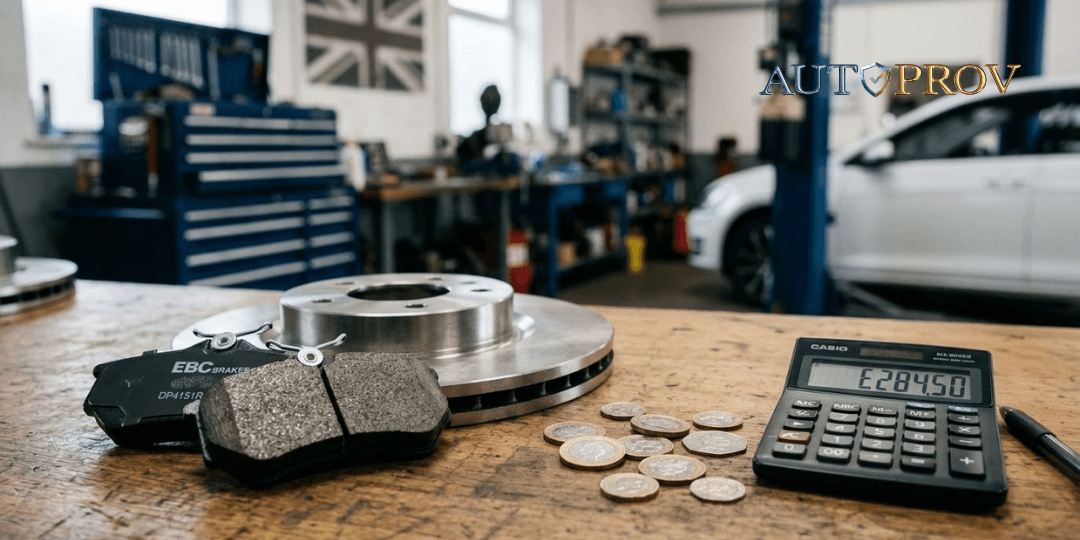
Brake pad replacement in the UK usually sits around £120 to £150 per axle for pads only, with widely cited benchmarks of about £127 for front pads and £121 for rear pads. That sounds straightforward until you're the buyer, valuer, or stock controller looking at a car where a simple pad job can turn into a much larger reconditioning bill once discs, labour rate, vehicle type, and hidden neglect come into view.
A dealer rarely asks about brake pad replacement cost UK out of curiosity. The question usually lands while appraising a part-exchange, reviewing auction photos, or trying to protect margin on a vehicle that looks clean enough everywhere else. The invoice matters, but the more useful question is what the brakes reveal.
Brake condition is one of the better physical clues to vehicle provenance. It can support the story the seller gives you, or it can undermine it. A car with strong cosmetics and poor brake maintenance often tells you something about the previous owner's priorities. A car with fresh pads fitted badly, or only just enough to quieten a noise, can point to pre-sale patching rather than proper preparation.
That's why experienced dealers treat brakes as both a cost line and a risk signal. You're not only budgeting for workshop time. You're reading maintenance culture, likely near-term spend, and whether the vehicle's overall story stacks up alongside your dealer vehicle checks, used car history report, and wider motor trade risk process.
Beyond the Invoice The Real Cost of Brakes in the Motor Trade
A retail customer sees brakes as a repair. A trader sees brakes as a margin event.
That difference matters most when the car presents well. Freshly valeted stock can hide a lot in plain sight. If the pads are low, the discs are lipped, and the wear pattern doesn't suit the mileage or ownership story, the issue isn't just the brake job. It's whether the car has been maintained in a way that makes the rest of the file trustworthy.
Why the invoice rarely tells the full story
A brake invoice only captures what's visible at the point of repair. It doesn't tell you whether the previous owner delayed maintenance, fitted the cheapest available parts, or repeatedly drove a vehicle with vibration, noise, or heat damage. Those patterns matter because they often sit alongside other deferred work.
For a dealer, a brake assessment sits inside the broader cost-of-entry question. The purchase price is only one layer. Prep, timing, downtime, and whether the car can be retailed with confidence all sit behind it. That's the same discipline behind AutoProv's thinking on cost of acquisition, where the actual number is what it takes to put a vehicle safely and credibly into stock, not what it cost to buy.
Practical rule: If brake work looks overdue, assume you're not looking at an isolated consumable until the rest of the vehicle proves otherwise.
Brakes affect cash flow as much as gross profit
Minor mechanical costs become bigger problems when they multiply across live stock. One borderline set of brakes on one car is manageable. The same pattern across several recent purchases starts to tie up workshop capacity, delay prep cycles, and distort true stocking cost. That's why stock controllers who think carefully about reconditioning discipline often also pay close attention to working capital. The same logic appears in Comfi's auto dealer cash flow insights, even though the market context differs.
In practice, brake condition helps answer a few hard trade questions fast:
- Is this car honestly presented: Clean wheels and shiny paint don't offset obvious brake neglect.
- Has someone prepared it properly: New pads on poor discs can be a budget fix, not a proper one.
- Will this become a comeback risk: Weak prep on braking components tends to show up quickly after delivery.
- Does the ownership story make sense: Wear patterns should broadly align with mileage, use, and prior maintenance behaviour.
A basic vehicle history check UK gives you one layer. Brake inspection gives you another. The trade does best when those layers agree.
Deconstructing UK Brake Replacement Costs
There's no single answer to brake pad replacement cost UK because the invoice moves with the axle involved, the vehicle, the labour rate, and whether the job stays as pads only.
The baseline is still useful. In the UK, a widely cited benchmark is about £127 for front pads and £121 for rear pads, while replacing both front and rear pads can range from £150 to more than £700 once labour, vehicle type, and additional components enter the picture, according to RAC's brake pad replacement cost guide. The same source notes that brake pads typically last 30,000 to 70,000 miles, which matters when you're forecasting prep on incoming stock.
The useful benchmark for traders
For appraisal purposes, it helps to separate the likely routine job from the expanded one.
- Pads only on one axle: This is the number many sellers have in mind.
- Pads plus related wear items: The job starts to move once sensors or associated components are involved.
- Pads and discs: Many trade margin assumptions prove incorrect for this.
A car that appears to need “just pads” can quickly stop being a simple estimate once the wheels come off and the discs are measured properly.

What should sit behind your budgeting
The most reliable way to price the job in the trade isn't to chase one average. It's to budget by inspection outcome.
A sensible appraisal note should record:
Cost driver Why it changes the number Axle involved Front and rear don't wear or price identically Vehicle type Parts availability and specification change the bill Disc condition A pad-only assumption often collapses here Labour setting Regional workshop rates and prep model matter Time in stock Delayed repair adds carrying cost, not just workshop cost For workshop-facing teams, a technical reference point also helps. A more detailed trade explainer on professional brake pad replacement practice is useful because pricing errors often begin with inspection errors.
A low advertised brake price is only meaningful if the job genuinely remains pads only after inspection.
Why average cost is only a starting point
The RAC figures are valuable because they show both the benchmark and the spread. £127 front and £121 rear sound manageable. £150 to more than £700 for a broader job is what catches out underwritten valuations.
That spread is why experienced buyers don't just ask, “What does a brake job cost?” They ask, “What version of the brake job am I buying into?”
Key Factors Driving Price Variation
Some cars need a routine consumable change. Others need a proper brake refresh before they're fit for retail. That difference is why averages often mislead at appraisal.
The cleanest illustration is the jump from pads to pads and discs. Checkatrade reports that a Vauxhall Corsa 1.4 might be around £89 for pads only and £175 for pads plus discs, while a Volkswagen Golf 1.4 is about £154 for pads only and £264 with discs, as shown in Checkatrade's brake pad replacement cost guide. That's a meaningful change in prep cost on everyday stock.
Pads only versus pads and discs
The trade mistake is assuming the cheaper job until proven otherwise. In reality, discs often determine whether your first estimate survives contact with the workshop.
Here's the useful side-by-side view.
Vehicle Type Pads Only (Est.) Pads & Discs (Est.) Vauxhall Corsa 1.4 £89 £175 Volkswagen Golf 1.4 £154 £264 The lesson isn't that one model is expensive and another is cheap. The lesson is that vehicle-specific reconditioning cost can move sharply even on mainstream hatchbacks.
What changes the bill in the real world
In day-to-day buying, the biggest variables are usually these:
- Disc condition: If the discs are worn, lipped, or compromised, the cheap estimate disappears.
- Model and specification: Similar-looking cars can carry very different parts costs.
- Location and labour rate: Regional workshop pricing still changes the final invoice materially.
- Additional brake components: Once the job widens beyond basic pad replacement, the number moves quickly.
For traders dealing with braking components regularly, this wider view of brake disc replacement considerations matters because the pad estimate is often only half the decision.
Why one average can damage a valuation
A buyer using a generic average across mixed stock usually makes one of two errors. They either over-allow on simple jobs and lose competitiveness, or they under-allow on more demanding vehicles and lose margin after purchase.
If the numbers only work on a pads-only assumption, the valuation is too thin.
Better buyers price brakes by likely scenario, not headline average. They also treat any uncertainty as valuation risk, especially if the car already shows other signs of shortcut maintenance.
Brake Wear as a Vehicle Provenance Signal
Brake condition often tells you more than the service book.
A standard used car history report can flag the administrative side of a vehicle. It can't tell you whether the last owner bought decent parts, delayed obvious maintenance, or had a habit of patching a car only when it became noisy enough to sell. That's where brake inspection becomes part of trade vehicle intelligence, not just workshop prep.

What wear patterns can tell you
ClickMechanic's UK guide puts average replacement cost at around £99 for front pads and £95 for rear pads, and notes that front brakes typically absorb more braking force and wear faster. It also notes that unusual patterns, such as rapidly worn rear pads on certain models, can be a red flag for mechanical faults or driving behaviour, which makes ClickMechanic's brake pad pricing guide relevant beyond cost alone.
That matters in appraisal. On most vehicles, front wear being more advanced than rear wear is unsurprising. If the opposite appears severe, or the wear is oddly uneven side to side, the brakes may be telling you something the paperwork hasn't.
The provenance clues traders should notice
Brake condition can support or challenge the seller's story in several ways:
- Mismatched component quality: Premium vehicles wearing obviously budget-minded brake parts can suggest a cost-cutting ownership pattern.
- Fresh parts with poor finish: New pads fitted untidily may indicate a quick pre-sale tidy-up rather than ongoing maintenance.
- Wear inconsistent with mileage narrative: If the claimed use is gentle but the brakes look heavily stressed, the broader history deserves more scrutiny.
- Rear wear that looks atypical: That can point to a fault pattern, use pattern, or previous maintenance issue that needs checking.
A proper service history check helps put those physical clues into context. That's where vehicle provenance becomes more useful than a pass-fail history screen.
Brake parts are one of the few consumables that still show ownership attitude very clearly.
Condition around the brakes matters too
Even presentation around the wheel area can add context. Excessive baked-on contamination doesn't prove neglect on its own, but poor cleaning and poor maintenance often travel together. For teams looking at how residue behaves on wheels and brake surfaces, this guide on how to remove brake dust is a practical reference because it helps distinguish normal contamination from the sort of neglected finish that suggests a car hasn't been cared for closely.
No single brake clue should make the decision for you. But several small clues together can turn a cheap-looking buy into a high-risk one.
Strategic Implications for Dealer Valuation and Reconditioning
The practical question isn't whether brakes matter. It's how early you price them in and how firmly you act on what they're telling you.
The strongest operators treat brake assessment as part of acquisition discipline, not a workshop surprise. If the car needs brake work, that should affect bidding, allowance, prep route, and retail timing before the vehicle is committed.
Build brakes into the valuation, not the apology
The best time to deal with brake cost is before purchase. Once the vehicle lands, the invoice is no longer a point for negotiation. It's just spend.
Use a simple valuation habit:
- Inspect the likely brake scenario early
- Don't appraise on seller description alone. Decide whether the evidence supports pads only or something wider.
- Write a range, not a single figure
- If the discs are doubtful, carry the more cautious internal assumption.
- Match the brake story to the vehicle story
- If maintenance quality elsewhere is weak, don't treat the brakes as an isolated exception.
- Adjust for stock strategy
- Retail-ready stock needs a different brake standard from a trade disposal unit, but both still need honest pricing.
A wider market view also helps when setting bid discipline and prep tolerance. Dealers comparing workshop cost, expected margin, and stock positioning often benefit from vehicle valuations and market insights because brake cost only makes sense inside the whole acquisition model.

Decide when to negotiate and when to walk away
Not every brake issue justifies a reduced bid. Some confirm normal consumable wear. The distinction comes from context.
Use brake findings to negotiate when:
- The wear is obvious and immediate: The cost is near-certain and should sit in the price.
- The condition contradicts the presentation: A “well maintained” car shouldn't arrive with clear brake neglect.
- The likely repair expands beyond pads: Once the job broadens, your prep exposure changes.
Walk away, or at least slow down, when the brake condition joins other concerns such as weak service support, questionable mileage narrative, or repeated signs of cheap short-term fixes.
Good valuation work doesn't separate mechanical condition from provenance. It joins them.
Workshop strategy matters
In-house prep can protect speed and consistency if the inspection standard is disciplined. External specialists can make sense when capacity is tight or the vehicle requires more model-specific attention. What doesn't work is vague responsibility, where appraisal underestimates the job and workshop teams inherit the problem later.
Brakes should be one of the first confirmed prep decisions on any retail-intended vehicle. They influence safety perception, road test quality, buyer confidence, and the chance of an early complaint.
Conclusion From Cost Item to Critical Risk Indicator
Brake pad replacement cost UK is easy to answer at headline level. The harder question is what the braking system says about the car in front of you.
A trader who only sees the likely invoice is missing the more valuable signal. Brake condition can reveal ownership attitude, maintenance standards, preparation quality, and near-term liability. It can also expose the gap between what a seller says and what the vehicle shows.
That's why the best buyers don't isolate brake assessment from the rest of their diligence. They combine physical inspection with broader vehicle provenance, mileage check UK processes, service evidence, and risk screening. A clean history file with a poor brake story still needs caution. A tidy brake presentation on a car with awkward ownership patterns also needs caution. The point is to join the clues, not to rely on one of them.
Brakes are particularly useful because they sit at the intersection of safety, maintenance culture, and retail readiness. They're consumables, but they're also evidence. If the wear pattern is wrong, the parts choice looks mean, or the recent work looks rushed, that should affect how you value the vehicle and how much confidence you place in the overall story.
For the motor trade, that's the shift. Brake costs aren't just workshop admin. They're a point-of-decision indicator.
A stronger buying decision comes from combining what the car physically shows with what the record reveals. AutoProv helps UK dealers, traders, and wholesalers add that wider context through advanced vehicle history, provenance, mileage, ownership pattern, and risk intelligence, so a brake concern doesn't sit in isolation and a clean-looking car doesn't get the benefit of the doubt without evidence.
Frequently Asked Questions
AI-Generated Content Notice
This article was created with the assistance of artificial intelligence technology. While we strive for accuracy, the information provided should be considered for general informational purposes only and should not be relied upon as professional automotive, legal, or financial advice. We recommend verifying any information with qualified professionals or official sources before making important decisions. AutoProv accepts no liability for any consequences resulting from the use of this information.
From our AI insights
- Navigating Recall Compliance for UK Car Traders
Ensure compliance with recall regulations: essential steps for UK car traders.
- Unlocking Manufacturer Warranty Transfers for UK Traders
Master the nuances of manufacturer warranty transfers for used cars in the UK and avoid disputes.
- Navigating Incomplete Service Histories: A Trader's Guide
Effective strategies for UK traders managing incomplete vehicle service histories.
Related Articles
The Importance of Car Maintenance and Provenance Checks
Discover why regular car maintenance and proper provenance checks are essential for vehicle quality and longevity.
Essential Car Maintenance Tips for UK Drivers
Discover vital car maintenance tips to keep your vehicle roadworthy and compliant in the UK.
How Much Is a Car Service? Complete UK Price Guide
Trying to pin down exactly "how much is a car service?" can feel a bit like asking "how long is a piece of string?". Prices vary quite a bit, but to give you a ballpark figure, an interim service will usually set you back around £100 to get started. A more thorough full service often begins at £180, while a major service for many cars can easily top £300.
Published by AutoProv
Your trusted source for vehicle intelligence