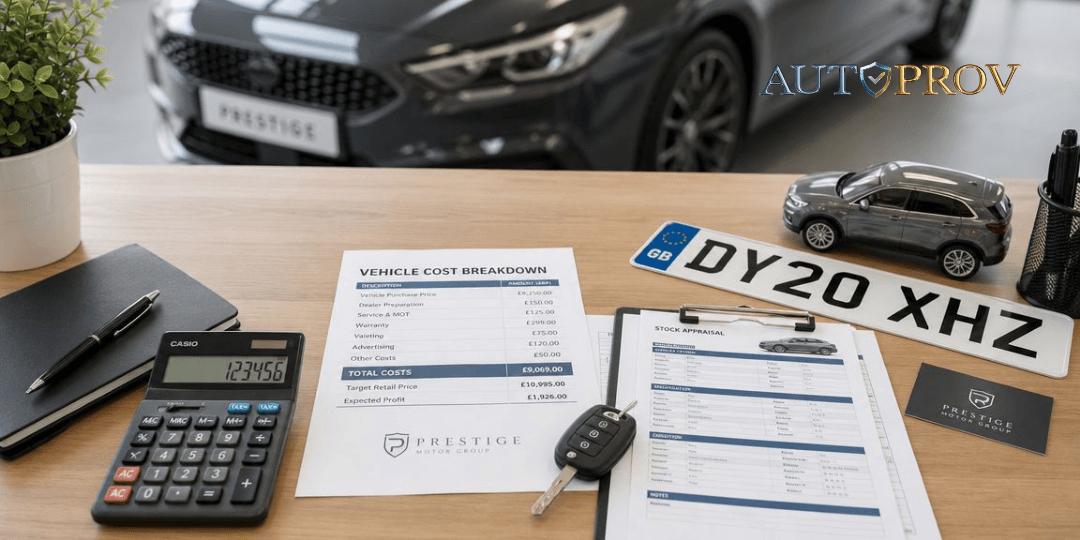
You buy a car well. The hammer drops at the right number. The spec looks retailable, the photos are clean, and the margin looks there on paper.
Then the file starts to grow.
Collection cost. Workshop time. Two tyres instead of one. A service you can't skip. A missing spare key. A bodyshop quote that turns a tidy unit into a negotiation. Then, after sale, a customer spots something in the history that should have been picked up before anyone bid. That's how a “good buy” becomes dead effort.
In the UK used market, every stock decision carries real weight. The SMMT reported 7,643,180 used car transactions in 2023, and the average used-car transaction price was £18,120 in the same year, according to market reporting cited in UK market analysis. At the same time, DVLA records include around 1.2 million vehicles with active write-off markers, which is a blunt reminder that provenance risk sits inside a market with five-figure capital tied up in each retail decision (market context cited here). If you want a wider view of how high stock values affect dealer buying decisions, AutoProv's look at the average car price in the UK is a useful companion read.
The same principle applies outside the forecourt. Anyone who's had to navigate complex business purchases will recognise the pattern. The headline price is only the start. The real number is the all-in cost once diligence, friction, and risk are priced properly.
Why Your True Cost of Acquisition Is More Than the Price
A junior buyer usually learns this lesson on a car that looked easy.
It might be a clean part-exchange, a late-plate fleet return, or an auction car that seemed under book and ready to go. On the worksheet, the margin is healthy because the buyer only used the purchase figure and a rough prep allowance. Once the vehicle lands, the workshop finds deferred maintenance, the valeter flags paint issues, and sales notices the service history doesn't read as clean as the advert needs it to.
That's the point where cost of acquisition stops meaning “what we paid” and starts meaning what it takes to turn that unit into safe, compliant, retail-ready stock.
The price buys the vehicle. The cost buys the margin.
The hammer price is only one line in the deal. It doesn't include the work needed to make the car presentable, saleable, and defensible if there's a complaint later.
A proper stock controller thinks in terms of total cost to retail. That means adding every cost that sits between the bid and the handover:
- Purchase cost linked to the stock source
- Movement cost to get the car on site
- Inspection cost to confirm what was bought
- Preparation cost to bring it to your retail standard
- Risk cost for what the file suggests may go wrong later
A vehicle can be cheap to buy and expensive to retail. Traders who miss that distinction usually overvalue their own stock.
That's why basic maths at the rostrum isn't enough anymore. Margins are won before the car is advertised. If the provenance is weak, if the condition has been guessed at, or if the worksheet ignores internal handling time, the buyer isn't measuring acquisition properly. They're just pricing hope.
The Hidden Components of a Vehicle's Acquisition Cost
The purchase figure gets attention because it's visible. The hidden lines do the damage because they arrive in fragments.
Independent market commentary on acquisition accounting is useful here because it separates purchase price from acquisition burden. In the used-car trade, that matters. Discussions of cost of acquisition often fixate on the price paid, while the larger exposure sits in the financial burden created by condition uncertainty, especially when higher used-car prices make issues like prior damage or misdescribed mileage more costly for dealer margins (background context here).

The direct costs buyers usually remember
These are the obvious lines. Most traders record them, although not always consistently.
- Bid or agreed purchase price. The starting point only.
- Auction or sourcing fees. Easy to forget when a buyer is moving quickly.
- Transport and collection. Trade plate time, fuel, transporter cost, or staff movement.
- Initial inspection. Mechanical appraisal, tyre check, diagnostics, road test, and admin booking time.
The costs that sit between purchase and retail
This is where margin usually leaks.
- Mechanical preparation. Service work, brakes, tyres, battery, fluids, diagnostics, warning lights, MOT-related rectification.
- Cosmetic preparation. Alloy repair, paint correction, dent removal, trim pieces, screen chips, interior repair, smart repair, valet.
- Documentation and compliance. File checks, invoicing, imaging, stock upload, warranty paperwork, and customer-facing prep of the history file.
- Time in process. Every day a vehicle sits waiting for prep or authorisation carries a real cost, even if it doesn't appear as a single invoice.
If you're valuing expected margin before purchase, it helps to pair your prep estimate with a realistic pricing view. A disciplined buyer should always connect landed cost to likely retail price, not to wishful price. AutoProv's guide to accurate vehicle pricing is useful for that part of the decision.
Watch this line closely: internal handling time isn't free just because it sits on payroll. If your buyer, workshop controller, valeter, and sales admin all touch the car, that labour belongs in the acquisition model.
The risk provision most dealers understate
This is the line many files don't carry at all.
A risk provision is the amount you hold against uncertainty in the vehicle's history, condition, or likely post-sale friction. Not every car needs the same buffer. A straight, well-documented unit with stable ownership can carry less risk than a car with patchy records, abrupt resale patterns, or mileage that needs explaining.
That provision can cover things such as:
- Expected comeback exposure from unresolved condition issues
- Negotiation drag when the history file weakens buyer confidence
- Warranty pressure on vehicles with unclear prior use
- Dispute handling time if a customer challenges provenance after sale
A dealer vehicle check shouldn't be viewed as an admin extra. It's a cost-mitigation step. The report itself is minor compared with the cost of buying stock blind.
How to Calculate Your Fully Loaded Acquisition Cost
The cleanest way to do this is to treat every vehicle as a mini investment case. Build the cost lines before you buy, then update them once the car lands and prep starts.
Procurement guidance is useful here because the discipline is the same. A robust acquisition cost model requires collecting all direct and indirect cost lines and validating each one, and a common failure is undercounting hidden items such as internal handling time and risk provisions, which can distort profitability (cost analysis guidance here).
Use a repeatable worksheet
For each vehicle, record these lines in order:
- Start with the purchase price
- Enter the agreed trade price or hammer price.
- Add source-related charges
- Include any buyer fee, release fee, or third-party sourcing charge.
- Add movement and intake costs
- Collection, transport, fuel, booking-in, initial inspection.
- Estimate prep to your retail standard
- Don't use a generic average if the car in front of you clearly needs more.
- Add compliance and file costs
- MOT work, documentation, imagery, admin, warranty setup if relevant to your internal model.
- Add a risk provision
- Provenance is critical. If the history raises questions, put a number against the uncertainty before you bid.
- Compare the all-in figure with realistic retail value
- Don't compare it with the top of the market. Compare it with what your site, your location, and your stock profile can genuinely achieve. If you need a refresher on setting retail values properly, this guide to accurate vehicle pricing is worth keeping close to the buying desk.
If a line exists after purchase and before retail, it belongs in the worksheet.
Worked Example
Below is a simple template. The amounts are illustrative and shown for structure rather than as a market benchmark.
Cost Item Amount (£) Hammer price 8,500 Buyer fee 250 Transport to site 120 Intake inspection 60 Service and fluids 180 Two tyres 190 Smart repair and valet 220 MOT rectification 140 Admin and imaging allocation 75 Risk provision 265 Fully loaded acquisition cost 10,000 This is why traders get caught out. The car that looked like an £8,500 buy is a £10,000 landed retail cost once the file is honest.
What works and what doesn't
What works
- Using one template for every source. Auction, part-exchange, direct purchase, and wholesale stock should all land in the same framework.
- Checking assumptions against invoices. If your prep estimate is always low, the worksheet isn't wrong by accident.
- Closing the loop after sale. Compare projected margin with actual margin so buyers learn where their estimate drifted.
What doesn't
- Carrying one flat prep number across every unit
- Ignoring internal labour because it's “already paid”
- Treating provenance checks as optional
- Using asking prices from other dealers as proof of retail value
There's a useful parallel in marketing finance. Teams that measure understanding dealership CAC properly don't stop at ad spend. They include labour, tooling, and overhead because that's the only way the number means anything. Vehicle acquisition works exactly the same way.
Using Provenance to Refine Valuations and Mitigate Risk
A static worksheet is useful, but it isn't enough. Two cars with the same age, mileage, and book position can carry very different financial risk once you look at their history properly.
That's where vehicle provenance changes the valuation. The buyer isn't only asking, “What is this car worth?” They're asking, “What extra cost or reduced liquidity does this specific history create?”

Risk signals that should move your number
A proper vehicle history check UK process shouldn't stop at whether a marker is present. It should look at context.
- Short-term ownership patterns
- Repeated quick changes of keeper don't automatically mean there's a problem. They do mean the buyer should ask why the car hasn't stayed put.
- Mileage irregularities
- A mileage check UK review is more than reading the latest MOT line. You're looking for gaps, unusual movement, or sequences that don't fit the vehicle's usage pattern.
- Plate changes and identity friction
- Registration changes can be completely legitimate, but they can also make appraisal and sales presentation harder if the story isn't clear.
- Geographic and usage inconsistencies
- History that suggests unusual movement or unexplained usage patterns can affect confidence, retail speed, and customer questions later.
Provenance should affect both offer and provision
When the history is straightforward, your risk provision can be tighter. When the file is noisy, the offer should move down or the car should be left alone.
This isn't about being dramatic. It's about assigning cost where cost is likely to appear.
The right question isn't “Can I buy it?” It's “What will this history do to prep, pricing, days to sell, and post-sale confidence?”
For dealers building this into day-to-day buying, AutoProv provides trade-focused vehicle intelligence by analysing DVLA, MOT, mileage, ownership timeline, and anomaly signals to surface provenance issues before capital is committed. If you want a deeper breakdown of what sits inside a strong used car history report, this guide to the ultimate car provenance report in the UK is the right reference point.
Strong financial control always starts before the invoice is raised. The same logic appears in broader advice on ways to safeguard your business finances. In stock buying, provenance is one of those controls. It helps stop a pricing error from becoming a profit problem.
Key Controls and KPIs to Manage Acquisition Performance
A strong buyer can still lose money inside a weak process. If you only review deals unit by unit, you'll miss the pattern.
The answer is to track a small set of controls every month and challenge drift early.
The KPIs worth watching
- Average cost to retail
- This is your all-in acquisition figure across sold units, not just purchase prices. It shows whether prep, intake, and hidden cost lines are staying under control.
- Actual versus projected margin
- This is the most honest test of buying quality. If buyers keep missing their projected margin, the issue is usually appraisal discipline, provenance assessment, or prep underestimation.
- Days to retail readiness
- A car that sits waiting for workshop approval or parts ordering ties up cash and slows turn. Delays here often expose process weakness rather than buying weakness.
- Reconditioning spend against purchase price
- This helps spot where stock profile is slipping. If this measure rises, the business may be buying too much cosmetic promise and not enough mechanical certainty.
The controls that keep those KPIs useful
Run a post-mortem on lost margin. Not every deal needs a meeting, but every painful miss needs one.
Use one appraisal standard across all buyers. If one person prices risk properly and another doesn't, the business ends up with mixed stock and unreliable margins.
Good acquisition control isn't admin. It's stock discipline made visible.
The best operators don't rely on memory. They compare estimate to outcome, feed the lesson back into the next appraisal, and tighten the worksheet each month.
Case Study How Intelligence Slashed a Dealer's Hidden Costs
A buyer is offered a tidy premium hatchback. Good colour, sensible spec, strong retail pitch. The basic history looks clear enough to proceed.
Before committing, the dealer runs a deeper provenance review. The file highlights rapid ownership changes over a short period and an MOT event that doesn't fit neatly with the keeper pattern shown elsewhere in the record. None of that proves fraud on its own, but it does change the risk profile.
The buyer steps back.
That matters because the cost of acquisition on a car like this isn't just the agreed trade money. It's the possible workshop cost if the vehicle turns out to be wrong, the pricing pressure if the history weakens buyer confidence, the extra days to sell while sales staff answer awkward questions, and the post-sale dispute risk if the customer later challenges mileage or provenance.

Instead of carrying all of that into stock, the dealer walks away and buys a cleaner alternative. That's a better result than trying to rescue margin after the car is already on site.
If you want to see how this kind of trade-focused vehicle intelligence fits into real dealer workflows, the write-up on Mill Street Motors in Barwell gives a practical example.
AutoProv helps UK motor traders assess vehicle history, provenance, mileage patterns, ownership timelines, and other risk signals before they buy. If you want a clearer view of a vehicle's true cost of acquisition, not just its price, you can review how AutoProv supports point-of-decision buying and stock risk assessment.
Frequently Asked Questions
AI-Generated Content Notice
This article was created with the assistance of artificial intelligence technology. While we strive for accuracy, the information provided should be considered for general informational purposes only and should not be relied upon as professional automotive, legal, or financial advice. We recommend verifying any information with qualified professionals or official sources before making important decisions. AutoProv accepts no liability for any consequences resulting from the use of this information.
From our AI insights
- Essential Pre-Purchase Checklist for UK Motor Traders
Ensure a seamless vehicle acquisition with our detailed pre-purchase checklist tailored for UK motor traders.
- Leveraging Auction Data for Strategic Car Purchases
Discover how to use auction data effectively to make profitable car buying decisions.
- Auction Pitfalls: Avoiding Costly Mistakes
Navigate UK car auctions with confidence by avoiding finance, write-off, and mileage risks.
Related Articles

Your Ultimate Guide to Buying a Used Car in the UK
Navigate the UK used car market with confidence using our comprehensive buying guide. Tips, checks, and AutoProv Provenance insights included.

Difference Between MOT and Service: What You Need to Know
An MOT is a mandatory legal inspection that every car on UK roads needs to pass.Think of it as the government's way of ensuring your vehicle meets the absolute minimum safety and environmental standards to be considered roadworthy. A service, on the other hand, is a completely different beast. It's the proactive maintenance routine recommended by the people who built your car, designed to keep it running smoothly and catch problems before they start. In short, an MOT is a pass-or-fail exam required by law. A service is a comprehensive health plan for your car.

Your Ultimate Used Car Inspection Checklist
A solid used car inspection checklist is the single most powerful tool you have to avoid buying a lemon. It gives you a methodical way to look past the shiny paint and assess a car's real condition, helping you spot hidden problems and get a fair price before you shake hands on the deal.
Published by AutoProv
Your trusted source for vehicle intelligence