
When UK motor traders search for "car vertical price," they're typically looking for a simple cost for a vehicle history check. However, the reality is more complex. The cost of vehicle history services ranges from a basic £10 data check to a comprehensive trade intelligence platform. For a professional dealer, successful stock acquisition isn't about finding the cheapest report; it's about securing the most valuable, actionable intelligence to mitigate risk.
Decoding The True Cost Of Vehicle Intelligence
For professionals in the motor trade, assessing the price of a vehicle history check requires looking beyond the initial cost per report. The real value is measured in the potential losses it helps you avoid and the insight it provides to protect your forecourt from high-risk vehicles.
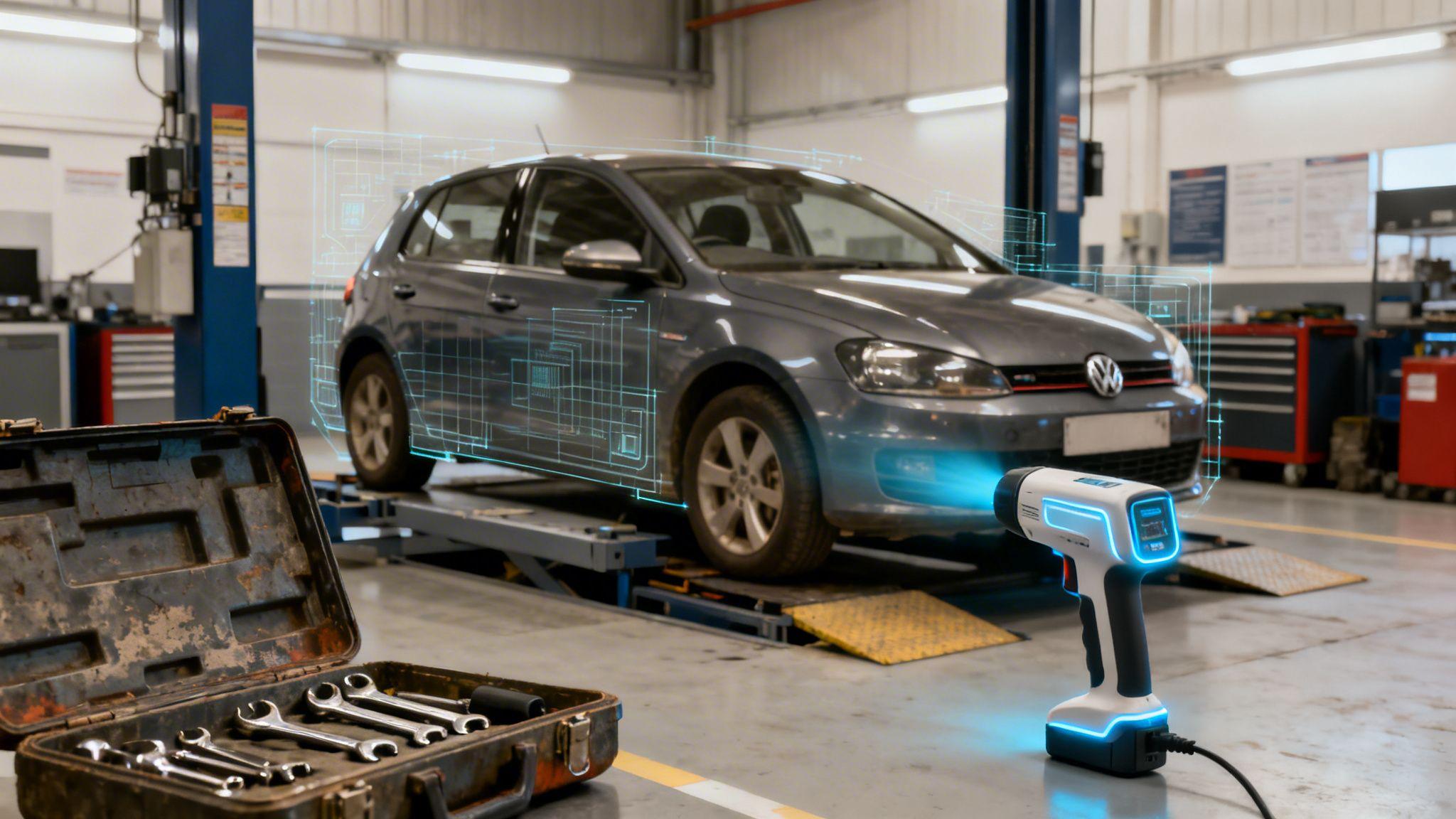
Consider this analogy: you wouldn't attempt to diagnose a complex ECU fault with a basic socket set. While a socket set is inexpensive and suitable for simple tasks, a professional diagnostic tool is essential for identifying hidden, costly problems. A standard data check is the socket set; true vehicle intelligence is the diagnostic tool.

A standard check provides a list of recorded events—a basic snapshot. In contrast, professional vehicle provenance intelligence connects these data points. It delivers the crucial context needed to identify red flags that more basic reports often miss, thereby protecting your dealership from costly errors and helping you secure profitable, sound stock.
Moving Beyond Price Per Report
While understanding the general pricing models of different services is useful, the primary metric for a dealer is the return on investment, measured in avoided losses. A cheap report might offer initial savings, but it is unlikely to detect sophisticated risks that can eliminate your profit margin.
Consider these trade-critical factors that define a service's true value:
- Depth of Data Analysis: Does the service merely list MOT advisories, or does it analyse patterns of recurring issues that suggest a persistent, underlying fault?
- Ownership Pattern Recognition: Does it flag rapid ownership changes or unusual geographical movements? These are classic indicators of potential fraud or hidden problems.
- Mileage Discrepancy Audits: An advanced check cross-references mileage from multiple, often disparate sources to detect potential clocking that simpler checks would overlook.
A single vehicle acquired with a cloned identity or a clocked odometer can negate the profit from ten successful sales. The right intelligence platform is not an operational expense; it is a fundamental risk management tool.
Ultimately, the most suitable vehicle intelligence partner for your dealership is one built for the trade, with a deep understanding of these specific risks. A platform like AutoProv is engineered to deliver this level of insight, focusing on the patterns and anomalies that directly threaten your bottom line.
To understand how our trade-focused bundles are structured, you can review our approach to vehicle intelligence pricing.
Why Past Market Volatility Still Impacts Your Stock Today
Valuing a used vehicle based solely on today's market price overlooks a critical piece of the puzzle. The significant market volatility between 2019 and late 2022 fundamentally disrupted traditional depreciation curves, and the repercussions are still evident on your forecourt today.
That period was characterised by constrained supply chains and high consumer demand, creating a market environment unprecedented in the UK motor trade. This was not a minor fluctuation; it was a seismic event that warped established valuation models. Attempting to value stock without this historical context is like navigating a city with an outdated map—you are blind to critical changes.
The Lasting Impact of Price Escalation
The statistics from that period are remarkable. The UK's used car market saw average values increase by an astonishing 47% between October 2019 and October 2022. By late 2022, approximately 17% of nearly new cars were advertised for more than their brand-new equivalents.
This market chaos created what can be termed "valuation traps"—vehicles bought and sold at inflated prices during the peak. Their transaction history now carries an artificially high benchmark that a standard used car history report will not highlight. It may show a clean record but will fail to flag that the vehicle's recent transactions occurred at the peak of a market bubble.
This is precisely where professional trade vehicle intelligence becomes essential. It is about identifying these hidden liabilities before you commit capital.
Relying solely on current market guides without understanding a vehicle's specific journey through the 2020-2022 peak represents a significant financial risk. You could be acquiring an asset whose residual value is poised for a steeper decline than any standard depreciation curve would predict.
A vehicle’s provenance—its unique record of ownership and sales—provides the context needed for sound judgment. A professional mileage check UK might confirm the mileage is legitimate, but if those miles were accrued on a vehicle whose value was artificially inflated, its true worth requires careful scrutiny.
Platforms designed for the motor trade, like AutoProv, are built specifically to provide this deeper layer of analysis. They enable you to look beyond surface-level data to understand the vehicle's true story, including its transaction history during those volatile years. You can see how AutoProv provides deeper insights into vehicle valuations and market trends to better protect your dealership.
This level of detail is no longer optional; it is an absolute necessity for making safe, profitable buying decisions in the current market.
Comparing Basic Checks To Professional Provenance Intelligence
For motor trade professionals, the discussion around a vehicle check's price is not merely about cost per report; it is about the quality of intelligence that fee provides. It requires shifting from a consumer mindset to a trade-focused one, recognising the substantial difference between a basic check and professional provenance intelligence. This is the gap between simple compliance and uncovering hidden, margin-destroying risks.
A low-cost, basic check is essentially a passive data-retrieval tool. It skims a few databases and presents the information it finds. It will confirm if the vehicle is recorded on the Police National Computer, has a write-off marker, or shows outstanding finance—the bare minimum for due diligence.
From Static Data To Dynamic Intelligence
However, this surface-level approach fails to detect the subtle patterns that indicate risk to an experienced professional. A simple check might confirm the mileage from the last MOT but lacks the capability to cross-reference it with other independent sources to flag a potential discrepancy. It views each data point in isolation, without context.
Professional trade vehicle intelligence, by contrast, is an active analysis tool. It is designed not just to display data but to interpret it, actively searching for anomalies and red flags that are specifically relevant to the motor trade.
- Ownership Velocity: It doesn’t just list previous keepers; it analyses the rate of change. Three owners in six months is a significant risk signal that a basic check would completely miss.
- Geographical Movement: It maps the vehicle's history across the country, flagging unusual or illogical movements that could indicate cloning or other fraudulent activities.
- Multi-Source Mileage Analysis: Instead of relying solely on the MOT history, a professional platform examines service records, previous sales listings, and other proprietary data. This constructs a more robust timeline, making it far easier to identify clocking inconsistencies.
This infographic illustrates how broader market events can distort a vehicle's perceived value, making a deep dive into its specific history essential.

As shown, a vehicle's journey through the recent price surge significantly impacts its true value today—a critical nuance that basic checks cannot analyse.
Vehicle Check Services: A Comparison for UK Dealers
For dealers, the choice is not just about price but about the depth of information and the level of risk management provided. This table breaks down the fundamental differences between a basic, consumer-grade check and a professional, trade-focused intelligence platform.
Feature Basic Vehicle Check (Low Price) Advanced Provenance Intelligence (Trade-Focused) Core Function Passive data retrieval from limited sources. Active analysis and interpretation of multi-source data. Finance Check Basic check for standard HP/PCP agreements. Comprehensive check including logbook loans and other niche finance. Mileage Analysis Checks against MOT history only. Cross-references multiple sources (MOT, service, sales) to flag discrepancies. Risk Signals Flags only major issues (stolen, write-off). Identifies subtle trade risks like high ownership velocity and unusual geographical movement. Data Guarantee Limited or no financial protection for data errors. Robust, high-value guarantee to protect against financial loss from inaccurate data. Focus Designed for private buyers (consumer-focused). Built for motor trade professionals (business risk-focused). Ultimately, the table highlights a clear choice: a low-cost report offers a basic safety net, while a trade-focused platform provides a proactive risk management tool designed to protect your business's profitability and reputation.
Investing In Risk Management, Not Just Data
The decision comes down to your appetite for risk. A slightly higher investment in a superior dealer vehicle checks service is your best insurance against a significant financial loss. The real return on investment is not saving a few pounds on a report; it is protecting your margin and reputation by identifying a clocked, cloned, or problem-riddled vehicle before acquisition.
The core function of a professional vehicle intelligence platform is to shift the balance of information in your favour. It provides the context and insight needed to make informed, defensible buying decisions.
Platforms like AutoProv are built on this principle. We provide the vehicle provenance analysis needed to identify these hidden risks, empowering you to acquire stock with greater confidence. It’s about moving from reactive data checking towards a proactive risk management strategy.
For a complete breakdown of what should be in a trade-level report, you can learn more by checking out our guide on the ultimate car provenance report UK.
Uncovering The Hidden Factors In A Vehicle's Trade Value
A vehicle's true trade value extends far beyond its sticker price or the figures in a basic guide. For motor trade professionals, mastering valuation means learning to look past the obvious and identify the subtle details that indicate either risk or opportunity. These are the clues that a standard used car history report will often miss entirely.
These red flags are not always as dramatic as a Category S write-off. More frequently, they are hidden patterns in the data, such as rapid ownership cycles, frequent private plate changes, or unusual geographical movements across the UK. A vehicle that has been transferred between three keepers in five months presents a completely different risk profile to one with a single owner for five years, even if both have a clean MOT.

Why Context Is King In Vehicle Valuation
Relying on generic market data alone is a flawed strategy. The market is not a single entity but a complex collection of thousands of micro-trends that can shift weekly. It is common to see brand values moving in opposite directions month-on-month—a critical detail for acquiring stock at the right price.
Recent data illustrates how much prices can vary between marques. According to full research on UK car price trends, Bentley vehicles, with an average price of £58,635, saw a remarkable 31.19% increase over 30 days. Meanwhile, mainstream brands showed divergent trends: Audi averaged £19,796 with a 1.99% monthly increase, while BMW, at a similar average of £19,627, experienced a 3.28% drop over 30 days.
This is precisely why trade vehicle intelligence is so crucial. It’s not just about obtaining data; it's about having the context to understand what that data means for the specific vehicle you are considering.
From Data Points To A Clear Story
True vehicle provenance analysis connects the data points to construct a coherent narrative. It’s the difference between knowing a vehicle has had four keepers and understanding that it was moved from London to Manchester, then to Birmingham, all within a year—a significant red flag for any trader.
Consider these critical signals that only deeper analysis can reveal:
- High Ownership Velocity: A rapid turnover of keepers often indicates a persistent, underlying fault that owners are unwilling to rectify. In more severe cases, it could suggest the vehicle has been used for illicit purposes.
- Atypical Location History: Vehicles appearing in multiple, geographically distant locations in a short period should be approached with extreme caution, as this is a classic indicator of potential cloning.
- Plate Change Frequency: While a single cherished plate transfer is common, multiple changes can be a deliberate tactic to obscure a vehicle's true history.
For a dealer, a vehicle’s history is its CV. A standard check provides the job titles, but professional provenance intelligence delivers the references, revealing the true story behind the employment history.
Platforms like AutoProv are built to provide exactly this type of contextual intelligence. Instead of presenting isolated facts, our system is designed to analyse patterns and flag these subtle risks, giving you a much clearer picture of a vehicle's viability before you invest capital. This same principle applies to verifying a vehicle's maintenance records, which you can read more about in our guide on the importance of a service history check.
How To Choose The Right Vehicle Intelligence Partner
Selecting a vehicle intelligence partner is a critical decision for your dealership, extending beyond a simple comparison of the "car vertical price" per report. For a UK motor trade professional, this is about finding a strategic ally to help manage risk, acquire stock more intelligently, and protect your bottom line. The right partner should function as an extension of your own expertise.
The market is active. With used car sales increasing by 2.2% last year, there are ample opportunities to acquire good stock. A total of 7,807,872 used cars were sold in 2025, up from 7,643,180 the previous year. However, this volume also brings increased risk, making your choice of intelligence partner more critical than ever.
The Trade-Focused Evaluation Process
Your evaluation must be grounded in the realities of professional trading. This means asking the right questions—ones that probe a provider's ability to identify genuine motor trade risk. Before committing, use this checklist.
- Data Sources and Depth: Where is the data sourced from? Does the service only use standard DVLA and MOT sources, or does it leverage proprietary datasets that provide a competitive edge?
- Ownership Pattern Analysis: How effectively does it flag high-velocity ownership? A professional trade platform should actively analyse the ownership timeline, not just list previous keepers.
- Mileage Discrepancy Engine: What is the process for a mileage check UK? Does it simply pull MOT records, or does it cross-reference multiple, independent sources to identify fraudulent readings?
- Platform Workflow: Is the platform designed for a busy dealer? Information must be clear, with risk signals prominently displayed for quick, at-a-glance decision-making.
The objective is to find a partner whose intelligence integrates seamlessly into your workflow, providing clear, actionable risk signals at the point of decision. A consumer-grade report filled with jargon is of little use when you have seconds to make a judgment on a vehicle.
Look For a Partner, Not Just a Provider
The best intelligence services understand that their success is linked to yours; they operate as genuine partners. Case studies on how some firms are empowering car dealers in the UAE demonstrate what a true partnership entails. You need a provider who understands the unique pressures of the UK motor trade.
A platform like AutoProv, for instance, was built from the ground up for this specific purpose. The goal is not just to deliver a vehicle history check UK; it is to provide a layer of analytical intelligence that puts data into context. This means highlighting the patterns and anomalies that represent real financial threats to your business.
Ultimately, choosing the right partner is a strategic decision. The right platform shifts the conversation from the cost of a single report to the value of the intelligence received—intelligence that directly protects your capital and profitability. When you start exploring AutoProv vs provenance reports, you’ll see the significant difference between basic data and true trade intelligence.
Thinking Strategically About Vehicle Intelligence
For any professional in the UK motor trade, the conversation around the price of a vehicle check needs to evolve. It is no longer about the simple cost of a single report; it is about the strategic value that intelligence brings to your entire operation. A vehicle history check is no longer a mere box-ticking exercise; it is a core component of how you manage risk, value stock accurately, and protect your profitability.
The right intelligence partner provides the insights to buy smarter, price with confidence, and safeguard your hard-won reputation. It is a direct investment in your decision-making capability, not just another overhead.
True vehicle intelligence is not about receiving a flood of raw data. It is about receiving sharp analysis, identifying patterns, and understanding the specific risks that can impact a UK motor trade business.
Thriving in today’s market requires a more sophisticated approach. You need to prioritise dealer vehicle checks that are built to identify subtle red flags—such as unusually short ownership cycles or mileage discrepancies from different sources—that a basic consumer check will almost always miss.
This is the principle upon which platforms like AutoProv are built. They provide the trade vehicle intelligence needed to properly interpret a vehicle’s past. By shifting your focus from a simple cost evaluation to a strategic value assessment, you move from reactively checking data to proactively managing risk. That is the key to securing your bottom line.
Frequently Asked Questions
When examining the specifics of vehicle intelligence, certain questions consistently arise. Here are some of the most common queries from UK motor trade professionals regarding pricing, value, and selecting the right service.
Why Can't I Just Use The Cheapest Vehicle Check Available?
While tempting, opting for the cheapest check is a classic false economy. These services cover the absolute basics, such as write-off markers or finance agreements, but they fail to identify the trade-critical risks that can have serious financial consequences.
A cheap check will not analyse short-term ownership cycles or cross-reference mileage from disparate, unlinked sources. These are subtle but crucial indicators of potential clocking, fraud, or misrepresentation that can turn an apparently sound vehicle into a liability. For a dealer, a single problematic vehicle acquired based on a basic check can erase thousands in profit and damage your professional reputation. The financial impact far outweighs the minimal savings on a cheap report.
How Does The Car Vertical Price Affect My Dealership's Profitability?
The "car vertical price"—what you pay for vehicle intelligence—directly impacts your profit margin. A top-tier service helps prevent overpaying for stock with a questionable history, thereby protecting your buying budget. It also equips you with the hard data needed to price vehicles accurately and defend your margins on the forecourt.
The real value, however, lies in what it prevents. Robust intelligence acts as a shield against post-sale disputes and costly comebacks arising from undisclosed issues. This protection for your bottom line and your professional standing is where the investment truly pays dividends.
What Is The Difference Between A Vehicle History Check And Provenance Intelligence?
A standard vehicle history check UK is like a simple list. It retrieves recorded events from specific databases, such as MOT records or insurance claims, and presents them as raw data. It is a straightforward data-retrieval function.
Vehicle provenance intelligence, in contrast, involves analysis. It actively connects the dots, cross-referencing all available data to construct the true story of the vehicle's life. Its primary purpose is to identify patterns and anomalies that indicate motor trade risk.
For example, a basic check might show a clean history, leading you to believe the vehicle is a safe bet. Provenance intelligence would go further, flagging that the same vehicle has had three owners in six months across different parts of the country—a major red flag for any trader that a basic check would completely overlook.
Ready to move beyond basic checks and start managing risk strategically? AutoProv delivers the advanced vehicle provenance intelligence the UK motor trade relies on. See our trade-only solutions at https://autoprov.ai.
Frequently Asked Questions
AI-Generated Content Notice
This article was created with the assistance of artificial intelligence technology. While we strive for accuracy, the information provided should be considered for general informational purposes only and should not be relied upon as professional automotive, legal, or financial advice. We recommend verifying any information with qualified professionals or official sources before making important decisions. AutoProv accepts no liability for any consequences resulting from the use of this information.
From our AI insights
- Navigating UK Grey Imports: A Trader's Guide
Understand the complexities and opportunities of UK grey imports for savvy motor traders.
- Navigating Private Plate Challenges in UK Vehicle Checks
Learn how private plates affect UK vehicle checks and how traders verify provenance and spot cloning risks.
- Navigating VIN Checks Post-Brexit: What UK Traders Need to Know
Discover how Brexit impacts VIN checks for UK traders and the crucial data to review.
Related Articles

Essential Vehicle Checks Before Buying a Used Car
Learn essential checks to ensure your used car purchase is safe and sound in the UK market.

Why a Provenance Check is Essential for Used Car Buyers
Ensure your used car is a smart investment by understanding the importance of a provenance check and how AutoProv can help.
A Guide to Vehicle Check with VIN Number
A vehicle check with vin number is easily the most important thing you can do before buying a used car. Think of it as your first line of defence—a quick, simple step that pulls back the curtain on a vehicle's past, protecting you from expensive mistakes, legal headaches, and downright dangerous cars.
Published by AutoProv
Your trusted source for vehicle intelligence
