

A junior buyer has just found a clean-looking part-exchange. The registration matches the car, the V5C is present, the tax position looks straightforward, and the seller wants a quick answer. The temptation is to check the car reg, see no obvious problem, and build the purchase price around that result.
A vehicle arrives at the buying desk with the right registration, a tidy presentation and an MOT that appears current. The seller wants a quick answer, the forecourt needs stock, and the obvious move is to check the car reg before deciding whether the numbers work.
That lookup matters, but it doesn't answer the whole buying question. A registration check is a point-in-time view of records that continue to change. The safer trade decision comes from reading the vehicle's timeline, mileage movement, ownership context and supporting documents together.
Table of Contents
- Why Checking a Car Reg Is Only the Starting Point for Dealers
- How to Check a Car Reg Using Official DVLA and MOT History
- Reading MOT Mileage History and Spotting Discrepancies
- Provenance Signals Basic Checks Often Miss
- Trade Buying Workflow That Turns Checks Into Safer Decisions
- Buying With Confidence After You Check a Car Reg
Why Checking a Car Reg Is Only the Starting Point for Dealers
A clean result can create false comfort. The registration may return the expected make, model and status, while the underlying vehicle history still contains a mileage anomaly, a rapid series of ownership changes or a record that needs clarification.
The issue is partly structural. UK vehicle registration data is maintained from DVLA administrative records. The latest government release recorded 769,000 vehicles registered for the first time in Q1 2026, an increase of 5.1% from Q1 2025. The wider 2024 annual total was 2,605,000 vehicles, about 3% higher than 2023, as shown in the official vehicle licensing statistics.
Those figures matter to a buyer because registration status isn't frozen. The national vehicle database is refreshed through official licensing records, so a lookup represents the position available at that time. It doesn't establish every event in the vehicle's past or prove that all information presented by a seller is complete.
The clean-result trap
Suppose a used car shows a valid registration, an apparently sensible age and no immediate issue on the basic screen. That result supports the next question, not the final decision. A dealer still needs to establish whether the recorded mileage moves logically, whether the MOT history has gaps or corrections, and whether ownership activity fits the vehicle's age and type.
A basic vehicle history check UK workflow often fails when it treats every field as an isolated answer. Experienced buyers read the registration as an identifier that connects several lines of evidence. The important question is not just whether the car passes a lookup. It's whether the available evidence forms a credible story.
Practical rule: A registration check should trigger investigation, not end it.
This is why provenance work needs more context than a pass or fail label. A useful analysis of why traditional provenance checks are no longer enough for professional traders reflects the buying reality: raw records have value, but their meaning depends on sequence, timing and consistency.
What the registration lookup cannot settle
A reg check won't, by itself, tell you whether the odometer reading matches the MOT trajectory, whether a correction has been made to an official record, or why a vehicle changed hands quickly. It also won't replace a physical inspection, document review or a sensible conversation with the supplying party.
Treat the first lookup as a gate. If the vehicle identity and basic status make sense, move to the official MOT timeline and then to wider provenance intelligence. If the identity doesn't match the stock description, stop before committing capital.
How to Check a Car Reg Using Official DVLA and MOT History
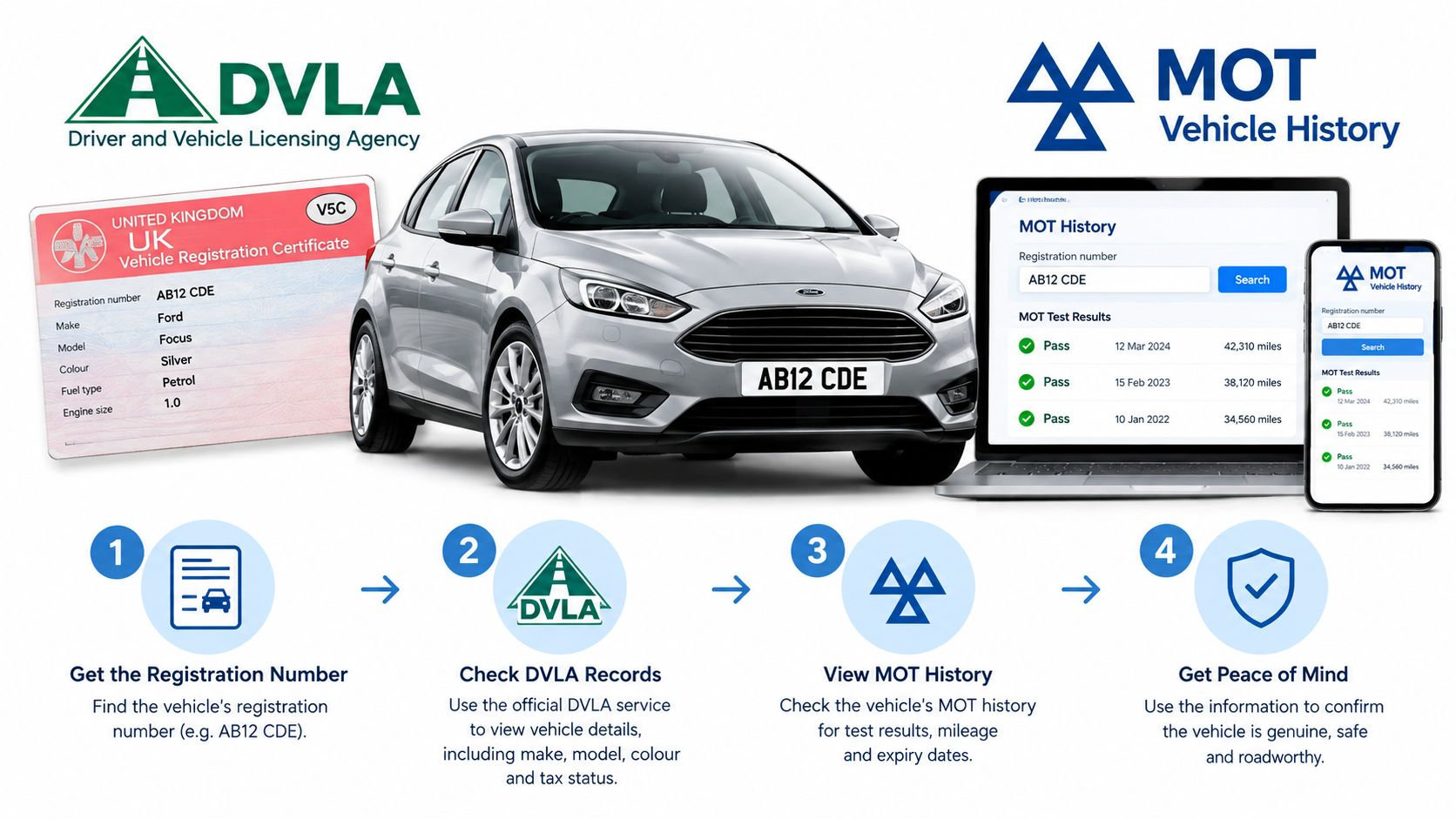
The most dependable starting point is the official government workflow. Use the registration to confirm the vehicle identity and status, then use the MOT history to examine the record over time. Keep the result with the stock file so another buyer can understand what was checked and when.
Start with the DVLA vehicle information service
Enter the registration into the official DVLA vehicle information service. Confirm the returned vehicle details against the physical car and the seller's description.
Check:
- Vehicle identity: Match the make, model and registration details to the car in front of you.
- Tax status: Record the current position shown by the official service.
- MOT status: Confirm whether the vehicle has an MOT and note the displayed due information.
- Description consistency: Treat any mismatch in identity, specification or status as a stop-and-clarify issue.
This first stage establishes that you're researching the correct vehicle. It doesn't provide a complete provenance assessment, and it shouldn't be treated as evidence that the car is mechanically sound or commercially safe.
Move to the DVSA MOT history
Open the official DVSA MOT history service and enter the same registration. For vehicles tested in Great Britain, the service exposes MOT records from 2005 onward, including test dates, pass or fail outcomes, expiry information, recorded mileage and advisory or failure items.
Read the entries as a timeline. Note each test date, the mileage recorded at that test, the result and any recurring advisory. A single advisory may be routine wear, but repeated comments can help you assess how the vehicle has been maintained and whether the current presentation matches its recorded use.
The official record can contain mistakes. DVSA provides a route for correcting errors through the test centre or online reporting, so a discrepancy is an investigate signal, not automatic proof of fraud.
Save evidence before making the offer
A dealer workflow should preserve the information used to support the buying decision. Save a dated report or screenshot in the vehicle file, alongside the stock appraisal, seller declarations and any follow-up evidence.
This is particularly useful when a vehicle moves between buyers, when a valuation is challenged or when the team needs to explain why a purchase was accepted or rejected. Dealers building a connected workflow can also review the DVLA vehicle check API guidance, but automation should still feed a human review process rather than replace it.
Buying desk standard: Verify the identity first, read the official timeline second, and document the result before negotiating.
The official services give you the foundation. They don't remove the need to interpret the evidence or investigate contradictions.
Reading MOT Mileage History and Spotting Discrepancies
A mileage reading only describes the car at one point in time. For a buying decision, build the sequence behind it. Place every MOT date beside its recorded mileage, then compare each entry with the previous one. That trajectory can expose a decrease, an implausible jump or annual use that does not fit the vehicle's age, type and apparent condition.
The available evidence points to mileage inconsistency as a practical risk screen, but the figures are not interchangeable. A 2026 UK sample of 3,626 vehicle lookups found that 1.2% of vehicles with a full MOT record showed mileage going backwards, roughly 1 in 80 cars. Where a discrepancy appeared, the median drop was 16,634 miles, according to the UK service history coverage research.
A separate analysis of 62.7 million UK vehicles identified 3.42 million cases with an odometer reduction between MOTs, equal to 5.45%, or roughly 1 in 18 vehicles. The average reduction among those cases was 46,089 miles. The MOT mileage analysis uses a much larger dataset and a different method from the smaller 2026 lookup sample, so the 1.2% and 5.45% figures should not be treated as competing universal fraud rates or fixed thresholds. Use both as context, then assess the individual record.
Build the trajectory
Start with the oldest available entry and work forwards. Mark:
- Drops: A lower reading than the previous test needs an explanation and supporting evidence.
- Jumps: A sharp increase may reflect genuine use, delayed testing or a missing record. Compare the dates with service paperwork and vehicle condition.
- Low-use patterns: Low annual mileage can be genuine, but it needs context if the interior, tyres, ownership history or seller's account suggest heavier use.
- Advisory repetition: Repeated wear items can support a consistent usage pattern, although they cannot prove the mileage is correct.
Cross-check the latest dashboard reading against service invoices, repair orders and auction or dealer documentation. The MOT mileage is one verification point. It should be tested against the physical car and the paperwork before capital is committed.
| Mileage Pattern | What It May Indicate | Trade Action |
|---|---|---|
| Reading falls between MOT tests | Recording error, replacement cluster or possible mileage manipulation | Pause the routine purchase path and request evidence |
| Reading rises sharply | Genuine high use, delayed testing or a missing record | Compare dates, service documents and vehicle condition |
| Mileage remains unusually low | Genuine low use, limited record or inconsistent disclosure | Check ownership context and supporting documents |
| Repeated advisory items match rising mileage | A coherent wear pattern | Use it to support, not replace, the wider assessment |
Separate an anomaly from proof
DVSA recognises that MOT records can contain mistakes, and mileage errors may be corrected when supporting evidence is available. Record the anomaly, ask the test centre or supplying party for clarification, and judge whether the explanation fits the wider file.
A correction window matters. If the reading was amended promptly with a credible audit trail, the risk may be manageable. If the gap appears only after a sale, valuation or inspection exposes it, treat the explanation with greater caution.
For a structured review of mileage readings alongside service evidence, use this guide to spotting clocked mileage with MOT and service history data. The buying decision should reflect the quality of the evidence. An unexplained contradiction raises motor trade risk, while a documented correction can change how the record is interpreted.
Provenance Signals Basic Checks Often Miss
A vehicle can show a consistent MOT mileage trail and still warrant closer scrutiny. Vehicle provenance is the wider story around the car, including ownership sequence, timing, use, documentation and the relationship between recorded events. A reg lookup remains a point-in-time snapshot, not a complete account of how the vehicle has been used or traded.
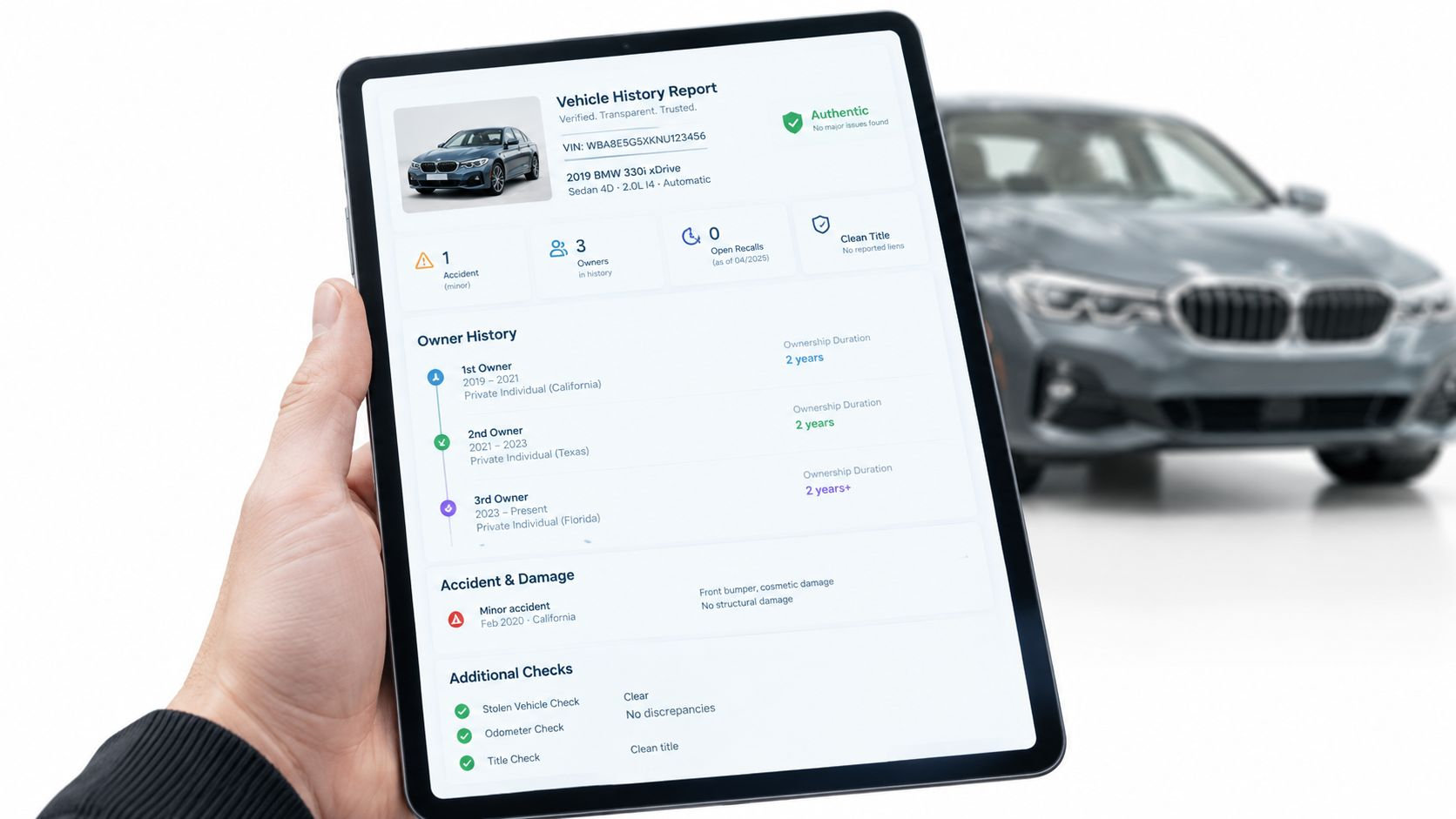
Ownership churn is useful context. A short period with one keeper followed by a quick resale does not prove wrongdoing, but it changes the questions a buyer should ask. The car may have been traded after a mechanical issue, bought for a short-term need, moved through a business, or sold after an ordinary change in circumstances. The record alone cannot identify the explanation.
Read ownership as a pattern
Judge keeper changes alongside the vehicle's age, type, condition and sale route. A nearly new vehicle moving through several businesses may have a different explanation from an older private car repeatedly advertised after short holding periods.
Look for alignment between:
- Ownership timing: Does the period appear consistent with the seller's account?
- Resale activity: Did the vehicle enter the trade soon after a recent acquisition?
- Mileage movement: Does the stated use fit the distances recorded at MOT tests?
- Documentation: Do invoices, service entries and handover paperwork support the ownership narrative?
- Vehicle condition: Do the interior, tyre wear and mechanical presentation fit the claimed use?
These signals are not automatic rejection criteria. They show whether the valuation can remain firm, whether more evidence is needed, or whether the stock belongs in a higher-risk buying category. The timing of a correction also matters. A record amended promptly with credible supporting evidence carries a different risk from one questioned only after a sale, valuation or inspection.
Context changes the commercial decision
A basic used car history report may surface individual events, while a trade buyer needs to examine how those events interact. Short-term ownership combined with incomplete service evidence may justify a stronger margin requirement than either signal alone. A clear explanation supported by consistent documents can reduce uncertainty without suggesting that the record is perfect.
A multi-source provenance report gives the buyer a structured view of relationships between events, rather than a list of isolated entries. The distinction is explained in this guide to provenance checks and full-scope provenance reports.
A clean timeline reduces one category of uncertainty. It does not explain who used the vehicle, how it moved through the market, or why it is being sold now.
For dealers, that context supports a defensible purchase price, a clearer negotiation position and more consistent stock selection. It also helps the team explain why two vehicles with similar headline specifications should not necessarily carry the same buying value. A reg result starts the assessment. Ownership patterns, mileage trajectory and the timing of corrections determine how much risk remains.
Trade Buying Workflow That Turns Checks Into Safer Decisions
A car can look right on the forecourt and still leave a dealer carrying unresolved risk. The buying workflow must work while stock is available, evidence is incomplete and the seller expects a quick answer. Apply checks in a sequence that increases scrutiny when the evidence stops lining up, instead of collecting every possible record before engaging with a seller.
Use a staged buying gate
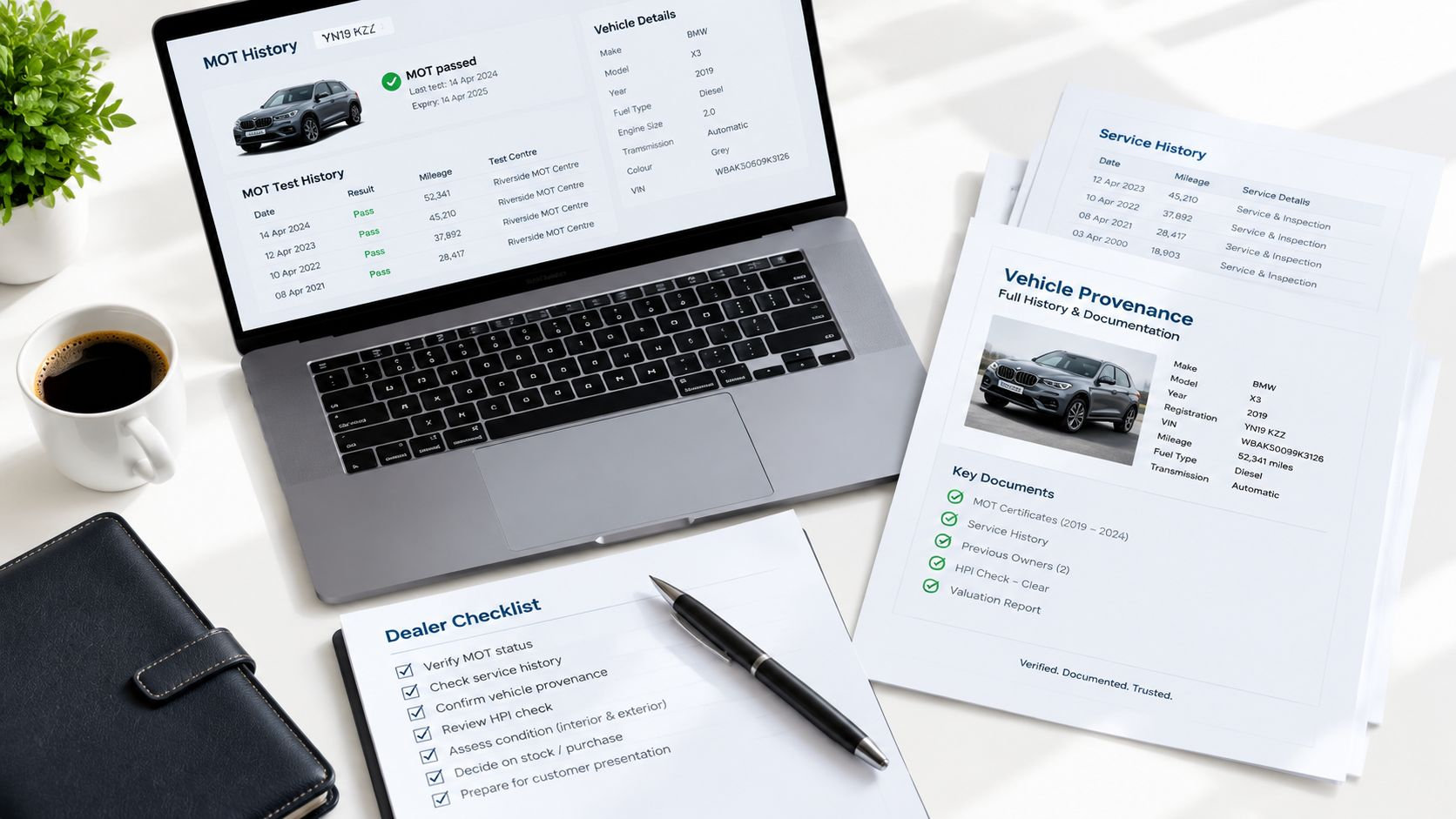
Gate one, identify the vehicle. Run the official registration lookup, then match its details against the physical car, paperwork and seller description. Any mismatch pauses the purchase until the identity is resolved.
Gate two, read the MOT record. Capture the full timeline, mileage entries, test outcomes, expiry information and advisories. A current pass gives only a point-in-time snapshot. It does not settle the buying decision.
Gate three, test the story. Compare the recorded mileage with the odometer, service documents and observed condition. Review ownership timing and resale activity for patterns that change the risk. A steady mileage trajectory with coherent paperwork supports confidence. Corrections, sharp changes or unusually thin evidence require an explanation.
Gate four, set the commercial response. A consistent record can proceed to valuation. A smaller unexplained issue may justify more evidence, a reduced offer or a condition in the deal. A material contradiction without credible support should lead to a decline. For a fuller framework, see this guide to conducting proper due diligence when buying trade stock.
Escalate with purpose
Each flag needs an owner and a next action. Ask for the missing invoice, contact the MOT test centre where appropriate, inspect the vehicle again or place the purchase on hold. Replace notes such as “history questionable” with the exact contradiction and the evidence needed to clear it.
Mileage corrections deserve prompt attention. UK guidance indicates that an MOT mileage error is easier to correct when raised within 28 days of the MOT date. Later amendments require more documentation, as explained in this MOT record correction guidance. Dealers should therefore challenge a suspicious entry promptly, while the supporting evidence is easier to assemble.
A dealer can add dealer vehicle checks to the appraisal record so the buyer, manager and compliance team use the same evidence. AutoProv can sit alongside official DVLA and DVSA checks, bringing registration-linked records, mileage patterns, ownership timelines and contextual risk indicators into the purchase review.
Don't ask whether the car is clean. Ask what remains unexplained, who owns that risk, and whether the buying price reflects it.
The process should protect throughput without giving every vehicle the same level of investigation. Clear identity and consistent evidence support a faster decision. Contradictions deserve more time because they can affect valuation, resale confidence and post-sale disputes.
Buying With Confidence After You Check a Car Reg
Checking a car reg remains an essential first action for UK dealers. It confirms the vehicle identity and gives access to official status information, but it isn't a complete statement of provenance.
The stronger method is disciplined rather than complicated:
- Confirm the vehicle: Match the registration record to the physical car and paperwork.
- Read the timeline: Use the MOT history, not only the latest status.
- Test mileage movement: Flag drops, implausible jumps and unexplained low-use patterns.
- Add context: Consider ownership timing, rapid resale activity and document quality.
- Decide commercially: Proceed, request evidence, renegotiate or walk away according to the unresolved risk.
That approach supports better pricing and more consistent compliance because each decision has an evidence trail. It also gives stock controllers a common standard when several buyers assess vehicles across different channels.
The key distinction is between data collection and trade vehicle intelligence. A raw result tells you what a record says. Risk-led interpretation asks whether the record, vehicle condition and seller explanation belong together. That is the standard worth applying before committing capital.
AutoProv provides UK motor traders with registration-based vehicle provenance reports covering official vehicle records, MOT and tax information, mileage patterns, ownership timelines and risk indicators. Visit AutoProv to review how its trade-focused intelligence can support point-of-decision checks before you buy stock.
Frequently Asked Questions
AI-Generated Content Notice
This article was created with the assistance of artificial intelligence technology. While we strive for accuracy, the information provided should be considered for general informational purposes only and should not be relied upon as professional automotive, legal, or financial advice. We recommend verifying any information with qualified professionals or official sources before making important decisions. AutoProv accepts no liability for any consequences resulting from the use of this information.
From our AI insights
- Navigating UK Grey Imports: A Trader's Guide
Understand the complexities and opportunities of UK grey imports for savvy motor traders.
- Uncovering the Real Costs of Vehicle Intelligence Services
Discover hidden fees and data quality issues in vehicle intelligence services.
- Decoding UK Auction Vehicle Histories
Understand how to assess UK auction vehicle histories and uncover hidden risks.
Related Articles

Essential Vehicle Checks Before Buying a Used Car
Learn essential checks to ensure your used car purchase is safe and sound in the UK market.

Why a Provenance Check is Essential for Used Car Buyers
Ensure your used car is a smart investment by understanding the importance of a provenance check and how AutoProv can help.

A Guide to Vehicle Check with VIN Number
A vehicle check with vin number is easily the most important thing you can do before buying a used car. Think of it as your first line of defence—a quick, simple step that pulls back the curtain on a vehicle's past, protecting you from expensive mistakes, legal headaches, and downright dangerous cars.
Published by AutoProv
Your trusted source for vehicle intelligence
