
If you’re in the motor trade, you know a basic consumer-level report just won’t cut it when you’re looking to check motorcycle history. You need a tool that actively protects your profit margins and your reputation. Relying on a superficial check is a direct threat to your bottom line, as it will almost certainly fail to spot critical issues like outstanding finance or a hidden write-off status. At AutoProv, we provide the specialised tools that dealerships need. This guide goes beyond the obvious, focusing on the real commercial risks you face every day.
Why Basic Motorcycle History Checks Fail in Today's Market
In the fast-paced UK used motorcycle market, a basic history check is a serious gamble. The market is more volatile than ever, with registration surges and economic pressures creating the perfect storm for misrepresented bikes to slip through the cracks and end up in your stock. This isn't just about dodging a "lemon"; it's about active risk management for your dealership.
The truth is, superficial consumer checks simply don't have the depth needed for professional due diligence. They might tell you the V5C details match the frame number, but they often miss the financial and legal baggage that can turn a great find into a massive liability.
The Real Commercial Risks
For professionals, the stakes are far higher than for a private buyer. One bad bike can create a ripple effect of problems across your entire business.
The biggest dangers of a half-hearted check are:
- Taking on a bike with outstanding finance: This is the most common and costly mistake. You could find yourself legally on the hook for someone else's debt or, even worse, have the asset repossessed right off your forecourt.
- Unknowingly buying a stolen motorcycle: Handling stolen goods—even by accident—leads to serious legal trouble, destroys your reputation, and means a total loss of your investment.
- Purchasing a written-off bike without knowing its real history: A bike with a hidden Category S (structural) or N (non-structural) history is worth significantly less and can be a nightmare to retail.
- Missing glaring mileage discrepancies: Clocking is still a huge problem. A basic check might not cross-reference enough data to flag suspicious drops or jumps, causing you to overpay.
A professional-grade check isn’t just about verification. It’s a risk management tool that protects your capital, safeguards your reputation, and ensures every purchase is made with total confidence. It turns due diligence from a chore into a strategic advantage.
Moving Beyond the Obvious
The complexities of the UK vehicle market demand a much more robust approach. Superficial checks fail because they simply don't have access to the deep data pools that reveal the bike’s true story.
This is precisely where a trade-focused solution like AutoProv becomes essential. It’s built to instantly surface the hidden problems that basic checks miss, from high-risk finance agreements to a secret past as a courier bike. By pulling multiple data streams into one clear, actionable report, it gives you the certainty you need to thrive, ensuring every buying decision strengthens your business.
The Four Pillars of a Professional Bike Check

When you’re in the trade, a proper motorcycle history check isn’t just a nice-to-have; it’s your entire defence against buying someone else’s problem. A professional check stands on four non-negotiable pillars. If even one of these is shaky, you’re exposing your business to serious financial and legal risk.
Think of it this way: these aren't just separate checks you tick off a list. They’re interconnected streams of data that, when pieced together, give you the full, unvarnished story of a bike’s life. A quick, cheap check feels efficient at the time, but the real cost comes later when that hidden finance agreement or Cat S frame damage comes to light. For any serious motor trade professional, this level of due diligence is the only way to build a profitable inventory.
DVLA and MOT History
This is ground zero. Pulling the official DVLA and MOT records is your first chance to see if the bike’s story holds up. It's not just about confirming the reg number; you’re looking for the subtle red flags that most people miss. Suspicious gaps in the MOT history, for example, can scream "neglect" or point to a bike being off the road for major, undisclosed repairs.
Mileage fraud—or ‘clocking’—is still a massive issue. By methodically comparing the mileage logged at every MOT, you can spot the dodgy patterns a mile off.
Keep an eye out for these tell-tale signs:
- Mileage that goes down between tests. An obvious one, but you'd be surprised.
- Long dormant periods followed by a new MOT with barely any new miles. Where has it been?
- The same advisories cropping up year after year. It’s a clear sign of a bike that's been run on a shoestring budget.
This data is more crucial than ever. Look at the recent market chaos caused by the Euro 5+ emissions rules. The rush to register non-compliant stock before the January 2025 deadline led to a massive 30.5% nosedive in new registrations that month. Why? Because dealers had already pushed through over 7,000 extra bikes in late 2024. Without a solid history check, you could easily end up with a bike from that chaotic period with a questionable past. You can get more insight into the 2025 market shifts here.
Outstanding Finance and High-Risk Agreements
This is the big one. This is where your capital is most at risk. Buying a bike with outstanding finance means you don’t actually own it, simple as that. The finance company holds the title, and they have every right to come and repossess the asset—right off your showroom floor.
The fallout is brutal. You lose the bike, you lose every penny you paid for it, and you get the bonus reputational damage of having a recovery agent knocking at your door. A lot of basic checks just don’t catch these liens, especially the more complex or high-risk agreements.
A professional-grade check, like the one we provide at AutoProv, digs into Experian data to give you a definitive yes or no on finance. This isn't just a precaution; it’s an absolute financial necessity to prevent a catastrophic loss.
Stolen Status Check
Next up, you have to verify the bike’s status on the Police National Computer (PNC). There are no grey areas here. If you unknowingly buy and then sell a stolen motorcycle, you are handling stolen goods. That’s a serious criminal offence, and the legal blowback can destroy a business and its reputation overnight.
If a bike is flagged as stolen, it will be seized by the police. You lose the bike and your money. There’s no getting it back. This check is your only real safeguard against becoming an unwilling part of a criminal enterprise. Tools like AutoProv integrate instant PNC checks, giving you that critical peace of mind right at the point of purchase.
Write-Off and Salvage Records
The final pillar is a deep dive into the Motor Insurance Anti-Fraud and Theft Register (MIAFTR). This database is the official record of a bike's insurance write-off history, which has a massive impact on its value, safety, and saleability. Getting your head around the categories is vital for making a smart buy.
You’ll mainly come across two:
- Category S (Structural): This means the bike has taken a hit to its core frame or chassis. It can be repaired and put back on the road, but its history must always be declared, and its value will be permanently lower.
- Category N (Non-Structural): The damage here is cosmetic or to parts that aren’t part of the main structure—think fairings, brakes, or electrics. An insurer might decide it’s not economical to fix, but for someone in the trade, it could be a straightforward and profitable repair.
If you miss that a bike is a Cat S or Cat N, you will almost certainly pay too much for it. Even worse, selling it on without declaring its history is illegal and leaves you wide open to being sued by an unhappy customer down the line.
These four pillars—DVLA, finance, stolen, and write-off—are the bedrock of any worthwhile history check. By bringing all this data together, AutoProv gives you the single, clear picture you need to judge the risk accurately and buy with absolute confidence.
Reading Between the Lines to Uncover Hidden Risks
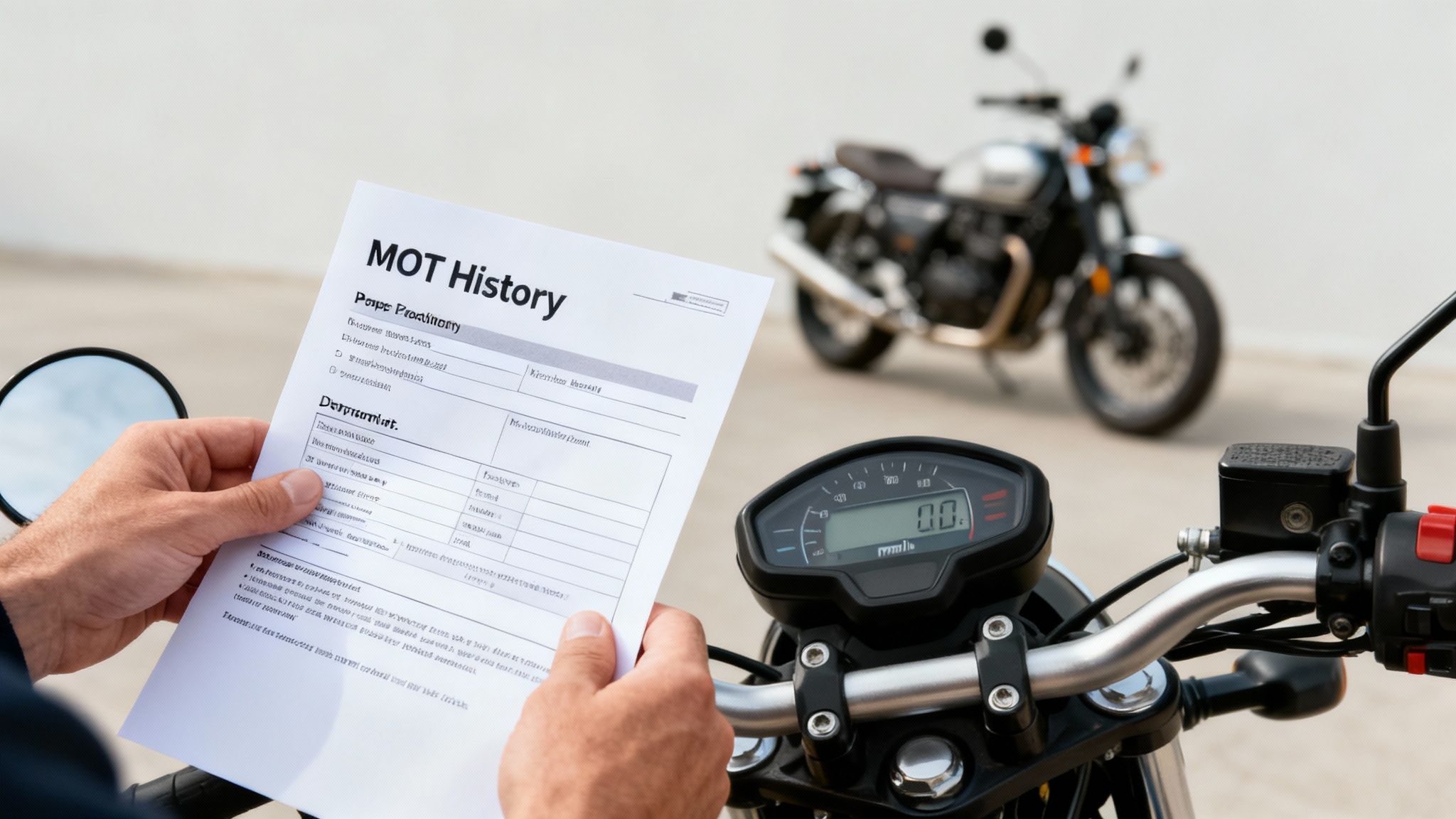
A professional-grade history report isn’t just a pass/fail certificate; it’s the story of a bike's life on the road. For anyone in the motor trade, the real skill lies in interpreting that story—spotting the subtle red flags that most people will skim right past. This is how you find the hidden risks and, just as crucially, the hidden opportunities.
This is where you have to connect the dots. Sure, a clean MOT certificate looks good, but what if the bike was written off two years ago? A low mileage figure is always appealing, but does it actually make sense for that particular model and its age? Getting these answers right is what separates a risky punt from a profitable addition to your stock.
It’s this deeper analysis that elevates a standard check motorcycle history report from a simple administrative task into a powerful commercial intelligence tool. It gives you the full picture, helps you understand the bike's true market value, and lets you negotiate from a position of absolute confidence.
Decoding Mileage Anomalies
Mileage clocking is one of the oldest tricks in the book, and it’s still a massive problem in the used vehicle market. While it’s certainly harder on modern bikes with digital displays, don't be fooled into thinking it doesn't happen. A quick glance at the odometer is never enough—you have to dig into the MOT history to see if the numbers add up.
The MOT history gives you a timeline, showing the mileage recorded at every test. You’re looking for patterns that just feel off. For instance, a high-performance sports bike that’s only done 200 miles between tests for three years straight should make you suspicious. Is it a stored-away gem, or is there another story?
Here's a classic scenario we see all the time:
- A ten-year-old commuter, maybe a Honda CBF125, is on offer with just 8,000 miles on the clock.
- Its MOT history shows it was doing a steady 3,000 miles a year for its first five years, hitting 15,000 miles.
- Suddenly, there’s a two-year gap in its MOT record. When it reappears, the mileage has dropped to 8,000. That’s a huge red flag for clocking.
Interpreting mileage is all about context. A weekend-warrior Ducati with genuinely low mileage is entirely plausible. A daily workhorse showing the same pattern is not. AutoProv’s reports lay out the MOT history clearly, making it easy to spot those illogical jumps or stagnant periods that scream tampering.
Beyond outright fraud, mileage data tells a story of wear and tear. Exceptionally high mileage on a model not known for its bulletproof reliability should heavily influence your offer. This sort of detailed analysis is also your best defence against sophisticated fraud like vehicle cloning. To better protect your business, it pays to understand the criminal mindset; our guide on preventing car cloning offers critical insights for any motor trade professional.
The Commercial Reality of Write-Off Categories
Getting your head around write-off categories is absolutely fundamental to your pricing and resale strategy. A bike that’s been declared a total loss isn’t automatically a bad buy, but its history completely changes its value proposition. Ignoring a write-off marker is one of the fastest ways to obliterate your profit margin.
The two main categories you'll see are:
- Cat S (Structural): This means the bike has suffered damage to its frame or other core structural components. It can be repaired and put back on the road, but that "S" marker is there for life. These bikes need an expert eye to verify the quality of the repair and must be priced well below a clean equivalent.
- Cat N (Non-Structural): The damage here is cosmetic or to non-essential parts—think fairings, exhausts, or wiring looms. The insurer decided it wasn't economical to fix. For a trade buyer with access to parts and labour, a Cat N bike can be a fantastic opportunity to create a profitable retail unit.
Think about a three-year-old Yamaha MT-07. A clean, low-mileage example might trade for £4,500. An identical bike, but marked as Cat N due to cosmetic damage, could be acquired for £3,000. Spend £500 on repairs, and you've got a great bike you can retail for a healthy profit, provided you're completely transparent about its history with the next buyer.
A Cat S version of that same bike is a totally different ball game. The question mark over its structural integrity means its resale value is permanently damaged, making it a much riskier purchase unless the price is rock-bottom.
Understanding Finance and Stolen Markers
Finally, you need to interpret finance and stolen markers like a pro, because not all flags are created equal. A trade-specific finance marker like 'unit stocking', for example, is a world away from a standard hire purchase agreement held by a private seller. The first is normal dealer business; the second is a hard stop until that finance is cleared.
Similarly, there's a huge difference between a current stolen marker and a recovered one. A bike with an active Police National Computer (PNC) stolen marker is a complete no-go. Full stop. However, a bike that was stolen and later recovered (often flagged on the Condition Alert Register) can be a perfectly legitimate purchase, as long as you know the full story.
This is where the clarity of a professional report is worth its weight in gold. The AutoProv platform doesn’t just throw a flag at you; it gives you the context you need. It translates complex data from Experian, the PNC, and other sources into clear, actionable intelligence, letting you make commercially sound decisions in seconds.
The Pro-Level Checks That Protect Your Profit Margin
If the basic checks are about dodging a bullet, these next steps are about actively building your profit margin. This is where the seasoned pros separate themselves from the amateurs, looking beyond the obvious to understand a bike's real story and, more importantly, its true market value.
These deeper dives uncover the kind of risks that won't pop up on a standard report. Think hidden commercial use that’s thrashed the engine, or outstanding safety recalls that could land you in hot water. By layering this data into your process, you shift from simply avoiding a loss to making a genuinely strategic, profit-focused purchase.
Uncovering a Hidden Commercial Past
A bike's history tells you far more about its condition than the number on the clock. Was it a pampered weekend ride, or was it a courier's workhorse, hammered through city traffic day in, day out? Finding out if it has a past life as a delivery vehicle or a taxi is a game-changer. That kind of relentless use puts extreme strain on the engine, clutch, suspension—you name it.
An AutoProv report flags this kind of history, handing you a serious advantage at the negotiating table. A bike that looks clean with low mileage but has a secret courier past isn't the bargain it seems. This knowledge means you can make an offer that reflects its actual mechanical state, not just what the odometer says.
The Make-or-Break Role of Manufacturer Recalls
One of the most easily missed—and most critical—checks is for outstanding manufacturer safety recalls. Selling a bike without checking and sorting a recall is a massive liability. It’s not just about the money; you’re putting your customer at risk and your business reputation on the line.
Imagine selling a bike with a known but unchecked brake system recall. The fallout from that could be catastrophic. For any professional outfit, a check that covers recall data across all the major manufacturers is non-negotiable. It’s about protecting your business and doing right by your customers.
Our system cross-references recalls from 42 different manufacturers, so nothing slips through the cracks. This lets you see any required work before you agree on a price, factoring in the time and cost involved. It protects your margin and your good name.
Verifying What Left the Factory
Is the bike sitting in front of you the same one that rolled off the production line? You'd be surprised how often the answer is no. Seemingly small things, like the wrong wheel sizes or non-standard tyres, can mess with the bike's handling and safety. They can also knock a surprising amount off its value.
Checking the original equipment (OE) specs is a vital step. If a bike is on a set of cheap, poorly-fitting tyres, that's a cost you'll have to swallow to get it ready for the forecourt. An AutoProv report lays out all this original spec data, so you can see with your own eyes if everything is as it should be.
From Past Problems to Current Market Position
Finally, a truly professional check goes beyond the bike's history and looks at where it sits in the market right now. The used motorcycle market moves fast. With around 500,000 used bikes changing hands in the UK each year, knowing your position is everything. Market wobbles, like the pre-registration push for Euro 5 stock we saw in early 2025, can flood certain segments and hit values hard. You can discover more insights about British motorcycle market trends on motorcyclesdata.com to get a sense of these dynamics.
This is where AutoProv's market intelligence really earns its keep. It gives you:
- Current Valuations: Live data on what a bike is worth at trade and retail.
- Depreciation Data: A clear view of how a model's value is trending over time.
- Desirability Scoring: A simple score showing how quickly you can expect a particular bike to sell.
With this intel, you can make much smarter, more profitable moves. You’ll stop overpaying at auction and start pricing your stock perfectly for a quick sale. While checking for finance is a must-do, combining that with this level of market data is what builds a truly powerful buying strategy.
Making AutoProv Part of Your Buying Workflow
Surviving in the used motorcycle market all comes down to one thing: making fast, informed, and profitable decisions. The risks are simply too high—financially, legally, and to your reputation—to leave anything to chance. This is exactly where a professional tool stops being a business expense and becomes a vital part of your stock acquisition strategy.
Weaving a service like AutoProv into your buying process changes the game. It turns your due diligence from a slow, manual chore into a real commercial advantage. Whether you’re standing on a noisy auction floor or sizing up a part-exchange on your own forecourt, getting definitive answers instantly is what lets you snap up the best stock at the right price.
Speed and Certainty When It Matters Most
In the heat of an auction, there’s no time to start cobbling together information from half a dozen different websites. You need one reliable answer, and you need it right now. That’s precisely what AutoProv delivers.
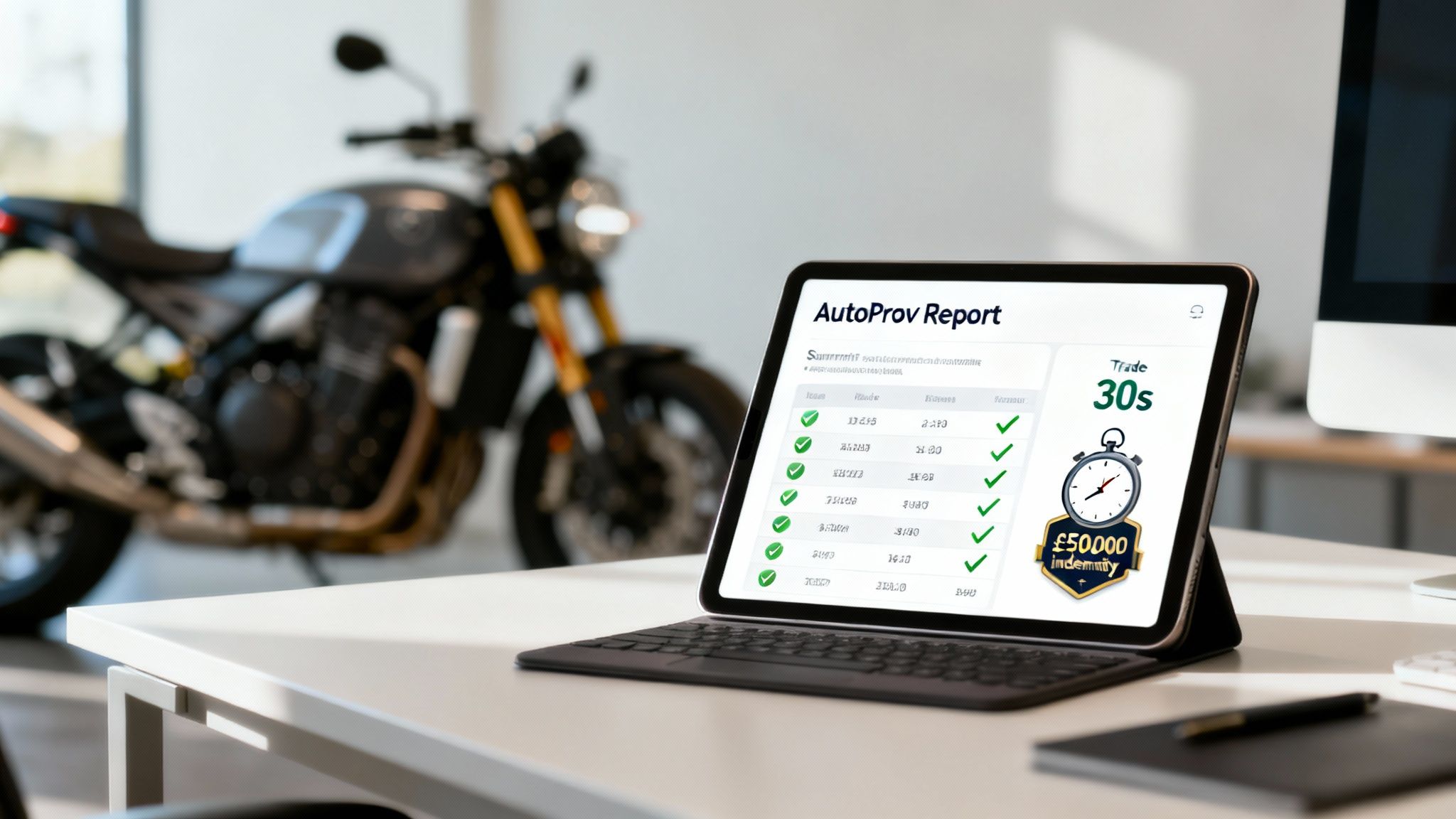
A complete verification, covering everything from outstanding finance with Experian to stolen status checks on the PNC, lands on your screen in under 30 seconds. That speed is absolutely critical. It means you can bid with confidence, knowing the bike's full story while other buyers are still second-guessing.
For anyone in the motor trade, every minute you save is a deal you could be making. An instant, trade-grade history check isn't just about convenience; it's about securing profitable bikes before your competitors even get a look-in.
The Complete Picture for Total Confidence
A good buy depends on having all the facts. A basic check might give you a hint, but AutoProv is built to show you the entire picture. With over 40 data points, it provides the depth you need to make a solid commercial decision.
This includes the kind of checks that are easy to miss but can carry massive risks:
- MIAFTR Condition Records: Instantly find out if a bike has been written off as a Cat S or N.
- Mileage Observations: Let the system cross-reference data to spot the classic signs of clocking.
- Outstanding Recalls: Protect your business and your future customers from serious safety liabilities.
The UK's used motorcycle market is huge, with around 500,000 transactions a year, easily dwarfing new sales. Within that volume, you see popular models like the Honda PCX125 and Yamaha MT-07 everywhere. This makes it dangerously easy for a high-mileage, hard-worked machine to be passed off as something it isn't. Without rock-solid checks, a dealer can easily overpay. AutoProv flags these problems fast, using data you can trust to protect your investment.
A Crucial Investment, Not an Expense
At the end of the day, a professional-grade check motorcycle history report is an investment in your dealership’s security and profitability. With reports from as little as £3, backed by an indemnity of up to £50,000, the value proposition is crystal clear. It wipes out the risk of a catastrophic financial loss from one bad purchase.
By building AutoProv into your day-to-day workflow, you create a solid, repeatable process for buying stock with complete confidence. You can find out more about how it works and see the platform in action. It’s all about enabling you to buy smarter, price your bikes more accurately, and ultimately, protect your bottom line.
Motor Trade FAQs: Your Questions Answered
In the trade, asking the right questions is what separates a profitable buy from a costly mistake. We get a lot of queries from professionals checking bikes day in, day out. Here are the straight-talking answers to the most common ones.
Can I Just Trust the History Check the Seller Gives Me?
The short answer? Absolutely not. While most sellers are genuine, taking a report they hand you is a massive gamble for your business. Think about it: that check could be old, missing the latest updates, or worse, deliberately faked to hide a nightmare issue like outstanding finance.
For your own protection, you have to run your own independent, professional check. It’s the only way to get a real-time, unbiased picture of the motorcycle's past. You're basing a business decision on this data, so it has to be accurate and complete. A tool like AutoProv gives you that impartial proof in seconds.
Which Is Riskier: Auctions or Private Sellers?
They both have their own unique pitfalls, and you need to be wise to them. When you’re buying privately, the biggest monster hiding in the shadows is usually undisclosed finance. The seller might not even know they can't legally sell the bike, leaving you to clean up the mess when the finance company turns up to claim their asset.
Auctions are a different beast altogether. The main danger here is speed. It's a high-pressure, fast-moving environment with zero time for clunky, manual checks. The risk is getting caught up in the moment and making a snap bid without the full story, only to find you've bought a Cat S write-off or something with a dodgy MOT history because you couldn't get the data quickly enough.
In either situation, having instant access to solid, comprehensive data is your best defence. AutoProv was built for these high-stakes environments, giving you the certainty you need to act fast, whether you're closing a private deal or raising your hand at an auction.
How Badly Does a Write-Off Category Hit the Value?
A write-off marker massively impacts a bike’s value, and knowing the difference is vital for your profit margins. A Category N (Non-Structural) flag means the damage was cosmetic or to non-essential parts. For a sharp trader, this can be a real opportunity—the bike can often be repaired properly and retailed for a good profit, as long as you're transparent about its history.
A Category S (Structural) bike is a completely different kettle of fish. This means there's been damage to the frame or chassis, which permanently scars its value and appeal. Even after a top-notch repair, a Cat S bike will always be worth a lot less than a straight one. If you miss that marker, you'll almost certainly pay too much and then struggle to sell it on.
Isn't a Basic DVLA Check Good Enough?
A DVLA check is a decent first step, but relying on it alone is dangerously incomplete. It’s useful for confirming the bike’s basic details and MOT history, which can help you spot potential mileage tampering. But it leaves you totally exposed to the biggest financial risks.
A DVLA-only check will NOT warn you about:
- Outstanding Finance: This is the single biggest threat to your capital.
- Stolen Status: It doesn’t check against the Police National Computer (PNC).
- Write-Off History: It won’t tap into the MIAFTR database to show if a bike is a Cat S or N write-off.
Relying just on the DVLA is like locking your front door but leaving all the windows wide open. If you've got more questions, you can find more direct answers in the AutoProv FAQ section.
Frequently Asked Questions
AI-Generated Content Notice
This article was created with the assistance of artificial intelligence technology. While we strive for accuracy, the information provided should be considered for general informational purposes only and should not be relied upon as professional automotive, legal, or financial advice. We recommend verifying any information with qualified professionals or official sources before making important decisions. AutoProv accepts no liability for any consequences resulting from the use of this information.
From our AI insights
- Navigating UK Grey Imports: A Trader's Guide
Understand the complexities and opportunities of UK grey imports for savvy motor traders.
- Navigating Private Plate Challenges in UK Vehicle Checks
Learn how private plates affect UK vehicle checks and how traders verify provenance and spot cloning risks.
- Navigating VIN Checks Post-Brexit: What UK Traders Need to Know
Discover how Brexit impacts VIN checks for UK traders and the crucial data to review.
Related Articles

Essential Vehicle Checks Before Buying a Used Car
Learn essential checks to ensure your used car purchase is safe and sound in the UK market.

Why a Provenance Check is Essential for Used Car Buyers
Ensure your used car is a smart investment by understanding the importance of a provenance check and how AutoProv can help.

A Guide to Vehicle Check with VIN Number
A vehicle check with vin number is easily the most important thing you can do before buying a used car. Think of it as your first line of defence—a quick, simple step that pulls back the curtain on a vehicle's past, protecting you from expensive mistakes, legal headaches, and downright dangerous cars.
Published by AutoProv
Your trusted source for vehicle intelligence