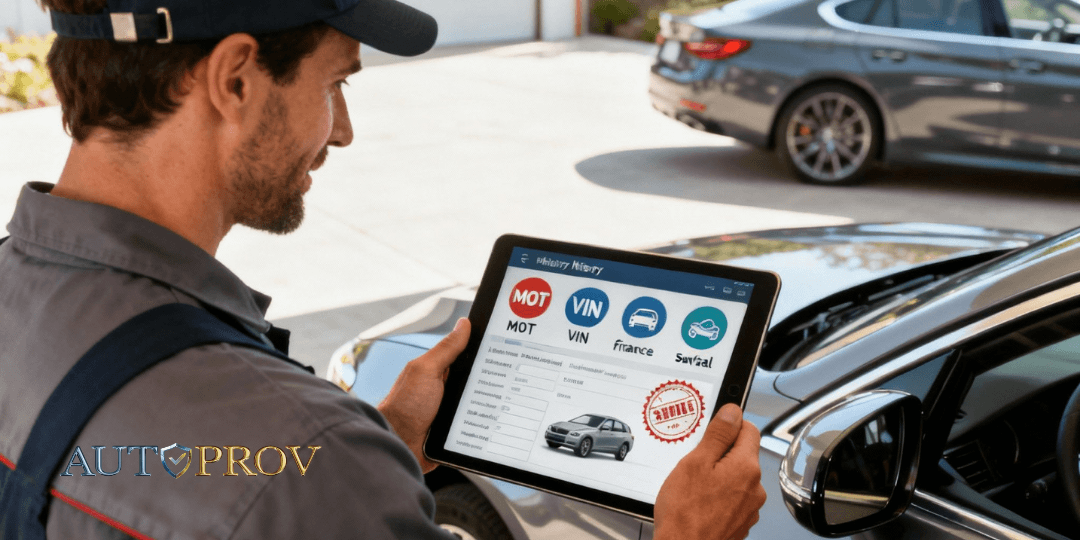
Checking a car's history before you buy isn't just a good idea—it's an absolutely non-negotiable step to protect yourself from some seriously costly hidden problems. Think of it as your first, and best, line of defence.
Checking a car's history before you buy isn't just a good idea—it's an absolutely non-negotiable step to protect yourself from some seriously costly hidden problems. Think of it as your first, and best, line of defence.
A proper check peels back the curtain, revealing critical details like outstanding finance, a shady write-off status, or dodgy mileage discrepancies. It's the only way to be sure the vehicle you're eyeing up is safe, legal, and actually worth the asking price. That small upfront investment, using a comprehensive service like AutoProv, is your best shield against buying a car with a dangerous or fraudulent past.
Why You Must Check a Car's History Before Buying

Let's be honest, buying a used car can feel like a massive gamble. A freshly polished exterior can easily hide a history of neglect, major accidents, or even criminal activity. If you don't run a thorough background check, you're essentially buying blind and just hoping the seller is being completely straight with you.
This is exactly why checking a car's history moves from a 'nice-to-have' to an absolute essential. It’s the single most important tool you have to sidestep the kind of financial and safety risks that can turn your new purchase into a total nightmare.
Uncovering the Hidden Risks
Imagine driving home in your new car, chuffed with your purchase, only to find out weeks later it was a 'Category S' write-off. That means it suffered structural damage in a crash, and unless it was repaired to a very high standard, its safety could be seriously compromised. To add insult to injury, its resale value will be a fraction of what you just paid.
This isn't just a scare story; it's a grim reality for thousands of unsuspecting buyers every year. The risks are varied, but they're all equally damaging:
- Clocked Mileage: The odometer has been illegally wound back to make the car seem less used and more valuable. You end up paying over the odds for a vehicle with far more wear and tear than you were led to believe.
- Outstanding Finance: The car still has an active finance agreement tied to it from a previous owner. If they stop making their payments, the finance company can legally repossess the vehicle—leaving you with no car and no money. We cover this in more detail if you want to learn about the importance of vehicle history checks for finance.
- Stolen Vehicle: You could unknowingly buy a stolen car. It will eventually be seized by the police, and you'll lose every penny of your investment.
The Foundation of a Smart Purchase
Looking at a vehicle history check as just another expense is the wrong way to think about it. It’s your insurance policy against hidden faults and dishonest sellers. A small fee for a detailed report can save you thousands in potential repairs, legal battles, or even losing the vehicle entirely.
A comprehensive vehicle check isn't about scaremongering; it's about empowerment. It gives you the verified facts you need to make an informed, confident decision, turning a potential gamble into a secure investment.
This is exactly what services like AutoProv are built for. We consolidate all these critical checks into one clear, instant report. By pulling data directly from the DVLA, police records, finance houses, and insurance databases, you get the complete, unvarnished story of the car’s life. This lets you verify everything the seller has told you and spot any red flags before any money changes hands, laying the groundwork for a smart, safe purchase.
What a Comprehensive Car History Check Reveals
So, you’ve rightly decided that skipping a proper vehicle check is a non-starter. But what are you actually looking for when that report lands? A thorough vehicle check isn’t just a simple thumbs-up or thumbs-down; it’s the car’s entire life story, laid bare. It tells you everything from its legal standing right through to its hidden mechanical past.
Knowing how to read this story is what separates a smart buy from a costly mistake. A quality report doesn't just dump a load of jargon on you. It translates raw data from dozens of different sources into a clear, complete picture that protects your cash and your reputation.

Verifying the V5C and Keeper History
First things first, you need to confirm the basics with the DVLA. This is where you make sure the V5C logbook details are a perfect match for the vehicle sitting in front of you. Any discrepancy here is a massive red flag—it could be a clone, or worse, stolen.
A solid check nails down these fundamentals instantly:
- Make, model, and colour: Does the paperwork match the metal? Simple, but critical.
- Date of first registration: This pins down the car's true age, which is essential for accurate valuation.
- Number of previous keepers: A revolving door of owners over a short time often points to a persistent, nagging issue that someone else has tried—and failed—to fix.
AutoProv cross-references all of this in a heartbeat. It confirms the car’s identity is legit before you waste a single second thinking about its mechanical state. It’s the bedrock of any proper vehicle inspection.
Uncovering the Mechanical Story in MOT Records
The MOT history is an absolute goldmine. It reveals a car’s true health and gives you a peek into how well (or how badly) it’s been looked after. You’re not just looking for a pass certificate; you’re looking for patterns. A car that just scrapes through its MOT every year with a laundry list of advisories is a completely different proposition to one that sails through cleanly.
Seeing the same components pop up as failures or advisories—suspension, for example, or brakes—can signal a chronic problem or a history of cheap, corner-cutting repairs. This data is your crystal ball for predicting future running costs. In the UK, digging into the MOT history is non-negotiable. It tells you what’s likely to break next, directly impacting the car’s safety and what it’s actually worth.
An MOT history doesn't just tell you if a car was roadworthy on a specific day. It provides a year-on-year health report, revealing the vehicle's vulnerabilities and the quality of its previous care.
This is exactly why having it all in one report is so powerful. Forget manually trawling through government websites. You get a clear, chronological breakdown of every test, every failure, and every advisory, all in one easy-to-scan format with AutoProv.
Exposing Financial and Legal Liabilities
Okay, this is where the stakes get really high. Two of the biggest landmines in the used car trade are outstanding finance and a stolen marker. Both can have catastrophic results for your business.
A professional-grade check goes deep into these high-risk areas:
- Outstanding Finance (Provenance Check): An incredible one in four cars checked still has finance owing on it. If you buy it, the finance company is the legal owner and they will come to repossess it, leaving you without the car and without your money.
- Police National Computer (PNC): This is the definitive check to see if a vehicle has been reported stolen. Buy a stolen car, even by accident, and you’re guaranteed to lose it—and every penny you paid—when the police track it down.
These are gambles you simply can’t afford to take. A service like AutoProv hits the official sources like Experian and the PNC directly, giving you a concrete answer on these deal-breaker points. Our platform pulls this crucial data together with information from dozens of other trusted partners, which you can see on our full list of vehicle data sources.
Ultimately, you’re not just buying a car; you’re securing a clear, legal title. It’s the only real peace of mind you can get, delivered in seconds.
How to Spot Red Flags in a Vehicle History Report
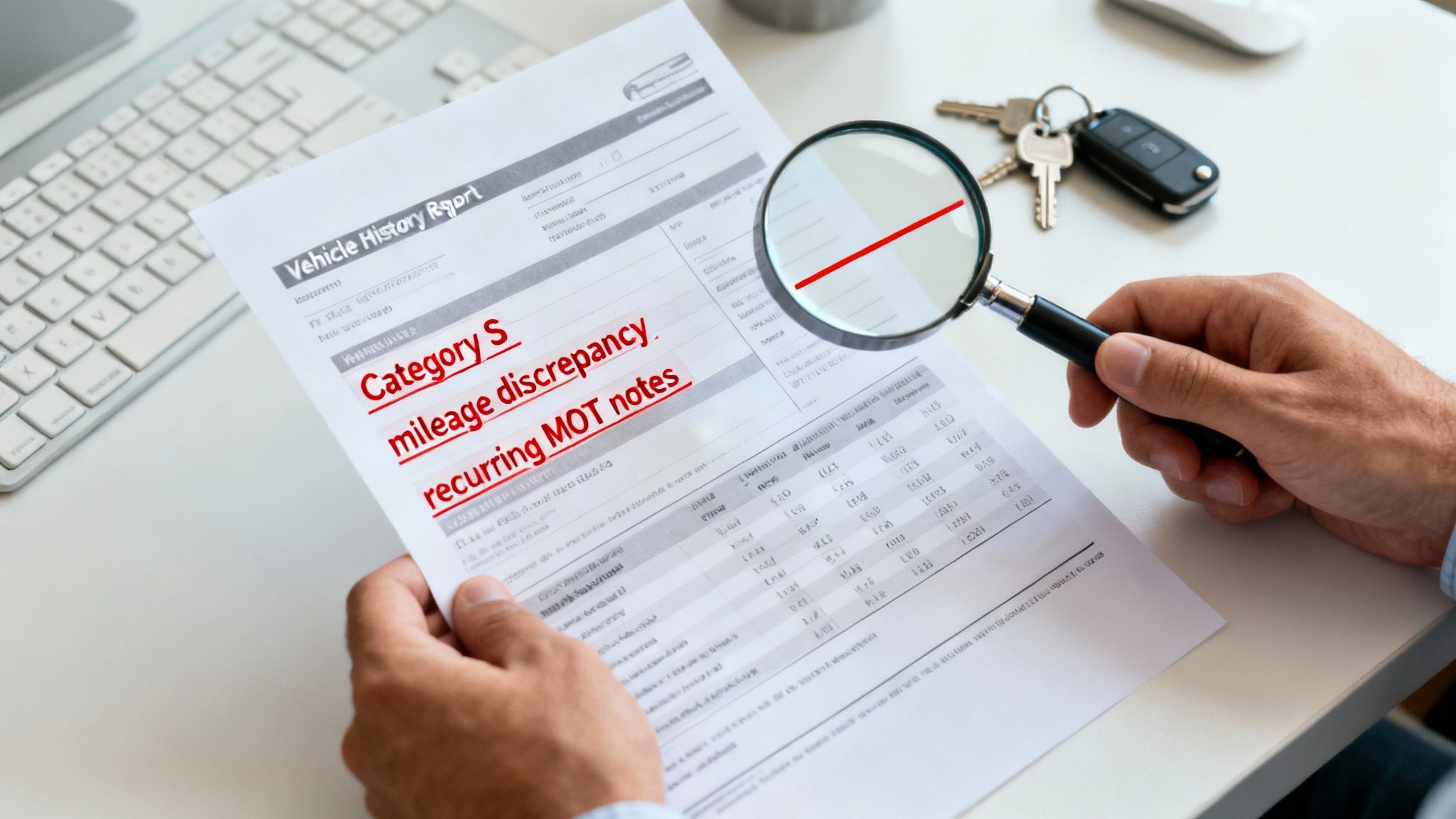
Getting your hands on a vehicle history report is the easy part. The real skill—the bit that separates a smart buy from a future headache—is reading between the lines. A report isn't just a list of facts; it’s the car's life story, and your job is to find the plot holes.
This is where you stop being a data collector and start applying real trade intelligence. A clean report is what we all want, but even tiny inconsistencies can point to much bigger problems. Knowing what to look for gives you the leverage to negotiate a better deal or, more importantly, the confidence to walk away from a car that could cost you your reputation and your profit.
Decoding MOT Gaps and Advisory Patterns
The MOT history is one of the most honest parts of a vehicle check, but the gold is in the patterns, not just the pass or fail stamps. A car that scrapes through its MOT year after year with a laundry list of advisories tells you everything you need to know about its previous owner. They did the bare minimum to keep it legal, leaving a pile of developing faults for you to sort out.
Big gaps in the MOT history? That’s an even bigger red flag. You need to ask why it was off the road. An undocumented period could be hiding a major accident and a cheap, unrecorded repair job. The seller might say it was tucked away in storage, but without proof, you have to assume the worst.
Keep an eye out for these specific tells:
- Recurring Advisories: If you see the same issue flagged year after year, like "slight play in front nearside wheel bearing," it’s a clear sign of a persistent problem that's never been properly fixed. It's been ignored, not resolved.
- Corrosion Advisories: Any mention of rust or corrosion, especially on structural parts like sills or subframes, needs to be taken seriously. A bit of surface rust might be manageable, but deep, structural corrosion is an absolute deal-breaker.
- The Sudden Clean MOT: Be wary of a car with a history littered with failures and advisories that suddenly passes with a completely clean sheet. It could mean everything's been fixed properly, or it could point to a quick, cheap patch-up just to get it sold.
Interpreting Write-Off Categories Correctly
For anyone in the trade, understanding insurance write-off categories is non-negotiable. These classifications have a direct and permanent impact on a vehicle's safety, value, and even its insurability. Seeing a "Category" marker isn't enough; you need to know exactly what it means for your business.
A report from AutoProv will clearly flag any write-off history, giving you the immediate clarity you need. It's vital to know the difference between the categories.
- Category S (Structural): This means the vehicle has taken a hit to its core frame or chassis. It can be professionally repaired and put back on the road, but its fundamental integrity may have been compromised. These cars carry a stigma for a reason, and their value is permanently damaged.
- Category N (Non-Structural): This points to cosmetic or non-structural issues—anything from battered body panels to fried electrics. While it’s less severe than a Cat S, it still tells you the car has been through a significant incident and will always be worth less than an equivalent car with a clean past.
A write-off marker is a permanent stain on a vehicle's record. No matter how perfect the repair, it will always be valued lower and can be harder to insure. Ignoring this is a guaranteed way to overpay for stock that will be a nightmare to shift.
If you come across a car with a write-off history, proceed with extreme caution. To get a better handle on this critical topic, it’s well worth reading our detailed guide on how to check if a car is a write-off.
Spotting Suspicious Mileage Patterns
Mileage clocking is still a massive problem in the used car market, and it catches people out every single day. A car's mileage should tell a simple, logical story of steady increases over time. Any break in that pattern is a huge red flag that needs a proper explanation.
An AutoProv report pulls all the mileage readings from MOTs, service records, and other sources into one clear timeline, making dodgy numbers stick out like a sore thumb. Look for sudden, inexplicable drops or long periods where the mileage barely moves. A classic trick is for someone to wind the clock back just before an MOT, getting that fraudulent reading officially on the record. Always check the latest figure against the entire history, not just last year's.
Think about this scenario: a car's history shows it climbing from 80,000 miles to 95,000 miles, but the next year it’s suddenly down at 75,000. That’s not a typo; it's a clear, undeniable sign of clocking. There is no legitimate reason for mileage to go down. This isn't something to negotiate on—it's your cue to walk away immediately.
The Serious Risks of Stolen and Cloned Cars
Mileage discrepancies and undisclosed write-offs are bad enough, but they don't even come close to the financial and legal nightmare of buying a stolen vehicle. This is the absolute worst-case scenario in the motor trade, and one you have to be constantly vigilant about.
If you unknowingly buy a stolen car, the outcome is brutal and swift. You lose the car, and you lose every single penny you paid for it.
When the police eventually track it down—and they will—the vehicle is seized and returned to its rightful owner or the insurance company that paid out the claim. You’re left high and dry, with zero legal recourse to get your money back from the criminals who have long since vanished. This risk alone is why a proper vehicle history check isn't just a "nice-to-have"; it's a non-negotiable part of the job.
Spotting the Deception of a Cloned Car
Cloning is a particularly nasty trick that makes stolen cars incredibly difficult to spot at a glance. Criminals take a stolen vehicle, often something desirable and high-value, and give it the identity of a legitimate, identical car that’s already on the road. Same make, same model, same colour.
They do this by physically swapping the number plates and forging the V5C logbook to match the details of the legitimate car. The goal is to create something that looks completely above board during a viewing. Without digging deeper, you could easily be fooled into buying a ghost—a stolen asset hiding in plain sight.
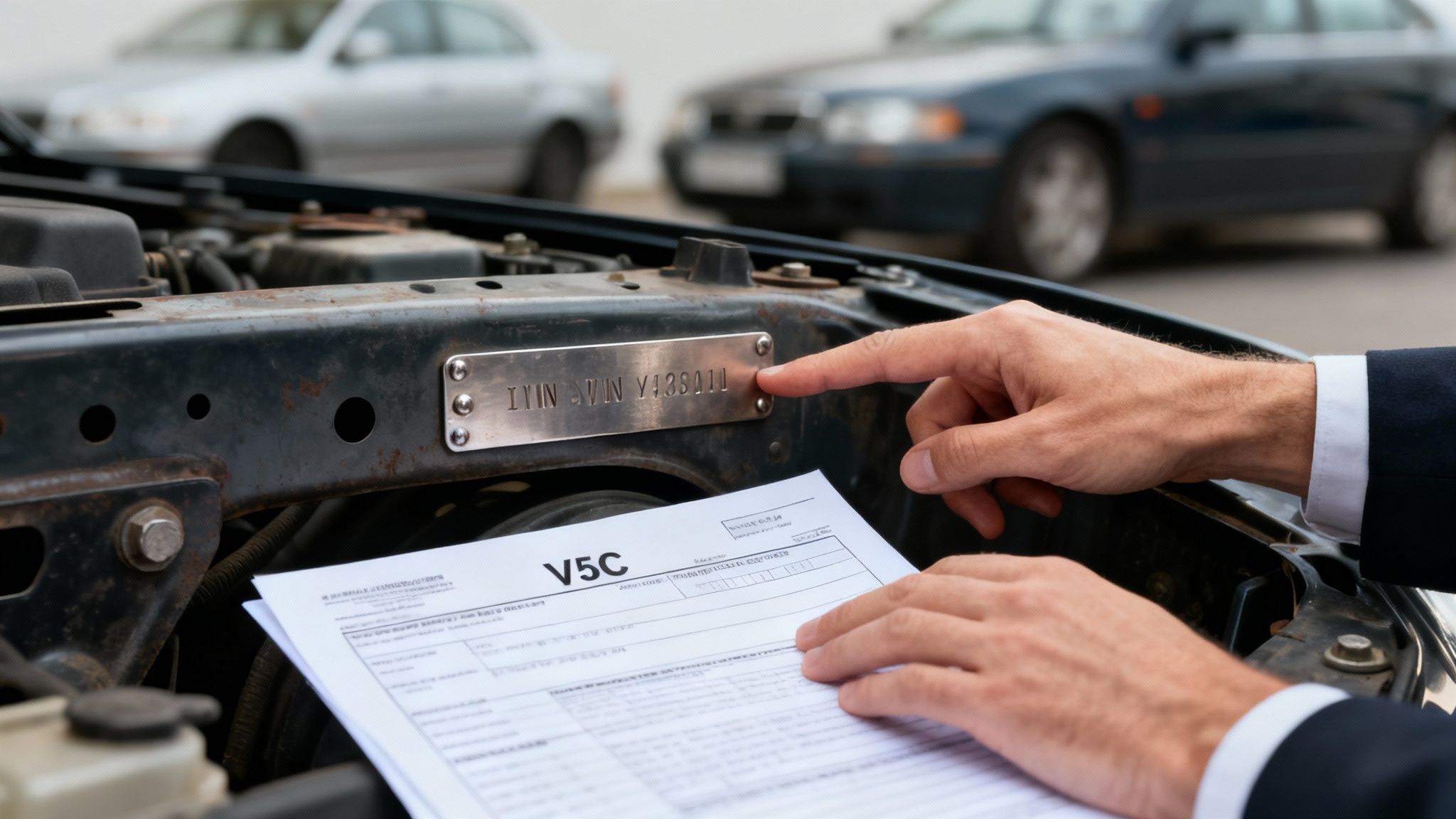
Your primary defence against this is a meticulous check of the Vehicle Identification Number (VIN).
- Check the Physical VIN: First, find the VIN on the car itself. You’ll usually see it stamped on a plate at the base of the windscreen (passenger side) and on a sticker inside the driver’s door jamb.
- Match it to the V5C: Make sure the VIN on the car is an exact match for the one printed on the V5C document the seller provides.
- Verify Against Your Report: This is the crucial bit. The VIN from both the car and the V5C must also perfectly match the VIN recorded on your vehicle history report.
Any discrepancy here, no matter how tiny, is an immediate red flag. It’s the single biggest sign you’re looking at a cloned vehicle. Walk away.
The Scale of the Problem and Your Defence
Vehicle theft is a massive, growing problem in the UK, which makes thorough checks more critical than ever. Official figures show hundreds of thousands of reported vehicle thefts across England and Wales each year, with organised crime gangs specifically targeting certain models. This isn’t a rare occurrence; it’s a daily reality of the market.
A robust history check that queries police databases isn't just a precaution; it's your only effective defence. It's the only way to see past the cloned plates and paperwork to uncover the vehicle's true identity.
This is where a professional-grade check proves its worth. A service like AutoProv queries the Police National Computer (PNC) in real-time, instantly flagging any vehicle with a "stolen" marker against its record. This goes far beyond what you can see on paper or during a physical inspection—it's a direct line to official police data.
It is, without a doubt, the definitive way to confirm you’re not about to sink your cash into a stolen asset. Skipping this step leaves you completely exposed to the most severe risk in the used car game.
Making Your Purchase with Confidence Using AutoProv
We’ve walked through the minefield of MOT histories, write-off categories, and even criminal activity like cloning. It’s pretty clear that properly checking a car's history is a serious, multi-layered job. Trying to piece this puzzle together yourself—bouncing between the DVLA portal, separate finance checkers, and police databases—isn't just slow. It's a recipe for missing something critical and making a very costly mistake.
This manual approach is a huge time sink and, frankly, leaves dangerous gaps in your due diligence. Forgetting just one check, or getting one piece of data wrong, could be the difference between a profitable new piece of stock and a car that costs you thousands. This is the exact headache AutoProv was built to eliminate.
From Hours of Hassle to a Clear Answer in Seconds
Imagine boiling down hours of frustrating research into a single click. That's exactly what you get with AutoProv. Just punch in a vehicle's registration number, and our platform gets to work, hitting dozens of official data sources all at once. Within seconds, you have one simple, easy-to-read report covering every single check you need to make.
No more juggling a dozen browser tabs or trying to make sense of conflicting information from different providers. Everything you need is laid out in a clear, logical format that’s built for making fast, smart decisions.
This speed is essential in today's market. The UK's roads are packed, with roughly 42.3 million licensed vehicles out there and over 732,000 new registrations in a recent quarter alone. In a market moving that fast, you simply can't afford to be slow. You can read more about these vehicle licensing statistics to get a sense of the scale. AutoProv gives you the speed to act decisively without ever cutting corners on your checks.
A Single Report for Total Peace of Mind
Whether you're a private buyer looking for a safe family car or a seasoned trader sourcing stock for your forecourt, the end goal is the same: confidence. You need to be certain that the vehicle is exactly what the seller says it is.
AutoProv delivers that certainty by pulling all the essential data points into one place:
- Finance Status: Is there an outstanding provenance check agreement that could become your problem?
- Theft Records: Has the vehicle been flagged as stolen on the Police National Computer?
- Write-Off History: Was it ever declared a write-off by an insurer?
- MOT History: What's the full story of its passes, fails, and advisories?
- Mileage Verification: Do the recorded mileages add up, or is something fishy going on?
By replacing guesswork and fragmented data with a single source of truth, AutoProv transforms a stressful, high-risk process into a confident, secure investment. It's the ultimate safety net for every purchase.
This all-in-one approach ensures no stone is left unturned. For a professional, that means protecting your bottom line and your reputation. For a private buyer, it means protecting your family and your wallet from hidden dangers.
Your Final Step Before a Smart Purchase
Running a proper, robust check is the final, non-negotiable step before you part with your money. It’s the moment of truth that confirms everything you’ve been told and, more importantly, uncovers everything you haven’t. With AutoProv, this vital step becomes the simplest part of your buying process.
Our service is designed to be quick and intuitive, giving you the critical intelligence needed to make smarter, safer purchasing decisions, every single time. By understanding how AutoProv works, you can see how this powerful data consolidation gives you a decisive advantage. Don't leave your next purchase to chance—arm yourself with the facts and buy with absolute confidence.
Your Questions Answered: Car History Checks
Even with a solid checklist, you're bound to have a few questions. It's only natural. Here are some of the most common queries we see, with straight-to-the-point answers to help you buy with confidence.
What’s the Real Difference Between a Free and a Paid Car Check?
Think of a free check as a quick glance. It’ll usually pull basic DVLA data, showing you if the car has a current MOT and is taxed. It's a decent first step, but it's nowhere near enough information to risk your hard-earned cash on.
A paid, professional check is where you get the crucial, high-risk intelligence that the free services simply don't have access to.
A free check tells you if a car is legal to be on the road right now. A paid check tells you if it's safe to own, financially sound, and not stolen property. One's a snapshot, the other's the full story.
This is the check that digs into the stuff that can really bite you: outstanding finance, whether the car's been written-off by an insurer, or if it's flagged as stolen on the Police National Computer. Spending a few quid on a comprehensive report from a service like AutoProv is the single best way to dodge a financial nightmare.
The Seller Won’t Let Me Run a History Check. What Should I Do?
This is one of the biggest, brightest red flags you will ever see. An honest seller with nothing to hide has absolutely no reason to stop you from doing your own due diligence. None.
If they get defensive, make up excuses, or flat-out say no, you can be almost certain they're hiding something serious. It could be anything from clocked mileage or a dodgy repair history to the fact it's a repaired write-off.
In this situation, there’s only one smart move: walk away. Don't even hesitate. No car, no matter how good it looks, is worth that kind of gamble.
How Long is a Vehicle History Report Actually Valid For?
A history report is a perfect snapshot of a vehicle's record at the precise moment you run it. The data is bang-on accurate for that instant, but a car's status can change in the blink of an eye.
For maximum peace of mind, you need to run your final, comprehensive check as close to the point of purchase as you can possibly get. Ideally, do it right there on the day you’re about to finalise the deal.
This simple last step closes that risky gap where a logbook loan could have been taken out or the car could have been in a prang between your first viewing and the moment you hand over the money. It guarantees the information you're basing your final decision on is completely up to date.
Frequently Asked Questions
AI-Generated Content Notice
This article was created with the assistance of artificial intelligence technology. While we strive for accuracy, the information provided should be considered for general informational purposes only and should not be relied upon as professional automotive, legal, or financial advice. We recommend verifying any information with qualified professionals or official sources before making important decisions. AutoProv accepts no liability for any consequences resulting from the use of this information.
From our AI insights
- Navigating UK Grey Imports: A Trader's Guide
Understand the complexities and opportunities of UK grey imports for savvy motor traders.
- Uncovering the Real Costs of Vehicle Intelligence Services
Discover hidden fees and data quality issues in vehicle intelligence services.
- Decoding UK Auction Vehicle Histories
Understand how to assess UK auction vehicle histories and uncover hidden risks.
Related Articles

Essential Vehicle Checks Before Buying a Used Car
Learn essential checks to ensure your used car purchase is safe and sound in the UK market.

Why a Provenance Check is Essential for Used Car Buyers
Ensure your used car is a smart investment by understanding the importance of a provenance check and how AutoProv can help.
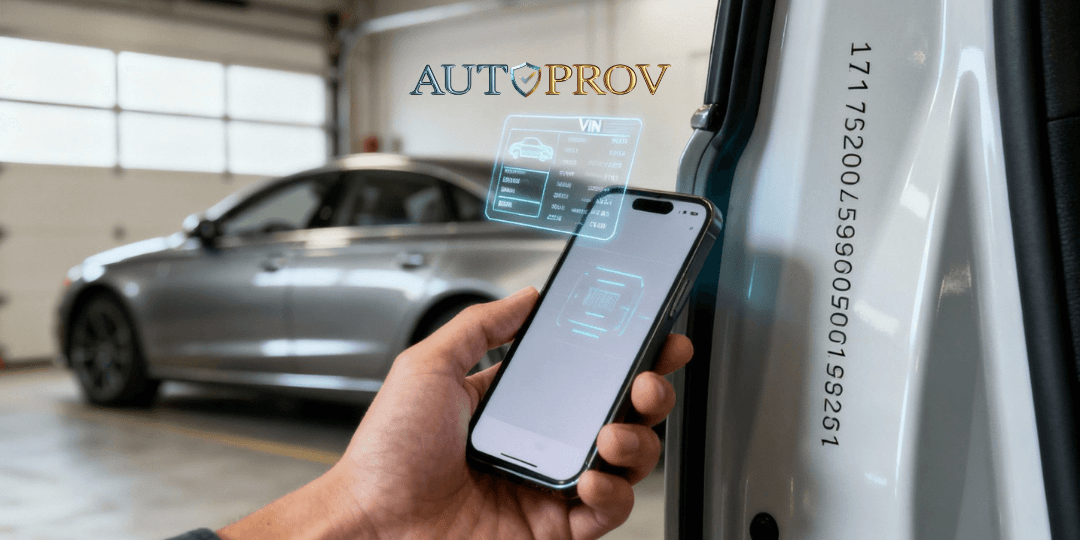
A Guide to Vehicle Check with VIN Number
A vehicle check with vin number is easily the most important thing you can do before buying a used car. Think of it as your first line of defence—a quick, simple step that pulls back the curtain on a vehicle's past, protecting you from expensive mistakes, legal headaches, and downright dangerous cars.
Published by AutoProv
Your trusted source for vehicle intelligence