You know the car. Clean photos, decent spec, engine bay dressed just enough, coolant level sitting where it should. Then you spot the residue. Not a dramatic puddle. Just a faint white trace around a hose union, a pink crust near the radiator neck, or staining under the expansion tank seam.
That's where experienced buying starts.
A coolant leak repair isn't just a workshop issue. In the UK motor trade, it's a risk signal. It can point to poor maintenance, repeated overheating risk, low-standard prep before disposal, or a vehicle that has been patched just well enough to survive an auction lane and fail later on a retail forecourt. If you treat it as a simple mechanical fault, you'll miss what it says about the vehicle's history, value, and comeback potential.
For a trade buyer, the right question usually isn't “can this be fixed?” It's “what else does this tell me?” A cooling system fault can sit at the intersection of vehicle provenance, MOT history, prep quality, and ownership behaviour. That's why a proper vehicle history check UK process and a hands-on inspection need to work together, not separately.
The Hidden Story Behind a Coolant Stain
A small coolant stain can mean three very different things.
It might be evidence of a one-off repair that was done properly. It might be the remains of an old leak with no current significance. Or it might be the visible edge of a bigger story involving repeated top-ups, intermittent overheating, and a seller who knows exactly how far the car can be moved before the issue reappears.
What the residue usually tells you
When I see dried coolant around a hose joint or radiator edge, I don't treat it as proof of one failed part. I treat it as proof that the cooling system has been under stress at some point. The question becomes whether that stress was contained, or whether it spread through the rest of the system.
A buyer who focuses only on the visible leak often ends up valuing the car too generously. Cooling systems rarely fail in isolation. A hose may be the part you can see, while the cap has been weak, the clamp has lost tension, or the system has been run low often enough to create repeat faults.
Practical rule: A coolant mark is never just a cleaning issue. It's provenance evidence until proven otherwise.
In the trade, that matters because a car can look mechanically acceptable on a quick appraisal while still carrying a pattern of neglect. That pattern affects stock risk far more than the cost of one hose or cap.
Why this changes a buying decision
A leak also tells you something about how the vehicle has been owned and prepared. If the surrounding area is dirty, original parts are tired, and the repair area looks recent, you may be looking at a car that was managed reactively. If the system shows professional work, matching coolant, and coherent service evidence, the same fault may be far less concerning.
That's where a proper vehicle provenance report becomes useful. Not to replace inspection, but to add context around ownership timelines, prior use patterns, and whether the physical clues match the vehicle's broader history.
Use that context to frame the stain properly:
- One clear event: A dated repair, sensible parts, and no other warning signs.
- A recurring issue: Repeated signs of cooling-system attention across time.
- A disposal patch: Fresh evidence of intervention with weak supporting history.
Those are three different vehicles from a risk perspective, even if the visible residue looks similar.
From Drip to Diagnosis A Professional Workflow
Trade buyers don't need a long DIY checklist. They need a fast, disciplined workflow that separates a manageable fault from a comeback risk.
A proper coolant leak repair assessment starts cold. If the seller has warmed the car before you arrive, that isn't ideal. Heat can dry off traces, change pressures, and make a small leak harder to place accurately.
Start cold and stay systematic
The first pass is visual, but not casual. Inspect the full circuit with the engine cold. Look at hose ends, clamp points, radiator seams, the expansion tank, cap sealing area, water pump region, heater hose routes, and any residue on undertrays or subframes.
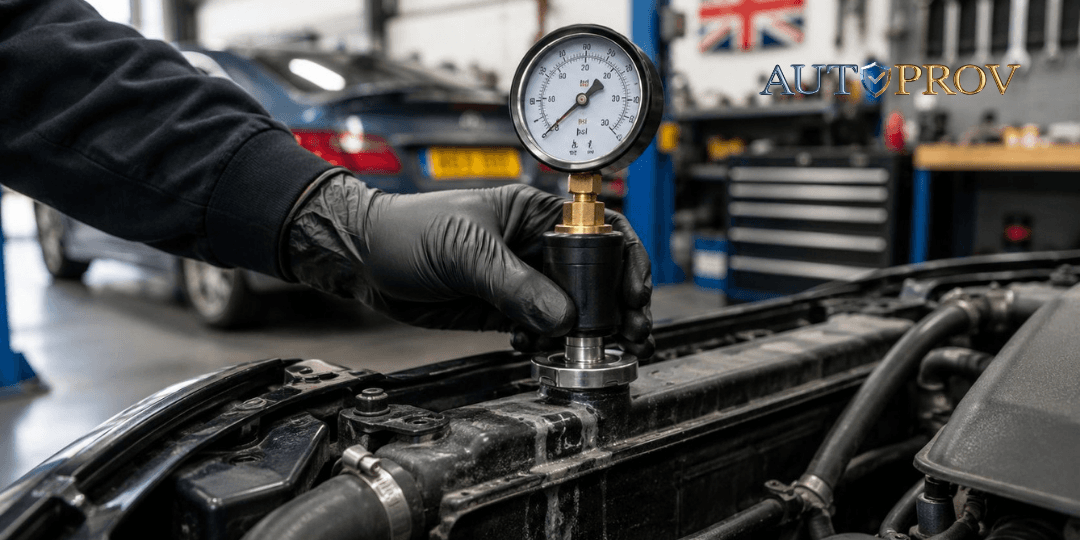
Then move to pressure verification. General workshop guidance puts cooling-system pressure testing in the 15 to 20 psi range when using the vehicle manufacturer's specified pressure, and a steady pressure drop helps identify an external leak path before parts are replaced, as outlined in this cooling-system diagnostic guidance.

A lot of traders still over-trust the visual check. That's where mistakes start. Systems often leak at small hose cracks, clamps, or caps rather than the radiator core itself. If someone says the car has had a coolant leak repair but there's no evidence the system has been pressure-tested, assume the diagnosis may have been guesswork.
What a trade-standard process looks like
Use a simple sequence:
- Cold-engine inspection
- Check level, residue, staining paths, and whether the coolant type looks consistent with the vehicle.
- Pressure test at the correct specification
- Don't pick a number at random. Use the manufacturer requirement and watch for pressure loss.
- Trace the leak path, not just the wettest area
- Coolant travels. The visible drip point isn't always the failed component.
- Inspect secondary suspects
- Cap seal, hose unions, heater-core circuit, radiator, and water pump all deserve attention.
- Verify after intervention
- A claimed repair without a retest is unfinished work.
If access is limited, combine that with scan tool context. Fault memory won't confirm an external leak on its own, but it can add useful temperature and operating clues during a broader appraisal. If your buying process already includes scan checks, this guide to using an OBD2 reader in trade inspections fits well alongside the cooling-system workflow.
A coolant system that only “looks dry” hasn't passed inspection. It has only avoided being caught.
What works and what wastes time
The efficient route is inspection, pressure test, source trace, and retest.
What wastes time is replacing the obvious part first. New radiator fitted, leak still present. New hose fitted, cap still venting. Coolant topped up, no actual verification. That's how traders inherit “already repaired” cars that return after handover with temperature complaints and fluid loss.
For buying decisions, the key judgement is simple. If the seller can't show a coherent diagnostic path, treat the vehicle as unresolved. Price it that way or leave it alone.
Temporary Fix vs Permanent Repair Reading the Signs
A temporary fix and a proper repair can look similar from two metres away. Up close, they usually don't.
The difference matters because a temporary coolant leak repair often buys just enough time to move the vehicle on. It doesn't restore trust in the cooling system. It postpones the next conversation.

What a bodge usually leaves behind
Temporary sealants have a place, but only in narrow circumstances. Guidance on these products makes clear that they're intended for minor leaks, and they shouldn't replace a proper repair to a split hose, degraded clamp, or failed cap. The definitive benchmark is whether the system holds pressure after warm-up and a short road test, as set out in sealant use instructions and repair expectations.
That's the benchmark trade buyers should adopt as well.
Signs that suggest a short-term patch:
- Sealant evidence: Residue in the expansion tank, filler neck, or around repaired areas.
- Mismatched hardware: Random jubilee clips, mixed hose types, or reused tired fasteners.
- Messy finish: Old coolant left in place, no cleaning around the repair, fresh product over old grime.
- No consistent logic: One shiny new part surrounded by visibly aged linked components.
A seller may describe all of that as “sorted”. It might be mobile. That isn't the same thing.
What a credible repair looks like
A permanent repair usually has a cleaner story. The failed component has been replaced, the fittings make sense, and the surrounding area doesn't look hurried.
Use this quick comparison when appraising:
Sign Temporary fix Permanent repair Part choice Patch or additive Correct replacement component Fasteners Mixed or improvised Properly fitted new clamps or equivalent quality Finish Residue and rushed presentation Clean area with clear evidence of completion Verification Seller assurance only Pressure-holding system after heat cycle and road test Risk outcome Delayed failure likely Lower comeback risk if history supports it One useful clue is whether the repair area has been cleaned because someone was proud of the work, or cleaned because someone wanted to hide its age. You can often tell from the edges. Freshly wiped surfaces around old residue deposits usually mean presentation came before diagnosis.
If there's any mention of coolant additives, it's also worth checking related warning signs such as recurring temperature alerts. This broader view of the coolant warning light helps when you're judging whether the leak was an isolated event or part of a bigger thermal-management issue.
Workshop view: If a system only stays dry because a product is masking the leak, the repair hasn't been completed. The timing of the failure has just been moved.
For valuation, that distinction is everything. A proper repair can be stockable. A disguised repair belongs in your risk allowance, or outside your buying profile entirely.
Uncovering Intermittent Faults and Hidden Leaks
The leaks that hurt dealers most are often the ones that don't show themselves in the lane, on level ground, with the bonnet up and the engine idling politely.
Some cooling-system faults only appear when the car is parked at an angle, driven under load, or left to sit after shutdown while heat soak drives pressure higher through the system.

Why some leaks disappear during inspection
Enthusiast troubleshooting often picks up patterns that generic repair guides miss. One UK-relevant discussion noted leaks that appeared only when a car was parked nose-up, with contributors also pointing to water-pump weep holes, heater-core hoses at the firewall, and leak behaviour that changed with heat soak and angle, as discussed in this intermittent coolant leak thread.
That's a useful reminder for the trade. Forecourt conditions are controlled. Real use isn't.
A car can sit dry on flat tarmac and still lose coolant when:
- It's parked nose-up and fluid shifts toward a weak connection.
- It's switched off hot and residual heat raises local pressure.
- It's driven harder than your appraisal route allowed.
- It cools down overnight and a tiny crack opens or closes with temperature change.
Where hidden leaks tend to catch traders out
Intermittent faults often sit in awkward places. Heater hose connections can seep and evaporate before they drip. A water pump may leak lightly from a weep point only under certain running conditions. Interior heater matrix issues may leave dampness or odour rather than an obvious external trail.
Use a more forensic check if the story doesn't add up:
- Check under the vehicle after standing: Cardboard or clean ground can expose pattern leaks.
- Inspect hot and cold if possible: Some faults only declare themselves in one state.
- Don't ignore smell or residue location: A sweet smell with no puddle still means something.
- Look beyond the front of the engine: Bulkhead hose areas and hidden routing matter.
The trade risk here is straightforward. If you can't reproduce the fault, you can't confidently say it's resolved. That doesn't automatically make the car bad stock. It does mean the burden of proof shifts. Either the history and repair evidence are strong enough to support confidence, or the car needs to be priced and prepared as a latent-risk unit.
Connecting Repairs to Vehicle Provenance and MOT History
Physical signs tell you what the car looks like now. Provenance tells you whether that condition makes sense.
That's where many dealer vehicle checks still fall short. A trader sees a dry engine bay and a recent invoice, then stops asking questions. The better approach is to line up the repair evidence against the vehicle's dated record and see whether the story is coherent.
Why MOT history matters in cooling-system risk
The MOT test gives the trade something unusually useful. It creates a dated trail of defect recording. In the UK, that trail became more informative after the May 2018 changes that introduced dangerous, major, and minor defect categories, replacing the older pass and advisory structure. That made cooling-related issues easier to interpret over time because severity is recorded more consistently in the official history, as noted in this explanation of MOT-linked cooling-system context.
That shift matters when you're trying to decide whether a coolant leak repair was a genuine resolution or the latest attempt to keep an ageing system presentable.
The MOT dataset is also large enough to make this trail commercially useful. In 2023/24, there were 33.25 million MOT tests in the UK, resulting in 6.58 million failures. The same MOT context shows why official defect history is valuable for spotting patterns before purchase, as discussed in this MOT and coolant-risk overview.

How to read the story, not just the line item
A cooling-system fault in the MOT record doesn't automatically make the car poor stock. Repeated signs of attention don't automatically make it bad either. What matters is sequence.
A trader should be asking:
- Was there a recorded issue, then a convincing repair trail?
- Did the defect recur across later dates?
- Did the ownership pattern change around the same time?
- Does the visible repair quality match the seriousness of the historical issue?
That's where a proper service history check becomes more than admin. It helps you test whether the physical state, workshop evidence, and official record support each other.
Three provenance patterns worth recognising
Pattern one is the one-off event.
The MOT trail shows a cooling-related defect once, the repair evidence is credible, and later history is clean. That can be acceptable stock, assuming the current inspection supports it.
Pattern two is the repeat management issue.
The car shows recurring attention around cooling-system components over time. That doesn't always mean severe failure, but it often points to a system ageing as a whole rather than one isolated part giving trouble.
Pattern three is the disposal sequence.
A defect appears, ownership or sale activity follows, and the current repair looks cosmetic or rushed. That's the car that catches traders. The visible leak may be gone, but the underlying risk remains.
Buy the story only when the evidence lines up in date order. If the history says “persistent issue” and the engine bay says “fresh patch”, believe the pattern, not the presentation.
Consequently, trade vehicle intelligence becomes more valuable than a basic used car history report. A simple pass or fail view won't tell you enough. You need context around timing, severity, and whether the car's maintenance narrative is stable or evasive.
For motor trade risk management, coolant leak analysis works best when it combines three things. The current physical condition. The quality of the repair. The vehicle's official and service-based paper trail. If one of those three is weak, the car needs more caution than the seller's description suggests.
A Strategic Approach to Mitigating Cooling System Risks
Cooling-system faults shouldn't be treated as a yes or no buying issue. They're better treated as a risk-weighted signal.
A car with evidence of coolant leak repair can still be a sensible buy. But only when the repair quality is credible, the history supports it, and the current inspection doesn't leave unanswered questions. If any one of those elements is weak, your margin has to absorb the uncertainty.
The buying discipline that actually protects you
Good trade buying isn't about finding perfect cars. It's about understanding which imperfect cars are still manageable.
Use a simple internal framework:
- Inspect the physical evidence properly: Residue, hose condition, clamp quality, cap area, and hidden leak points all matter.
- Verify the repair, don't assume it: If the system hasn't been pressure-checked after intervention, treat the job as unproven.
- Read the provenance alongside the mechanics: A proper used car history report or vehicle history check UK process helps explain whether the fault fits a stable maintenance story.
- Price latent risk accurately: Intermittent faults and patch repairs are where profit disappears.
There's a broader operational point here as well. Cooling-system problems are a reminder that maintenance discipline matters in every asset environment, not just vehicle retail. The same logic behind maintaining equipment in field service applies here. Small faults become expensive when teams rely on visible failure instead of structured checks.
What to walk away from
Some cars are still worth leaving.
Walk away, or bid defensively, when you've got a weak repair story, inconsistent history, and signs that the leak may only be temporarily hidden. That combination creates the classic post-sale dispute. The vehicle looked fine. The customer gets it hot, parks it on an incline, or uses it properly for the first time in weeks, and the problem returns.
A disciplined process is part of wider risk mitigation strategies for used vehicle buying. Cooling-system assessment belongs inside that process, not outside it as an afterthought for prep.
The traders who protect margin on cars like these aren't guessing better. They're reading the vehicle more completely.
AutoProv helps UK dealers, traders, and wholesalers make better buying decisions with deeper vehicle provenance, service-history context, and trade-focused risk intelligence. If you want clearer insight before you commit capital, explore AutoProv.
Frequently Asked Questions
AI-Generated Content Notice
This article was created with the assistance of artificial intelligence technology. While we strive for accuracy, the information provided should be considered for general informational purposes only and should not be relied upon as professional automotive, legal, or financial advice. We recommend verifying any information with qualified professionals or official sources before making important decisions. AutoProv accepts no liability for any consequences resulting from the use of this information.
From our AI insights
- Digital Service Records: The Future of Vehicle Maintenance
Discover why UK motor traders trust digital service records for accurate vehicle history verification.
- The Impact of EV Service Records on Resale Value
Discover how electric vehicle service records affect resale value and buyer confidence in the UK market.
- The Importance of Tyre Verification for UK Motor Traders
Discover why verifying tyre specs is crucial for UK traders to ensure safety and compliance.
Related Articles

The Importance of Car Maintenance and Provenance Checks
Discover why regular car maintenance and proper provenance checks are essential for vehicle quality and longevity.

Essential Car Maintenance Tips for UK Drivers
Discover vital car maintenance tips to keep your vehicle roadworthy and compliant in the UK.

How Much Is a Car Service? Complete UK Price Guide
Trying to pin down exactly "how much is a car service?" can feel a bit like asking "how long is a piece of string?". Prices vary quite a bit, but to give you a ballpark figure, an interim service will usually set you back around £100 to get started. A more thorough full service often begins at £180, while a major service for many cars can easily top £300.
Published by AutoProv
Your trusted source for vehicle intelligence