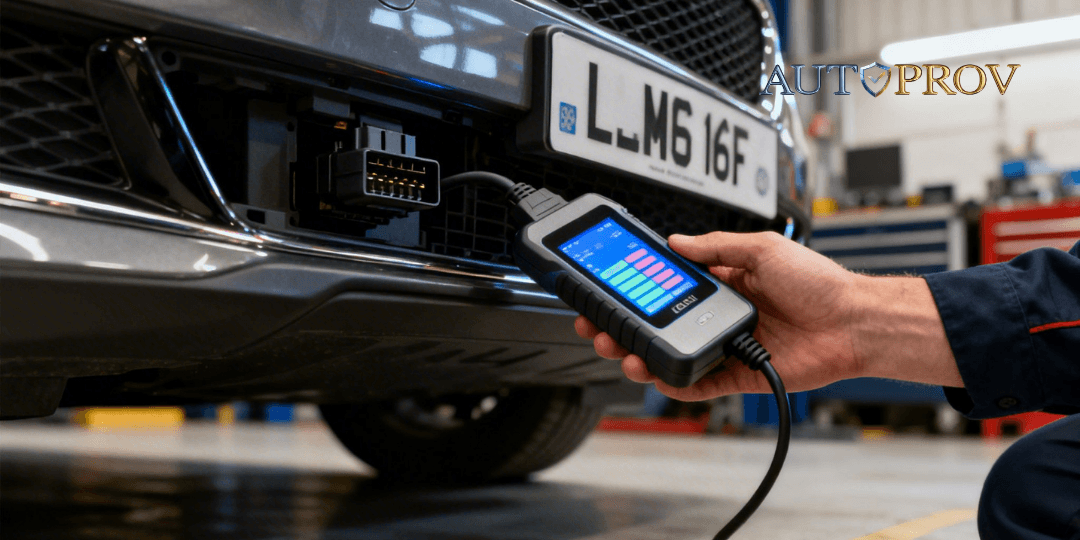
Using an On-Board Diagnostics (OBD2) reader is a straightforward process. A motor trade professional locates the 16-pin port—typically located under the dashboard—plugs in the scanner, and initiates a scan. For any UK motor trader, this rapid check is a crucial first step in assessing a vehicle's electronic health before committing to a purchase.
Beyond the Basics: The OBD2 Reader as a Trader's Risk Assessment Tool

In the current market, a physical inspection and a standard vehicle history check are no longer sufficient. An OBD2 reader has become an indispensable part of a professional trader's toolkit, providing a vital window into a vehicle's electronic control units (ECUs).
Consider this device a first line of defence against hidden liabilities that basic checks often miss. These include intermittent electronic faults, masked engine issues, or early-stage emissions problems that can lead to MOT failures and significant workshop costs. A quick scan protects margin by identifying these potential costs at the point of decision, reducing the risk of future financial loss and customer complaints.
Uncovering Hidden Risks Before Acquisition
The primary value of an OBD2 scan extends beyond simply reading a Diagnostic Trouble Code (DTC). It is about building a more complete picture of the vehicle's condition to corroborate a physical appraisal and its provenance intelligence. For any motor trade professional, a scanner helps:
- Identify recently cleared codes: If the readiness monitors show as ‘Not Ready’, this is a significant red flag. It indicates that fault codes have been recently erased, most likely to conceal an underlying problem.
- Flag potential MOT failures: A pending code such as P0420 (Catalyst System Efficiency Below Threshold) provides an early warning of expensive emissions system repairs that a visual inspection would not detect.
- Question recorded mileage: Advanced readers can extract engine run hours from the ECU. This data can be cross-referenced with the odometer reading to identify discrepancies that warrant a deeper investigation into the vehicle's history, a crucial part of a mileage check UK traders rely on.
Integrating Diagnostics with Provenance Intelligence
For a professional using a platform like AutoProv, an OBD2 scan is the first practical step in verifying a vehicle's digital footprint. Since EU Directive 98/69/EC mandated compliance for new petrol cars in 2001 and diesels in 2004, the vast majority of UK stock is OBD2-compliant.
This diagnostic data, when combined with a comprehensive vehicle provenance report, creates a powerful decision-making framework. It’s an integrated approach that enhances the methodology for acquiring used vehicles. For further technical information, you may find useful insights from automotive specialists.
Selecting a Professional OBD2 Reader for Trade Use
When acquiring an OBD2 reader for a motor trade business, consumer-grade gadgets are inadequate. Professional use demands a robust, reliable tool that delivers the detailed information required for sound commercial decisions. The right device will make vehicle appraisals faster and more accurate.
The market offers numerous options, which can be broadly categorised into three types. Each has a role in a trade environment, with the optimal choice depending on operational needs and the level of detail required for your dealer vehicle checks.
The Main Types of Reader Explained
Basic handheld code readers are simple, no-frills tools. They are typically durable and designed for quickly retrieving and clearing generic Diagnostic Trouble Codes (DTCs). They are effective for an initial check to see if any warning lights are present, but their functionality is limited.
Advanced handheld scanners represent a significant step up and are the workhorses for many independent dealers. Their capabilities include the crucial function of reading manufacturer-specific codes, which provides a much clearer diagnostic picture than generic 'P' codes alone.
Finally, smartphone-based dongles that connect via Bluetooth or Wi-Fi offer the most advanced features. These pair a small hardware device with a powerful application, enabling live data streaming and the creation of detailed reports. While highly capable, reliance on a smartphone and app can be a practical limitation in a busy workshop or auction environment.
To clarify the options, a side-by-side comparison is useful. Here is a breakdown of the main reader types and their suitability for the motor trade.
OBD2 Reader Types for the Motor Trade
Reader Type Best For Key Features Typical Price Range (UK) Basic Handheld Reader Quick initial triage, mobile appraisals, part-exchange assessments. Pulls & clears generic DTCs, shows MOT/I/M readiness status, simple plug-and-play. £30 - £100 Advanced Handheld Scanner Independent dealers, workshops, diagnostic specialists. Reads generic & manufacturer-specific codes, live data, freeze frame, special functions (e.g., DPF regen). £150 - £800+ Bluetooth/Wi-Fi Dongle Detailed data logging, creating shareable reports, tech-focused operations. Pairs with powerful apps, highly customisable dashboards, advanced data streaming & graphing. £50 - £200 (plus app subscription) Ultimately, choosing the right tool involves matching its capabilities to your daily workflow. A basic reader is suitable for quick checks, but an advanced scanner is necessary for in-depth diagnostics before committing capital to stock.
Trade Best Practice: Prioritise function over form. A robust tool that provides reliable access to live data and manufacturer-specific codes is more valuable than a visually appealing gadget that only retrieves generic faults.
The Features That Matter for Vehicle Appraisal
When assessing potential stock, certain features are non-negotiable. It is important to focus on capabilities that deliver genuine trade vehicle intelligence.
- Live Data Streaming: This is critical. It allows you to monitor the vehicle's sensor outputs in real-time. For example, you can observe fuel trims to identify a potential vacuum leak or check engine coolant temperature to verify thermostat operation—problems a simple code scan would not reveal.
- Freeze Frame Data: This functions as a "black box" for fault codes. When a code is logged, the ECU captures a snapshot of key sensor readings at that moment. This data is invaluable for diagnosing intermittent faults, as it reveals the precise operating conditions when the problem occurred.
- Manufacturer-Specific Codes: Generic OBD2 codes (starting with 'P0') are universal, but manufacturer codes (e.g., 'P1xxx') provide deeper insight into proprietary systems like transmission, ABS, or airbags. The ability to read these is essential for a thorough diagnosis on marques such as BMW, VAG, or JLR.
- UK Vehicle Coverage: Ensure any device you purchase has proven compatibility with the UK and European vehicle parc. Less reputable, cheaper tools often struggle to communicate with manufacturers common on UK roads.
How to Perform an OBD2 Scan on a Trade Vehicle
In a professional motor trade environment, efficiency is key. A reliable OBD2 scan process is a fundamental part of the initial vehicle appraisal, capable of instantly flagging a problematic vehicle before further time is wasted.
The first step is to locate the 16-pin Data Link Connector (DLC), commonly known as the OBD2 port. On most UK and European vehicles, regulations require it to be within three feet of the steering wheel. Common locations include under the dashboard on the driver’s side, near the bonnet release, or concealed behind a small plastic panel.
The Scanning Process From Start to Finish
Once the port is located, the scan itself is straightforward. Before connecting the reader, turn the ignition to the second position—the ‘Key On, Engine Off’ (KOEO) state. The dashboard lights should illuminate, but the engine must not be running.
Scanning with the engine running can interfere with diagnostic communication on some vehicles and may even mask certain codes. With the ignition in the correct position, firmly connect the OBD2 reader. It will draw power from the vehicle and should power on automatically.
Navigate the scanner’s menu and initiate a scan for Diagnostic Trouble Codes (DTCs). This can take from a few seconds to a minute, depending on the reader and the vehicle. The infographic below provides a quick comparison of reader capabilities.

As shown, capabilities scale from basic code pulling to the advanced data streams available with professional-grade tools.
Troubleshooting Common Connection Issues
Even with professional equipment, connection issues can occur. Knowing how to troubleshoot them is essential to maintaining an efficient appraisal process.
- Reader Won’t Power On: In most cases, this indicates an issue with the vehicle, not the scanner. Check the vehicle's "cigar lighter" or accessory fuse, as the OBD2 port often shares this circuit. A blown fuse is the most common cause.
- Fails to Communicate with ECU: If the reader powers on but reports a "linking error," first ensure the connector is correctly seated. If re-seating it does not resolve the issue, it could indicate a more serious problem, such as a fault in the vehicle’s CAN bus wiring—a significant red flag in itself.
Professional Best Practice: Never force the OBD2 connector. If it does not fit easily, you may have the wrong angle or port. Damaging the pins on the vehicle or your reader is a costly and avoidable problem.
A successful scan is a critical part of the appraisal puzzle. To understand how these electronic checks integrate into a wider inspection framework, refer to our complete guide: Your Ultimate Used Car Inspection Checklist. This will help you combine OBD2 findings with physical checks for a comprehensive assessment.
Interpreting Fault Codes and Live Data for Commercial Advantage
Extracting data from a vehicle’s ECU is one thing; understanding its commercial implications is where true expertise lies. This is the distinction between merely reading a fault code and translating that information into actionable trade vehicle intelligence that provides a competitive edge.
This skill involves looking beyond the alphanumeric code to understand what the vehicle is revealing about its health, its history, and, critically, the potential profit or loss it represents.
A Diagnostic Trouble Code (DTC) is a structured message. The first letter indicates the system at fault: ‘P’ for Powertrain, ‘B’ for Body, ‘C’ for Chassis, and ‘U’ for Network Communication. While the subsequent numbers provide specifics, a code in isolation can be misleading.
Decoding Common UK Fault Codes
In the UK used car market, certain codes appear frequently. They should be treated as immediate red flags, as they often signal expensive repairs that a seller may not have disclosed. Recognising these is a core competency.
Key examples include:
- P0420 (Catalyst System Efficiency Below Threshold): This almost always indicates a failing catalytic converter—a costly MOT failure. If this code is present, a potential four-figure repair bill must be factored into any offer.
- U0100 (Lost Communication With ECM/PCM 'A'): A 'U' code signals a network fault. This could range from a simple corroded wire to a failing Engine Control Module (ECU), representing a potential diagnostic challenge you do not want to inherit.
- P030X (Cylinder X Misfire Detected): A misfire code, such as P0301 for cylinder 1, typically points to spark plugs, coil packs, or injectors. While often a straightforward fix, it can also be a symptom of a deeper engine issue, like low compression.
These codes are the starting point. They indicate what the vehicle has identified as a fault. Live data helps determine why.
Going Beyond Codes with Live Data Analysis
This is how you identify problems that have not yet triggered a warning light or those that have been deliberately cleared. Live data provides a real-time view of sensor outputs—a powerful inspection tool. You just need to know what to look for.
A Critical Insight: A vehicle with no stored fault codes is not necessarily fault-free. It can mean the codes have just been cleared. Always check the I/M Readiness monitors on your scanner. If they show as ‘Not Ready’, it is a strong indication that the system memory was recently wiped.
Monitoring live data streams enables a quick and effective health check. For instance, watch the Short-Term and Long-Term Fuel Trims. If these figures are consistently high (e.g., above +10%), the engine is running lean. This could point to a vacuum leak or a failing fuel pump—issues that are difficult to spot visually.
Spotting Red Flags for Mileage and Engine Health
Perhaps the most powerful application of live data is cross-referencing information to detect potential fraud or hidden wear. This is essential when performing a mileage check UK traders must trust.
A professional scanner may allow you to extract engine run time from the ECU. A simple calculation—dividing the odometer reading by the engine run hours—provides an average speed. If this figure is unusually low (e.g., under 15-20 mph for a typical car), it could mean excessive idling or suggest the odometer reading does not reflect the engine's true usage, a strong indicator of potential mileage tampering.
When this diagnostic insight is combined with a comprehensive vehicle provenance check from a service like AutoProv, you gain a complete overview. If OBD2 data raises questions, the history report provides the context to make a final commercial decision. You can learn more about interpreting warnings in our guide on how the engine management light operates and what it signifies. This integrated approach turns a simple scan into a powerful risk assessment tool.
Connecting OBD2 Data with Vehicle Provenance Checks

An OBD2 scan provides technical facts; a vehicle provenance check provides the narrative. For a trade professional, using one without the other is an incomplete appraisal. The real expertise lies in integrating these two data sources to build a robust risk assessment.
Your OBD2 scanner is the tool to validate—or challenge—the narrative presented in the vehicle's history file. This is how you move from basic diagnostics to generating genuine motor trade risk intelligence that directly protects your margin. It is about connecting data points that other buyers will miss.
Using OBD2 Scans to Investigate Provenance Red Flags
A professional provenance report, like those from AutoProv, is designed to highlight anomalies in a vehicle’s history. Your OBD2 reader is the ideal tool to investigate these warnings on a technical level. The two datasets work together to expose issues that would otherwise remain hidden.
Consider these common scenarios:
- Suspicious MOT History: The history check shows a long SORN period or a failed MOT for emissions, followed by a clean pass just before the vehicle is offered for sale. Your OBD2 scan allows you to check the I/M Readiness monitors. If they show as ‘Not Ready’, it strongly suggests fault codes were cleared to pass the test, rather than the issue being properly rectified.
- Unexplained Ownership Gaps: The vehicle has a gap in its history or was off the road with no explanation. A scan revealing recently cleared 'U' codes (network communication) or 'B' codes (body control module) could indicate major, undeclared electrical issues or accident repair.
- Mileage Discrepancies: A mileage check UK record hints at a potential rollback. An advanced scanner can often pull engine run hours or distance data from other ECUs, providing an independent figure to validate the odometer.
A provenance report asks, "Is this vehicle's story credible?" The scanner asks, "Does the vehicle's electronic health support that story?" When the answers do not align, you have identified a risk.
Linking Specific Faults to Historical Events
The real power is in linking specific technical faults to potential events in the vehicle’s past. This enables you to build a solid case for negotiation or, just as importantly, to walk away from a high-risk vehicle.
For example, imagine a used car history report shows a rear-end damage marker from two years prior, but the seller claims it was a minor incident. If your OBD2 scan then flags current or stored faults in the parking sensor module (such as B10A4) or an issue with the boot latch sensor, you have hard evidence. This suggests the repair was either incomplete or poorly executed.
This level of detail transforms the appraisal process. Instead of relying on guesswork, you are using integrated data to make fact-based decisions. You can learn more about this by exploring a complete vehicle provenance report, which provides the necessary context to interpret your OBD2 findings. This methodology turns isolated data points into actionable intelligence that safeguards your investment.
Common OBD2 Questions from Motor Traders
Even experienced traders encounter challenges when using an OBD2 reader. A correct diagnosis can be the difference between a profitable acquisition and a costly error.
Here are direct answers to the questions we hear most frequently from trade professionals.
Can an OBD2 Reader Show if a Car Has Been Clocked?
Not directly, but a professional reader is your best tool for uncovering evidence of mileage tampering. While it will not display a "clocked" warning, it can access data far beyond the dashboard display.
Some advanced scanners can retrieve total engine run hours or distance travelled from the Engine Control Unit (ECU). This is where significant red flags can be found. For instance, if a vehicle displays 40,000 miles but has 2,500 engine run hours, a quick calculation reveals an average speed of only 16 mph. For a vehicle described as covering "motorway miles," this discrepancy strongly suggests tampering and signals the need for a more thorough vehicle provenance investigation.
What if I Scan a Car and Find No Fault Codes?
A clean scan is a positive sign, but it should not be taken as definitive proof of a fault-free vehicle. A common tactic is for a seller to clear fault codes immediately before an inspection to hide a recurring problem.
This is precisely why you must check the I/M Readiness status on your scanner.
If the readiness monitors show as ‘Not Ready’ or ‘Incomplete’, it is a major warning sign. This indicates the system’s memory has been recently cleared. You should immediately use the live data function to try and identify the underlying issue before it has time to re-trigger a code.
Will Using a Scanner Damage a Vehicle’s ECU?
Using a reputable, professional-grade OBD2 scanner correctly is extremely safe. The risk of damaging an ECU is negligible, as these tools are designed as ‘read-only’ devices that passively listen to the vehicle's systems.
Problems typically only arise from using cheap, poorly manufactured clone devices or attempting 'write' functions like ECU remapping without the appropriate professional equipment and expertise. By sticking to a trusted brand, you can connect the device with confidence.
Do I Need Separate Readers for Petrol and Diesel Cars?
No. A single, professional-quality reader will handle both fuel types. The OBD2 standard (known as EOBD in the UK and Europe) applies to all compliant cars—generally petrol models from 2001 and diesels from 2004 onwards.
A good scanner will automatically detect the communication protocol the vehicle uses, requiring no manual configuration. For more technical details, please consult our comprehensive FAQ section.
Frequently Asked Questions
AI-Generated Content Notice
This article was created with the assistance of artificial intelligence technology. While we strive for accuracy, the information provided should be considered for general informational purposes only and should not be relied upon as professional automotive, legal, or financial advice. We recommend verifying any information with qualified professionals or official sources before making important decisions. AutoProv accepts no liability for any consequences resulting from the use of this information.
From our AI insights
- Navigating UK Grey Imports: A Trader's Guide
Understand the complexities and opportunities of UK grey imports for savvy motor traders.
- Understanding Insurance Write-Offs: UK Trader Insights
Explore insurance write-off categories and their implications for UK motor traders.
- Avoid Write-Off Pitfalls: A UK Trader's Guide
Discover how to confidently verify vehicle provenance and avoid write-off pitfalls in the UK trade market.
Related Articles

Essential Vehicle Checks Before Buying a Used Car
Learn essential checks to ensure your used car purchase is safe and sound in the UK market.

Why a Provenance Check is Essential for Used Car Buyers
Ensure your used car is a smart investment by understanding the importance of a provenance check and how AutoProv can help.
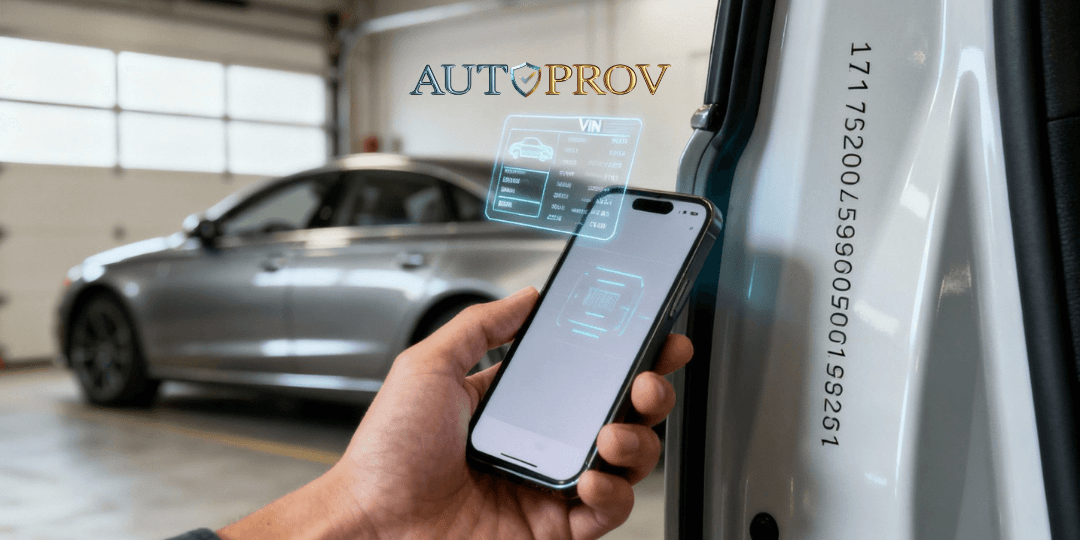
A Guide to Vehicle Check with VIN Number
A vehicle check with vin number is easily the most important thing you can do before buying a used car. Think of it as your first line of defence—a quick, simple step that pulls back the curtain on a vehicle's past, protecting you from expensive mistakes, legal headaches, and downright dangerous cars.
Published by AutoProv
Your trusted source for vehicle intelligence