
Complete guide to Consumer Contracts Regulations 2013 for UK motor traders selling vehicles remotely. Understand your legal obligations, cancellation rights, and
By CiteFlow
What Are Distance Selling Regulations for Motor Traders?
Distance selling regulations for motor traders are governed by the Consumer Contracts Regulations 2013 (CCR 2013), which require dealers to provide specific pre-contract information and honour a 14-day cancellation period when selling vehicles without face-to-face contact. These regulations apply whenever a customer purchases a vehicle through online listings, telephone sales, or any transaction where the buyer does not physically visit your premises before committing to purchase. The rules exist alongside the Consumer Rights Act 2015 but impose additional obligations specific to remote transactions, including mandatory information disclosure and unconditional return rights that do not apply to traditional forecourt sales.
Understanding CCR 2013 is not optional for modern motor traders. The shift towards online vehicle sales has made distance selling the primary revenue channel for many dealerships, yet the regulatory framework catches out even experienced traders who assume their usual consumer rights knowledge suffices. The penalties for non-compliance extend beyond refunds to include enforcement action from Trading Standards and reputational damage that spreads quickly through online reviews.
When Do Distance Selling Regulations Apply?
Distance selling regulations apply when a contract is concluded exclusively through distance communication, meaning the buyer and seller are not simultaneously present at any point before the contract is formed. This includes sales initiated through AutoTrader listings, eBay Motors, your own website, telephone enquiries, email exchanges, or social media messages where the customer commits to purchase without visiting your site. The critical test is whether the customer could physically inspect the vehicle before agreeing to buy it, not whether they eventually collect it in person.
Many traders mistakenly believe that if a customer collects a vehicle from the dealership, CCR 2013 does not apply. This is incorrect. The regulations are triggered by how the contract was formed, not how the vehicle is delivered. A customer who reserves and pays a deposit online, then collects the vehicle a week later, has still entered a distance contract with full cancellation rights. Conversely, a customer who browses your website, visits your forecourt to inspect vehicles, then completes the purchase at your premises has not entered a distance contract, even though their initial contact was remote.
The regulations also apply to part-exchange transactions conducted remotely. If a customer agrees to sell you their vehicle and purchase one of yours without physically meeting, both transactions fall under CCR 2013. This creates particular complexity around remote appraisal accuracy and the customer's right to cancel after you have already taken possession of their part-exchange vehicle.
Pre-Contract Information Requirements Under CCR 2013
Before a customer commits to a distance purchase, you must provide comprehensive pre-contract information covering the main characteristics of the vehicle, your identity and contact details, the total price including all taxes and delivery charges, payment and delivery arrangements, and the existence of the 14-day cancellation right. The "main characteristics" requirement for vehicles is extensive and must include registration number, mileage, service history status, MOT expiry, specification details, and any known faults or damage. Generic descriptions or placeholder text do not satisfy this requirement.
The information must be provided in a clear and comprehensible manner appropriate to the distance communication method used. For online listings, this means detailed written descriptions with photographs showing the vehicle's condition. For telephone sales, you must verbally communicate all required information and follow up with written confirmation. The customer must explicitly acknowledge receipt of this information, and you must retain evidence of that acknowledgement. Email confirmations with read receipts, signed order forms, or recorded telephone conversations all serve this purpose.
Failure to provide complete pre-contract information has two consequences. First, the customer's cancellation period extends from 14 days to 12 months plus 14 days from delivery. Second, you cannot enforce payment if the customer claims they were not properly informed. Courts consistently side with consumers in disputes over whether information was adequately provided, making thorough documentation essential. AutoProv's Digital Distance Sale Pack automates the creation of compliant pre-contract documentation, ensuring all CCR 2013 requirements are met with evidence of delivery.
The 14-Day Cancellation Period Explained
Customers have an unconditional right to cancel a distance contract within 14 calendar days, starting from the day after they receive the vehicle or the day after they receive the required pre-contract information, whichever is later. This cancellation right requires no justification, cannot be waived by agreement, and applies even if the vehicle is exactly as described with no faults. The customer can drive the vehicle during this period, provided they treat it with reasonable care, and still exercise their cancellation right for any reason or no reason at all.
The 14-day period is strict. If day 14 falls on a Sunday or bank holiday, the deadline extends to the next working day. Customers can cancel by any clear statement, whether verbal, written, email, or even social media message. You cannot require them to use a specific cancellation form, though providing one makes the process clearer. Once a customer communicates their decision to cancel, you have 14 days to refund all payments, including any delivery charges you imposed. You can withhold the refund until you receive the vehicle back or the customer provides evidence of return, whichever comes first.
The customer must return the vehicle within 14 days of notifying you of cancellation. They bear the direct cost of return unless you agreed to cover it or failed to inform them they would be liable. This is where many disputes arise. If your pre-contract information did not explicitly state that the customer pays return delivery costs, you must cover them. For a vehicle, this can mean reimbursing several hundred pounds in transport fees, making proper disclosure critical.
What Customers Can Be Charged During Cancellation
You can make a deduction from the refund to reflect any diminished value resulting from handling beyond what is necessary to establish the nature, characteristics, and functioning of the vehicle. This means a customer can test drive the vehicle, inspect it thoroughly, and drive it home, but cannot use it as their daily transport for two weeks then return it. The test is whether the use went beyond what would be permitted in a physical shop, though for vehicles this creates obvious ambiguity since you cannot test drive a car in a showroom.
Courts have interpreted "necessary to establish characteristics" generously for vehicles, typically allowing several hundred miles of driving for genuine assessment purposes. However, excessive mileage, damage beyond normal wear, or commercial use clearly exceed this threshold. You must document the vehicle's condition at handover and return, ideally with photographs, mileage readings, and a signed condition report. Without this evidence, you cannot prove diminished value and must provide a full refund.
You cannot charge a restocking fee, administration fee, or any other penalty for exercising cancellation rights. The only permitted deduction is for diminished value caused by excessive handling. Any attempt to impose additional charges risks Trading Standards enforcement action and invalidates your refund, potentially requiring you to refund the full amount plus return the vehicle.
Exceptions and Exclusions to Distance Selling Rights
CCR 2013 contains limited exceptions relevant to motor traders. The regulations do not apply to contracts concluded at auction, meaning vehicles sold through physical or online auction platforms like BCA or Manheim fall outside distance selling rules. However, this exception is narrow. If you list a vehicle on eBay Motors with a "Buy It Now" price, that is not an auction for CCR 2013 purposes, even though eBay is an auction platform. The vehicle must be sold through a genuine competitive bidding process to qualify for the exception.
The regulations also exclude contracts for goods made to the consumer's specifications or clearly personalised. This exception rarely applies to vehicle sales, though it might cover bespoke modifications made to customer order before delivery. Standard factory-order vehicles do not qualify as made to specification simply because the customer chose the colour and options.
Trade sales to business buyers fall outside CCR 2013, which applies only to consumer contracts. However, you cannot assume a buyer is a trader simply because they operate a business. The test is whether they are buying the vehicle for purposes wholly or mainly outside their trade. A builder buying a van for their business is a consumer for CCR 2013 purposes if they are not in the motor trade. A taxi driver buying a vehicle for their taxi business is similarly a consumer. Only purchases by motor traders or businesses buying vehicles for resale clearly fall outside the regulations.
How Distance Selling Interacts with Consumer Rights Act 2015
CCR 2013 operates alongside the Consumer Rights Act 2015, creating overlapping but distinct obligations. CRA 2015 requires vehicles to be of satisfactory quality, fit for purpose, and as described, giving customers rejection rights if these standards are not met. These rights apply to all consumer sales, whether distance or face-to-face. CCR 2013 adds the unconditional 14-day cancellation right specifically for distance sales, which exists independently of whether the vehicle has any faults.
This creates two separate return mechanisms with different rules. A customer who discovers a fault within 30 days can reject under CRA 2015, which requires you to provide a full refund with no deduction for use. The same customer also has CCR 2013 cancellation rights for 14 days, which allow you to deduct for diminished value from excessive use. The customer can choose whichever route is more favourable, and you must honour both sets of rights.
The interaction becomes complex when a customer cancels under CCR 2013 but you discover damage or faults that were not present at handover. You can deduct for this diminished value from the CCR 2013 refund, but if the customer then claims the damage was a pre-existing fault and switches to a CRA 2015 rejection, you must refund the full amount. Proper documentation at handover, including photographs and a signed condition report, is essential to defend against these scenarios. Understanding both CCR 2013 obligations and CRA 2015 rejection rights is necessary for compliant distance selling.
Practical Compliance Steps for Motor Traders
Compliant distance selling starts with comprehensive vehicle descriptions in your online listings. Every advertisement must include registration number, current mileage, MOT expiry date, service history status, specification details, and clear photographs showing the vehicle's condition from all angles. Generic stock phrases like "excellent condition" or "full service history" are insufficient. You must state specifically what service records exist, whether digital or stamped, and disclose any gaps or missing documentation.
Create a standardised pre-contract information document that covers all CCR 2013 requirements and send it to every distance buyer before they commit to purchase. This document should include your full business details, the vehicle's complete specification verified against factory build data, the total price breakdown, delivery arrangements, payment methods, and a clear explanation of the 14-day cancellation right including who pays return costs. Require customers to acknowledge receipt and understanding before processing payment.
Document every vehicle handover with photographs, mileage readings, fuel level, and a condition report signed by the customer. Use the same process for returns, creating an evidence trail that shows the vehicle's condition at both points. This evidence is essential if you need to deduct for diminished value or defend against claims that pre-existing faults were not disclosed.
Implement a clear cancellation process that customers can easily find and use. Provide a cancellation form in your pre-contract information, on your website, and with the vehicle at handover. Train your team to handle cancellation requests professionally and process refunds within the 14-day deadline. Attempting to discourage cancellations or making the process difficult invites complaints and enforcement action.
Common Distance Selling Mistakes and How to Avoid Them
The most frequent error is assuming CCR 2013 does not apply because the customer collected the vehicle in person. Collection method is irrelevant. If the contract was formed remotely, cancellation rights apply. This catches traders who take telephone reservations with deposits, assuming the subsequent collection visit makes it a face-to-face sale. It does not.
Many traders fail to provide complete pre-contract information, particularly around vehicle specifications and known faults. Omitting a minor scratch or failing to mention that the service history is incomplete might seem trivial, but it extends the cancellation period to 12 months and gives customers grounds to claim misrepresentation under CRA 2015. Comprehensive disclosure protects you more than it exposes you.
Charging restocking fees or administration charges for cancellations is unlawful but remains common. Some traders include terms in their contracts stating that deposits are non-refundable or that a cancellation fee applies. These terms are void and unenforceable. You can only deduct for diminished value from excessive use, and you must prove that value reduction with evidence.
Failing to process refunds within 14 days is another persistent problem, often caused by waiting for finance companies to confirm settlement or delaying until the vehicle is resold. Neither excuse is valid. You must refund within 14 days of receiving the vehicle back or evidence of return, regardless of your own cash flow or settlement processes. Late refunds trigger penalty interest and potential Trading Standards involvement.
Record Keeping and Evidence Requirements
Maintain comprehensive records of every distance sale, including copies of all pre-contract information provided, evidence of customer acknowledgement, the signed contract, handover documentation with photographs and mileage, any correspondence during the cancellation period, and return documentation if applicable. These records must be kept for at least six years to defend against potential claims or enforcement investigations.
Email communications provide strong evidence if properly managed. Use read receipts for pre-contract information, save all customer responses acknowledging terms, and maintain a clear audit trail showing when information was sent and received. Avoid relying on verbal communications without written follow-up, as they are difficult to prove in disputes.
Photographic evidence at handover and return is essential for defending diminished value deductions. Take multiple photographs showing the vehicle's exterior from all angles, interior condition, dashboard mileage reading, and any existing damage or wear. Repeat this process when the vehicle is returned, ideally with the customer present to verify the condition. Timestamp the photographs and store them securely linked to the customer's file.
For vehicles with complex histories or high values, consider using professional vehicle intelligence reports that provide independent verification of mileage, service history, and specification. These reports create objective evidence of the vehicle's condition and characteristics at the point of sale, supporting your pre-contract disclosures and protecting against claims of misrepresentation.
Frequently Asked Questions
AI-Generated Content Notice
This article was created with the assistance of artificial intelligence technology. While we strive for accuracy, the information provided should be considered for general informational purposes only and should not be relied upon as professional automotive, legal, or financial advice. We recommend verifying any information with qualified professionals or official sources before making important decisions. AutoProv accepts no liability for any consequences resulting from the use of this information.
From our AI insights
- Navigating Hidden Finance Claims: CRA 2015 Insights
Discover how hidden finance claims affect UK car dealers under CRA 2015 and strategies to manage them.
- Navigating CCR 2013: Niche Insights for UK Motor Traders
Explore niche insights on CCR 2013 for UK motor traders, focusing on compliance and cancellation rights.
- Decoding CRA 2015: Dealer's Guide to 30-Day Rejections
Explore CRA 2015's 30-day rejection rights from a dealer's perspective, highlighting key compliance strategies.
Related Articles

Understanding the Consumer Rights Act 2015 in the UK Motor Trade
Explore the Consumer Rights Act 2015 and its impact on UK car buyers and sellers, offering essential protections and insights.

Understanding UK Automotive Regulations
Explore the complexities of automotive regulations in the UK, covering DVLA, FCA, MOT, and more.
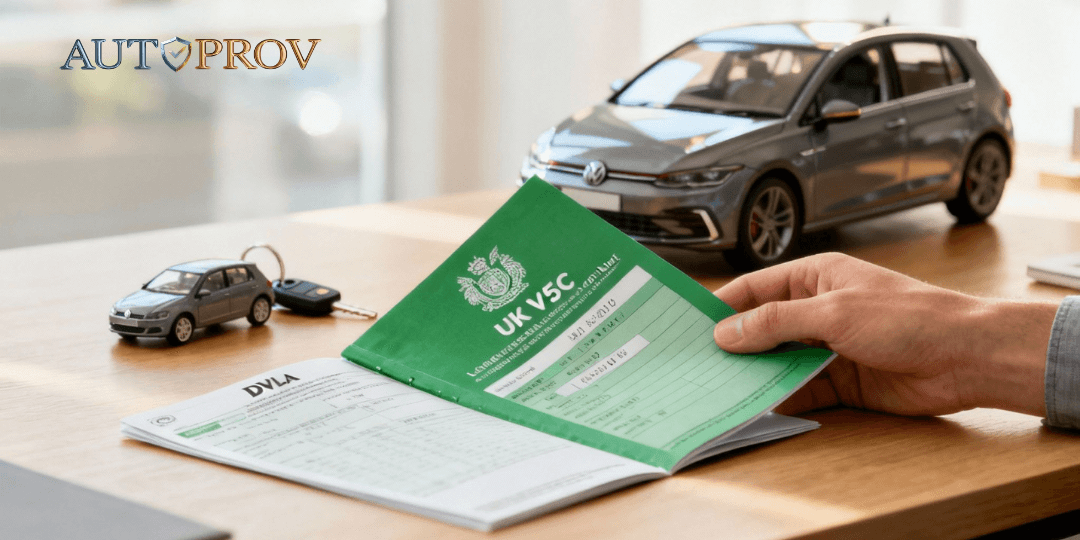
What is a V5C Document: A Quick UK Log Book Guide
If you've ever bought or sold a car in the UK, you've definitely come across the V5C. It's often just called the 'log book', and it’s the official Vehicle Registration Certificate issued by the DVLA.
Published by AutoProv
Your trusted source for vehicle intelligence