
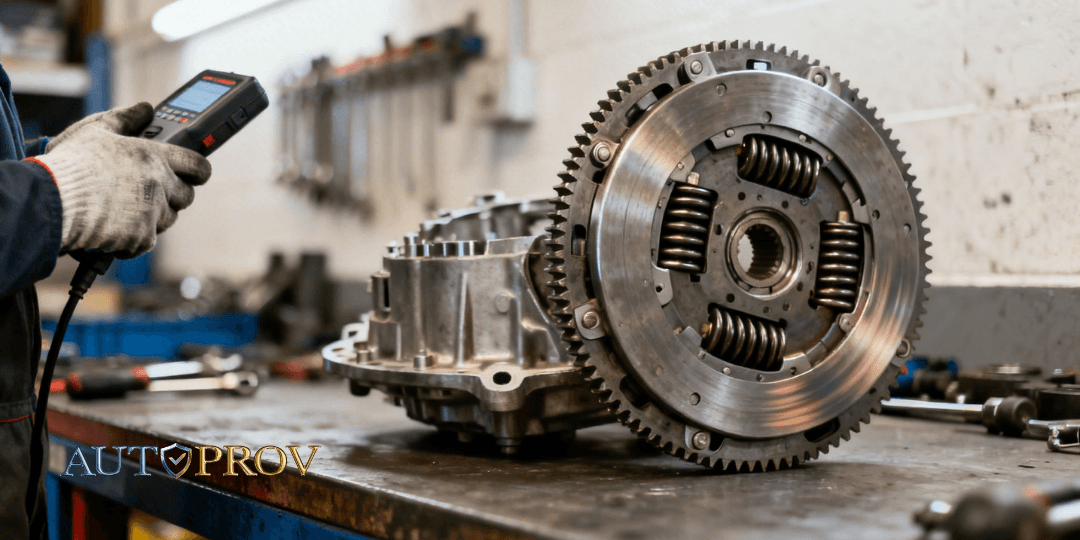
A diesel part-exchange arrives late in the afternoon. It starts cleanly enough, but there is a faint rattle at idle and a heavier knock as the engine shuts down. The road test is passable. The clutch still bites, the gearbox still selects, and the warning lights are not screaming for attention. This is exactly the sort of car that catches traders out. A dual mass flywheel problem often starts as a noise customers ignore and buyers underestimate. Then it turns into a clutch job that should have been a clutch-and-flywheel job, or a comeback that damages margin and trust in one hit. On the forecourt, the issue is mechanical. In the deal file, it becomes valuation, prep cost, and reputational exposure. That is why dual mass flywheel failure symptoms matter well before the workshop strips anything down. A trader needs to recognise what the vehicle is doing physically, what the history is hinting at commercially, and what basic checks are not telling you.
The Hidden Cost of a Rattle An Introduction to DMF Risk
The familiar mistake is to treat a DMF noise as background diesel roughness. Plenty of cars come in with some idle chatter, a bit of driveline movement, or a customer description that sounds vague enough to file under “monitor it”. That approach is expensive.
On used stock, dual mass flywheel failure symptoms rarely stay contained. The flywheel sits in the middle of the engine’s torque pulses and the gearbox’s tolerance for abuse. Once it starts to break down, the vehicle can still drive well enough to pass through an auction lane or survive a short appraisal. That is what makes it dangerous.
Why traders feel the cost first
A retail customer may only notice a shudder or a clunk. The trader absorbs the full chain of consequences:
- Buying risk: You price the car as routine prep, then discover the driveline needs major work.
- Workshop risk: A clutch is fitted, but the underlying flywheel fault remains and the complaint comes back.
- Reputation risk: The buyer hears the same rattle a week later and assumes the vehicle was knowingly sold with a fault.
The broader UK picture supports what many workshops already see on the ramp. Faulty DMFs trigger dashboard warning lights in up to 25% of reported clutch-related breakdowns annually, based on RAC roadside assistance logs from 2015 to 2020, and vehicles with DMFs fail MOTs at a 15% higher rate for transmission-related issues after 100,000 miles compared with single-mass flywheels (RAC guidance on dual mass flywheels).
Those numbers matter because they turn a workshop complaint into a stock-control issue. High-mileage diesels, urban-use vans, and cars with inconsistent ownership patterns deserve more scrutiny than a quick drive around the block.
Practical takeaway: If a diesel has a rattle at idle, a harsh shutdown, and a patchy recent ownership pattern, treat it as a valuation problem immediately, not just a workshop diagnosis later.
DMF trouble also overlaps with other fault themes that traders already watch, including emissions and drivability complaints. A vehicle that already presents as uneasy or warning-prone may justify a wider review of risk indicators, not just a mechanical listen test. That is one reason related faults such as a DPF warning light on used stock should never be viewed in isolation.
Understanding the Dual Mass Flywheel's Function
A DMF is best thought of as a torsional shock absorber for the drivetrain. It is there to soften the engine’s firing pulses before they hit the gearbox. Diesels especially produce strong low-speed torque pulses, and without damping, those pulses travel straight into the transmission, making the car noisier, harsher, and harder on components.

What the DMF contains
A conventional flywheel is largely a single rotating mass. A dual mass flywheel splits that job into two sections:
- Primary mass: This side is connected to the engine.
- Secondary mass: This side connects to the clutch and gearbox input.
- Spring and damping assembly: This sits between the two masses and controls rotational movement.
That internal spring pack and damper system is the whole point of the component. It allows a controlled amount of movement between engine and transmission so the gearbox receives a smoothed version of engine torque rather than every pulse and shock directly.
Why manufacturers used them so widely
From a design point of view, a DMF solves several problems at once.
First, it reduces noise, vibration and harshness. That matters on diesel passenger cars and commercial vehicles where refinement became a stronger selling point.
Second, it protects the driveline from repeated low-speed shock loading. The smoother the torque transfer, the easier life is for the gearbox and the rest of the clutch assembly.
Third, it helps make modern engines feel more usable at low revs. Drivers can lug the engine harder, and the driveline remains acceptable for longer. The catch is that the DMF itself absorbs the punishment.
Why failure produces the symptoms it does
When the internal springs and dampers wear, break down, or develop excessive play, the DMF stops isolating the gearbox from engine pulses. Then the signs start to make sense:
- a rattle at idle, because the masses are no longer controlled properly
- a clunk at start-up or shutdown, because the two sections hit their stops
- pedal, floor, or seat vibration, because torsional pulses now pass straight through the drivetrain
- poor gear engagement, because the clutch and gearbox are working against an unstable rotating assembly
A healthy unit smooths movement. A worn unit allows movement in the wrong places and at the wrong time.
Key point: DMFs improve refinement by allowing controlled movement. They fail when that movement becomes uncontrolled.
For traders, this matters because the same part that makes a diesel feel civilised when healthy can make it feel expensive when worn. A car can still appear saleable while the damping quality has already deteriorated enough to create a future comeback.
Key Dual Mass Flywheel Failure Symptoms to Recognise
The strongest appraisals come from pattern recognition. One symptom on its own can mislead. A cluster of symptoms, appearing under the right conditions, usually tells a clearer story.
Vibration through the cabin and controls
The most common early complaint is vibration. Not all vibration points to a DMF, but the location and timing matter.
On a deteriorating DMF, the vibration is often felt:
- through the clutch pedal
- in the floorpan
- through the seat base
- sometimes through the steering wheel, especially when the engine is labouring
A trader should pay attention to when it happens. Idle vibration is one clue. Low-rev acceleration in a higher gear is another. Pulling away, reversing, or creeping in traffic can also expose it because those conditions load the driveline at low engine speed.
In later stages, the car can feel rough when coming on and off the throttle, as if the driveline has developed extra slack.
Rattle at idle and knock on start-up or shutdown
Noise is often the giveaway that turns suspicion into a proper diagnosis. DMF noise is not one fixed sound. It changes with wear level and operating condition.
A worn unit can produce:
- Idle rattle: a rotational chatter from the bellhousing area
- Shutdown clunk: a heavier metallic knock as the engine stops
- Start-up knock: similar noise as the engine catches and settles
- Squeak or rough mechanical noise: less common, but possible as internal wear advances
The shutdown noise is especially useful because it reflects uncontrolled movement inside the flywheel as rotational speed drops away. That is different from general diesel clatter. It has more weight to it and tends to feel tied to engine movement, not trim or ancillary vibration.
Judder and poor clutch feel
Drivers often describe this stage badly. They may say the car feels “grabby”, “shaky”, or “odd taking up drive”. The key point is that the clutch feel changes because the flywheel is no longer providing a stable, damped interface.
Common signs include:
- a judder when pulling away
- a pulsing sensation through the pedal
- inconsistent engagement in first or reverse
- a rough take-up that varies with engine temperature or load
These symptoms can push buyers towards blaming the friction plate alone. That is where expensive misdiagnosis starts.
Gearshift issues and driveline shunt
A failing DMF can also show up as a drivability problem rather than an obvious noise complaint. Gear selection may feel notchy or awkward, particularly at lower speed. The vehicle may shunt when the driver lifts off and reapplies throttle.
That behaviour comes from lost damping in the driveline. Instead of smoothing the handover, the system transmits the engine’s torsional movement more directly into the gearbox.
A road test that includes traffic pace, low-speed manoeuvring, and loaded acceleration tells you more than a fast run on open roads. Many DMF faults are easier to provoke at low rpm than at cruising speed.
Trade tip: If the car feels worst in first gear, reverse, idle, and shutdown, put the DMF high on the list.
Some symptoms also overlap with broader acceleration complaints. If the vehicle jerks under load, especially at low revs, it is worth looking at related drivability patterns such as why a car jerks when accelerating, then separating engine, clutch, and flywheel causes carefully.
Differentiating DMF Failure from Other Driveline Faults
Misdiagnosis costs twice. First in labour and parts. Then again when the car returns.
The reason DMF faults catch people out is simple. They mimic clutch wear, release bearing noise, engine mount movement, and even early gearbox trouble. Some high-mileage diesels with DMF deterioration show severe low-RPM shuddering and clutch slippage, with vibrations exceeding 10g at 1500 to 2000 RPM under load, and pedal or floor vibration during clutch engagement is a primary indicator according to Phoenix Friction’s DMF symptom guidance.
Where the overlap happens
A worn clutch friction plate can slip under load. A DMF can also create a slipping feel because it no longer provides a stable mounting and damping platform.
A release bearing can make noise during pedal operation. A DMF can also create noise around clutch engagement, but the character is usually more rotational and load-related.
Engine mounts can cause harshness on take-up. A DMF can produce similar shunt, but usually with more bellhousing-related noise and low-speed torsional roughness.
Symptom Checker DMF vs Other Driveline Faults
Symptom Likely Dual Mass Flywheel (DMF) Cause Could Also Be (Differential Diagnosis) Rattle at idle from bellhousing area Internal spring or damper wear allowing uncontrolled rotational movement Release bearing noise, gearbox input bearing noise Heavy knock on engine shutdown Excess movement between primary and secondary masses hitting end stops Worn engine mount, exhaust movement Judder pulling away Loss of damping causing unstable clutch take-up Contaminated clutch plate, warped friction surface Pedal and floor vibration under load Torsional isolation breaking down in the flywheel Clutch wear, engine misfire, mount issues Difficult low-speed gear engagement Driveline instability affecting clutch and input shaft behaviour Clutch hydraulic fault, worn clutch assembly Shunt on and off throttle Excess play in flywheel transmitting torsional shock Mount wear, driveshaft backlash What usually points back to the DMF
Several features lean the diagnosis back towards the flywheel:
- Start-stop behaviour matters: A distinct knock on ignition or shutdown is a strong clue.
- Low-rpm load matters: DMF faults show themselves when the driveline is asked to absorb torque at low revs.
- The complaint is mixed: Noise, vibration, clutch feel, and shunt often arrive together rather than as one isolated symptom.
A release bearing complaint is often more closely tied to pedal movement. A warped clutch plate usually shows as engagement roughness without the same shutdown clunk. Early gearbox bearing wear may hum, whine, or worsen with road speed and gear selection.
If you want a broader comparison of jerk and shunt complaints in stock appraisal, the trade-focused guide on uncovering acceleration jerks for traders is useful as a companion framework.
Rule of thumb: If the vehicle has bellhousing noise, low-rpm shudder, and a harsh engine stop, do not assume the clutch kit alone will solve it.
Professional Inspection and Diagnostic Procedures
A DMF diagnosis can go wrong before a spanner touches the car. The usual failure point is not access. It is attribution. A noisy diesel with a rough idle, a clutch complaint, and a gearbox rattle can send a buyer, a workshop, or an appraiser down the wrong path fast. On stock cars, that mistake costs margin twice. First at purchase, then again when the comeback lands.

The workshop process needs two threads running together. One is physical diagnosis on the ramp and on the road. The other is risk context. If the provenance file shows repeated clutch or transmission work, inconsistent mileage progression, heavy urban use signals, or prior advisories that fit driveline abuse, the threshold for suspecting DMF wear drops. That does not confirm the fault, but it changes how hard you push to prove or rule it out.
In-car checks that expose the problem
Road test the car with intent. Five minutes around local roads will not tell you enough.
Start with idle quality and noise source. Listen at the bellhousing area with the car stationary, then repeat with the clutch pedal up and down. A change tied closely to pedal movement points you toward release components. A rotational chatter that stays in the background and worsens with torsional load keeps the DMF in play.
Then watch the engine start and stop. A harsh catch on start-up or a pronounced knock at shutdown is useful because it loads the flywheel through its travel range without much road noise to hide the result.
Use controlled low-rpm load next. In a higher gear at low engine speed, feed torque in gently and listen for knock, shunt, or a coarse vibration that was not present at cruise. Follow that with slow pull-aways and reverse manoeuvres, where weak damping often shows up early as unstable take-up or judder.
Finish with driveline transition. On and off throttle at low speed, a worn DMF often lets too much shock through the system, which the driver feels as looseness, snatch, or an abrupt handover.
Ramp and workshop checks
On the lift, the job is to build a case, not chase one clue in isolation.
Check the obvious confusers first. Engine and gearbox mounts, clutch hydraulics, driveshaft play, and any sign of misfire or uneven idle all matter because they can mimic DMF complaints or exaggerate a minor flywheel issue into something that feels terminal. If the electronic side has not been checked, pull codes and review live data before condemning parts. A quick guide on how to use an OBD 2 reader for fault-code and live-data checks is useful for ruling out engine-side causes of shunt and harshness.
Then inspect around the bellhousing. Grease escape, metallic debris, heat marking, or clutch dust patterns that suggest repeated slip all add weight to the diagnosis. None of those signs alone prove DMF failure, but together they help separate a tired flywheel from a simple clutch wear issue.
What to assess once the gearbox is out
What to assess once the gearbox is out. Poor diagnosis, if it happens here, gets expensive.
Check free rotational movement by hand and judge the quality of that movement, not just the amount. A serviceable unit feels controlled through its travel. A failing one often feels loose, rough, stepped, or notchy. Rocking movement that reaches the stops too easily, visible heat damage, grease leakage, cracked surfaces, or blueing around the working face all support replacement.
Avoid quoting precise tolerances unless you are working to the vehicle maker's workshop method or the component manufacturer's bulletin for that exact unit. In general trade practice, the decision rests on controlled versus uncontrolled movement, evidence of overheating, and whether the wear pattern matches the complaint. That is safer than forcing generic figures onto every platform.
Add provenance context before authorising repair
On retail stock, diagnosis should finish with a risk call, not just a technical conclusion.
If workshop findings suggest early DMF wear and the provenance history shows previous clutch work, patchy maintenance, repeated short-interval ownership, or usage patterns consistent with stop-start life, the chance of a near-term failure is higher. For a trader, that affects appraisal, prep budget, warranty exposure, and how the car should be described at sale.
Workshop advice: If the gearbox is already out, the flywheel shows clear roughness or uncontrolled play, and the vehicle history suggests a hard previous life, reusing that DMF is rarely a sound commercial decision.
Repair Options Valuations and Typical Costs
Once the fault is confirmed, the question changes from diagnosis to economics. The trader has to decide whether to fit the correct original-style solution, use a conversion, or walk away from the stock entirely.
Like-for-like DMF replacement
A direct DMF replacement keeps the car closest to original specification. On better diesels and more refined vehicles, that matters.
The advantages are straightforward:
- refinement remains closer to factory behaviour
- gearbox protection is retained in the way the vehicle was designed
- resale conversations are usually simpler on cars where buyers expect original driveline feel
The downside is cost. The verified trade guidance on UK conditions notes that cascading damage to gearboxes can lead to significant repair costs if problems are not caught early. That is enough to wipe out margin on the wrong unit if it was missed at purchase.
Solid flywheel conversion
A solid flywheel conversion can be the right commercial call on some vehicles, especially where durability and lower replacement cost matter more than refinement.
The known trade-off is clear. You gain simplicity and often durability, but you may reintroduce noise, vibration, and harshness that the original DMF was designed to suppress.
The verified data also notes that solid flywheel conversion costs are considerable and that early intervention can significantly extend transmission life. That makes conversion worth considering on the right van or workhorse diesel, but less attractive on stock where refinement supports retail value.
How this affects valuation
A suspected DMF fault is not a generic prep allowance. It is a negotiating point that should be priced with discipline.
Think in three layers:
- Immediate cost: parts, labour, and the chance that the clutch should be done at the same time
- Secondary exposure: gearbox wear, heat damage, or comeback risk if the diagnosis was late
- Retail positioning: whether the eventual buyer will accept an SMF-converted car without pushback
On premium retail stock, the cheaper repair is not always the better commercial answer. On older working diesels, originality may matter less than durability and saleable pricing.
Buying principle: Value the car as if the fault is real until inspection proves otherwise. Do not value it as “probably fine” because the test drive was short.
Using Provenance Intelligence to Mitigate DMF Risk
A car arrives clean on paper, drives well enough around the block, and only shows its hand once it is hot on the ramp. That is how traders end up owning someone else's DMF problem.
The best time to assess that risk is before the viewing, before the bid, and before the transport is booked. Road test symptoms and ramp inspection still matter, but stock decisions improve when those physical checks are paired with provenance signals that suggest a driveline liability sitting just below the surface.

Why basic checks are not enough
A standard vehicle history check UK process usually clears title, finance, theft, and insurance concerns. That protects against legal and identity exposure. It does not tell you whether the next noise you hear will turn into a clutch and flywheel invoice.
DMF risk sits in the pattern, not in a single red flag. Traders should look for ownership churn that suggests the car has been moved on quickly, mileage movement that does not match the service trail, MOT wording that hints at transmission vibration or clutch-related complaints, and usage profiles that fit hard urban diesel work. None of those points proves a failing DMF on its own. Together, they justify a tighter appraisal and a more sceptical price.
That matters commercially. If the file looks marginal before you inspect the car, the road test and ramp check should be planned around that risk rather than treated as a routine drive.
What to look for in a used car history report
A good used car history report helps sort stock into three groups. Low apparent risk, inspect with caution, and walk away unless the price leaves room for repair.
The strongest warning signs are combinations:
- Short-term ownership: repeated quick changes can indicate an unresolved fault that each keeper chose not to absorb
- Mileage inconsistency: a mileage check UK result that conflicts with servicing, wear, or usage deserves closer mechanical scrutiny
- MOT language and repeat themes: recurring advisories or failure notes around clutch operation, vibration, or driveline condition can support what you later find on the road or ramp
- Usage profile: diesels from urban fleets, courier work, or stop-start commercial service should be appraised with DMF wear in mind, even if the basic history check is clear
Dealer vehicle checks must therefore move beyond pass-fail thinking. The useful question is whether the history raises the probability of hidden transmission spend and comeback risk.
A detailed vehicle provenance report gives that wider context before physical inspection starts. Used properly, it helps buyers decide which cars need a longer test drive, a hotter restart check, and a firmer number at appraisal.
Frequently Asked Questions for the Motor Trade
Are certain models more prone to DMF trouble
Yes. Some models appear more often in workshop conversations and trade appraisals, particularly high-mileage diesel cars and vans that spend their lives in traffic, on delivery work, or doing repeated stop-start runs. Common examples include the VW Golf TDI, BMW 3-Series, Ford Transit, VW Transporter, Peugeot Boxer, and Mercedes Sprinter.
That does not make every example a problem car. It does mean the buyer should price in diagnostic time, pay close attention to idle quality and shutdown noise, and treat weak provenance signals as part of the same risk picture.
Can a failing DMF still pass an MOT
Yes. MOT status is not a clean bill of health for the flywheel or clutch assembly.
A car can pass with clear dual mass flywheel failure symptoms if the issue has not reached a specific testable failure point. For traders, that matters because the commercial risk sits well before the MOT line. A passed MOT does not protect margin if the car still rattles hot, shudders on take-up, or comes back with a driveline complaint a week after handover.
Is a solid flywheel conversion a red flag
It depends on the vehicle, the standard of the conversion, and who will buy it next. On an older van or a budget diesel workhorse, a properly fitted SMF conversion can be acceptable if engagement is clean and the extra noise is disclosed clearly. On a retail car sold on refinement, the same conversion can create objections, test-drive doubt, and post-sale complaints.
The trade-off is simple. Lower parts cost and simpler hardware on one side. More noise, more vibration, and a narrower buyer pool on the other.
Is it ever sensible to replace only the clutch
Only if inspection supports it. If the gearbox is already out and the DMF shows heat marking, excess rock, grease loss, or clear free-play issues, clutch-only replacement is poor judgement.
Labour is the expensive part of this job. Saving money on the flywheel and then stripping the same car again after a comeback is how a marginal deal turns into a loss.
What is the quickest appraisal clue on-site
Start the engine cold if you can. Listen at idle, listen again at shutdown, then check take-up in first and reverse at low speed.
That short sequence will not confirm the fault on its own, but it will tell you whether the car deserves more time on the road test, a proper ramp inspection, and a firmer stance on price.
What usually gets missed by busy buyers
The link between symptom and history.
A buyer hears a rattle and treats it as a routine clutch concern. Another sees short-term keepers, repeated driveline comments, or inconsistent mileage context and fails to connect that history with what the car is doing on the ramp. The stronger appraisal combines both. Physical symptoms show the current mechanical condition. Provenance shows whether the vehicle has been passed around, used harshly, or carrying an unresolved cost that others chose not to absorb.
AutoProv helps UK dealers, motor traders, and wholesalers make better stock decisions with deeper vehicle provenance, mileage analysis, ownership pattern review, and trade vehicle intelligence. If you want a more informed vehicle history check UK process that goes beyond basic checks, explore AutoProv.
Frequently Asked Questions
AI-Generated Content Notice
This article was created with the assistance of artificial intelligence technology. While we strive for accuracy, the information provided should be considered for general informational purposes only and should not be relied upon as professional automotive, legal, or financial advice. We recommend verifying any information with qualified professionals or official sources before making important decisions. AutoProv accepts no liability for any consequences resulting from the use of this information.
From our AI insights
- The Importance of Tyre Verification for UK Motor Traders
Discover why verifying tyre specs is crucial for UK traders to ensure safety and compliance.
- Decoding CO2 Emissions: A Trader's Guide
Learn how traders can verify CO2 data using factory build sheets to prevent disputes.
- Navigating Recall Compliance for UK Car Traders
Ensure compliance with recall regulations: essential steps for UK car traders.
Related Articles

The Importance of Car Maintenance and Provenance Checks
Discover why regular car maintenance and proper provenance checks are essential for vehicle quality and longevity.
Essential Car Maintenance Tips for UK Drivers
Discover vital car maintenance tips to keep your vehicle roadworthy and compliant in the UK.

How Much Is a Car Service? Complete UK Price Guide
Trying to pin down exactly "how much is a car service?" can feel a bit like asking "how long is a piece of string?". Prices vary quite a bit, but to give you a ballpark figure, an interim service will usually set you back around £100 to get started. A more thorough full service often begins at £180, while a major service for many cars can easily top £300.
Published by AutoProv
Your trusted source for vehicle intelligence
