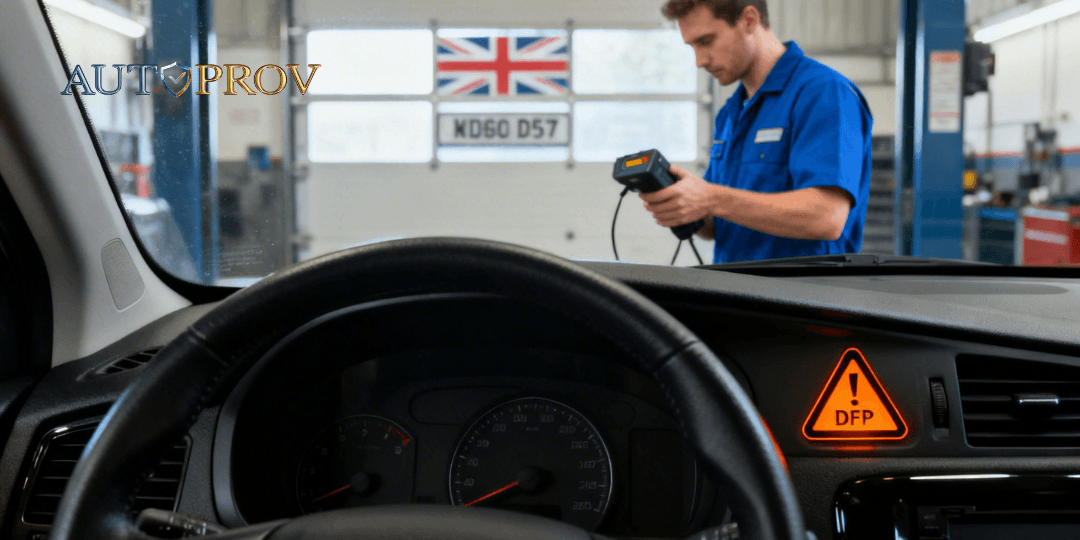
That amber DPF symbol isn't just another dashboard light. For any motor trade professional, it’s a clear signal of potential financial risk. Seeing it illuminated on a piece of prospective stock should be more than a point of mild concern; it should trigger a comprehensive risk assessment.
What a DPF Warning Light Really Means for Your Business

For a UK motor trader, an illuminated DPF warning light signifies more than a simple dashboard notification. It is a direct alert to a potential four-figure liability. This single light can point to complex, expensive failures within the vehicle's emissions system. Ignoring it is an effective way to erode your profit margin.
These failures are rarely spontaneous. They are almost always the culmination of a vehicle's usage history—a pattern of repeated short journeys, missed services, or the use of incorrect engine oil. This is where the light becomes a crucial clue in the vehicle's provenance, offering insight into how it has been maintained and operated. Understanding the context of different dashboard symbols is key; for a general overview, it can be helpful to review various Dash Light Meanings.
A Widespread and Costly Problem
The DPF warning light became a common sight on UK roads after the Euro 5 emissions standards were introduced in September 2009. Since then, the prevalence of related issues has grown. MOT testing data consistently shows emissions-related faults as a major cause of failures. In 2025, for instance, DPF malfunctions were a key contributor, affecting a significant number of vehicles and resulting in substantial repair costs for unprepared traders.
A DPF warning is a signal that demands more than a quick diagnostic scan. It necessitates a detailed review of the vehicle's history to accurately assess the financial risk before committing to purchase.
Ultimately, the DPF light must be treated as a critical risk indicator, comparable in severity to other major warnings like the engine management light. It is a data point with a direct link to your business's profitability. To learn more about that particular warning, see our full guide on the engine management light.
Understanding the Root Causes of DPF Blockages
When a DPF warning light is active on a potential trade-in, it is rarely an isolated event. It is the final symptom of a problem that has likely been developing for some time, rooted in the vehicle's operational and maintenance history. For a motor trader, understanding these root causes is what separates a sound acquisition from a significant liability.
A blocked DPF can be likened to a vacuum cleaner with a filter so clogged it can no longer function effectively. The engine is forced to work harder, performance deteriorates, and eventually, the system fails. This process is gradual and driven by several common factors.
The Most Common Culprits
The condition of a Diesel Particulate Filter is a direct reflection of the vehicle's operational life. Certain driving habits and maintenance oversights are notorious for causing a DPF warning light to illuminate.
- Chronic Short Journeys: This is the primary cause. Diesel engines require sustained high temperatures for the DPF to initiate its self-cleaning cycle, known as "regeneration." Vehicles used exclusively for short, low-speed trips rarely reach these temperatures, leading to a rapid accumulation of soot.
- Incorrect Engine Oil: Not all engine oils are suitable for modern diesel vehicles. The use of a correct low-ash (Low SAPS) oil is mandatory. Using an incorrect or lower-grade oil introduces non-combustible particles into the filter, causing irreversible blockages that necessitate a full replacement.
- Faulty Sensors: The vehicle's ECU relies on data from pressure and temperature sensors to determine when the DPF is full and requires regeneration. A malfunctioning sensor can transmit incorrect data—or no data at all—preventing the ECU from initiating a necessary regeneration cycle.
- Underlying Engine or EGR Faults: A problem in another part of the engine system will invariably impact the DPF. Issues such as a leaking injector, a malfunctioning EGR valve, or a split turbo hose can cause the engine to produce excessive soot, overwhelming the DPF's capacity to clear it. This can also be linked to other symptoms, such as those that cause black smoke from the exhaust.
From Cause to Consequence
These issues do more than just block the filter; they create a cycle of failed regeneration attempts. The vehicle's ECU will attempt to force a "active" regeneration by injecting extra fuel to raise exhaust temperatures. However, if the underlying problem is not resolved, or if the driver interrupts the cycle, the process aborts.
Repeated, incomplete regeneration cycles can be more damaging than no regeneration at all. They can lead to fuel dilution of the engine oil, which compromises lubrication and accelerates wear on critical engine components, escalating a single DPF problem into a broader mechanical risk.
Understanding these causes highlights the importance of consistent and correct preventative maintenance examples throughout a vehicle's life. As a trader, you are often assessing the consequences of past neglect. The clues are frequently present in a vehicle's service and MOT history, revealing high-risk patterns long before a warning light appears. This is precisely where a detailed vehicle history check UK becomes an essential component of your risk assessment protocol.
DPF Light On? Initial On-the-Spot Diagnosis
An illuminated amber DPF light during an appraisal is a significant risk signal. Your initial actions are critical in determining whether you are facing a minor issue or a costly repair that will eliminate your margin. A consistent diagnostic approach is essential.
The first, and simplest, step is to attempt a regeneration run. This involves operating the vehicle under conditions that allow it to reach a sufficient temperature to burn off the accumulated soot. If the issue is simply a lack of opportunity for passive regeneration, a solid amber light may clear after a sustained drive.
Attempting a Regeneration Run
To initiate a regeneration cycle, the exhaust system must reach and maintain a high temperature. This cannot be achieved in urban traffic; an open road is required.
- Attain Sufficient Speed: Maintain a steady speed between 40-60 mph. A sustained drive on a dual carriageway or motorway is ideal.
- Maintain Operation: The process typically requires around 20 minutes of continuous driving. Stopping the engine will abort the cycle.
- Monitor the Light: If the regeneration is successful, the DPF warning light will extinguish.
This flowchart outlines common root causes that can prevent a successful regeneration and trigger the warning light.

As illustrated, the problem is often not the blockage itself but an underlying issue, such as a faulty sensor or incorrect engine oil, preventing the system from self-cleaning.
When the Light Persists
If you have completed a proper regeneration run and the light remains illuminated—or worse, is flashing—the problem has advanced beyond a simple fix. This indicates the DPF is too heavily blocked for a drive cycle to clear, or there is a more significant component failure. A flashing light is a serious warning, often signifying the filter is critically full, and may cause the vehicle to enter a "limp mode" to protect the engine.
At this stage, professional workshop intervention is non-negotiable. The vehicle requires connection to a diagnostic scanner to identify the true fault. For traders, understanding how to use an OBD-2 reader can provide valuable initial insights. A light that stays on after a regeneration attempt is your cue to factor in significant costs for a forced regeneration, chemical clean, or full DPF replacement. This is the trade vehicle intelligence that informs a more accurate valuation or the decision to walk away from a high-risk vehicle.
Estimating DPF Repair Costs and Managing Liability
When a regeneration drive fails to extinguish the DPF light, the vehicle requires workshop attention, with costs that can significantly impact, or entirely eliminate, your profit margin.
An accurate understanding of these potential costs is essential for vehicle valuation and intelligent buying decisions. However, the financial risk extends beyond the repair bill. A DPF fault that manifests shortly after a sale can quickly lead to a customer dispute, placing your business in a reactive and legally vulnerable position. As a motor trader, the Consumer Rights Act places the onus on you for faults that were likely present at the point of sale.
Common Repair Scenarios and Cost Estimates
Once a DPF is severely blocked, professional intervention is the only viable solution. The final cost will vary depending on the severity of the blockage and the required remedy.
- Forced Regeneration: This is the first step for a workshop. A diagnostic tool is used to initiate the regeneration cycle while the vehicle is stationary. This typically costs between £150 - £250 and is only effective if there are no underlying faults, such as a failed sensor.
- Chemical Cleaning: If a forced regeneration is unsuccessful, the next option is an intensive clean. This involves flushing the DPF (either on or off the vehicle) with specialist chemicals designed to dissolve hardened soot and ash deposits. Budget approximately £300 - £500 for this service.
- Full DPF Replacement: This is the most costly outcome. If the internal filter has cracked, melted, or is otherwise beyond recovery, a new unit is the only solution. Costs can range from £800 to over £2,000, depending on the choice between an OEM or a quality aftermarket part.
Data from organisations like the RAC on diesel particulate filters confirms the high costs associated with these repairs and the speed at which a minor issue can escalate.
Your Legal Responsibilities as a Trader
A post-sale DPF fault is a common source of disputes between dealers and customers. It is critical to understand your legal position.
Under the Consumer Rights Act 2015, goods must be of satisfactory quality, fit for purpose, and as described. A DPF failure within the first few weeks or months of ownership can be argued as evidence the vehicle was not of satisfactory quality at the time of sale, making you liable for the repair.
This is where meticulous pre-purchase due diligence becomes your primary defence. A comprehensive dealer vehicle check, incorporating a detailed vehicle provenance report, is designed to identify the high-risk usage patterns that lead to DPF failures.
This intelligence enables you to either avoid a problematic vehicle or, at minimum, factor the potential liability into your acquisition price. It is about safeguarding your business from costly comebacks and protecting your professional reputation. For a complete understanding of your obligations, refer to our detailed guide covering the Consumer Rights Act and second-hand cars.
Using Provenance Intelligence to Predict DPF Risk
Reacting to an illuminated DPF warning light is a flawed strategy. By that point, the problem is established, and you are already facing a costly, time-consuming repair. The superior approach for a motor trade professional is not to react to problems, but to predict them.
This requires shifting from a mechanical mindset to an analytical one. The real skill lies in using a vehicle’s provenance to assess the probability of a DPF failure before committing to purchase. A car’s history reveals its operational patterns, and certain patterns are highly detrimental to a modern diesel engine's emissions system. Identifying these signals is your best defence against acquiring a latent liability.
Red Flags in a Vehicle's History
A professional AutoProv vehicle provenance report is filled with data points that, when interpreted correctly, provide a clear picture of DPF health risk. Certain patterns are classic indicators that should prompt further investigation.
Train your eye to spot these red flags as part of your standard appraisal process:
- Service History Gaps: Missing service records are always a concern. For DPFs, the detail matters. If there is no explicit proof that the correct low-ash engine oil was used at every interval, the risk of terminal damage is high.
- A Trail of MOT Advisories: Review the vehicle's entire MOT history, not just the latest certificate. Repeated advisories or failures for "Exhaust emissions" or "Engine MIL inoperative or indicates a fault" are strong indicators of a long-term issue that has been putting stress on the DPF.
- High-Risk Postcodes: A vehicle that has spent its entire life registered to an address in a congested city centre has likely been subjected to a constant cycle of short, low-speed journeys. This is a perfect recipe for a clogged DPF.
Interpreting Mileage and Ownership Patterns
Beyond the service record, the cadence of a vehicle’s life provides crucial intelligence. For modern diesels, low mileage is not always the positive indicator it once was. In fact, it can be a more significant risk factor than high mileage.
The riskiest diesel on your forecourt is not the 100,000-mile motorway vehicle. It is often the three-year-old, 15,000-mile model that has only been used for short urban trips. Its DPF has likely never achieved the conditions for a successful regeneration, creating the conditions for a catastrophic failure.
An analysis of the ownership timeline is vital. Be vigilant for short-term ownership cycles. A vehicle that has been sold on every 6-12 months is a major red flag. This pattern often suggests previous owners have identified a looming, expensive repair and have chosen to dispose of the vehicle to avoid the cost.
This checklist summarises the key signals within a history report that should heighten your scrutiny.
DPF Risk Indicators in a Vehicle History Report
Provenance Signal What It Indicates Why It's a DPF Red Flag Urban Postcodes A history of short, stop-start journeys in a city. The engine rarely reaches the temperature needed for DPF regeneration, leading to soot build-up. Low Mileage for its Age The "school run" diesel scenario; infrequent long journeys. Lack of motorway driving prevents passive and active regeneration, choking the filter over time. Short Ownership Cycles Car sold on multiple times in a short period (e.g., <12 months). Suggests previous owners may have been offloading the car to avoid an imminent, expensive DPF repair. Gaps in Service History Missed services or a lack of specialist diesel care. No proof that vital, low-ash DPF-specific engine oil was used, which is critical for filter health. MOT Emission Advisories Recurring notes on emissions or MIL light faults. A clear history of the engine management system struggling, placing constant stress on the DPF. Evidence of Deletion Notes of non-standard exhaust or ECU "tuning." A sign the DPF may have been illegally removed. Reinstating it is costly and legally required. By synthesising these data points, you build a powerful risk profile. You are no longer guessing; you are making an informed commercial decision. This intelligence provides the leverage to adjust your offer to cover potential repair costs or to walk away from a vehicle that represents an unacceptable level of risk.
Integrating DPF Checks Into Your Buying Process

Theoretical knowledge is useful, but converting it into a robust, repeatable process is what distinguishes professional traders. A systematic buying process is your most effective defence against the significant hidden costs associated with modern diesels, enabling you to identify and price-in DPF risks on every vehicle you appraise.
This is about building a case based on evidence. By combining digital intelligence with physical checks, you create a firewall against acquiring vehicles with imminent emissions system failures. This strategy protects your capital, reduces post-sale disputes, and builds a reputation for retailing quality, reliable stock.
An Actionable Checklist for Diesel Appraisals
Adopting a standardised checklist ensures no critical checks are missed. This process should be a non-negotiable part of your appraisal for every diesel vehicle you consider, creating a consistent methodology for motor trade risk management.
- 1. Run an Advanced Provenance Check: Before any physical inspection, run a full vehicle history check UK using a trade-specific platform like AutoProv. Pay close attention to short ownership cycles and check the keeper’s postcode – a dense urban area is a major red flag for DPF-killing short journeys.
- 2. Scrutinise the MOT History: Search for any past advisories or failures related to emissions, warning lights, or the engine management system. A pattern of these is a strong indicator that a DPF warning light issue is developing.
- 3. Question the Seller: Ask directly about the car's typical usage. Was it a high-mileage motorway vehicle or used primarily for short urban trips? The answer provides crucial context for the mileage and its likely impact on DPF health.
- 4. Perform a Thorough Test Drive: Ensure the engine reaches full operating temperature. Drive the vehicle for at least 20 minutes at sustained speeds over 40mph to see if any latent issues or warning lights appear.
- 5. Adjust Your Offer Accordingly: If any of these red flags are present, factor the potential cost of a DPF clean or replacement directly into your offer. This protects your margin and ensures a high-risk vehicle does not become a loss-maker.
Frequently Asked Questions About DPFs
Here are some of the most common DPF-related questions from motor trade professionals. Addressing these situations correctly is key to protecting your margin.
Is DPF Removal a Viable Option?
Unequivocally, no. The removal of a DPF from a vehicle where it was fitted as standard is illegal in the UK. If an MOT tester observes that the DPF casing is empty or sees evidence of removal, it is an instant MOT failure.
Furthermore, it is illegal to sell a vehicle that you know has been tampered with in this manner. Knowingly selling a car with a deleted DPF can lead to serious legal consequences and significant reputational damage. It is not a viable or professional option.
How Does a DPF Warning Affect a Part-Exchange Valuation?
An active DPF warning light must significantly reduce your valuation. At a minimum, you must factor in the cost of a forced regeneration or a professional chemical clean, which can amount to several hundred pounds.
The prudent approach, however, is to assume a worst-case scenario. Price the part-exchange as if it requires a new DPF—a cost that can exceed £1,500. This provides a firm negotiating position and, more importantly, protects your profit margin should the less expensive fixes prove ineffective.
Are High-Mileage Diesels a Safer Bet?
Counterintuitively, they often are. A high-mileage diesel that has primarily been used for motorway driving presents a much lower DPF risk than a low-mileage equivalent used only in town. The sustained high-speed operation means the filter has been able to regenerate regularly and effectively.
The highest risk is often the 3-to-5-year-old diesel with only 20,000-30,000 miles. This history strongly suggests a life of short, cold journeys—the perfect conditions for a terminally blocked DPF.
Navigating the complexities of diesel emissions systems requires more than a standard used car history report. It demands a deeper level of trade vehicle intelligence. AutoProv delivers advanced vehicle provenance insights that help you identify the historical red flags associated with DPF failures, enabling you to buy smarter and protect your business from hidden liabilities. Discover the difference at AutoProv.
Frequently Asked Questions
AI-Generated Content Notice
This article was created with the assistance of artificial intelligence technology. While we strive for accuracy, the information provided should be considered for general informational purposes only and should not be relied upon as professional automotive, legal, or financial advice. We recommend verifying any information with qualified professionals or official sources before making important decisions. AutoProv accepts no liability for any consequences resulting from the use of this information.
From our AI insights
- The Importance of Tyre Verification for UK Motor Traders
Discover why verifying tyre specs is crucial for UK traders to ensure safety and compliance.
- Decoding CO2 Emissions: A Trader's Guide
Learn how traders can verify CO2 data using factory build sheets to prevent disputes.
- Navigating Recall Compliance for UK Car Traders
Ensure compliance with recall regulations: essential steps for UK car traders.
Related Articles

The Importance of Car Maintenance and Provenance Checks
Discover why regular car maintenance and proper provenance checks are essential for vehicle quality and longevity.

Essential Car Maintenance Tips for UK Drivers
Discover vital car maintenance tips to keep your vehicle roadworthy and compliant in the UK.
How Much Is a Car Service? Complete UK Price Guide
Trying to pin down exactly "how much is a car service?" can feel a bit like asking "how long is a piece of string?". Prices vary quite a bit, but to give you a ballpark figure, an interim service will usually set you back around £100 to get started. A more thorough full service often begins at £180, while a major service for many cars can easily top £300.
Published by AutoProv
Your trusted source for vehicle intelligence