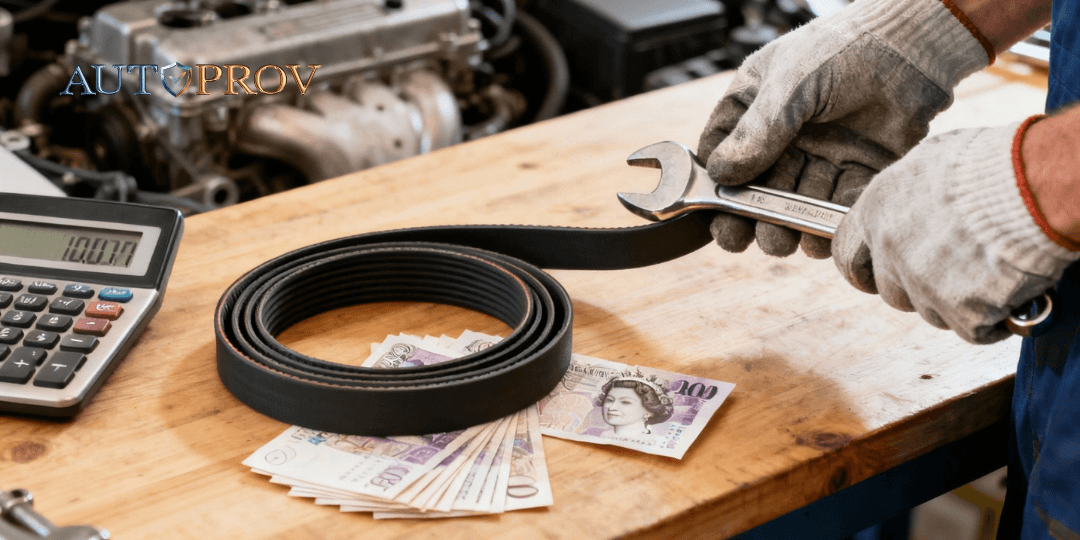
For any UK motor trader, the fan belt replacement cost isn't just a line item on a reconditioning invoice; it's a critical variable that directly impacts the profitability of a vehicle. A seemingly straightforward task can range from £80 to over £150, a cost that erodes trade-in valuations and reconditioning budgets. Misjudging this figure during appraisal is a common way to lose margin on a unit.
Understanding the True Cost of Fan Belt Replacement
The fan belt, also known as the auxiliary or serpentine belt, drives essential components including the alternator, water pump, and power steering. While replacement is a routine maintenance job, overlooking its potential cost during vehicle acquisition is a fundamental error that can turn a profitable deal into a loss.
This is not a fixed-price repair. The final cost is influenced by vehicle make and model, parts sourcing, and the choice between an independent workshop or a main dealer. For a professional trader, this variability represents both a risk to be managed and a point of negotiation.
Average Costs Across Vehicle Types
The primary factor dictating the cost is the vehicle itself. A small city car with an accessible engine bay will be a faster, and therefore cheaper, job than a premium SUV with a tightly packed engine compartment where a technician requires significant time just to gain access. This is a vital consideration when valuing a part-exchange or bidding on stock. While assessing repair costs, it's prudent to consider other potential expenses; this comprehensive replacement cost guide may be useful for other common jobs.
A fan belt replacement is one of the more affordable preventative maintenance tasks. However, the price variance between garages is significant. Consider a common forecourt vehicle like a Peugeot 208. An independent garage might quote £38 to £45, whereas a main dealer is likely to charge £65 to £74. That 40-60% price differential directly impacts your margin.
The table below provides a scannable overview of expected costs for different vehicle types.
Estimated UK Fan Belt Replacement Costs By Vehicle Type
Here is a guide to help you budget for reconditioning or justify part-exchange valuations. Note the consistent price gap between independent garages and main dealers—a key leverage point for any trader.
Vehicle Type Average Independent Garage Cost Average Main Dealer Cost Key Considerations for Traders Small City Car £70 - £110 £110 - £160 Typically a quick job. A high main dealer quote on a basic car can be a strong negotiation point. Family Saloon/Hatchback £85 - £130 £130 - £190 A very common repair. Costs are competitive, but be wary of upselling on tensioners and pulleys. Executive/Premium Saloon £120 - £180 £180 - £250+ Complex engine layouts increase labour time. OEM parts are often pushed, driving up the cost significantly. SUV/4x4 £110 - £170 £160 - £240 Engine access is often the most significant cost factor. Always check for signs of off-road use which can accelerate wear. Light Commercial Vehicle £90 - £150 £140 - £220 Durability is paramount. Aftermarket parts are common, but quality can be inconsistent. An essential check for fleet vehicles. Ultimately, a squealing or cracked fan belt identified during an appraisal is a direct, justifiable deduction from an offer. Knowing these figures allows you to explain a valuation with confidence, ensuring you buy correctly. These numbers are just one component of overall vehicle upkeep; to understand the broader context, review our guide on how much a car service costs in the UK.
Decoding the Key Factors Driving Cost Variation
The headline figure for a fan belt replacement is only the start. For any experienced motor trader, understanding what drives that price is vital for accurate appraisals and margin protection. Two vehicles that appear identical on paper can have vastly different reconditioning costs due to a few crucial details.
A significant portion of the final invoice is determined by the parts. The choice between Original Equipment Manufacturer (OEM), Original Equipment Supplier (OES), and aftermarket parts directly impacts both the initial outlay and the long-term reliability of the repair—a major factor in your dealership's reputation.
Parts Quality: OEM vs Aftermarket
Understanding the parts hierarchy is fundamental for managing reconditioning costs. Each tier presents different trade-offs in price, quality, and customer perception.
- OEM (Original Equipment Manufacturer) Parts: These are identical to the components fitted on the production line, supplied in the vehicle manufacturer's branded packaging. They guarantee a perfect fit and quality but command a premium price that can be difficult to justify on older or lower-value stock.
- OES (Original Equipment Supplier) Parts: Manufactured by the same company that supplies the carmaker, these parts are often identical to OEM but are sold in the supplier's packaging. This provides OEM quality without the main dealer markup, making them a sensible choice for quality-focused reconditioning.
- Aftermarket Parts: These are produced by a wide range of third-party companies, with quality varying from excellent to poor. While they are the most budget-friendly option, a low-quality belt could fail prematurely, leading to a costly comeback for your business.
This infographic illustrates how these factors contribute to the true cost of the job. 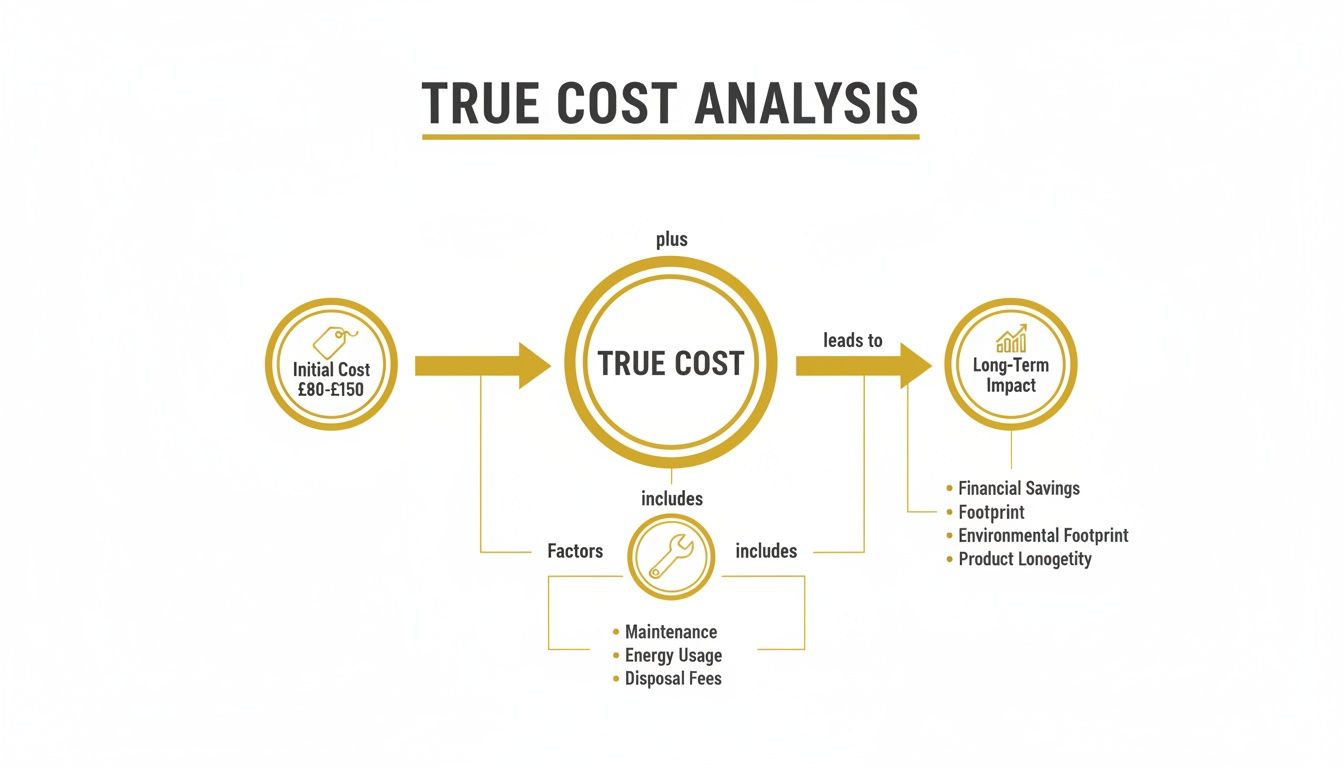 As shown, the initial quote is just one element; the real cost is shaped by parts quality, labour complexity, and any additional repairs identified during the work.
Associated Components: Tensioners and Pulleys
A fan belt rarely fails in isolation. The components it runs on—the tensioner and idler pulleys—wear at a similar rate. The characteristic squealing noise often attributed to the belt is frequently caused by a failing bearing within one of these pulleys.
It is standard practice to replace these components concurrently. Fitting a new belt onto a worn, unstable tensioner will likely cause the new belt to fail prematurely. While this is a sensible upsell during a retail repair, for a trader, it is a hidden cost that must be factored in at the appraisal stage. A simple £80 belt replacement can quickly escalate to £200 or more if the tensioner and pulleys also require replacement.
For a trader, discovering a worn tensioner after acquiring a vehicle is a direct hit to profit. A quick physical check for pulley wobble or noise during the walkaround is a non-negotiable part of any professional dealer vehicle check.
Engine Complexity and Labour Time
The largest cost driver is labour, which is dictated entirely by engine accessibility. A transverse-mounted four-cylinder engine in a family hatchback typically offers ample space, allowing a technician to replace the belt in under an hour.
Conversely, a large V6 or V8 engine in a premium saloon or SUV can present significant packaging challenges. Technicians may need to remove air boxes, engine covers, or undertrays to gain access. This can easily turn a one-hour job into a three-hour task, tripling the labour cost. This is a crucial distinction, sharing similarities with more intensive jobs. For further insight, learn more about cambelt change costs in our guide for motor traders. This significant variation in labour is why making blanket cost assumptions is a high-risk practice when valuing a diverse range of stock.
What a Worn Belt Reveals About a Vehicle's Past
Beyond the immediate fan belt replacement cost, the condition of this component provides a powerful, real-world insight into a vehicle's history. For an experienced trader, it is a crucial piece of physical evidence that can confirm or contradict the service record. A brief inspection under the bonnet can reveal major risk signals.
A new, quality-brand belt on a high-mileage vehicle is a positive indicator. It suggests a diligent owner who was proactive with maintenance, which reflects well on the overall mechanical condition of the vehicle. This small detail builds confidence in the asset.
Reading the Signs of Neglect
Conversely, a heavily cracked, shiny, or frayed original belt on a vehicle that is well past its service interval is a major red flag indicating deferred maintenance. If an owner has ignored a critical but relatively inexpensive component, it is highly probable that more costly items like fluid changes or brake services have also been neglected.
Suddenly, the belt is no longer just a service item; it becomes a key data point for your motor trade risk assessment. It provides the physical context needed to properly interpret digital records from a dealer vehicle check, helping to build a more complete picture of the asset.
Corroborating Evidence with Service Schedules
To properly assess the belt's condition, you must know the manufacturer's recommended replacement schedule. This provides a baseline for your evaluation.
As a general rule, manufacturers recommend inspecting and replacing the fan belt every 60,000 to 100,000 miles, or approximately every five to ten years. Therefore, if you acquire a vehicle at auction with 75,000 miles and its original belt, you are facing an immediate and predictable reconditioning cost. This is the kind of insight that informs smarter buying decisions.
A vehicle’s belt condition must align with its documented history. If a service invoice from 5,000 miles ago states the belt was replaced, but the component appears old and worn, this indicates a serious issue, such as fraudulent paperwork or a sub-standard repair.
This is the required level of detail. By cross-referencing physical evidence with service records and MOT history, you can identify inconsistencies that a basic check would miss. A clean MOT history paired with a visibly worn belt, for instance, often suggests the vehicle was prepared just enough to pass the test, leaving underlying issues unresolved.
This hands-on approach helps you avoid stocking vehicles with a problematic history. The fan belt is one of the most effective tools in your risk-assessment arsenal, helping to protect your investment and reputation. The insights gained are a core part of a robust vehicle provenance analysis, a topic we explore further in our article on the importance of car maintenance and provenance checks.
How Regional Labour Rates Impact Your Reconditioning Budget
For a motor trader operating nationally, or even across different counties, the workshop's postcode is a significant variable in the reconditioning budget. The final fan belt replacement cost is not a fixed national figure; it is heavily influenced by local labour rates, creating an operational challenge that requires strategic planning.
A simple one-hour job in a rural workshop can cost a fraction of the same repair in a high-rent city centre. This difference is often substantial enough to dictate where stock should be prepared for sale. For any business operating on tight margins, managing this geographic variance is a powerful way to protect profit.
The North-South Divide in Workshop Costs
The disparity in mechanic labour rates across the UK is stark and directly affects the cost of reconditioning every vehicle. This variation creates meaningful pricing differences that astute motor traders must manage. Industry data indicates that mechanic labour rates typically range from £40 to £80 per hour across the country.
Unsurprisingly, urban centres, particularly London, command premium rates. This directly inflates the final invoice. A vehicle requiring a new fan belt might cost a dealer £95-£105 to prepare in rural Yorkshire but could easily reach £140-£150 in London. For more on this, refer to the regional repair cost variations on WhoCanFixMyCar.com.
This is actionable trade vehicle intelligence. If you acquire a vehicle in a high-cost area that requires work, it may be more profitable to transport it to a preparation centre in a region with lower labour rates before listing it for sale.
For a multi-site dealership, calculating transport costs versus the savings on reconditioning labour is a crucial exercise. A saving of £50 per vehicle on labour may seem minor, but when scaled across hundreds of units annually, it represents a significant boost to overall profitability.
To illustrate the impact of location, consider a standard 1.5-hour fan belt job. We will use a consistent parts cost of £40 to isolate the effect of the labour rate.
Illustrative UK Regional Labour Rate Impact on a Standard Fan belt Replacement
UK Region Average Hourly Labour Rate Estimated Total Labour Cost Total Job Cost (Parts + Labour) North East £55 £82.50 £122.50 Midlands £65 £97.50 £137.50 South West £70 £105.00 £145.00 Greater London £85 £127.50 £167.50 As the table demonstrates, the same job can vary in cost by as much as £45 based solely on workshop location. When this difference is multiplied across an entire fleet or a year's worth of stock, the financial impact becomes impossible to ignore.
Strategic Reconditioning Planning
This knowledge allows you to transition from a reactive "fix-it-where-it-is" model to a proactive, cost-saving strategy. Instead of repairing vehicles where they are acquired, you can make data-driven decisions to optimise your entire reconditioning workflow. This is where a deep understanding of operational costs and the market becomes invaluable.
Consider these strategic approaches:
- Centralised Prep Centres: Establish or partner with a vehicle preparation centre in a lower-cost region. The labour savings on common jobs like belt replacements, servicing, and brake work can easily offset logistics costs.
- Tiered Acquisition Strategy: Factor in the likely reconditioning location when bidding on stock. You can afford to bid slightly higher on a vehicle located near your low-cost prep centre, knowing your subsequent costs will be lower.
- In-House vs. Outsourced Labour: If your primary site is in an expensive area, compare the cost of your own workshop against outsourcing work to trusted independent garages in more affordable nearby towns.
Recognising that a fan belt replacement cost is subject to regional variation allows you to turn a variable expense into a strategic advantage. By analysing these differences, you can refine your processes, protect margins, and make smarter decisions about your stock. This level of detail is key to optimising operations, a theme we explore further in our insights into vehicle valuations and market trends.
Identifying a Failing Belt Before Acquisition
In the motor trade, the appraisal is where profit is made or lost. Missing the signs of a failing fan belt is a basic error that can eliminate your margin. This guide outlines the tell-tale signs your team must identify on every walkaround, turning a quick check into a powerful risk mitigation tool.
Identifying these symptoms before the vehicle becomes your stock shifts the fan belt replacement cost from a liability on your balance sheet to a valid negotiating point during acquisition.
Key Auditory and Visual Checks
Often, the auditory clues of a failing auxiliary belt are present long before the visual signs. Training your appraisal team to listen for specific noises at start-up is essential.
- High-Pitched Squealing: This is the classic indicator. It’s a sharp squeal that is usually most pronounced on a cold start or when turning the steering wheel fully, which places extra load on the power steering pump. The noise is caused by a slipping belt, likely due to wear, fluid contamination, or a failing tensioner.
- Chirping or Ticking Sounds: A steady, rhythmic chirping often points to a misaligned pulley or a failing bearing in the belt tensioner. The belt itself may appear serviceable, but this sound indicates that associated components are failing, making the future repair more complex and costly.
Beyond auditory clues, a quick visual inspection under the bonnet can provide definitive evidence.
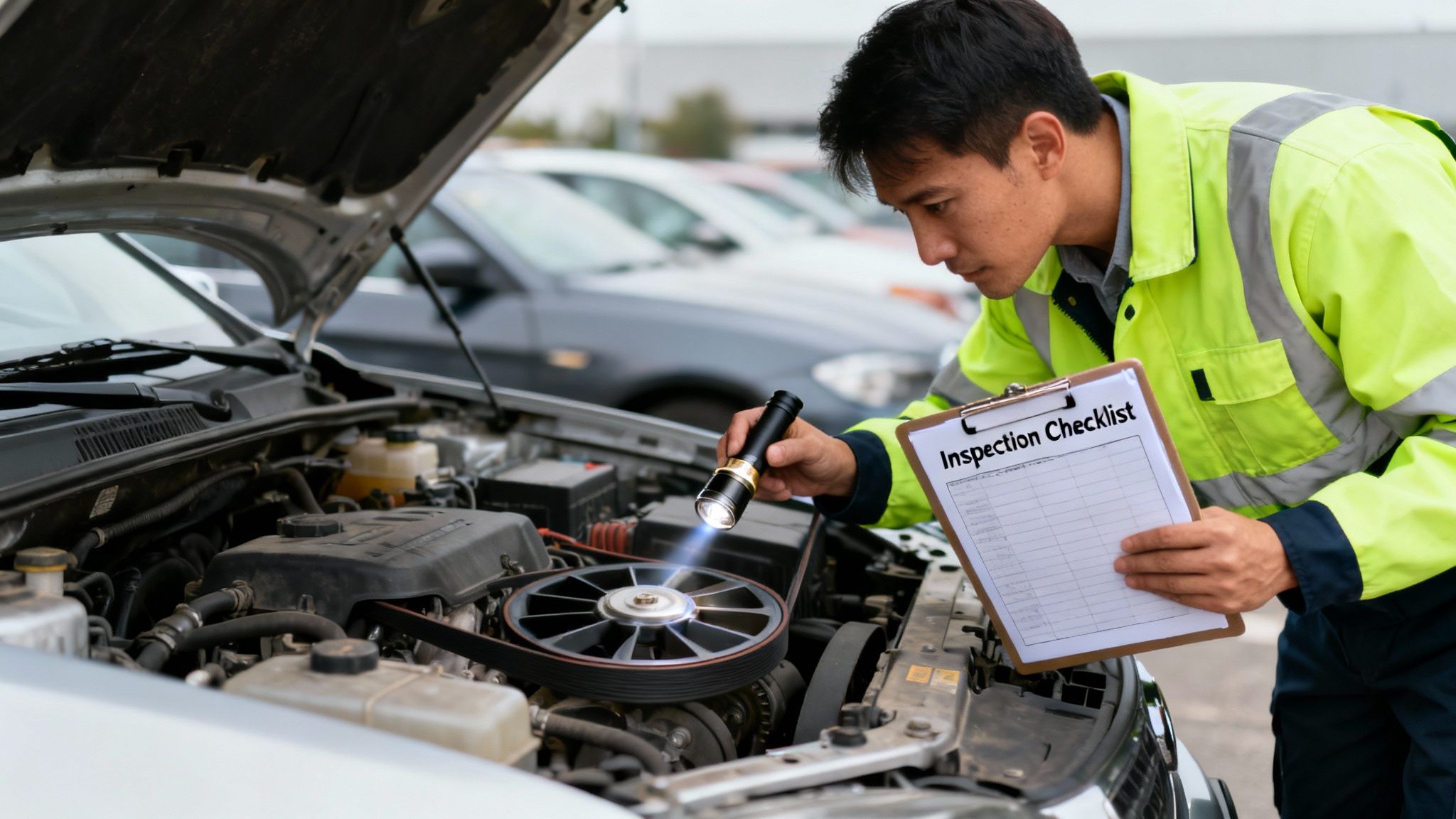
- Visible Cracks and Fraying: Illuminate the ribbed surface of the belt and look for small cracks. Any fraying along the edges or missing sections of rubber are clear warning signs. A belt in this condition has a limited remaining service life.
- Glazed or Shiny Surface: A glossy, polished appearance indicates that the belt has been slipping for some time. This hardens the rubber, reducing its grip on the pulleys and impairing the function of the components it drives.
Understanding the Consequence of Failure
A failing fan belt is not merely a noise issue; its failure triggers an immediate and critical loss of the vehicle’s vital systems. This is the scenario you are trying to avoid acquiring.
When the auxiliary belt snaps, the vehicle immediately loses its alternator, water pump, and power steering. The battery will no longer charge, the engine will begin to overheat within minutes, and the steering will become extremely heavy. This is not a "limp home" scenario; it is a breakdown that can easily lead to further damage.
The risk of serious engine damage makes a simple belt check a crucial part of your risk assessment. This is why a thorough physical inspection is so important, as detailed in our ultimate used car inspection checklist for traders. A small crack identified during appraisal could prevent you from acquiring a vehicle with a hidden, high-cost problem that will destroy your profit and damage your reputation.
Building Maintenance Costs Into Your Pricing Strategy
Successfully navigating the motor trade requires turning unpredictable variables into quantifiable costs. A potential fan belt replacement is a perfect example. It can either be a hidden issue that erodes your margin post-acquisition, or a calculated data point that facilitates a smarter deal from the outset.
For any business focused on profitability, integrating a thorough assessment workflow into every appraisal is non-negotiable.
This involves more than a cursory look under the bonnet. A best-practice approach combines three distinct intelligence streams to provide a complete picture of a vehicle's condition and its likely upcoming costs. This methodology allows you to move beyond estimation and make data-driven decisions on every unit.
Creating a Comprehensive Assessment Workflow
To price a vehicle accurately, your appraisal process must be systematic. It involves creating a repeatable workflow that ensures potential problems are identified before they become a financial burden.
This workflow should always include three key stages:
- Diligent Physical Inspection: This is the first and most critical step. Listen for any tell-tale squeals on start-up and conduct a thorough visual check of the auxiliary belt. Look for cracks, fraying, or a shiny, glazed surface. Check for any wobble in the tensioner and idler pulleys—their failure often precedes belt failure and significantly increases the repair cost.
- MOT History Analysis: Scrutinise the vehicle's MOT history for any advisories related to belts, engine noise, or oil leaks. An old advisory for an "engine oil leak," for example, could mean fluid has been contaminating and degrading the belt, even if the leak was subsequently repaired.
- Service Record Cross-Reference: The service history is the final piece of the puzzle. Does the documentation show a recent belt replacement? If so, does the belt under the bonnet appear new? A discrepancy here is a major red flag, suggesting either inaccurate maintenance claims or the use of low-quality parts.
Factoring Costs into Valuations and Offers
With this complete picture, you can factor potential costs into your valuations with confidence. If a vehicle is approaching its recommended belt replacement interval of 60,000-100,000 miles and there is no clear evidence the work has been completed, you have a justifiable basis for adjusting your offer.
A proactive approach ensures you remain in control. Instead of being surprised by a reconditioning bill, you have already accounted for the fan belt replacement cost in the initial valuation. This protects your margin and strengthens your negotiating position.
This intelligence directly informs your downstream decisions. You can choose to absorb the cost and replace the belt as part of your pre-sale reconditioning—a sound practice that enhances the vehicle's retail value and builds customer trust. Alternatively, for a trade sale, you can present the evidence to justify a lower price, transparently passing the predictable maintenance requirement to the next buyer.
Ultimately, this systematic approach turns a simple wearable component into a key indicator of vehicle provenance. By combining physical checks with a detailed vehicle history check UK traders can rely on, you build a robust risk assessment process. This is the foundation of smart acquisition, ensuring every vehicle is priced correctly and its potential costs are fully understood from the outset.
Frequently Asked Questions for Motor Traders
In the motor trade, time is money and accurate information is critical. Here are common questions from dealers about fan belts and the associated risks.
How Can I Tell if a Belt Was Replaced Using a Cheap Part?
Visually distinguishing a quality aftermarket part from a low-grade one can be difficult, but there are indicators. Cheaper rubber may feel unusually stiff or brittle, and you might notice untidy moulding or rough edges. The most reliable clue is often the brand name printed on the belt. If it is an unrecognised or generic brand, it warrants caution.
When in doubt, the service history is your primary reference. If the paperwork specifies a premium brand was fitted, but the belt on the engine appears to be a budget part, you have identified a discrepancy. This is a signal to investigate the vehicle's maintenance history more thoroughly.
Is a Squealing Belt Always a Sign it Needs Replacing?
Not always, but it is always a sign that an issue requires immediate investigation. The squeal is the sound of the belt slipping, which can have several causes:
- Wear: The belt is old, hardened, or glazed and can no longer grip the pulleys effectively.
- Contamination: An oil or coolant leak has contaminated the belt, causing it to slip. This indicates a separate, potentially more significant, repair is needed.
- Tensioner Failure: The automatic tensioner has weakened and is no longer maintaining adequate tension.
- Pulley Misalignment: A pulley is out of alignment, causing the belt to run at an angle and slip.
Regardless of the cause, a squealing belt is a critical warning that cannot be ignored during an appraisal. Overlooking it constitutes a significant motor trade risk.
What is the Difference Between a Fan Belt and a Cambelt?
Understanding this distinction is critical for any trader. Confusing the two can lead to significant errors in vehicle valuation.
A fan belt (also auxiliary or serpentine belt) is visible on the front or side of the engine. It powers accessories like the alternator, power steering pump, and air-conditioning compressor. Its failure is serious but will not typically cause catastrophic engine damage if addressed quickly. The fan belt replacement cost is relatively manageable.
A cambelt (or timing belt) is usually concealed behind a plastic cover. Its function is to synchronise the engine's internal components. If a cambelt snaps, the pistons will collide with the valves, causing catastrophic and often terminal engine damage. A cambelt replacement is a much more significant and expensive procedure.
Can I Defer a Fan Belt Replacement on a Vehicle I Plan to Trade On?
While possible, it is a high-risk practice that can damage your reputation. Passing on a vehicle with a known fault, even to another trader, is unprofessional. If the belt fails during a test drive or shortly after the sale, you could face a dispute or liability claim.
The professional approach is to factor the repair cost into your acquisition price. You can then either complete the work yourself or be transparent about the required maintenance with the next buyer. This protects all parties and maintains your credibility. Motor traders have specific workshop needs; investigating specialized automotive solutions can provide ideas for optimising your reconditioning setup.
Understanding these details protects your margins. A cracked belt or an inconsistent service invoice is more than just a repair cost; it is a clue to the vehicle's true history. At AutoProv, we provide the advanced trade vehicle intelligence to connect physical observations with deep historical data. Our reports go beyond basic checks, flagging ownership patterns and risk signals so you can build a complete picture of a vehicle's provenance and acquire every unit with confidence. Find out how AutoProv can strengthen your appraisal process at https://autoprov.ai.
Frequently Asked Questions
AI-Generated Content Notice
This article was created with the assistance of artificial intelligence technology. While we strive for accuracy, the information provided should be considered for general informational purposes only and should not be relied upon as professional automotive, legal, or financial advice. We recommend verifying any information with qualified professionals or official sources before making important decisions. AutoProv accepts no liability for any consequences resulting from the use of this information.
From our AI insights
- The Importance of Tyre Verification for UK Motor Traders
Discover why verifying tyre specs is crucial for UK traders to ensure safety and compliance.
- Decoding CO2 Emissions: A Trader's Guide
Learn how traders can verify CO2 data using factory build sheets to prevent disputes.
- Navigating Recall Compliance for UK Car Traders
Ensure compliance with recall regulations: essential steps for UK car traders.
Related Articles

The Importance of Car Maintenance and Provenance Checks
Discover why regular car maintenance and proper provenance checks are essential for vehicle quality and longevity.

Essential Car Maintenance Tips for UK Drivers
Discover vital car maintenance tips to keep your vehicle roadworthy and compliant in the UK.
How Much Is a Car Service? Complete UK Price Guide
Trying to pin down exactly "how much is a car service?" can feel a bit like asking "how long is a piece of string?". Prices vary quite a bit, but to give you a ballpark figure, an interim service will usually set you back around £100 to get started. A more thorough full service often begins at £180, while a major service for many cars can easily top £300.
Published by AutoProv
Your trusted source for vehicle intelligence