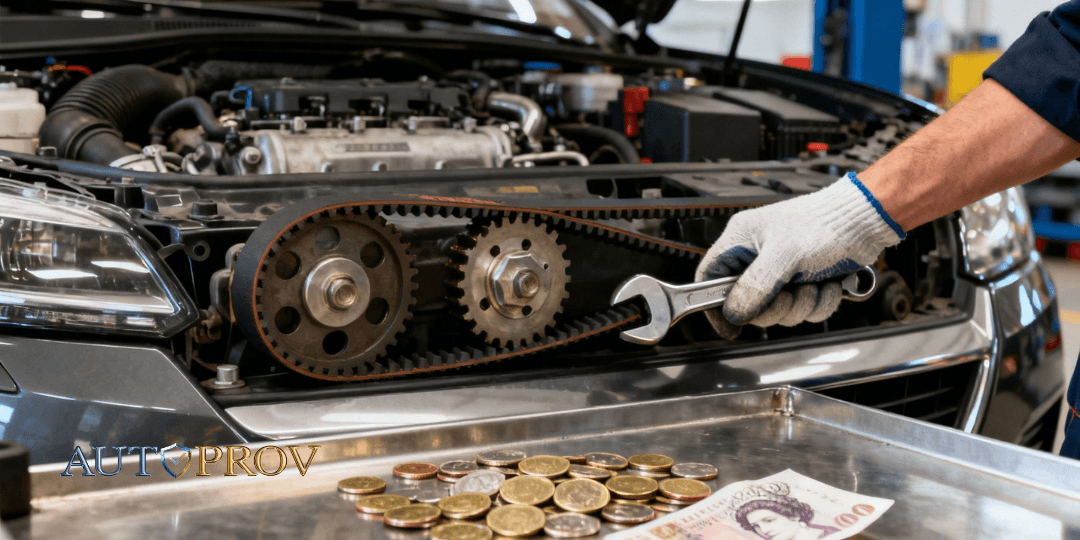
Let's get right to it. The average cambelt change cost in the UK can swing anywhere between £290 and £1,000. For anyone in the motor trade, that’s a number that can wipe out your entire profit margin on a car before you’ve even listed it. This isn't just another line item on a service invoice; it's a massive variable that can make or break a deal.
Understanding the True Cost for UK Motor Traders
If you're buying from auctions or taking in part-exchanges, that huge price gap for a cambelt job represents a serious financial risk. A car with an overdue cambelt, hidden from plain sight, can quickly sour a promising purchase and turn it into a money pit. This is exactly why doing your homework isn't just good practice—it's essential for protecting your margins and your reputation.
Knowing the cost isn't just about prepping a car for the forecourt. It's about getting your valuation right before you even think about placing a bid. If there’s no solid proof the belt has been done, you have to assume it hasn't and build that potential expense right into your offer.
Digging into a car's service history is no longer a 'nice-to-have'; it's a must. In the UK used car market, a cambelt job averages between £290 and £730. The bulk of that cost is labour, simply because getting to the belt is often an intricate, time-consuming process. The parts themselves—the belt, tensioner, and idler pulleys—might only be £70-£180 for OEM quality or £40-£120 for aftermarket, but the hours on the ramp are what really add up.
This is where having the right data from AutoProv becomes your biggest advantage. Our vehicle intelligence platform gives you the verified history you need to:
- Confirm if—and when—the last cambelt service was actually done.
- Flag up any vehicle that’s getting close to its replacement interval.
- Negotiate with confidence, because you have hard evidence of future costs.
By tackling this financial risk at the point of acquisition, you turn a potential blind spot into a real strategic edge. This guide will break down all the factors that influence the final cambelt change cost, so you can accurately forecast your expenses on any vehicle that comes your way. For a wider view on workshop bills, you might also be interested in our complete UK car service price guide.
Deconstructing the Bill: Parts, Labour, and Location
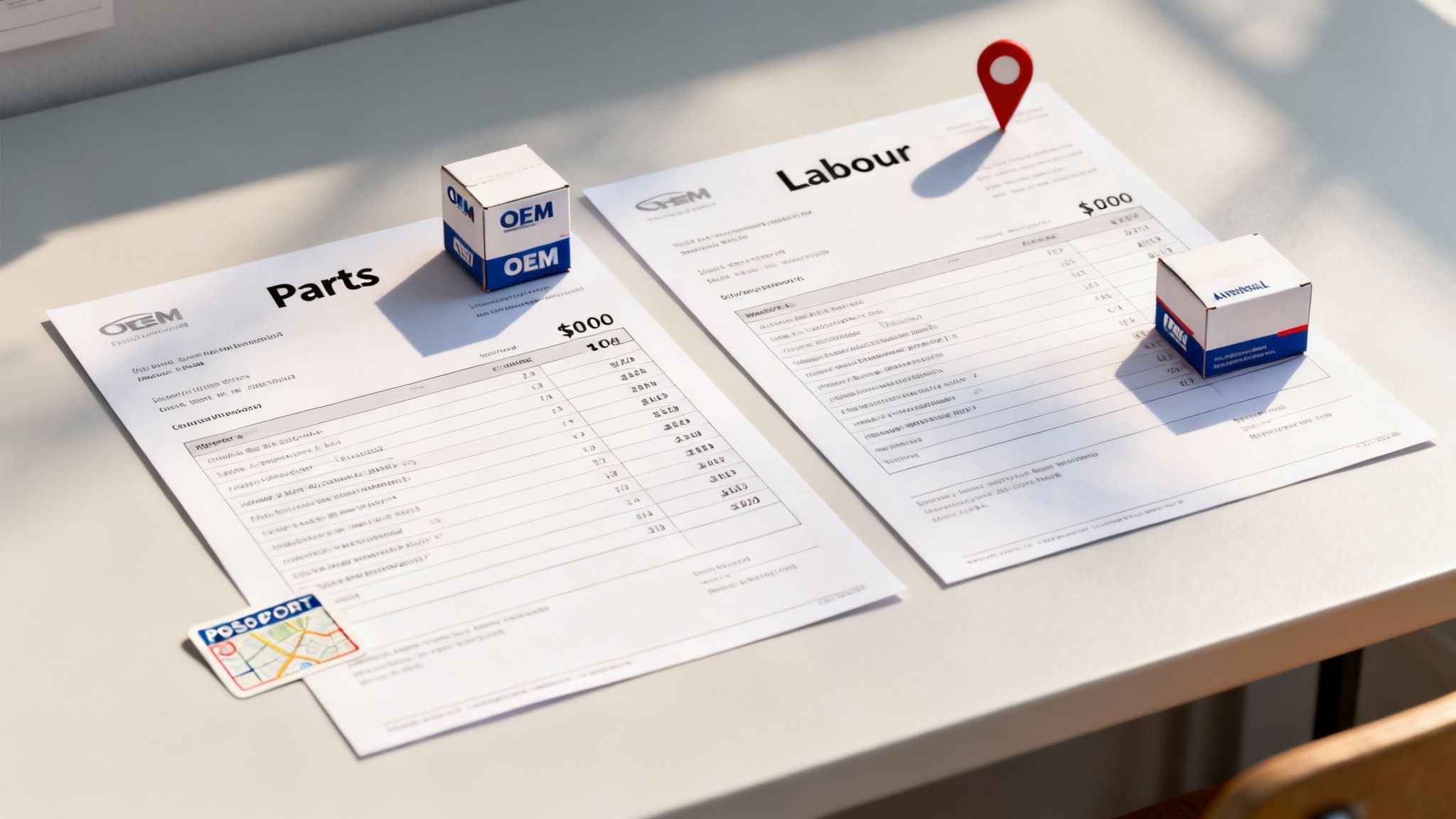
Ever wondered why one garage quotes £400 for a cambelt change while another, just a few miles down the road, quotes double that? It's a common story. The final figure on any repair invoice is really just a blend of two key ingredients: the parts themselves and the hours spent fitting them. Getting your head around this breakdown is the first step to accurately forecasting your reconditioning costs.
The first variable is the choice of parts. Going for cheaper, aftermarket components can certainly slash the initial bill, but it introduces a real risk. These parts might not offer the same longevity or precise fit as Original Equipment Manufacturer (OEM) parts, potentially leading to premature failure. That's a nightmare scenario, especially when a car you’ve sold comes bouncing back with problems.
On the other hand, fitting genuine OEM parts provides peace of mind and is often essential for keeping a vehicle's warranty intact, but it comes at a premium. For any motor trader, the decision between aftermarket and OEM is a constant balancing act between keeping costs down and ensuring quality.
The True Cost Is on the Clock
While the parts are a big piece of the puzzle, the labour cost is where the real variation creeps in. A cambelt replacement isn't a simple swap-out job like changing a tyre. It’s more like performing engine surgery, demanding a technician to meticulously dismantle a good chunk of the engine bay just to get access.
This complexity means the job can take anywhere from two to five hours, and sometimes even longer on particularly fiddly engines. Labour rates themselves also vary enormously across the country and between different types of garages.
A main dealer, with its shiny showroom, higher overheads, and brand-specific training, will almost always charge a higher hourly rate than your trusted local independent. This single difference can easily add hundreds of pounds to the final cambelt change cost.
Location, Location, Location
It might sound strange, but the garage's postcode plays a surprisingly big role in the final bill. Labour costs are heavily influenced by local economic factors, meaning a garage in Central London can charge substantially more per hour than one in a sleepy rural town.
In fact, labour costs are often the dominant factor in UK cambelt replacements, frequently adding £300 or more on top of the parts bill. National averages put the total cost somewhere between £600 and £950, with some statistics showing that London garages can charge up to 25% more than their rural counterparts. For dealers and auction houses, this makes verifying a car's service history with a service like AutoProv absolutely critical to avoid huge, hidden expenses.
This geographical price difference is a crucial calculation for any trader buying stock from different regions. A car that looks like a profitable flip in one area could easily become a loss in another, purely based on local labour rates. It's a detail just as important as knowing the signs of a failing head gasket, which carries similar eye-watering financial risks. A proactive check of a vehicle's history isn't just a nice-to-have; it's your best defence against these profit-destroying surprises.
How the Badge on the Bonnet Dictates Your Bill
The make and model of a car aren't just about prestige or performance; they're a huge clue to the potential cambelt change cost hiding under the bonnet. Not all engines are created equal, and this simple fact is why the final invoice for a premium German saloon can be worlds apart from that of a popular city runaround. For anyone pricing up trade-ins or buying diverse stock at auction, getting your head around these differences is absolutely essential.
Think of it this way. Working on a simple, transverse four-cylinder engine in something like a Ford Fiesta is like navigating a quiet country lane. For a skilled mechanic, the parts are generally easy to get to, and the job is relatively straightforward because there’s decent space to work in. The design often prioritises ease of maintenance.
Now, imagine swapping that for a complex, longitudinally mounted V6 engine in an Audi A4. That’s the equivalent of trying to navigate a maze-like city centre during rush hour. Access is tight, often forcing the technician to dismantle the entire front end of the car just to get near the belt. This complexity sends the labour time soaring—and as we know, labour is the biggest chunk of the final cost.
Prestige Premiums and Complicated Engines
It's not just about the extra hours on the ramp, either. Parts for prestige brands often carry a hefty premium, even for components that do the exact same job as their more mainstream counterparts. When you combine higher parts prices with these more complex, labour-intensive designs, you've got the perfect recipe for a wallet-wincing repair bill.
This is precisely why cambelt change costs can vary so wildly between manufacturers. For instance, while some data points to a UK average cost of £678.20, that number hides some massive differences. A premium brand like BMW can see those costs climb to an average of £1,051.66, whereas a more budget-friendly MINI might be closer to £421.67. For a franchised dealer group assessing the risk on a trade-in, figures like these are gold dust. You can find more detailed repair data here to see just how much these costs fluctuate.
This model-specific cost variance is a critical piece of data for any motor trade professional. A potential £600+ difference between models can instantly turn a profitable acquisition into a loss if not accounted for during valuation.
For remarketing outfits and independent dealers, this knowledge is power. It lets you build much more accurate bidding and pricing strategies. A few real-world examples:
- Vauxhall Corsa: You're typically looking in the £300-£500 range.
- Toyota Yaris/Corolla: Generally, you'll be estimating between £300-£600.
- Mercedes C-Class: This can easily push into the £500-£800 bracket.
This is where having detailed vehicle data from a platform like AutoProv becomes a game-changer. Instead of just guessing, you can pull up a comprehensive vehicle report and understand a car's specific maintenance needs. It turns a high-risk estimate into a calculated business decision, ensuring you know the true cost of getting that vehicle ready for your forecourt.
Spotting the Hidden Costs of Associated Repairs
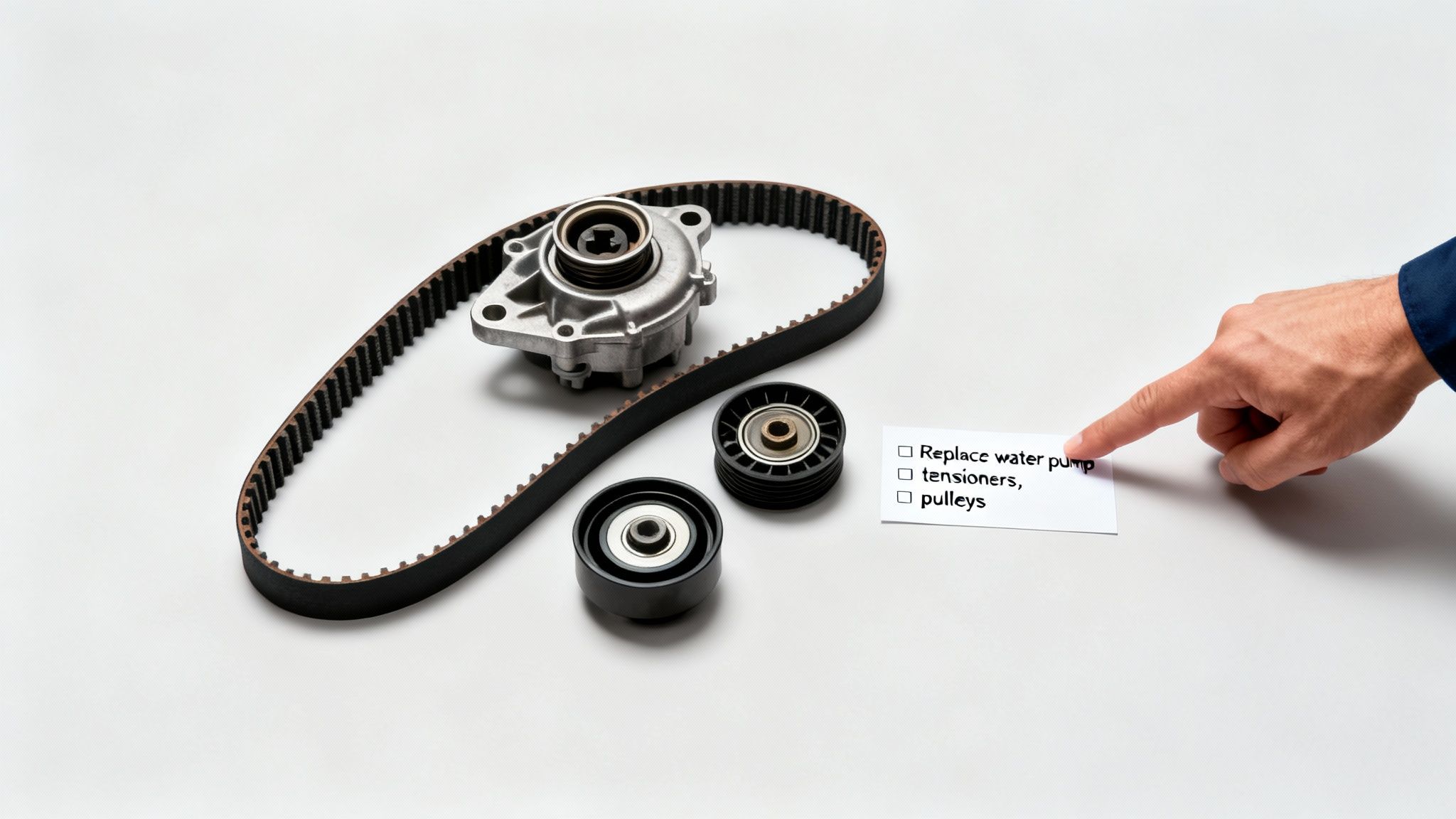
Any experienced motor trader will tell you a cambelt change is rarely just about the belt. Suggesting other parts get swapped out at the same time isn't an upsell; it's essential preventative medicine that protects your investment and your reputation. More importantly, it saves your customer from a wallet-busting failure down the road.
Think about it. Once a technician has stripped down the engine bay to get to the cambelt, a bunch of other critical components are sitting right there, easy to get to. The lion's share of the bill—the labour—is already sunk. This is the golden opportunity for all those crucial "while you're in there" jobs.
The Essential Cambelt Kit Components
Trying to save a few quid by ignoring these associated parts is a classic false economy. A shiny new cambelt is only as reliable as the parts supporting it. If an old, worn tensioner fails or a water pump seizes, it'll take that new belt with it, leading to the very catastrophic engine damage you were trying to prevent in the first place.
This is why any professional cambelt service worth its salt will always replace the full kit, which includes:
- The Water Pump: On many engines, the cambelt drives the water pump. If that's the case, replacing it is non-negotiable. A failing pump won't just shred the new belt; it can cause the engine to overheat catastrophically.
- Tensioners and Idler Pulleys: These components are the unsung heroes, keeping the belt perfectly tensioned and guided. They wear out at roughly the same pace as the belt, and a failed tensioner is one of the most common culprits behind a snapped belt.
Here’s a simple way to think about it: you wouldn't fit a brand-new, high-performance tyre to a rusty, buckled wheel. The same logic applies here. For a new belt to do its job properly for its entire service life, it needs a fresh set of pulleys and a new tensioner to work with.
Taking this proactive approach turns a simple repair into a long-term investment in the vehicle's health. For anyone prepping cars for the forecourt, this isn't just good mechanical sense; it's a shrewd business decision. It shows you're committed to quality, builds trust with buyers, and dramatically cuts the risk of costly warranty claims that eat into your profit and tarnish your name.
Of course, you need to verify this work has actually been done. You can learn more about how to find car service history in the UK to make sure you're not caught out by a missing stamp in the book.
Using Provenance Data to Sidestep Costly Surprises

So, how do you spot a vehicle that's a ticking cambelt time bomb before you put your money down? The answer isn't under the bonnet; it's buried in its history. For any savvy motor trade professional, this is where provenance data becomes your best line of defence against a nasty, unforeseen bill.
Every decision at the auction house or during a part-exchange valuation is a calculated risk. Without solid proof of a cambelt change, you're effectively gambling with your profit margin. This is precisely where a service like AutoProv comes in, turning what was once high-stakes guesswork into a clear, data-driven business decision.
Think of an AutoProv report as your instant due diligence engine. It's about reading between the lines of a vehicle's past to get an accurate fix on its future costs.
Decoding a Vehicle's History
A vehicle's history tells a story, and learning to read it is the key to dodging a surprise cambelt change cost. By pulling together a few key data points, you can build a surprisingly accurate picture of its real maintenance status.
An AutoProv report does the heavy lifting for you in seconds, allowing you to:
- Analyse DVLA MOT History: Look for tell-tale signs like mileage discrepancies or long gaps where the car was off the road, which often point to neglected maintenance.
- Track Mileage Records: Pit the current mileage against the manufacturer's recommended cambelt interval. A car that's hit 80,000 miles when the interval is 85,000 is an immediate red flag demanding your attention.
- Verify Service Records: Instantly check for documented proof of major services. The all-important cambelt change should be logged right on schedule.
This process shines a spotlight on vehicles that are overdue for this wallet-draining job. Suddenly, a hidden liability is dragged out into the open, giving you a powerful advantage. To get a better sense of what these reports uncover, check out our ultimate guide to a car provenance report in the UK.
By using comprehensive vehicle data, you can turn a potential £1,000 repair bill from a nasty surprise into a powerful negotiation tool at the auction block—or a clear signal to walk away.
From Liability to Leverage
Discovering that a vehicle needs a new cambelt doesn't automatically make it a bad buy. What really matters is that you know about it before you make your offer. This knowledge completely changes the game, shifting the power firmly back in your favour.
When an AutoProv check flags an overdue cambelt, you're left with two smart options. First, you can factor the full, anticipated cost of the repair directly into your bid, ring-fencing your profit margin. Second, you can use that hard data as leverage to negotiate a lower price from the seller, backing up your offer with a clear breakdown of the imminent costs.
This isn't just about avoiding a loss; it's about making smarter, more profitable acquisitions. It replaces the fuzzy uncertainty of a missing service stamp with the solid confidence of knowing the true, all-in cost of getting a car ready for your forecourt. In a market full of variables, this is how you consistently protect your bottom line.
The Real Financial Damage of a Snapped Cambelt
To really get your head around the value of proper due diligence, you need to understand what happens when it all goes wrong. The true financial fallout from a snapped cambelt is much more than just a hefty repair bill; it’s a catastrophic event for the engine and a serious blow to your business's bottom line.
Forget the technical jargon about bent valves and smashed pistons for a moment. For a motor trader, a snapped belt means one thing: a potential £3,000+ engine rebuild or replacement that doesn't just eat into your profit margin—it completely obliterates it. This single point of failure can instantly flip a great sale into a devastating loss.
A Trader's Worst-Case Scenario
Picture this, because it’s a scenario many in the trade can relate to. You’re at an auction and spot what looks like a peach of a deal: a clean, popular model with good mileage that you know will fly off the forecourt. You win the bid, get it prepped, and sell it quickly for a healthy profit. Job done.
Then, a week later, you get that dreaded phone call. The car has broken down, the engine is dead, and the new owner is, understandably, furious. A quick trip to the garage confirms the worst: the cambelt has let go, causing carnage inside the engine.
This situation is a financial nightmare. Not only are you legally on the hook for a multi-thousand-pound repair under consumer rights, but the damage to your reputation can be even more costly and long-lasting.
This is the hidden risk lurking inside every car with an unverified service history. It’s a powerful reminder of the immense value of using a vehicle intelligence tool like AutoProv. The small, upfront cost of a comprehensive provenance check is your insurance policy against this kind of disastrous financial hit. It gives you the certainty to avoid buying a ticking time bomb, protecting your profit, your reputation, and your peace of mind.
To learn more about how unforeseen costs can impact a vehicle's value, check out our guide on how to calculate vehicle depreciation simply.
Your Cambelt Questions Answered
Got a few nagging questions about cambelts? You’re not the only one. Here are some quick-fire answers to the questions we hear most often from professionals in the motor trade.
How Can I Verify a Cambelt Change?
The gold standard is a stamped service book or, even better, a detailed invoice from a proper garage. It should clearly list the date, the car's mileage, and exactly which parts were fitted.
Without that paper trail, you're flying blind. This is where a vehicle provenance report from a service like AutoProv becomes invaluable. It can pull together MOT history and mileage records, flagging vehicles that are almost certainly overdue this critical job based on the manufacturer's schedule.
What Is the Difference Between a Cambelt and a Timing Chain?
Think of a cambelt as a heavy-duty rubber band with teeth. It does a vital job but has a limited lifespan, needing to be swapped out every 60,000 to 100,000 miles. A timing chain, on the other hand, is a metal chain, much like one on a bicycle, and is built to last the life of the engine.
While a chain doesn't need routine replacement, its plastic guides and tensioners can wear out and fail. Getting these two mixed up is a classic rookie error that can throw your reconditioning budget out by hundreds, if not thousands, of pounds.
Knowing whether a car has a belt or a chain is fundamental business intelligence. A belt is a predictable, future cost you can plan for. A failing chain is often an unexpected—and much bigger—financial headache.
How Does an Overdue Cambelt Affect Resale Value?
A car with a cambelt that’s past its due date takes a serious hit on its value. Any clued-up buyer, whether in the trade or a member of the public, is going to knock the cost of the job straight off their offer.
For a dealer, this is a massive negotiating lever. For a seller, it’s a guaranteed price drop of £400-£800+, often more than the repair itself would cost. More than that, it screams "neglected maintenance," making potential buyers wonder what else has been skipped.
Frequently Asked Questions
AI-Generated Content Notice
This article was created with the assistance of artificial intelligence technology. While we strive for accuracy, the information provided should be considered for general informational purposes only and should not be relied upon as professional automotive, legal, or financial advice. We recommend verifying any information with qualified professionals or official sources before making important decisions. AutoProv accepts no liability for any consequences resulting from the use of this information.
From our AI insights
- The Importance of Tyre Verification for UK Motor Traders
Discover why verifying tyre specs is crucial for UK traders to ensure safety and compliance.
- Decoding CO2 Emissions: A Trader's Guide
Learn how traders can verify CO2 data using factory build sheets to prevent disputes.
- Navigating Recall Compliance for UK Car Traders
Ensure compliance with recall regulations: essential steps for UK car traders.
Related Articles

The Importance of Car Maintenance and Provenance Checks
Discover why regular car maintenance and proper provenance checks are essential for vehicle quality and longevity.

Essential Car Maintenance Tips for UK Drivers
Discover vital car maintenance tips to keep your vehicle roadworthy and compliant in the UK.
How Much Is a Car Service? Complete UK Price Guide
Trying to pin down exactly "how much is a car service?" can feel a bit like asking "how long is a piece of string?". Prices vary quite a bit, but to give you a ballpark figure, an interim service will usually set you back around £100 to get started. A more thorough full service often begins at £180, while a major service for many cars can easily top £300.
Published by AutoProv
Your trusted source for vehicle intelligence