
A vehicle doesn't have to fail dramatically to create a fleet risk problem for a dealer. More often, the trouble starts with something ordinary. A buyer comes back after delivery with a fault that should have been spotted, a member of staff has a minor road incident in a demonstrator, or a stock unit is found to have a pattern of ownership and mileage data that makes it far harder to retail with confidence.
That's why fleet risk management matters in the motor trade. It isn't only about vans, lorries, or route-heavy operations. For a UK dealership, it sits across stock acquisition, demonstrator use, collections, deliveries, staff driving, documentation, and the quality of the vehicles entering the business in the first place. If you buy the wrong metal, weak processes won't save you. If you buy well but run loose controls, margin still leaks out.
Table of Contents
- The True Cost of Overlooking Risk in the Motor Trade
- What Fleet Risk Management Means for UK Car Dealers
- Your fleet is broader than your road cars
- Where dealers usually get it wrong
- Mapping Your Dealerships Core Risk Areas
- Vehicle-centric risks
- Operational risks
- A Practical Risk Assessment Framework and KPIs
- Use a four-part assessment cycle
- Key Risk Areas and Corresponding KPIs for Motor Traders
- Implementing a Robust Risk Management Programme
- Policies that remove ambiguity
- Processes that stand up to scrutiny
- People and accountability
- How Vehicle Intelligence Platforms Elevate Your Strategy
- Why basic checks often fall short
- What point-of-decision intelligence changes
- Turning Risk Management into a Competitive Advantage
The True Cost of Overlooking Risk in the Motor Trade
A familiar example is a stock car that looked straightforward at purchase. It cleaned up well, passed through prep, and sold quickly. Then the complaint starts. The customer raises concerns about prior damage, inconsistent history, or a mechanical issue that now looks less like bad luck and more like a buying failure. The deal becomes a dispute, the workshop gets dragged back in, and the original gross shrinks fast.
That's the daily reality of risk in the motor trade. It rarely arrives labelled as “fleet risk management”. It appears as a comeback, a rejected vehicle, an avoidable repair bill, a test-drive incident, or a staff collection done without enough control. Dealers often think in terms of margin and days in stock, but risk sits underneath both.
The exposure isn't limited to vehicle quality. Work-related driving carries serious consequences in the UK. In the UK, 29% of all road fatalities involve people driving for work, and 21% of all casualties on UK roads are caused by collisions involving driving-for-work incidents according to Lightfoot's summary of Highways England data. For a dealership, that covers demonstrators, courtesy cars, collections, deliveries, site-to-site movements, and employee journeys carried out for business purposes.
Practical rule: If a vehicle is being bought, moved, tested, loaned, or sold through the business, it belongs inside your risk process.
A lot of dealers still separate “vehicle history” from “operational risk” as if they were different conversations. They aren't. A unit with hidden damage history can trigger a post-sale dispute. A loose handover policy can turn a routine movement into an incident. A poor buying note can leave nobody able to explain why the car was acquired at all.
The commercial cost is broader than one bad transaction. Weak controls also affect confidence in stock, staff behaviour, customer trust, and the consistency of your buying decisions. That's why the most resilient operators treat provenance, driving exposure, inspections, and documentation as part of the same discipline. If you want a good illustration of how quickly hidden issues become expensive, this breakdown of the true cost of buying a vehicle with hidden history is worth reading.
What Fleet Risk Management Means for UK Car Dealers
For a dealer, fleet risk management means controlling risk across every vehicle the business owns, operates, lends, buys, moves, or prepares for sale. That definition is wider than the usual logistics view. In a haulage business, the focus is route safety, compliance, maintenance intervals, and driver conduct over sustained mileage. In a dealership, the risk picture is more mixed and often less formal.

A dealer's fleet includes retail stock in motion, demonstrators, courtesy cars, loan vehicles, collection vehicles, site transfer units, and sometimes personal vehicles used for business tasks. It also includes the decision chain around acquisition. If your buyer brings in a poor unit with unresolved provenance questions, that's a fleet risk issue as much as a vehicle appraisal issue.
Your fleet is broader than your road cars
The practical way to view it is by asset exposure.
- Stock exposure: Every car bought into stock carries provenance, condition, and resale risk.
- Usage exposure: Every staff movement, test drive, collection, and delivery creates operational risk.
- Documentation exposure: Every missed inspection, incomplete appraisal, or weak handover note makes disputes harder to defend.
- Liability exposure: Every vehicle used for work, whether company-owned or otherwise, can pull the business into a claim, complaint, or internal process failure.
That's why dealer vehicle checks shouldn't sit in a silo. A proper vehicle history check UK process needs to feed into buying approval, prep planning, valuation, and who is allowed to move the vehicle.
Where dealers usually get it wrong
The usual failure isn't that no checks are done. It's that checks are treated as isolated admin steps.
A dealer might run a used car history report, glance at MOT history, and file it away without asking the harder questions. Does the ownership pattern fit the age and type of vehicle? Is the mileage progression consistent enough to support the asking price? Is there anything in the record that changes who should inspect the car and how thoroughly? That's the difference between basic compliance and real motor trade risk control.
Good dealers don't just ask whether a car is clear enough to buy. They ask whether the known facts support the intended retail strategy.
Operationally, the same principle applies. Test drives, fuel use, key control, overnight storage, and collection procedures all need structure. If they don't, the dealership ends up relying on memory and habit. That works until something goes wrong.
Dealers looking at the wider operating side of this can use this guide to modern fleet management for UK businesses as a useful reference point, but the key point remains simple. In the motor trade, fleet risk management starts before the keys ever reach a customer.
Mapping Your Dealerships Core Risk Areas
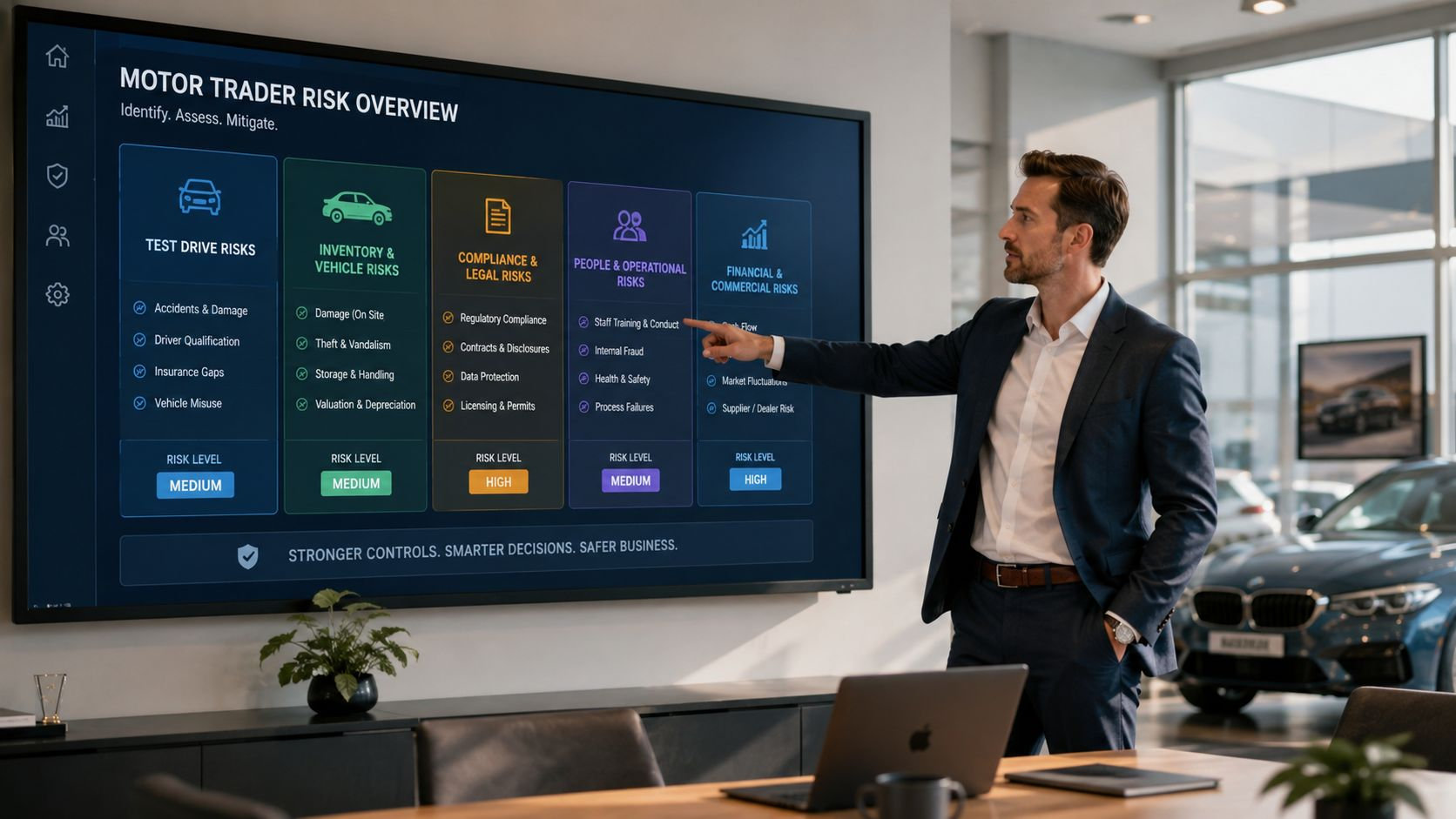
Most dealership risk sits in two places. One is the vehicle itself. The other is what your team does with it. When those two areas are reviewed together, weak spots become easier to spot and far easier to control.
Vehicle-centric risks
These are the risks built into the asset before it reaches the forecourt. They affect buying confidence, preparation cost, retail suitability, and dispute exposure.
- Provenance gaps: A car can look acceptable on a basic report but still raise concerns when ownership timing, usage patterns, and history chronology are reviewed properly.
- Mileage concerns: A proper mileage check UK process isn't only about spotting obvious rollbacks. It's about identifying inconsistent mileage progression, unexplained gaps, or readings that don't fit the vehicle's story.
- Short-term ownership and rapid resale: Frequent changes of keeper over short periods can signal instability around the vehicle. It doesn't prove a problem, but it does justify deeper scrutiny.
- Undisclosed damage history: Prior structural or insurance-related events can alter valuation, prep planning, and retail appetite, even where a vehicle presents well at first inspection.
- Data anomalies: Conflicting records across history sources can be just as important as any single adverse marker.
For trade buyers, vehicle provenance is critical. The issue isn't limited to whether a flag exists. The issue is whether the wider pattern supports buying the unit at the money.
Operational risks
Operational risks sit in your people, procedures, and site controls. They're often easier to ignore because they feel routine.
Consider a few common examples:
- Vehicle movement risk: Staff collect stock, move vehicles between sites, deliver sold units, and run errands in company vehicles. If driver standards aren't monitored, the business absorbs risk incrementally.
- Test drive controls: Unclear sign-out procedures, weak licence checks, and inconsistent accompaniment rules create avoidable exposure.
- Key management: Missing, duplicated, or poorly logged keys create both theft risk and accountability problems.
- Premises movement: Tight yards, workshop traffic, and rushed vehicle shuffling lead to minor damage that steadily eats margin.
- Grey fleet use: Employees using personal vehicles for business create a difficult compliance area. The concern isn't theoretical. Fleet Operations highlights grey fleet as a major oversight point in UK fleet safety, and the same principle applies in dealership settings where staff use non-company vehicles for work tasks.
When a dealership reviews only driver behaviour, it misses buying risk. When it reviews only stock quality, it misses operational loss. The expensive problems usually involve both.
A sound risk map should connect the two. For example, a vehicle with questionable ownership history may deserve a deeper workshop inspection before any customer test drive. A high-value unit with unusual provenance may need stricter approval before inter-site transfer. That joined-up view is what turns risk management from paperwork into control.
For dealers formalising this process, an inventory risk assessment approach helps structure how vehicle-specific concerns feed into stock decisions, not just after-the-event reviews.
A Practical Risk Assessment Framework and KPIs
Most dealerships already know where some risk sits. The problem is that too much of it remains informal. One buyer notices odd history. One sales manager is strict on test drives. One prep controller spots recurring issues. That isn't a system. It's local knowledge.
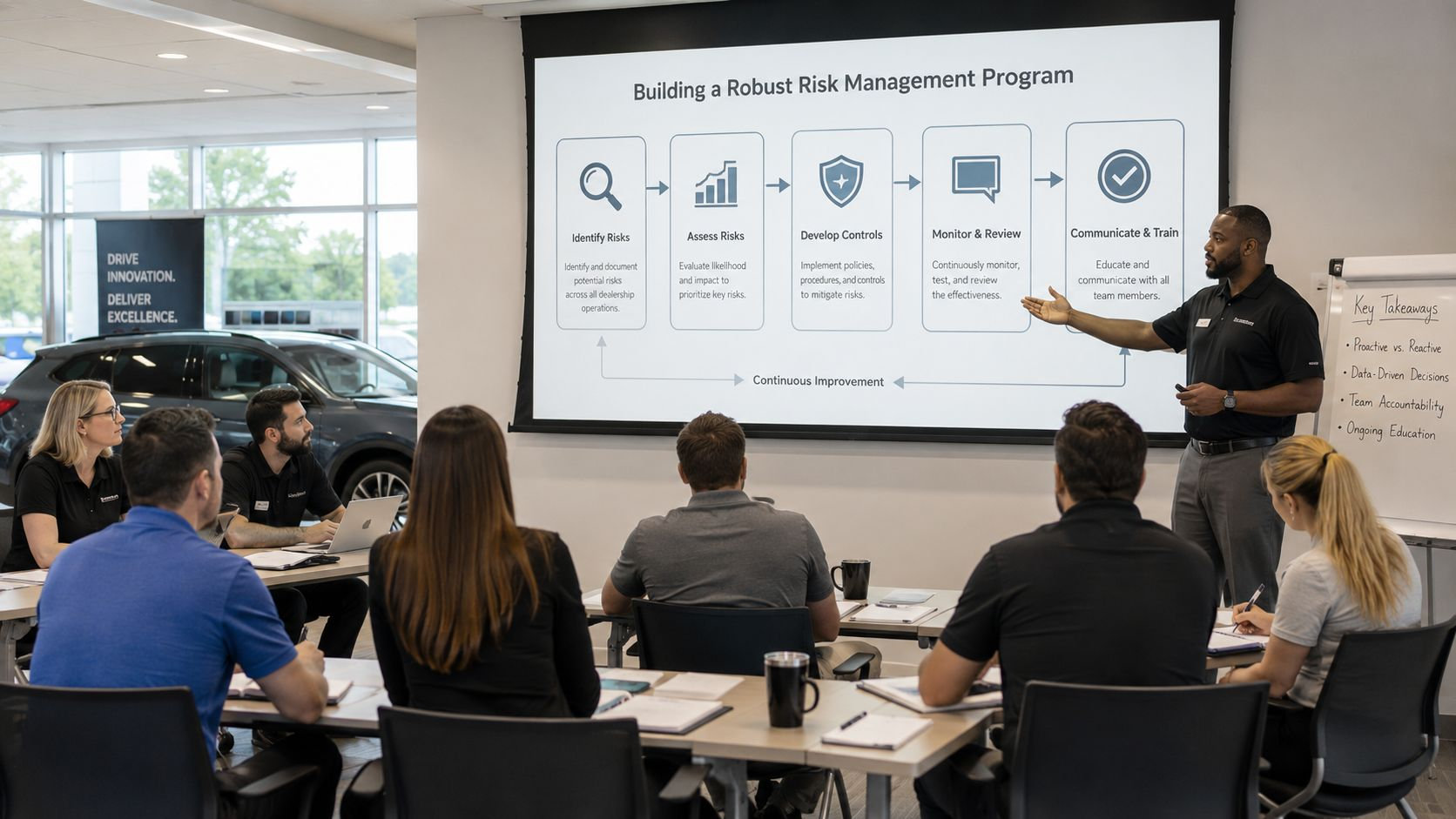
A stronger approach uses four stages. Identify, analyse, control, and monitor. That keeps risk management practical and repeatable.
Use a four-part assessment cycle
Identify the exposures that can hurt the business. Start with stock acquisition, demonstrator use, test drives, staff road movements, prep sign-off, and grey fleet use. Then list the vehicle intelligence issues that affect buying confidence, such as mileage inconsistencies, rapid keeper changes, or unclear provenance.
Analyse the likely impact. Ask simple commercial questions. Could this create a post-sale dispute? Could it increase prep cost? Could it make the vehicle harder to finance, warranty, or retail? Could it expose the business to an incident on the road?
Control the risk with specific actions. Some controls are procedural, such as two-person sign-off on unusual stock. Others are operational, such as tighter licence checks, key logs, or route rules for collections.
Monitor what happens over time. If you don't track the result, you won't know whether the control is working or merely creating admin.
One useful outside reference for structuring this kind of process is Lighthouse Consultants' expert advice on risk assessment for SMEs. The principle fits motor retail well. Simple frameworks beat vague concern every time.
The monitoring stage is where KPIs matter. For driver-related exposure, there are two metrics dealers should take seriously. Drivers exhibiting 3+ harsh braking events per 1,000 km have a 47% higher probability of preventable collision involvement, and speeding events exceeding 5% of total journey time correlate with a 3.2-fold increase in insurance claim frequency according to Fleet Service GB's guide to fleet driver risk assessment tools and metrics. Even if your dealership isn't running a large transport fleet, those indicators are still relevant for demonstrators, couriers, collection drivers, and site transfer activity.
Buying insight: A stock profile that turns slowly and a driving profile that turns careless usually share the same root cause, poor control at the point of decision.
Key Risk Areas and Corresponding KPIs for Motor Traders
Risk Area Example Risk Suggested KPI Stock acquisition Vehicle bought with unresolved provenance concerns Share of purchased stock requiring escalation for provenance review Mileage integrity Inconsistent mileage pattern on incoming appraisal Share of appraisals with mileage anomalies identified before purchase Ownership profile Rapid resale or short-term keeper history Share of stock flagged for unusual ownership pattern analysis Test drive management Poor sign-out controls or incomplete licence verification Test drives with complete documented sign-out and return records Staff road use Harsh braking, speeding, or poor vehicle handling during collections Harsh braking events per 1,000 km and share of journey time spent speeding Workshop handover Vehicle released without full inspection record Vehicle release files with complete inspection and sign-off documentation Key control Missing or unlogged key movements Key issue and return compliance rate Stock holding quality Vehicles ageing in stock while unresolved issues remain open Aged stock with outstanding provenance or technical queries Many businesses also connect risk with stock performance. If your buying team wants to sharpen acquisition decisions, using days-to-sell data for smarter stock buying alongside risk indicators helps separate acceptable complexity from avoidable trouble.
Implementing a Robust Risk Management Programme
A workable programme doesn't start with software. It starts with discipline. Dealers who implement strong controls usually organise them around three areas. Policies, processes, and people. If one is weak, the others won't carry it for long.
Policies that remove ambiguity
Written rules matter because memory changes and staff habits drift.
A dealership should have clear policies on who can approve stock with adverse history signals, who may drive demonstrators or customer vehicles, what documents must be recorded before a test drive, and how exceptions are signed off. Keep these policies short enough to use, but specific enough to defend.
A useful way to write them is to focus on decision points:
- Buying decisions: What history signals require escalation before purchase?
- Vehicle movement decisions: Who can authorise collections, deliveries, and inter-site transfers?
- Customer access decisions: What licence, insurance, and sign-out checks are mandatory before any test drive?
- Release decisions: What must be complete before a vehicle can be handed over or delivered?
Processes that stand up to scrutiny
Policies set intent. Processes prove control.
Every incoming vehicle should move through a standard sequence. Appraisal. provenance review. physical inspection. workshop note. pricing decision. release authority. The exact form can vary by operation, but the principle can't. If you skip the same step often, that step isn't embedded.
For road risk, inspection records and maintenance controls are central. UK fleet protocols place weight on auditable standards. Practical driver training must be delivered by Approved Driving Instructors registered on the ADI route, and ISO accreditation is considered vital for providers to support audit-ready documentation. Key technical KPIs include a roadside inspection pass rate target of more than 95% and a preventive maintenance compliance rate of more than 98% according to Fleet News on the fleet risk management eight-stage plan. Dealers may not operate like a national fleet, but the lesson is the same. If it isn't documented properly, it won't stand up when challenged.
The businesses that handle disputes best usually aren't the ones with no issues. They're the ones that can show what they checked, when they checked it, and who signed it off.
People and accountability
Even good systems fail when nobody owns them. Assign responsibility by role, not by vague group.
A buyer should own initial stock assessment quality. A prep lead should own inspection completion. A sales manager should own test-drive compliance. A site manager should own key control and vehicle movement standards. Once ownership is clear, exceptions stop disappearing into the business.
Training also needs to be practical. Don't rely on a generic induction and assume that's enough. Collection drivers, valeters moving stock, sales staff running demonstrations, and workshop road testers all create different forms of exposure.
For operators building this more formally, a compliance risk management framework helps connect daily controls with audit readiness and internal accountability.
How Vehicle Intelligence Platforms Elevate Your Strategy
Most risk programmes in the motor trade focus on what staff do with vehicles after purchase. That matters, but it leaves a serious gap. If the car itself enters stock with hidden issues, the business starts from a weak position.
Why basic checks often fall short
A standard used car history report can confirm useful data points, but it won't always give enough context for a trade decision. That's especially true when the issue isn't one dramatic marker, but a pattern across ownership timing, mileage chronology, MOT behaviour, insurance-related events, and vehicle usage signals.
This is a recognised blind spot. Most UK fleet risk guides focus exclusively on driver behaviour and maintenance, completely omitting how purchasing high-risk vehicles, such as those with undisclosed damage or mileage discrepancies, increases the likelihood of mechanical failure and subsequent accidents according to the RSA fleet risk control guide. For UK dealers, that omission matters because buying is where risk often becomes irreversible. Once capital is committed, every later process is damage limitation.
That's why dealer vehicle checks need to move beyond pass or fail thinking. A car can be technically checkable yet still commercially unattractive once the wider pattern is reviewed.
What point-of-decision intelligence changes
The strongest trade vehicle intelligence tools don't merely return records. They help the buyer interpret them in context. That means drawing attention to signals such as unusual ownership churn, unresolved mileage questions, chronology that doesn't fit the age and type of vehicle, or risk indicators that warrant deeper inspection before purchase.
That changes the workflow in practical ways:
- Before buying: The buyer sees whether the vehicle deserves standard treatment, enhanced review, or rejection.
- During appraisal: The team can price with more realism when provenance risk affects retail confidence.
- During prep: Workshop and compliance teams know which units require added scrutiny.
- Before retail: Sales teams are less likely to inherit preventable surprises late in the process.
A proper vehicle history check UK workflow should support the point of decision, not merely confirm facts after the deal is already moving. That's the operational value of deeper provenance analysis. It helps dealers act earlier, document better, and avoid turning uncertain stock into certain cost.
Turning Risk Management into a Competitive Advantage
Good fleet risk management protects more than vehicles. It protects margin, buying discipline, staff accountability, and the credibility of the business. Dealers who combine operational controls with sharper provenance review usually make cleaner stock decisions and handle problems with far less disruption.
For a broader management perspective, this piece on understanding enterprise risk is a useful reminder that risk isn't a back-office exercise. In a dealership, it affects appraisal quality, vehicle preparation, customer outcomes, and reputation. The businesses that treat risk as part of commercial decision-making, not as paperwork after the fact, tend to trade with more confidence and less avoidable loss.
If your business wants stronger point-of-decision vehicle intelligence, AutoProv helps UK motor traders assess vehicle history, vehicle provenance, mileage anomalies, ownership patterns, and broader risk signals before capital is committed. It's built for dealers who need more than a basic used car history report and want dealer vehicle checks that support smarter buying, valuation, and compliance decisions.
Frequently Asked Questions
AI-Generated Content Notice
This article was created with the assistance of artificial intelligence technology. While we strive for accuracy, the information provided should be considered for general informational purposes only and should not be relied upon as professional automotive, legal, or financial advice. We recommend verifying any information with qualified professionals or official sources before making important decisions. AutoProv accepts no liability for any consequences resulting from the use of this information.
From our AI insights
- Dealer Management Systems: Maximizing ROI in UK Fleets
Discover how UK motor traders can maximise ROI with dealer management systems.
- Navigating Fleet Risk Management with Vehicle Intelligence
Discover how vehicle intelligence transforms risk management in UK fleet operations.
- Fleet Management: Impact of Brexit on UK Fleet Operations
Explore how Brexit has reshaped fleet management in the UK, affecting regulations, costs, and operations.
Related Articles

Essential Fleet Management Practices for UK Businesses
Discover key fleet management practices to enhance efficiency and compliance in UK businesses.

A Guide to UK Vehicle Inventory Management Software
In the fast-paced UK automotive market, vehicle inventory management software is what separates the dealerships that thrive from those just trying to keep their heads above water. Think of it as the central nervous system for your entire operation, going way beyond a simple spreadsheet to give you real-time, data-driven command over every car on the forecourt. It's the true engine room of any modern dealership.

A Guide to Modern Fleet Management for UK Businesses
Forget the old-school idea of fleet management being just about tracking vans on a map. Today, it’s the strategic heart of any profitable motor trade business, pulling together logistics, finance, and risk management into one essential role. The ultimate goal? To squeeze every drop of efficiency out of your vehicles, slash costs, and keep everything compliant throughout a vehicle's entire life on your books.
Published by AutoProv
Your trusted source for vehicle intelligence