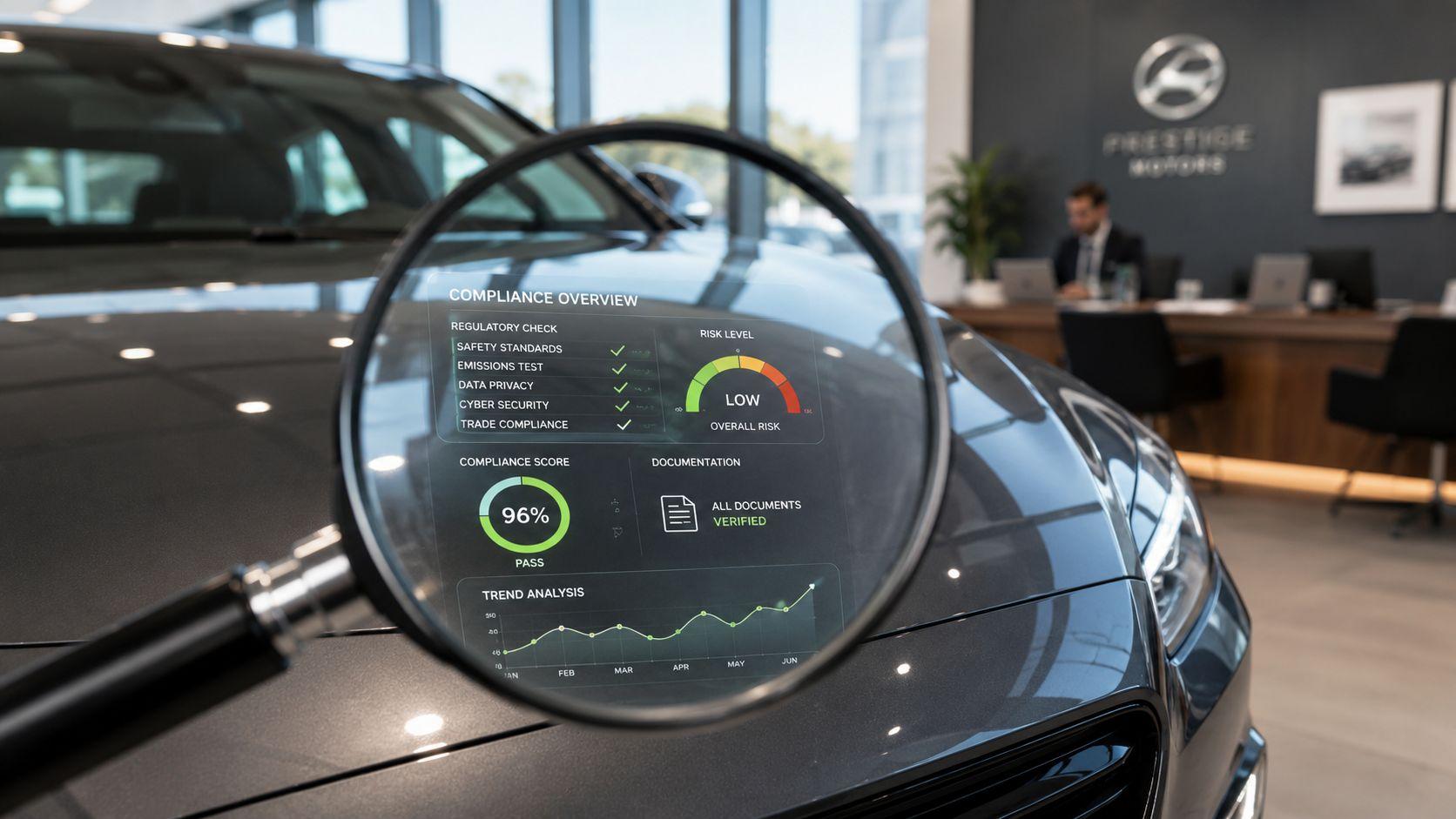
You're buying stock in a hurry, juggling appraisals, watching margin, and trying to keep vehicles moving. Then a deal that looked straightforward turns into a complaint, a return, or a regulator's question because a vehicle's background wasn't understood properly at the point of purchase. That's how compliance problems usually arrive in the motor trade. Not as a dramatic legal event at first, but as an avoidable weakness in process.
For dealers, compliance risk management isn't a corporate buzzword. It's the discipline of making sure buying, preparation, advertising, finance, handover, and supplier management all stand up to scrutiny when something goes wrong. In practice, that means spotting risks early, recording why decisions were made, and using better vehicle intelligence before capital is committed.
Table of Contents
- The Growing Cost of Compliance in the Motor Trade
- Why the issue lands on the dealer's desk
- What has changed in practice
- Understanding Your Regulatory Landscape
- Consumer law, finance rules, and operational duties
- Seeing risk the way a regulator does
- Common Compliance Risks Every Dealer Faces
- Financial exposure from incomplete checks
- Operational weaknesses in sourcing and appraisal
- Reputational damage that starts with one vehicle
- A Practical Framework for Managing Compliance Risk
- Assess
- Design
- Implement
- Monitor
- How Vehicle Intelligence Becomes a Key Compliance Control
- From data point to decision control
- Why vendor accountability matters as much as the report
- Measuring Success and Maintaining Your Programme
- What good looks like over time
- Building a culture that protects margin and reputation
The Growing Cost of Compliance in the Motor Trade
A dealer can absorb a tough part-exchange. It's much harder to absorb a vehicle that triggers a dispute because key background risks weren't understood before sale. One missed issue can mean refund costs, workshop time, finance complications, wasted prep, management time, and reputational drag that outlasts the transaction itself.

Why the issue lands on the dealer's desk
Motor trade compliance is unforgiving because problems overlap. A provenance issue doesn't stay a provenance issue. It can become a pricing issue, a disclosure issue, a complaint-handling issue, and sometimes a question about whether your buying process was competent in the first place.
That's why the old approach of treating compliance as paperwork at the edge of the business no longer works. In the UK, the enterprise governance, risk, and compliance market is projected to reach USD 10,935.6 million by 2033, and 55% of organisations now manage compliance through a dedicated function, reflecting a move from checklist thinking to a central business priority over the last five years, according to UK governance, risk, and compliance market projections.
For motor traders, the practical point is simple. If larger organisations are formalising compliance, smaller dealer groups and independents can't afford to rely on memory, instinct, and inconsistent file notes.
What has changed in practice
Dealers now operate in a market where buyers expect transparency, regulators expect evidence, and disputes move quickly from informal conversation to formal complaint. A used car history report is no longer just a buying aid for stock selection. It supports decision-making, pricing discipline, and defensible disclosure.
Practical rule: If a risk would change your bid, it should be identified before the vehicle is bought, not after it's prepared and advertised.
That applies to ownership patterns, mileage signals, finance concerns, and the broader question of whether the story behind the car makes sense. It also applies to pricing presentation and sales conduct. Dealers reviewing their customer-facing controls should also look at how clear and consistent their pricing processes are, because weak transparency often sits alongside weak compliance discipline in the same business workflow. That's why transparent vehicle pricing practices belong in the same conversation as risk controls.
Understanding Your Regulatory Landscape
Compliance risk in a dealership isn't one rule. It's a set of obligations that cut across sourcing, advertising, finance, delivery, record keeping, and transport operations. When dealers struggle, it's usually because they treat these as separate issues rather than one connected control environment.
Consumer law, finance rules, and operational duties
Start with the sales side. Consumer law affects how you describe a vehicle, how you handle faults, and whether your internal file would support your position if a dispute follows. If your appraisal notes are thin and your vehicle provenance work was basic, your defence is weaker before the conversation even starts.
Finance introduces another layer. Any dealer involved in regulated activity has to think carefully about sales processes, disclosures, affordability boundaries, and record quality. The operational burden is different from a straightforward cash sale, but the underlying discipline is the same. You need evidence of a sound process, not just confidence that staff “usually do it right”.
Operator Licence obligations are often underestimated by dealers who focus mainly on retail risk. Yet they matter. For UK dealerships, compliance pressures demand strict adherence to Operator Licence undertakings, and proactive risk management, including verifying ownership timelines and mileage patterns against DVLA records, has been shown to reduce regulatory infringements, financial loss, and post-sale disputes, as outlined in Thomson Reuters guidance on risk and compliance trends.
Seeing risk the way a regulator does
A regulator won't view your business in departments. They'll look at whether your controls are coherent. They'll ask whether your sourcing checks are adequate, whether responsibility is clear, and whether issues are escalated when anomalies appear.
That means a practical compliance map should include:
- Stock acquisition controls: Who approves a purchase when the vehicle history check UK data raises inconsistencies?
- Vehicle file standards: What has to be recorded before prep or advertisement starts?
- Sales and finance conduct: Which disclosures are mandatory, and where are they evidenced?
- Operational responsibilities: Who owns transport, documentation, and third-party supplier oversight?
Dealers often focus on the sale because that's where complaints surface. The real control point is earlier, when stock is still being assessed.
Physical security and information security also support this environment. A dealership with weak site control, poor footage retention, or inconsistent access management can struggle to evidence events properly when challenged. For a useful operational perspective on premises risk and oversight, South West business security insights are worth reviewing alongside your vehicle and process controls.
If you want a broader grounding in the rules affecting dealers, UK automotive regulatory guidance for motor traders helps frame how these obligations intersect in day-to-day trade activity.
Common Compliance Risks Every Dealer Faces
Some compliance risks are obvious. Others look like ordinary buying decisions until they become expensive. The most persistent problems in the motor trade usually fall into three groups: financial, operational, and reputational.
Financial exposure from incomplete checks
A free check can tell you something useful, but not enough for trade buying where margin and liability are both at stake. In the UK, 27.5% of checked used cars had a number plate change and 17.6% had outstanding debt attached, according to used car history data analysed by The Car Expert. That matters because standard free tools don't give a dealer the full picture.
Free UK car history checks only access government data from the DVLA, while paid checks can also pull from finance, theft, and insurance databases, revealing outstanding loans, write-off categories, and stolen vehicle flags that free tools can miss, as explained in this overview of UK history check data sources.
If your buyer relies on a basic result when a fuller used car history report was needed, the issue isn't just missed data. It's a weak control.
Operational weaknesses in sourcing and appraisal
Trade buying fails when teams collect facts but don't interpret them. One of the clearest examples is ownership churn. A vehicle showing multiple keepers in a short period is a major red flag for UK motor traders because that pattern can indicate an unresolved mechanical fault passed from owner to owner, and it's a detail absent from free checks, as discussed in this guide to the limits of free car history checks.
Mileage discrepancies create the same problem. A mileage check UK process shouldn't stop at reading the latest figure. Buyers need to look for pattern, sequence, plausibility, and whether the story of the car matches the data trail.
For a broader operational mindset, some teams use visual compliance prompts in internal training packs and audit checklists. Even a simple resource such as these regulatory compliance essentials can help reinforce that controls need to be visible and repeatable, not buried in policy documents.
Reputational damage that starts with one vehicle
Most reputation damage in the trade doesn't begin with a headline event. It begins with one buyer who feels the dealer should have known more than they did. If a car later appears to have a problematic background, the customer rarely blames the data environment. They blame the dealership.
That's why dealer vehicle checks need to support a stronger standard than “nothing obvious came up”. The question is whether the dealership used trade vehicle intelligence in a way that was proportionate to the risk of the purchase.
Compliance Risk Area Potential Impact Primary Control Type Outstanding finance or debt Stock tied up, disposal issues, dispute costs Enhanced history and finance checks Short-term ownership pattern Hidden fault exposure, poor stock selection Ownership timeline review Mileage anomaly Mispricing, complaint risk, credibility loss Mileage pattern analysis Incomplete supplier due diligence Fraud exposure, weak audit trail Third-party onboarding controls Weak advertisement disclosure Customer complaints, remediation cost File review and approval process Poor vehicle provenance review Post-sale dispute, margin erosion Point-of-decision risk assessment A lot of these failures are preventable if buyers follow a consistent process before bidding or accepting a part exchange. Practical buying discipline matters more than hindsight. Dealers tightening that discipline should also review fraud prevention steps for UK trade professionals as part of their sourcing controls.
A Practical Framework for Managing Compliance Risk
Most dealerships don't need a large compliance department. They need a system that works every day under commercial pressure. The strongest programmes are usually straightforward. Risks are identified, controls are documented, staff follow the process, and managers review whether it's working.

Effective compliance risk programmes require organisations to map risks by likelihood and impact so resources can be prioritised, and technology plays a key role by helping track adherence and flag potential violations in real time, according to compliance risk management market analysis.
Assess
Start with exposures in your business, not a generic template.
- Review recent pain points: Look back at returns, rejected claims, finance issues, supplier disputes, and stock purchases that didn't feel right after the fact.
- Map risk by transaction stage: Separate sourcing, appraisal, preparation, advertising, sale, handover, and aftersales. Problems often cluster at one stage.
- Score what matters commercially: Focus first on risks that can freeze capital, trigger disputes, or create regulatory attention.
Design
Once the risks are visible, turn them into simple controls people can follow.
- Write short operating rules: For example, no vehicle moves into prep until required checks and approvals are complete.
- Set escalation triggers: A plate change, ownership anomaly, inconsistent mileage story, or missing file document should force a second review.
- Assign named ownership: Someone must own stock checks, someone must own file quality, and someone must own supplier oversight.
A control that depends on memory is not a control. It's a habit, and habits break under pressure.
Implement
Many dealers either improve quickly or stay exposed. Controls only work when they are embedded into routine workflow.
- Make checks part of the buying gate: Build vehicle provenance review into trade appraisals, auction buying, and wholesale sourcing before money is committed.
- Standardise the evidence trail: Save reports, notes, exceptions, and approvals in the same place every time.
- Train around examples: Staff learn faster from real stock decisions than from abstract policy wording.
Monitor
A process that isn't reviewed drifts. The motor trade changes fast, and so do the risks attached to stock sourcing and disclosure.
- Run periodic file audits: Check whether the required steps were followed, not whether the team meant well.
- Track exception trends: If the same issue keeps appearing, the process is either unclear or being bypassed.
- Refresh tools and controls: If your current process is too slow, fragmented, or manual, it won't hold under volume.
Dealers that want a starting point without building everything from scratch can review practical compliance tools for motor trade workflows and adapt them to their own approval process.
How Vehicle Intelligence Becomes a Key Compliance Control
Vehicle intelligence is often treated as a buying convenience. In reality, it functions as a compliance control when used properly. The point isn't just to pull more data. The point is to detect risk signals early enough to stop a bad purchasing decision, challenge a valuation, or document why the business proceeded.

From data point to decision control
A dealer doesn't need every vehicle to be perfect. A dealer needs to know which risks are acceptable, which require a lower bid, and which should stop the purchase entirely. That's where vehicle provenance changes from information to control.
Risk assessments in the UK automotive sector must evaluate root causes and financial, reputational, and regulatory impacts. Structured evaluation using third-party risk solutions helps ensure that causes such as short-term ownership anomalies or mileage inconsistencies are flagged before capital commitment, mitigating the root cause of fraud, according to LSEG guidance on third-party risk in automotive compliance.
That matters for three reasons:
- Buying discipline improves: A dealer vehicle checks process becomes more than a pass or fail exercise.
- Valuation becomes more defensible: Risk signals help explain why a bid changed or why stock was declined.
- Audit evidence strengthens: The dealership can show that it assessed vehicle provenance rather than relying on assumption.
Good trade vehicle intelligence doesn't replace judgement. It sharpens it and records why it was used.
In practical terms, a strong vehicle history check UK workflow should help buyers see ownership timing, mileage sequence, MOT context, and other anomalies in one place. That gives appraisers and buyers a better basis for decision-making than disconnected lookups done under time pressure.
Why vendor accountability matters as much as the report
A less discussed compliance problem sits behind the data itself. Many businesses don't clearly assign responsibility for third-party vendor oversight. In the UK and Europe, regulators are increasingly focused on organisations that don't maintain a clear vendor registry or assign responsibility for managing third-party risk, as highlighted in this discussion of vendor accountability and regulatory scrutiny.
For motor traders, that creates a simple question. Who owns the choice of vehicle intelligence provider, the review of outputs, and the rule for when a flagged vehicle can still be bought? If no one owns that decision, the process isn't controlled.
This idea isn't unique to compliance software. The same accountability principle appears across automotive technology more broadly. When dealers assess connected in-car services, for example, they still need clarity on supplier responsibility, integration, and support standards. That's why references such as Nimbio's Apple CarPlay solution are useful reminders that vendor management is an operational discipline, not just a procurement formality.
If your team wants a concrete example of how a structured provenance workflow supports point-of-decision buying, review a trade-focused vehicle provenance report and decide what should be mandatory before any stock approval.
Measuring Success and Maintaining Your Programme
A compliance programme is only useful if it changes behaviour and reduces avoidable exposure. Dealers don't need a complicated dashboard to judge that. They need a small set of measures that reflect whether buying controls, disclosure standards, and supplier oversight are improving.
What good looks like over time
The clearest signs of progress are operational. Fewer borderline purchases make it into stock. Buyers escalate anomalies earlier. File quality becomes more consistent. Complaint handling becomes easier because the business can show what it checked and why.
Useful internal measures can include:
- Coverage of checks: The share of stock acquired with a full used car history report and documented review.
- Exception handling quality: Whether flagged vehicles were escalated, approved, declined, or repriced with a clear record.
- Post-sale issue trends: Complaints linked to provenance, mileage, finance, or disclosure problems.
- Supplier oversight discipline: Whether third-party providers are reviewed, assigned to an owner, and kept on a current register.
These don't need to be published figures. They need to be reviewed consistently by someone with authority to tighten the process.
Building a culture that protects margin and reputation
The strongest compliance risk management programmes become part of how the dealership buys and sells, not a separate activity staff bypass when the forecourt gets busy. That only happens when managers reinforce two ideas.
First, compliance protects margin. Better vehicle provenance work prevents bad purchases, weak valuations, and expensive aftersales friction. Second, compliance protects reputation. A buyer who trusts your standards is more likely to trust your stock descriptions, pricing rationale, and response when issues arise.
A good programme doesn't aim to eliminate every risk. It aims to make risk visible early enough for the dealership to act on it properly.
Staff training matters, but examples matter more. Review real purchases. Challenge the ones that were approved too quickly. Ask whether the decision would still be defended today with the same file. That habit creates a more reliable buying culture than any policy binder on a shelf.
Over time, the dealerships that handle motor trade risk best are usually not the ones with the longest manuals. They're the ones with the clearest buying rules, the best evidence trail, and the discipline to use vehicle intelligence before they commit funds.
Dealers who want stronger point-of-decision controls can use AutoProv to support vehicle provenance review, mileage and ownership analysis, and risk-based stock appraisal workflows built for the UK motor trade.
Frequently Asked Questions
AI-Generated Content Notice
This article was created with the assistance of artificial intelligence technology. While we strive for accuracy, the information provided should be considered for general informational purposes only and should not be relied upon as professional automotive, legal, or financial advice. We recommend verifying any information with qualified professionals or official sources before making important decisions. AutoProv accepts no liability for any consequences resulting from the use of this information.
From our AI insights
- Avoiding Towing Missteps: Legal Checks for Dealers
Protect your dealership by ensuring vehicle weight and towing capacity compliance before listing stock.
- V5C Logbook: Untold Legal Limitations & Verification Needs
Explore the V5C logbook's legal boundaries and why traders need extra checks.
- Managing CRA 2015 Rejections: Evidence Essentials for Dealers
Learn how UK motor traders can effectively handle CRA 2015 rejection claims with proper evidence management.
Related Articles

Understanding the Consumer Rights Act 2015 in the UK Motor Trade
Explore the Consumer Rights Act 2015 and its impact on UK car buyers and sellers, offering essential protections and insights.

Understanding UK Automotive Regulations
Explore the complexities of automotive regulations in the UK, covering DVLA, FCA, MOT, and more.
What is a V5C Document: A Quick UK Log Book Guide
If you've ever bought or sold a car in the UK, you've definitely come across the V5C. It's often just called the 'log book', and it’s the official Vehicle Registration Certificate issued by the DVLA.
Published by AutoProv
Your trusted source for vehicle intelligence