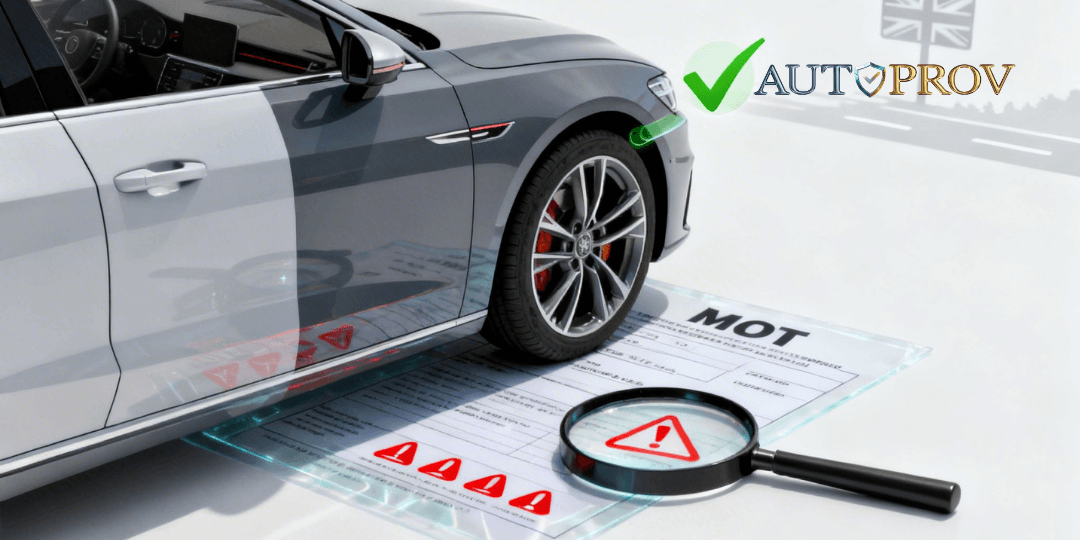
In the UK motor trade, the term ‘car history check free’ almost exclusively refers to the MOT history service on the GOV.UK website. While an essential first filter in any vehicle appraisal, relying solely on this free data exposes a dealership to significant commercial and legal risk. For a trade professional, understanding its limitations is critical.
What a Free Car History Check Really Tells a Motor Trader

For a car dealer, the official MOT portal provides a basic, no-cost snapshot of a vehicle’s roadworthiness and reported mileage at the time of each annual test. It is a necessary first step, but it is not a comprehensive vehicle provenance report. Think of it as reviewing a property's basic planning permissions; it’s a vital piece of the official record, but it reveals nothing about underlying structural defects or legal disputes that could jeopardise the investment.
This data is crucial for an initial vet. It allows you to quickly identify recurring advisory notes that signal persistent corrosion or uneven tyre wear, which may point to deeper mechanical faults. It also provides a high-level view of how a vehicle's mileage has progressed over time.
However, the limitations of this free service are where the real risk to your business lies. The MOT check is simply a record of pass/fail results and advisories recorded on one specific day of the year. It is not a risk assessment tool.
Free MOT Check vs. Comprehensive Trade Intelligence
To understand what a free check misses, it helps to compare the data points side-by-side. A free MOT check provides a narrow slice of the full picture, whereas a professional trade report delivers the complete intelligence needed to protect your capital and manage motor trade risk.
Data Point Free GOV.UK Check Comprehensive Trade Report MOT Pass/Fail History ✅ ✅ MOT Advisory Notes ✅ ✅ MOT Mileage Readings ✅ ✅ Outstanding Finance ❌ ✅ Insurance Write-Off Status ❌ ✅ Stolen Vehicle Marker (PNC) ❌ ✅ Number of Previous Keepers ❌ ✅ Scrapped Vehicle Marker ❌ ✅ Import/Export History ❌ ✅ Taxi/Private Hire Usage ❌ ✅ National Mileage Register Check ❌ ✅ As the table shows, the gaps in the free data are precisely where the most costly and reputation-damaging problems hide. Relying solely on a free check means you are operating blind to a vehicle's financial status, accident history, and true provenance.
The Gaps in Free MOT Data
A free check from GOV.UK is a public service, not a risk assessment tool designed for motor trade professionals. It completely omits the critical information required to protect your investment, your margin, and your reputation. The most significant blind spots for a dealer include:
- Outstanding Finance: The MOT check has zero visibility of any hire purchase, PCP, or loan agreements secured against the vehicle. This is a primary risk to legal title.
- Insurance Write-Off Status: It will not disclose if a vehicle has been declared a Category S (structural) or N (non-structural) write-off.
- Ownership History: There is no data on the number of previous keepers or the duration of their ownership—a key indicator of potential underlying issues.
- Scrapped Vehicle Markers: A free check cannot confirm if a vehicle has been officially recorded as scrapped by the DVLA.
For a trader, the most dangerous vehicle isn’t one with a failed MOT; it’s one with a clean MOT certificate but a hidden history of finance, an undisclosed write-off status, or a rapid turnover of owners. These are the issues that directly torpedo valuation and legal title.
While a free check is a useful starting point, it is insufficient for making an informed commercial buying decision. For more detail on vehicle identifiers, our guide on performing a free UK VIN number check offers additional context. The next sections will explore how to interpret MOT data effectively and highlight the specific risks that only professional, trade vehicle intelligence can uncover.
Decoding GOV.UK MOT History for Trade Insights

For a diligent motor trader, the GOV.UK portal is an effective first-pass filter. Its true value lies not in the simple pass or fail result, but in analysing the data for patterns and risk signals. To extract genuine value from this free tool, you must review the data like a risk analyst, turning raw information into actionable intelligence.
The MOT history is your foundational car history check free of charge, providing pass/fail records, advisory notes, and mileage readings from each test. It is a good starting point for spotting recurring mechanical issues or checking basic tax and ULEZ status, but it is only one component of a full vehicle provenance assessment.
The key is to look beyond the latest test result and identify trends. For example, does the vehicle have a string of advisories for corrosion on the same component year after year? This could signal a much deeper structural problem that will impact valuation and future repair costs.
Analysing MOT Advisory Patterns
Advisory notes are a valuable source of intelligence. They are clues to a vehicle’s maintenance history and can highlight potential future liabilities. A professional trader should scrutinise these notes for recurring themes.
- Persistent Corrosion: Advisories for "corrosion" on brake pipes, suspension components, or sub-frames that appear over multiple tests are a major red flag, often indicating neglect or use in harsh environments.
- Uneven Tyre Wear: A recurring note for wear on the inner or outer edge of the tyres strongly suggests underlying suspension or alignment faults that a quick pre-sale adjustment might mask but not resolve.
- Minor Leaks: Notes like "oil misting" or a "slight leak" on engine or gearbox components should not be dismissed. They can be early warnings of failing seals or gaskets that could lead to expensive repairs.
A single advisory for tyre wear is inconclusive. An advisory for the same issue across three consecutive MOTs is a significant risk signal, pointing to a persistent and potentially costly underlying fault. This level of analysis is fundamental to effective motor trade risk management.
Scrutinising Mileage Progression
The mileage check UK function within the MOT history is one of its most valuable features, but it requires careful interpretation. You are looking for a consistent, logical progression from one test to the next. Any anomaly demands immediate and thorough investigation.
A significant drop in mileage is an obvious red flag. However, long periods where the mileage barely changes can be just as telling, suggesting the vehicle has been off the road—perhaps due to major repairs or an unrecorded accident. Our guide on how to view MOT history and make smarter buying decisions offers a deeper dive into this topic.
It is crucial to remember what this free data does not show. It cannot account for mileage alteration between tests, data entry errors at the testing station, or confirm if a vehicle has been cloned. This is where the limitations of a free check become clear. It is an essential filter, but no substitute for a comprehensive risk assessment solution like AutoProv.
The High-Stakes Risks a Free Car History Check Misses
The free GOV.UK MOT history tool is a valuable preliminary step, but its utility ends precisely where a trader's most significant financial and reputational risks begin. Relying on it exclusively is akin to checking a car's tyres but ignoring the engine; you see the surface while remaining blind to expensive problems under the bonnet.
These gaps are not minor details; they are high-stakes issues that can turn a profitable unit into a catastrophic loss. A comprehensive, paid-for used car history report is not an optional extra—it is an essential defence against these hidden dangers.
The choice between limited free data and professional-grade intelligence is a clear one for any business focused on risk management.

As the diagram illustrates, the path of a free-only check leads directly toward major hidden risks. A professional report, conversely, is designed to provide clarity and protect your business.
Mileage Clocking Between MOT Tests
The MOT history provides one mileage reading, once a year. This leaves 364 days unaccounted for. A common fraudulent practice is "clocking" the odometer—illegally winding it back—just before the annual test. A car driven 25,000 miles in a year can be clocked back by 15,000, and the MOT history will simply show a plausible 10,000-mile increase.
Professional trade vehicle intelligence platforms like AutoProv cross-reference mileage from multiple data sources, including service records, auction histories, and fleet data, to build a more detailed timeline. This methodology is how you identify discrepancies that a basic mileage check UK derived from MOT history will always miss.
Hidden Ownership and Provenance Patterns
A vehicle's ownership history is a critical part of its vehicle provenance, yet it is a complete black hole on free checks. A pattern of multiple keepers in a short period is a major red flag for any experienced trader.
A car with three owners in two years represents a far higher risk than one with a single owner for a decade. This rapid turnover—known as short-term ownership—often points to a persistent, underlying fault that previous owners have failed to fix, instead passing the problem on until it lands on your forecourt.
This is a classic risk signal that a free MOT history will never show you, leaving you to discover a problematic vehicle only after you have committed your capital. For a closer look at another common risk, you might want to check out our guide on how to check outstanding car finance in the UK.
Scrapped or Cloned Vehicle Risks
Perhaps the most severe risks are those that challenge a vehicle’s identity and legality. A free check offers almost no protection in this area. It will not tell you if a car has been officially declared as scrap by the DVLA, nor will it include the essential VIN/Chassis Number verification required to spot a cloned vehicle—a serious and growing threat in the UK.
Acquiring a cloned or previously scrapped vehicle is not just a financial write-off; it is a legal minefield that can cause irreparable damage to your business's reputation.
A Trader's Framework: When to Escalate to a Full Check

In the fast-paced motor trade, operational efficiency is paramount. Knowing when a vehicle warrants a deeper investigation beyond the free MOT history is a discipline that protects both time and capital. While relying solely on a car history check free of charge is a commercial gamble, paying for a full report on every potential vehicle before an initial appraisal is not always practical.
The optimal approach is a structured, two-step process. Use the free GOV.UK check as a rapid initial filter. Then, apply a set of firm, non-negotiable rules for when to escalate to a professional used car history report. This framework transforms due diligence from a gut feeling into a repeatable, risk-mitigating business process.
Trigger 1: Sourcing from Unfamiliar Channels
Your risk exposure is directly correlated with your sourcing channel. When buying from trusted, long-term trade partners, there is a degree of established recourse. However, as soon as you operate outside that trusted circle, your risk increases, and the need for objective data becomes critical.
A full check should be mandatory when sourcing from:
- Auctions: The fast pace and 'as-seen' nature of auction sales mean hidden issues are prevalent. A comprehensive report is your primary line of defence.
- New or Unfamiliar Suppliers: When dealing with a new trade contact, you have no track record to fall back on. Independent verification of the vehicle's history is essential business practice.
- Private Acquisitions: Buying directly from the public carries the highest risk. The seller may be genuinely unaware of the vehicle's full history or, in some cases, could be actively concealing it.
Trigger 2: High-Value or Specialist Vehicles
The financial stakes change dramatically with the value of the asset. For standard, lower-margin stock, your risk tolerance may be higher. But for high-value, performance, or specialist vehicles, the potential for a catastrophic loss makes a full provenance check non-negotiable.
The cost of a full report on a £40,000 vehicle is a rounding error. The cost of discovering undisclosed finance or a clocked mileage history on that same car after acquisition is a business-damaging event. That small outlay for robust dealer vehicle checks is a low-cost insurance policy for your margin.
This rule also applies to vehicles with complex histories, such as imported models or those with significant modifications. A basic MOT check lacks the depth to flag the unique risks these vehicles present. They demand a deeper investigation, and for a detailed look at this, you can learn more about what a comprehensive trade provenance check should cover.
Trigger 3: Inconsistencies and Professional Judgment
Finally, your own professional judgment is a powerful trigger. If anything feels 'off' during an initial appraisal, it almost certainly warrants a deeper dive. Never dismiss this instinct; simply ensure you back it up with objective data.
Automatic triggers for escalation should include:
- Irregular Paperwork: V5C logbooks that appear tampered with, service history stamps from unverified garages, or a seller who is evasive about documentation.
- Suspicious Vehicle Condition: A vehicle showing excessive wear and tear inconsistent with its stated mileage or age. A freshly valeted interior combined with a worn-out steering wheel is a classic example.
- Short-Term Ownership Patterns: If the V5C indicates the car has changed hands multiple times in a short period, it is a major red flag that only a full report can properly investigate.
By embedding this framework into your buying process, you build a system that balances speed with security, ensuring major capital decisions are never based on incomplete information.
The Business Case for Professional Vehicle Intelligence
In the motor trade, every pound of margin counts. It is tempting to view a comprehensive used car history report as another overhead. This is a flawed perspective. Professional-grade vehicle intelligence is not a cost; it is an investment in margin protection and risk mitigation.
The fee for a full provenance report is an insurance policy against catastrophic financial loss. Acquiring a single vehicle with hidden finance can lead to its repossession by the legal owner, wiping out your entire investment. Similarly, unknowingly buying a clocked car or an undisclosed write-off means you have overpaid for an asset you will struggle to retail legally and profitably.
Protecting Your Margin and Reputation
The financial impact of one bad vehicle can easily erase the profit from five good ones. These are not abstract risks; they are real-world losses that directly affect your bottom line.
- Undisclosed Finance: If you buy a vehicle with an active finance agreement, you do not gain legal title. The finance company can reclaim the asset, leaving you completely out of pocket.
- Mileage Discrepancies: A clocked odometer artificially inflates a vehicle's value. A proper mileage check UK that goes beyond basic MOT data is the only way to protect yourself from overpaying by thousands.
- Write-Off History: A past life as a Category S or N write-off severely impacts a car’s value and desirability. Retailing it without declaring its history can lead to legal action under the Consumer Rights Act and destroy your reputation.
For any professional trader, the cost of a full report is negligible when weighed against the potential loss. It transforms the buying process from a gamble into a calculated, data-backed decision.
Why It Makes Financial Sense
The UK used car market is a high-stakes environment. Spending a small fee on a car history check before committing thousands of pounds is one of the most prudent decisions you can make. With average used car prices sitting between £14,000 and £26,000, that minor outlay is a crucial component of risk management.
Consider this fact: a significant percentage of recalled vehicles in the UK never receive the required fix. This is a major safety and liability risk that free checks will not show you. In contrast, professional reports increasingly flag open safety recalls, giving you a much clearer picture of potential liabilities. You can see more about what's covered by leading providers and their findings.
A professional vehicle provenance report, such as those from AutoProv, provides this essential layer of protection. It enhances your buying process, ensuring every decision is based on a clear, accurate understanding of the vehicle's true history. This deeper intelligence doesn't just protect capital; it ensures compliance and upholds your reputation as a knowledgeable and trustworthy dealer.
By investing a small amount upfront, you secure your margins, protect your business, and build a more resilient and profitable operation. You can learn more about how to strengthen your buying process with a vehicle provenance report in our detailed guide.
Frequently Asked Questions for Motor Traders
Diving into the specifics of vehicle checks can raise several questions, particularly when separating genuine due diligence from marketing claims. Here are direct answers to common queries from UK motor trade professionals.
Are Any Free Car History Checks All-Inclusive?
No. The only truly free and official resource is the GOV.UK MOT history service. It is a useful first-glance tool for basic roadworthiness and mileage history, but it is not a comprehensive risk assessment tool for a professional buyer.
The critical data points that protect your business—and your margin—are only available in paid-for, trade-focused reports. These services aggregate data from dozens of official and commercial sources to which free tools have no access.
Information you will never find in a free check includes:
- Outstanding Finance Agreements: Confirmation of any active hire purchase or loan against the vehicle.
- Insurance Write-Off Category: A vehicle’s history as a Category S, N, or a previous C/D write-off.
- Scrapped Vehicle Markers: The official DVLA flag indicating a vehicle should not be on the road.
- Full Ownership History: Data on the number of keepers and ownership duration.
If a service claims to offer this level of detail for free, it is almost certainly a lead-generation tactic to upsell you to a paid report.
How Is a Provider's 'Basic Free Check' Different?
Many commercial providers offer a ‘free’ initial check. This typically only confirms the make, model, and basic DVLA data—information you can see by looking at the vehicle.
This is not a history check; it is a marketing tool. Its sole purpose is to capture the vehicle registration to persuade you to purchase their full used car history report. For a professional trader, it offers zero due diligence value and should not be confused with a proper vehicle provenance check.
A true dealer vehicle check must go beyond simple vehicle identification. It needs to provide historical context and risk signals, which these basic free tools are not designed to do.
Can I Use MOT History Alone to Spot Clocked Mileage?
Relying solely on MOT history to verify mileage is a significant risk. While it can sometimes flag an obvious discrepancy between one year's test and the next, it has major blind spots.
Firstly, a mileage check UK from the MOT history cannot detect fraudulent alterations made between the annual tests. It also fails to account for simple data entry errors by the MOT tester, which can create a false impression of the vehicle's mileage history.
Professional trade vehicle intelligence platforms operate on another level. They cross-reference mileage readings from multiple sources, including previous sale listings, auction data, and service records. This builds a more robust and reliable timeline, flagging subtle inconsistencies that a free MOT check will always miss.
Why Pay for a Check if I Can Speak to the Seller?
A conversation with the seller is useful for appraisal but is no substitute for objective, data-driven verification. A private seller may not be aware of their vehicle's full history. In other cases, they may be deliberately concealing adverse information.
A professional vehicle intelligence report provides impartial data from trusted sources like the DVLA, insurance databases, finance companies, and the police. It exists to verify the seller’s claims and, more importantly, to uncover issues they might not be aware of—or may not want you to know about.
For robust risk management, legal compliance, and accurate stock pricing, your business requires verifiable data, not just an individual's word.
Gain a competitive edge with AutoProv's advanced vehicle intelligence platform, built exclusively for the UK motor trade. We provide the deep provenance insights and risk signals you need to buy smarter, reduce exposure, and protect your margins. Discover how to enhance your due diligence at https://autoprov.ai.
Frequently Asked Questions
AI-Generated Content Notice
This article was created with the assistance of artificial intelligence technology. While we strive for accuracy, the information provided should be considered for general informational purposes only and should not be relied upon as professional automotive, legal, or financial advice. We recommend verifying any information with qualified professionals or official sources before making important decisions. AutoProv accepts no liability for any consequences resulting from the use of this information.
From our AI insights
- Navigating UK Grey Imports: A Trader's Guide
Understand the complexities and opportunities of UK grey imports for savvy motor traders.
- Navigating Private Plate Challenges in UK Vehicle Checks
Learn how private plates affect UK vehicle checks and how traders verify provenance and spot cloning risks.
- Navigating VIN Checks Post-Brexit: What UK Traders Need to Know
Discover how Brexit impacts VIN checks for UK traders and the crucial data to review.
Related Articles

Essential Vehicle Checks Before Buying a Used Car
Learn essential checks to ensure your used car purchase is safe and sound in the UK market.

Why a Provenance Check is Essential for Used Car Buyers
Ensure your used car is a smart investment by understanding the importance of a provenance check and how AutoProv can help.
A Guide to Vehicle Check with VIN Number
A vehicle check with vin number is easily the most important thing you can do before buying a used car. Think of it as your first line of defence—a quick, simple step that pulls back the curtain on a vehicle's past, protecting you from expensive mistakes, legal headaches, and downright dangerous cars.
Published by AutoProv
Your trusted source for vehicle intelligence